FOR A CHILD AUDIENCE:
MOCK AWARD PROGRAMS
IN THE LIBRARY
Amy Koester | MASL 2016
ON OUR AGENDA
• Why mock?
• Choosing the best award for your students
• Involving teachers & community members
• How to run a mock discussion, step by step
• Resources & time for questions
ANDYOU ARE…?
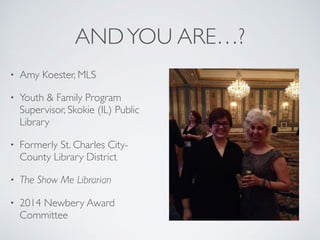
• Amy Koester, MLS
• Youth & Family Program
Supervisor, Skokie (IL) Public
Library
• Formerly St. Charles City-
County Library District
• The Show Me Librarian
• 2014 Newbery Award
Committee
WHY RUN A MOCK AWARDS
DISCUSSION INYOUR LIBRARY?
• Engage students in new ways of reading
• Build a community of critical readers
• Develop students’ evaluation & public speaking skills
• Ensure more people know about awards for great
books
CHOOSINGTHE BEST*
AWARD
*for your students
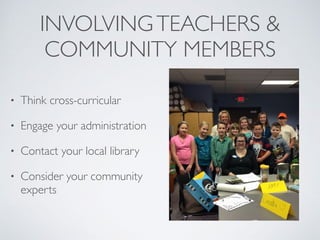
INVOLVINGTEACHERS &
COMMUNITY MEMBERS
• Think cross-curricular
• Engage your administration
• Contact your local library
• Consider your community
experts
HOWTO RUN A MOCK
DISCUSSION
Creating your “committee”:
• Determine your preferred age focus
• Don’t limit participation to “high” readers
• Consider best times for consistent participation
• Be open to subgroups
HOWTO RUN A MOCK
DISCUSSION
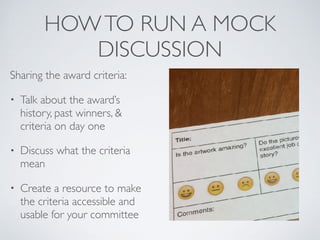
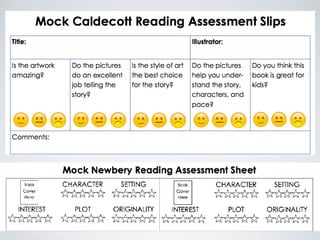
Sharing the award criteria:
• Talk about the award’s
history, past winners, &
criteria on day one
• Discuss what the criteria
mean
• Create a resource to make
the criteria accessible and
usable for your committee
HOWTO RUN A MOCK
DISCUSSION
Guide reading:
• Choose the books you
want to focus on
• Multiple copies vs. single
copies
• Leave room for “write-ins”
HOWTO RUN A MOCK
DISCUSSION
Facilitate discussion:
• Ask open-ended questions
“How did the pacing contribute to the story?”
• Encourage students to go deeper
“Tell me more about why the setting gave you the
creeps.”
HOWTO RUN A MOCK
DISCUSSION
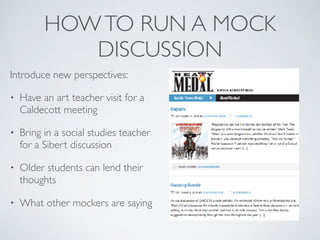
Introduce new perspectives:
• Have an art teacher visit for a
Caldecott meeting
• Bring in a social studies teacher
for a Sibert discussion
• Older students can lend their
thoughts
• What other mockers are saying
HOWTO RUN A MOCK
DISCUSSION
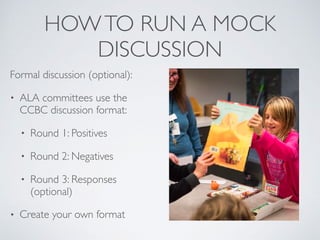
Formal discussion (optional):
• ALA committees use the
CCBC discussion format:
• Round 1: Positives
• Round 2: Negatives
• Round 3: Responses
(optional)
• Create your own format
HOWTO RUN A MOCK
DISCUSSION
Vote:
• Explain the balloting process
• Print voting slips with clear lines for first, second,
and third choices
• Tally votes and repeat as necessary
HOWTO RUN A MOCK
DISCUSSION
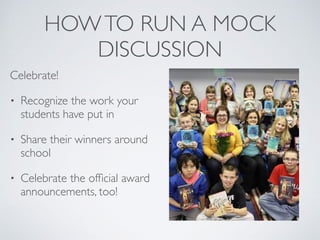
Celebrate!
• Recognize the work your
students have put in
• Share their winners around
school
• Celebrate the official award
announcements, too!
BONUS: INCENTIVIZE
PARTICIPATION
• Make it a club
• Arrange for classroom
benefits
• Waive overdue fines for
mock books
SOME GREAT RESOURCES
• Book & Media Awards Committee Manuals,ALSC
• How to Host a Mock Newbery Book Club: 10 Easy
Steps,Armin Arethna & Mary Ann Scheuer
• Newbery and Caldecott Mock ElectionsTool Kit,ALSC
• The Newbery Award & Mock Award Discussion
Resources, The Show Me Librarian (Amy Koester)
QUESTIONS?
amy.e.koester@gmail.com
@amyeileenk

For a Child Audience: Mock Award Programs in the Library

  • 1.
    FOR A CHILDAUDIENCE: MOCK AWARD PROGRAMS IN THE LIBRARY Amy Koester | MASL 2016
  • 2.
    ON OUR AGENDA •Why mock? • Choosing the best award for your students • Involving teachers & community members • How to run a mock discussion, step by step • Resources & time for questions
  • 3.
    ANDYOU ARE…? • AmyKoester, MLS • Youth & Family Program Supervisor, Skokie (IL) Public Library • Formerly St. Charles City- County Library District • The Show Me Librarian • 2014 Newbery Award Committee
  • 4.
    WHY RUN AMOCK AWARDS DISCUSSION INYOUR LIBRARY? • Engage students in new ways of reading • Build a community of critical readers • Develop students’ evaluation & public speaking skills • Ensure more people know about awards for great books
  • 5.
  • 6.
    INVOLVINGTEACHERS & COMMUNITY MEMBERS •Think cross-curricular • Engage your administration • Contact your local library • Consider your community experts
  • 7.
    HOWTO RUN AMOCK DISCUSSION Creating your “committee”: • Determine your preferred age focus • Don’t limit participation to “high” readers • Consider best times for consistent participation • Be open to subgroups
  • 8.
    HOWTO RUN AMOCK DISCUSSION Sharing the award criteria: • Talk about the award’s history, past winners, & criteria on day one • Discuss what the criteria mean • Create a resource to make the criteria accessible and usable for your committee
  • 10.
    HOWTO RUN AMOCK DISCUSSION Guide reading: • Choose the books you want to focus on • Multiple copies vs. single copies • Leave room for “write-ins”
  • 11.
    HOWTO RUN AMOCK DISCUSSION Facilitate discussion: • Ask open-ended questions “How did the pacing contribute to the story?” • Encourage students to go deeper “Tell me more about why the setting gave you the creeps.”
  • 12.
    HOWTO RUN AMOCK DISCUSSION Introduce new perspectives: • Have an art teacher visit for a Caldecott meeting • Bring in a social studies teacher for a Sibert discussion • Older students can lend their thoughts • What other mockers are saying
  • 13.
    HOWTO RUN AMOCK DISCUSSION Formal discussion (optional): • ALA committees use the CCBC discussion format: • Round 1: Positives • Round 2: Negatives • Round 3: Responses (optional) • Create your own format
  • 14.
    HOWTO RUN AMOCK DISCUSSION Vote: • Explain the balloting process • Print voting slips with clear lines for first, second, and third choices • Tally votes and repeat as necessary
  • 15.
    HOWTO RUN AMOCK DISCUSSION Celebrate! • Recognize the work your students have put in • Share their winners around school • Celebrate the official award announcements, too!
  • 16.
    BONUS: INCENTIVIZE PARTICIPATION • Makeit a club • Arrange for classroom benefits • Waive overdue fines for mock books
  • 17.
    SOME GREAT RESOURCES •Book & Media Awards Committee Manuals,ALSC • How to Host a Mock Newbery Book Club: 10 Easy Steps,Armin Arethna & Mary Ann Scheuer • Newbery and Caldecott Mock ElectionsTool Kit,ALSC • The Newbery Award & Mock Award Discussion Resources, The Show Me Librarian (Amy Koester)
  • 18.