STEAM Power Your 
Library! 
Amy Koester 
Skokie Public Library
During this session… 
• What is STEAM? 
• Why STEAM in the library 
• Preschool Programs & Elements 
• School-Age Programs 
• Services & Resources
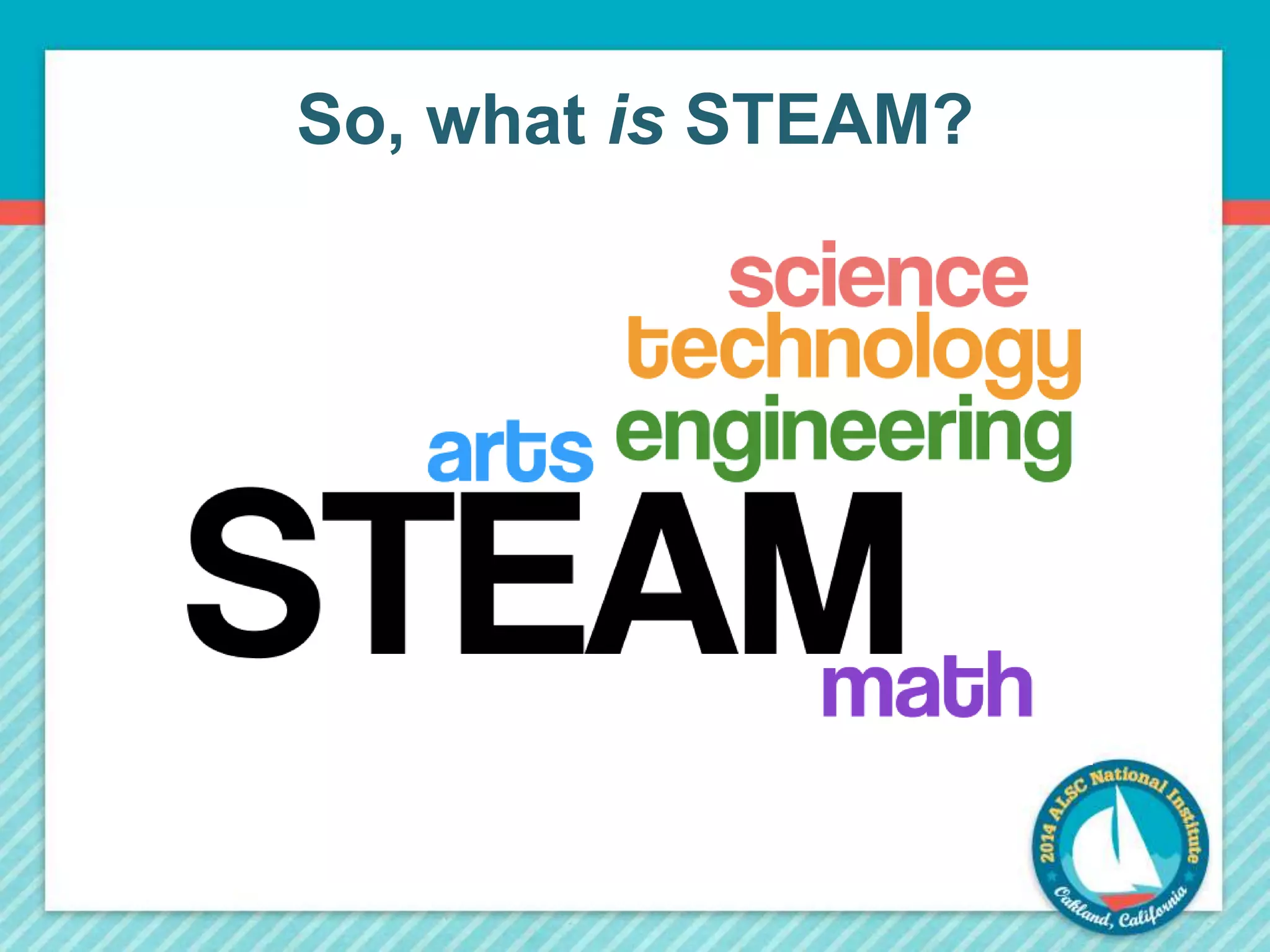
So, what is STEAM?
So, what is STEAM? 
• Arts ≠ Crafts 
• Arts = Creativity
So, what is STEAM? 
• Arts ≠ Crafts 
• Arts = Creativity 
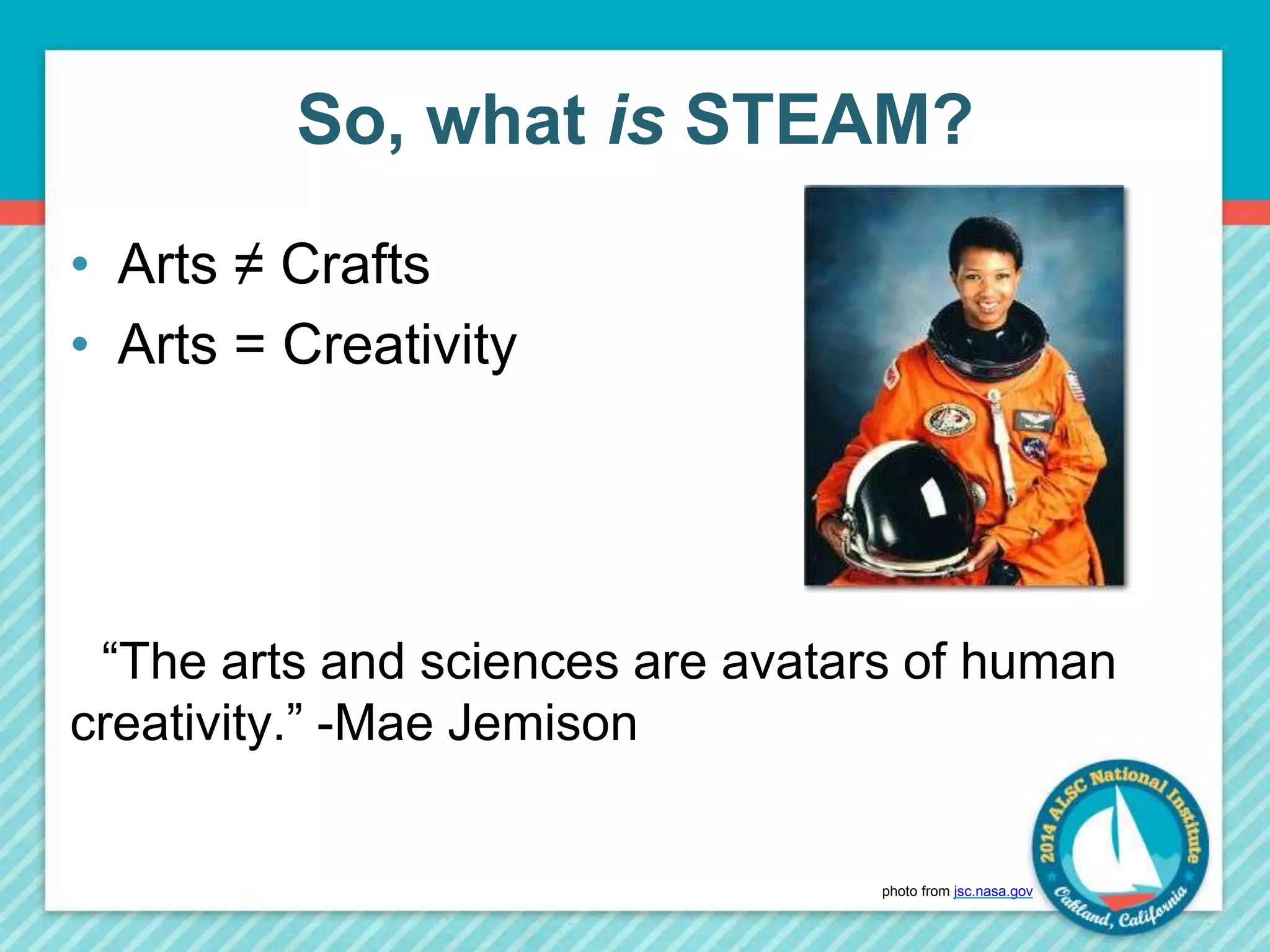
“The arts and sciences are avatars of human 
creativity.” -Mae Jemison 
photo from jsc.nasa.gov
So, what is STEAM? 
• Arts ≠ Crafts 
• Arts = Creativity 
• Arts = Open-ended
So, what is STEAM? 
• Arts ≠ Crafts 
• Arts = Creativity 
• Arts = Open-ended 
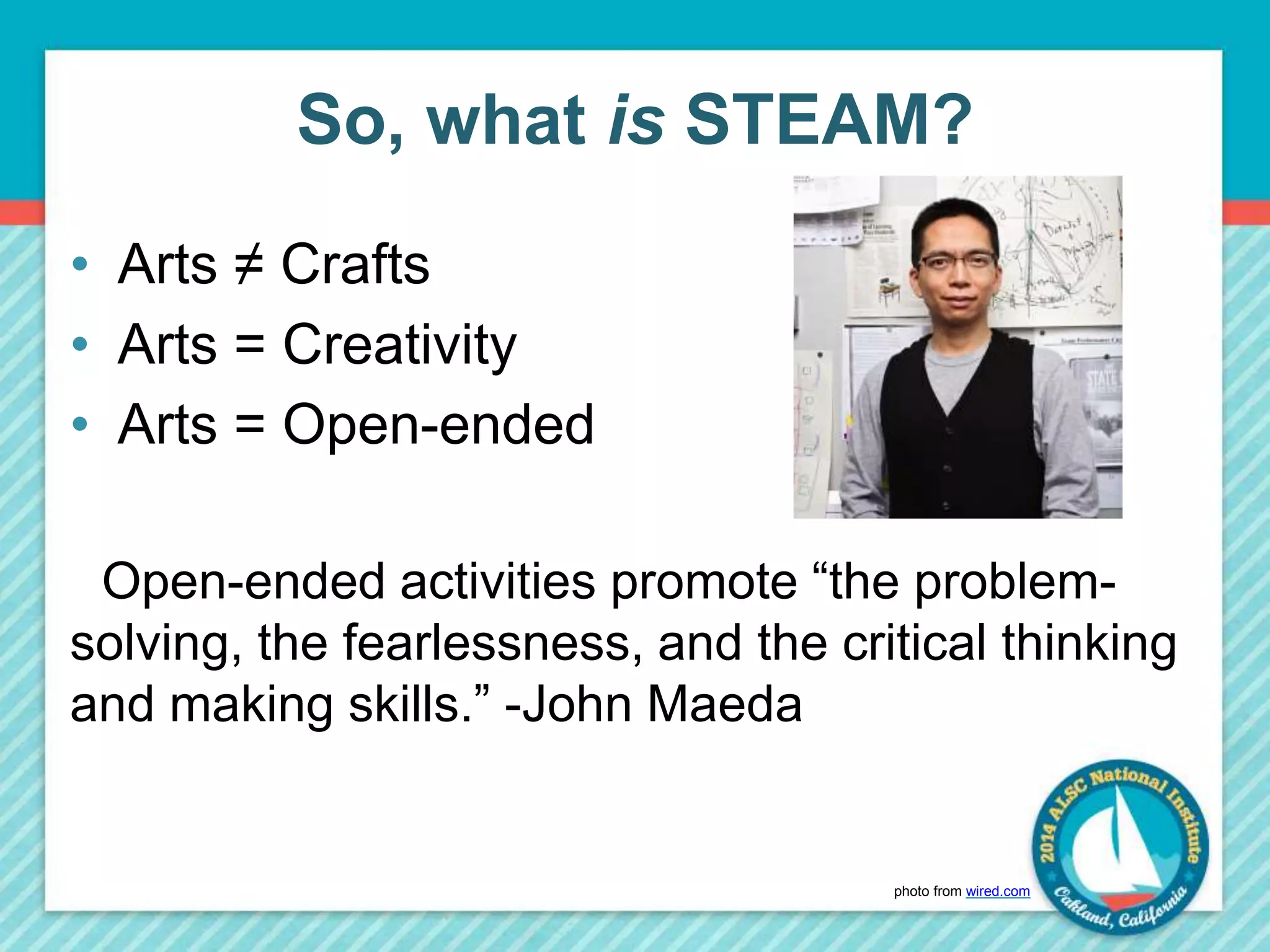
Open-ended activities promote “the problem-solving, 
the fearlessness, and the critical thinking 
and making skills.” -John Maeda 
photo from wired.com
So, what is STEAM? 
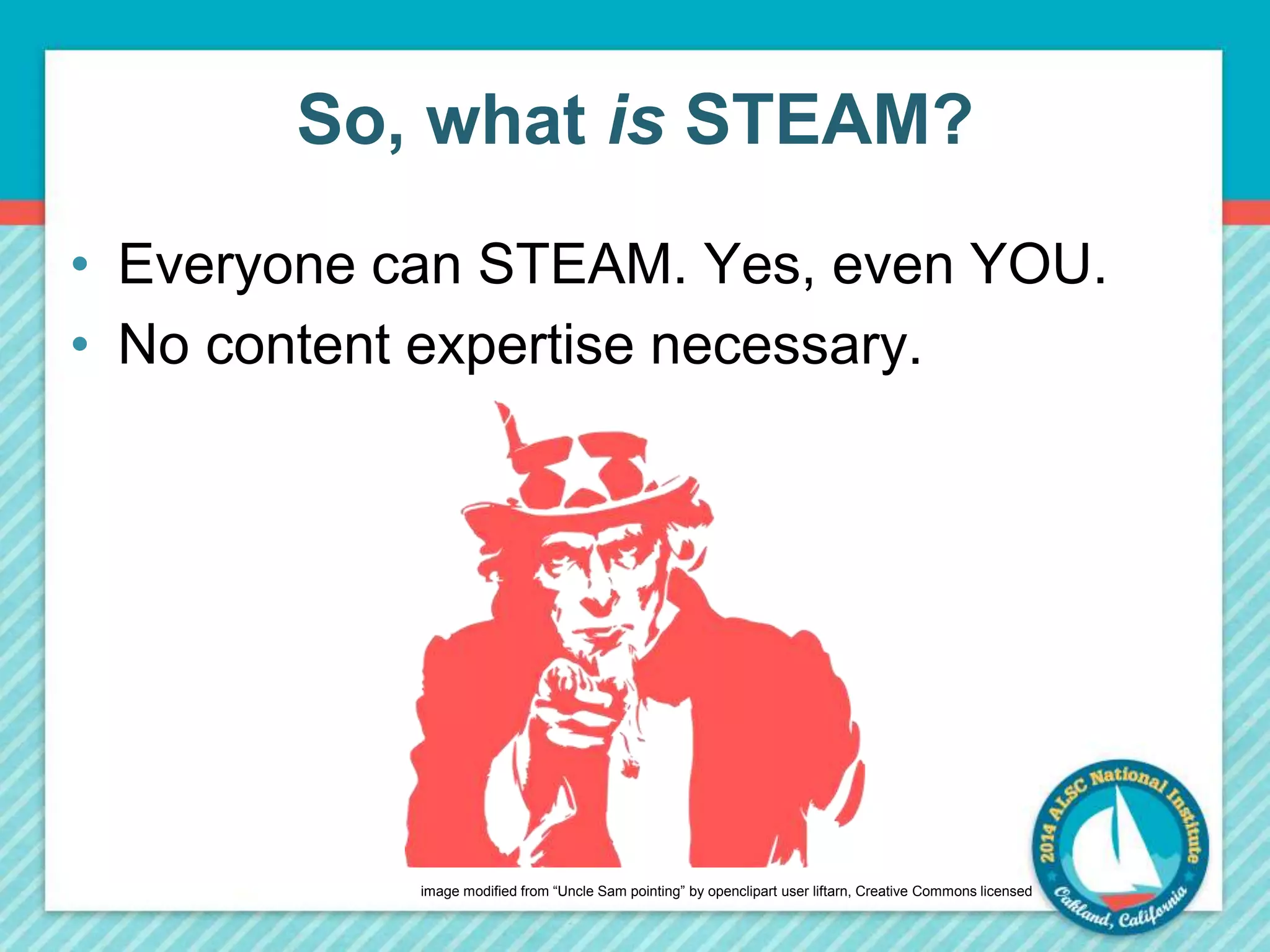
• Everyone can STEAM. Yes, even YOU. 
• No content expertise necessary. 
image modified from “Uncle Sam pointing” by openclipart user liftarn, Creative Commons licensed
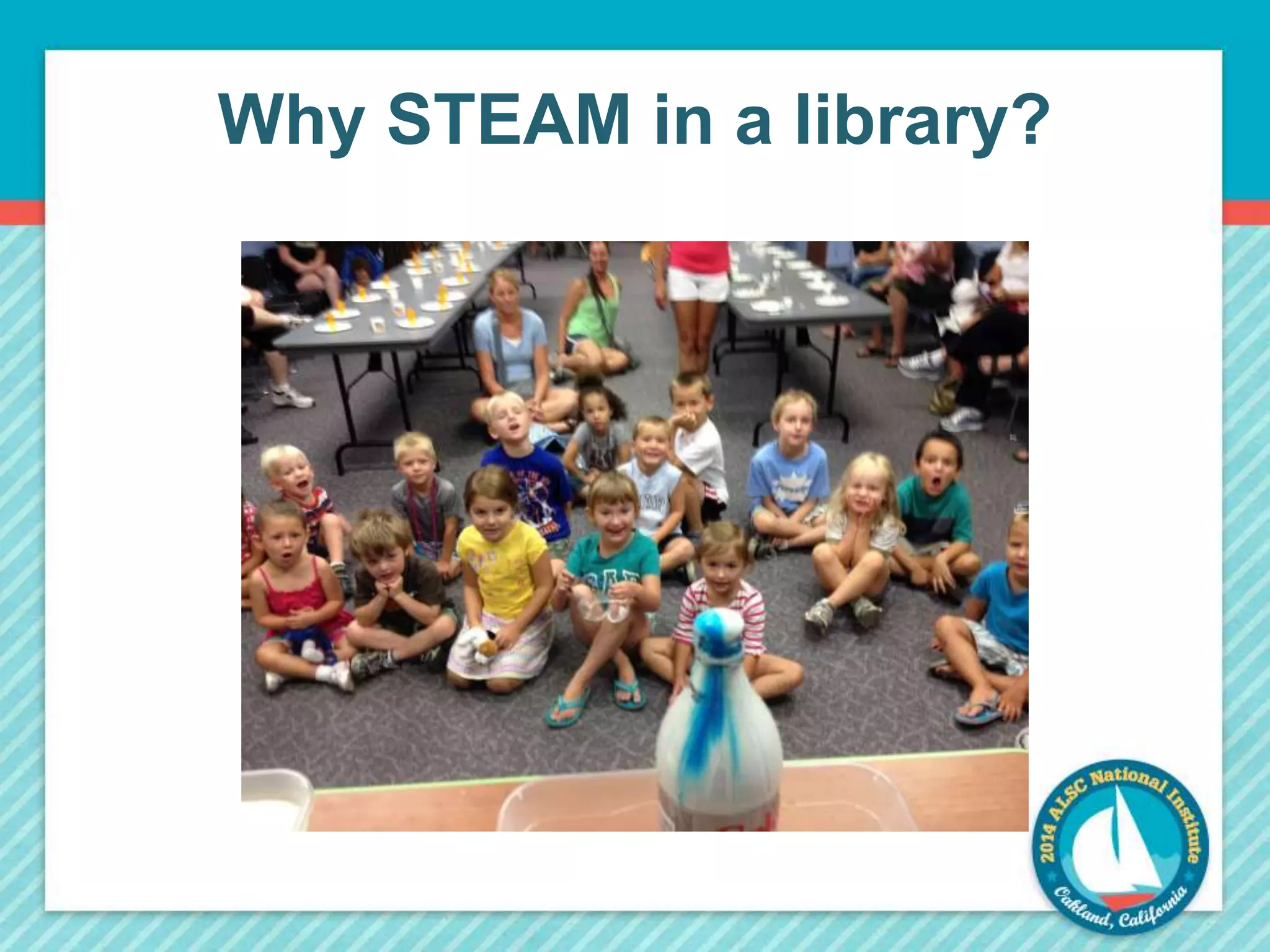
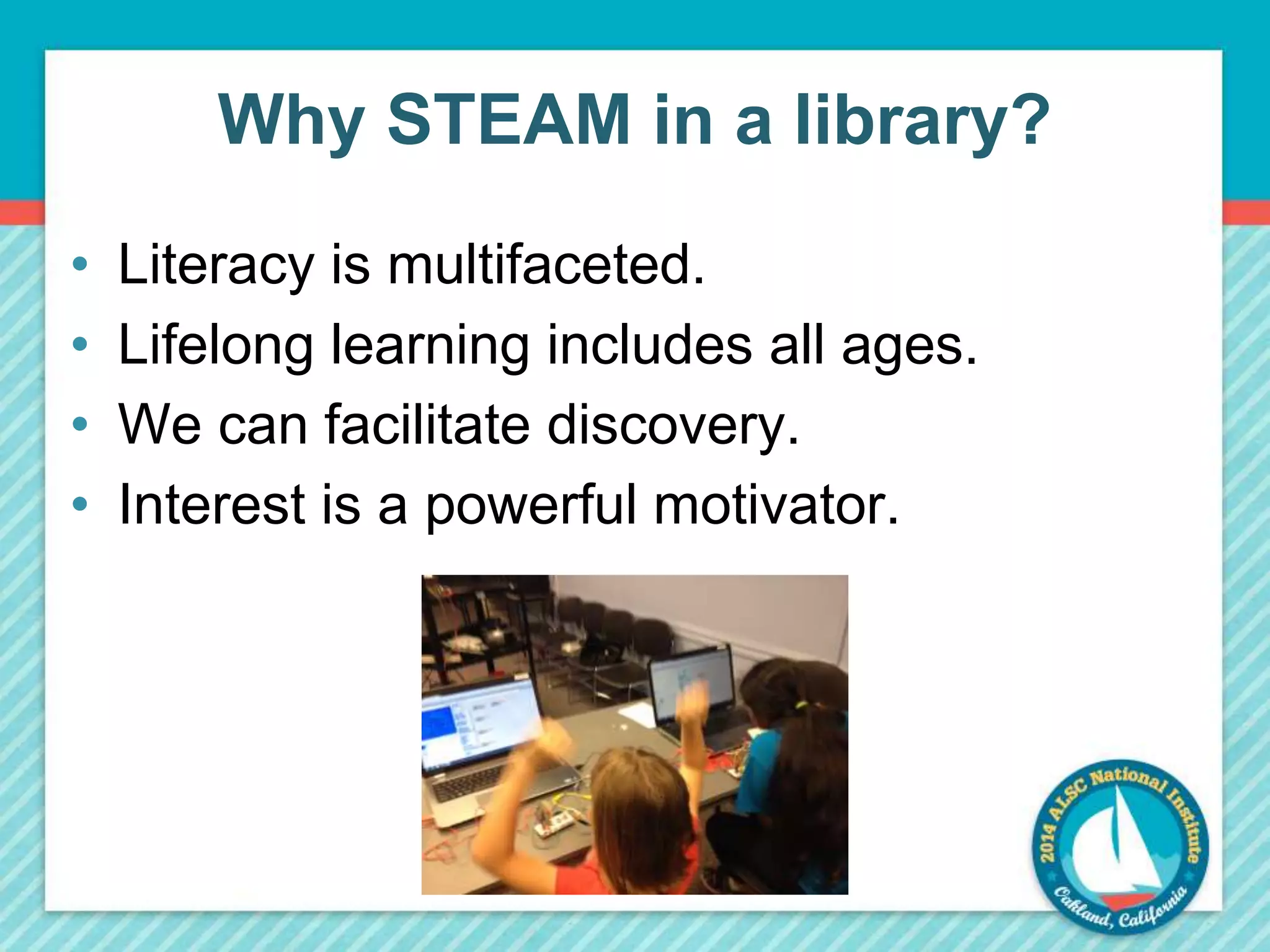
Why STEAM in a library?
Why STEAM in a library? 
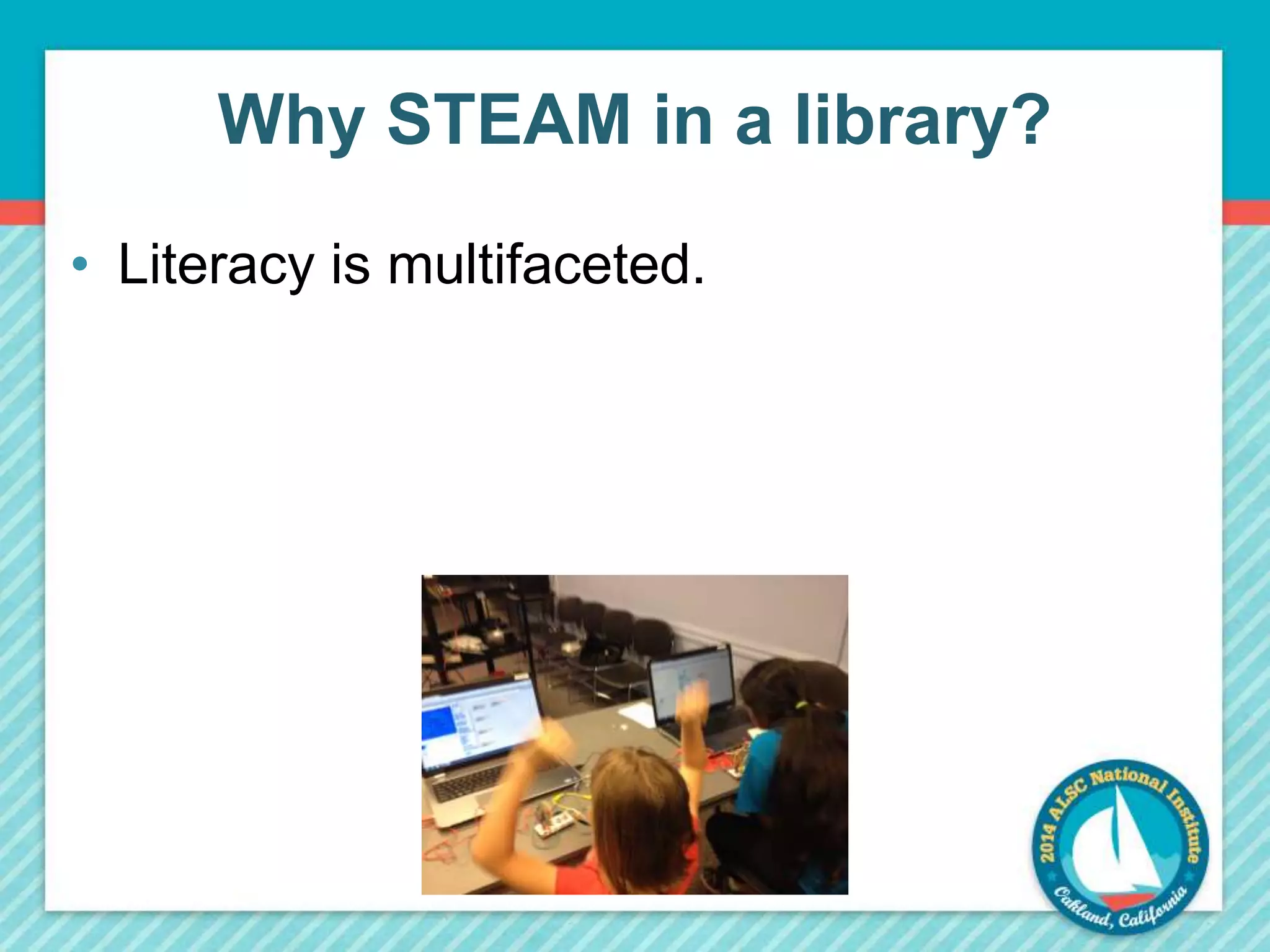
• Literacy is multifaceted.
Why STEAM in a library? 
• Literacy is multifaceted. 
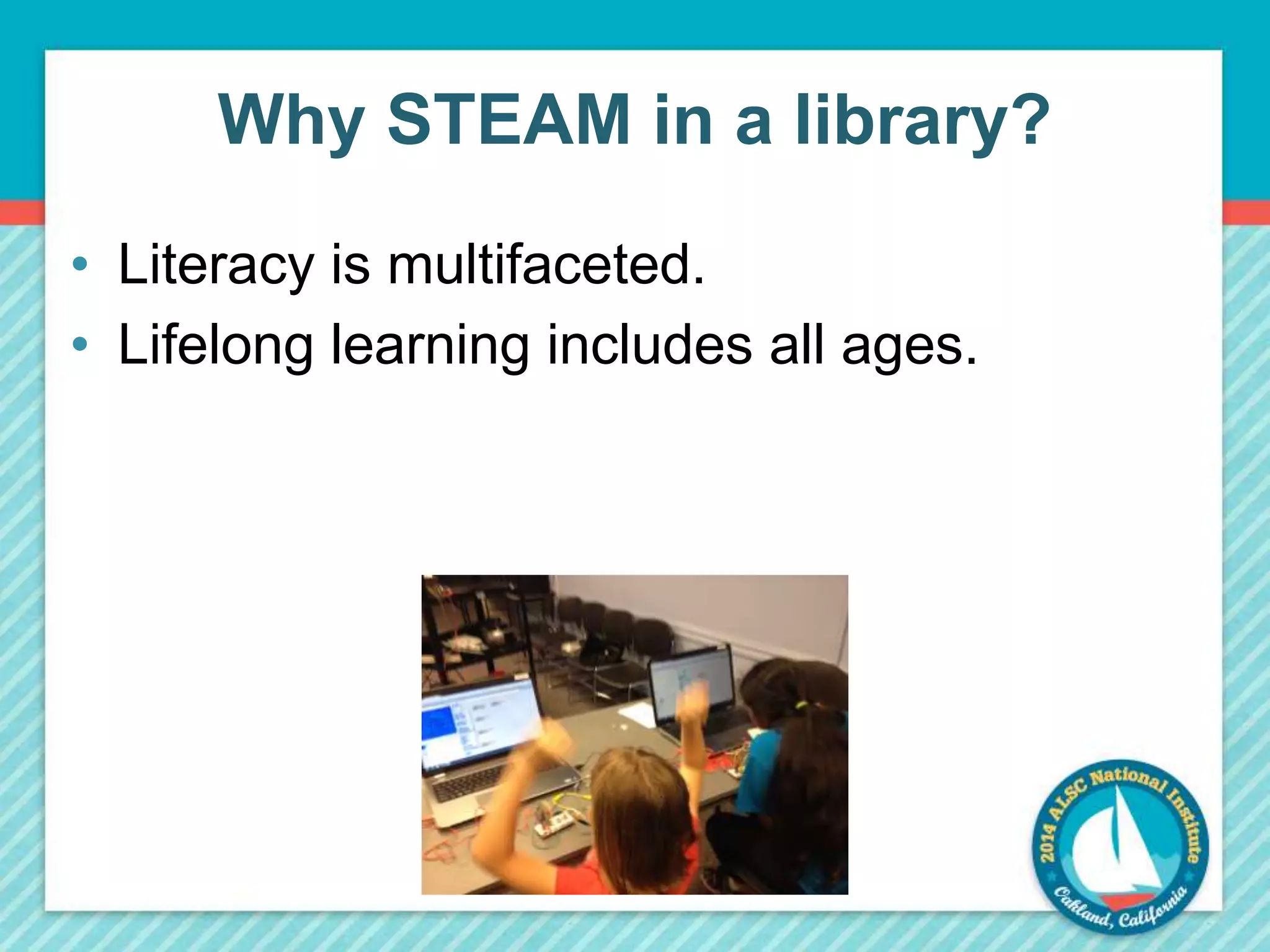
• Lifelong learning includes all ages.
Why STEAM in a library? 
• Literacy is multifaceted. 
• Lifelong learning includes all ages. 
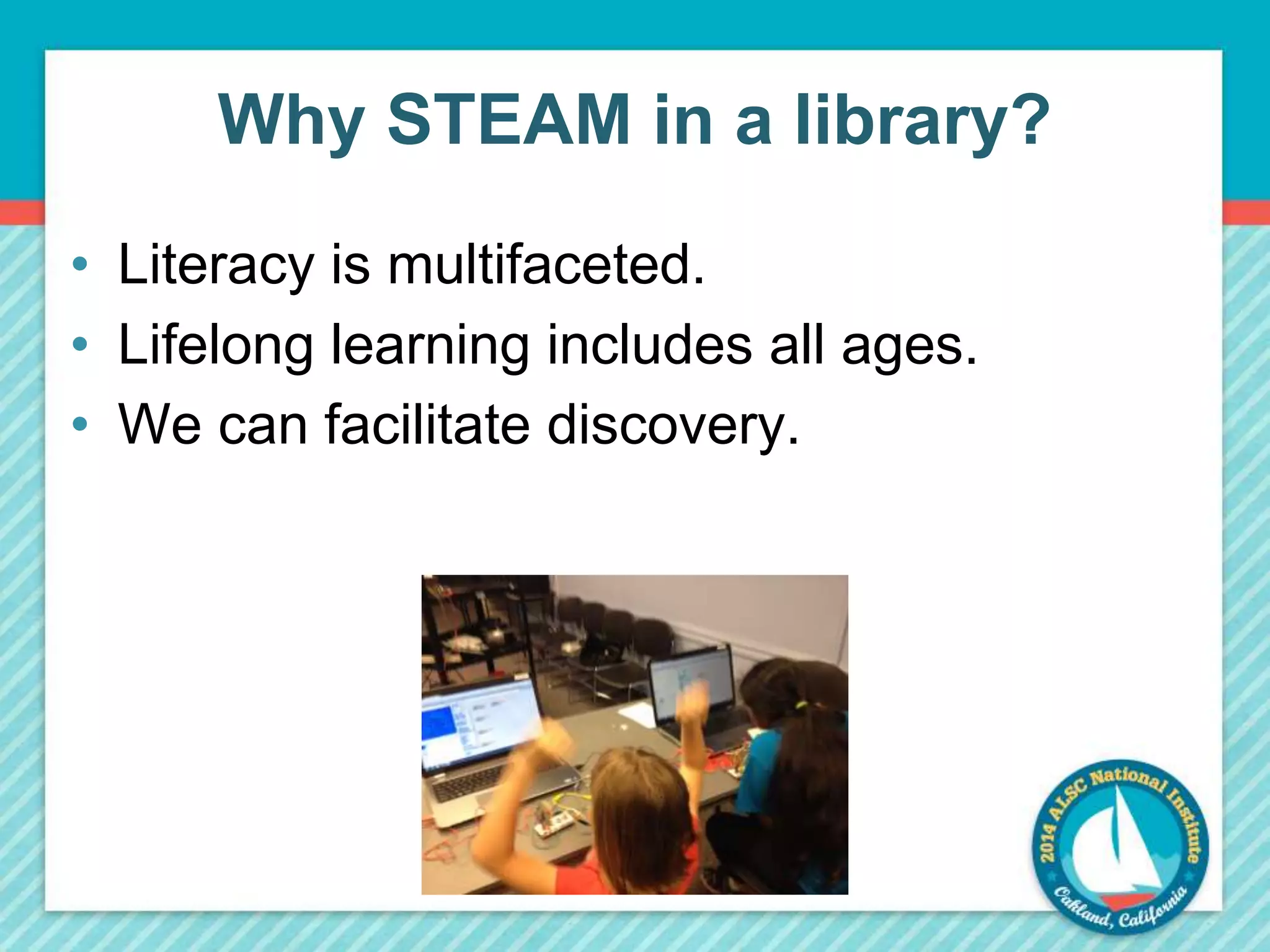
• We can facilitate discovery.
Why STEAM in a library? 
• Literacy is multifaceted. 
• Lifelong learning includes all ages. 
• We can facilitate discovery. 
• Interest is a powerful motivator.
Preschool STEAM 
1. Promote the collection.
Preschool STEAM 
1. Promote the collection. 
2. Introduce fundamental concepts & 
skills.
Preschool STEAM 
1. Promote the collection. 
2. Introduce fundamental concepts & 
skills. 
3. Facilitate interest in STEAM.
Preschool STEAM 
1. Promote the collection. 
2. Introduce fundamental concepts & 
skills. 
3. Facilitate interest in STEAM. 
4. Promote love of the library.
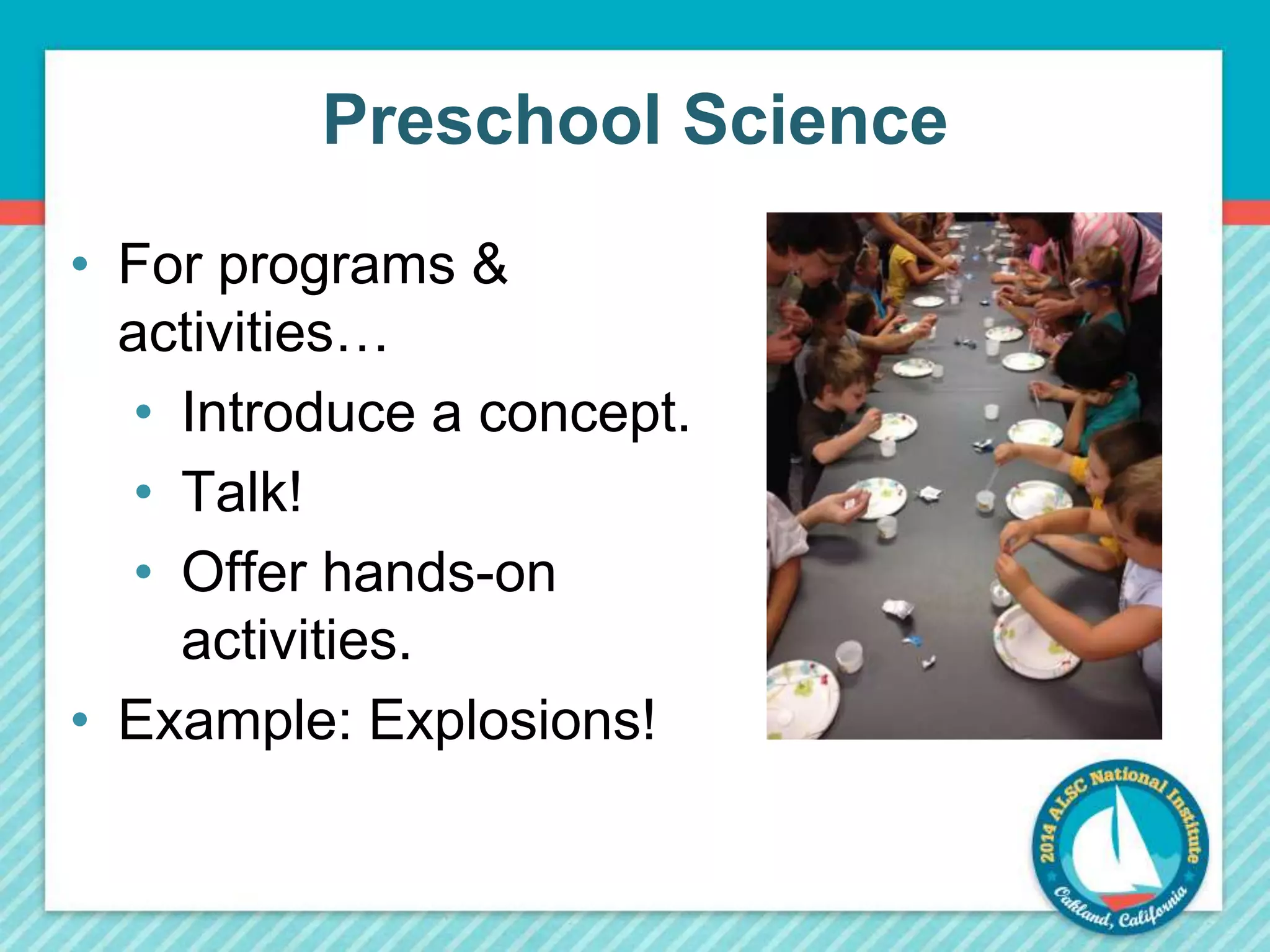
Preschool Science 
• For programs & 
activities… 
• Introduce a concept. 
• Talk! 
• Offer hands-on 
activities. 
• Example: Explosions!
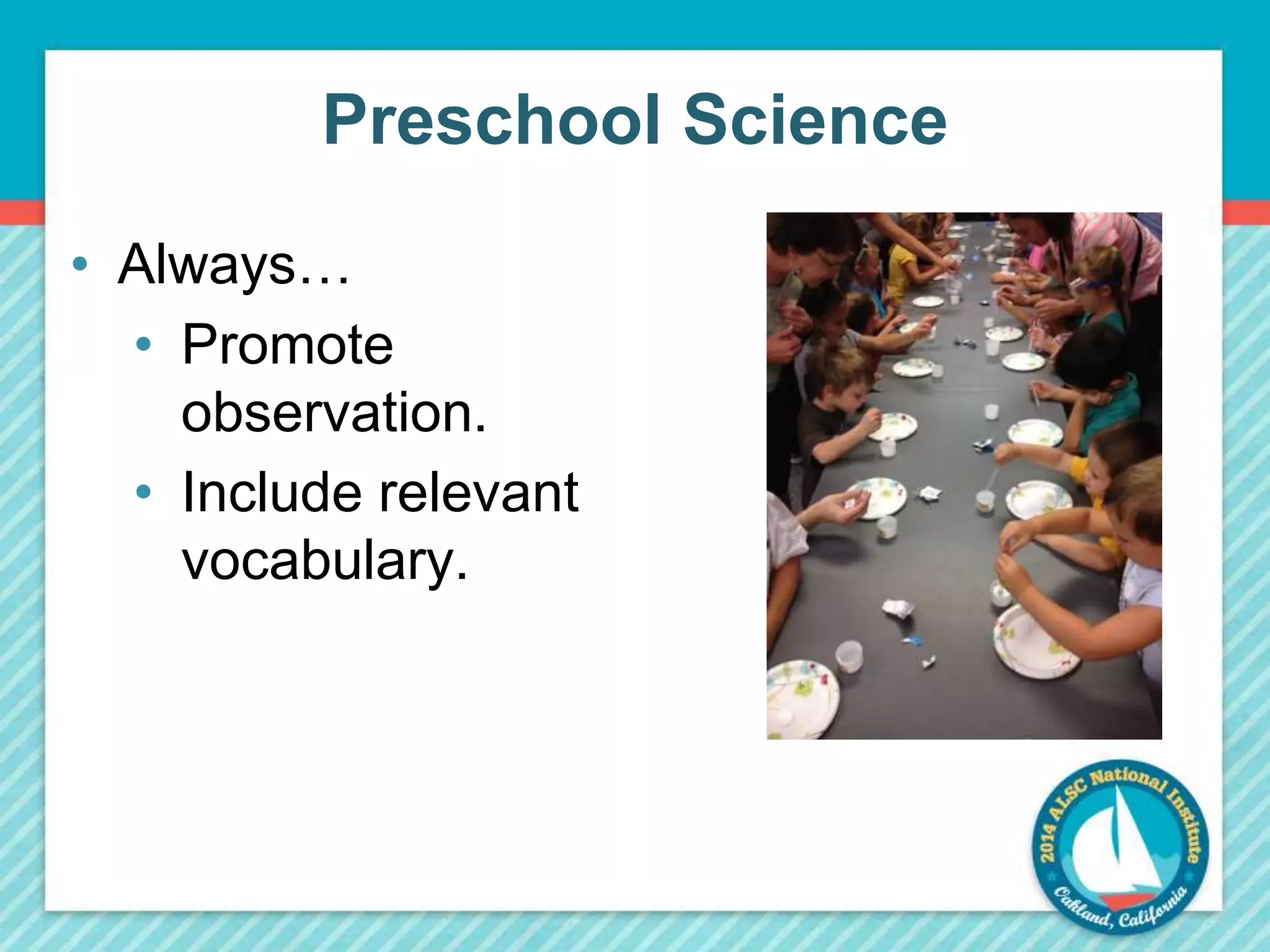
Preschool Science 
• Always… 
• Promote 
observation. 
• Include relevant 
vocabulary.
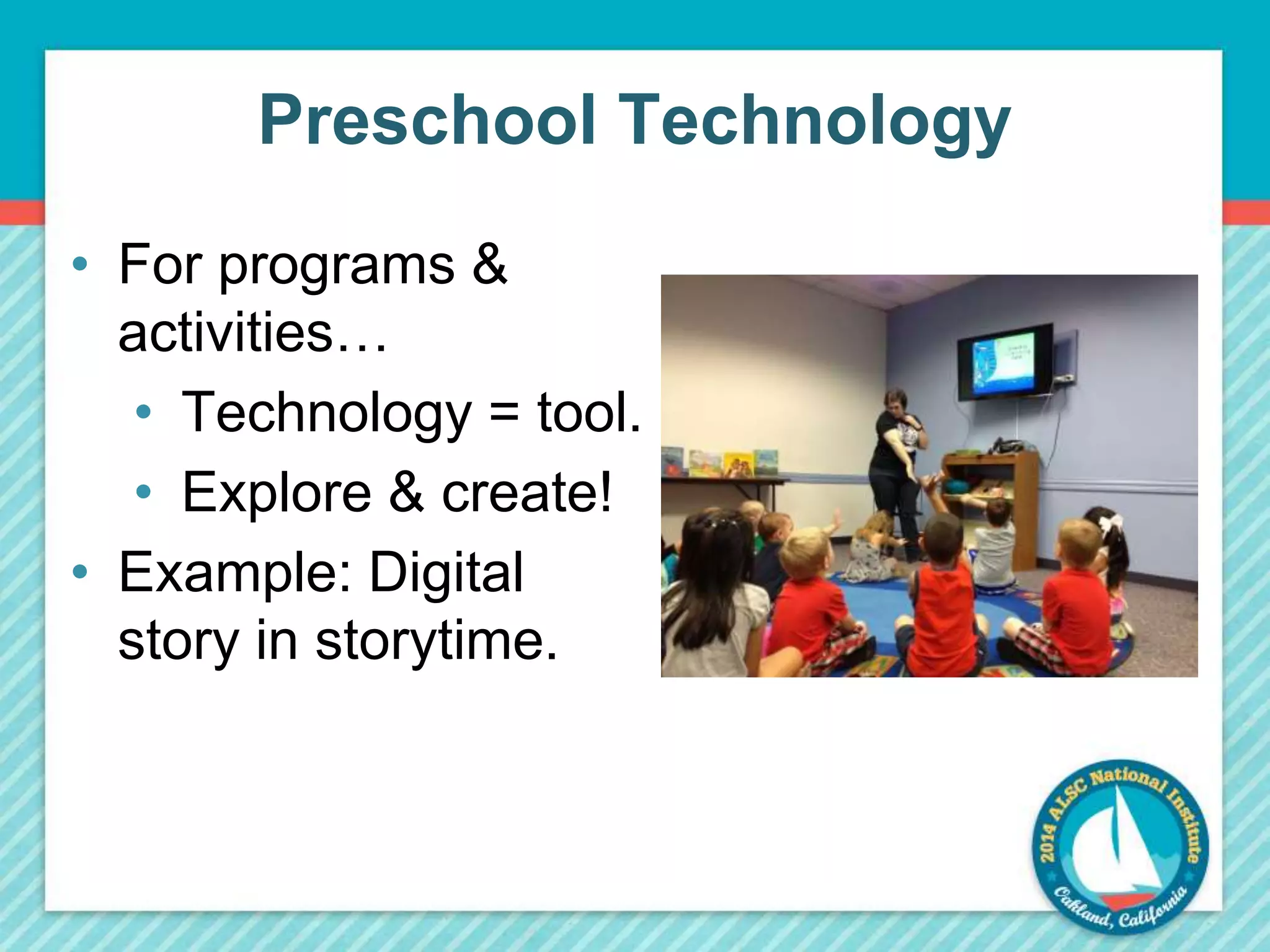
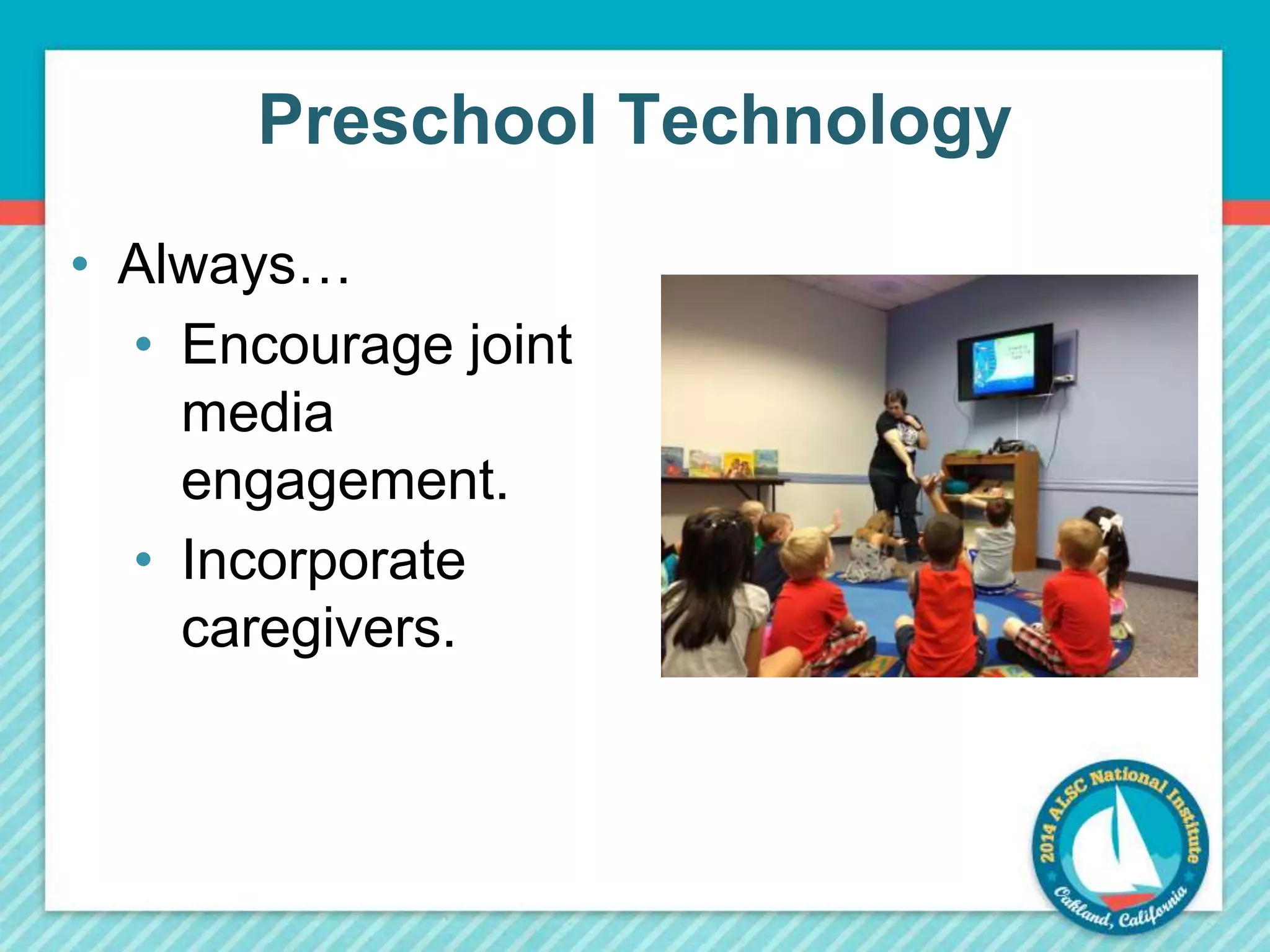
Preschool Technology 
• For programs & 
activities… 
• Technology = tool. 
• Explore & create! 
• Example: Digital 
story in storytime.
Preschool Technology 
• Always… 
• Encourage joint 
media 
engagement. 
• Incorporate 
caregivers.
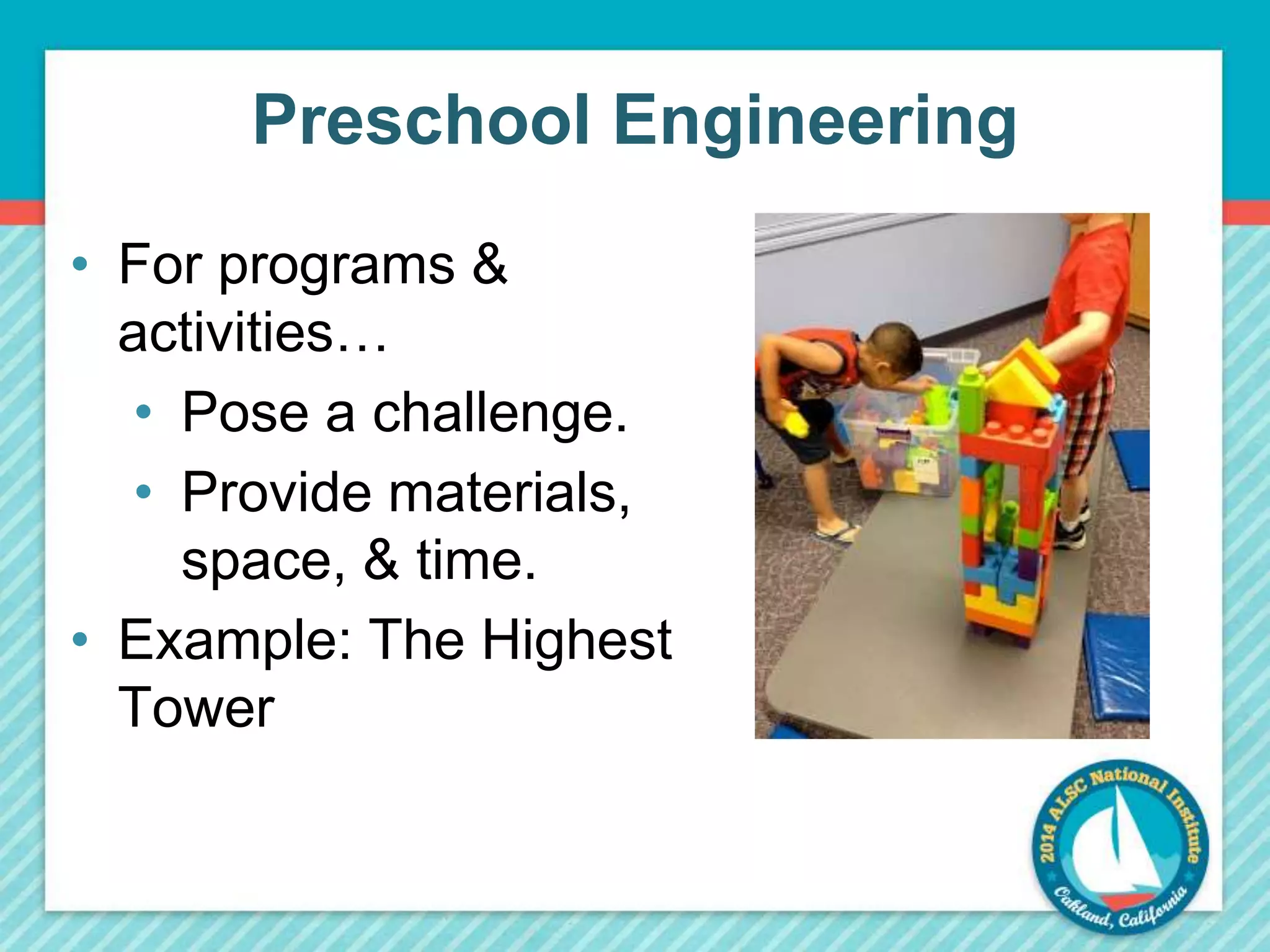
Preschool Engineering 
• For programs & 
activities… 
• Pose a challenge. 
• Provide materials, 
space, & time. 
• Example: The Highest 
Tower
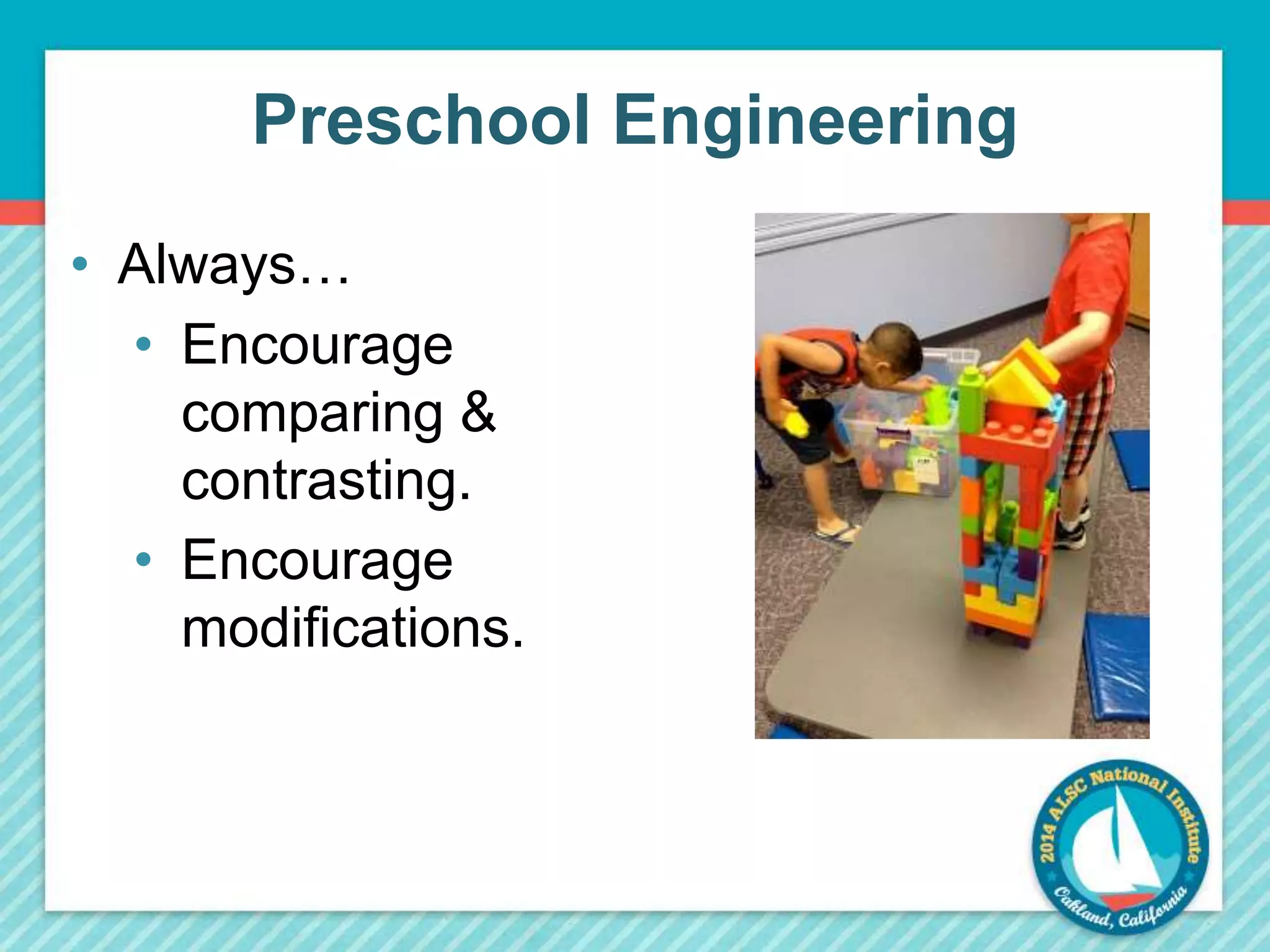
Preschool Engineering 
• Always… 
• Encourage 
comparing & 
contrasting. 
• Encourage 
modifications.
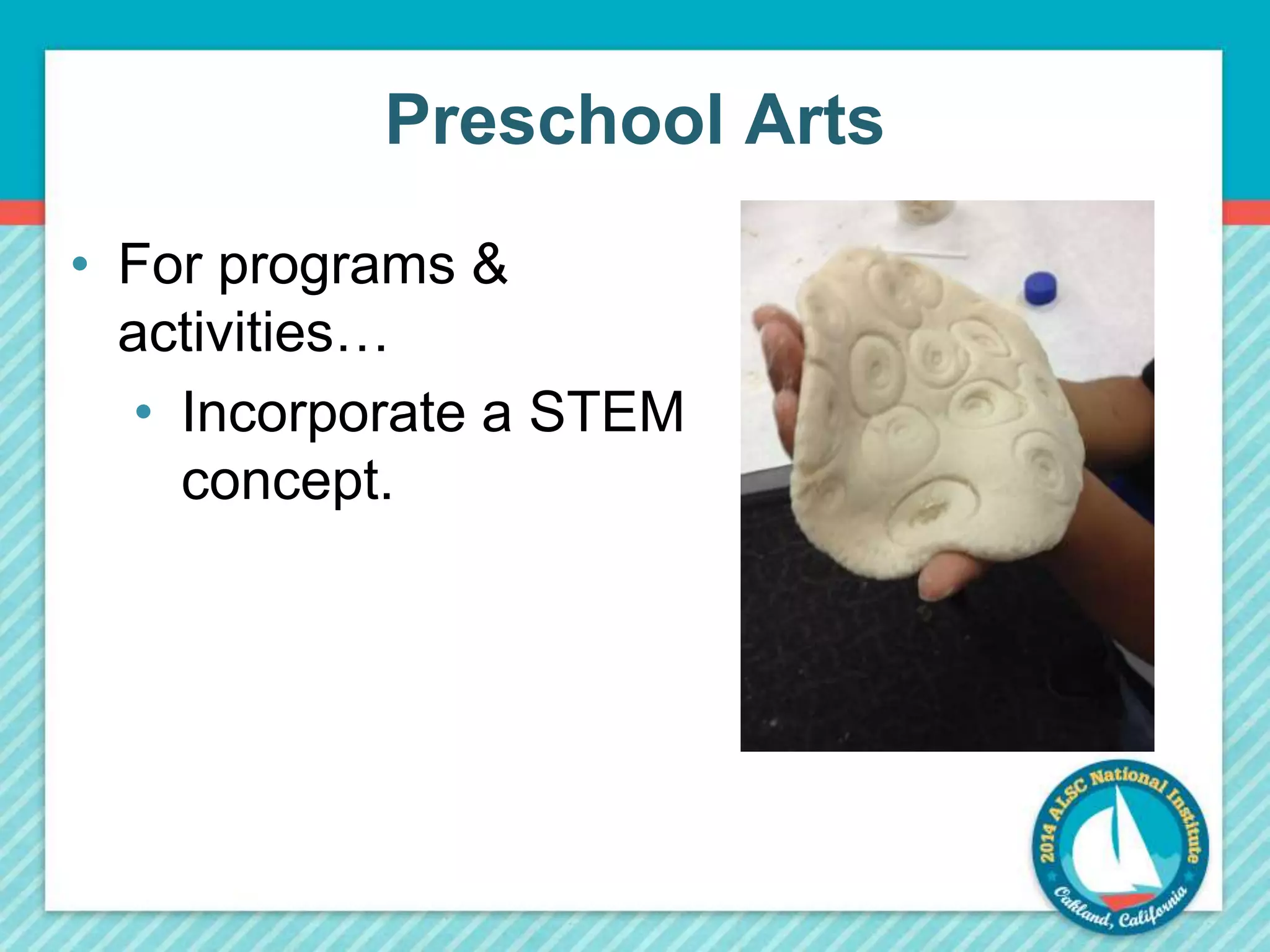
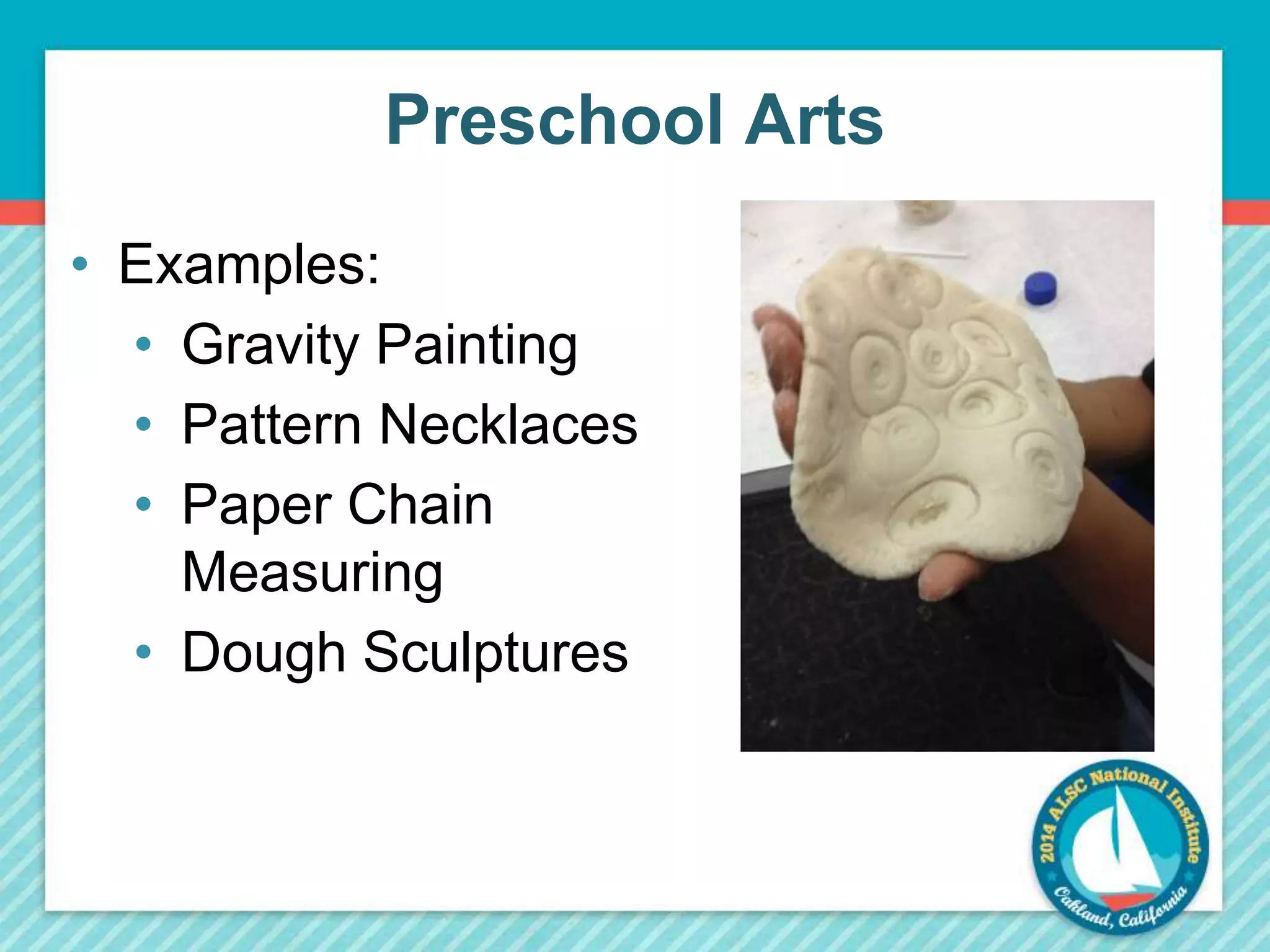
Preschool Arts 
• For programs & 
activities… 
• Incorporate a STEM 
concept.
Preschool Arts 
• Examples: 
• Gravity Painting 
• Pattern Necklaces 
• Paper Chain 
Measuring 
• Dough Sculptures
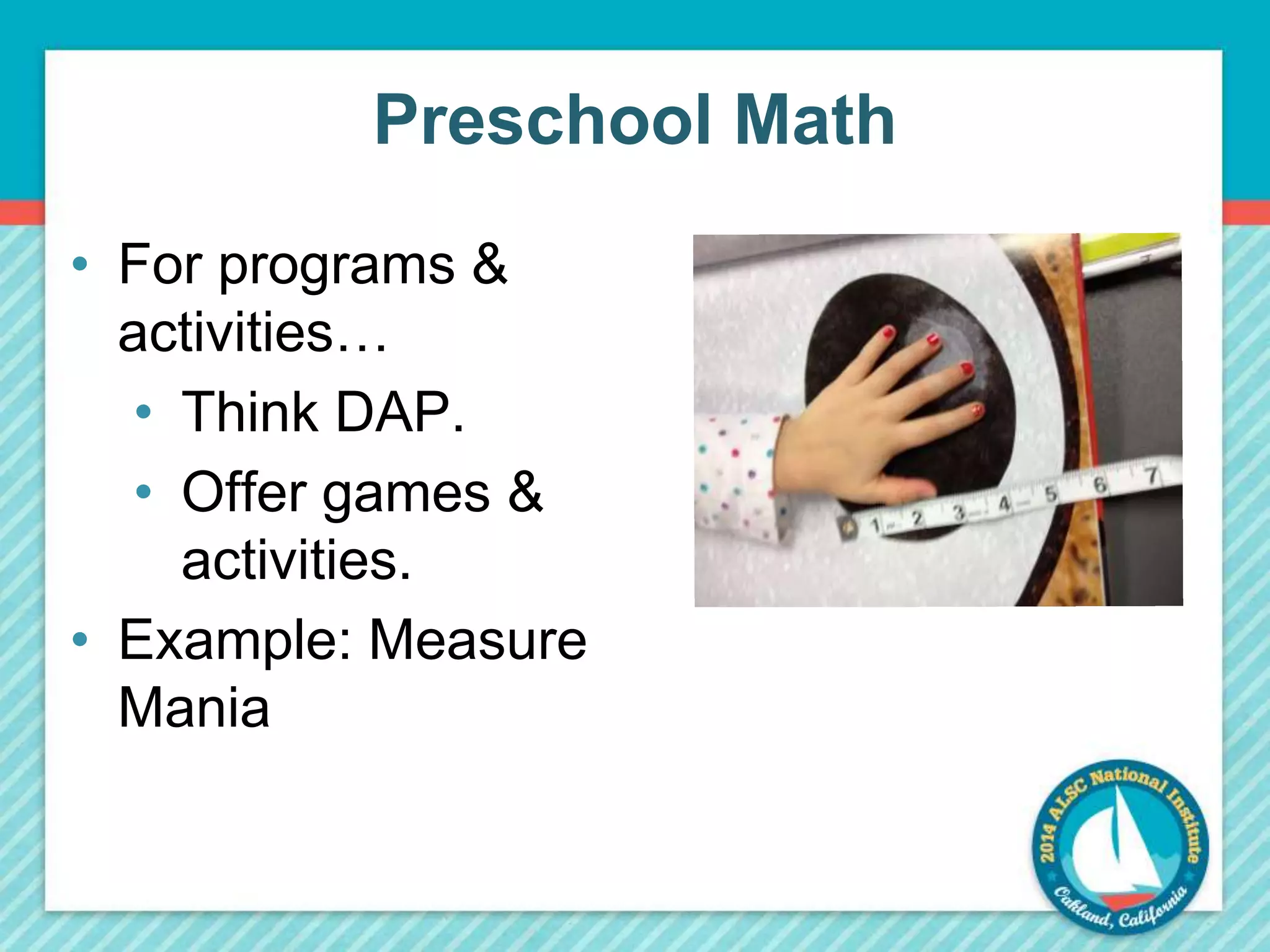
Preschool Math 
• For programs & 
activities… 
• Think DAP. 
• Offer games & 
activities. 
• Example: Measure 
Mania
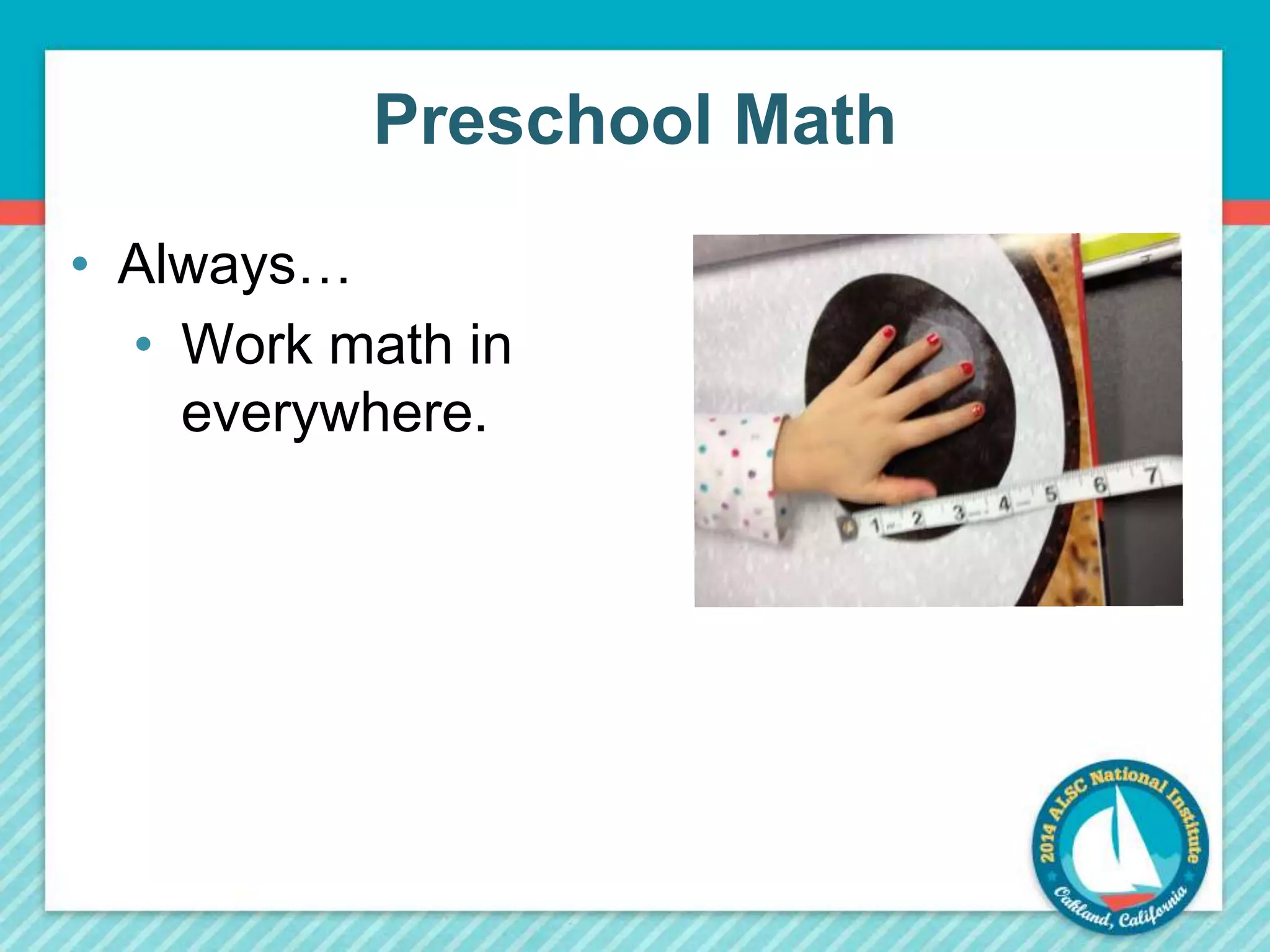
Preschool Math 
• Always… 
• Work math in 
everywhere.
School-Age STEAM Programs 
1. Promote the collection.
School-Age STEAM Programs 
1. Promote the collection. 
2. Introduce & deepen STEAM 
understanding.
School-Age STEAM Programs 
1. Promote the collection. 
2. Introduce & deepen STEAM 
understanding. 
3. Facilitate interest in STEAM.
School-Age STEAM Programs 
1. Promote the collection. 
2. Introduce & deepen STEAM 
understanding. 
3. Facilitate interest in STEAM. 
4. Promote love of the library.
School-Age STEAM Programs 
1. Promote the collection. 
2. Introduce & deepen STEAM 
understanding. 
3. Facilitate interest in STEAM. 
4. Promote love of the library. 
5. Engage “reluctant readers.”
School-Age Science Programs 
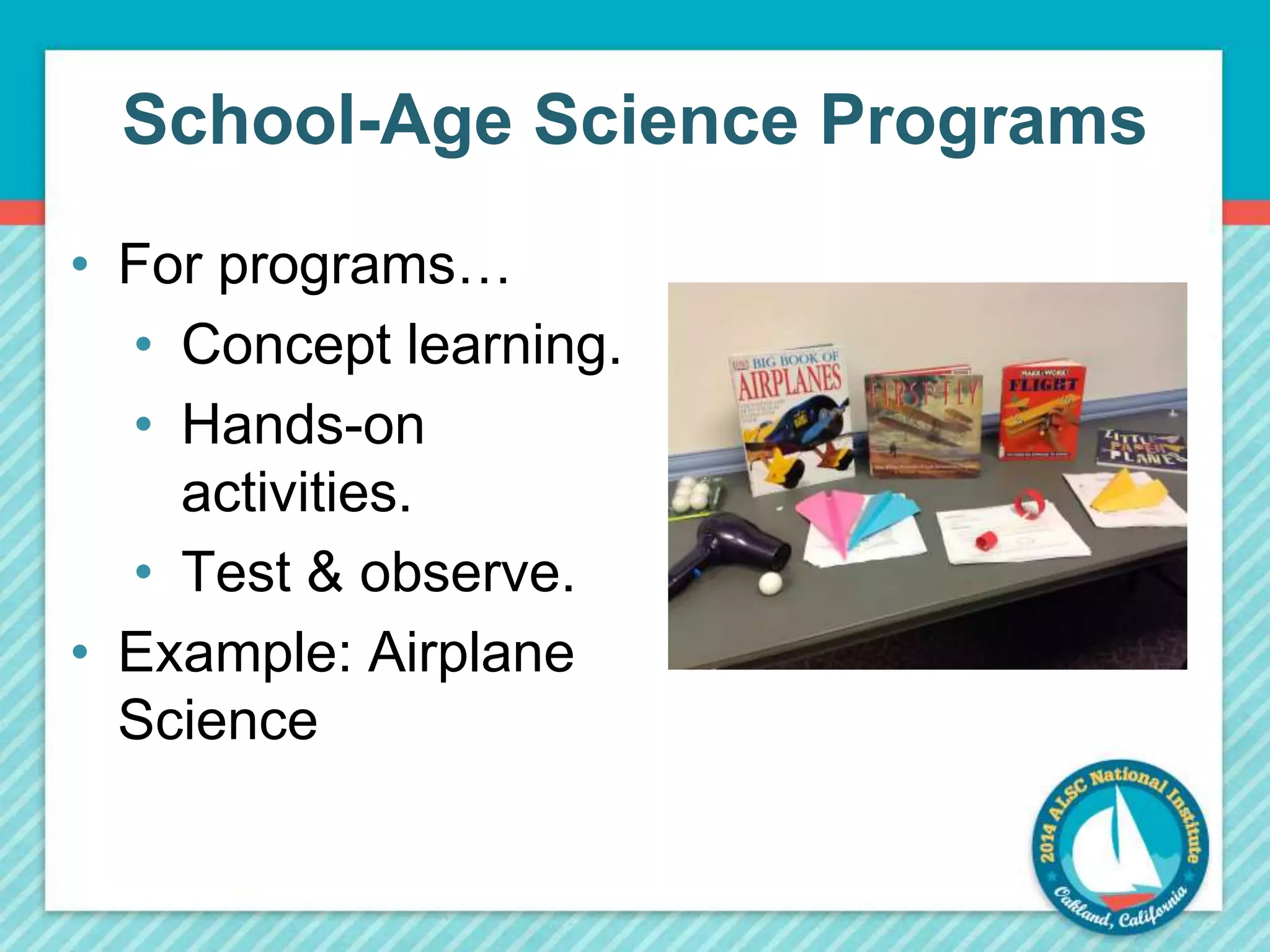
• For programs… 
• Concept learning. 
• Hands-on 
activities. 
• Test & observe. 
• Example: Airplane 
Science
School-Age Science Programs 
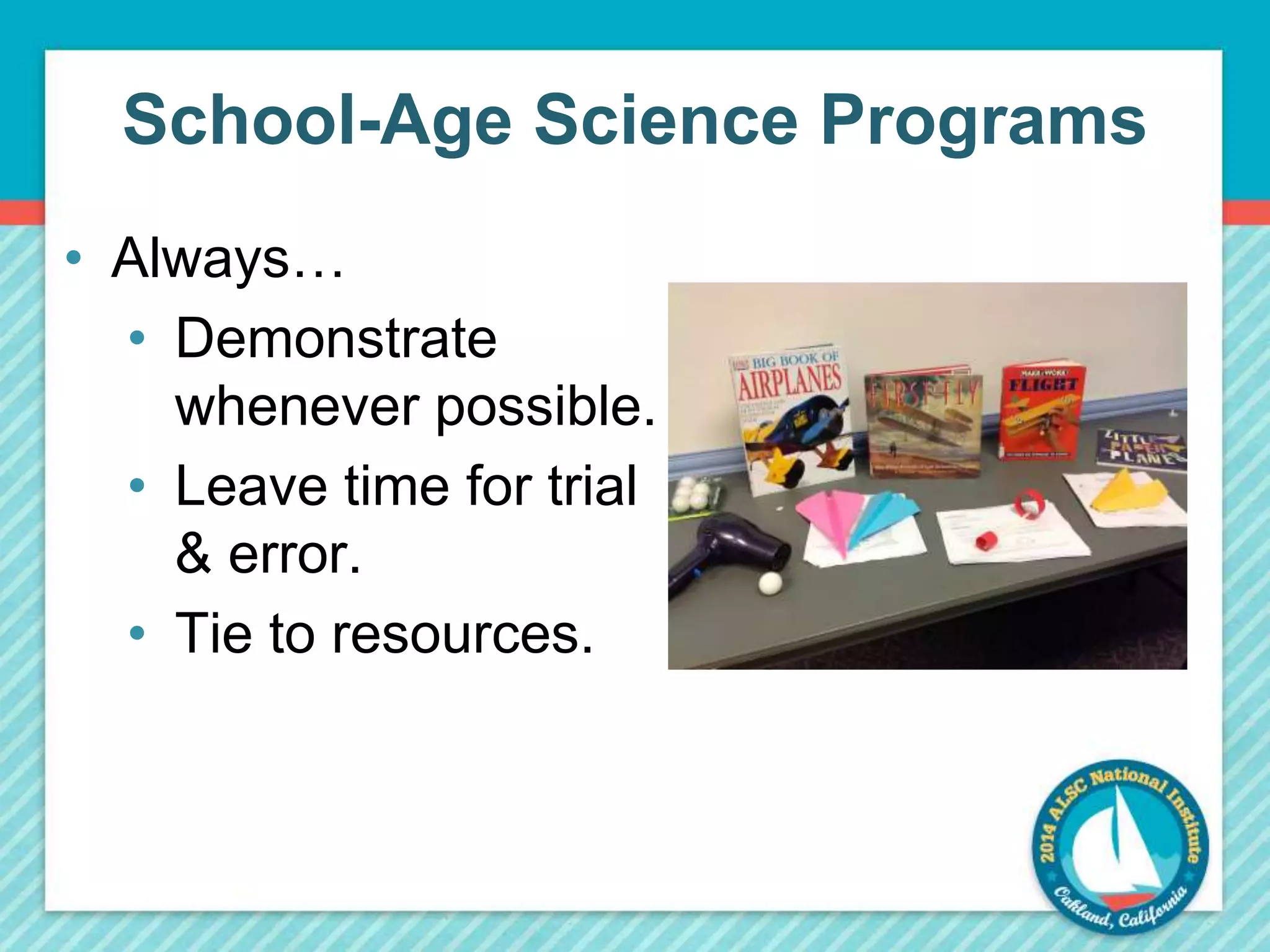
• Always… 
• Demonstrate 
whenever possible. 
• Leave time for trial 
& error. 
• Tie to resources.
School-Age Technology Programs 
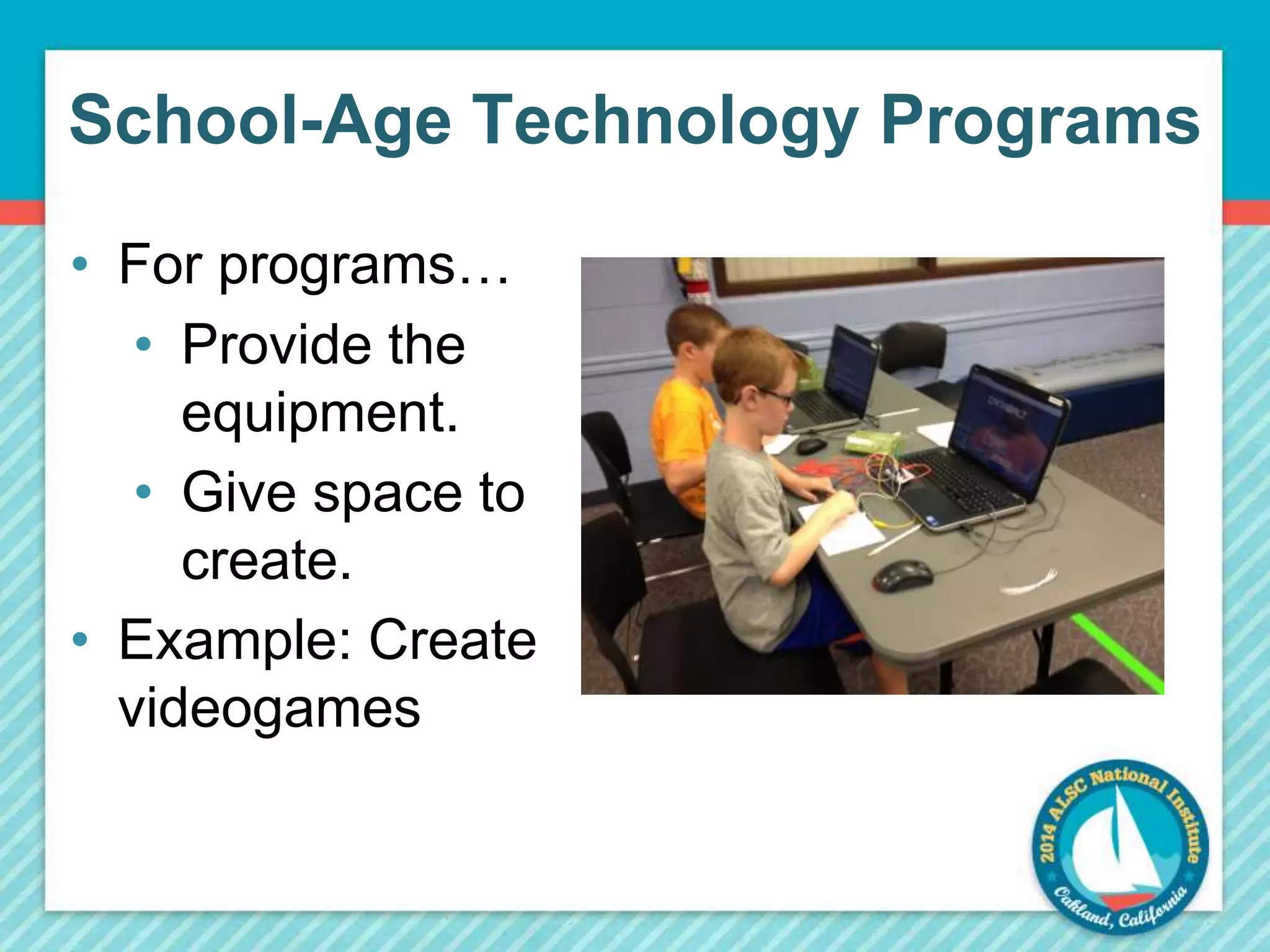
• For programs… 
• Provide the 
equipment. 
• Give space to 
create. 
• Example: Create 
videogames
School-Age Technology 
Programs 
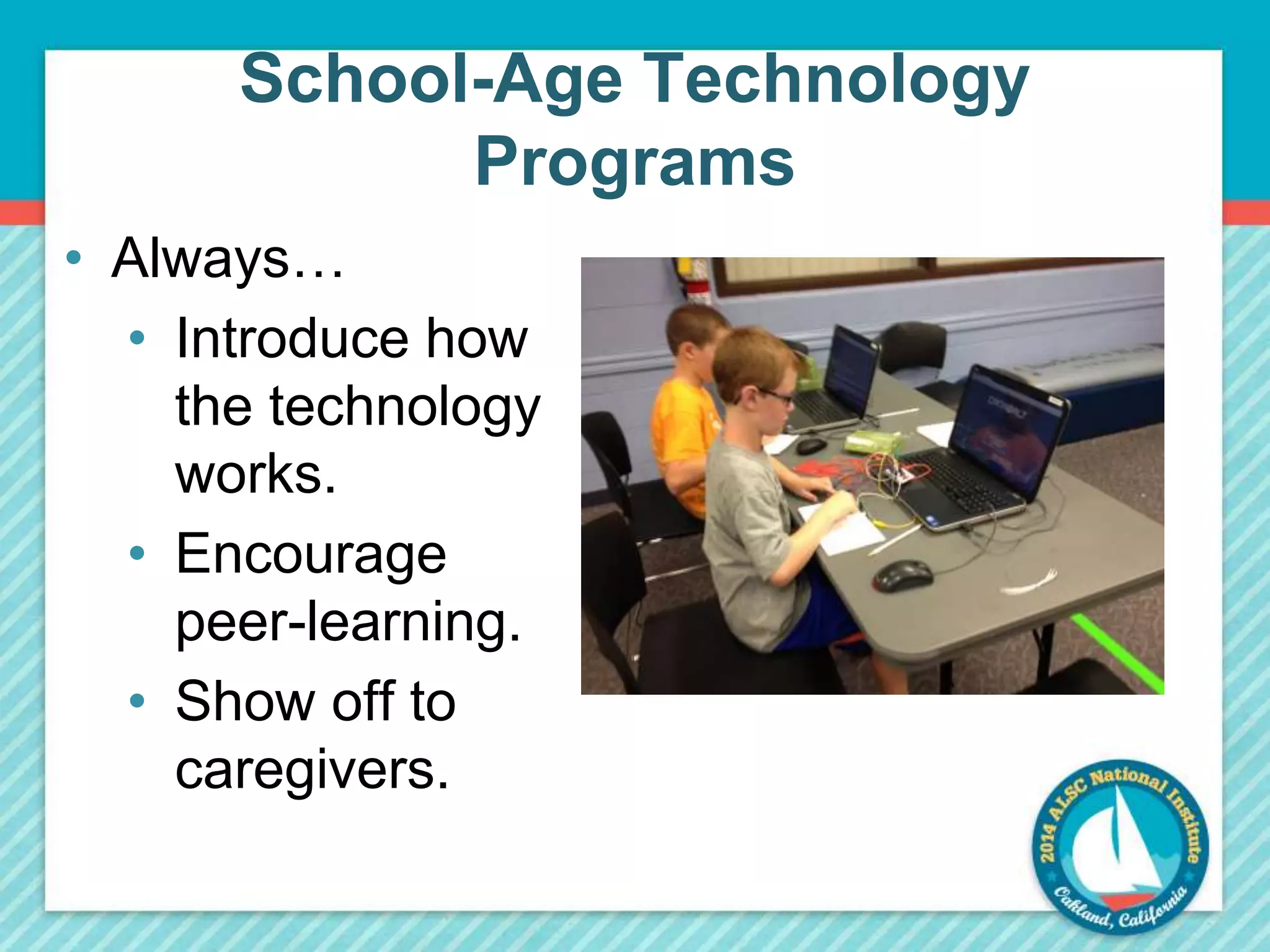
• Always… 
• Introduce how 
the technology 
works. 
• Encourage 
peer-learning. 
• Show off to 
caregivers.
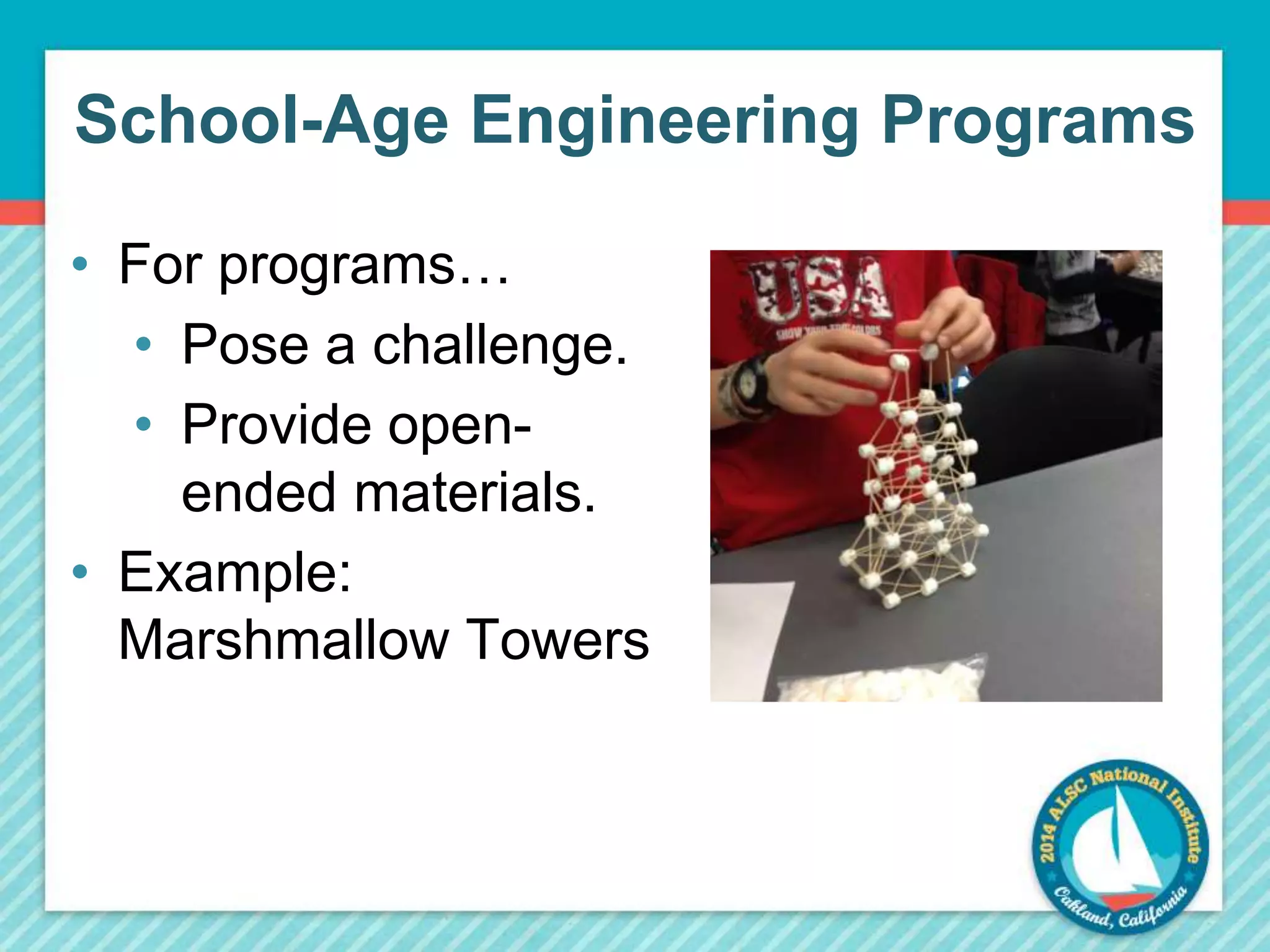
School-Age Engineering Programs 
• For programs… 
• Pose a challenge. 
• Provide open-ended 
materials. 
• Example: 
Marshmallow Towers
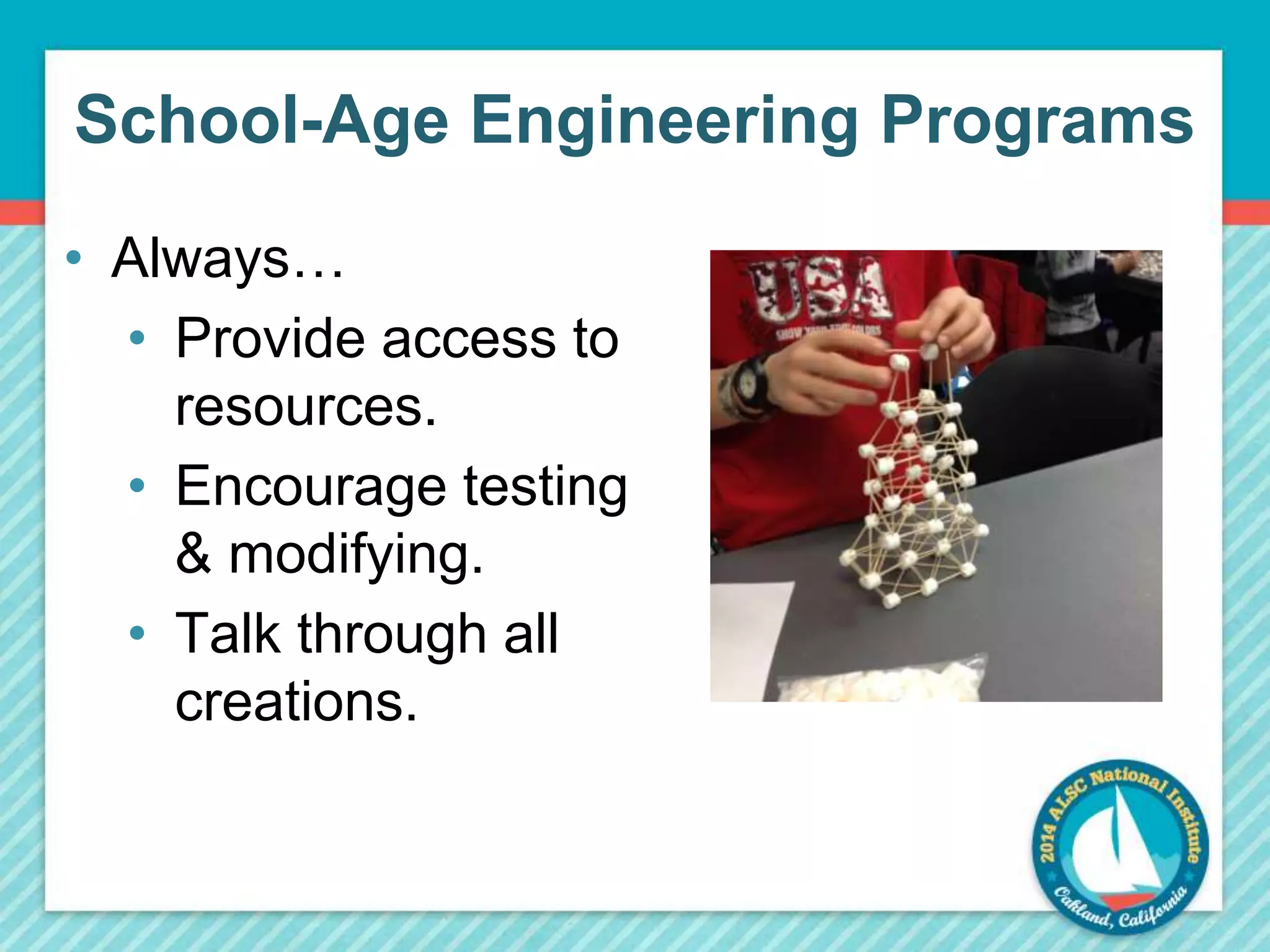
School-Age Engineering Programs 
• Always… 
• Provide access to 
resources. 
• Encourage testing 
& modifying. 
• Talk through all 
creations.
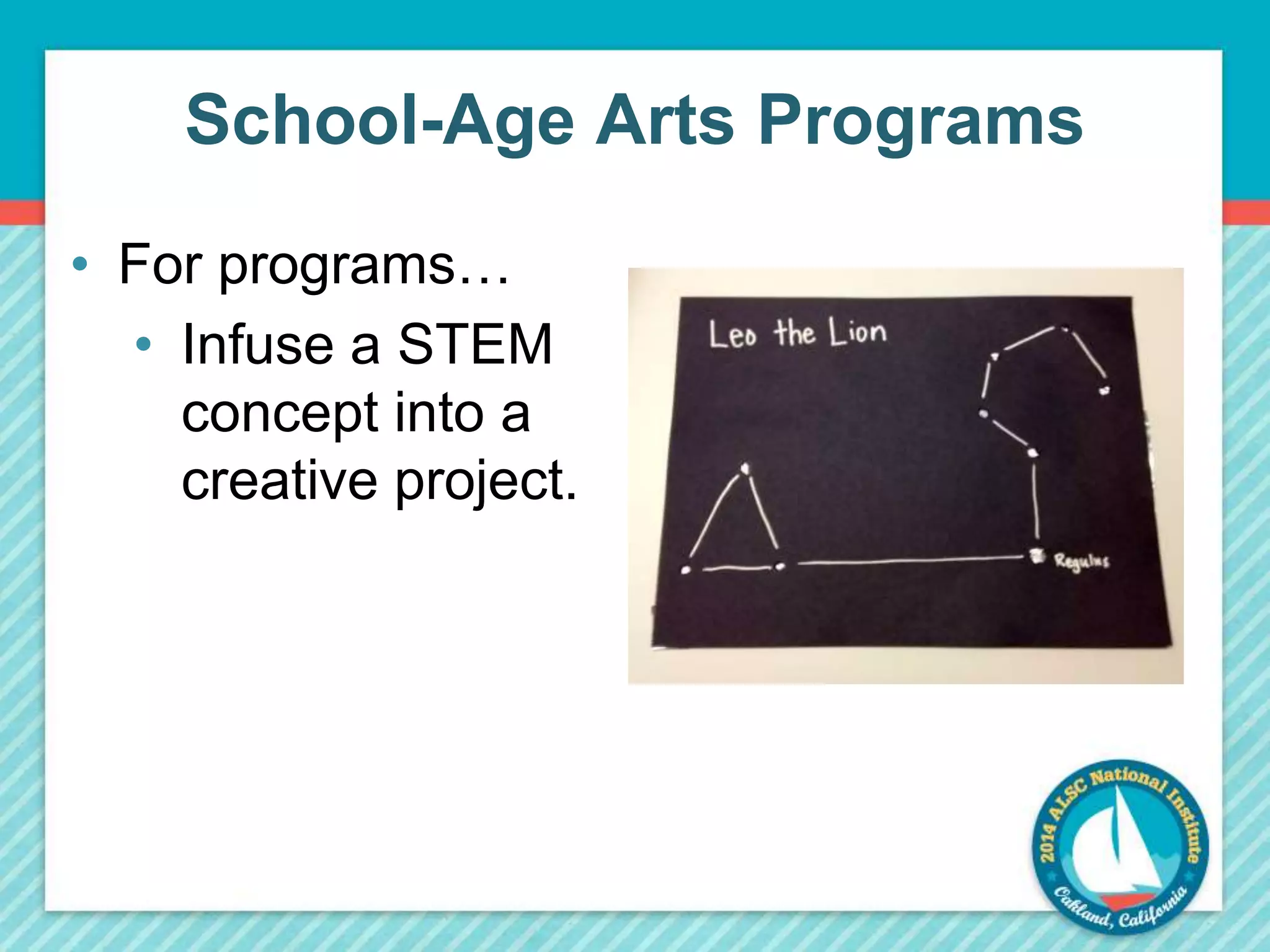
School-Age Arts Programs 
• For programs… 
• Infuse a STEM 
concept into a 
creative project.
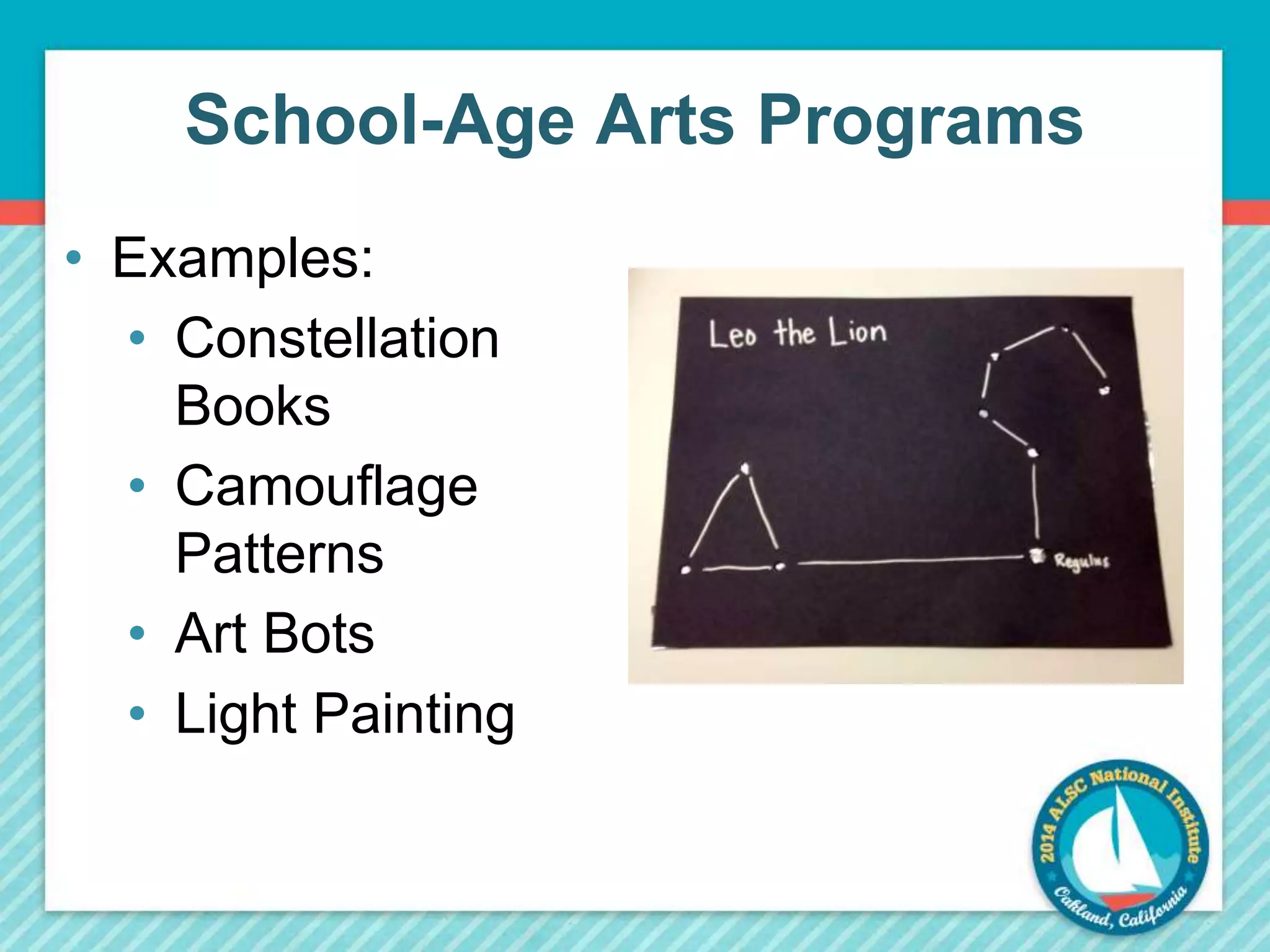
School-Age Arts Programs 
• Examples: 
• Constellation 
Books 
• Camouflage 
Patterns 
• Art Bots 
• Light Painting
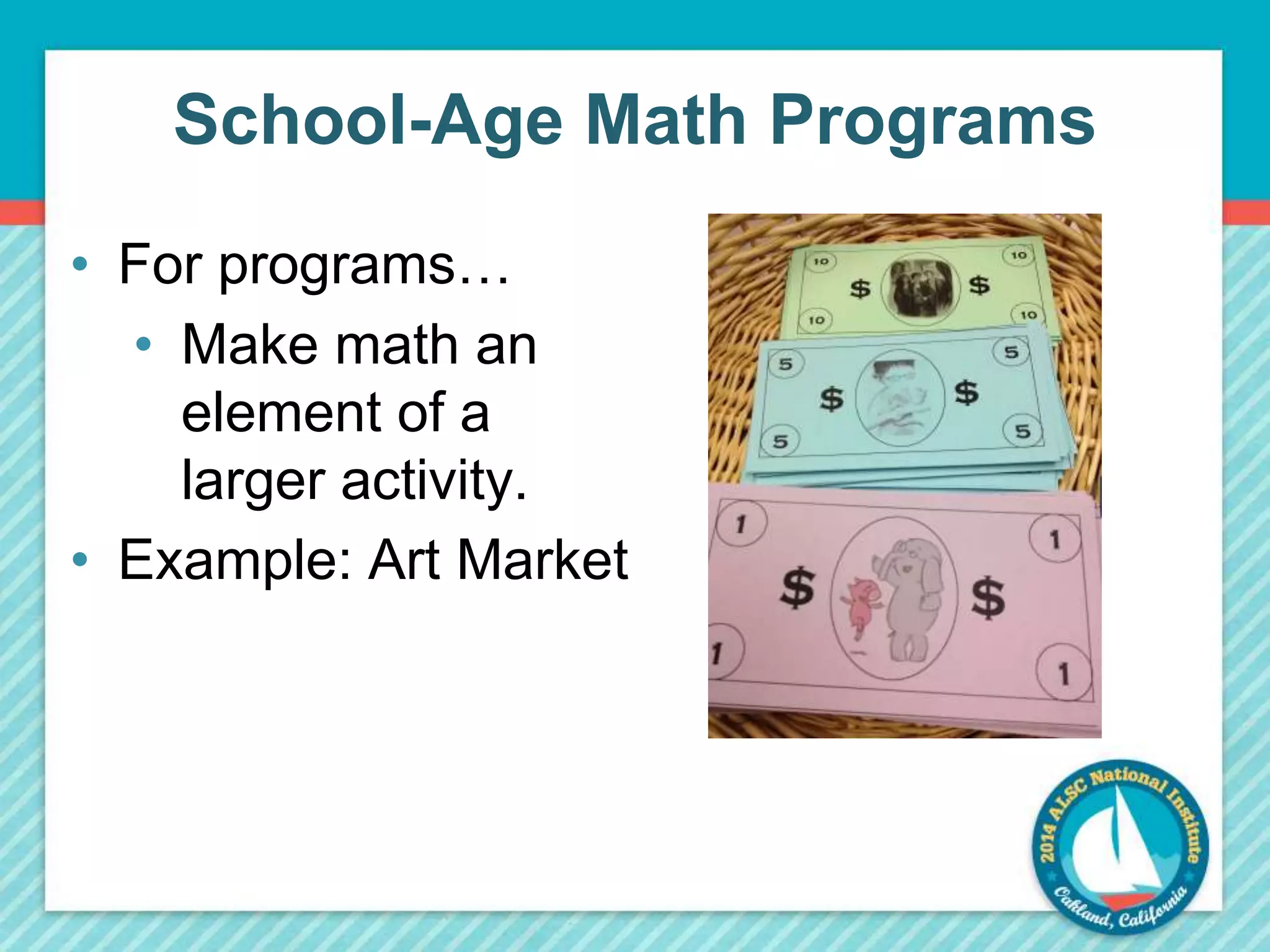
School-Age Math Programs 
• For programs… 
• Make math an 
element of a 
larger activity. 
• Example: Art Market
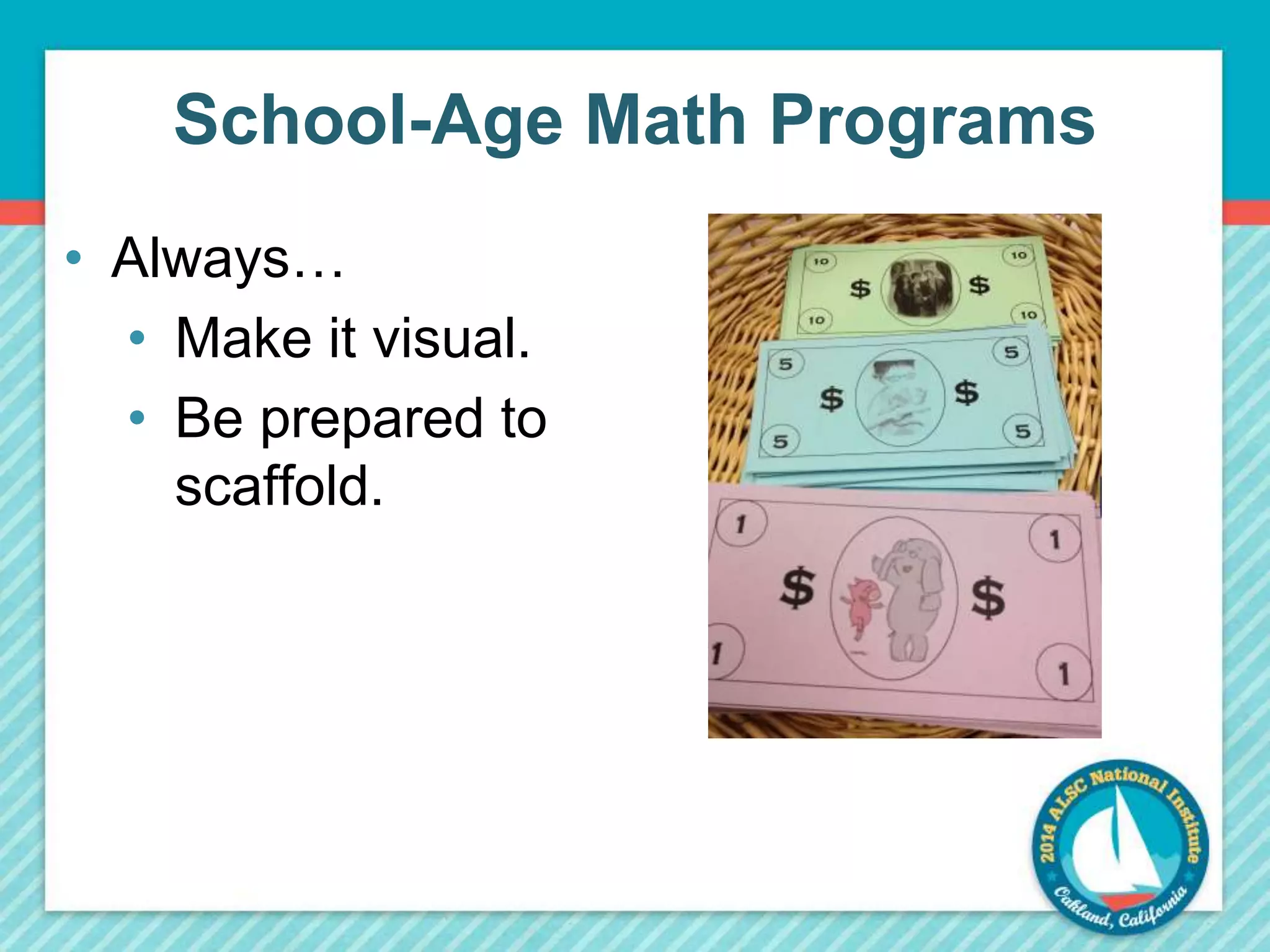
School-Age Math Programs 
• Always… 
• Make it visual. 
• Be prepared to 
scaffold.
STEAM Services 
1. Provide personal access to STEAM.
STEAM Services 
1. Provide personal access to STEAM. 
2. Facilitate self-paced exploration.
STEAM Services 
1. Provide personal access to STEAM. 
2. Facilitate self-paced exploration. 
3. Highlight STEAM collections.
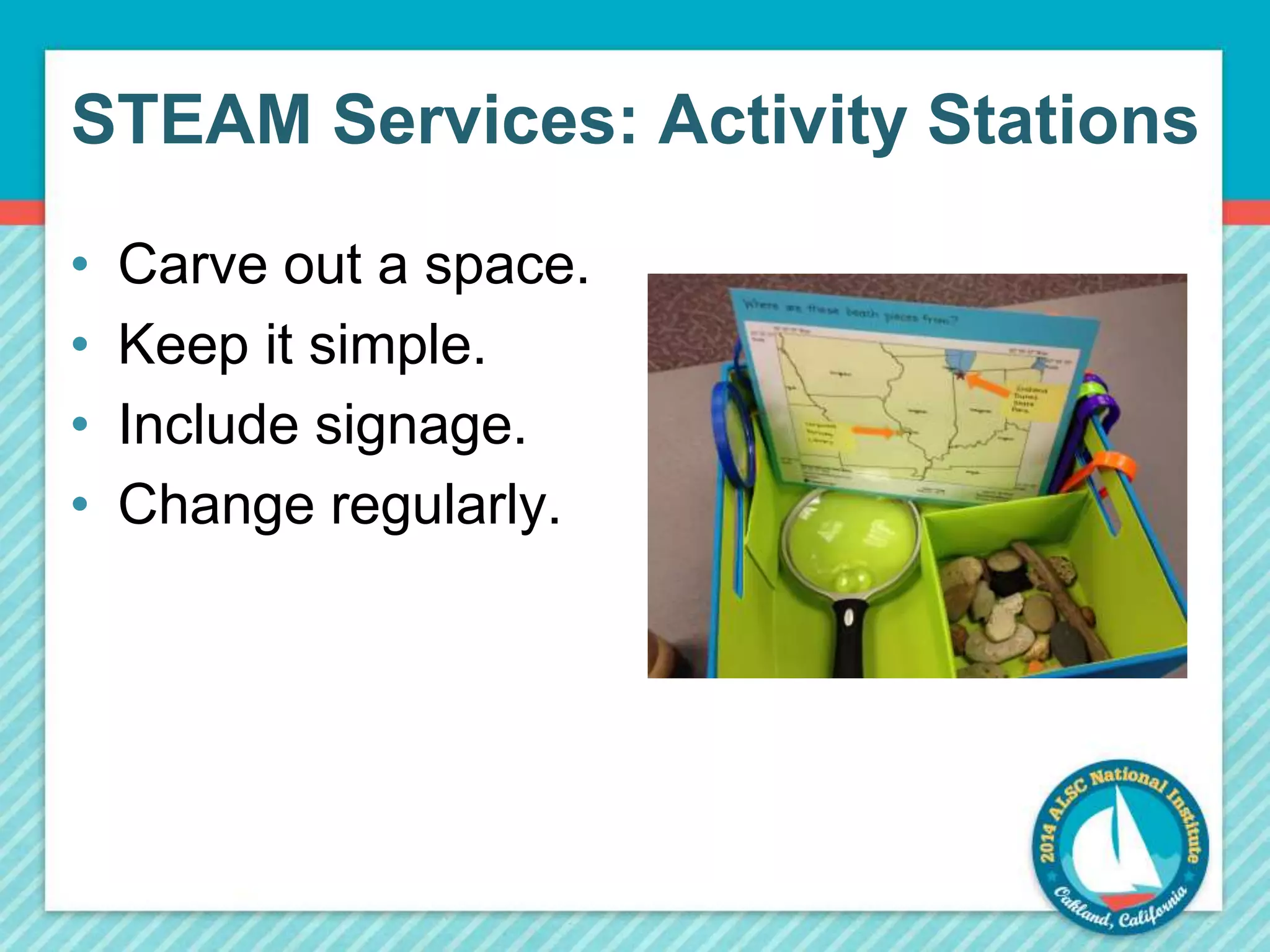
STEAM Services: Activity Stations 
• Carve out a space. 
• Keep it simple. 
• Include signage. 
• Change regularly.
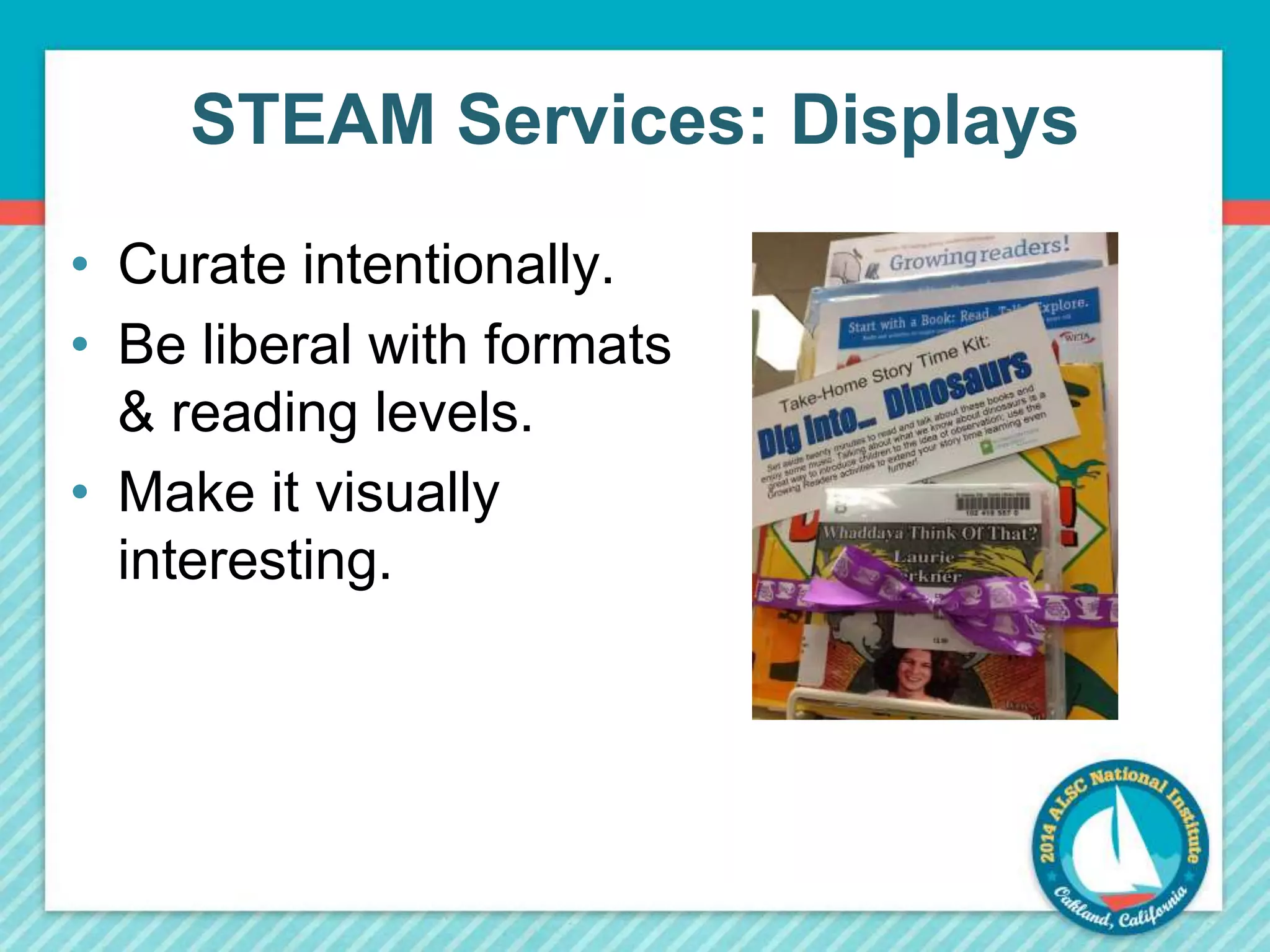
STEAM Services: Displays 
• Curate intentionally. 
• Be liberal with formats 
& reading levels. 
• Make it visually 
interesting.
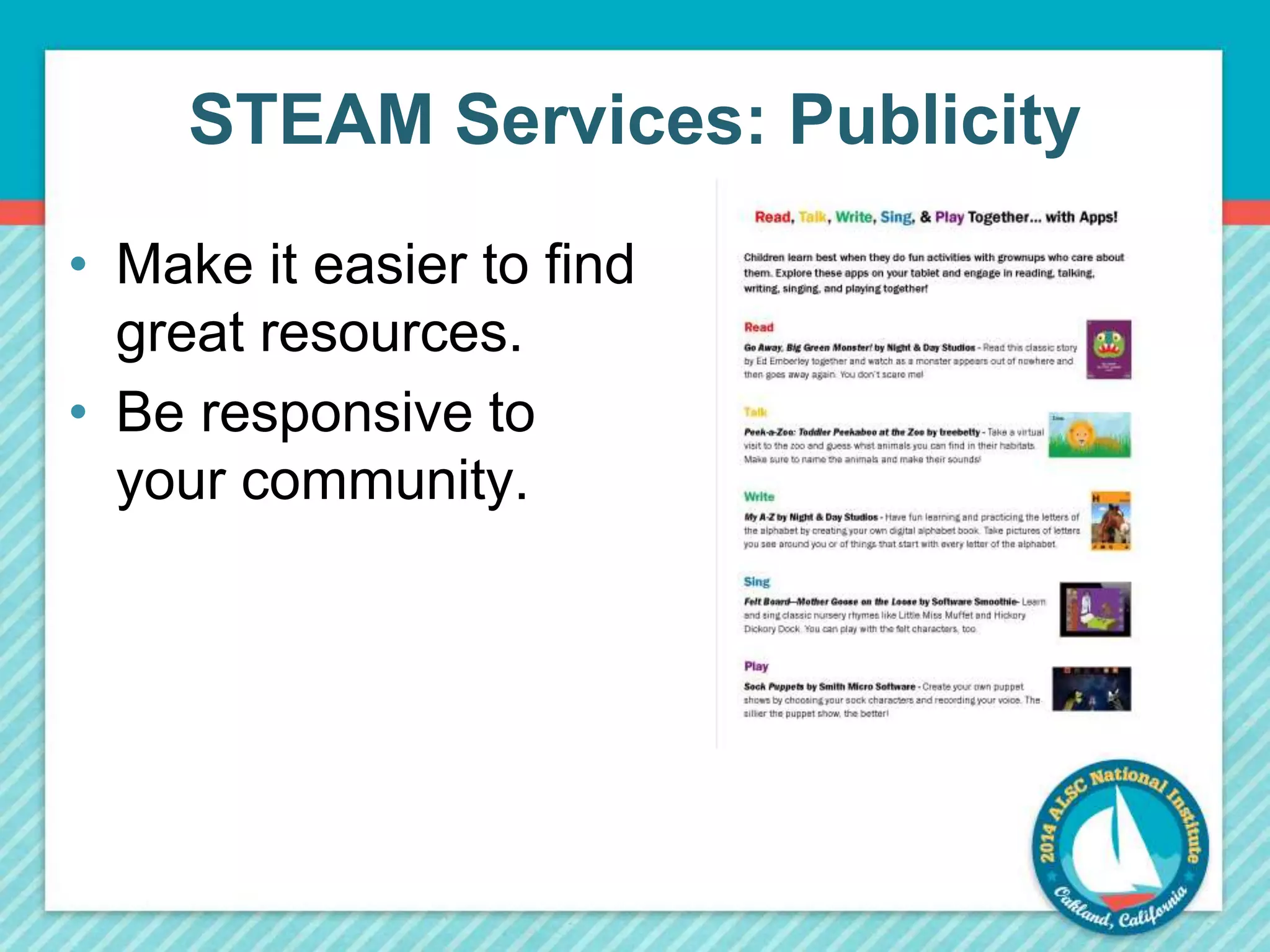
STEAM Services: Publicity 
• Make it easier to find 
great resources. 
• Be responsive to 
your community.
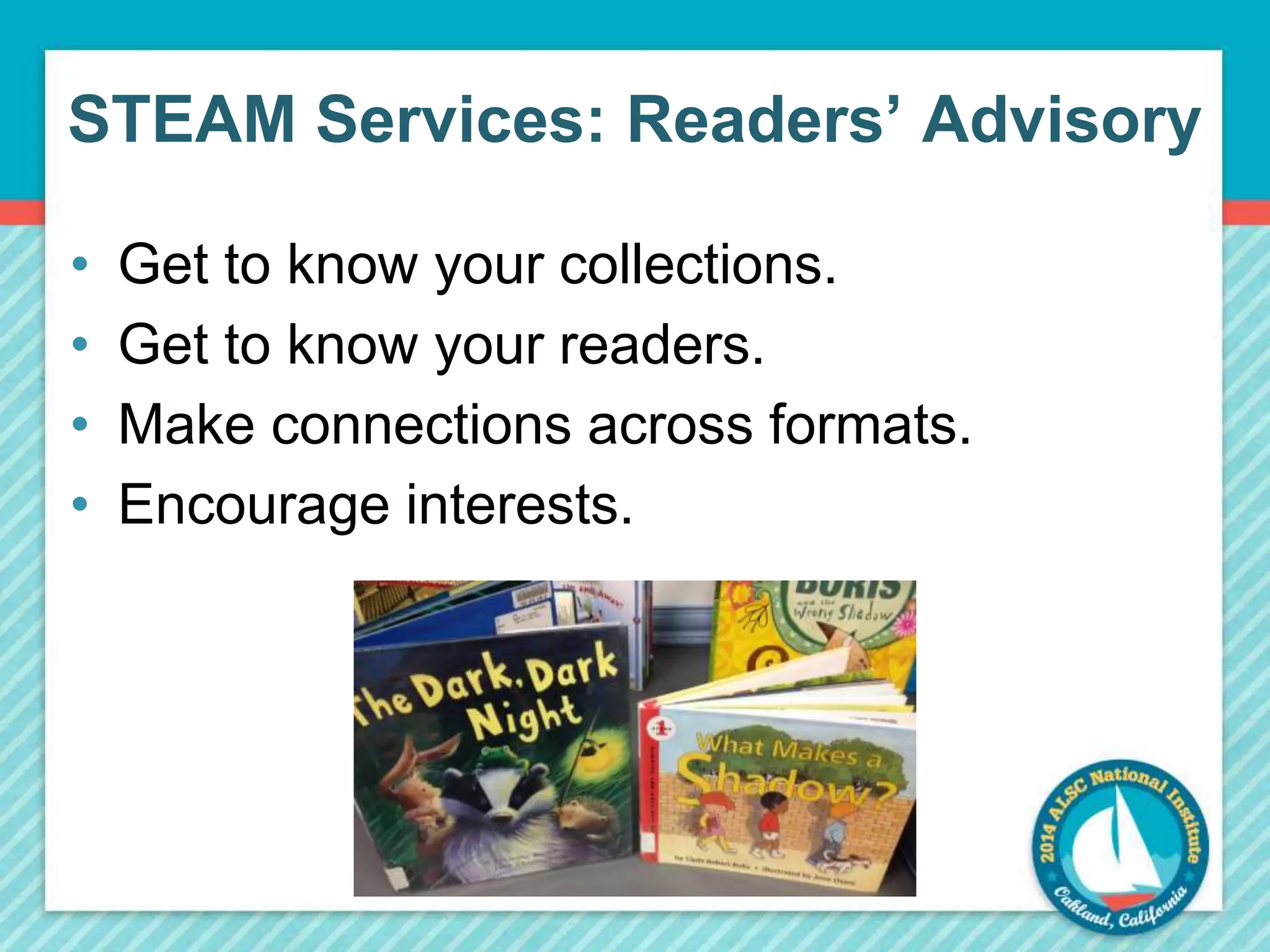
STEAM Services: Readers’ Advisory 
• Get to know your collections. 
• Get to know your readers. 
• Make connections across formats. 
• Encourage interests.
Resources to STEAM 
• You don’t have to go it alone. 
• USE YOUR RESOURCES!
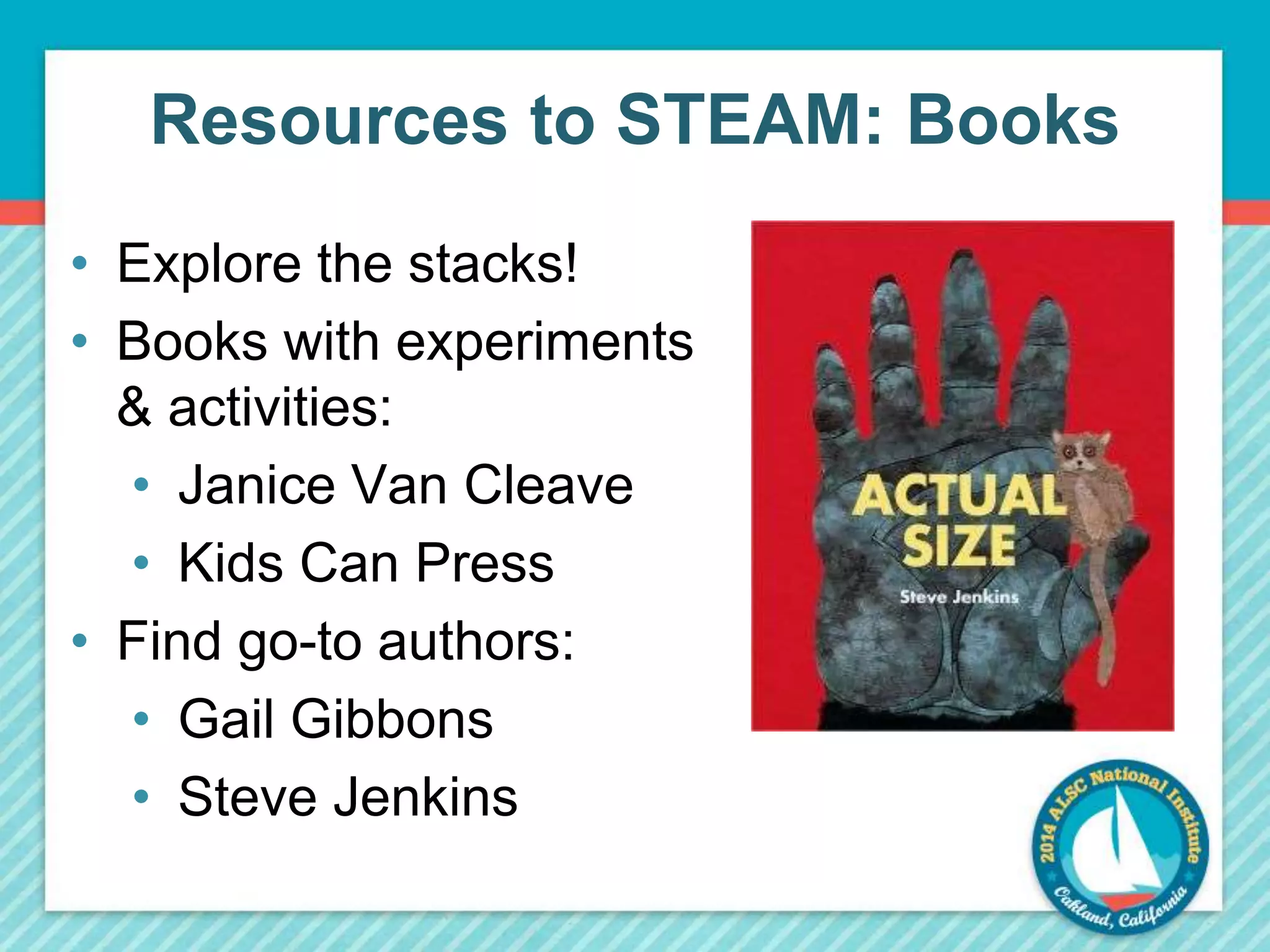
Resources to STEAM: Books 
• Explore the stacks! 
• Books with experiments 
& activities: 
• Janice Van Cleave 
• Kids Can Press 
• Find go-to authors: 
• Gail Gibbons 
• Steve Jenkins
Resources to STEAM: Blogs 
• Library Makers 
• Abby the Librarian 
• Read Sing Play 
• Library Bonanza 
• Never Shushed 
• Teach Preschool 
• PreKinders 
• So Tomorrow 
• Gadgets, Gizmos, 
and Goo (G3): The 
Mad Scientists Club 
• The Show Me 
Librarian: All Things 
STEAM
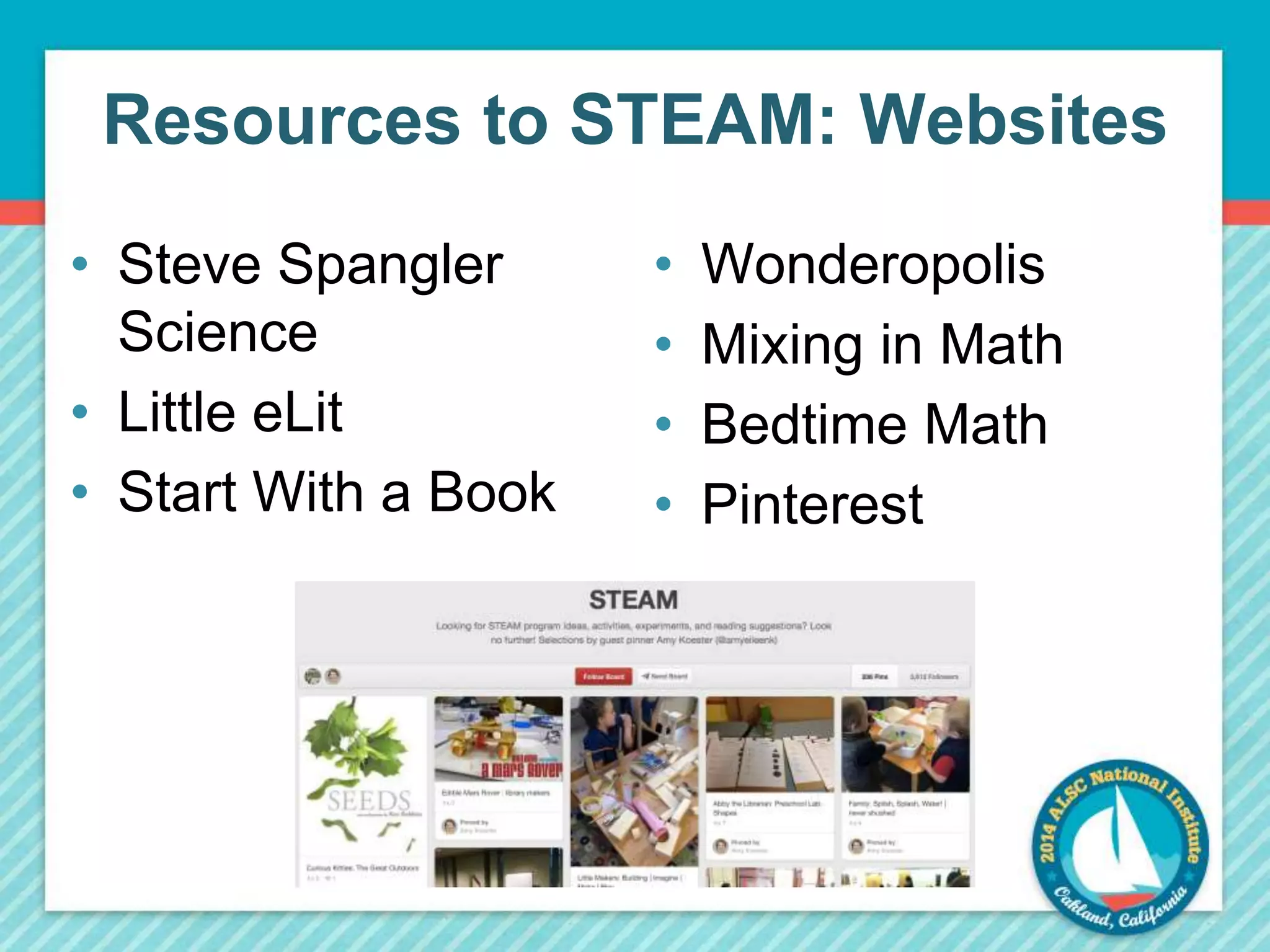
Resources to STEAM: Websites 
• Steve Spangler 
Science 
• Little eLit 
• Start With a Book 
• Wonderopolis 
• Mixing in Math 
• Bedtime Math 
• Pinterest
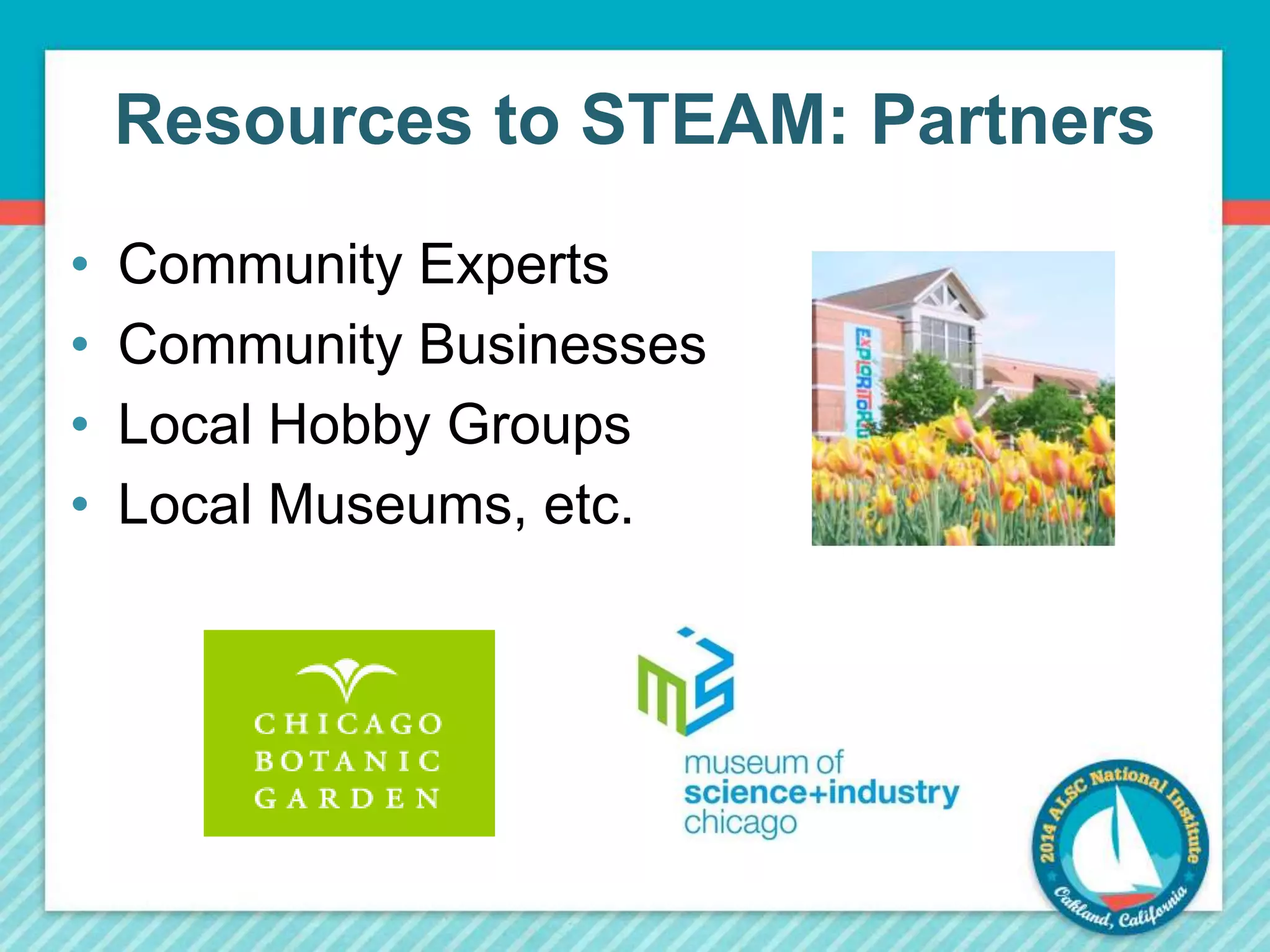
Resources to STEAM: Partners 
• Community Experts 
• Community Businesses 
• Local Hobby Groups 
• Local Museums, etc.
Resources to STEAM: Funding 
• Friends of the Library 
• LSTA Grants 
• Other Grants (via 
LEGO Education) 
• Donations 
• Local Business 
Support
In Conclusion… 
• You CAN offer STEAM in your library. 
• Start with what you have. 
• Above all else, engage interests.
Thoughts to share? Questions? 
• Do you have stories to share on: 
• STEAM programs? 
• Favorite STEAM reads? 
• Planning resources? 
• Questions? Shoot me an email: 
• akoester@skokielibrary.info
Further Reading 
• “Every Child Is Born A Scientist” from Marcelo Gleiser on NPR 13.7 Cosmos And 
Culture 
• “From STEM to STEAM: Science and Art Go Hand-in-Hand” from Steven 
Ross Pomeroy on Scientific American 
• “Full STEAM Ahead: Injecting Art and Creativity into STEM” from Amy 
Koester on School Library Journal 
• Improving STEM Curriculum and Instruction: Engaging Students and 
Raising Standards, Successful STEM Education Initiative, a National 
Research Council report funded by the National Science Foundation 
• “What does STEM look like in preschool and what is STEM anyway?” 
from Deborah J. Stewart, M.Ed., on Teach Preschool

STEAM Power Your Library

  • 1.
    STEAM Power Your Library! Amy Koester Skokie Public Library
  • 2.
    During this session… • What is STEAM? • Why STEAM in the library • Preschool Programs & Elements • School-Age Programs • Services & Resources
  • 3.
  • 4.
    So, what isSTEAM? • Arts ≠ Crafts • Arts = Creativity
  • 5.
    So, what isSTEAM? • Arts ≠ Crafts • Arts = Creativity “The arts and sciences are avatars of human creativity.” -Mae Jemison photo from jsc.nasa.gov
  • 6.
    So, what isSTEAM? • Arts ≠ Crafts • Arts = Creativity • Arts = Open-ended
  • 7.
    So, what isSTEAM? • Arts ≠ Crafts • Arts = Creativity • Arts = Open-ended Open-ended activities promote “the problem-solving, the fearlessness, and the critical thinking and making skills.” -John Maeda photo from wired.com
  • 8.
    So, what isSTEAM? • Everyone can STEAM. Yes, even YOU. • No content expertise necessary. image modified from “Uncle Sam pointing” by openclipart user liftarn, Creative Commons licensed
  • 9.
    Why STEAM ina library?
  • 10.
    Why STEAM ina library? • Literacy is multifaceted.
  • 11.
    Why STEAM ina library? • Literacy is multifaceted. • Lifelong learning includes all ages.
  • 12.
    Why STEAM ina library? • Literacy is multifaceted. • Lifelong learning includes all ages. • We can facilitate discovery.
  • 13.
    Why STEAM ina library? • Literacy is multifaceted. • Lifelong learning includes all ages. • We can facilitate discovery. • Interest is a powerful motivator.
  • 14.
    Preschool STEAM 1.Promote the collection.
  • 15.
    Preschool STEAM 1.Promote the collection. 2. Introduce fundamental concepts & skills.
  • 16.
    Preschool STEAM 1.Promote the collection. 2. Introduce fundamental concepts & skills. 3. Facilitate interest in STEAM.
  • 17.
    Preschool STEAM 1.Promote the collection. 2. Introduce fundamental concepts & skills. 3. Facilitate interest in STEAM. 4. Promote love of the library.
  • 18.
    Preschool Science •For programs & activities… • Introduce a concept. • Talk! • Offer hands-on activities. • Example: Explosions!
  • 19.
    Preschool Science •Always… • Promote observation. • Include relevant vocabulary.
  • 20.
    Preschool Technology •For programs & activities… • Technology = tool. • Explore & create! • Example: Digital story in storytime.
  • 21.
    Preschool Technology •Always… • Encourage joint media engagement. • Incorporate caregivers.
  • 22.
    Preschool Engineering •For programs & activities… • Pose a challenge. • Provide materials, space, & time. • Example: The Highest Tower
  • 23.
    Preschool Engineering •Always… • Encourage comparing & contrasting. • Encourage modifications.
  • 24.
    Preschool Arts •For programs & activities… • Incorporate a STEM concept.
  • 25.
    Preschool Arts •Examples: • Gravity Painting • Pattern Necklaces • Paper Chain Measuring • Dough Sculptures
  • 26.
    Preschool Math •For programs & activities… • Think DAP. • Offer games & activities. • Example: Measure Mania
  • 27.
    Preschool Math •Always… • Work math in everywhere.
  • 28.
    School-Age STEAM Programs 1. Promote the collection.
  • 29.
    School-Age STEAM Programs 1. Promote the collection. 2. Introduce & deepen STEAM understanding.
  • 30.
    School-Age STEAM Programs 1. Promote the collection. 2. Introduce & deepen STEAM understanding. 3. Facilitate interest in STEAM.
  • 31.
    School-Age STEAM Programs 1. Promote the collection. 2. Introduce & deepen STEAM understanding. 3. Facilitate interest in STEAM. 4. Promote love of the library.
  • 32.
    School-Age STEAM Programs 1. Promote the collection. 2. Introduce & deepen STEAM understanding. 3. Facilitate interest in STEAM. 4. Promote love of the library. 5. Engage “reluctant readers.”
  • 33.
    School-Age Science Programs • For programs… • Concept learning. • Hands-on activities. • Test & observe. • Example: Airplane Science
  • 34.
    School-Age Science Programs • Always… • Demonstrate whenever possible. • Leave time for trial & error. • Tie to resources.
  • 35.
    School-Age Technology Programs • For programs… • Provide the equipment. • Give space to create. • Example: Create videogames
  • 36.
    School-Age Technology Programs • Always… • Introduce how the technology works. • Encourage peer-learning. • Show off to caregivers.
  • 37.
    School-Age Engineering Programs • For programs… • Pose a challenge. • Provide open-ended materials. • Example: Marshmallow Towers
  • 38.
    School-Age Engineering Programs • Always… • Provide access to resources. • Encourage testing & modifying. • Talk through all creations.
  • 39.
    School-Age Arts Programs • For programs… • Infuse a STEM concept into a creative project.
  • 40.
    School-Age Arts Programs • Examples: • Constellation Books • Camouflage Patterns • Art Bots • Light Painting
  • 41.
    School-Age Math Programs • For programs… • Make math an element of a larger activity. • Example: Art Market
  • 42.
    School-Age Math Programs • Always… • Make it visual. • Be prepared to scaffold.
  • 43.
    STEAM Services 1.Provide personal access to STEAM.
  • 44.
    STEAM Services 1.Provide personal access to STEAM. 2. Facilitate self-paced exploration.
  • 45.
    STEAM Services 1.Provide personal access to STEAM. 2. Facilitate self-paced exploration. 3. Highlight STEAM collections.
  • 46.
    STEAM Services: ActivityStations • Carve out a space. • Keep it simple. • Include signage. • Change regularly.
  • 47.
    STEAM Services: Displays • Curate intentionally. • Be liberal with formats & reading levels. • Make it visually interesting.
  • 48.
    STEAM Services: Publicity • Make it easier to find great resources. • Be responsive to your community.
  • 49.
    STEAM Services: Readers’Advisory • Get to know your collections. • Get to know your readers. • Make connections across formats. • Encourage interests.
  • 50.
    Resources to STEAM • You don’t have to go it alone. • USE YOUR RESOURCES!
  • 51.
    Resources to STEAM:Books • Explore the stacks! • Books with experiments & activities: • Janice Van Cleave • Kids Can Press • Find go-to authors: • Gail Gibbons • Steve Jenkins
  • 52.
    Resources to STEAM:Blogs • Library Makers • Abby the Librarian • Read Sing Play • Library Bonanza • Never Shushed • Teach Preschool • PreKinders • So Tomorrow • Gadgets, Gizmos, and Goo (G3): The Mad Scientists Club • The Show Me Librarian: All Things STEAM
  • 53.
    Resources to STEAM:Websites • Steve Spangler Science • Little eLit • Start With a Book • Wonderopolis • Mixing in Math • Bedtime Math • Pinterest
  • 54.
    Resources to STEAM:Partners • Community Experts • Community Businesses • Local Hobby Groups • Local Museums, etc.
  • 55.
    Resources to STEAM:Funding • Friends of the Library • LSTA Grants • Other Grants (via LEGO Education) • Donations • Local Business Support
  • 56.
    In Conclusion… •You CAN offer STEAM in your library. • Start with what you have. • Above all else, engage interests.
  • 57.
    Thoughts to share?Questions? • Do you have stories to share on: • STEAM programs? • Favorite STEAM reads? • Planning resources? • Questions? Shoot me an email: • akoester@skokielibrary.info
  • 58.
    Further Reading •“Every Child Is Born A Scientist” from Marcelo Gleiser on NPR 13.7 Cosmos And Culture • “From STEM to STEAM: Science and Art Go Hand-in-Hand” from Steven Ross Pomeroy on Scientific American • “Full STEAM Ahead: Injecting Art and Creativity into STEM” from Amy Koester on School Library Journal • Improving STEM Curriculum and Instruction: Engaging Students and Raising Standards, Successful STEM Education Initiative, a National Research Council report funded by the National Science Foundation • “What does STEM look like in preschool and what is STEM anyway?” from Deborah J. Stewart, M.Ed., on Teach Preschool