Downloaded 196 times







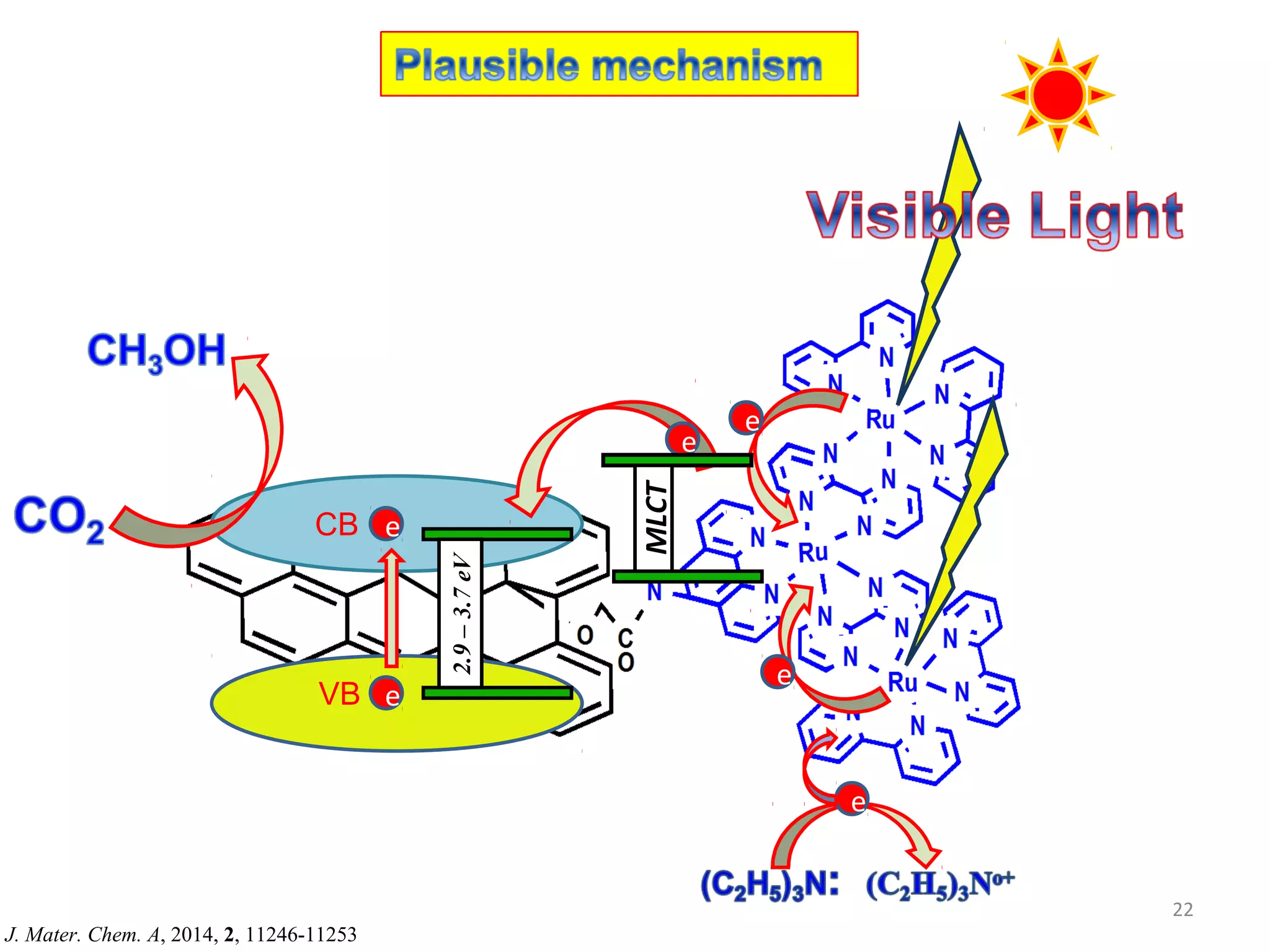
![18
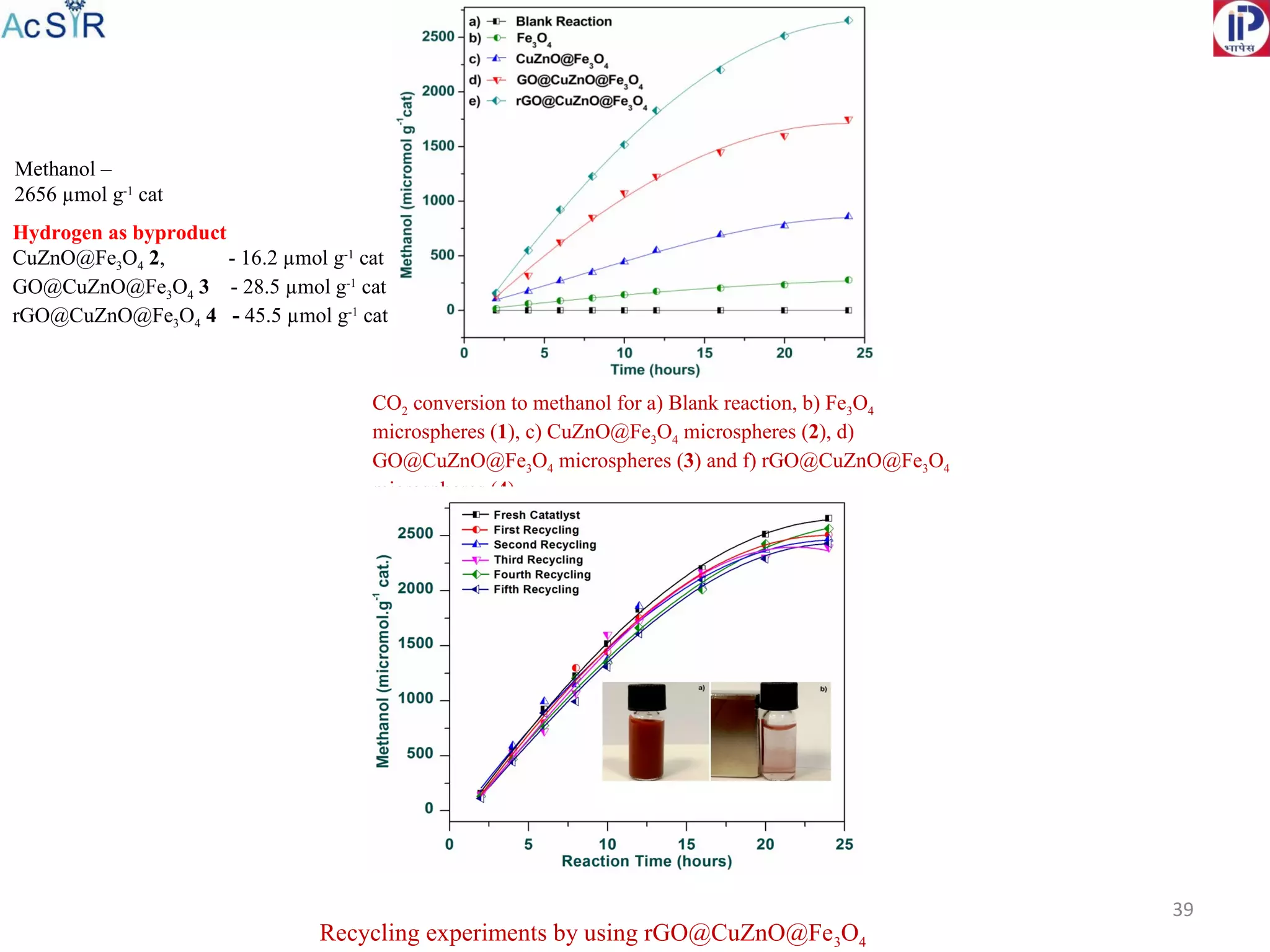
ESI-Mass spectra of ruthenium trinuclear complex 1
(Expanded form)
ESI-Mass spectra of ruthenium trinuclear complex 1
XRD Pattern
SEM images of a) GO, b) Ru-phen-GO 2 and c) EDX
pattern of 2
J. Mater. Chem. A, 2014, 2, 11246-11253
M+
-2Cl-
+2H+
[M+
- 2PF6 + F-
]
(001)
(002)](https://image.slidesharecdn.com/pawanppt-170411213830/75/Pawan-CO2-REDUCTION-PPT-18-2048.jpg)










![44
Chapter 5: Metallic clusters as efficient photocatalysts for conversion of CO2 to
methanol
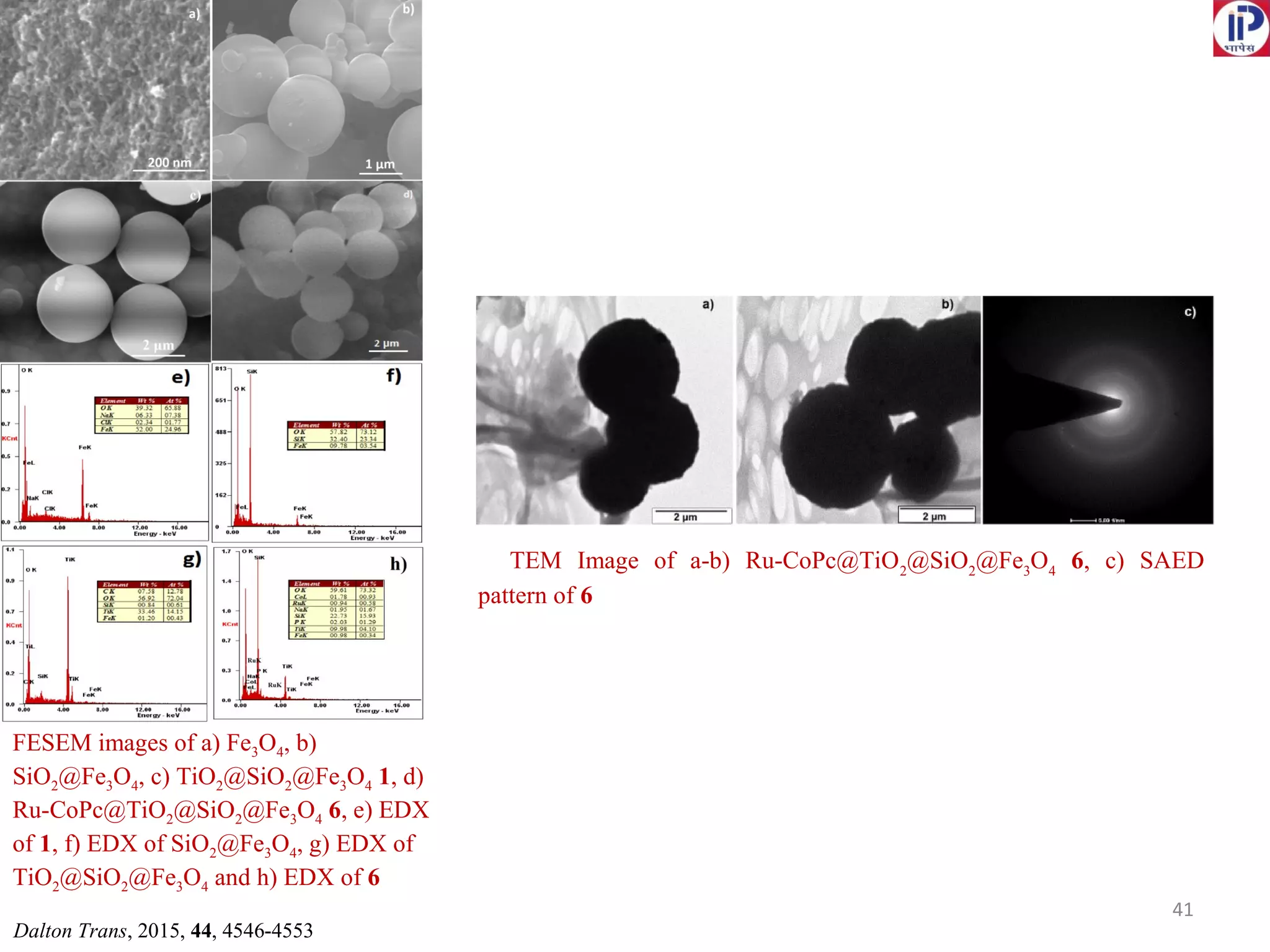
Schematic representation of octahedral
molybdnum cluster La
=Apical ligand
Li
=inner ligand.
Metal cluster is a multimettalic oxide or halides aggregates with
general formula [Mo6X14]2-
Metal clusters due to presence of multi-metallic centers can
undergo multi-electron redox process which is an essential
requirement for reduction of carbon dioxide to higher hydrocarbons.
The main drawback of metal clusters are their homogeneous
nature and non-recyclability.
They strongly absorbs in visible region near 500 nm
The halogen hydroxy or ligands situated on apical
position are labile and can be replaced with donor ligands
like pyridine derivatives, etc.](https://image.slidesharecdn.com/pawanppt-170411213830/75/Pawan-CO2-REDUCTION-PPT-44-2048.jpg)
![45
Part A: Photoreduction of CO2 to methanol with hexanuclear molybdenum
[Mo6Br14]2-
cluster units under visible light irradiation
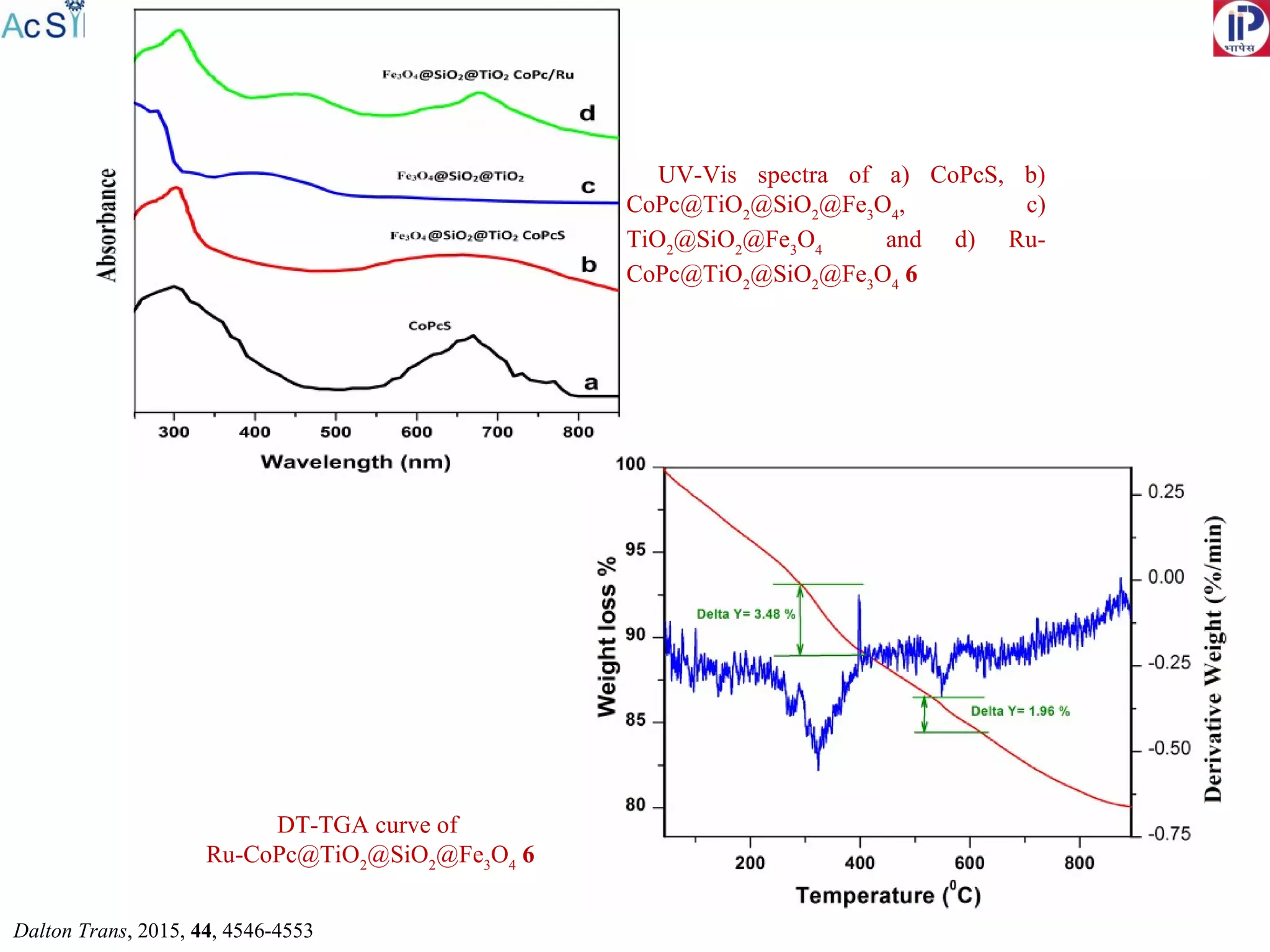
Schematic representation of the [Mo6
Bri
8
La
6
]2-
cluster unit
RSC Adv., 2014, 4, 10420-10423
CO2 photoreduction experiment
Methanol Yield by using Cs2[Mo6Br14] and
Cs Mo cluster - 6679
TBA Mo cluster - 5550](https://image.slidesharecdn.com/pawanppt-170411213830/75/Pawan-CO2-REDUCTION-PPT-45-2048.jpg)


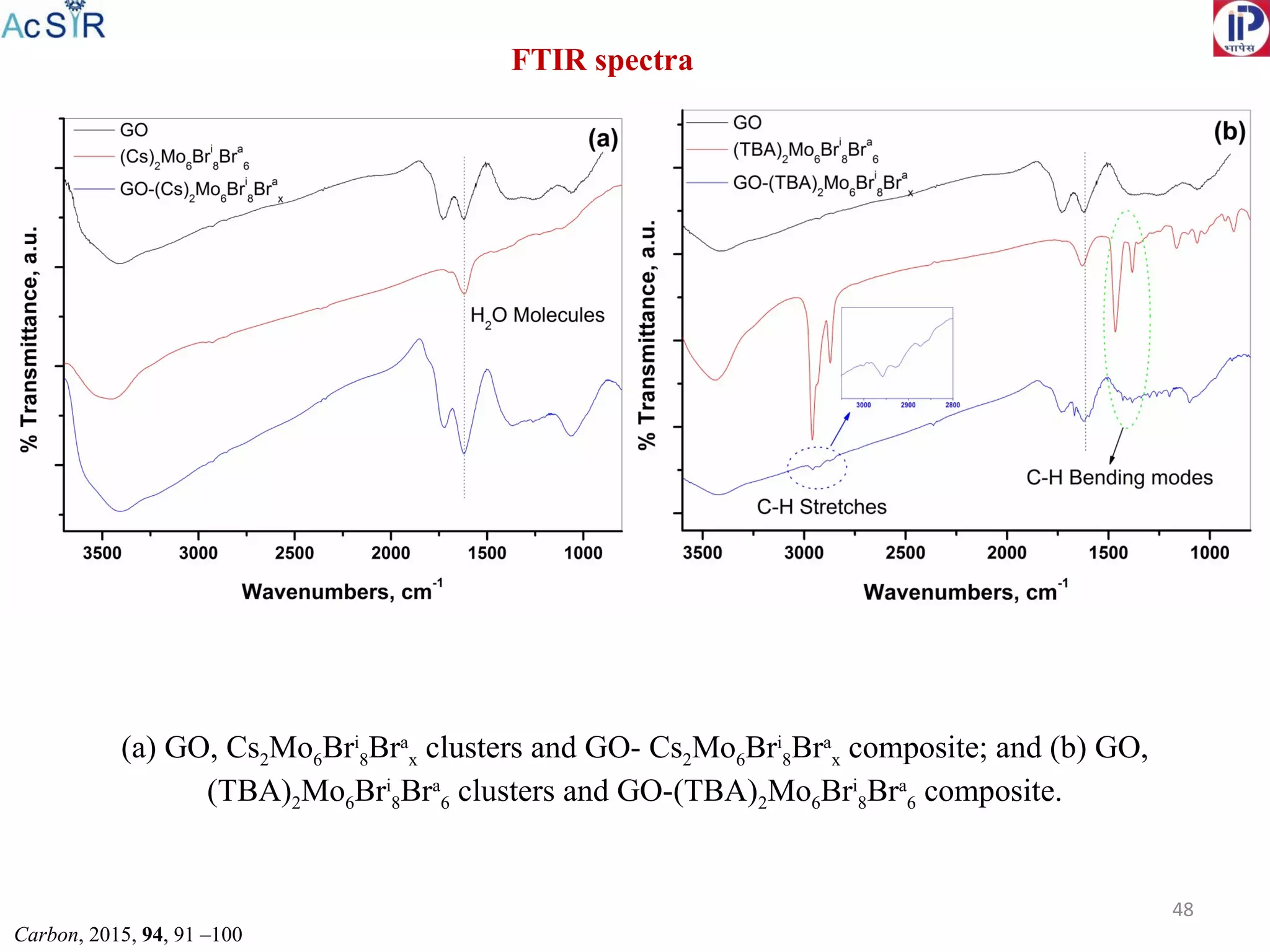


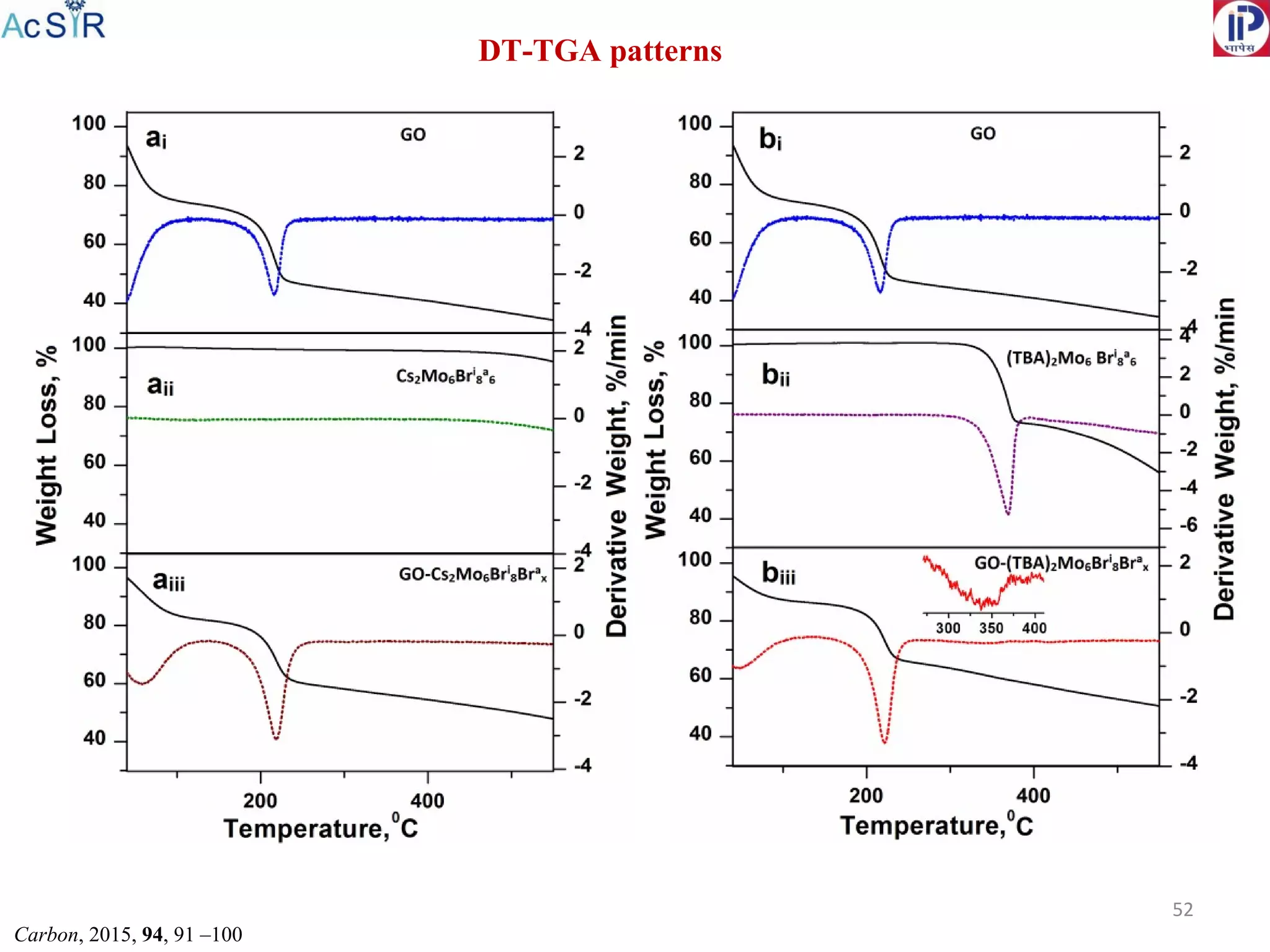
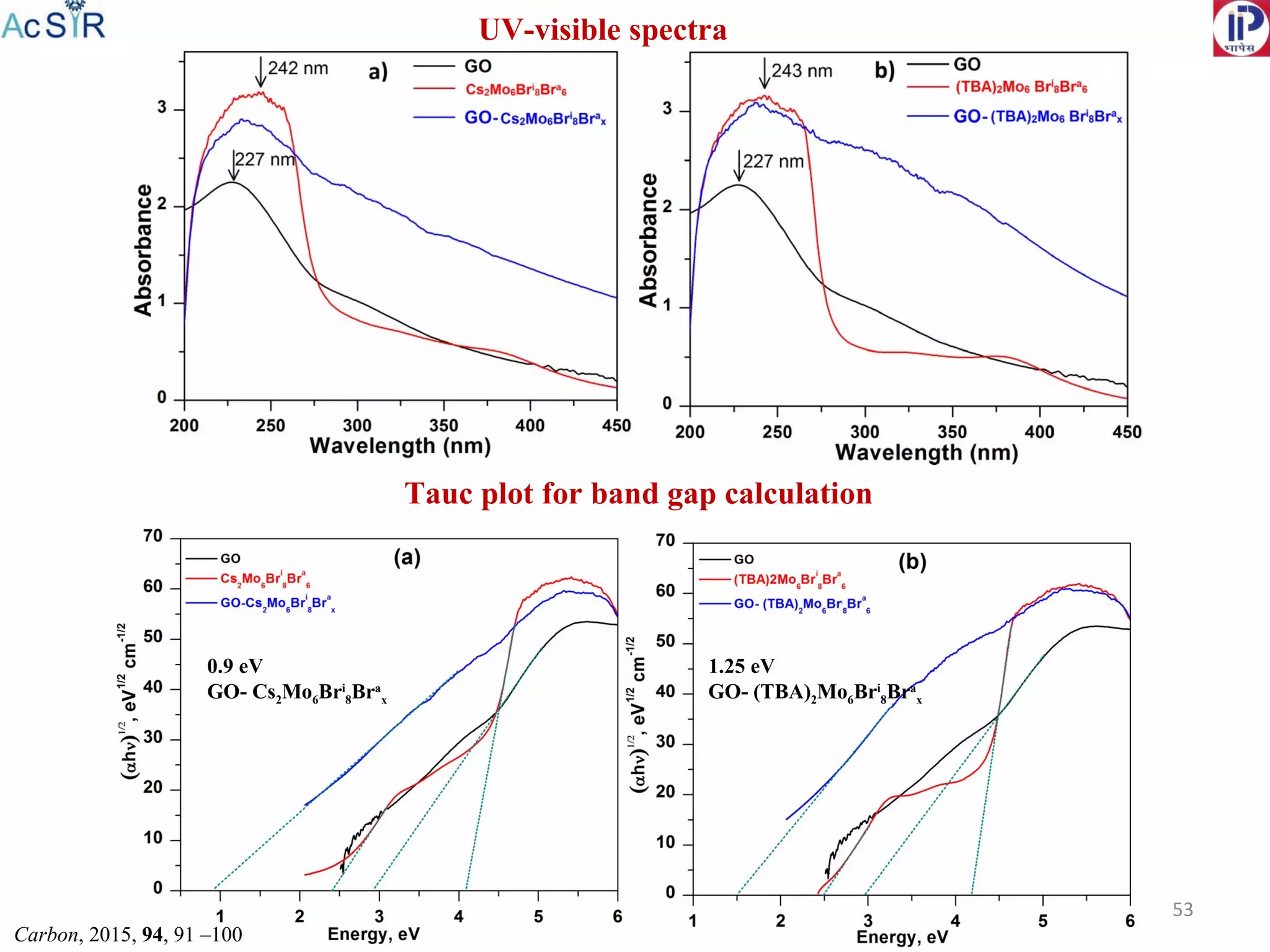
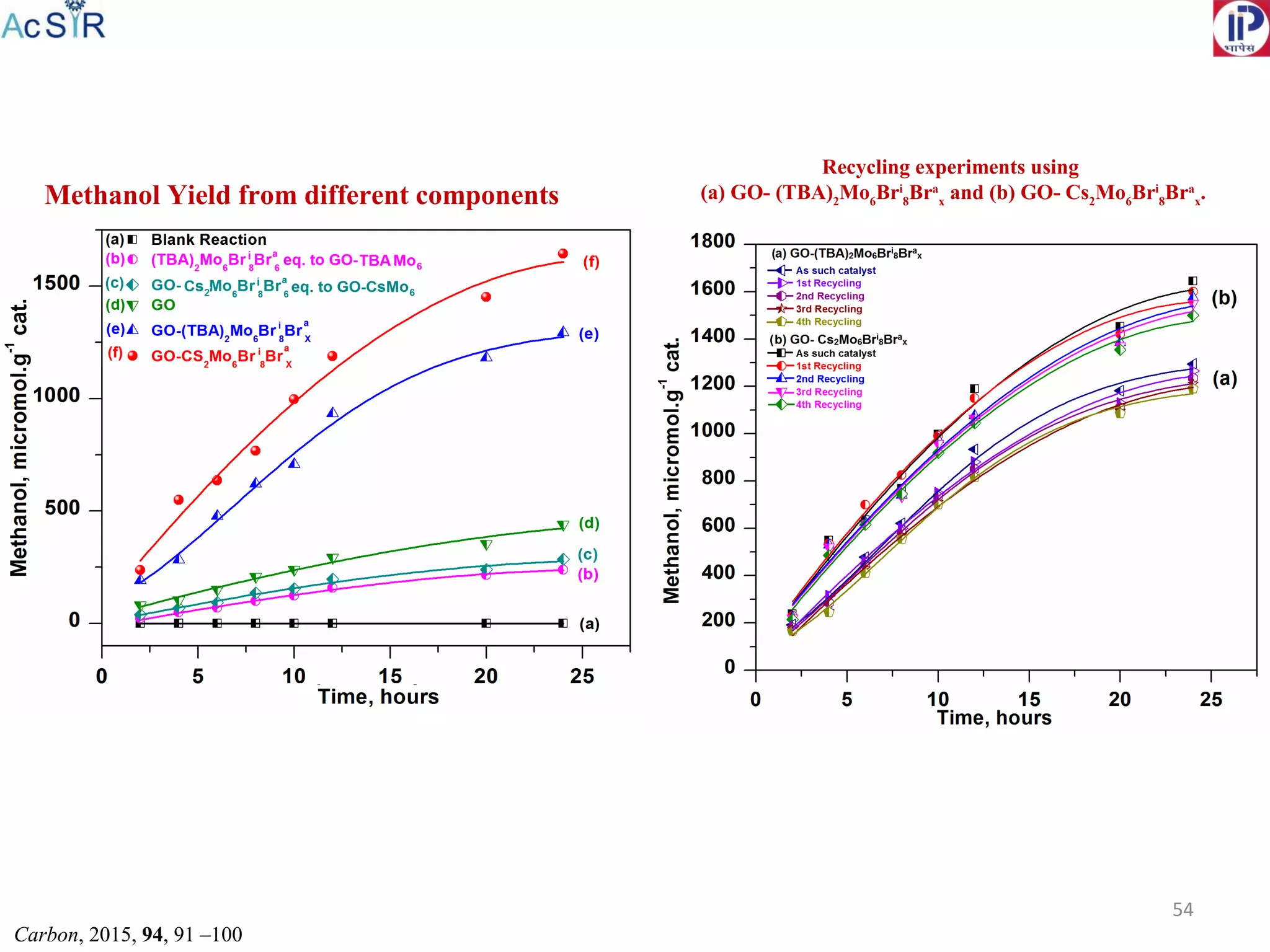

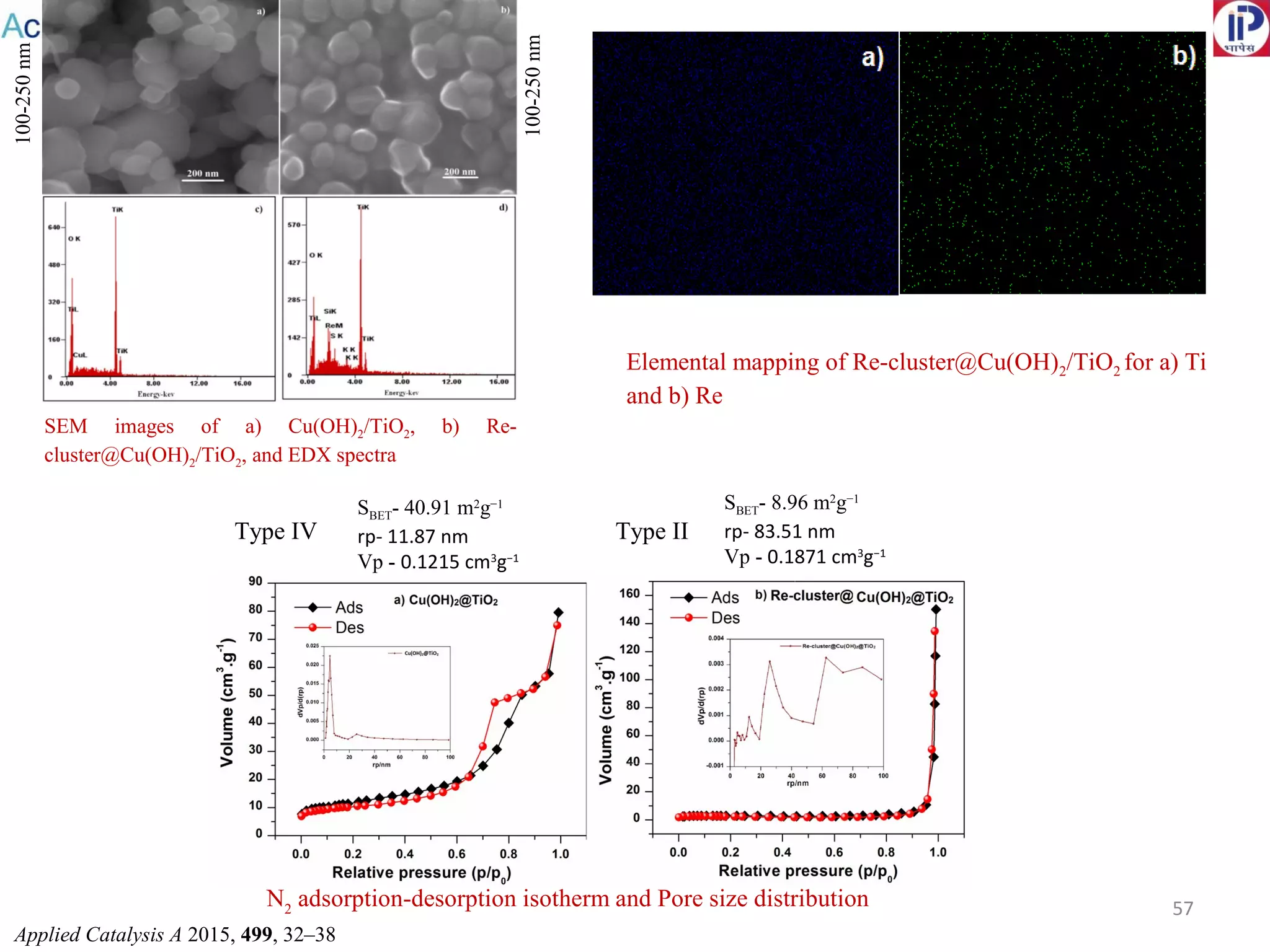
![56
Part C: Octahedral Rhenium K4[Re6S8(CN)6] and Cu(OH)2 cluster modified TiO2
for the Photoreduction of CO2 under Visible Light Irradiation
Schematic representation of the
[Re6S8(CN)6]4–
cluster unit
Applied Catalysis A 2015, 499, 32–38
Synthesis of photocatalyst
Step 1: First Cu(OH)2 modified P25 TiO2 was synthesized
P25 TiO2
4.0 g
Dispersed in 0.25 M
NaOH (250 mL)
100 ml of 0.0077 M
Cu(NO3)2drop-wise with
vigorous stirring
Cu(OH)2/TiO2
Cu(OH)2/TiO2
Step 2: Then Re clusters was attached to Cu(OH)2/TiO2
Re-cluster@Cu(OH)2/TiO2
K4[Re6S8(CN)6]
1 g
200 mg
Reflux in DMF, 24 h
Cu – 1.68 wt%
Re – 1.65 wt%
Energy Environ. Sci. 2011, 4, 1364–1371.
Covalent immobilization via Re-CN-M bridges](https://image.slidesharecdn.com/pawanppt-170411213830/75/Pawan-CO2-REDUCTION-PPT-56-2048.jpg)
![58
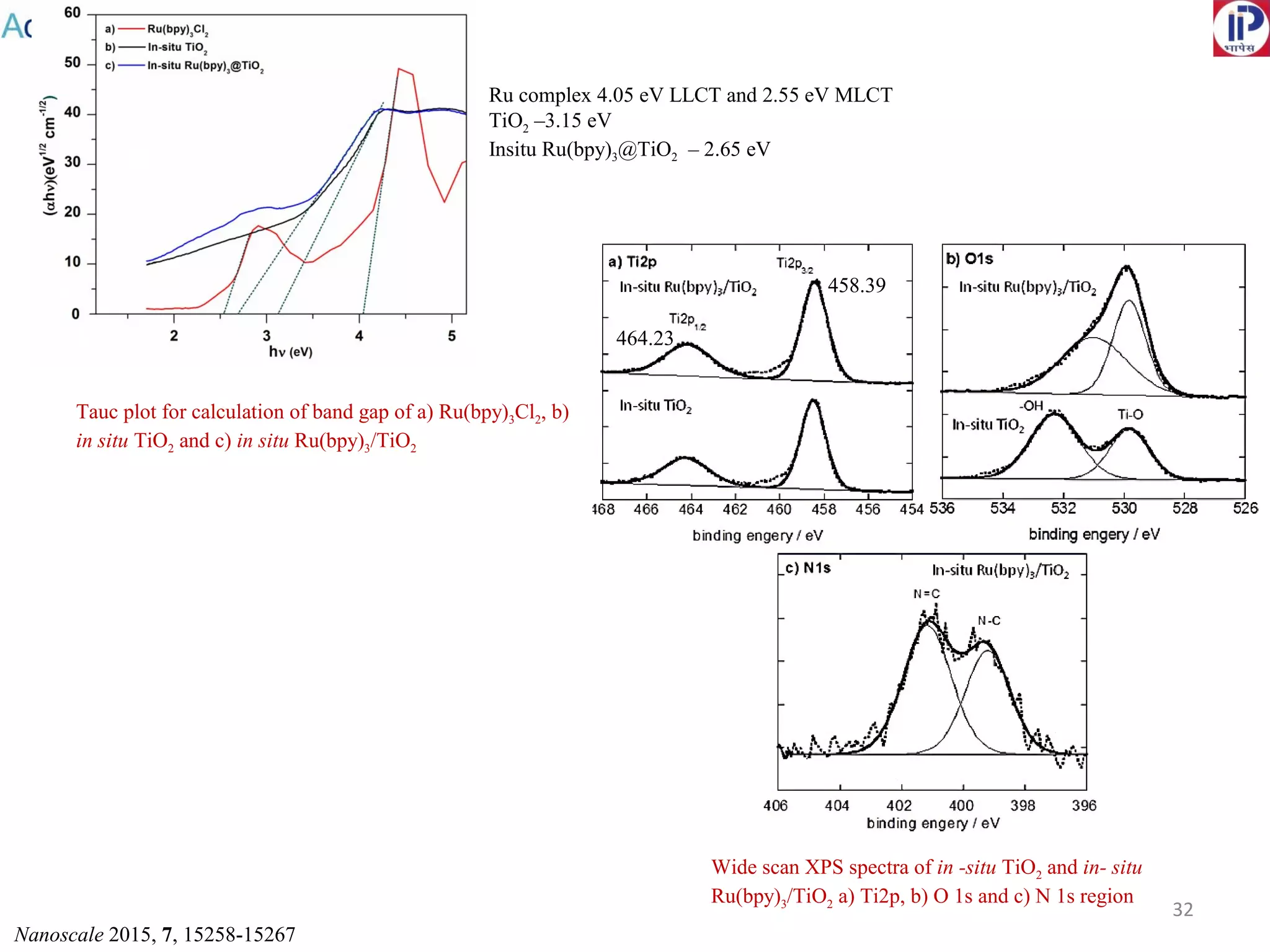
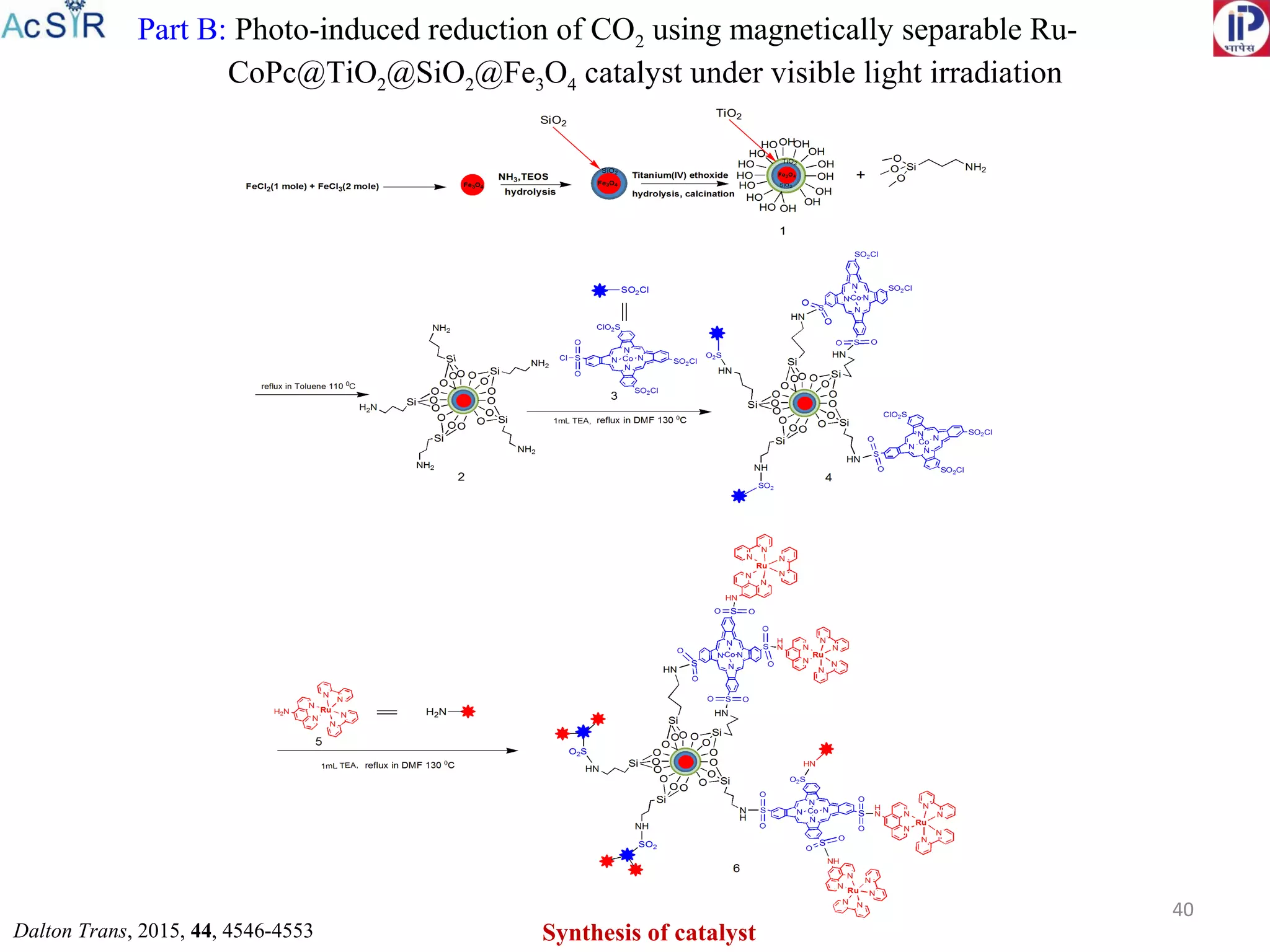
Tauc plots for optical band gap determination of a) K4[Re6S8(CN)6], b) Cu(OH)2/TiO2 and
c) Re-cluster@ Cu(OH)2/TiO2
Applied Catalysis A 2015, 499, 32–38
TGA of a) K4
[Re6
S8
(CN)6
], b) Cu(OH)2
/TiO2
and c) Re-
cluster/Cu(OH)2
/TiO2
UV/Vis absorption spectra of a) K4[Re6S8(CN)6], b) Re-
cluster@Cu(OH)2/TiO2 and c) Cu(OH)2/TiO2 and d) TiO2
2.50 eV
2.69 eV,
3.11 eV 2.43 eV](https://image.slidesharecdn.com/pawanppt-170411213830/75/Pawan-CO2-REDUCTION-PPT-58-2048.jpg)




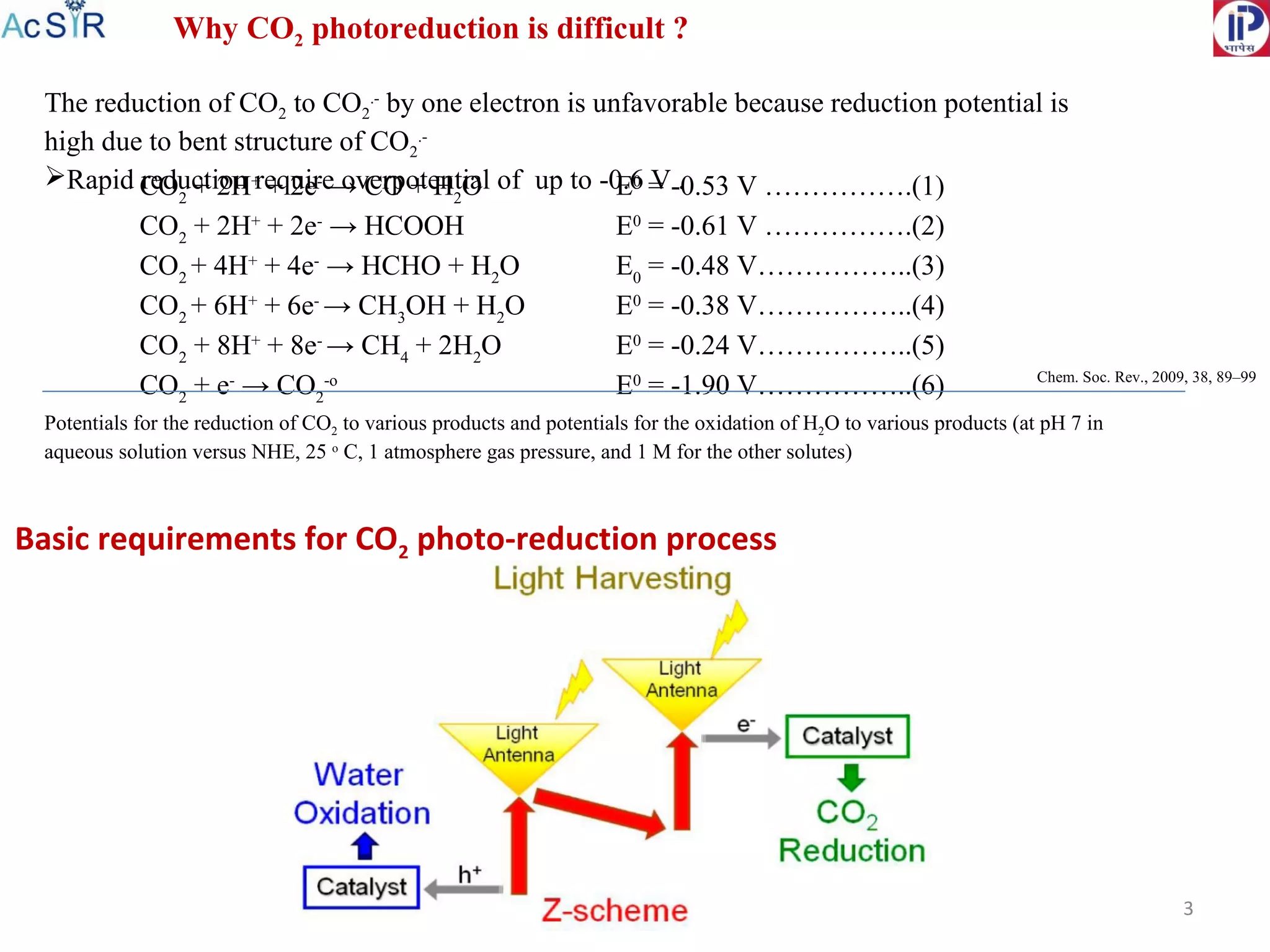
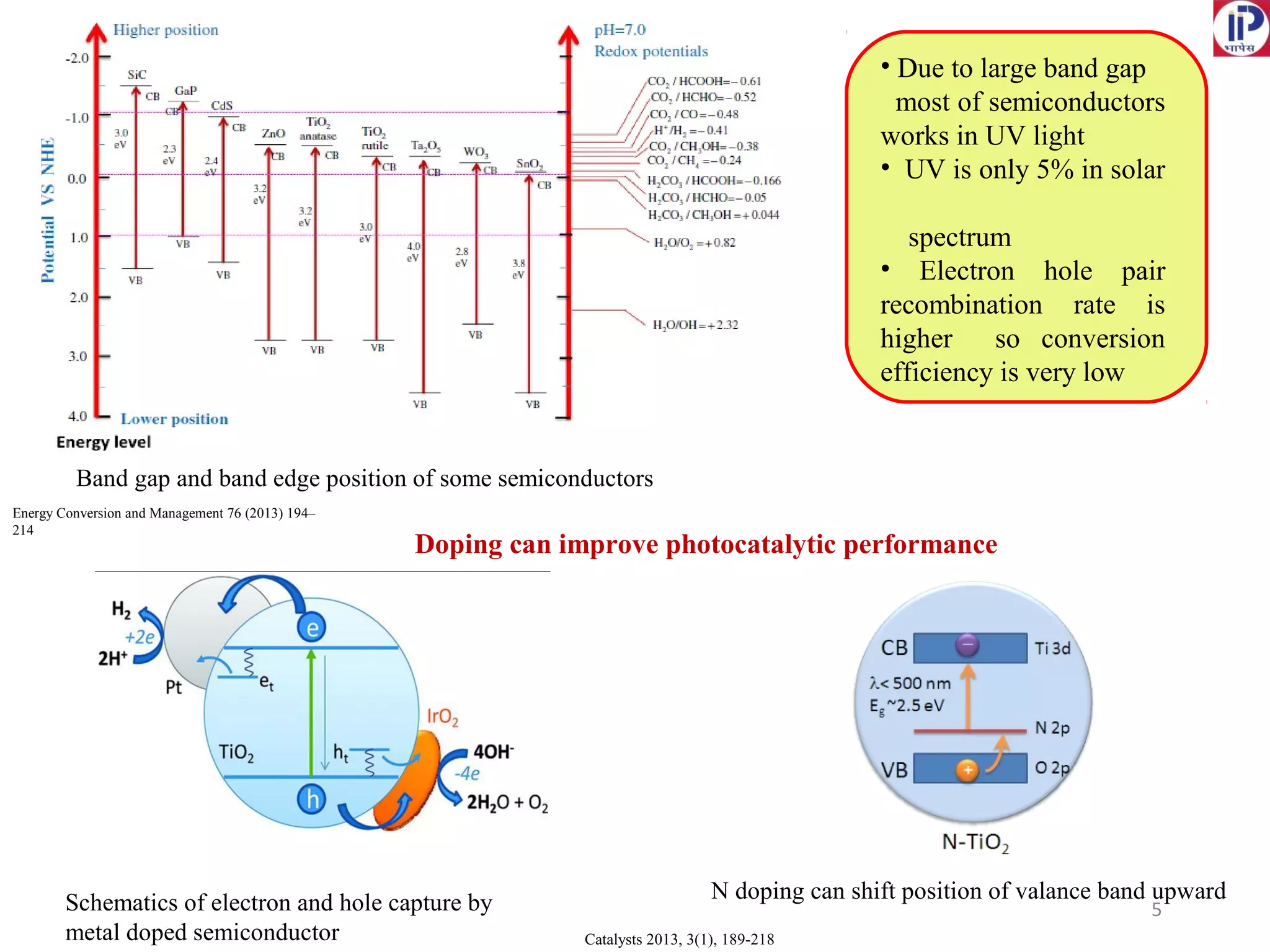
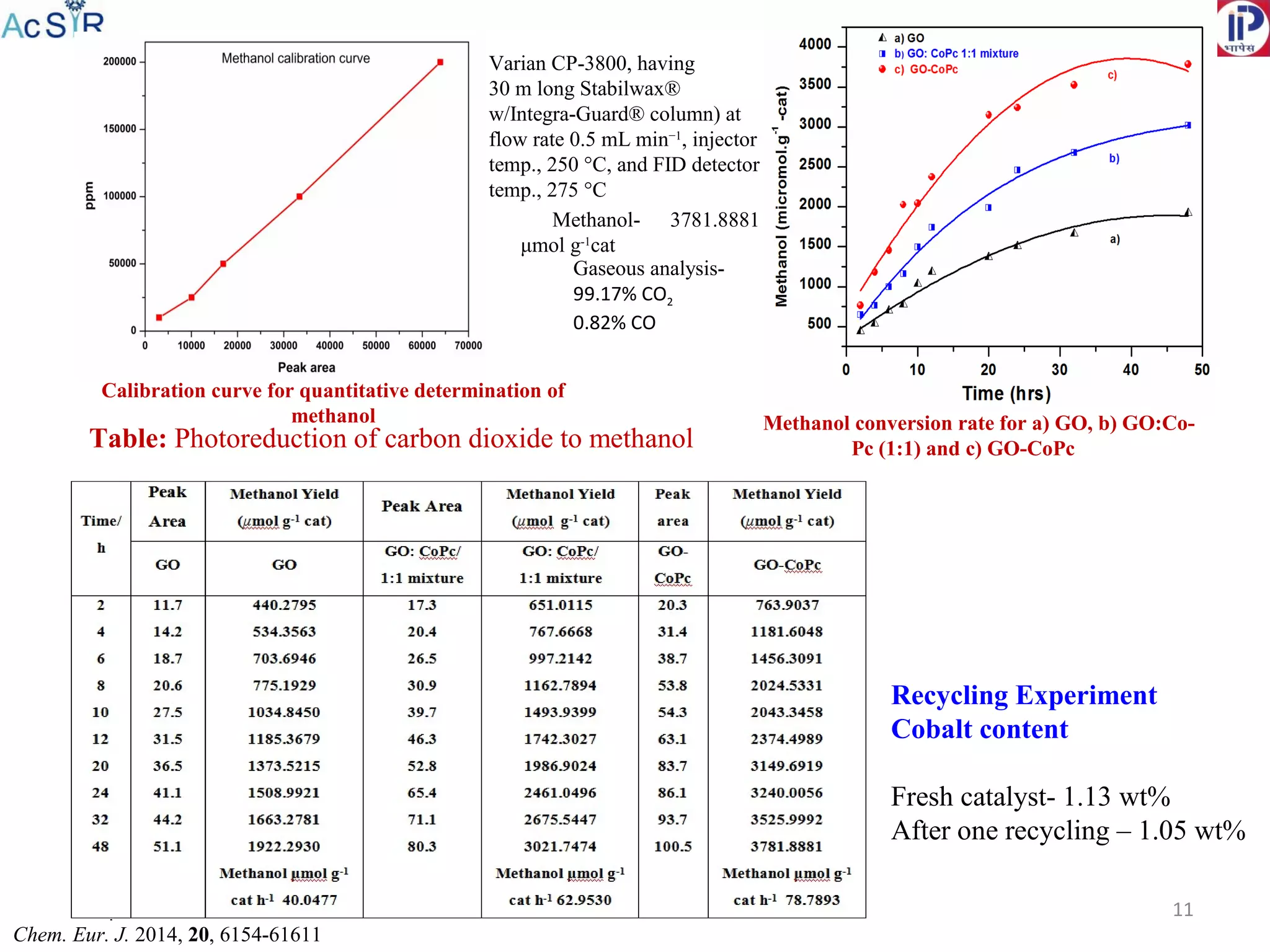
The document discusses photocatalytic conversion of carbon dioxide into fuels and chemicals. It describes how semiconductor-based photocatalysts like TiO2 can be used to drive the reduction of CO2 into products like methanol using solar energy. Challenges include the large band gap of most semiconductors, which limits them to using only UV light. The document explores using metal complexes immobilized on photoactive supports as an alternative, as they have visible light activity and can be tuned to favor specific products. Specific examples discussed include cobalt phthalocyanine and tin phthalocyanine immobilized on graphene oxide and mesoporous ceria, respectively, as well as heteroleptic ruthenium complexes immobilized on graphene oxide


![Octahedral rhenium K4[Re6S8(CN)6] and Cu(OH)2cluster modifiedTiO2for the phot...](https://cdn.slidesharecdn.com/ss_thumbnails/appliedcatalysisageneral49920153238-171005000403-thumbnail.jpg?width=640&height=640&fit=bounds)
![Octahedral rhenium k4[re6 s8(cn)6] and](https://cdn.slidesharecdn.com/ss_thumbnails/octahedralrheniumk4re6s8cn6and-200110040250-thumbnail.jpg?width=640&height=640&fit=bounds)


