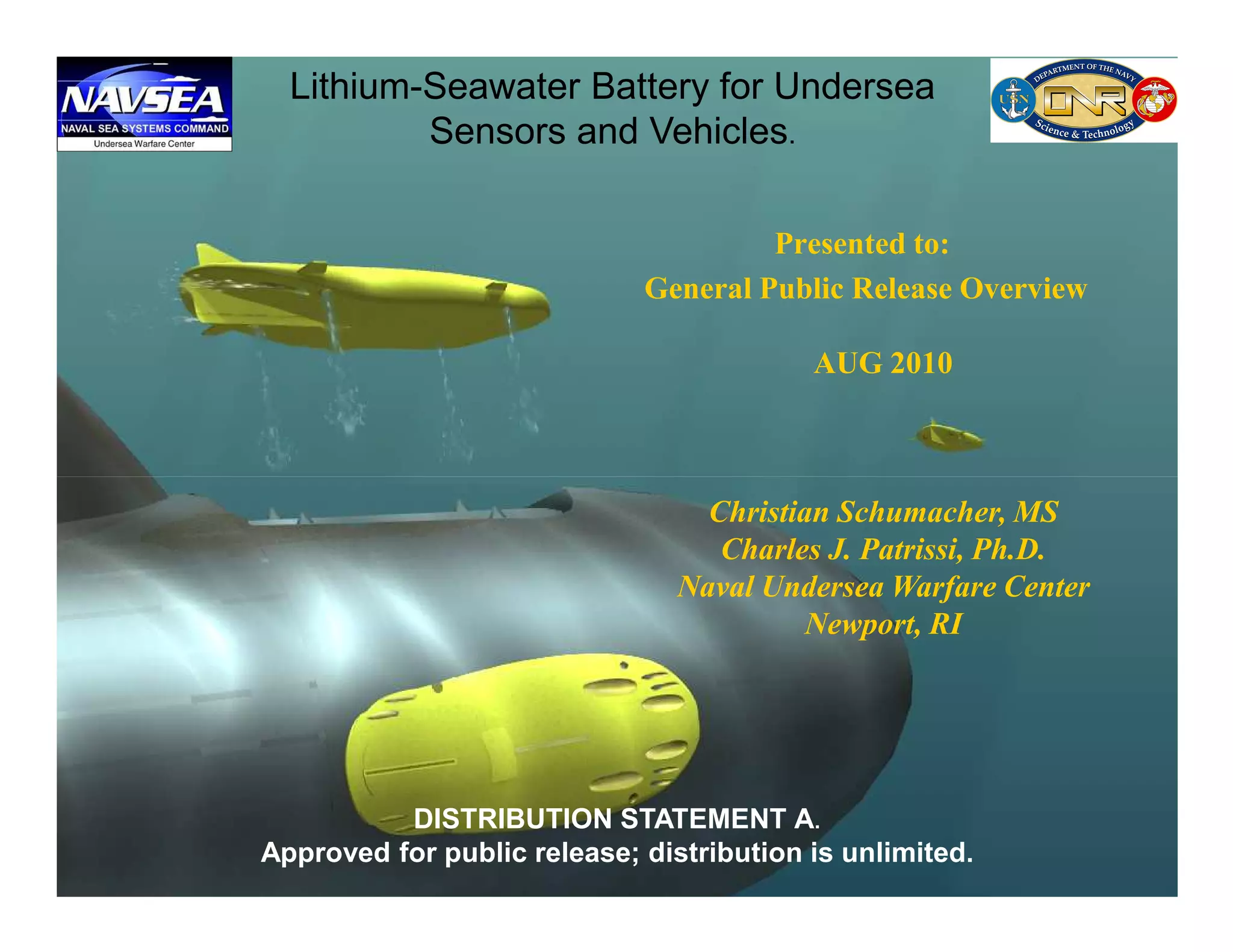
Lithium-Seawater Battery for Undersea
Sensors and Vehicles.
Presented to:
General Public Release Overview
AUG 2010
1
Christian Schumacher, MS
Charles J. Patrissi, Ph.D.
Naval Undersea Warfare Center
Newport, RI
DISTRIBUTION STATEMENT A.
Approved for public release; distribution is unlimited.
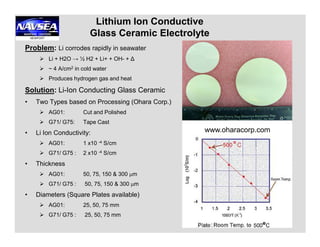
Lithium Ion Conductive
Glass Ceramic Electrolyte
Problem: Li corrodes rapidly in seawater
Li + H2O → ½ H2 + Li+ + OH- + ∆
~ 4 A/cm2 in cold water
Produces hydrogen gas and heat
Solution: Li-Ion Conducting Glass Ceramic
• Two Types based on Processing (Ohara Corp.)
AG01: Cut and Polished
G71/ G75: Tape Cast
2
www.oharacorp.com
G71/ G75: Tape Cast
• Li Ion Conductivity:
AG01: 1 x10 -4 S/cm
G71/ G75 : 2 x10 -4 S/cm
• Thickness
AG01: 50, 75, 150 & 300 µm
G71/ G75 : 50, 75, 150 & 300 µm
• Diameters (Square Plates available)
AG01: 25, 50, 75 mm
G71/ G75 : 25, 50, 75 mm
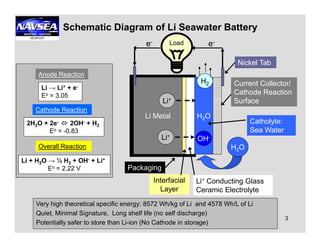
Schematic Diagram of Li Seawater Battery
2H2O + 2e- 2OH- + H2
Cathode Reaction
Li → Li+ + e-
Eo = 3.05
Anode Reaction
H2OLi Metal
e-e- Load
Li+
H2 Current Collector/
Cathode Reaction
Surface
Catholyte:
Nickel Tab
3
2H2O + 2e- 2OH- + H2
Eo = -0.83
Li + H2O → ½ H2 + OH- + Li+
Eo = 2.22 V
Overall Reaction
Li+
OH-
H2O
Li+ Conducting Glass
Ceramic Electrolyte
Packaging
Interfacial
Layer
Catholyte:
Sea Water
Very high theoretical specific energy: 8572 Wh/kg of Li and 4578 Wh/L of Li
Quiet, Minimal Signature, Long shelf life (no self discharge)
Potentially safer to store than Li-ion (No Cathode in storage)
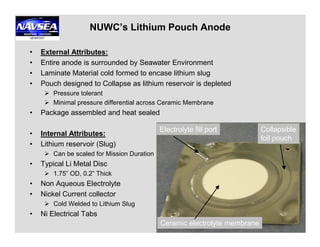
NUWC’s Lithium Pouch Anode
• External Attributes:
• Entire anode is surrounded by Seawater Environment
• Laminate Material cold formed to encase lithium slug
• Pouch designed to Collapse as lithium reservoir is depleted
Pressure tolerant
Minimal pressure differential across Ceramic Membrane
• Package assembled and heat sealed
4
• Internal Attributes:
• Lithium reservoir (Slug)
Can be scaled for Mission Duration
• Typical Li Metal Disc
1.75” OD, 0.2” Thick
• Non Aqueous Electrolyte
• Nickel Current collector
Cold Welded to Lithium Slug
• Ni Electrical Tabs
Electrolyte fill port
Ceramic electrolyte membrane
Collapsible
foil pouch
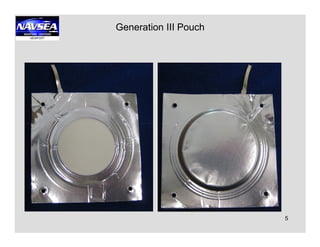
Generation III Pouch
5
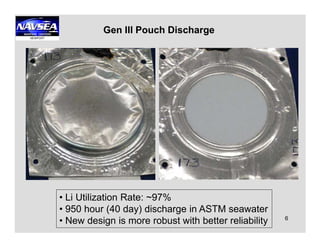
Gen III Pouch Discharge
6
• Li Utilization Rate: ~97%
• 950 hour (40 day) discharge in ASTM seawater
• New design is more robust with better reliability

Lithium sea water battery overview

  • 1.
    Lithium-Seawater Battery forUndersea Sensors and Vehicles. Presented to: General Public Release Overview AUG 2010 1 Christian Schumacher, MS Charles J. Patrissi, Ph.D. Naval Undersea Warfare Center Newport, RI DISTRIBUTION STATEMENT A. Approved for public release; distribution is unlimited.
  • 2.
    Lithium Ion Conductive GlassCeramic Electrolyte Problem: Li corrodes rapidly in seawater Li + H2O → ½ H2 + Li+ + OH- + ∆ ~ 4 A/cm2 in cold water Produces hydrogen gas and heat Solution: Li-Ion Conducting Glass Ceramic • Two Types based on Processing (Ohara Corp.) AG01: Cut and Polished G71/ G75: Tape Cast 2 www.oharacorp.com G71/ G75: Tape Cast • Li Ion Conductivity: AG01: 1 x10 -4 S/cm G71/ G75 : 2 x10 -4 S/cm • Thickness AG01: 50, 75, 150 & 300 µm G71/ G75 : 50, 75, 150 & 300 µm • Diameters (Square Plates available) AG01: 25, 50, 75 mm G71/ G75 : 25, 50, 75 mm
  • 3.
    Schematic Diagram ofLi Seawater Battery 2H2O + 2e- 2OH- + H2 Cathode Reaction Li → Li+ + e- Eo = 3.05 Anode Reaction H2OLi Metal e-e- Load Li+ H2 Current Collector/ Cathode Reaction Surface Catholyte: Nickel Tab 3 2H2O + 2e- 2OH- + H2 Eo = -0.83 Li + H2O → ½ H2 + OH- + Li+ Eo = 2.22 V Overall Reaction Li+ OH- H2O Li+ Conducting Glass Ceramic Electrolyte Packaging Interfacial Layer Catholyte: Sea Water Very high theoretical specific energy: 8572 Wh/kg of Li and 4578 Wh/L of Li Quiet, Minimal Signature, Long shelf life (no self discharge) Potentially safer to store than Li-ion (No Cathode in storage)
  • 4.
    NUWC’s Lithium PouchAnode • External Attributes: • Entire anode is surrounded by Seawater Environment • Laminate Material cold formed to encase lithium slug • Pouch designed to Collapse as lithium reservoir is depleted Pressure tolerant Minimal pressure differential across Ceramic Membrane • Package assembled and heat sealed 4 • Internal Attributes: • Lithium reservoir (Slug) Can be scaled for Mission Duration • Typical Li Metal Disc 1.75” OD, 0.2” Thick • Non Aqueous Electrolyte • Nickel Current collector Cold Welded to Lithium Slug • Ni Electrical Tabs Electrolyte fill port Ceramic electrolyte membrane Collapsible foil pouch
  • 5.
  • 6.
    Gen III PouchDischarge 6 • Li Utilization Rate: ~97% • 950 hour (40 day) discharge in ASTM seawater • New design is more robust with better reliability