Theseus and the “Test-and-Quest” 
Myth 
❖ We will focus on the exploits of one particular hero, 
Theseus. We will look at his birth, childhood, and 
maturation story, which is a typical example of the 
“test-and-quest” pattern. 
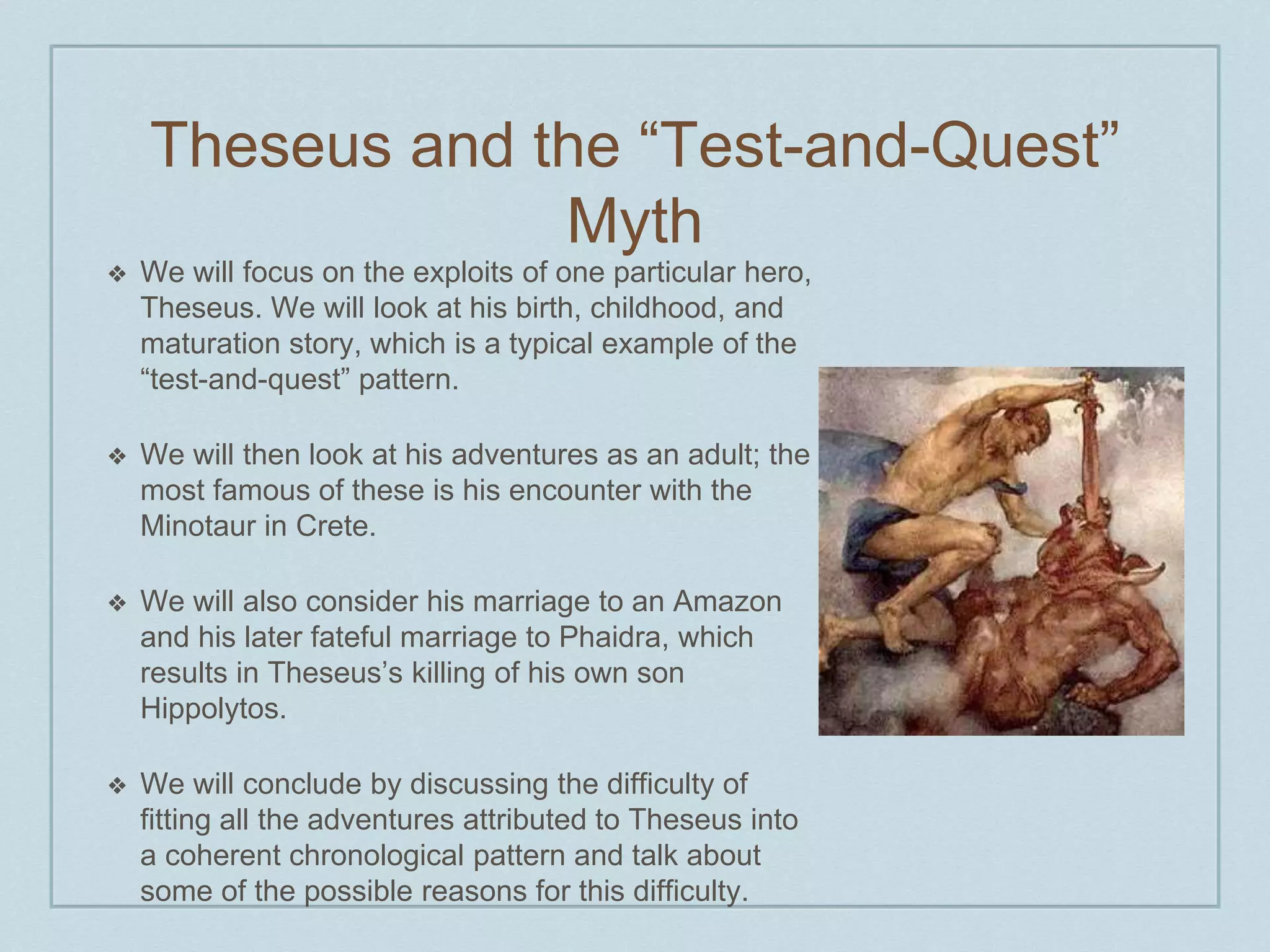
❖ We will then look at his adventures as an adult; the 
most famous of these is his encounter with the 
Minotaur in Crete. 
❖ We will also consider his marriage to an Amazon 
and his later fateful marriage to Phaidra, which 
results in Theseus’s killing of his own son 
Hippolytos. 
❖ We will conclude by discussing the difficulty of 
fitting all the adventures attributed to Theseus into 
a coherent chronological pattern and talk about 
some of the possible reasons for this difficulty.
The stories of several heroes fit what has been called the “quest” 
pattern. Among these, Theseus’s story is particularly rich for 
investigating mythic themes and presenting possibilities for 
interpretation. 
❖ Theseus is less well known to 
modern readers than Heracles or 
Jason is, but as the legendary 
synoikistes (“unifier”) of Attica, he 
was an important figure in 
Athenian myth. In Theseus’s case, 
myth became a charter for 
Athenian hegemonic control over 
Attica. 
❖ Perhaps because of his important 
role in Athens, various stories 
accrued around Theseus, and it is 
difficult to work out a consistent 
chronology for his adventures. 
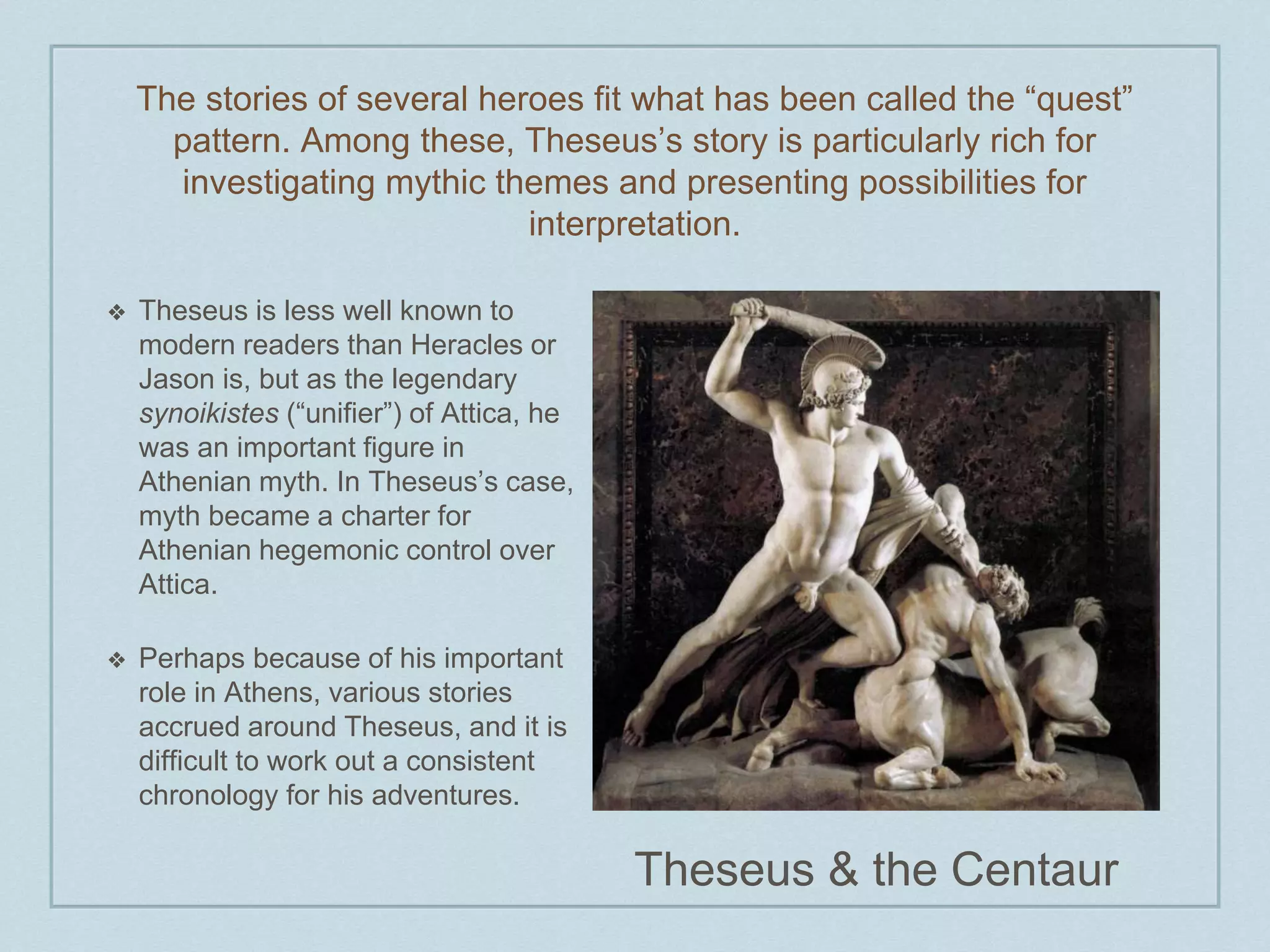
Theseus & the Centaur
Theseus’s birth story 
❖ His birth, childhood, and young 
adulthood show typical “hero” elements, 
reminiscent of folktale. 
❖ Oddities and ambiguities surround his 
conception, not the least of which is an 
apparent double-fatherhood. 
❖ His human father was Aigeus, king of 
Athens. 
❖ His mother, Aithra, was raped by 
Poseidon on the same night that she 
slept with Aigeus; this, Theseus’s 
parentage was uncertain. This explains 
how he was a top-notch hero who, at 
the same time, inherited his father’s 
throne.
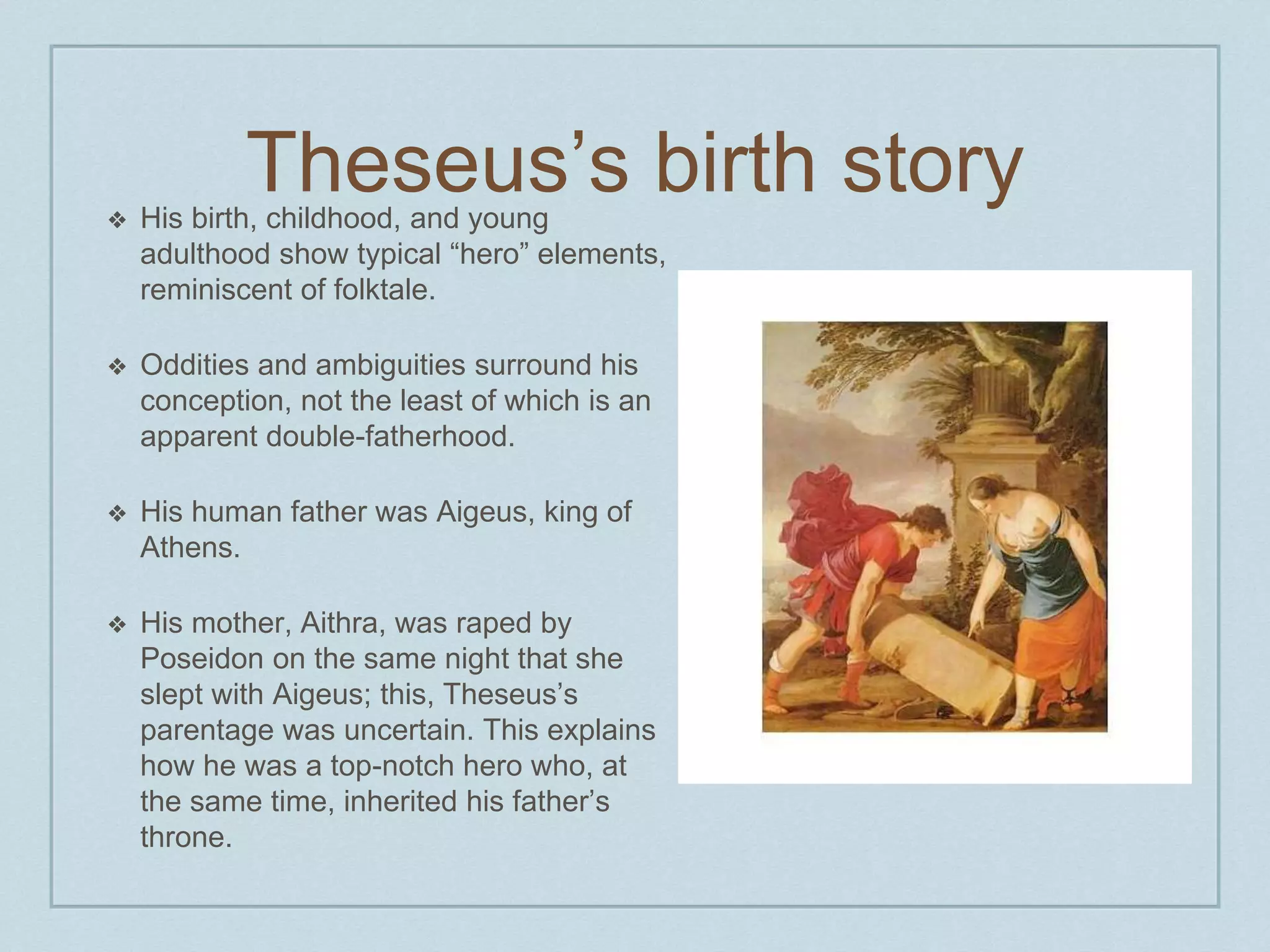
❖ Aigeus left sandals and a sword under a boulder, with instructions that his son 
should come to him in Athens when he was strong enough to lift the boulder 
and retrieve the tokens. Theseus does so and sets off for Athens. 
❖ Theseus’s journey to athens to claim his patrimony involves a series of 
encounters with monsters. 
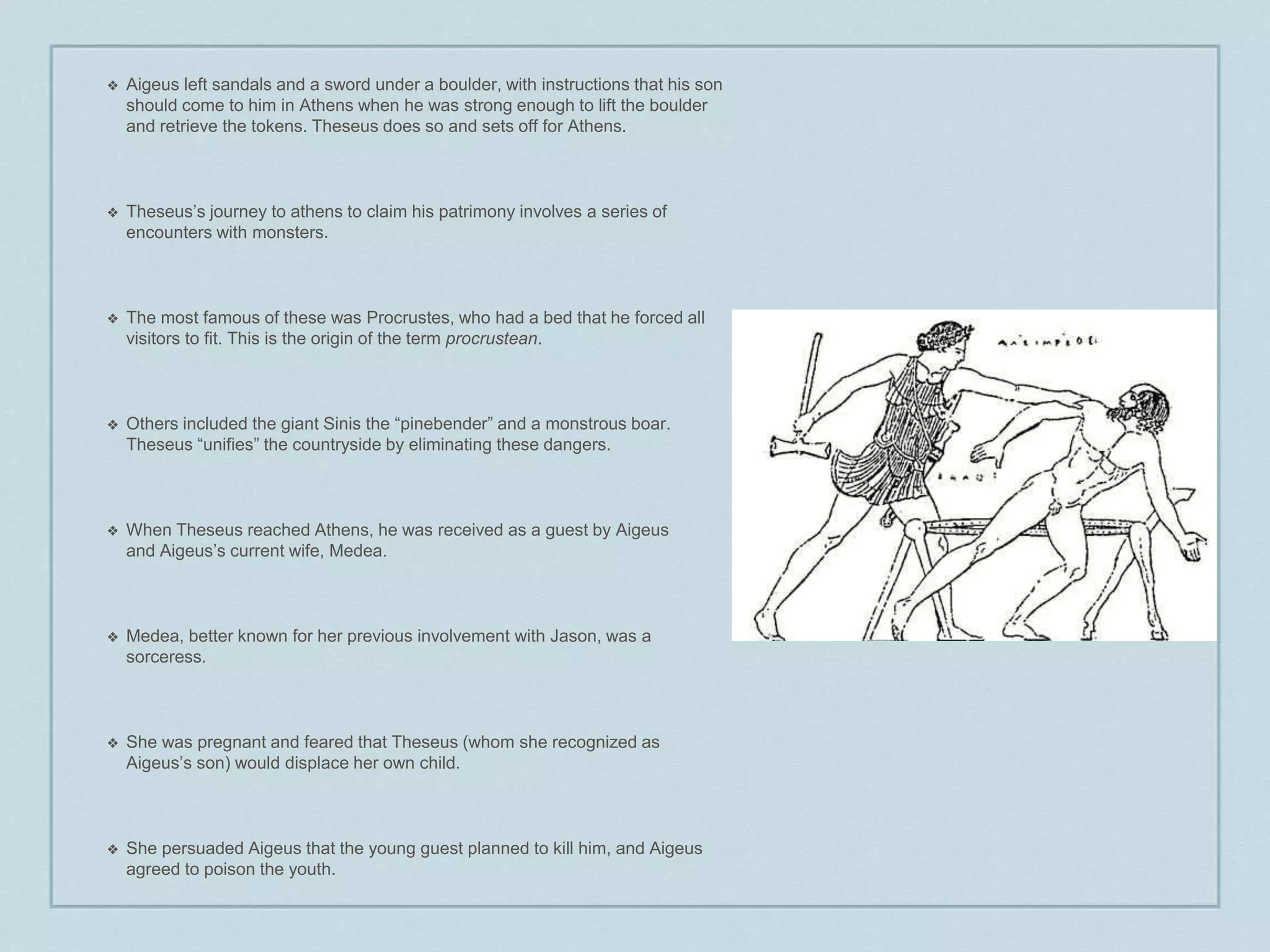
❖ The most famous of these was Procrustes, who had a bed that he forced all 
visitors to fit. This is the origin of the term procrustean. 
❖ Others included the giant Sinis the “pinebender” and a monstrous boar. 
Theseus “unifies” the countryside by eliminating these dangers. 
❖ When Theseus reached Athens, he was received as a guest by Aigeus 
and Aigeus’s current wife, Medea. 
❖ Medea, better known for her previous involvement with Jason, was a 
sorceress. 
❖ She was pregnant and feared that Theseus (whom she recognized as 
Aigeus’s son) would displace her own child. 
❖ She persuaded Aigeus that the young guest planned to kill him, and Aigeus 
agreed to poison the youth.
❖ At the dinner table, Theseus drew his sword to cut his meat. Aigeus 
recognized the sword and stopped Theseus from drinking his poisoned 
wine, just in time. 
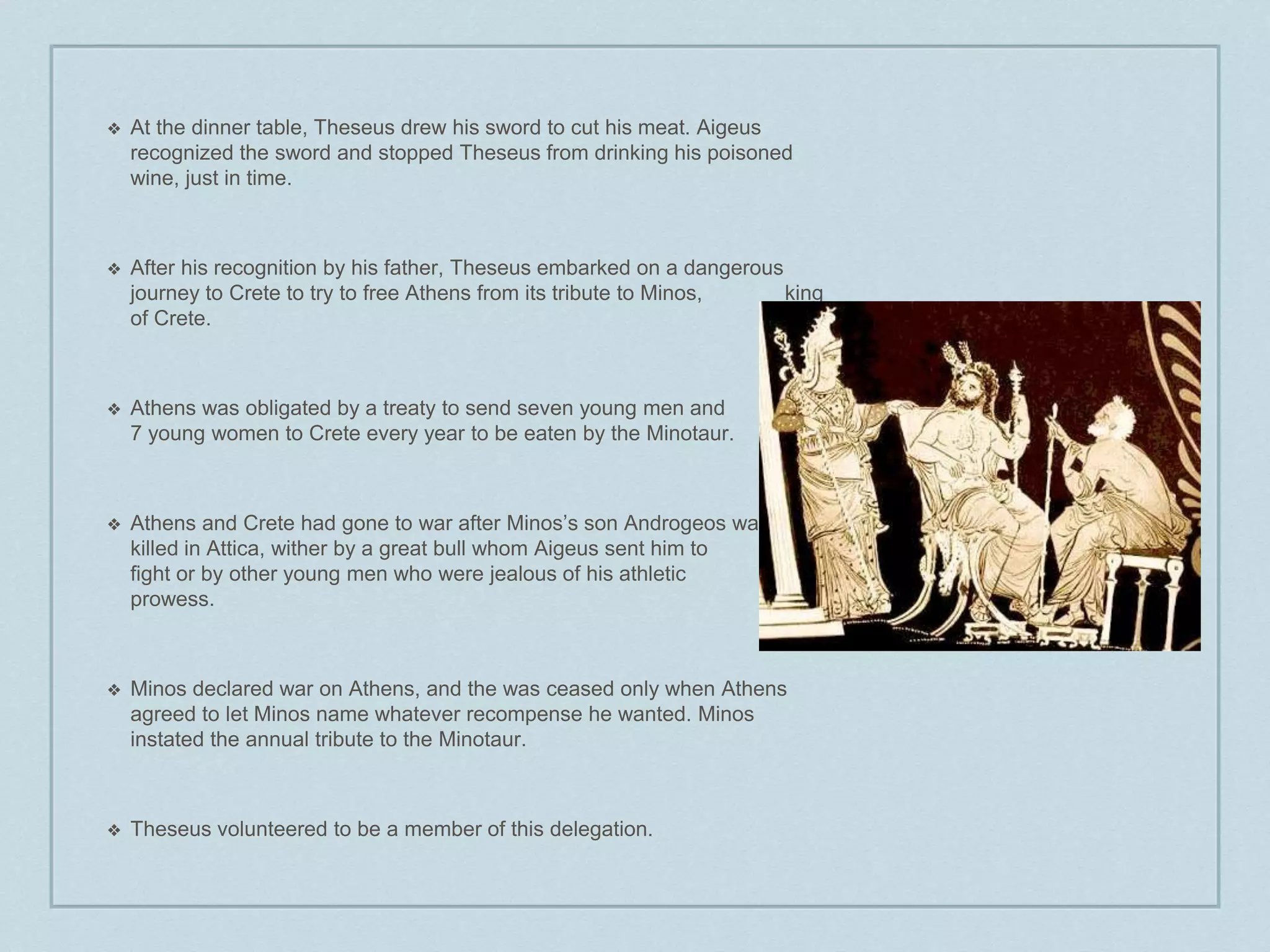
❖ After his recognition by his father, Theseus embarked on a dangerous 
journey to Crete to try to free Athens from its tribute to Minos, king 
of Crete. 
❖ Athens was obligated by a treaty to send seven young men and 
7 young women to Crete every year to be eaten by the Minotaur. 
❖ Athens and Crete had gone to war after Minos’s son Androgeos was 
killed in Attica, wither by a great bull whom Aigeus sent him to 
fight or by other young men who were jealous of his athletic 
prowess. 
❖ Minos declared war on Athens, and the was ceased only when Athens 
agreed to let Minos name whatever recompense he wanted. Minos 
instated the annual tribute to the Minotaur. 
❖ Theseus volunteered to be a member of this delegation.
❖ Theseus’s adventures in Crete 
are the most famous part of his 
story. 
❖ He wa helped by Ariadne, the 
daughter of Minos. As in other 
“test-and-quest” stories, the 
young man is helped by a young 
woman. 
❖ Ariadne gave Theseus a ball of 
thread so that he could find his 
way out of the Minotaur’s 
labyrinth. 
❖ In return, he agreed to take her 
with him when he left Crete. 
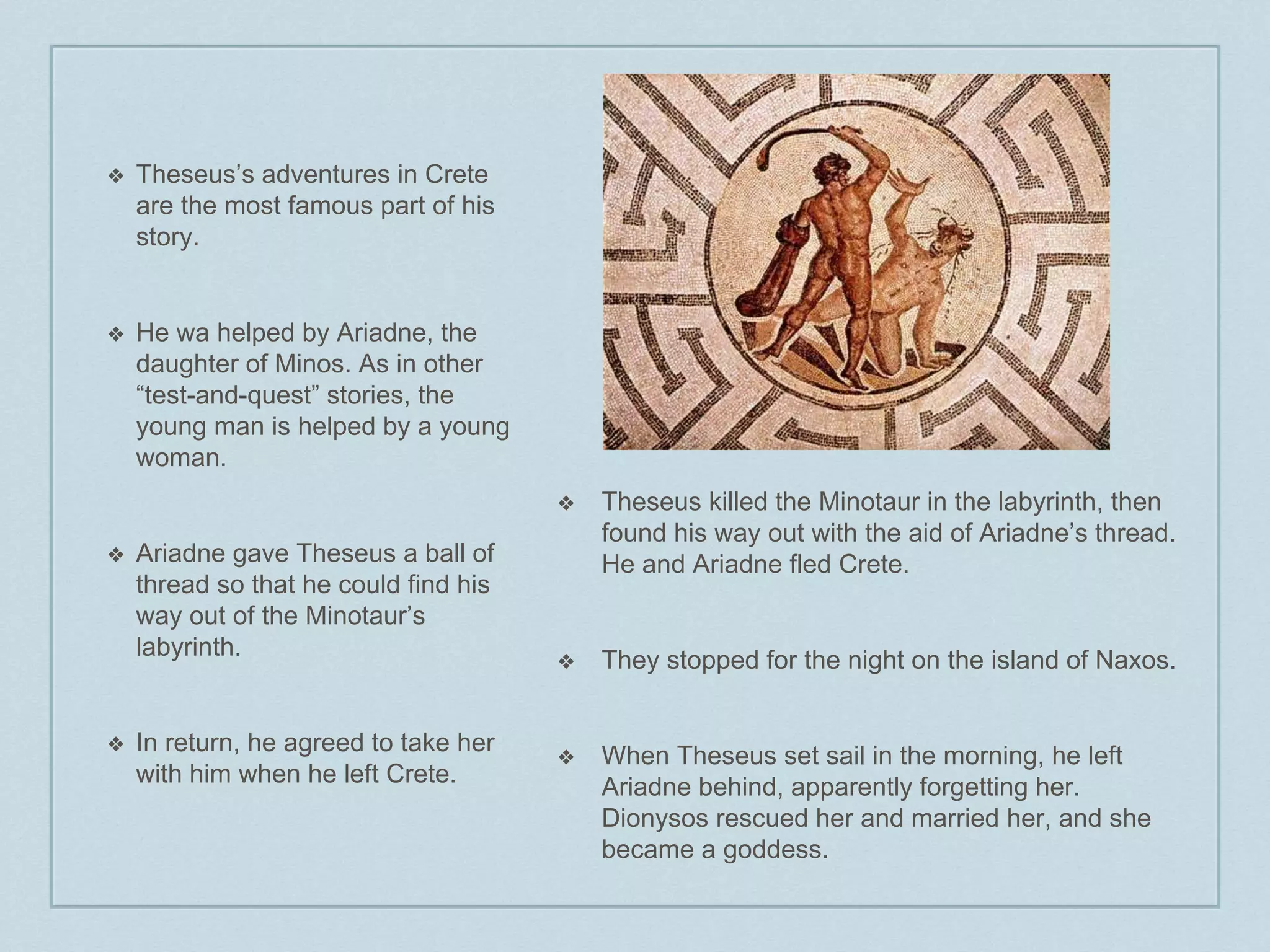
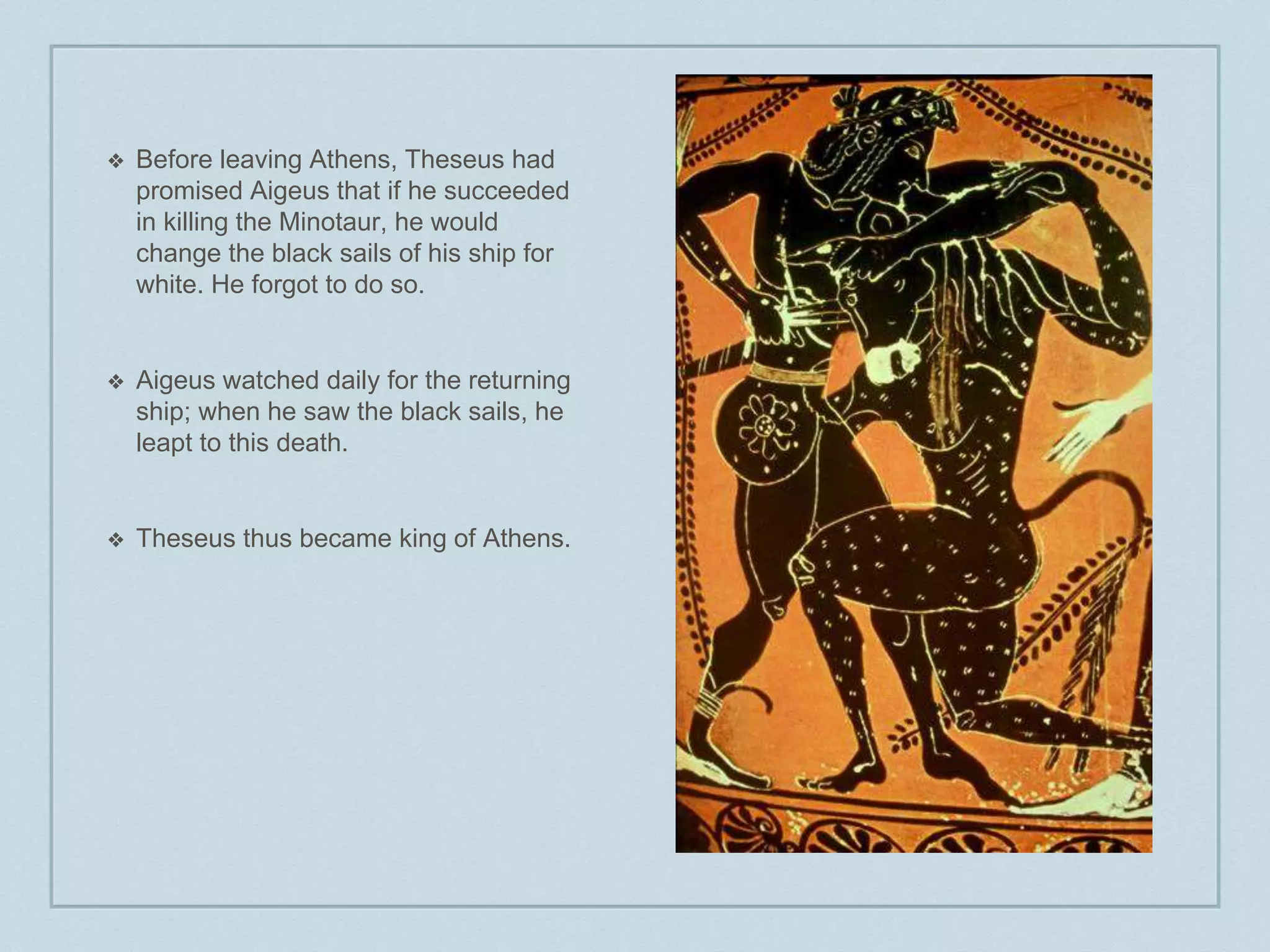
❖ Theseus killed the Minotaur in the labyrinth, then 
found his way out with the aid of Ariadne’s thread. 
He and Ariadne fled Crete. 
❖ They stopped for the night on the island of Naxos. 
❖ When Theseus set sail in the morning, he left 
Ariadne behind, apparently forgetting her. 
Dionysos rescued her and married her, and she 
became a goddess.
❖ Before leaving Athens, Theseus had 
promised Aigeus that if he succeeded 
in killing the Minotaur, he would 
change the black sails of his ship for 
white. He forgot to do so. 
❖ Aigeus watched daily for the returning 
ship; when he saw the black sails, he 
leapt to this death. 
❖ Theseus thus became king of Athens.
❖ After the loss of Ariadne, Theseus married at least two more times. 
❖ Theseus and his friend Pirithous agreed that they should both marry 
daughters of Zeus. 
❖ For Theseus, they kidnapped Helen (later of Troy) who was too young for 
marriage but already extraordinarily beautiful. The plan was to keep her until 
she was old enough to marry. 
❖ For Pirithous, the two men journeyed to the Underworld to kidnap 
Persephone. 
❖ At the invitation of Hades, they sat down on stone chairs and became stuck 
there. 
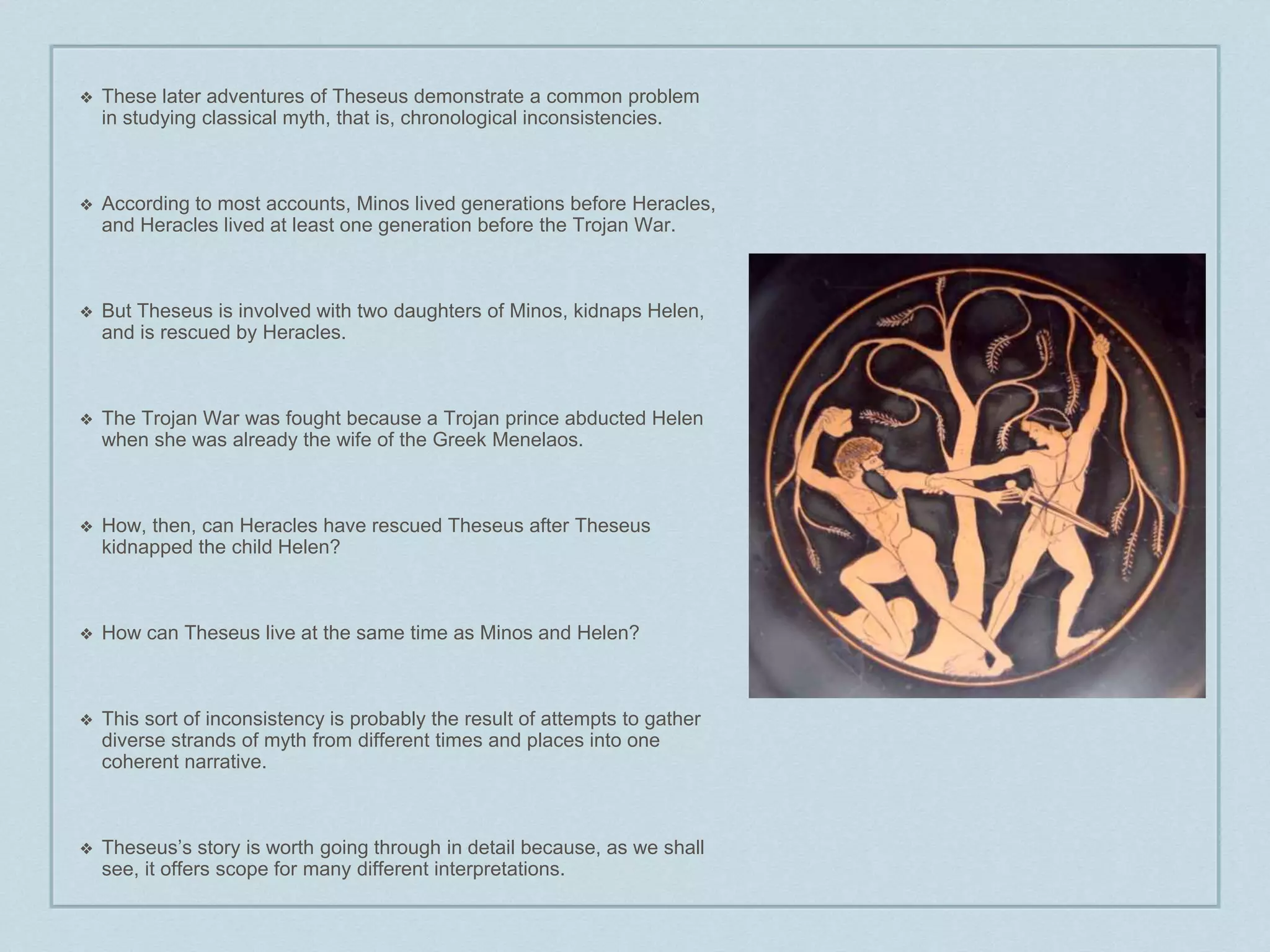
❖ Theseus remained stuck in the Underworld for some years until Heracles 
rescued him. Pirithous remained there forever.
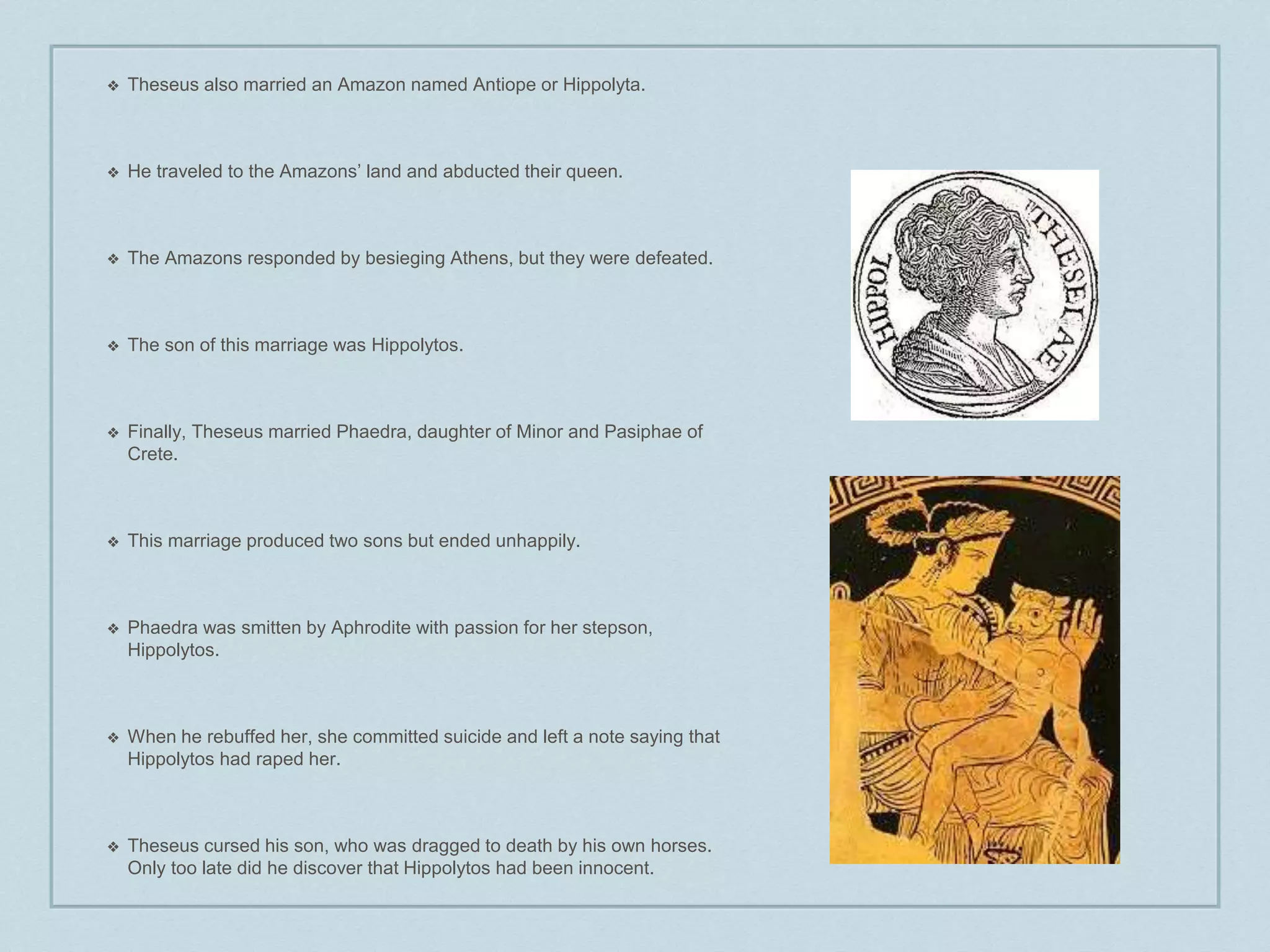
❖ Theseus also married an Amazon named Antiope or Hippolyta. 
❖ He traveled to the Amazons’ land and abducted their queen. 
❖ The Amazons responded by besieging Athens, but they were defeated. 
❖ The son of this marriage was Hippolytos. 
❖ Finally, Theseus married Phaedra, daughter of Minor and Pasiphae of 
Crete. 
❖ This marriage produced two sons but ended unhappily. 
❖ Phaedra was smitten by Aphrodite with passion for her stepson, 
Hippolytos. 
❖ When he rebuffed her, she committed suicide and left a note saying that 
Hippolytos had raped her. 
❖ Theseus cursed his son, who was dragged to death by his own horses. 
Only too late did he discover that Hippolytos had been innocent.
❖ These later adventures of Theseus demonstrate a common problem 
in studying classical myth, that is, chronological inconsistencies. 
❖ According to most accounts, Minos lived generations before Heracles, 
and Heracles lived at least one generation before the Trojan War. 
❖ But Theseus is involved with two daughters of Minos, kidnaps Helen, 
and is rescued by Heracles. 
❖ The Trojan War was fought because a Trojan prince abducted Helen 
when she was already the wife of the Greek Menelaos. 
❖ How, then, can Heracles have rescued Theseus after Theseus 
kidnapped the child Helen? 
❖ How can Theseus live at the same time as Minos and Helen? 
❖ This sort of inconsistency is probably the result of attempts to gather 
diverse strands of myth from different times and places into one 
coherent narrative. 
❖ Theseus’s story is worth going through in detail because, as we shall 
see, it offers scope for many different interpretations.

Theseus

  • 1.
    Theseus and the“Test-and-Quest” Myth ❖ We will focus on the exploits of one particular hero, Theseus. We will look at his birth, childhood, and maturation story, which is a typical example of the “test-and-quest” pattern. ❖ We will then look at his adventures as an adult; the most famous of these is his encounter with the Minotaur in Crete. ❖ We will also consider his marriage to an Amazon and his later fateful marriage to Phaidra, which results in Theseus’s killing of his own son Hippolytos. ❖ We will conclude by discussing the difficulty of fitting all the adventures attributed to Theseus into a coherent chronological pattern and talk about some of the possible reasons for this difficulty.
  • 2.
    The stories ofseveral heroes fit what has been called the “quest” pattern. Among these, Theseus’s story is particularly rich for investigating mythic themes and presenting possibilities for interpretation. ❖ Theseus is less well known to modern readers than Heracles or Jason is, but as the legendary synoikistes (“unifier”) of Attica, he was an important figure in Athenian myth. In Theseus’s case, myth became a charter for Athenian hegemonic control over Attica. ❖ Perhaps because of his important role in Athens, various stories accrued around Theseus, and it is difficult to work out a consistent chronology for his adventures. Theseus & the Centaur
  • 3.
    Theseus’s birth story ❖ His birth, childhood, and young adulthood show typical “hero” elements, reminiscent of folktale. ❖ Oddities and ambiguities surround his conception, not the least of which is an apparent double-fatherhood. ❖ His human father was Aigeus, king of Athens. ❖ His mother, Aithra, was raped by Poseidon on the same night that she slept with Aigeus; this, Theseus’s parentage was uncertain. This explains how he was a top-notch hero who, at the same time, inherited his father’s throne.
  • 4.
    ❖ Aigeus leftsandals and a sword under a boulder, with instructions that his son should come to him in Athens when he was strong enough to lift the boulder and retrieve the tokens. Theseus does so and sets off for Athens. ❖ Theseus’s journey to athens to claim his patrimony involves a series of encounters with monsters. ❖ The most famous of these was Procrustes, who had a bed that he forced all visitors to fit. This is the origin of the term procrustean. ❖ Others included the giant Sinis the “pinebender” and a monstrous boar. Theseus “unifies” the countryside by eliminating these dangers. ❖ When Theseus reached Athens, he was received as a guest by Aigeus and Aigeus’s current wife, Medea. ❖ Medea, better known for her previous involvement with Jason, was a sorceress. ❖ She was pregnant and feared that Theseus (whom she recognized as Aigeus’s son) would displace her own child. ❖ She persuaded Aigeus that the young guest planned to kill him, and Aigeus agreed to poison the youth.
  • 5.
    ❖ At thedinner table, Theseus drew his sword to cut his meat. Aigeus recognized the sword and stopped Theseus from drinking his poisoned wine, just in time. ❖ After his recognition by his father, Theseus embarked on a dangerous journey to Crete to try to free Athens from its tribute to Minos, king of Crete. ❖ Athens was obligated by a treaty to send seven young men and 7 young women to Crete every year to be eaten by the Minotaur. ❖ Athens and Crete had gone to war after Minos’s son Androgeos was killed in Attica, wither by a great bull whom Aigeus sent him to fight or by other young men who were jealous of his athletic prowess. ❖ Minos declared war on Athens, and the was ceased only when Athens agreed to let Minos name whatever recompense he wanted. Minos instated the annual tribute to the Minotaur. ❖ Theseus volunteered to be a member of this delegation.
  • 6.
    ❖ Theseus’s adventuresin Crete are the most famous part of his story. ❖ He wa helped by Ariadne, the daughter of Minos. As in other “test-and-quest” stories, the young man is helped by a young woman. ❖ Ariadne gave Theseus a ball of thread so that he could find his way out of the Minotaur’s labyrinth. ❖ In return, he agreed to take her with him when he left Crete. ❖ Theseus killed the Minotaur in the labyrinth, then found his way out with the aid of Ariadne’s thread. He and Ariadne fled Crete. ❖ They stopped for the night on the island of Naxos. ❖ When Theseus set sail in the morning, he left Ariadne behind, apparently forgetting her. Dionysos rescued her and married her, and she became a goddess.
  • 7.
    ❖ Before leavingAthens, Theseus had promised Aigeus that if he succeeded in killing the Minotaur, he would change the black sails of his ship for white. He forgot to do so. ❖ Aigeus watched daily for the returning ship; when he saw the black sails, he leapt to this death. ❖ Theseus thus became king of Athens.
  • 8.
    ❖ After theloss of Ariadne, Theseus married at least two more times. ❖ Theseus and his friend Pirithous agreed that they should both marry daughters of Zeus. ❖ For Theseus, they kidnapped Helen (later of Troy) who was too young for marriage but already extraordinarily beautiful. The plan was to keep her until she was old enough to marry. ❖ For Pirithous, the two men journeyed to the Underworld to kidnap Persephone. ❖ At the invitation of Hades, they sat down on stone chairs and became stuck there. ❖ Theseus remained stuck in the Underworld for some years until Heracles rescued him. Pirithous remained there forever.
  • 9.
    ❖ Theseus alsomarried an Amazon named Antiope or Hippolyta. ❖ He traveled to the Amazons’ land and abducted their queen. ❖ The Amazons responded by besieging Athens, but they were defeated. ❖ The son of this marriage was Hippolytos. ❖ Finally, Theseus married Phaedra, daughter of Minor and Pasiphae of Crete. ❖ This marriage produced two sons but ended unhappily. ❖ Phaedra was smitten by Aphrodite with passion for her stepson, Hippolytos. ❖ When he rebuffed her, she committed suicide and left a note saying that Hippolytos had raped her. ❖ Theseus cursed his son, who was dragged to death by his own horses. Only too late did he discover that Hippolytos had been innocent.
  • 10.
    ❖ These lateradventures of Theseus demonstrate a common problem in studying classical myth, that is, chronological inconsistencies. ❖ According to most accounts, Minos lived generations before Heracles, and Heracles lived at least one generation before the Trojan War. ❖ But Theseus is involved with two daughters of Minos, kidnaps Helen, and is rescued by Heracles. ❖ The Trojan War was fought because a Trojan prince abducted Helen when she was already the wife of the Greek Menelaos. ❖ How, then, can Heracles have rescued Theseus after Theseus kidnapped the child Helen? ❖ How can Theseus live at the same time as Minos and Helen? ❖ This sort of inconsistency is probably the result of attempts to gather diverse strands of myth from different times and places into one coherent narrative. ❖ Theseus’s story is worth going through in detail because, as we shall see, it offers scope for many different interpretations.