Demeter, Persephone and the Conquest 
of Death 
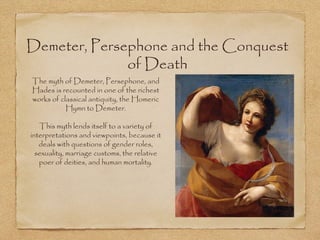
The myth of Demeter, Persephone, and 
Hades is recounted in one of the richest 
works of classical antiquity, the Homeric 
Hymn to Demeter. 
This myth lends itself to a variety of 
interpretations and viewpoints, because it 
deals with questions of gender roles, 
sexuality, marriage customs, the relative 
poer of deities, and human mortality.
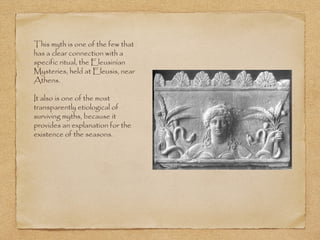
This myth is one of the few that 
has a clear connection with a 
specific ritual, the Eleusinian 
Mysteries, held at Eleusis, near 
Athens. 
It also is one of the most 
transparently etiological of 
surviving myths, because it 
provides an explanation for the 
existence of the seasons.
The basic story of the 
abduction of Persephone 
by Hades is fairly simple. 
Demeter, goddess of 
grain and agriculture, had 
a daughter, Persephone. 
Persephone’s father was 
Zeus.
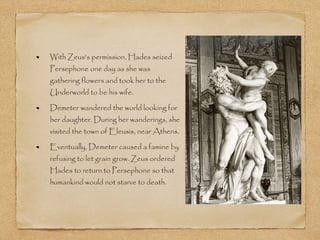
With Zeus’s permission, Hades seized 
Persephone one day as she was 
gathering flowers and took her to the 
Underworld to be his wife. 
Demeter wandered the world looking for 
her daughter. During her wanderings, she 
visited the town of Eleusis, near Athens. 
Eventually, Demeter caused a famine by 
refusing to let grain grow. Zeus ordered 
Hades to return to Persephone so that 
humankind would not starve to death.
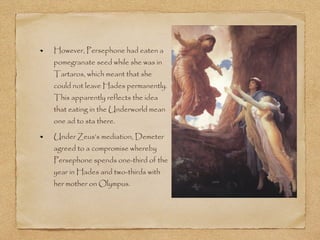
However, Persephone had eaten a 
pomegranate seed while she was in 
Tartaros, which meant that she 
could not leave Hades permanently. 
This apparently reflects the idea 
that eating in the Underworld mean 
one ad to sta there. 
Under Zeus’s mediation, Demeter 
agreed to a compromise whereby 
Persephone spends one-third of the 
year in Hades and two-thirds with 
her mother on Olympus.
Demeter’s search for her missing daughter and its aftermath give us a 
window onto many aspects of ancient Greek life. 
First, the story reflects marriage practices. 
A marriage in Athens was a contract between the groom and the bride’s 
father. Zeus gave Hades permission to take Persephone. 
Marriage of an only daughter with no brothers to her uncle was perfectly 
acceptable. Such a girl was called an epikleros. 
Human marraige were patrilocal. 
Human mothers and daughters woud have greatly restricted contact after 
marriage. Thus, sorrow was a natural raction to such an arrangement.
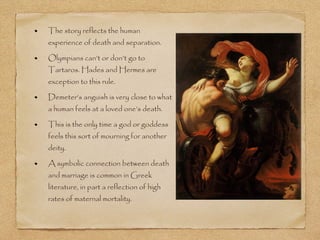
The story reflects the human 
experience of death and separation. 
Olympians can’t or don’t go to 
Tartaros. Hades and Hermes are 
exception to this rule. 
Demeter’s anguish is very close to what 
a human feels at a loved one’s death. 
This is the only time a god or goddess 
feels this sort of mourning for another 
deity. 
A symbolic connection between death 
and marriage is common in Greek 
literature, in part a reflection of high 
rates of maternal mortality.
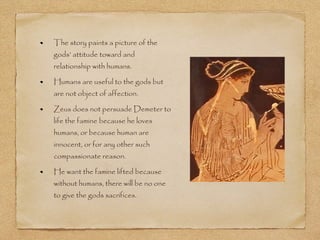
The story paints a picture of the 
gods’ attitude toward and 
relationship with humans. 
Humans are useful to the gods but 
are not object of affection. 
Zeus does not persuade Demeter to 
life the famine because he loves 
humans, or because human are 
innocent, or for any other such 
compassionate reason. 
He want the famine lifted because 
without humans, there will be no one 
to give the gods sacrifices.
Along with the account of Persephone’s abduction, the Homeric Hymn to 
Demeter also contains the story of Demeter’s visit to Metaneira, the Queen 
of Eleusis. 
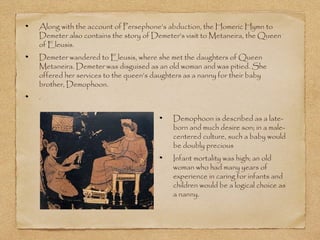
Demeter wandered to Eleusis, where she met the daughters of Queen 
Metaneira. Demeter was disguised as an old woman and was pitied. She 
offered her services to the queen’s daughters as a nanny for their baby 
brother, Demophoon. 
. 
Demophoon is described as a late-born 
and much desire son; in a male-centered 
culture, such a baby would 
be doubly precious 
Infant mortality was high; an old 
woman who had many years of 
experience in caring for infants and 
children would be a logical choice as 
a nanny.
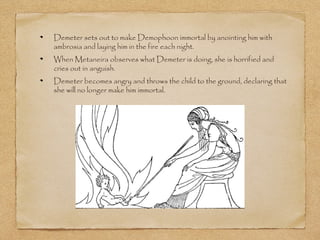
Demeter sets out to make Demophoon immortal by anointing him with 
ambrosia and laying him in the fire each night. 
When Metaneira observes what Demeter is doing, she is horrified and 
cries out in anguish. 
Demeter becomes angry and throws the child to the ground, declaring that 
she will no longer make him immortal.
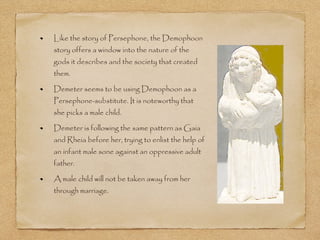
Like the story of Persephone, the Demophoon 
story offers a window into the nature of the 
gods it describes and the society that created 
them. 
Demeter seems to be using Demophoon as a 
Persephone-substitute. It is noteworthy that 
she picks a male child. 
Demeter is following the same pattern as Gaia 
and Rheia before her, trying to enlist the help of 
an infant male sone against an oppressive adult 
father. 
A male child will not be taken away from her 
through marriage.
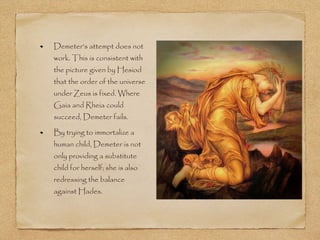
Demeter’s attempt does not 
work. This is consistent with 
the picture given by Hesiod 
that the order of the universe 
under Zeus is fixed. Where 
Gaia and Rheia could 
succeed, Demeter fails. 
By trying to immortalize a 
human child, Demeter is not 
only providing a substitute 
child for herself; she is also 
redressing the balance 
against Hades.
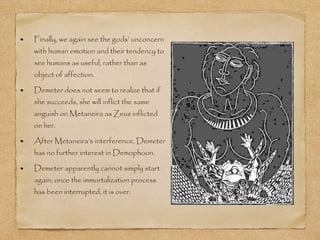
Finally, we again see the gods’ unconcern 
with human emotion and their tendency to 
see humans as useful, rather than as 
object of affection. 
Demeter does not seem to realize that if 
she succeeds, she will inflict the same 
anguish on Metaneira as Zeus inflicted 
on her. 
After Metaneira’s interference, Demeter 
has no further interest in Demophoon. 
Demeter apparently cannot simply start 
again; once the immortalization process 
has been interrupted, it is over.

Demeter and Persephone

  • 1.
    Demeter, Persephone andthe Conquest of Death The myth of Demeter, Persephone, and Hades is recounted in one of the richest works of classical antiquity, the Homeric Hymn to Demeter. This myth lends itself to a variety of interpretations and viewpoints, because it deals with questions of gender roles, sexuality, marriage customs, the relative poer of deities, and human mortality.
  • 2.
    This myth isone of the few that has a clear connection with a specific ritual, the Eleusinian Mysteries, held at Eleusis, near Athens. It also is one of the most transparently etiological of surviving myths, because it provides an explanation for the existence of the seasons.
  • 3.
    The basic storyof the abduction of Persephone by Hades is fairly simple. Demeter, goddess of grain and agriculture, had a daughter, Persephone. Persephone’s father was Zeus.
  • 4.
    With Zeus’s permission,Hades seized Persephone one day as she was gathering flowers and took her to the Underworld to be his wife. Demeter wandered the world looking for her daughter. During her wanderings, she visited the town of Eleusis, near Athens. Eventually, Demeter caused a famine by refusing to let grain grow. Zeus ordered Hades to return to Persephone so that humankind would not starve to death.
  • 5.
    However, Persephone hadeaten a pomegranate seed while she was in Tartaros, which meant that she could not leave Hades permanently. This apparently reflects the idea that eating in the Underworld mean one ad to sta there. Under Zeus’s mediation, Demeter agreed to a compromise whereby Persephone spends one-third of the year in Hades and two-thirds with her mother on Olympus.
  • 6.
    Demeter’s search forher missing daughter and its aftermath give us a window onto many aspects of ancient Greek life. First, the story reflects marriage practices. A marriage in Athens was a contract between the groom and the bride’s father. Zeus gave Hades permission to take Persephone. Marriage of an only daughter with no brothers to her uncle was perfectly acceptable. Such a girl was called an epikleros. Human marraige were patrilocal. Human mothers and daughters woud have greatly restricted contact after marriage. Thus, sorrow was a natural raction to such an arrangement.
  • 7.
    The story reflectsthe human experience of death and separation. Olympians can’t or don’t go to Tartaros. Hades and Hermes are exception to this rule. Demeter’s anguish is very close to what a human feels at a loved one’s death. This is the only time a god or goddess feels this sort of mourning for another deity. A symbolic connection between death and marriage is common in Greek literature, in part a reflection of high rates of maternal mortality.
  • 8.
    The story paintsa picture of the gods’ attitude toward and relationship with humans. Humans are useful to the gods but are not object of affection. Zeus does not persuade Demeter to life the famine because he loves humans, or because human are innocent, or for any other such compassionate reason. He want the famine lifted because without humans, there will be no one to give the gods sacrifices.
  • 9.
    Along with theaccount of Persephone’s abduction, the Homeric Hymn to Demeter also contains the story of Demeter’s visit to Metaneira, the Queen of Eleusis. Demeter wandered to Eleusis, where she met the daughters of Queen Metaneira. Demeter was disguised as an old woman and was pitied. She offered her services to the queen’s daughters as a nanny for their baby brother, Demophoon. . Demophoon is described as a late-born and much desire son; in a male-centered culture, such a baby would be doubly precious Infant mortality was high; an old woman who had many years of experience in caring for infants and children would be a logical choice as a nanny.
  • 10.
    Demeter sets outto make Demophoon immortal by anointing him with ambrosia and laying him in the fire each night. When Metaneira observes what Demeter is doing, she is horrified and cries out in anguish. Demeter becomes angry and throws the child to the ground, declaring that she will no longer make him immortal.
  • 11.
    Like the storyof Persephone, the Demophoon story offers a window into the nature of the gods it describes and the society that created them. Demeter seems to be using Demophoon as a Persephone-substitute. It is noteworthy that she picks a male child. Demeter is following the same pattern as Gaia and Rheia before her, trying to enlist the help of an infant male sone against an oppressive adult father. A male child will not be taken away from her through marriage.
  • 12.
    Demeter’s attempt doesnot work. This is consistent with the picture given by Hesiod that the order of the universe under Zeus is fixed. Where Gaia and Rheia could succeed, Demeter fails. By trying to immortalize a human child, Demeter is not only providing a substitute child for herself; she is also redressing the balance against Hades.
  • 13.
    Finally, we againsee the gods’ unconcern with human emotion and their tendency to see humans as useful, rather than as object of affection. Demeter does not seem to realize that if she succeeds, she will inflict the same anguish on Metaneira as Zeus inflicted on her. After Metaneira’s interference, Demeter has no further interest in Demophoon. Demeter apparently cannot simply start again; once the immortalization process has been interrupted, it is over.