The Trojan War 
• In this lecture we will examine the most famous episode of classical myth, the Trojan 
War. The Trojan War functioned as the dividing line between the heroic” age and the 
age of normal human history; perhaps because of this function, the episode is 
frequently drawn on by authors in various genres. 
• The lecture summarizes the basic story of the Trojan War, from its beginnings in the 
marriage of Peleus and Thetis through the ill-fated sack of Troy. 
• We will then note the Trojan War myth’s importance for understanding the myth of the 
House of Atreus and ends by discussing how complicated a picture the myth draws of 
the relationships between fate, the gods’ orders, and individual responsibility. 
• The Trojan War is the most famous episode of classical myth. This fame results from 
the fact that it was a considered an especially important event by the Greeks and 
Romans themselves and, thus, because especially productive in classical literature.
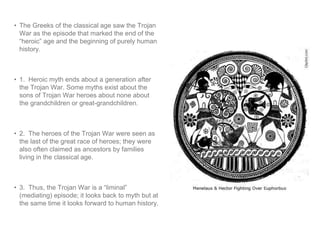
• The Greeks of the classical age saw the Trojan 
War as the episode that marked the end of the 
“heroic” age and the beginning of purely human 
history. 
• 1. Heroic myth ends about a generation after 
the Trojan War. Some myths exist about the 
sons of Trojan War heroes about none about 
the grandchildren or great-grandchildren. 
• 2. The heroes of the Trojan War were seen as 
the last of the great race of heroes; they were 
also often claimed as ancestors by families 
living in the classical age. 
• 3. Thus, the Trojan War is a “liminal” 
(mediating) episode; it looks back to myth but at 
the same time it looks forward to human history.
• Probably because of this liminal nature of the 
Trojan War myth, it became the most fruitful 
episode of all Greek mythology for literature. 
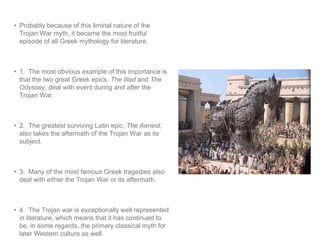
• 1. The most obvious example of this importance is 
that the two great Greek epics, The Iliad and The 
Odyssey, deal with event during and after the 
Trojan War. 
• 2. The greatest surviving Latin epic, The Aeneid, 
also takes the aftermath of the Trojan War as its 
subject. 
• 3. Many of the most famous Greek tragedies also 
deal with either the Trojan War or its aftermath. 
• 4. The Trojan war is exceptionally well represented 
in literature, which means that it has continued to 
be, in some regards, the primary classical myth for 
later Western culture as well.
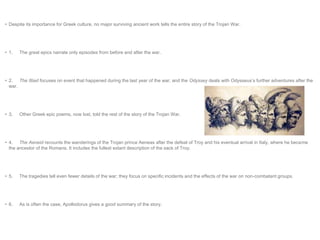
• Despite its importance for Greek culture, no major surviving ancient work tells the entire story of the Trojan War. 
• 1. The great epics narrate only episodes from before and after the war. 
• 2. The Illiad focuses on event that happened during the last year of the war, and the Odyssey deals with Odysseus’s further adventures after the 
war. 
• 3. Other Greek epic poems, now lost, told the rest of the story of the Trojan War. 
• 4. The Aeneid recounts the wanderings of the Trojan prince Aeneas after the defeat of Troy and his eventual arrival in Italy, where he became 
the ancestor of the Romans. It includes the fullest extant description of the sack of Troy. 
• 5. The tragedies tell even fewer details of the war; they focus on specific incidents and the effects of the war on non-combatant groups. 
• 6. As is often the case, Apollodorus gives a good summary of the story.
• The story of the Trojan War is basically quite simple; however, many allied 
stories link into the story of the Trojan War in one way or another and 
make the overall topic quite complex. The basic story is as follows: 
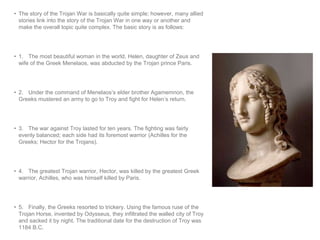
• 1. The most beautiful woman in the world, Helen, daughter of Zeus and 
wife of the Greek Menelaos, was abducted by the Trojan prince Paris. 
• 2. Under the command of Menelaos’s elder brother Agamemnon, the 
Greeks mustered an army to go to Troy and fight for Helen’s return. 
• 3. The war against Troy lasted for ten years. The fighting was fairly 
evenly balanced; each side had its foremost warrior (Achilles for the 
Greeks; Hector for the Trojans). 
• 4. The greatest Trojan warrior, Hector, was killed by the greatest Greek 
warrior, Achilles, who was himself killed by Paris. 
• 5. Finally, the Greeks resorted to trickery. Using the famous ruse of the 
Trojan Horse, invented by Odysseus, they infiltrated the walled city of Troy 
and sacked it by night. The traditional date for the destruction of Troy was 
1184 B.C.
• The basic story of the Trojan War attracted many related stories over the centuries. One such 
connected story has to do with the birth of Achilles. 
• The ultimate cause of the war was a prophecy about the hero Achilles, before he was conceived. 
• 1. Achilles’s mother was Thetis, a sea-goddess. She was desired by Zeus, but he heard a prophecy 
that she would bear a son who would be greater than his father. 
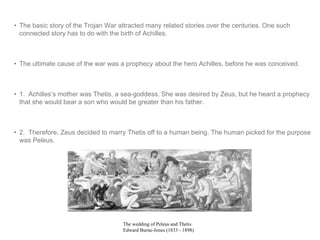
• 2. Therefore, Zeus decided to marry Thetis off to a human being. The human picked for the purpose 
was Peleus. 
The wedding of Peleus and Thetis 
Edward Burne-Jones (1833 - 1898)
• 1. Thetis was less than please with this 
marriage; to placate her, Zeus hosted a 
magnificent wedding feast, to which all the 
gods and goddesses were invited except 
Eris, goddess of Strife. 
• 2. In anger at her exclusion, Eris threw 
onto the table a golden apple inscribed 
“for the fairest.” 
• 3. Hera, Athena, and Aphrodite each 
claimed the apple as her own. 
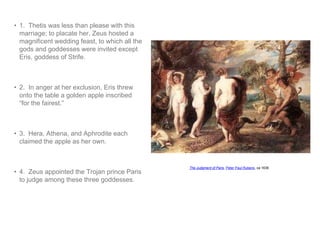
• 4. Zeus appointed the Trojan prince Paris 
to judge among these three goddesses. 
The Judgment of Paris, Peter Paul Rubens, ca 1636
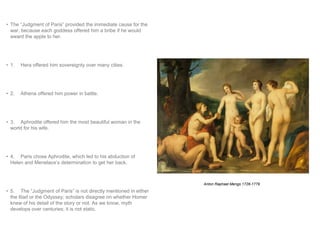
• The “Judgment of Paris” provided the immediate cause for the 
war, because each goddess offered him a bribe if he would 
award the apple to her. 
• 1. Hera offered him sovereignty over many cities. 
• 2. Athena offered him power in battle. 
• 3. Aphrodite offered him the most beautiful woman in the 
world for his wife. 
• 4. Paris chose Aphrodite, which led to his abduction of 
Helen and Menelaos’s determination to get her back. 
• 5. The “Judgment of Paris” is not directly mentioned in either 
the Iliad or the Odyssey; scholars disagree on whether Homer 
knew of his detail of the story or not. As we know, myth 
develops over centuries; it is not static. 
Anton Raphael Mengs 1728-1779
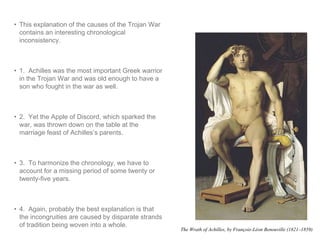
• This explanation of the causes of the Trojan War 
contains an interesting chronological 
inconsistency. 
• 1. Achilles was the most important Greek warrior 
in the Trojan War and was old enough to have a 
son who fought in the war as well. 
• 2. Yet the Apple of Discord, which sparked the 
war, was thrown down on the table at the 
marriage feast of Achilles’s parents. 
• 3. To harmonize the chronology, we have to 
account for a missing period of some twenty or 
twenty-five years. 
• 4. Again, probably the best explanation is that 
the incongruities are caused by disparate strands 
of tradition being woven into a whole. 
The Wrath of Achilles, by François-Léon Benouville (1821–1859)
• The events leading up to the war are also closely connected with the story of the family of 
Agamemnon and Menelaos. Their entire past and future are bound up with this war. 
• The most obvious connection, of course, is that Helen was the wife of Menelaos, and her half-sister 
Clytemnestra was Agamemnon’s wife. 
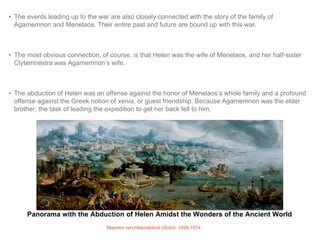
• The abduction of Helen was an offense against the honor of Menelaos’s whole family and a profound 
offense against the Greek notion of xenia, or guest friendship. Because Agamemnon was the elder 
brother, the task of leading the expedition to get her back fell to him. 
Panorama with the Abduction of Helen Amidst the Wonders of the Ancient World 
Maerten van Heemskerck (Dutch, 1498-1574
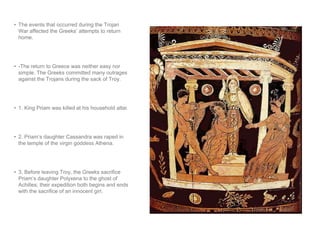
• The events that occurred during the Trojan 
War affected the Greeks’ attempts to return 
home. 
• -The return to Greece was neither easy nor 
simple. The Greeks committed many outrages 
against the Trojans during the sack of Troy. 
• 1. King Priam was killed at his household altar. 
• 2. Priam’s daughter Cassandra was raped in 
the temple of the virgin goddess Athena. 
• 3. Before leaving Troy, the Greeks sacrifice 
Priam’s daughter Polyxena to the ghost of 
Achilles; their expedition both begins and ends 
with the sacrifice of an innocent girl.
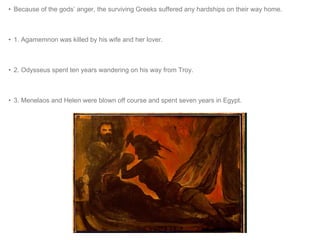
• Because of the gods’ anger, the surviving Greeks suffered any hardships on their way home. 
• 1. Agamemnon was killed by his wife and her lover. 
• 2. Odysseus spent ten years wandering on his way from Troy. 
• 3. Menelaos and Helen were blown off course and spent seven years in Egypt.
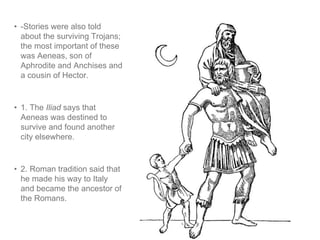
• -Stories were also told 
about the surviving Trojans; 
the most important of these 
was Aeneas, son of 
Aphrodite and Anchises and 
a cousin of Hector. 
• 1. The Iliad says that 
Aeneas was destined to 
survive and found another 
city elsewhere. 
• 2. Roman tradition said that 
he made his way to Italy 
and became the ancestor of 
the Romans.
• In all these connected 
stories, we can see 
how complex the 
interaction is between 
the gods’ commands 
and individual 
responsibility. 
• The war was 
inevitable. Although it 
was caused by the 
actions of several 
individuals (most 
notably Paris), all the 
actions were 
sanctioned by the 
gods; thus the 
individuals involved 
could claim necessity. 
Venus Presenting Arms to Aeneas by Nicolas Poussin
• Yet this necessity does not mitigate the horror of 
the individuals’ wrongdoings on both sides. 
• 1. Paris violated the guest-host relationship, or 
xenia, by his abduction of Helen. 
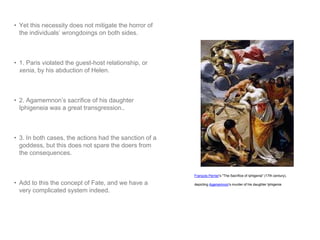
• 2. Agamemnon’s sacrifice of his daughter 
Iphigeneia was a great transgression.. 
• 3. In both cases, the actions had the sanction of a 
goddess, but this does not spare the doers from 
the consequences. 
• Add to this the concept of Fate, and we have a 
very complicated system indeed. 
François Perrier's "The Sacrifice of Iphigenia" (17th century), 
depicting Agamemnon's murder of his daughter Iphigenia

Trojan War

  • 1.
    The Trojan War • In this lecture we will examine the most famous episode of classical myth, the Trojan War. The Trojan War functioned as the dividing line between the heroic” age and the age of normal human history; perhaps because of this function, the episode is frequently drawn on by authors in various genres. • The lecture summarizes the basic story of the Trojan War, from its beginnings in the marriage of Peleus and Thetis through the ill-fated sack of Troy. • We will then note the Trojan War myth’s importance for understanding the myth of the House of Atreus and ends by discussing how complicated a picture the myth draws of the relationships between fate, the gods’ orders, and individual responsibility. • The Trojan War is the most famous episode of classical myth. This fame results from the fact that it was a considered an especially important event by the Greeks and Romans themselves and, thus, because especially productive in classical literature.
  • 2.
    • The Greeksof the classical age saw the Trojan War as the episode that marked the end of the “heroic” age and the beginning of purely human history. • 1. Heroic myth ends about a generation after the Trojan War. Some myths exist about the sons of Trojan War heroes about none about the grandchildren or great-grandchildren. • 2. The heroes of the Trojan War were seen as the last of the great race of heroes; they were also often claimed as ancestors by families living in the classical age. • 3. Thus, the Trojan War is a “liminal” (mediating) episode; it looks back to myth but at the same time it looks forward to human history.
  • 3.
    • Probably becauseof this liminal nature of the Trojan War myth, it became the most fruitful episode of all Greek mythology for literature. • 1. The most obvious example of this importance is that the two great Greek epics, The Iliad and The Odyssey, deal with event during and after the Trojan War. • 2. The greatest surviving Latin epic, The Aeneid, also takes the aftermath of the Trojan War as its subject. • 3. Many of the most famous Greek tragedies also deal with either the Trojan War or its aftermath. • 4. The Trojan war is exceptionally well represented in literature, which means that it has continued to be, in some regards, the primary classical myth for later Western culture as well.
  • 4.
    • Despite itsimportance for Greek culture, no major surviving ancient work tells the entire story of the Trojan War. • 1. The great epics narrate only episodes from before and after the war. • 2. The Illiad focuses on event that happened during the last year of the war, and the Odyssey deals with Odysseus’s further adventures after the war. • 3. Other Greek epic poems, now lost, told the rest of the story of the Trojan War. • 4. The Aeneid recounts the wanderings of the Trojan prince Aeneas after the defeat of Troy and his eventual arrival in Italy, where he became the ancestor of the Romans. It includes the fullest extant description of the sack of Troy. • 5. The tragedies tell even fewer details of the war; they focus on specific incidents and the effects of the war on non-combatant groups. • 6. As is often the case, Apollodorus gives a good summary of the story.
  • 5.
    • The storyof the Trojan War is basically quite simple; however, many allied stories link into the story of the Trojan War in one way or another and make the overall topic quite complex. The basic story is as follows: • 1. The most beautiful woman in the world, Helen, daughter of Zeus and wife of the Greek Menelaos, was abducted by the Trojan prince Paris. • 2. Under the command of Menelaos’s elder brother Agamemnon, the Greeks mustered an army to go to Troy and fight for Helen’s return. • 3. The war against Troy lasted for ten years. The fighting was fairly evenly balanced; each side had its foremost warrior (Achilles for the Greeks; Hector for the Trojans). • 4. The greatest Trojan warrior, Hector, was killed by the greatest Greek warrior, Achilles, who was himself killed by Paris. • 5. Finally, the Greeks resorted to trickery. Using the famous ruse of the Trojan Horse, invented by Odysseus, they infiltrated the walled city of Troy and sacked it by night. The traditional date for the destruction of Troy was 1184 B.C.
  • 6.
    • The basicstory of the Trojan War attracted many related stories over the centuries. One such connected story has to do with the birth of Achilles. • The ultimate cause of the war was a prophecy about the hero Achilles, before he was conceived. • 1. Achilles’s mother was Thetis, a sea-goddess. She was desired by Zeus, but he heard a prophecy that she would bear a son who would be greater than his father. • 2. Therefore, Zeus decided to marry Thetis off to a human being. The human picked for the purpose was Peleus. The wedding of Peleus and Thetis Edward Burne-Jones (1833 - 1898)
  • 7.
    • 1. Thetiswas less than please with this marriage; to placate her, Zeus hosted a magnificent wedding feast, to which all the gods and goddesses were invited except Eris, goddess of Strife. • 2. In anger at her exclusion, Eris threw onto the table a golden apple inscribed “for the fairest.” • 3. Hera, Athena, and Aphrodite each claimed the apple as her own. • 4. Zeus appointed the Trojan prince Paris to judge among these three goddesses. The Judgment of Paris, Peter Paul Rubens, ca 1636
  • 8.
    • The “Judgmentof Paris” provided the immediate cause for the war, because each goddess offered him a bribe if he would award the apple to her. • 1. Hera offered him sovereignty over many cities. • 2. Athena offered him power in battle. • 3. Aphrodite offered him the most beautiful woman in the world for his wife. • 4. Paris chose Aphrodite, which led to his abduction of Helen and Menelaos’s determination to get her back. • 5. The “Judgment of Paris” is not directly mentioned in either the Iliad or the Odyssey; scholars disagree on whether Homer knew of his detail of the story or not. As we know, myth develops over centuries; it is not static. Anton Raphael Mengs 1728-1779
  • 9.
    • This explanationof the causes of the Trojan War contains an interesting chronological inconsistency. • 1. Achilles was the most important Greek warrior in the Trojan War and was old enough to have a son who fought in the war as well. • 2. Yet the Apple of Discord, which sparked the war, was thrown down on the table at the marriage feast of Achilles’s parents. • 3. To harmonize the chronology, we have to account for a missing period of some twenty or twenty-five years. • 4. Again, probably the best explanation is that the incongruities are caused by disparate strands of tradition being woven into a whole. The Wrath of Achilles, by François-Léon Benouville (1821–1859)
  • 10.
    • The eventsleading up to the war are also closely connected with the story of the family of Agamemnon and Menelaos. Their entire past and future are bound up with this war. • The most obvious connection, of course, is that Helen was the wife of Menelaos, and her half-sister Clytemnestra was Agamemnon’s wife. • The abduction of Helen was an offense against the honor of Menelaos’s whole family and a profound offense against the Greek notion of xenia, or guest friendship. Because Agamemnon was the elder brother, the task of leading the expedition to get her back fell to him. Panorama with the Abduction of Helen Amidst the Wonders of the Ancient World Maerten van Heemskerck (Dutch, 1498-1574
  • 11.
    • The eventsthat occurred during the Trojan War affected the Greeks’ attempts to return home. • -The return to Greece was neither easy nor simple. The Greeks committed many outrages against the Trojans during the sack of Troy. • 1. King Priam was killed at his household altar. • 2. Priam’s daughter Cassandra was raped in the temple of the virgin goddess Athena. • 3. Before leaving Troy, the Greeks sacrifice Priam’s daughter Polyxena to the ghost of Achilles; their expedition both begins and ends with the sacrifice of an innocent girl.
  • 12.
    • Because ofthe gods’ anger, the surviving Greeks suffered any hardships on their way home. • 1. Agamemnon was killed by his wife and her lover. • 2. Odysseus spent ten years wandering on his way from Troy. • 3. Menelaos and Helen were blown off course and spent seven years in Egypt.
  • 13.
    • -Stories werealso told about the surviving Trojans; the most important of these was Aeneas, son of Aphrodite and Anchises and a cousin of Hector. • 1. The Iliad says that Aeneas was destined to survive and found another city elsewhere. • 2. Roman tradition said that he made his way to Italy and became the ancestor of the Romans.
  • 14.
    • In allthese connected stories, we can see how complex the interaction is between the gods’ commands and individual responsibility. • The war was inevitable. Although it was caused by the actions of several individuals (most notably Paris), all the actions were sanctioned by the gods; thus the individuals involved could claim necessity. Venus Presenting Arms to Aeneas by Nicolas Poussin
  • 15.
    • Yet thisnecessity does not mitigate the horror of the individuals’ wrongdoings on both sides. • 1. Paris violated the guest-host relationship, or xenia, by his abduction of Helen. • 2. Agamemnon’s sacrifice of his daughter Iphigeneia was a great transgression.. • 3. In both cases, the actions had the sanction of a goddess, but this does not spare the doers from the consequences. • Add to this the concept of Fate, and we have a very complicated system indeed. François Perrier's "The Sacrifice of Iphigenia" (17th century), depicting Agamemnon's murder of his daughter Iphigenia