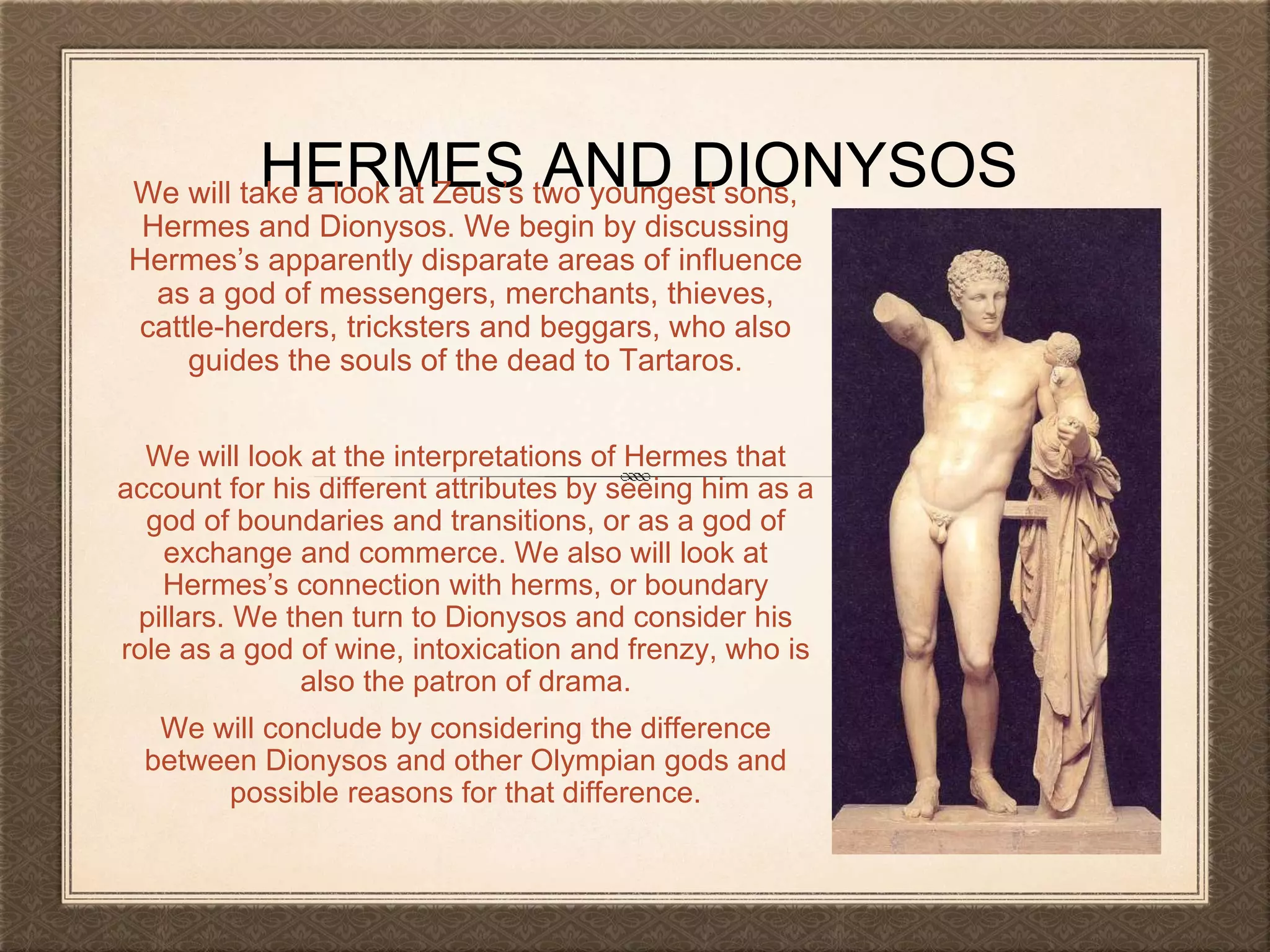
HERMES AND DIONYSOS We will take a look at Zeus’s two youngest sons, 
Hermes and Dionysos. We begin by discussing 
Hermes’s apparently disparate areas of influence 
as a god of messengers, merchants, thieves, 
cattle-herders, tricksters and beggars, who also 
guides the souls of the dead to Tartaros. 
We will look at the interpretations of Hermes that 
account for his different attributes by seeing him as a 
god of boundaries and transitions, or as a god of 
exchange and commerce. We also will look at 
Hermes’s connection with herms, or boundary 
pillars. We then turn to Dionysos and consider his 
role as a god of wine, intoxication and frenzy, who is 
also the patron of drama. 
We will conclude by considering the difference 
between Dionysos and other Olympian gods and 
possible reasons for that difference.
ZEUS’S TWO YOUNGEST SONS ARE HERMES AND DIONYSOS. HERMES IS 
THE SON OF A MINOR GODDESS, MAIA, AND DIONYSOS IS THE SON OF A 
HUMAN WOMAN, SEMELE. 
Hermes is often identified simply as the “messenger of the 
gods,” a description that does not do him justice. 
Like his siblings Apollo and Artemis, Hermes presides over 
a group of characteristics that at first glance seem 
unconnected. He is the patron god of messengers, 
heralds, merchants, thieves, beggars, travelers, and roads; 
cattle and cattle-herders; liars and tricksters. In addition, 
he is the god who conducts the souls of the dead to 
Tartaros. 
Hermes is often described as a god of boundaries and 
transitions. 
Another way of looking at him is to see him as the god of 
exchange and commerce.
THE HOMERIC HYMN TO HERMES, WHICH NARRATES HIS 
BIRTH STORY, SUPPORTS THE IDEA THAT HERMES IS THE 
GOD OF EXCHANGE. 
The first thing the newborn god does is create a lyre out of a tortoise shell. This he 
later barters to Apollo in exchange for Apollo’s cattle. 
If we view Hermes as primarily a god of exchange, then the association with both 
merchants and thieves makes sense. 
His association with cattle also makes sense, because cattle are a primary means 
of determining wealth. 
His association with messengers and heralds can be explained in two ways. 
Messengers and heralds preside over the exchange of information, which is a 
logical development from the exchange of goods. 
Messengers and heralds often perform other tasks having to do with the exchange 
of goods.
HERMES IS ASSOCIATED WITH HERMS, PILLARS THAT STOOD IN THE 
MARKETPLACE, IN FRONT OF PRIVATE HOUSES, AND AT 
CROSSROADS. THIS REFLECTS HIS ASPECT AS A GOD OF 
BOUNDARIES.. 
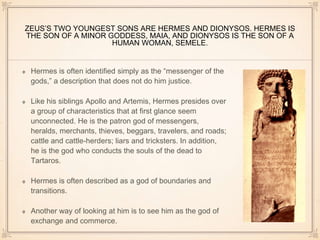
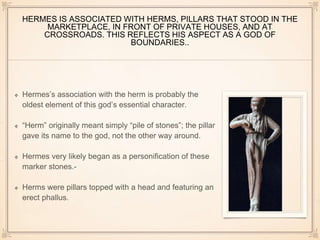
Hermes’s association with the herm is probably the 
oldest element of this god’s essential character. 
“Herm” originally meant simply “pile of stones”; the pillar 
gave its name to the god, not the other way around. 
Hermes very likely began as a personification of these 
marker stones.- 
Herms were pillars topped with a head and featuring an 
erect phallus.
HERMES 
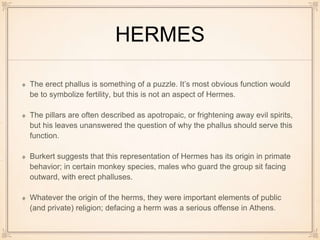
The erect phallus is something of a puzzle. It’s most obvious function would 
be to symbolize fertility, but this is not an aspect of Hermes. 
The pillars are often described as apotropaic, or frightening away evil spirits, 
but his leaves unanswered the question of why the phallus should serve this 
function. 
Burkert suggests that this representation of Hermes has its origin in primate 
behavior; in certain monkey species, males who guard the group sit facing 
outward, with erect phalluses. 
Whatever the origin of the herms, they were important elements of public 
(and private) religion; defacing a herm was a serious offense in Athens.
ZEUS HAD ONE MORE IMPORTANT SON, DIONYSOS. 
HE IS A COMPLEX GOD WHOSE DOMAINS INCLUDE 
FERTILITY OF PLANTS, WINE, FRENZY, IRRATIONALITY 
AND DRAMA 
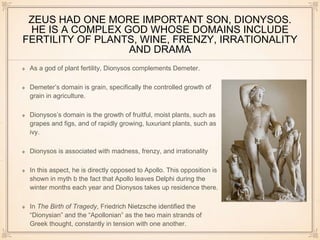
As a god of plant fertility, Dionysos complements Demeter. 
Demeter’s domain is grain, specifically the controlled growth of 
grain in agriculture. 
Dionysos’s domain is the growth of fruitful, moist plants, such as 
grapes and figs, and of rapidly growing, luxuriant plants, such as 
ivy. 
Dionysos is associated with madness, frenzy, and irrationality 
In this aspect, he is directly opposed to Apollo. This opposition is 
shown in myth b the fact that Apollo leaves Delphi during the 
winter months each year and Dionysos takes up residence there. 
In The Birth of Tragedy, Friedrich Nietzsche identified the 
“Dionysian” and the “Apollonian” as the two main strands of 
Greek thought, constantly in tension with one another.
Dionysos’s connection with frenzy is represented 
in myth as his possession of his followers; under 
his influence, they do things completely at odds 
with their usual personalities. 
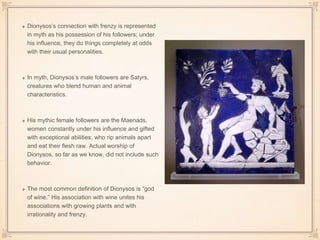
In myth, Dionysos’s male followers are Satyrs, 
creatures who blend human and animal 
characteristics. 
His mythic female followers are the Maenads, 
women constantly under his influence and gifted 
with exceptional abilities, who rip animals apart 
and eat their flesh raw. Actual worship of 
Dionysos, so far as we know, did not include such 
behavior. 
The most common definition of Dionysos is “god 
of wine.” His association with wine unites his 
associations with growing plants and with 
irrationality and frenzy.
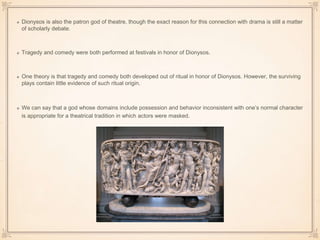
Dionysos is also the patron god of theatre, though the exact reason for this connection with drama is still a matter 
of scholarly debate. 
Tragedy and comedy were both performed at festivals in honor of Dionysos. 
One theory is that tragedy and comedy both developed out of ritual in honor of Dionysos. However, the surviving 
plays contain little evidence of such ritual origin. 
We can say that a god whose domains include possession and behavior inconsistent with one’s normal character 
is appropriate for a theatrical tradition in which actors were masked.
MANY ASPECTS OF DIONYSOS ARE UNUSUAL OR EVEN UNIQUE 
AMONG THE OLYMPIAN GODS. THE FIRST SUCH ASPECT IS HIS 
BIRTH FROM A HUMAN MOTHER. 
Dionysos’s mother was Semele, princess of Thebes, who had an affair with Zeus. 
Hera was jealous and decided to destroy Semele. 
Hera visits Semele disguised as her old nanny. 
Hera suggests that Semele’s lover is simply a man claiming to be Zeus. 
She suggests that Semele should induce him to promise to do whatever she asks, then ask to see him as 
he appears to Hera. 
Semele follows Hera’s advice, Zeus reveals his true form to her, and Semele is incinerated. 
Zeus snatches the infant Dionysos from Semele’s womb and implants him in his own thigh. 
Dionysos is later born from Zeus’s thigh, thus receiving his epithet “twice-born.” 
Dionysos apparently gains his immortal status from his incubation in Zeus’s body.
Semele’s sisters did not believe that their sister could have been the mother of a god. 
In Euripides’ Bacchae, Dionysos returned to Thebes as an adult, disguised as a human priest. He had two purposes to accomplish 
there. 
He wanted to punish is disbelieving relatives. He wanted to establish is religion in Greece. His first step is to drive the Theban women 
mad. 
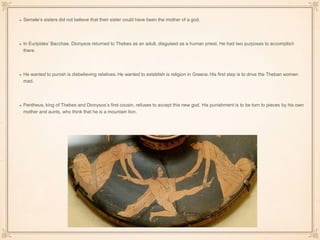
Pentheus, king of Thebes and Dionysos’s first cousin, refuses to accept this new god. His punishment is to be torn to pieces by his own 
mother and aunts, who think that he is a mountain lion.
Scholars used to believe that all these aspects of Dionysos’s myth--his unusual ancestry, the 
resistance to his worship, his general unruliness--were evidence that he was, in fact, a late importation 
into Greece from Asia Minor. 
Evidence now shows that Dionysos was worshipped in Greece as early as most of the other Olympic 
gods; hi is not a late arrival. 
The questions of why Dionysos is so different and why e is represented in myth as a latecomer to the 
pantheon are left open. 
Some scholars think that the representation of Dionysos as a latecomer reflects the Greeks’ own 
discomfort with and distrust of irrationality and frenzy. 
Another possibility is that Dionysos’s association with young, verdant, growing things carries over into 
his myths as the ideas that he himself is young, i.e.e, recent. 
No definitive answer exists.

Hermes and Dionysos

  • 1.
    HERMES AND DIONYSOSWe will take a look at Zeus’s two youngest sons, Hermes and Dionysos. We begin by discussing Hermes’s apparently disparate areas of influence as a god of messengers, merchants, thieves, cattle-herders, tricksters and beggars, who also guides the souls of the dead to Tartaros. We will look at the interpretations of Hermes that account for his different attributes by seeing him as a god of boundaries and transitions, or as a god of exchange and commerce. We also will look at Hermes’s connection with herms, or boundary pillars. We then turn to Dionysos and consider his role as a god of wine, intoxication and frenzy, who is also the patron of drama. We will conclude by considering the difference between Dionysos and other Olympian gods and possible reasons for that difference.
  • 2.
    ZEUS’S TWO YOUNGESTSONS ARE HERMES AND DIONYSOS. HERMES IS THE SON OF A MINOR GODDESS, MAIA, AND DIONYSOS IS THE SON OF A HUMAN WOMAN, SEMELE. Hermes is often identified simply as the “messenger of the gods,” a description that does not do him justice. Like his siblings Apollo and Artemis, Hermes presides over a group of characteristics that at first glance seem unconnected. He is the patron god of messengers, heralds, merchants, thieves, beggars, travelers, and roads; cattle and cattle-herders; liars and tricksters. In addition, he is the god who conducts the souls of the dead to Tartaros. Hermes is often described as a god of boundaries and transitions. Another way of looking at him is to see him as the god of exchange and commerce.
  • 3.
    THE HOMERIC HYMNTO HERMES, WHICH NARRATES HIS BIRTH STORY, SUPPORTS THE IDEA THAT HERMES IS THE GOD OF EXCHANGE. The first thing the newborn god does is create a lyre out of a tortoise shell. This he later barters to Apollo in exchange for Apollo’s cattle. If we view Hermes as primarily a god of exchange, then the association with both merchants and thieves makes sense. His association with cattle also makes sense, because cattle are a primary means of determining wealth. His association with messengers and heralds can be explained in two ways. Messengers and heralds preside over the exchange of information, which is a logical development from the exchange of goods. Messengers and heralds often perform other tasks having to do with the exchange of goods.
  • 4.
    HERMES IS ASSOCIATEDWITH HERMS, PILLARS THAT STOOD IN THE MARKETPLACE, IN FRONT OF PRIVATE HOUSES, AND AT CROSSROADS. THIS REFLECTS HIS ASPECT AS A GOD OF BOUNDARIES.. Hermes’s association with the herm is probably the oldest element of this god’s essential character. “Herm” originally meant simply “pile of stones”; the pillar gave its name to the god, not the other way around. Hermes very likely began as a personification of these marker stones.- Herms were pillars topped with a head and featuring an erect phallus.
  • 5.
    HERMES The erectphallus is something of a puzzle. It’s most obvious function would be to symbolize fertility, but this is not an aspect of Hermes. The pillars are often described as apotropaic, or frightening away evil spirits, but his leaves unanswered the question of why the phallus should serve this function. Burkert suggests that this representation of Hermes has its origin in primate behavior; in certain monkey species, males who guard the group sit facing outward, with erect phalluses. Whatever the origin of the herms, they were important elements of public (and private) religion; defacing a herm was a serious offense in Athens.
  • 6.
    ZEUS HAD ONEMORE IMPORTANT SON, DIONYSOS. HE IS A COMPLEX GOD WHOSE DOMAINS INCLUDE FERTILITY OF PLANTS, WINE, FRENZY, IRRATIONALITY AND DRAMA As a god of plant fertility, Dionysos complements Demeter. Demeter’s domain is grain, specifically the controlled growth of grain in agriculture. Dionysos’s domain is the growth of fruitful, moist plants, such as grapes and figs, and of rapidly growing, luxuriant plants, such as ivy. Dionysos is associated with madness, frenzy, and irrationality In this aspect, he is directly opposed to Apollo. This opposition is shown in myth b the fact that Apollo leaves Delphi during the winter months each year and Dionysos takes up residence there. In The Birth of Tragedy, Friedrich Nietzsche identified the “Dionysian” and the “Apollonian” as the two main strands of Greek thought, constantly in tension with one another.
  • 7.
    Dionysos’s connection withfrenzy is represented in myth as his possession of his followers; under his influence, they do things completely at odds with their usual personalities. In myth, Dionysos’s male followers are Satyrs, creatures who blend human and animal characteristics. His mythic female followers are the Maenads, women constantly under his influence and gifted with exceptional abilities, who rip animals apart and eat their flesh raw. Actual worship of Dionysos, so far as we know, did not include such behavior. The most common definition of Dionysos is “god of wine.” His association with wine unites his associations with growing plants and with irrationality and frenzy.
  • 8.
    Dionysos is alsothe patron god of theatre, though the exact reason for this connection with drama is still a matter of scholarly debate. Tragedy and comedy were both performed at festivals in honor of Dionysos. One theory is that tragedy and comedy both developed out of ritual in honor of Dionysos. However, the surviving plays contain little evidence of such ritual origin. We can say that a god whose domains include possession and behavior inconsistent with one’s normal character is appropriate for a theatrical tradition in which actors were masked.
  • 9.
    MANY ASPECTS OFDIONYSOS ARE UNUSUAL OR EVEN UNIQUE AMONG THE OLYMPIAN GODS. THE FIRST SUCH ASPECT IS HIS BIRTH FROM A HUMAN MOTHER. Dionysos’s mother was Semele, princess of Thebes, who had an affair with Zeus. Hera was jealous and decided to destroy Semele. Hera visits Semele disguised as her old nanny. Hera suggests that Semele’s lover is simply a man claiming to be Zeus. She suggests that Semele should induce him to promise to do whatever she asks, then ask to see him as he appears to Hera. Semele follows Hera’s advice, Zeus reveals his true form to her, and Semele is incinerated. Zeus snatches the infant Dionysos from Semele’s womb and implants him in his own thigh. Dionysos is later born from Zeus’s thigh, thus receiving his epithet “twice-born.” Dionysos apparently gains his immortal status from his incubation in Zeus’s body.
  • 10.
    Semele’s sisters didnot believe that their sister could have been the mother of a god. In Euripides’ Bacchae, Dionysos returned to Thebes as an adult, disguised as a human priest. He had two purposes to accomplish there. He wanted to punish is disbelieving relatives. He wanted to establish is religion in Greece. His first step is to drive the Theban women mad. Pentheus, king of Thebes and Dionysos’s first cousin, refuses to accept this new god. His punishment is to be torn to pieces by his own mother and aunts, who think that he is a mountain lion.
  • 11.
    Scholars used tobelieve that all these aspects of Dionysos’s myth--his unusual ancestry, the resistance to his worship, his general unruliness--were evidence that he was, in fact, a late importation into Greece from Asia Minor. Evidence now shows that Dionysos was worshipped in Greece as early as most of the other Olympic gods; hi is not a late arrival. The questions of why Dionysos is so different and why e is represented in myth as a latecomer to the pantheon are left open. Some scholars think that the representation of Dionysos as a latecomer reflects the Greeks’ own discomfort with and distrust of irrationality and frenzy. Another possibility is that Dionysos’s association with young, verdant, growing things carries over into his myths as the ideas that he himself is young, i.e.e, recent. No definitive answer exists.