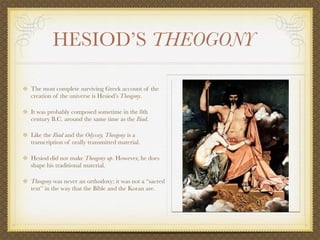
HESIOD’S THEOGONY
The most complete surviving Greek account of the
creation of the universe is Hesiod’s Theogony.
It was probably composed sometime in the 8th
century B.C. around the same time as the Iliad.
Like the Iliad and the Odyssey, Theogony is a
transcription of orally transmitted material.
Hesiod did not make Theogony up. However, he does
shape his traditional material.
Theogony was never an orthodoxy; it was not a “sacred
text” in the way that the Bible and the Koran are.
THEOGONY IS BOTH A DESCRIPTION OF HOW THE MATERIAL
UNIVERSE CAME INTO BEING AND A DESCRIPTION OF
THE BIRTH OF THE GODS.
The Greek Gods are not separate from the universe and they don’t
create the universe; they are part of it.
They are not outside the universe; they themselves are beings inside
the universe.
Theogony uses the narrative of the gods’ birth to describe events
that we would approach through science, philosophy, and
psychology.
This aspect of Theogony means that a character can be both a
natural force or element and an anthropomorphic entity with
volition, emotion, and bodily functions.
This creation story reveals much about the nature of the gods. No
external creator exists outside and beyond the universe itself.
These gods are not transcendent, and they are not omnipotent. The
gods are immortal for at least so long as the universe lasts.
The gods are highly anthropomorphic. They eat, drink, sleep, mate,
and feel emotions.
This implies, among other things, that these gods
are not omnipotent within the universe.
They are extremely powerful, but none of them--
not even Zeus, the head god--is altogether
omnipotent.
First was Chaos:
then Hesiod posits several primordial gods:
Chaos, Gaia, Tartaros, and Eros
“Chaos” in ancient Greek meant a gap or yawning,
not a state of disorder.
Hesiod says that Chaos came first, then Gaia; it is
unclear whether Gaia and the other original entities
were born from Chaos or simply appear after Chaos.
Gaia is the earth. Because Hesiod’s universe was
geocentric, she is pictured as the first natural entity to
exist.
Tartaros is the Underworld, the land that will
eventually be inhabited by the souls of dead humans.
Eros means “sexual desire.” In later versions of myth,
he is the son of Aphrodite; but in this account, almost
all creation takes place through sexual reproduction.
For Hesiod, Eros must be a primal deity. Gaia by Anselm Feuerbach, 1875
THE UNIVERSE BEGINS TO TAKE SHAPE
After the appearance of the primordial deities, birth and sexual
reproduction become the standard means of reproduction.
Chaos gives birth to Night (Nyx) and Erebos (the gloomy darkness
of the Underworld). The latter mate and produce Aether (Upper Air)
and Day (Hemera).
Night and Day share a house, forever shrouded in darkness by the
grim clouds of Tartaros. Yet they never stay in the same house
together. Instead, they take turns, each waiting for the other to depart
before crossing the bronze threshold and entering the house.
Gaia gives birth (out of her own self through parthogenesis) to
Ouranos (Sky), Pontos (Sea), and Mountains.
The earth is taking recognizable shape, creating the Mediterranean
Sea and the important mountains known to Hesiod.
These include important natural elements, such as the Sun, the Moon,
and the River Oceanos, which flows around the edges of Gaia.
GAIA MATES WITH OURANOS AND PRODUCES TWELVE
CHILDREN - THE TITANS (THE "OVERREACHERS")
The Daughters were: Theia, who would become an early
goddess of light
Rhea, an earth goddess who would later become mother
of the Olympian Gods
Themis, another earth or mother goddess
Mnemosyne, a personification of Memory
Phoebe, who would become an early moon goddess
Tethys, who would become the most ancient goddess of
the sea
The Sons were: Oceanus, the first born of the Titans,
both the god of the primordial river and the river itself,
who flowed from the Underworld in a circular and never
ending stream around the edge of the earth
Coeus, who would become the father of Leto, the
mother of the Olympian Gods Apollo and Artemis
Crius, who would become the father of Astraeus
Hyperion, who would become an early god of the son
Iapetus, who would become the father of Prometheus
Cronus, the youngest of the titans, but the craftiest and
most daring.
Though not as well known as the Titans who came after
them, the first children of Gaia and Uranus were three
giants: Cortus, Briareus and Gyges. Each of these
brothers had 50 heads and 100 arms. These Hundred-
Handed giants would be the mightiest of all Gaia's and
Uranus's offspring. Their great strength and
imposing presence caused even Titans and later
Olympians to quake with fear.
ALL WAS NOT WELL WITH
GAIA AND OURANOS
Being intimidated by an oracle stating that he
would be overthrown by one of his children,
Ouranos does not allow the children to be born,
but pushes them back into Gaia’s womb.
With the help of her youngest son Cronos, Gaia
disables Ouranos. Cronos hides inside his
mother’s body and castrates his father with a sickle
that his mother has given him.
Cronos thrown the severed genitals into Pontos;
Aphrodite (goddess of sexual passion) is born
form the foam that springs up around them.
Ouranos retreats from Gaia and becomes the
dome of the sky; leaving room for his children to
be born and for other entities to develop.
Ouranos and Gaia fathered twelve sons and six
daughters. The eldest of these--the giant Kyklopes and
Hekatonkheires--he locked away inside the belly of
Earth. Gaia suffered immense pain and persuaded her
Titan sons to rebel. Four of these were set as sentinels at
the four corners of the world, ready to grasp their father
as he descended to lie upon the Earth. The fifth took his
place in the centre, and armed with an adamantine
sickle, castrated Ouranos while his brothers held him
firm. The sky-god's blood fell and drenched the earth,
producing the avenging Erinyes and the Gigantes.
THIS STORY SHOWS HOW MYTH CAN WORK
ON SEVERAL LEVELS AT ONCE
Gaia is the Earth and Ouranos is the
Sky; at the same time, Gaia is a female
entity with a womb, who can feel both
pain and anger when her husband
pushes her babies back into her.
We also see the Sky pressing down on
Earth so that there is no space for
anything to develop between them.
With the freeing of Gaia’s children, the
world enters a new stage of
development, represented in the text by
a whole flurry of reproduction.
THE STORY ALSO LENDS ITSELF TO
ALLEGORICAL INTERPRETATIONS
Because Cronos’s name resembles
the Greek work for “time,” chronos
According to this interpretation,
when Cronos’s freed from Gaia’s
womb, Time came into being.
The two words, Cronos and chronos
are not actually related, but this
does not invalidate the allegorical
interpretation, if Hesiod or his
contemporaries thought that they
were related.
THE SAME BASIC PATTERN IS REPEATED IN THE NEXT GENERATION,
WHEN CRONOS IN HIS TURN TIRES TO PREVENT THE BIRTH OF HIS
CHILDREN.
Cronos marries his sister Rheia, and they
produce six children: Hestia, Demeter,
Hera, Hades, Poseidon, and Zeus
Unlike his father, Cronos does not leave
his children in their mother’s body and,
thus, to some extent under her control.
He swallows each child as it is born.
Rheia tricks him by giving him a stone
wrapped in swaddling clothes in place of
the youngest child, Zeus.
Zeus is sent to the island of Crete to be
reared in secret.
ZEUS REACHES MATURITY AND OVERTHROWS
HIS FATHER.
Cronos spits out the children in reverse order. Thus, Zeus is, in a sense, both the youngest
and the oldest of his siblings. Zeus and his 5 siblings, together with several of Zeus’s
children, come to be called the Olympians.
A 10-year war ensues between the Titans (Cronos) and the Olympians (Zeus). Finally, Zeus
and his siblings triumph.
At this point, the struggle for power ends and the order of rule in the universe is set; Zeus
will remain the head god forever. As such, he is often called simply “The Olympian.”
ONE IMMEDIATELY NOTICEABLE AND INTRIGUING POINT ABOUT
THIS NARRATIVE IS THAT IT PORTRAYS THE STRUGGLE FOR POWER
AS ONE INVOLVING OLDER FEMALE DEITIES OPPOSED BY YOUNGER
MALE DEITIES
Many scholars argue that this reflects the psychological anxieties of males about their parents’ sexuality,
about displacing their fathers, and about having to hand power over to their sons in turn.
Others see the increased anthropomorphism of each generation and the decreased identification of gods
and natural forces as representing the development of civilization.
Others point to the apparent anxiety in Greek culture about the power of women, the fear that women
would exert control if they could.
Other explanations exist. Any effort to find just one “decoding” of the Ouranos-Cronos-Zeus story is
probably doomed to failure.

Firstchaos

  • 1.
    HESIOD’S THEOGONY The mostcomplete surviving Greek account of the creation of the universe is Hesiod’s Theogony. It was probably composed sometime in the 8th century B.C. around the same time as the Iliad. Like the Iliad and the Odyssey, Theogony is a transcription of orally transmitted material. Hesiod did not make Theogony up. However, he does shape his traditional material. Theogony was never an orthodoxy; it was not a “sacred text” in the way that the Bible and the Koran are.
  • 2.
    THEOGONY IS BOTHA DESCRIPTION OF HOW THE MATERIAL UNIVERSE CAME INTO BEING AND A DESCRIPTION OF THE BIRTH OF THE GODS. The Greek Gods are not separate from the universe and they don’t create the universe; they are part of it. They are not outside the universe; they themselves are beings inside the universe. Theogony uses the narrative of the gods’ birth to describe events that we would approach through science, philosophy, and psychology. This aspect of Theogony means that a character can be both a natural force or element and an anthropomorphic entity with volition, emotion, and bodily functions. This creation story reveals much about the nature of the gods. No external creator exists outside and beyond the universe itself. These gods are not transcendent, and they are not omnipotent. The gods are immortal for at least so long as the universe lasts. The gods are highly anthropomorphic. They eat, drink, sleep, mate, and feel emotions. This implies, among other things, that these gods are not omnipotent within the universe. They are extremely powerful, but none of them-- not even Zeus, the head god--is altogether omnipotent.
  • 3.
    First was Chaos: thenHesiod posits several primordial gods: Chaos, Gaia, Tartaros, and Eros “Chaos” in ancient Greek meant a gap or yawning, not a state of disorder. Hesiod says that Chaos came first, then Gaia; it is unclear whether Gaia and the other original entities were born from Chaos or simply appear after Chaos. Gaia is the earth. Because Hesiod’s universe was geocentric, she is pictured as the first natural entity to exist. Tartaros is the Underworld, the land that will eventually be inhabited by the souls of dead humans. Eros means “sexual desire.” In later versions of myth, he is the son of Aphrodite; but in this account, almost all creation takes place through sexual reproduction. For Hesiod, Eros must be a primal deity. Gaia by Anselm Feuerbach, 1875
  • 4.
    THE UNIVERSE BEGINSTO TAKE SHAPE After the appearance of the primordial deities, birth and sexual reproduction become the standard means of reproduction. Chaos gives birth to Night (Nyx) and Erebos (the gloomy darkness of the Underworld). The latter mate and produce Aether (Upper Air) and Day (Hemera). Night and Day share a house, forever shrouded in darkness by the grim clouds of Tartaros. Yet they never stay in the same house together. Instead, they take turns, each waiting for the other to depart before crossing the bronze threshold and entering the house. Gaia gives birth (out of her own self through parthogenesis) to Ouranos (Sky), Pontos (Sea), and Mountains. The earth is taking recognizable shape, creating the Mediterranean Sea and the important mountains known to Hesiod. These include important natural elements, such as the Sun, the Moon, and the River Oceanos, which flows around the edges of Gaia.
  • 5.
    GAIA MATES WITHOURANOS AND PRODUCES TWELVE CHILDREN - THE TITANS (THE "OVERREACHERS") The Daughters were: Theia, who would become an early goddess of light Rhea, an earth goddess who would later become mother of the Olympian Gods Themis, another earth or mother goddess Mnemosyne, a personification of Memory Phoebe, who would become an early moon goddess Tethys, who would become the most ancient goddess of the sea The Sons were: Oceanus, the first born of the Titans, both the god of the primordial river and the river itself, who flowed from the Underworld in a circular and never ending stream around the edge of the earth Coeus, who would become the father of Leto, the mother of the Olympian Gods Apollo and Artemis Crius, who would become the father of Astraeus Hyperion, who would become an early god of the son Iapetus, who would become the father of Prometheus Cronus, the youngest of the titans, but the craftiest and most daring. Though not as well known as the Titans who came after them, the first children of Gaia and Uranus were three giants: Cortus, Briareus and Gyges. Each of these brothers had 50 heads and 100 arms. These Hundred- Handed giants would be the mightiest of all Gaia's and Uranus's offspring. Their great strength and imposing presence caused even Titans and later Olympians to quake with fear.
  • 6.
    ALL WAS NOTWELL WITH GAIA AND OURANOS Being intimidated by an oracle stating that he would be overthrown by one of his children, Ouranos does not allow the children to be born, but pushes them back into Gaia’s womb. With the help of her youngest son Cronos, Gaia disables Ouranos. Cronos hides inside his mother’s body and castrates his father with a sickle that his mother has given him. Cronos thrown the severed genitals into Pontos; Aphrodite (goddess of sexual passion) is born form the foam that springs up around them. Ouranos retreats from Gaia and becomes the dome of the sky; leaving room for his children to be born and for other entities to develop. Ouranos and Gaia fathered twelve sons and six daughters. The eldest of these--the giant Kyklopes and Hekatonkheires--he locked away inside the belly of Earth. Gaia suffered immense pain and persuaded her Titan sons to rebel. Four of these were set as sentinels at the four corners of the world, ready to grasp their father as he descended to lie upon the Earth. The fifth took his place in the centre, and armed with an adamantine sickle, castrated Ouranos while his brothers held him firm. The sky-god's blood fell and drenched the earth, producing the avenging Erinyes and the Gigantes.
  • 7.
    THIS STORY SHOWSHOW MYTH CAN WORK ON SEVERAL LEVELS AT ONCE Gaia is the Earth and Ouranos is the Sky; at the same time, Gaia is a female entity with a womb, who can feel both pain and anger when her husband pushes her babies back into her. We also see the Sky pressing down on Earth so that there is no space for anything to develop between them. With the freeing of Gaia’s children, the world enters a new stage of development, represented in the text by a whole flurry of reproduction.
  • 8.
    THE STORY ALSOLENDS ITSELF TO ALLEGORICAL INTERPRETATIONS Because Cronos’s name resembles the Greek work for “time,” chronos According to this interpretation, when Cronos’s freed from Gaia’s womb, Time came into being. The two words, Cronos and chronos are not actually related, but this does not invalidate the allegorical interpretation, if Hesiod or his contemporaries thought that they were related.
  • 9.
    THE SAME BASICPATTERN IS REPEATED IN THE NEXT GENERATION, WHEN CRONOS IN HIS TURN TIRES TO PREVENT THE BIRTH OF HIS CHILDREN. Cronos marries his sister Rheia, and they produce six children: Hestia, Demeter, Hera, Hades, Poseidon, and Zeus Unlike his father, Cronos does not leave his children in their mother’s body and, thus, to some extent under her control. He swallows each child as it is born. Rheia tricks him by giving him a stone wrapped in swaddling clothes in place of the youngest child, Zeus. Zeus is sent to the island of Crete to be reared in secret.
  • 10.
    ZEUS REACHES MATURITYAND OVERTHROWS HIS FATHER. Cronos spits out the children in reverse order. Thus, Zeus is, in a sense, both the youngest and the oldest of his siblings. Zeus and his 5 siblings, together with several of Zeus’s children, come to be called the Olympians. A 10-year war ensues between the Titans (Cronos) and the Olympians (Zeus). Finally, Zeus and his siblings triumph. At this point, the struggle for power ends and the order of rule in the universe is set; Zeus will remain the head god forever. As such, he is often called simply “The Olympian.”
  • 11.
    ONE IMMEDIATELY NOTICEABLEAND INTRIGUING POINT ABOUT THIS NARRATIVE IS THAT IT PORTRAYS THE STRUGGLE FOR POWER AS ONE INVOLVING OLDER FEMALE DEITIES OPPOSED BY YOUNGER MALE DEITIES Many scholars argue that this reflects the psychological anxieties of males about their parents’ sexuality, about displacing their fathers, and about having to hand power over to their sons in turn. Others see the increased anthropomorphism of each generation and the decreased identification of gods and natural forces as representing the development of civilization. Others point to the apparent anxiety in Greek culture about the power of women, the fear that women would exert control if they could. Other explanations exist. Any effort to find just one “decoding” of the Ouranos-Cronos-Zeus story is probably doomed to failure.