Energy Balance
S.Gunabalan
Associate Professor
Mechanical Engineering Department
Bharathiyar College of Engineering & Technology
Karaikal - 609 609.
e-Mail : gunabalans@yahoo.com
Part - 2
Energy accounting
• Energy accounting is a system used to
measure, analyze and report the energy
consumption of different activities on a
regular basis.
• It is done to improve energy efficiency
Energy Balances
Energy Balances is the law of conservation of
energy,
Unit II
13) Discuss briefly the energy balance for closed
and open system (Nov 2011)
OR explain or derive energy balance equation
OR Explain or derive Steady Flow Energy equation
Energy Balances on Closed Systems
• Example for a Closed System
– Storage tank
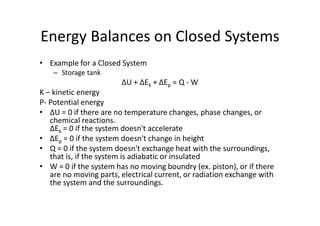
ΔU + ΔEk + ΔEp = Q - W
K – kinetic energy
P- Potential energy
• ΔU = 0 if there are no temperature changes, phase changes, or
chemical reactions.
ΔEk = 0 if the system doesn't accelerate
• ΔEp = 0 if the system doesn't change in height
• Q = 0 if the system doesn't exchange heat with the surroundings,
that is, if the system is adiabatic or insulated
• W = 0 if the system has no moving boundry (ex. piston), or if there
are no moving parts, electrical current, or radiation exchange with
the system and the surroundings.
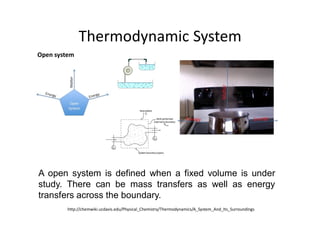
Thermodynamic System
Open system
http://chemwiki.ucdavis.edu/Physical_Chemistry/Thermodynamics/A_System_And_Its_Surroundings
A open system is defined when a fixed volume is under
study. There can be mass transfers as well as energy
transfers across the boundary.
Thermodynamic System
• Truly isolated systems cannot exist in nature,
• The only possibility is the universe itself,
• So its is a hypothetical concepts
http://chemwiki.ucdavis.edu/Physical_Chemistry/Thermodynamics/A_System_And_Its_Surroundings
isolated systems
Thermodynamic System
http://chemwiki.ucdavis.edu/Physical_Chemistry/Thermodynamics/A_System_And_Its_Surroundings
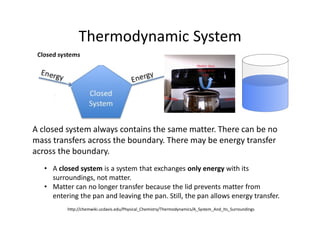
Closed systems
• A closed system is a system that exchanges only energy with its
surroundings, not matter.
• Matter can no longer transfer because the lid prevents matter from
entering the pan and leaving the pan. Still, the pan allows energy transfer.
A closed system always contains the same matter. There can be no
mass transfers across the boundary. There may be energy transfer
across the boundary.
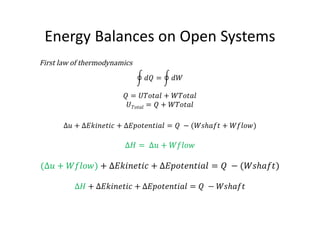
First law of thermodynamics
=
= +
= +
∆ + ∆ + ∆ = 	 − ( ℎ + )
∆ =	∆ +
(∆ + ) + ∆ + ∆ = 	 − ( ℎ )
∆ + ∆ + ∆ = 	 − ℎ
Energy Balances on Open Systems
∆ + ∆ + ∆
= 	 − ℎ
( 2	 − 1) + 2 − 1 + ( 2 − 1) = 	 − ℎ
1 + 1 + 1 +
= 2 + 2 + 2 + ℎ
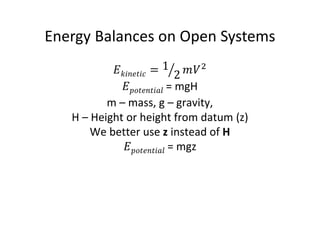
Energy Balances on Open Systems
= 1
2
= mgH
m – mass, g – gravity,
H – Height or height from datum (z)
We better use z instead of H
= mgz
Energy Balances on Open Systems
1 +
1
2 1
2 + 1 + = 2 +
1
2 2
2 + 2 +
Convert in to specific term ie /Kg
ℎ1 +
1
2 1
2 + 1 +
= ℎ2 +
1
2 2
2 + 2 +
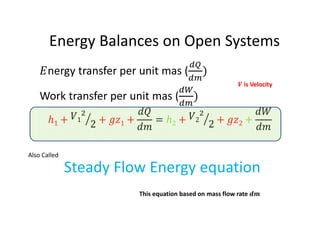
Energy Balances on Open Systems
nergy transfer per unit mas ( )
Work transfer per unit mas ( )
ℎ1 + 1
2 + 1 + = ℎ2 + 2
2 + 2 +
Steady Flow Energy equation
Energy Balances on Open Systems
Also Called
is Velocity
This equation based on mass flow rate
ℎ1 + 1
2 + 1 + = ℎ2 + 2
2 + 2 +
X by 		 	 	 	 	 	 	 	 	
(ℎ1 + + 1) + = (ℎ2 + + 2) +
represented as w
(ℎ1 + 1
2 + 1) +
= 	(ℎ2 + 2
2 + 2) +
Energy Balances on Open Systemsis Velocity
Derive the steady flow energy equation for open system on time basis (Apr/May 2010)
This equation based on Time
Mass Balance
• Conservation of mass
– The mass flow rate of a system at entry equal to
mass flow rate at exit of the system
	 = 	
1 1
1
=	
2 2
2
This is Equation of Continuity
– Velocity of flow
=
	 	 /
/
=
	
= mass flow rate
Steady Flow systems
• Steady Flow systems where mass flow in
equals mass flow out.
• In unsteady flow systems parameters such as
pressure, mass, temperature etc. will
• change with time. (hence ‘unsteady’)
• In steady flow systems parameters such as
pressure, mass, temperature etc. will remain
• constant with time. (hence ‘steady’
Reference
• Rajput, R. K. 2010. Engineering thermodynamics. Jones and Bartlett
Publishers, Sudbury, Mass.
• Nag, P. K. 2002. Basic and applied thermodynamics. Tata McGraw-Hill, New
Delhi.
• http://blowers.chee.arizona.edu/201project/EBopensys.pg1.HTML
• http://chemwiki.ucdavis.edu/Physical_Chemistry/Thermodynamics/A_Sys
tem_And_Its_Surroundings

02 part5 energy balance

  • 1.
    Energy Balance S.Gunabalan Associate Professor MechanicalEngineering Department Bharathiyar College of Engineering & Technology Karaikal - 609 609. e-Mail : gunabalans@yahoo.com Part - 2
  • 2.
    Energy accounting • Energyaccounting is a system used to measure, analyze and report the energy consumption of different activities on a regular basis. • It is done to improve energy efficiency
  • 3.
    Energy Balances Energy Balancesis the law of conservation of energy, Unit II 13) Discuss briefly the energy balance for closed and open system (Nov 2011) OR explain or derive energy balance equation OR Explain or derive Steady Flow Energy equation
  • 4.
    Energy Balances onClosed Systems • Example for a Closed System – Storage tank ΔU + ΔEk + ΔEp = Q - W K – kinetic energy P- Potential energy • ΔU = 0 if there are no temperature changes, phase changes, or chemical reactions. ΔEk = 0 if the system doesn't accelerate • ΔEp = 0 if the system doesn't change in height • Q = 0 if the system doesn't exchange heat with the surroundings, that is, if the system is adiabatic or insulated • W = 0 if the system has no moving boundry (ex. piston), or if there are no moving parts, electrical current, or radiation exchange with the system and the surroundings.
  • 5.
  • 6.
    Thermodynamic System Open system http://chemwiki.ucdavis.edu/Physical_Chemistry/Thermodynamics/A_System_And_Its_Surroundings Aopen system is defined when a fixed volume is under study. There can be mass transfers as well as energy transfers across the boundary.
  • 7.
    Thermodynamic System • Trulyisolated systems cannot exist in nature, • The only possibility is the universe itself, • So its is a hypothetical concepts http://chemwiki.ucdavis.edu/Physical_Chemistry/Thermodynamics/A_System_And_Its_Surroundings isolated systems
  • 8.
    Thermodynamic System http://chemwiki.ucdavis.edu/Physical_Chemistry/Thermodynamics/A_System_And_Its_Surroundings Closed systems •A closed system is a system that exchanges only energy with its surroundings, not matter. • Matter can no longer transfer because the lid prevents matter from entering the pan and leaving the pan. Still, the pan allows energy transfer. A closed system always contains the same matter. There can be no mass transfers across the boundary. There may be energy transfer across the boundary.
  • 9.
    First law ofthermodynamics = = + = + ∆ + ∆ + ∆ = − ( ℎ + ) ∆ = ∆ + (∆ + ) + ∆ + ∆ = − ( ℎ ) ∆ + ∆ + ∆ = − ℎ Energy Balances on Open Systems
  • 10.
    ∆ + ∆+ ∆ = − ℎ ( 2 − 1) + 2 − 1 + ( 2 − 1) = − ℎ 1 + 1 + 1 + = 2 + 2 + 2 + ℎ Energy Balances on Open Systems
  • 11.
    = 1 2 = mgH m– mass, g – gravity, H – Height or height from datum (z) We better use z instead of H = mgz Energy Balances on Open Systems
  • 12.
    1 + 1 2 1 2+ 1 + = 2 + 1 2 2 2 + 2 + Convert in to specific term ie /Kg ℎ1 + 1 2 1 2 + 1 + = ℎ2 + 1 2 2 2 + 2 + Energy Balances on Open Systems
  • 13.
    nergy transfer perunit mas ( ) Work transfer per unit mas ( ) ℎ1 + 1 2 + 1 + = ℎ2 + 2 2 + 2 + Steady Flow Energy equation Energy Balances on Open Systems Also Called is Velocity This equation based on mass flow rate
  • 14.
    ℎ1 + 1 2+ 1 + = ℎ2 + 2 2 + 2 + X by (ℎ1 + + 1) + = (ℎ2 + + 2) + represented as w (ℎ1 + 1 2 + 1) + = (ℎ2 + 2 2 + 2) + Energy Balances on Open Systemsis Velocity Derive the steady flow energy equation for open system on time basis (Apr/May 2010) This equation based on Time
  • 15.
    Mass Balance • Conservationof mass – The mass flow rate of a system at entry equal to mass flow rate at exit of the system = 1 1 1 = 2 2 2 This is Equation of Continuity – Velocity of flow = / / = = mass flow rate
  • 16.
    Steady Flow systems •Steady Flow systems where mass flow in equals mass flow out. • In unsteady flow systems parameters such as pressure, mass, temperature etc. will • change with time. (hence ‘unsteady’) • In steady flow systems parameters such as pressure, mass, temperature etc. will remain • constant with time. (hence ‘steady’
  • 17.
    Reference • Rajput, R.K. 2010. Engineering thermodynamics. Jones and Bartlett Publishers, Sudbury, Mass. • Nag, P. K. 2002. Basic and applied thermodynamics. Tata McGraw-Hill, New Delhi. • http://blowers.chee.arizona.edu/201project/EBopensys.pg1.HTML • http://chemwiki.ucdavis.edu/Physical_Chemistry/Thermodynamics/A_Sys tem_And_Its_Surroundings