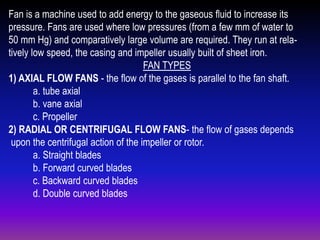
Fan is a machine used to add energy to the gaseous fluid to increase its
pressure. Fans are used where low pressures (from a few mm of water to
50 mm Hg) and comparatively large volume are required. They run at relatively low speed, the casing and impeller usually built of sheet iron.
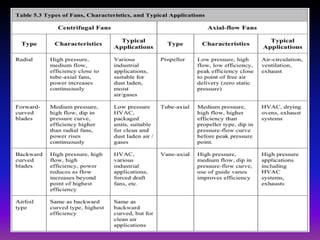
FAN TYPES
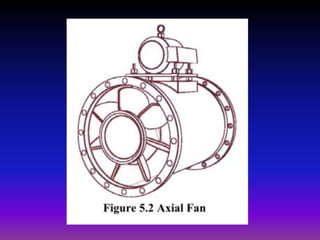
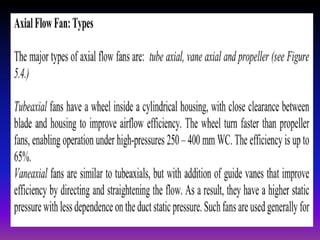
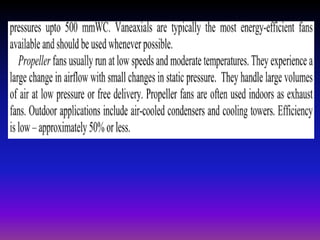
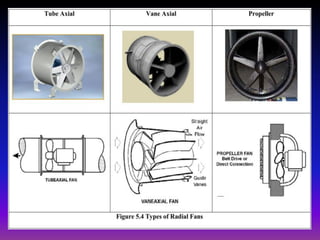
1) AXIAL FLOW FANS - the flow of the gases is parallel to the fan shaft.
a. tube axial
b. vane axial
c. Propeller
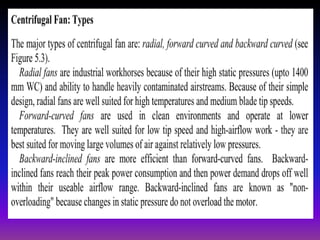
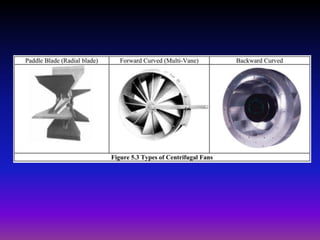
2) RADIAL OR CENTRIFUGAL FLOW FANS- the flow of gases depends
upon the centrifugal action of the impeller or rotor.
a. Straight blades
b. Forward curved blades
c. Backward curved blades
d. Double curved blades
Propeller Fan

Tubeaxial Fan

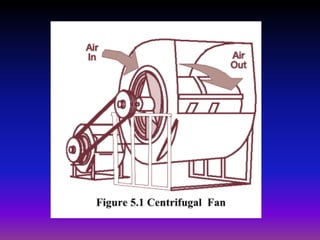
Centrifugal Fan
Air in
Housing

Rotor
Motor

Air out

Vaneaxial Fan
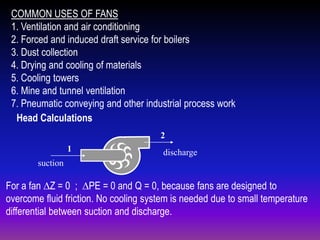
COMMON USES OF FANS
1. Ventilation and air conditioning
2. Forced and induced draft service for boilers
3. Dust collection
4. Drying and cooling of materials
5. Cooling towers
6. Mine and tunnel ventilation
7. Pneumatic conveying and other industrial process work
Head Calculations
2
1

discharge

suction

For a fan Z = 0 ; PE = 0 and Q = 0, because fans are designed to
overcome fluid friction. No cooling system is needed due to small temperature
differential between suction and discharge.
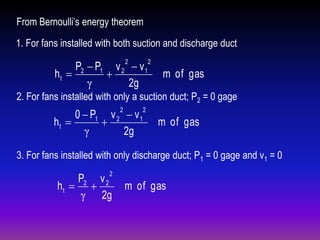
From Bernoulli’s energy theorem
1. For fans installed with both suction and discharge duct
2

P2  P1 v 2  v 1
ht 

γ
2g

2

m of gas

2. For fans installed with only a suction duct; P2 = 0 gage
2

0  P1 v 2  v 1
ht 

γ
2g

2

m of gas

3. For fans installed with only discharge duct; P1 = 0 gage and v1 = 0
2

P2 v 2
ht  
γ 2g

m of gas
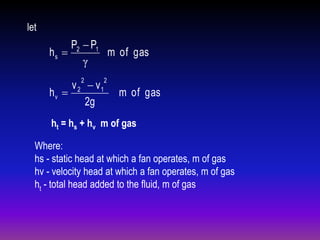
let

P2  P1
hs 
m of gas
γ
2

v 2  v1
hv 
2g

2

m of gas

ht = hs + hv m of gas
Where:
hs - static head at which a fan operates, m of gas
hv - velocity head at which a fan operates, m of gas
ht - total head added to the fluid, m of gas
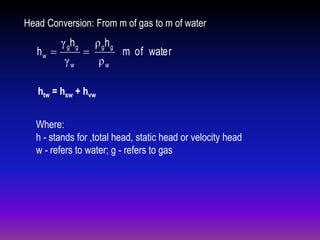
Head Conversion: From m of gas to m of water

hw 

γ gh g
γw



ρ gh g
ρw

m of water

htw = hsw + hvw
Where:
h - stands for ,total head, static head or velocity head
w - refers to water; g - refers to gas
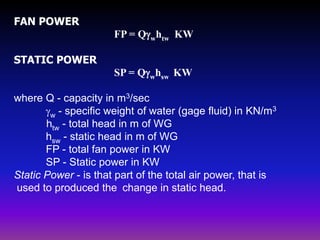
FAN POWER
FP = Qwhtw KW
STATIC POWER

SP = Qwhsw KW
where Q - capacity in m3/sec
w - specific weight of water (gage fluid) in KN/m3
htw - total head in m of WG
hsw - static head in m of WG
FP - total fan power in KW
SP - Static power in KW
Static Power - is that part of the total air power, that is
used to produced the change in static head.
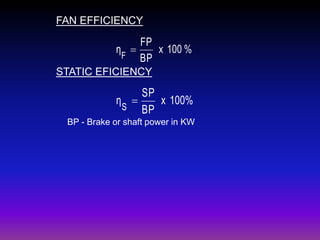
FAN EFFICIENCY

FP
η 
x 100 %
F BP
STATIC EFICIENCY

SP
η 
x 100%
S
BP
BP - Brake or shaft power in KW
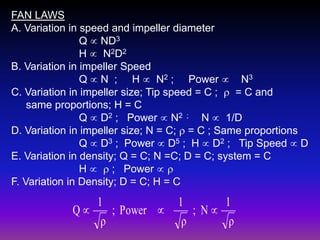
FAN LAWS
A. Variation in speed and impeller diameter
Q  ND3
H  N2D2
B. Variation in impeller Speed
Q  N ; H  N2 ; Power  N3
C. Variation in impeller size; Tip speed = C ;  = C and
same proportions; H = C
Q  D2 ; Power  N2 ; N  1/D
D. Variation in impeller size; N = C;  = C ; Same proportions
Q  D3 ; Power  D5 ; H  D2 ; Tip Speed  D
E. Variation in density; Q = C; N =C; D = C; system = C
H   ; Power  
F. Variation in Density; D = C; H = C

1
Q
; Power 
ρ

1
1
; N
ρ
ρ
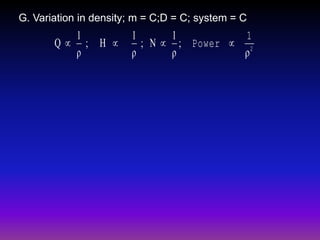
G. Variation in density; m = C;D = C; system = C

1
Q ; H 
ρ

1
1
1
; N  ; Power  2
ρ
ρ

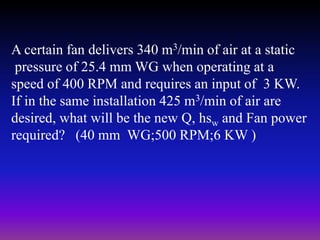
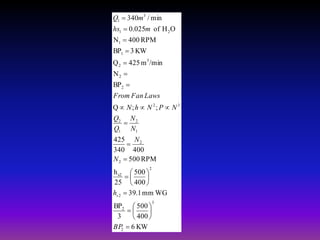
A certain fan delivers 340 m3/min of air at a static
pressure of 25.4 mm WG when operating at a
speed of 400 RPM and requires an input of 3 KW.
If in the same installation 425 m3/min of air are
desired, what will be the new Q, hsw and Fan power
required? (40 mm WG;500 RPM;6 KW )
Q1  340m 3 / min
hs1  0.025m of H 2 O
N1  400 RPM
BP1  3 KW
Q 2  425 m 3 /min
N2 
BP2 
From Fan Laws
Q  N; h  N 2; P  N 3
Q2 N 2

Q1 N1
425 N 2

340 400
N 2  500 RPM
2

h s2  500 


25  400 
hs 2  39.1 mm WG
BP2  500 


3
400 

BP2  6 KW

3
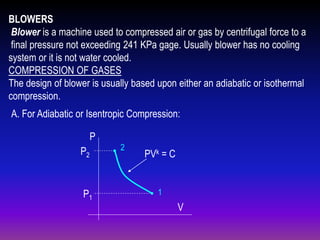
BLOWERS
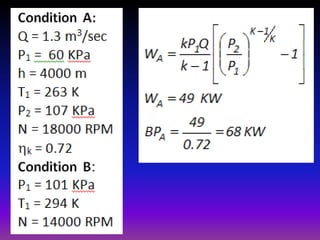
Blower is a machine used to compressed air or gas by centrifugal force to a
final pressure not exceeding 241 KPa gage. Usually blower has no cooling
system or it is not water cooled.
COMPRESSION OF GASES
The design of blower is usually based upon either an adiabatic or isothermal
compression.
A. For Adiabatic or Isentropic Compression:
P
P2

P1

2

PVk = C

1

V
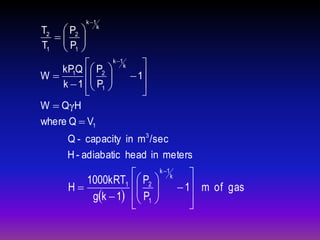
k 1

T2  P2  k
 
T1  P1 
 
 P  k 1k

kP1Q  2
 
W
 1
P 
k  1  1 



W  QγH
where Q  V1
Q - capacity in m3 /sec
H - adiabatic head in meters

 P  k 1k 
1000kRT1  2
 
H
 1 m of gas
gk  1  P1 

 


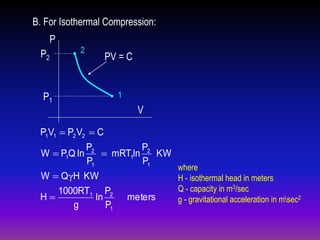
B. For Isothermal Compression:
P

P2

2

PV = C

1

P1

V

P1V1  P2 V2  C
P2
P2
W  P1Q ln
 mRT1ln
KW
P1
P1
W  QγH KW
H

1000RT1 P2
ln
g
P1

meters

where
H - isothermal head in meters
Q - capacity in m3/sec
g - gravitational acceleration in msec2
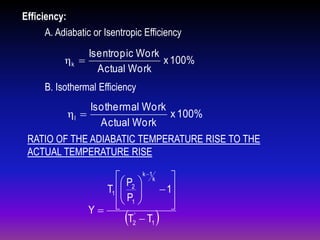
Efficiency:
A. Adiabatic or Isentropic Efficiency

Isentropic Work
ηk 
x 100%
Actual Work
B. Isothermal Efficiency

Isothermal Work
ηI 
x 100%
Actual Work
RATIO OF THE ADIABATIC TEMPERATURE RISE TO THE
ACTUAL TEMPERATURE RISE
 P  k 1k 
T1  2 
 1
P 
 1 


Y  '
T2  T1




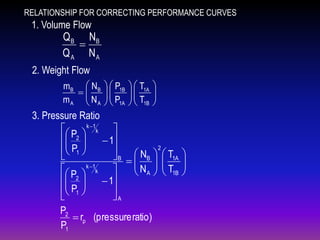
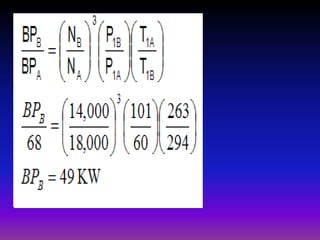
RELATIONSHIP FOR CORRECTING PERFORMANCE CURVES

1. Volume Flow

Q B NB

Q A NA

2. Weight Flow
mB  NB   P1B
  
m A  N A   P1A
 

  T1A

 T
  1B






3. Pressure Ratio
 P  k 1k 
 2 
 1
P 
2
 1 


 B   NB   T1A
  
N  T
k 1
 P  k 
 A   1B
2
 
 1
P 
 1 


A
P2
 rp (pressure ratio)
P1





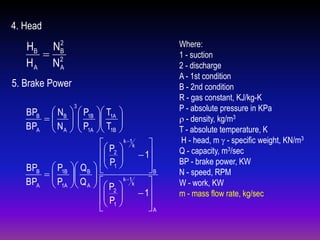
4. Head
2
HB N B
 2
HA NA

5. Brake Power
BPB  NB 
 
BPA  N A 
 

3

 P1B

P
 1A

 T1A

 T
 1B






 P  k 1k 
 2 
 1
P 


BPB  P1B  Q B   1 
B



BPA  P1A  Q A    k 1k 


 P
 2 
 1
P 
 1 


A

Where:
1 - suction
2 - discharge
A - 1st condition
B - 2nd condition
R - gas constant, KJ/kg-K
P - absolute pressure in KPa
 - density, kg/m3
T - absolute temperature, K
H - head, m  - specific weight, KN/m3
Q - capacity, m3/sec
BP - brake power, KW
N - speed, RPM
W - work, KW
m - mass flow rate, kg/sec
Copyright: YURI G. MELLIZA
324619CYE

Fan and blowers (mech 326)

  • 1.
    Fan is amachine used to add energy to the gaseous fluid to increase its pressure. Fans are used where low pressures (from a few mm of water to 50 mm Hg) and comparatively large volume are required. They run at relatively low speed, the casing and impeller usually built of sheet iron. FAN TYPES 1) AXIAL FLOW FANS - the flow of the gases is parallel to the fan shaft. a. tube axial b. vane axial c. Propeller 2) RADIAL OR CENTRIFUGAL FLOW FANS- the flow of gases depends upon the centrifugal action of the impeller or rotor. a. Straight blades b. Forward curved blades c. Backward curved blades d. Double curved blades
  • 2.
    Propeller Fan Tubeaxial Fan CentrifugalFan Air in Housing Rotor Motor Air out Vaneaxial Fan
  • 11.
    COMMON USES OFFANS 1. Ventilation and air conditioning 2. Forced and induced draft service for boilers 3. Dust collection 4. Drying and cooling of materials 5. Cooling towers 6. Mine and tunnel ventilation 7. Pneumatic conveying and other industrial process work Head Calculations 2 1 discharge suction For a fan Z = 0 ; PE = 0 and Q = 0, because fans are designed to overcome fluid friction. No cooling system is needed due to small temperature differential between suction and discharge.
  • 12.
    From Bernoulli’s energytheorem 1. For fans installed with both suction and discharge duct 2 P2  P1 v 2  v 1 ht   γ 2g 2 m of gas 2. For fans installed with only a suction duct; P2 = 0 gage 2 0  P1 v 2  v 1 ht   γ 2g 2 m of gas 3. For fans installed with only discharge duct; P1 = 0 gage and v1 = 0 2 P2 v 2 ht   γ 2g m of gas
  • 13.
    let P2  P1 hs m of gas γ 2 v 2  v1 hv  2g 2 m of gas ht = hs + hv m of gas Where: hs - static head at which a fan operates, m of gas hv - velocity head at which a fan operates, m of gas ht - total head added to the fluid, m of gas
  • 14.
    Head Conversion: Fromm of gas to m of water hw  γ gh g γw  ρ gh g ρw m of water htw = hsw + hvw Where: h - stands for ,total head, static head or velocity head w - refers to water; g - refers to gas
  • 17.
    FAN POWER FP =Qwhtw KW STATIC POWER SP = Qwhsw KW where Q - capacity in m3/sec w - specific weight of water (gage fluid) in KN/m3 htw - total head in m of WG hsw - static head in m of WG FP - total fan power in KW SP - Static power in KW Static Power - is that part of the total air power, that is used to produced the change in static head.
  • 18.
    FAN EFFICIENCY FP η  x100 % F BP STATIC EFICIENCY SP η  x 100% S BP BP - Brake or shaft power in KW
  • 19.
    FAN LAWS A. Variationin speed and impeller diameter Q  ND3 H  N2D2 B. Variation in impeller Speed Q  N ; H  N2 ; Power  N3 C. Variation in impeller size; Tip speed = C ;  = C and same proportions; H = C Q  D2 ; Power  N2 ; N  1/D D. Variation in impeller size; N = C;  = C ; Same proportions Q  D3 ; Power  D5 ; H  D2 ; Tip Speed  D E. Variation in density; Q = C; N =C; D = C; system = C H   ; Power   F. Variation in Density; D = C; H = C 1 Q ; Power  ρ 1 1 ; N ρ ρ
  • 20.
    G. Variation indensity; m = C;D = C; system = C 1 Q ; H  ρ 1 1 1 ; N  ; Power  2 ρ ρ 
  • 21.
    A certain fandelivers 340 m3/min of air at a static pressure of 25.4 mm WG when operating at a speed of 400 RPM and requires an input of 3 KW. If in the same installation 425 m3/min of air are desired, what will be the new Q, hsw and Fan power required? (40 mm WG;500 RPM;6 KW )
  • 22.
    Q1  340m3 / min hs1  0.025m of H 2 O N1  400 RPM BP1  3 KW Q 2  425 m 3 /min N2  BP2  From Fan Laws Q  N; h  N 2; P  N 3 Q2 N 2  Q1 N1 425 N 2  340 400 N 2  500 RPM 2 h s2  500    25  400  hs 2  39.1 mm WG BP2  500    3 400   BP2  6 KW 3
  • 23.
    BLOWERS Blower is amachine used to compressed air or gas by centrifugal force to a final pressure not exceeding 241 KPa gage. Usually blower has no cooling system or it is not water cooled. COMPRESSION OF GASES The design of blower is usually based upon either an adiabatic or isothermal compression. A. For Adiabatic or Isentropic Compression: P P2 P1 2 PVk = C 1 V
  • 24.
    k 1 T2 P2  k   T1  P1     P  k 1k  kP1Q  2   W  1 P  k  1  1     W  QγH where Q  V1 Q - capacity in m3 /sec H - adiabatic head in meters  P  k 1k  1000kRT1  2   H  1 m of gas gk  1  P1      
  • 25.
    B. For IsothermalCompression: P P2 2 PV = C 1 P1 V P1V1  P2 V2  C P2 P2 W  P1Q ln  mRT1ln KW P1 P1 W  QγH KW H 1000RT1 P2 ln g P1 meters where H - isothermal head in meters Q - capacity in m3/sec g - gravitational acceleration in msec2
  • 26.
    Efficiency: A. Adiabatic orIsentropic Efficiency Isentropic Work ηk  x 100% Actual Work B. Isothermal Efficiency Isothermal Work ηI  x 100% Actual Work RATIO OF THE ADIABATIC TEMPERATURE RISE TO THE ACTUAL TEMPERATURE RISE  P  k 1k  T1  2   1 P   1    Y  ' T2  T1  
  • 27.
    RELATIONSHIP FOR CORRECTINGPERFORMANCE CURVES 1. Volume Flow Q B NB  Q A NA 2. Weight Flow mB  NB   P1B    m A  N A   P1A     T1A   T   1B     3. Pressure Ratio  P  k 1k   2   1 P  2  1     B   NB   T1A    N  T k 1  P  k   A   1B 2    1 P   1    A P2  rp (pressure ratio) P1    
  • 28.
    4. Head 2 HB NB  2 HA NA 5. Brake Power BPB  NB    BPA  N A    3  P1B  P  1A  T1A   T  1B      P  k 1k   2   1 P    BPB  P1B  Q B   1  B    BPA  P1A  Q A    k 1k     P  2   1 P   1    A Where: 1 - suction 2 - discharge A - 1st condition B - 2nd condition R - gas constant, KJ/kg-K P - absolute pressure in KPa  - density, kg/m3 T - absolute temperature, K H - head, m  - specific weight, KN/m3 Q - capacity, m3/sec BP - brake power, KW N - speed, RPM W - work, KW m - mass flow rate, kg/sec
  • 35.
    Copyright: YURI G.MELLIZA 324619CYE