APPLICATI
ONS OF
COGENER
ATION
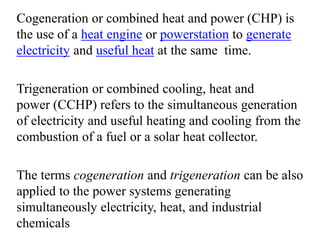
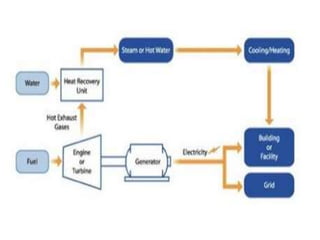
Cogeneration or combined heat and power (CHP) is
the use of a heat engine or powerstation to generate
electricity and useful heat at the same time.
Trigeneration or combined cooling, heat and
power (CCHP) refers to the simultaneous generation
of electricity and useful heating and cooling from the
combustion of a fuel or a solar heat collector.
The terms cogeneration and trigeneration can be also
applied to the power systems generating
simultaneously electricity, heat, and industrial
chemicals
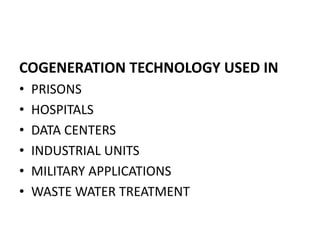
COGENERATION TECHNOLOGY USED IN
• PRISONS
• HOSPITALS
• DATA CENTERS
• INDUSTRIAL UNITS
• MILITARY APPLICATIONS
• WASTE WATER TREATMENT
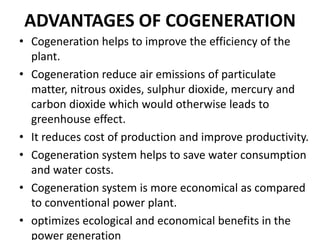
ADVANTAGES OF COGENERATION
• Cogeneration helps to improve the efficiency of the
plant.
• Cogeneration reduce air emissions of particulate
matter, nitrous oxides, sulphur dioxide, mercury and
carbon dioxide which would otherwise leads to
greenhouse effect.
• It reduces cost of production and improve productivity.
• Cogeneration system helps to save water consumption
and water costs.
• Cogeneration system is more economical as compared
to conventional power plant.
• optimizes ecological and economical benefits in the
power generation
• Cogeneration systems that combine the power and heat
generation processes can be up to 80 percent efficient. In
addition to reducing carbon emissions and contributing to
sustainability goals, cogeneration offers many other benefits,
including:
• Enhancing operational efficiency to lower overhead costs
• Reducing energy waste, thereby increasing energy efficiency
• Offering greater energy independence by moving a portion of
the load off the grid
• Allowing companies to replace aging infrastructure
• When combined with a renewable fuel supply, such as
biomass or biogas, cogeneration is an environmentally
responsible source of reliable, base load generation. These
benefits have attracted the attention of many large-scale
facilities.
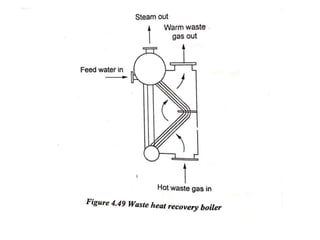
Waste heat recovery unit
• A waste heat recovery unit (WHRU) is an energy
recovery heat exchanger that transfers heat from
process outputs at high temperature to another
part of the process for some purpose, usually
increased efficiency.
• The WHRU is a tool involved in cogeneration.
Waste heat may be extracted from sources such as
hot flue gases from a diesel generator, steam
from cooling towers, or even waste water from
cooling processes such as in steel cooling.
Primary Benefits of Waste-Heat
Recovery Waste-heat recovery
• • Reduces energy costs: All recovered waste heat directly
replaces purchased energy, thereby reducing energy costs
• • Reduces cost of capital equipment: Reuse of waste heat allows
for the use of smaller energy conversion equipment capacity,
often resulting in savings in capital expenditures offsetting the
cost of the heat recovery system
• • Reduces operating costs: Since waste heat recovery reduces
energy costs and often also reduces capital costs, it reduces
operating costs;
• • Reduces environmental impact: Because all waste-heat
recovery directly replaces purchased energy, it also reduces the
environmental impact on air and water
• • Reduces GHG emissions: Waste-heat recovery by industry
reduces GHG emissions associated with industrial operation;
APPLICATIONS OF RESIDUAL HEAT
RECOVERY
Preheating( of combustion air, boiler feed
water,water)
Load preheating
Power generation
Steam generation
Space heating
Transfer to liquid or gaseous process steams
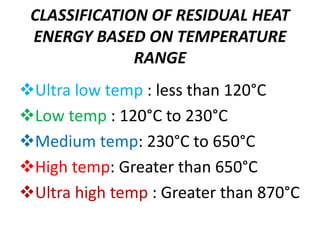
CLASSIFICATION OF RESIDUAL HEAT
ENERGY BASED ON TEMPERATURE
RANGE
Ultra low temp : less than 120°C
Low temp : 120°C to 230°C
Medium temp: 230°C to 650°C
High temp: Greater than 650°C
Ultra high temp : Greater than 870°C
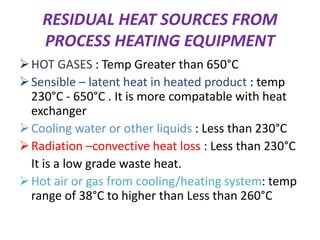
RESIDUAL HEAT SOURCES FROM
PROCESS HEATING EQUIPMENT
HOT GASES : Temp Greater than 650°C
Sensible – latent heat in heated product : temp
230°C - 650°C . It is more compatable with heat
exchanger
Cooling water or other liquids : Less than 230°C
Radiation –convective heat loss : Less than 230°C
It is a low grade waste heat.
Hot air or gas from cooling/heating system: temp
range of 38°C to higher than Less than 260°C
• Heat losses in providing chill water or in the
disposal of chilled water.
• Heat stored in the products leaving the
process.
Three “R” of Residual Heat
• Waste heat REDUCTION within
the system or equipment
• Waste heat RECYCLING
• Waste heat RECOVERY within the
plant or industrial complex
UTILIZATION OF RESIDUAL HEAT
•In-process recycling
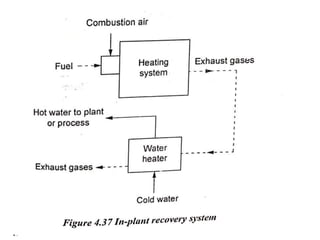
•In-plant recovery
•Electricity generation
IN PROCESS RECYCLING
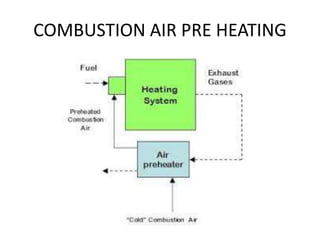
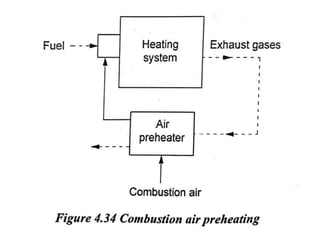
Combustion air preheating
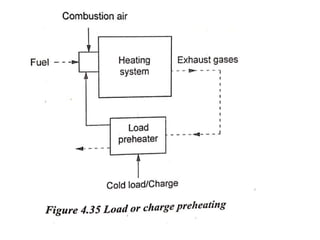
Load or charge preheating
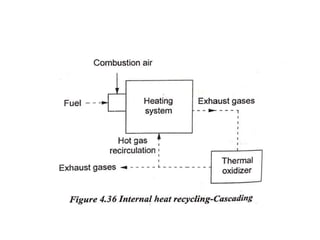
Internal heat recycling - cascading
COMBUSTION AIR PRE HEATING
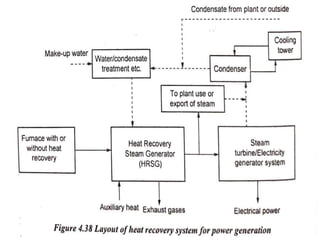
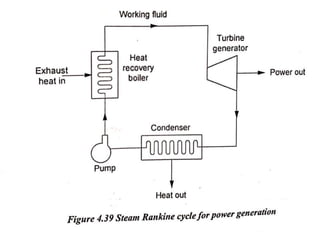
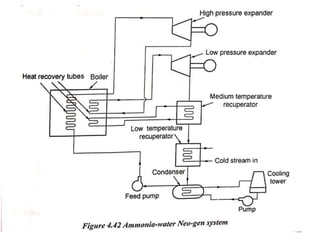
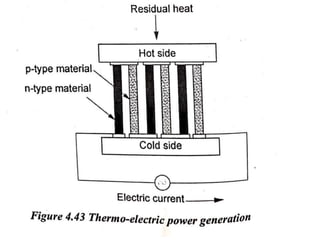
RESIDUAL HEAT TO POWER
CONVERSION
Conversion steam power plant using
a Rankine cycle
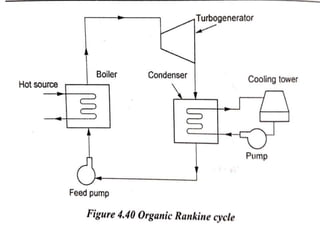
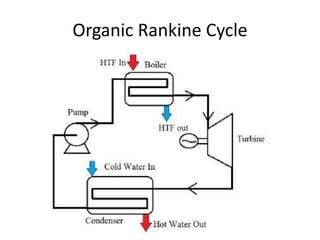
Organic Rankine Cycle (ORC) plant
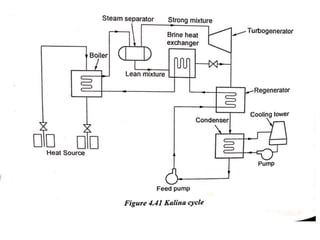
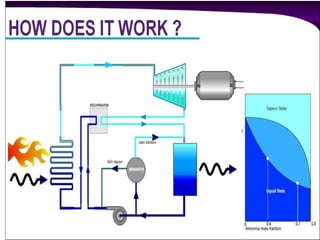
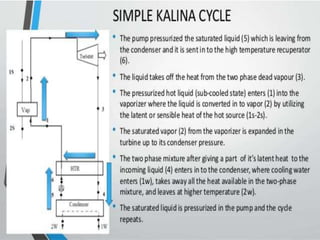
Ammonia-water systems (i.e., Kalina,
Neogen systems)
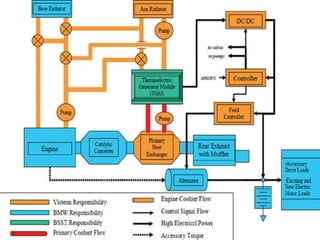
Thermo-electric power generation
(TEG)
Organic Rankine Cycle
Application of Thermoelectric
Generators
For increasing the fuel efficiency of cars,
thermoelectric generators are used. These
generator use heat produced when the vehicle
is running.
Seebeck Power Generation is used to supply
power to spacecrafts.
These generators are used to supply power to
remote stations like weather stations, relay
stations etc.
HIGH-TO-ULTRA-HIGH-TEMPERATURE
HEAT RECOVERY EQUIPMENTS
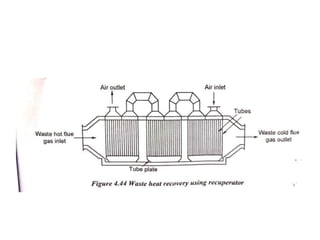
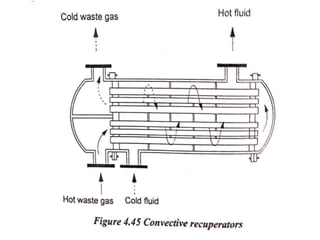
• A Recuperative Heat Exchanger
(Recuperators) has separate flow paths for each
fluid and fluids flow simultaneously through the
exchanger exchanging heat across the wall
separating the flow paths.
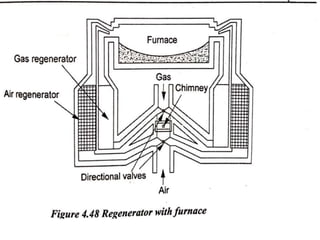
• A Regenerative Heat Exchanger has a single flow
path, which the hot and cold fluids alternately
pass through.
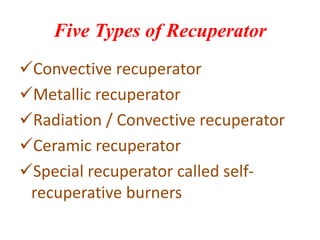
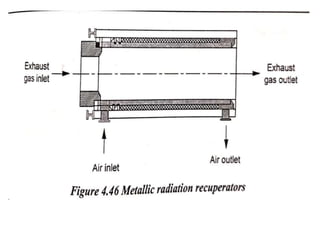
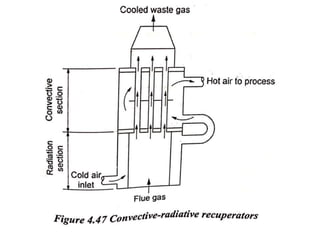
Five Types of Recuperator
Convective recuperator
Metallic recuperator
Radiation / Convective recuperator
Ceramic recuperator
Special recuperator called self-
recuperative burners
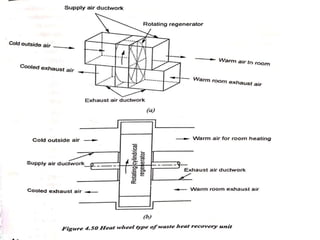
REGENERATIVE
HEAT
EXCHANGERS
(REGENERATORS)
Low-to Medium-Temperature
Heat Recovery Equipment
HEAT WHEELS
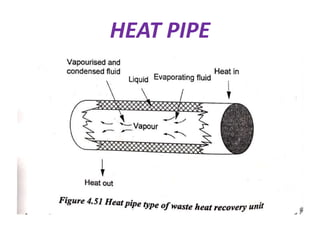
HEAT PIPE
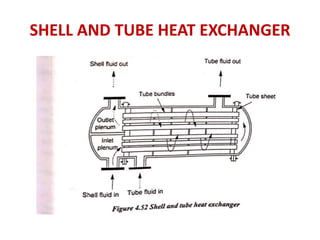
SHELL AND TUBE HEAT EXCHANGER
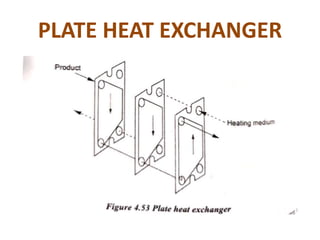
PLATE HEAT EXCHANGER
ECONOMIC ASPECTS OF
COGENERATION
Various cost involved in cogeneration economics
Installed capital cost
Operation and maintenance ( O & M )
cost.
Installed capital cost
Equipment cost
Installation cost
Interest cost
Taxes
Insurance cost
Storage cost
Operation and maintenance
( O & M ) cost.
Repair and maintenance cost
Fuel cost
Cost of lubricating oil, filter and grease
Wages of operation
Cost of replacing high-wear items
Cost of mobilization, demobilization and
assembly.

Thermal Engineering - II

  • 1.
  • 2.
    Cogeneration or combinedheat and power (CHP) is the use of a heat engine or powerstation to generate electricity and useful heat at the same time. Trigeneration or combined cooling, heat and power (CCHP) refers to the simultaneous generation of electricity and useful heating and cooling from the combustion of a fuel or a solar heat collector. The terms cogeneration and trigeneration can be also applied to the power systems generating simultaneously electricity, heat, and industrial chemicals
  • 3.
    COGENERATION TECHNOLOGY USEDIN • PRISONS • HOSPITALS • DATA CENTERS • INDUSTRIAL UNITS • MILITARY APPLICATIONS • WASTE WATER TREATMENT
  • 4.
    ADVANTAGES OF COGENERATION •Cogeneration helps to improve the efficiency of the plant. • Cogeneration reduce air emissions of particulate matter, nitrous oxides, sulphur dioxide, mercury and carbon dioxide which would otherwise leads to greenhouse effect. • It reduces cost of production and improve productivity. • Cogeneration system helps to save water consumption and water costs. • Cogeneration system is more economical as compared to conventional power plant. • optimizes ecological and economical benefits in the power generation
  • 6.
    • Cogeneration systemsthat combine the power and heat generation processes can be up to 80 percent efficient. In addition to reducing carbon emissions and contributing to sustainability goals, cogeneration offers many other benefits, including: • Enhancing operational efficiency to lower overhead costs • Reducing energy waste, thereby increasing energy efficiency • Offering greater energy independence by moving a portion of the load off the grid • Allowing companies to replace aging infrastructure • When combined with a renewable fuel supply, such as biomass or biogas, cogeneration is an environmentally responsible source of reliable, base load generation. These benefits have attracted the attention of many large-scale facilities.
  • 7.
    Waste heat recoveryunit • A waste heat recovery unit (WHRU) is an energy recovery heat exchanger that transfers heat from process outputs at high temperature to another part of the process for some purpose, usually increased efficiency. • The WHRU is a tool involved in cogeneration. Waste heat may be extracted from sources such as hot flue gases from a diesel generator, steam from cooling towers, or even waste water from cooling processes such as in steel cooling.
  • 8.
    Primary Benefits ofWaste-Heat Recovery Waste-heat recovery • • Reduces energy costs: All recovered waste heat directly replaces purchased energy, thereby reducing energy costs • • Reduces cost of capital equipment: Reuse of waste heat allows for the use of smaller energy conversion equipment capacity, often resulting in savings in capital expenditures offsetting the cost of the heat recovery system • • Reduces operating costs: Since waste heat recovery reduces energy costs and often also reduces capital costs, it reduces operating costs; • • Reduces environmental impact: Because all waste-heat recovery directly replaces purchased energy, it also reduces the environmental impact on air and water • • Reduces GHG emissions: Waste-heat recovery by industry reduces GHG emissions associated with industrial operation;
  • 9.
    APPLICATIONS OF RESIDUALHEAT RECOVERY Preheating( of combustion air, boiler feed water,water) Load preheating Power generation Steam generation Space heating Transfer to liquid or gaseous process steams
  • 10.
    CLASSIFICATION OF RESIDUALHEAT ENERGY BASED ON TEMPERATURE RANGE Ultra low temp : less than 120°C Low temp : 120°C to 230°C Medium temp: 230°C to 650°C High temp: Greater than 650°C Ultra high temp : Greater than 870°C
  • 11.
    RESIDUAL HEAT SOURCESFROM PROCESS HEATING EQUIPMENT HOT GASES : Temp Greater than 650°C Sensible – latent heat in heated product : temp 230°C - 650°C . It is more compatable with heat exchanger Cooling water or other liquids : Less than 230°C Radiation –convective heat loss : Less than 230°C It is a low grade waste heat. Hot air or gas from cooling/heating system: temp range of 38°C to higher than Less than 260°C
  • 12.
    • Heat lossesin providing chill water or in the disposal of chilled water. • Heat stored in the products leaving the process.
  • 13.
    Three “R” ofResidual Heat • Waste heat REDUCTION within the system or equipment • Waste heat RECYCLING • Waste heat RECOVERY within the plant or industrial complex
  • 14.
    UTILIZATION OF RESIDUALHEAT •In-process recycling •In-plant recovery •Electricity generation
  • 15.
    IN PROCESS RECYCLING Combustionair preheating Load or charge preheating Internal heat recycling - cascading
  • 16.
  • 21.
    RESIDUAL HEAT TOPOWER CONVERSION Conversion steam power plant using a Rankine cycle Organic Rankine Cycle (ORC) plant Ammonia-water systems (i.e., Kalina, Neogen systems) Thermo-electric power generation (TEG)
  • 25.
  • 32.
    Application of Thermoelectric Generators Forincreasing the fuel efficiency of cars, thermoelectric generators are used. These generator use heat produced when the vehicle is running. Seebeck Power Generation is used to supply power to spacecrafts. These generators are used to supply power to remote stations like weather stations, relay stations etc.
  • 33.
    HIGH-TO-ULTRA-HIGH-TEMPERATURE HEAT RECOVERY EQUIPMENTS •A Recuperative Heat Exchanger (Recuperators) has separate flow paths for each fluid and fluids flow simultaneously through the exchanger exchanging heat across the wall separating the flow paths. • A Regenerative Heat Exchanger has a single flow path, which the hot and cold fluids alternately pass through.
  • 35.
    Five Types ofRecuperator Convective recuperator Metallic recuperator Radiation / Convective recuperator Ceramic recuperator Special recuperator called self- recuperative burners
  • 39.
  • 42.
  • 44.
  • 45.
    SHELL AND TUBEHEAT EXCHANGER
  • 46.
  • 49.
    ECONOMIC ASPECTS OF COGENERATION Variouscost involved in cogeneration economics Installed capital cost Operation and maintenance ( O & M ) cost.
  • 50.
    Installed capital cost Equipmentcost Installation cost Interest cost Taxes Insurance cost Storage cost
  • 51.
    Operation and maintenance (O & M ) cost. Repair and maintenance cost Fuel cost Cost of lubricating oil, filter and grease Wages of operation Cost of replacing high-wear items Cost of mobilization, demobilization and assembly.