A Presentation recupretor
Submitted to:
Dr. Jyotirmay mathur
Associate Professor
MNIT, Jaipur
Submitted By:
Padmadhar garg
(2011PME5258)
what is recupretor
A recupretor is aone in which the two fluids are separated at all timE by a solid barrier.
A recuperator is a special purpose counter flow energy recovery heat exchanger
positioned within the supply and exhaust air streams of an air handling system, or in the
exhaust gases of an industrial process, in order to recover the waste heat
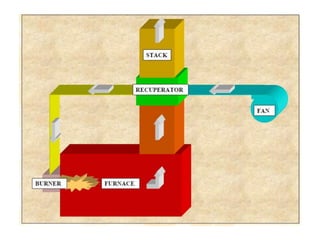
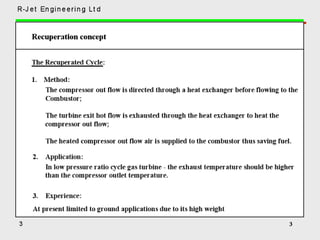
Recuperators are often used in association with the burner portion of a heat engine, to
increase the overall efficiency. For example, in a gas turbine engine, air is
compressed, mixed with fuel, which is then burned and used to drive a turbine. The
recuperator transfers some of the waste heat in the exhaust to the compressed air, thus
preheating it before entering the fuel burner stage. Since the gases have been pre-
heated, less fuel is needed to heat the gases up to the turbine inlet temperature. By
recovering some of the energy usually lost as waste heat, the recuperator can make a
heat engine or gas turbine significantly more efficient.
4
PRACTICAL RECUPERATION
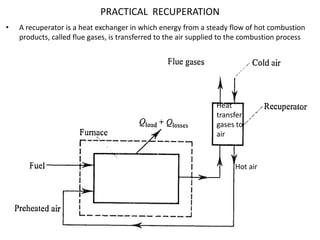
• A recuperator is a heat exchanger in which energy from a steady flow of hot combustion
products, called flue gases, is transferred to the air supplied to the combustion process
Hot air
Heat
transfer
gases to
air
5
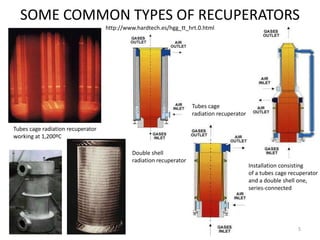
SOME COMMON TYPES OF RECUPERATORS
http://www.hardtech.es/hgg_tt_hrt.0.html
Tubes cage radiation recuperator
working at 1,200ºC
Double shell
radiation recuperator
Tubes cage
radiation recuperator
Installation consisting
of a tubes cage recuperator
and a double shell one,
series-connected
• When heat recovery is not required, it is
typical for the device to be bypassed by use of
dampers arranged within the ventilation
distribution system. Assuming the fans are
fitted with inverter speed controls, set to
maintain a constant pressure in the ventilation
system, then the reduced pressure drop leads
to a slowing of the fan motor and thus
reducing power consumption, and in turn
improves the seasonal efficiency of the system
• The aim of a heat recuperator is to transfer the
heat contained in the outlet air, having
temperatures of 80-95 ºC, to preheat the drying
air. But it is also possible to use the recuperated
heat to heat water for cleaning purposes or air
for heating rooms.
•
In principle, there are two different recuperating
systems:
• Air-to-Air
• Air-Liquid-Air
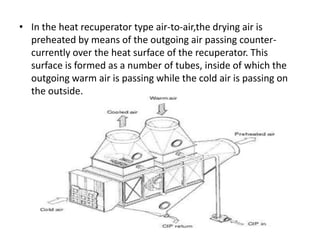
• In the heat recuperator type air-to-air,the drying air is
preheated by means of the outgoing air passing counter-
currently over the heat surface of the recuperator. This
surface is formed as a number of tubes, inside of which the
outgoing warm air is passing while the cold air is passing on
the outside.
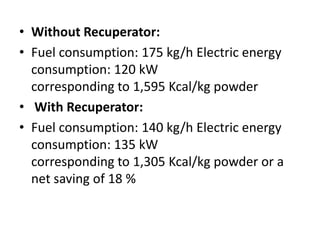
• Without Recuperator:
• Fuel consumption: 175 kg/h Electric energy
consumption: 120 kW
corresponding to 1,595 Kcal/kg powder
• With Recuperator:
• Fuel consumption: 140 kg/h Electric energy
consumption: 135 kW
corresponding to 1,305 Kcal/kg powder or a
net saving of 18 %
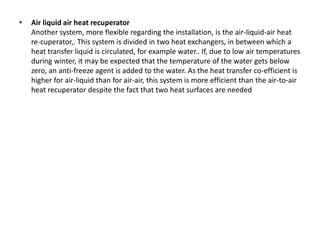
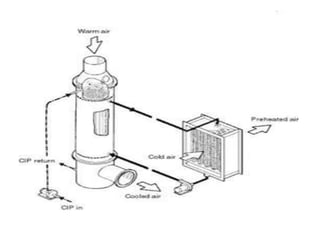
• Air liquid air heat recuperator
Another system, more flexible regarding the installation, is the air-liquid-air heat
re-cuperator,. This system is divided in two heat exchangers, in between which a
heat transfer liquid is circulated, for example water.. If, due to low air temperatures
during winter, it may be expected that the temperature of the water gets below
zero, an anti-freeze agent is added to the water. As the heat transfer co-efficient is
higher for air-liquid than for air-air, this system is more efficient than the air-to-air
heat recuperator despite the fact that two heat surfaces are needed
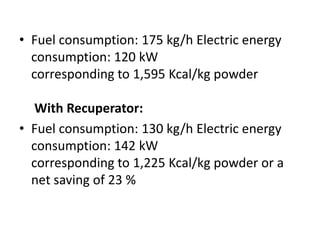
• Fuel consumption: 175 kg/h Electric energy
consumption: 120 kW
corresponding to 1,595 Kcal/kg powder
With Recuperator:
• Fuel consumption: 130 kg/h Electric energy
consumption: 142 kW
corresponding to 1,225 Kcal/kg powder or a
net saving of 23 %
THANK YOU

Recupretor

  • 1.
    A Presentation recupretor Submittedto: Dr. Jyotirmay mathur Associate Professor MNIT, Jaipur Submitted By: Padmadhar garg (2011PME5258)
  • 2.
    what is recupretor Arecupretor is aone in which the two fluids are separated at all timE by a solid barrier. A recuperator is a special purpose counter flow energy recovery heat exchanger positioned within the supply and exhaust air streams of an air handling system, or in the exhaust gases of an industrial process, in order to recover the waste heat Recuperators are often used in association with the burner portion of a heat engine, to increase the overall efficiency. For example, in a gas turbine engine, air is compressed, mixed with fuel, which is then burned and used to drive a turbine. The recuperator transfers some of the waste heat in the exhaust to the compressed air, thus preheating it before entering the fuel burner stage. Since the gases have been pre- heated, less fuel is needed to heat the gases up to the turbine inlet temperature. By recovering some of the energy usually lost as waste heat, the recuperator can make a heat engine or gas turbine significantly more efficient.
  • 4.
    4 PRACTICAL RECUPERATION • Arecuperator is a heat exchanger in which energy from a steady flow of hot combustion products, called flue gases, is transferred to the air supplied to the combustion process Hot air Heat transfer gases to air
  • 5.
    5 SOME COMMON TYPESOF RECUPERATORS http://www.hardtech.es/hgg_tt_hrt.0.html Tubes cage radiation recuperator working at 1,200ºC Double shell radiation recuperator Tubes cage radiation recuperator Installation consisting of a tubes cage recuperator and a double shell one, series-connected
  • 6.
    • When heatrecovery is not required, it is typical for the device to be bypassed by use of dampers arranged within the ventilation distribution system. Assuming the fans are fitted with inverter speed controls, set to maintain a constant pressure in the ventilation system, then the reduced pressure drop leads to a slowing of the fan motor and thus reducing power consumption, and in turn improves the seasonal efficiency of the system
  • 7.
    • The aimof a heat recuperator is to transfer the heat contained in the outlet air, having temperatures of 80-95 ºC, to preheat the drying air. But it is also possible to use the recuperated heat to heat water for cleaning purposes or air for heating rooms. • In principle, there are two different recuperating systems: • Air-to-Air • Air-Liquid-Air
  • 8.
    • In theheat recuperator type air-to-air,the drying air is preheated by means of the outgoing air passing counter- currently over the heat surface of the recuperator. This surface is formed as a number of tubes, inside of which the outgoing warm air is passing while the cold air is passing on the outside.
  • 9.
    • Without Recuperator: •Fuel consumption: 175 kg/h Electric energy consumption: 120 kW corresponding to 1,595 Kcal/kg powder • With Recuperator: • Fuel consumption: 140 kg/h Electric energy consumption: 135 kW corresponding to 1,305 Kcal/kg powder or a net saving of 18 %
  • 10.
    • Air liquidair heat recuperator Another system, more flexible regarding the installation, is the air-liquid-air heat re-cuperator,. This system is divided in two heat exchangers, in between which a heat transfer liquid is circulated, for example water.. If, due to low air temperatures during winter, it may be expected that the temperature of the water gets below zero, an anti-freeze agent is added to the water. As the heat transfer co-efficient is higher for air-liquid than for air-air, this system is more efficient than the air-to-air heat recuperator despite the fact that two heat surfaces are needed
  • 12.
    • Fuel consumption:175 kg/h Electric energy consumption: 120 kW corresponding to 1,595 Kcal/kg powder With Recuperator: • Fuel consumption: 130 kg/h Electric energy consumption: 142 kW corresponding to 1,225 Kcal/kg powder or a net saving of 23 %
  • 19.