REFRIGERATION AND
AIR CONDITIONING
REFRIGERATION
 It is the process of removing heat
continuously from a body/object, to reduce its
temperature lower than that of its
surrounding atmospheric and maintaining it
by continuously absorbing the heat
REFRIGERATOR
It is an equipment used for producing
and maintaining the temperature in a
closed space below the surrounding
atmospheric temperature
REFRIGERANT
• Ammonia (NH3)
• Carbon dioxide (CO2)
• Sulphur dioxide (SO2)
• Freon which has the types of R-11, R-12, R-21,
R-22 and R-502
REFRIGERANT
 Refrigerant is a fluid which absorbs the heat from the
body and rejects the heat at high temperature
 Properties of refrigerant :
It should have low freezing and low boiling point
It should have high co-efficient of performance
It should be non-Explosive
It should have low specific heat of liquid
It should be non flammable
It should be non corrosive to metal
APPLICATIONS OF REFRIGERATION
• For preserving the food, fruits, and drinks for a
long duration
• For preserving the flowers, medicines and
medical drugs
• Refrigeration is used in refineries for removing
wax
TERMINOLOGY OF REFRIGERATION
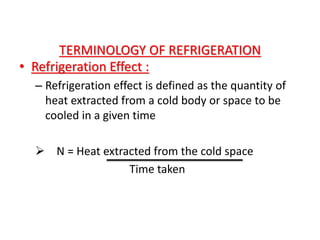
• Refrigeration Effect :
– Refrigeration effect is defined as the quantity of
heat extracted from a cold body or space to be
cooled in a given time
 N = Heat extracted from the cold space
Time taken
Capacity of refrigeration unit
• The capacity of refrigerating machines are expressed by
their cooling capacity
• The standard unit used for expressing the capacity of
refrigerating machines is tonne of refrigeration
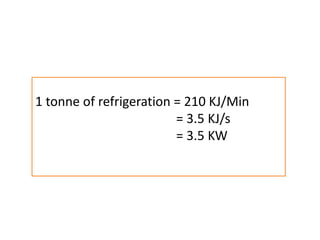
• One tonne of refrigeration is defined as the quantity of
heat abstracted ( refrigerating effect ) to freeze ( into
ice ) one tonne of water in a duration of 24 hours at 0oC
1 tonne of refrigeration = 210 KJ/Min
= 3.5 KJ/s
= 3.5 KW
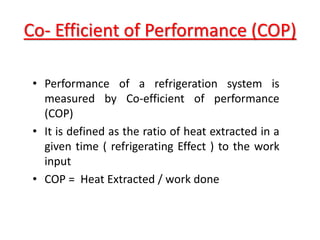
Co- Efficient of Performance (COP)
• Performance of a refrigeration system is
measured by Co-efficient of performance
(COP)
• It is defined as the ratio of heat extracted in a
given time ( refrigerating Effect ) to the work
input
• COP = Heat Extracted / work done
Classifications of refrigerants
• Primary refrigerants
• Secondary refrigerants
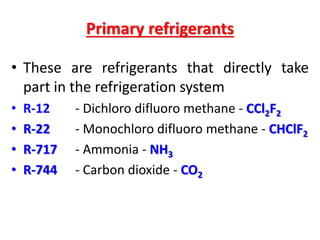
Primary refrigerants
• These are refrigerants that directly take
part in the refrigeration system
• R-12 - Dichloro difluoro methane - CCl2F2
• R-22 - Monochloro difluoro methane - CHClF2
• R-717 - Ammonia - NH3
• R-744 - Carbon dioxide - CO2
Secondary refrigerants
• These are the refrigerants which are first
cooled by primary refrigerants and then used
for cooling purpose
• Calcium chloride - CaCl2
• Sodium chloride - NaCl
• Glycols
Types of refrigerators
• Vapour compression refrigerators
• Vapour absorption refrigerators
Vapour compression refrigerators
Main Parts :
–Compressor
–Condenser
–Receiver
–Expansion Valve
–Evaporator
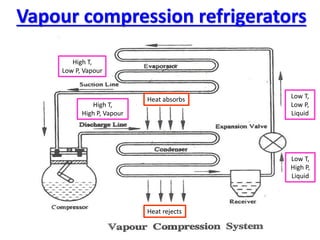
Vapour compression refrigerators
High T,
Low P, Vapour
High T,
High P, Vapour
Low T,
High P,
Liquid
Low T,
Low P,
Liquid
Heat absorbs
Heat rejects
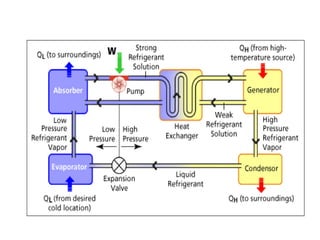
Vapour absorption refrigerators
Main Parts :
• Absorber
• Pump
• Heat Exchanger
• Generator
• Condenser
• Expansion valve
• Evaporator
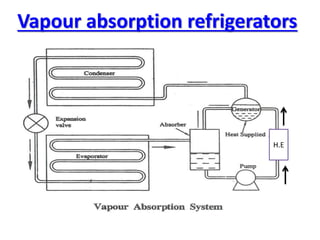
Vapour absorption refrigerators
H.E
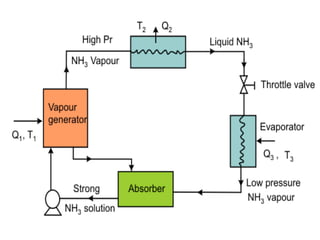
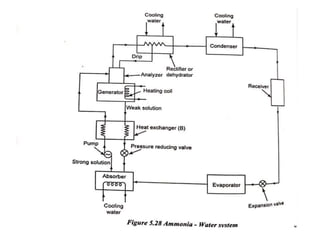
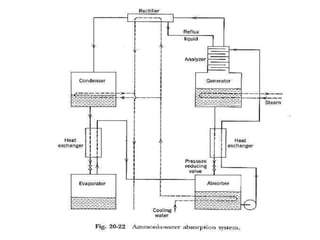
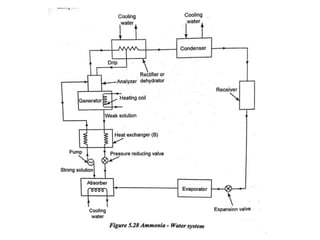
Ammonia-water vapour absorption
refrigeration system
• The working of ammonia-water absorption
refrigeration system is based on the simple
vapor absorption refrigeration system. In this
system ammonia is used as the refrigerant and
water is used as the absorbent. The ammonia-
water absorption system is used in the
domestic as well the commercial applications
where the requirement of the temperature is
above 32 degree F.
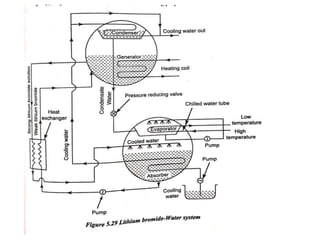
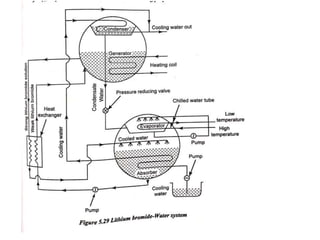
In a water-lithium bromide vapor absorption
refrigeration system, water is used as the
refrigerant while lithium bromide (Li Br) is used as
the absorbent.
In the absorber, the lithium bromide absorbs the
water refrigerant, creating a solution of water
and lithium bromide.
This solution is pumped by the pump to the
generator where the solution is heated.
The water refrigerant gets vaporized and moves
to the condenser where it is cooled while the
lithium bromide flows back to the absorber
where it further absorbs water coming from the
evaporator.
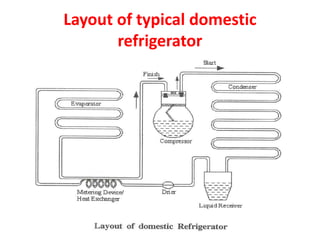
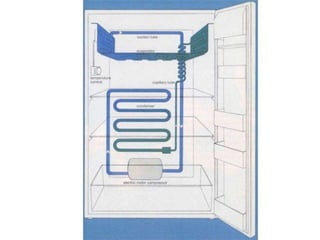
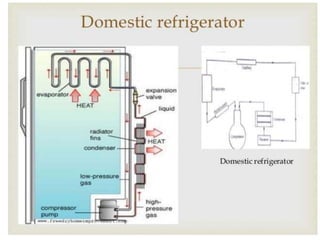
Layout of typical domestic
refrigerator
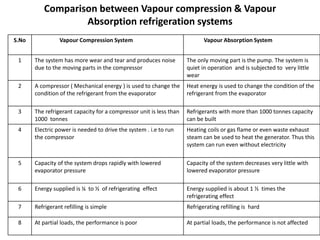
Comparison between Vapour compression & Vapour
Absorption refrigeration systems
S.No Vapour Compression System Vapour Absorption System
1 The system has more wear and tear and produces noise
due to the moving parts in the compressor
The only moving part is the pump. The system is
quiet in operation and is subjected to very little
wear
2 A compressor ( Mechanical energy ) is used to change the
condition of the refrigerant from the evaporator
Heat energy is used to change the condition of the
refrigerant from the evaporator
3 The refrigerant capacity for a compressor unit is less than
1000 tonnes
Refrigerants with more than 1000 tonnes capacity
can be built
4 Electric power is needed to drive the system . i.e to run
the compressor
Heating coils or gas flame or even waste exhaust
steam can be used to heat the generator. Thus this
system can run even without electricity
5 Capacity of the system drops rapidly with lowered
evaporator pressure
Capacity of the system decreases very little with
lowered evaporator pressure
6 Energy supplied is ¼ to ½ of refrigerating effect Energy supplied is about 1 ½ times the
refrigerating effect
7 Refrigerant refilling is simple Refrigerating refilling is hard
8 At partial loads, the performance is poor At partial loads, the performance is not affected
AIR CONDITIONING
AIR CONDITIONING
• Air conditioning is the process of conditioning
the air according to the human comfort,
irrespective of external conditions
PSYCHROMETRY
• Science which is the study about the
behaviour of moisture air.
PROPERTIES OF PYSCHROMETRIC
• Atmospheric air:
Air in the atmosphere is referred to as
atmospheric air.
• Dry air:
The normal atmospheric air with out the
presence of water vapour is called dry air.
• Water vapour:
It is the moisture present in the dry air.
• Moisture:
It is the water vapour present in dry air.
• Moisture air:
It is the mixture of dry air and water vapour.
• Saturated air:
When the mixture of air and water vapour
at a given temperature contains the maximum
amount of water vapour that it hold then it is
known as saturated air.
• Humidity:
It is the mass of water vapour present in 1
Kg of dry air and is generally expressed in
terms of gm per kg of dry air.
• Absolute Humidity:
It is the mass of water vapour present in
1m cube of dry air and is generally expressed
in terms of gm per cubic meter of dry air.
• Relative humidity:
It is the ratio of actual mass of water
vapour in a given volume of moisture air to
the mass of water vapour in the same volume
of saturated air. at the same temperature and
pressure.
• Degree of saturation:
It is the ratio of actual mass of water
vapour in unit mass of dry air to mass water
vapour in the same volume of saturated air at
the same temperature.
• Dry Bulb Temperature (DBT):
The temperature which is measured by an
ordinary thermometer is known as dry bulb
temperature.
• Wet bulb temperature (WBT):
It is the temperature of air measured by a
thermometer when its bulb is covered with wet
cloth and is exposed to a current rapidly moving
air.
• Wet bulb depression (WBD):
It is the difference between dry bulb
temperature and wet bulb temperature.
• Dew point temperature (DPT):
It is temperature at which the water vapour
present in the air begins to condense when the
air is cooled.
• Dew point Depression (DPD):
It is the difference between dry bulb
temperature and dew point temperature.
• Psychrometer:
It is a device which is used for measuring
dry bulb and wet bulb temperature
simultaneously.
PSYCHROMETRIC PROCESS
• Sensible heating process
• Sensible cooling process
• Humidification process
• Dehumidification process
• Sensible heating process:
The heating of air with out addition of
moisture is known as sensible heating. The
heating is done by passing the air over heating
coil of tubes.
• Sensible cooling process:
The cooling of air with out removal of
moisture is known as sensible cooling. The
cooling is done by passing the air over cooling
coil of tubes.
• Humidification process:
The addition of water vapour to the air is
known as humidification. Humidification is
done by spraying water over air stream at
constant dry bulb temperature of air.
• Dehumidification process:
The removal of water vapour from the air
is known as dehumidification. The water
vapour from the air can be removed
chemically, physically or thermodynamically.
Requirements of comfort air
conditioning
• The following factors are affecting the human
comfort in air conditioning
• Temperature of air
• Humidity of air
• Air motion
• Air purity
• noise
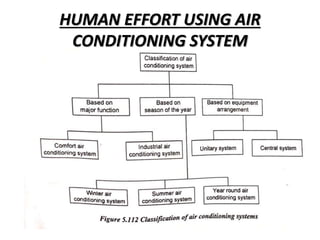
Classifications of Air conditioning
• According to the purpose
– Comfort air conditioning
– Industrial air conditioning
• According to season of the year
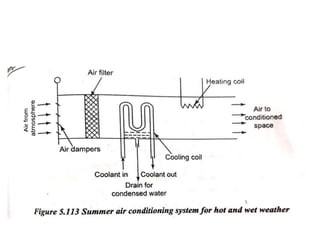
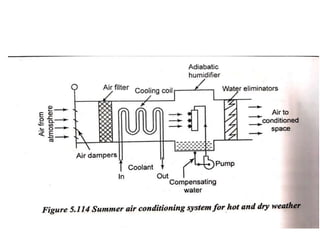
– Summer air conditioning
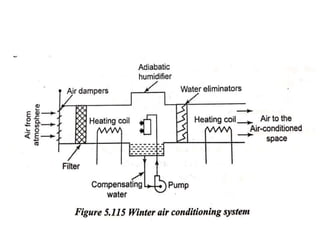
– Winter air conditioning
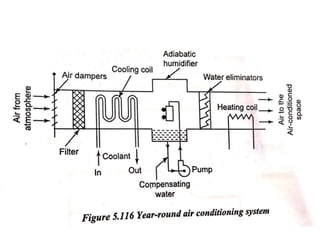
– Year round air conditioning
Types of air conditioning
• Room air conditioning
• Window air conditioning
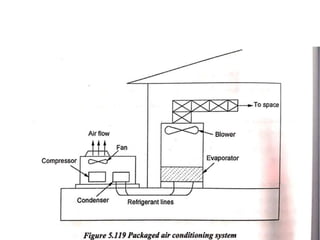
• Central air conditioning
Functions of air conditioning
• Cleaning air
• Controlling the temperature of air
• Controlling the moisture content
• Circulating the air
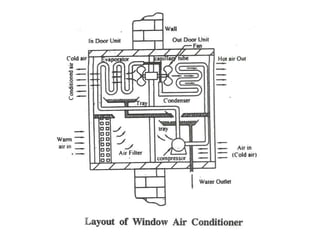
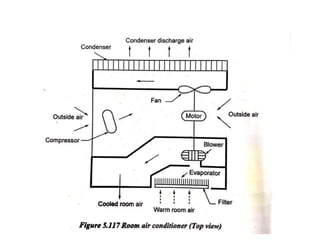
Window air conditioner
• Or Room air conditioner
• Refrigerant used : R-12 or R-22
• It consists of :
– Compressor
– Air cooled condensor
– Capillary tube
– Evaporator
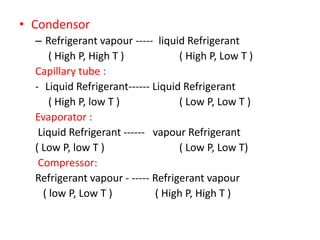
• Condensor
– Refrigerant vapour ----- liquid Refrigerant
( High P, High T ) ( High P, Low T )
Capillary tube :
- Liquid Refrigerant------ Liquid Refrigerant
( High P, low T ) ( Low P, Low T )
Evaporator :
Liquid Refrigerant ------ vapour Refrigerant
( Low P, low T ) ( Low P, Low T)
Compressor:
Refrigerant vapour - ----- Refrigerant vapour
( low P, Low T ) ( High P, High T )
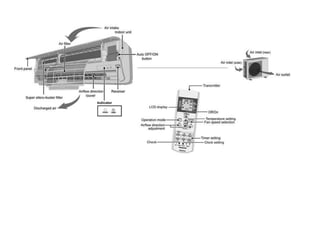
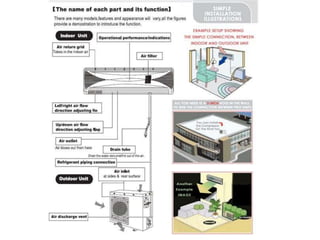
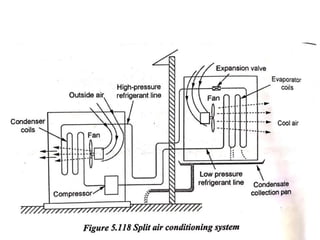
Split type room air conditioner
• They are used for small rooms and halls,
usually in places where window air
conditioners cannot be installed.
• It can be classified into two parts :
– The outdoor unit
– The indoor unit
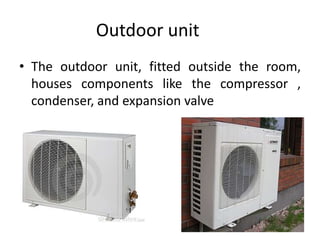
Outdoor unit
• The outdoor unit, fitted outside the room,
houses components like the compressor ,
condenser, and expansion valve
• It consists of :
• Compressor :
– main component of the system
– used to compress the refrigerant
• Condenser coil :
 used to reject the heat from the refrigerant to the
outside air
• Condenser fan :
 rejecting the heat from the indoor unit to the space
outside the building
• Condenser motor :
 usually has two to three speeds. Smaller unit may
only have 1 speed of control and turns on/off
simultaneously with the compressor
Indoor unit
• The indoor unit comprises the evaporator or
cooling coil and the cooling fan. The spilt air
conditioner can be used to cool one or two
rooms
• It consists of
• Evaporator coil
• Control panel
• Air filter
• Supply and return Air Grills
• Fan Blower
• Capillary tube
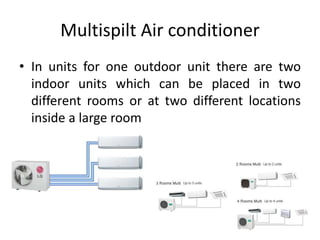
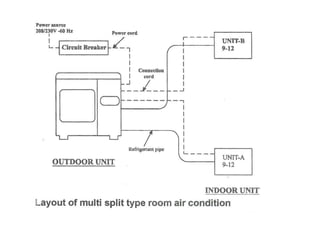
Multispilt Air conditioner
• In units for one outdoor unit there are two
indoor units which can be placed in two
different rooms or at two different locations
inside a large room
HUMAN EFFORT USING AIR
CONDITIONING SYSTEM
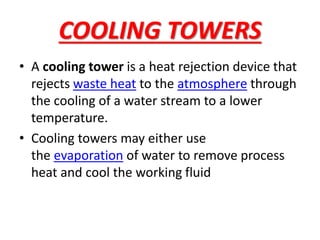
COOLING TOWERS
• A cooling tower is a heat rejection device that
rejects waste heat to the atmosphere through
the cooling of a water stream to a lower
temperature.
• Cooling towers may either use
the evaporation of water to remove process
heat and cool the working fluid
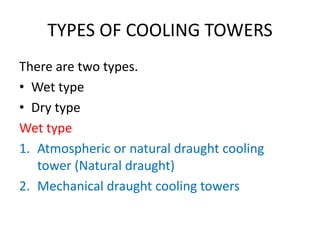
TYPES OF COOLING TOWERS
There are two types.
• Wet type
• Dry type
Wet type
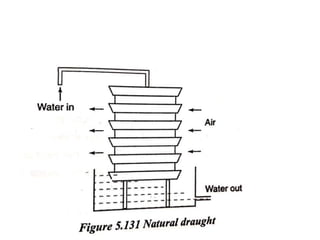
1. Atmospheric or natural draught cooling
tower (Natural draught)
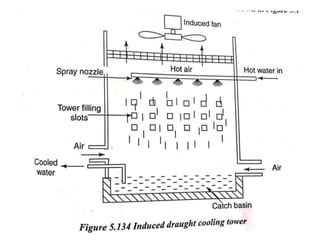
2. Mechanical draught cooling towers
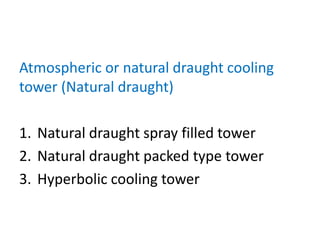
Atmospheric or natural draught cooling
tower (Natural draught)
1. Natural draught spray filled tower
2. Natural draught packed type tower
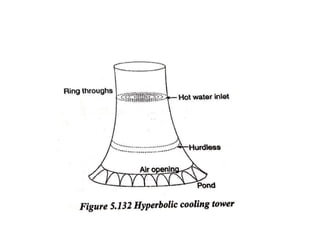
3. Hyperbolic cooling tower
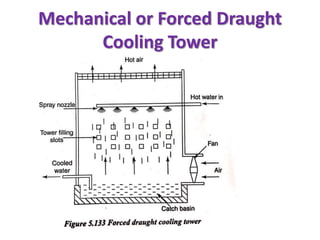
Mechanical or Forced Draught
Cooling Tower
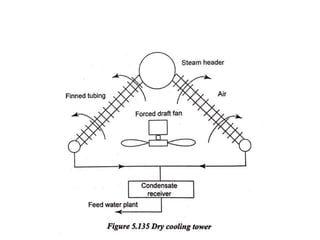
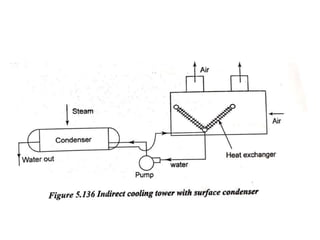
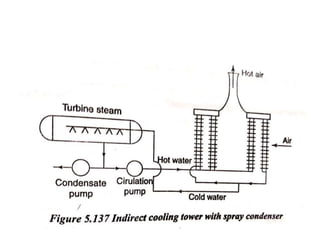
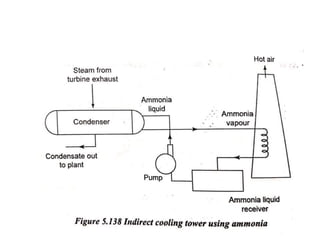
Dry cooling towers
• Direct type
• Indirect type
Thermal Engineering - II

Thermal Engineering - II

  • 1.
  • 2.
    REFRIGERATION  It isthe process of removing heat continuously from a body/object, to reduce its temperature lower than that of its surrounding atmospheric and maintaining it by continuously absorbing the heat
  • 3.
    REFRIGERATOR It is anequipment used for producing and maintaining the temperature in a closed space below the surrounding atmospheric temperature
  • 4.
    REFRIGERANT • Ammonia (NH3) •Carbon dioxide (CO2) • Sulphur dioxide (SO2) • Freon which has the types of R-11, R-12, R-21, R-22 and R-502
  • 5.
    REFRIGERANT  Refrigerant isa fluid which absorbs the heat from the body and rejects the heat at high temperature  Properties of refrigerant : It should have low freezing and low boiling point It should have high co-efficient of performance It should be non-Explosive It should have low specific heat of liquid It should be non flammable It should be non corrosive to metal
  • 6.
    APPLICATIONS OF REFRIGERATION •For preserving the food, fruits, and drinks for a long duration • For preserving the flowers, medicines and medical drugs • Refrigeration is used in refineries for removing wax
  • 8.
    TERMINOLOGY OF REFRIGERATION •Refrigeration Effect : – Refrigeration effect is defined as the quantity of heat extracted from a cold body or space to be cooled in a given time  N = Heat extracted from the cold space Time taken
  • 9.
    Capacity of refrigerationunit • The capacity of refrigerating machines are expressed by their cooling capacity • The standard unit used for expressing the capacity of refrigerating machines is tonne of refrigeration • One tonne of refrigeration is defined as the quantity of heat abstracted ( refrigerating effect ) to freeze ( into ice ) one tonne of water in a duration of 24 hours at 0oC
  • 10.
    1 tonne ofrefrigeration = 210 KJ/Min = 3.5 KJ/s = 3.5 KW
  • 11.
    Co- Efficient ofPerformance (COP) • Performance of a refrigeration system is measured by Co-efficient of performance (COP) • It is defined as the ratio of heat extracted in a given time ( refrigerating Effect ) to the work input • COP = Heat Extracted / work done
  • 12.
    Classifications of refrigerants •Primary refrigerants • Secondary refrigerants
  • 13.
    Primary refrigerants • Theseare refrigerants that directly take part in the refrigeration system • R-12 - Dichloro difluoro methane - CCl2F2 • R-22 - Monochloro difluoro methane - CHClF2 • R-717 - Ammonia - NH3 • R-744 - Carbon dioxide - CO2
  • 14.
    Secondary refrigerants • Theseare the refrigerants which are first cooled by primary refrigerants and then used for cooling purpose • Calcium chloride - CaCl2 • Sodium chloride - NaCl • Glycols
  • 15.
    Types of refrigerators •Vapour compression refrigerators • Vapour absorption refrigerators
  • 16.
    Vapour compression refrigerators MainParts : –Compressor –Condenser –Receiver –Expansion Valve –Evaporator
  • 17.
    Vapour compression refrigerators HighT, Low P, Vapour High T, High P, Vapour Low T, High P, Liquid Low T, Low P, Liquid Heat absorbs Heat rejects
  • 18.
    Vapour absorption refrigerators MainParts : • Absorber • Pump • Heat Exchanger • Generator • Condenser • Expansion valve • Evaporator
  • 19.
  • 22.
    Ammonia-water vapour absorption refrigerationsystem • The working of ammonia-water absorption refrigeration system is based on the simple vapor absorption refrigeration system. In this system ammonia is used as the refrigerant and water is used as the absorbent. The ammonia- water absorption system is used in the domestic as well the commercial applications where the requirement of the temperature is above 32 degree F.
  • 25.
    In a water-lithiumbromide vapor absorption refrigeration system, water is used as the refrigerant while lithium bromide (Li Br) is used as the absorbent. In the absorber, the lithium bromide absorbs the water refrigerant, creating a solution of water and lithium bromide. This solution is pumped by the pump to the generator where the solution is heated. The water refrigerant gets vaporized and moves to the condenser where it is cooled while the lithium bromide flows back to the absorber where it further absorbs water coming from the evaporator.
  • 27.
    Layout of typicaldomestic refrigerator
  • 30.
    Comparison between Vapourcompression & Vapour Absorption refrigeration systems S.No Vapour Compression System Vapour Absorption System 1 The system has more wear and tear and produces noise due to the moving parts in the compressor The only moving part is the pump. The system is quiet in operation and is subjected to very little wear 2 A compressor ( Mechanical energy ) is used to change the condition of the refrigerant from the evaporator Heat energy is used to change the condition of the refrigerant from the evaporator 3 The refrigerant capacity for a compressor unit is less than 1000 tonnes Refrigerants with more than 1000 tonnes capacity can be built 4 Electric power is needed to drive the system . i.e to run the compressor Heating coils or gas flame or even waste exhaust steam can be used to heat the generator. Thus this system can run even without electricity 5 Capacity of the system drops rapidly with lowered evaporator pressure Capacity of the system decreases very little with lowered evaporator pressure 6 Energy supplied is ¼ to ½ of refrigerating effect Energy supplied is about 1 ½ times the refrigerating effect 7 Refrigerant refilling is simple Refrigerating refilling is hard 8 At partial loads, the performance is poor At partial loads, the performance is not affected
  • 31.
  • 32.
    AIR CONDITIONING • Airconditioning is the process of conditioning the air according to the human comfort, irrespective of external conditions
  • 33.
    PSYCHROMETRY • Science whichis the study about the behaviour of moisture air.
  • 34.
    PROPERTIES OF PYSCHROMETRIC •Atmospheric air: Air in the atmosphere is referred to as atmospheric air. • Dry air: The normal atmospheric air with out the presence of water vapour is called dry air. • Water vapour: It is the moisture present in the dry air.
  • 35.
    • Moisture: It isthe water vapour present in dry air. • Moisture air: It is the mixture of dry air and water vapour. • Saturated air: When the mixture of air and water vapour at a given temperature contains the maximum amount of water vapour that it hold then it is known as saturated air. • Humidity: It is the mass of water vapour present in 1 Kg of dry air and is generally expressed in terms of gm per kg of dry air.
  • 36.
    • Absolute Humidity: Itis the mass of water vapour present in 1m cube of dry air and is generally expressed in terms of gm per cubic meter of dry air. • Relative humidity: It is the ratio of actual mass of water vapour in a given volume of moisture air to the mass of water vapour in the same volume of saturated air. at the same temperature and pressure.
  • 37.
    • Degree ofsaturation: It is the ratio of actual mass of water vapour in unit mass of dry air to mass water vapour in the same volume of saturated air at the same temperature. • Dry Bulb Temperature (DBT): The temperature which is measured by an ordinary thermometer is known as dry bulb temperature.
  • 38.
    • Wet bulbtemperature (WBT): It is the temperature of air measured by a thermometer when its bulb is covered with wet cloth and is exposed to a current rapidly moving air. • Wet bulb depression (WBD): It is the difference between dry bulb temperature and wet bulb temperature. • Dew point temperature (DPT): It is temperature at which the water vapour present in the air begins to condense when the air is cooled.
  • 39.
    • Dew pointDepression (DPD): It is the difference between dry bulb temperature and dew point temperature. • Psychrometer: It is a device which is used for measuring dry bulb and wet bulb temperature simultaneously.
  • 40.
    PSYCHROMETRIC PROCESS • Sensibleheating process • Sensible cooling process • Humidification process • Dehumidification process
  • 41.
    • Sensible heatingprocess: The heating of air with out addition of moisture is known as sensible heating. The heating is done by passing the air over heating coil of tubes. • Sensible cooling process: The cooling of air with out removal of moisture is known as sensible cooling. The cooling is done by passing the air over cooling coil of tubes.
  • 42.
    • Humidification process: Theaddition of water vapour to the air is known as humidification. Humidification is done by spraying water over air stream at constant dry bulb temperature of air. • Dehumidification process: The removal of water vapour from the air is known as dehumidification. The water vapour from the air can be removed chemically, physically or thermodynamically.
  • 43.
    Requirements of comfortair conditioning • The following factors are affecting the human comfort in air conditioning • Temperature of air • Humidity of air • Air motion • Air purity • noise
  • 44.
    Classifications of Airconditioning • According to the purpose – Comfort air conditioning – Industrial air conditioning • According to season of the year – Summer air conditioning – Winter air conditioning – Year round air conditioning
  • 45.
    Types of airconditioning • Room air conditioning • Window air conditioning • Central air conditioning
  • 46.
    Functions of airconditioning • Cleaning air • Controlling the temperature of air • Controlling the moisture content • Circulating the air
  • 47.
    Window air conditioner •Or Room air conditioner • Refrigerant used : R-12 or R-22 • It consists of : – Compressor – Air cooled condensor – Capillary tube – Evaporator
  • 49.
    • Condensor – Refrigerantvapour ----- liquid Refrigerant ( High P, High T ) ( High P, Low T ) Capillary tube : - Liquid Refrigerant------ Liquid Refrigerant ( High P, low T ) ( Low P, Low T ) Evaporator : Liquid Refrigerant ------ vapour Refrigerant ( Low P, low T ) ( Low P, Low T) Compressor: Refrigerant vapour - ----- Refrigerant vapour ( low P, Low T ) ( High P, High T )
  • 50.
    Split type roomair conditioner • They are used for small rooms and halls, usually in places where window air conditioners cannot be installed. • It can be classified into two parts : – The outdoor unit – The indoor unit
  • 51.
    Outdoor unit • Theoutdoor unit, fitted outside the room, houses components like the compressor , condenser, and expansion valve
  • 52.
    • It consistsof : • Compressor : – main component of the system – used to compress the refrigerant • Condenser coil :  used to reject the heat from the refrigerant to the outside air • Condenser fan :  rejecting the heat from the indoor unit to the space outside the building • Condenser motor :  usually has two to three speeds. Smaller unit may only have 1 speed of control and turns on/off simultaneously with the compressor
  • 53.
    Indoor unit • Theindoor unit comprises the evaporator or cooling coil and the cooling fan. The spilt air conditioner can be used to cool one or two rooms
  • 54.
    • It consistsof • Evaporator coil • Control panel • Air filter • Supply and return Air Grills • Fan Blower • Capillary tube
  • 57.
    Multispilt Air conditioner •In units for one outdoor unit there are two indoor units which can be placed in two different rooms or at two different locations inside a large room
  • 59.
    HUMAN EFFORT USINGAIR CONDITIONING SYSTEM
  • 68.
    COOLING TOWERS • Acooling tower is a heat rejection device that rejects waste heat to the atmosphere through the cooling of a water stream to a lower temperature. • Cooling towers may either use the evaporation of water to remove process heat and cool the working fluid
  • 69.
    TYPES OF COOLINGTOWERS There are two types. • Wet type • Dry type Wet type 1. Atmospheric or natural draught cooling tower (Natural draught) 2. Mechanical draught cooling towers
  • 70.
    Atmospheric or naturaldraught cooling tower (Natural draught) 1. Natural draught spray filled tower 2. Natural draught packed type tower 3. Hyperbolic cooling tower
  • 73.
    Mechanical or ForcedDraught Cooling Tower
  • 75.
    Dry cooling towers •Direct type • Indirect type