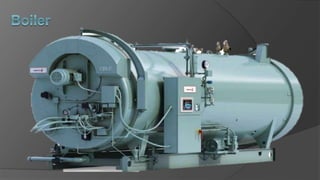
Can anyone tell me what is this?
 Is this a Sewing machine?
 or, a Cannon?
This is a Boiler !!!
HISTORY
George Babcock and Steven Wilcox were two of
the founding fathers of the steam-generating
boiler. They were the first to patent their boiler
design, which used tubes inside a firebrick-
walled structure to generate steam, in 1867, and
they formed Babcock & Wilcox Company in New
York City in 1891.
GROUP 2| CEP,SUST
Presentation Overview
 Forward-thinking, flexible solutions that
save energy.
 Adding value to process by cost
reduction (lowering TCoO and improving
ROI)
 Reducing carbon footprint
TOPICS INCLUDED
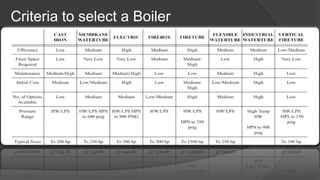
Criteria to select a Boiler
Boiler Efficiency: (Facts vs. Reality)
 According to the 2nd law of Thermodynamics, the
greater the temperature of heat source the more
efficient is the cycle. Therefore, making the steam
temperature very high will result in a highly efficient
power plant.
 But this temperature increase has certain limitations.
The steam turbine blade materials cannot withstand
temperatures greater than 600 0C.
Boiler efficiency (contd.)
 One more heat exchanger is added after the steam
drum to superheat the steam and it is heated to the
maximum allowable limit (about-550 degree
Celsius).(Efficiency gain~5%)
 A clever idea to increase the power plant efficiency is
to bypass the steam completely after the first stage
and add more heat. This process is known as
reheating. A heat exchanger known as ‘reheater' is
used for this purpose. (Efficiency gain~3%)
Boiler efficiency (contd.)
 Superheating and reheating also helps in minimizing
MC in the steam, increasing power plant capacity.
 Another efficiency reducer of the boiler is the dissolved
O2 and CO2 in the feed water. These dissolved gases
will spoil the boiler material over time. So the feed water
is preheated by the preheater for removing the
dissolved gases. This increases the efficiency of the
boiler dramatically.
Step by step procedure for maximizing
efficiency:
Preheating of the
feed water.
Heating by flue gas
in economizer
Steam Drum reduces
moisture content of
steam
Superheating of
steam.
Reheating after
first stage of HP
turbine.
Heat balance in a
boiler
HEAT FLOW DIAGRAM
 Heat delivered to water = m(Hsteam - Hfeed)
where,
 Hsteam = Enthalpy of superheated steam (kJ/kg)
 Hfeed = Enthalpy of feed water (kJ/kg)
 m = amount of water produced from all sources
Heat given to steam in a boiler
Components of Heat Input, Q
• Lower heating value (LHV)
• Sensible heat of fuel
• Sensible heat of air
• Heat of fuel atomizing steam
HEAT LOSS
COMPONENTS
 Flue gas loss, Q2
 Incomplete combustion of gas,Q3
 Heat loss due to unburnt carbon, Q4
 Heat loss due to surface convection & radiation, Q5
HEAT BALANCE
 HEAT INPUT = HEAT UTILIZATION + HEAT LOSSES
 Q = Q1+ Q2+ Q3+ Q4+ Q5
 Q = Available heat of fuel
 Q1= Heat utilized by steam and water
 Q2= Heat lost through stack gas
 Q3= Incomplete combustion (CO,CH4,H2)
 Q4 = Unburnt carbon
 Q5 = Loss from boiler surfaces
Waste Heat Recovery Boiler (WHRB)
 A WHRB is an energy recovery
heat exchanger that recovers
heat from hot streams with
potential high energy content,
such as hot flue gases from
diesel generator or steam from
cooling towers or even waste
water from different cooling
processes such as in steel
cooling.
Examples of WHRB are:
1. Recuperator
2. Regenerator
3. Thermal wheels
4. Heat pumps
5. Economizer and so on…
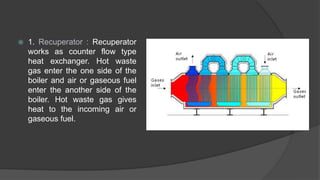
 1. Recuperator : Recuperator
works as counter flow type
heat exchanger. Hot waste
gas enter the one side of the
boiler and air or gaseous fuel
enter the another side of the
boiler. Hot waste gas gives
heat to the incoming air or
gaseous fuel.
 2. Regenerator : Regenerator works in
two cycle and has two sets of check-
work chambers, called regenerators.
The hot waste gas enter the one set of
regenerators and gives heat to the
regenerators. Then waste gas
removed and air or gaseous fuel are
heated in the heated regenerators.
The direction of in going air or
gaseous fuel are reversed after every
25-30 minutes during which one set of
regenerators gets cooled because of
loss of heat to air or gaseous fuel and
others set of regenerators gets heated
up because of absorption of heat from
the hot waste gases.
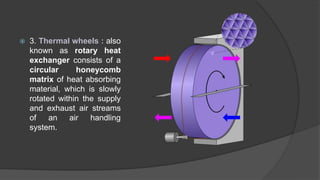
 3. Thermal wheels : also
known as rotary heat
exchanger consists of a
circular honeycomb
matrix of heat absorbing
material, which is slowly
rotated within the supply
and exhaust air streams
of an air handling
system.
 4. Heat pumps : Heat
pumps are designed to
move thermal energy in
the opposite direction of
spontaneous heat transfer
by absorbing heat from a
cold space and releasing
it to a warmer one.
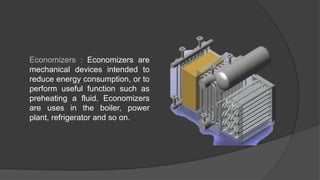
Economizers : Economizers are
mechanical devices intended to
reduce energy consumption, or to
perform useful function such as
preheating a fluid. Economizers
are uses in the boiler, power
plant, refrigerator and so on.
All boilers and domestic water heaters have a range of built-in
devices to help ensure their safe operation. Like other
components of building mechanical systems, they require
periodic maintenance to ensure proper operation. Boiler
operators and technicians should pay close attention to three
key safety devices to protect personnel, equipment, and the
facility.
The safety valve is the most
important safety device in a boiler
or domestic hot-water system. It
is designed to relieve internal
pressure if a range of failures
occur within the system. Although
it is simple in design and
straightforward in operation,
something as simple as corrosion
or restricted flow within the valve
and its related piping can affect its
operation.
Even with a functioning water-
level-control system, operators
must verify the actual level of
water in the system. Here too,
a build-up of sludge and scale
can give false level
indications.
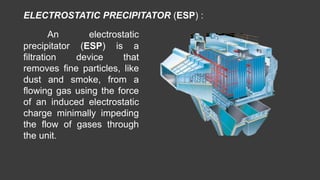
An electrostatic
precipitator (ESP) is a
filtration device that
removes fine particles, like
dust and smoke, from a
flowing gas using the force
of an induced electrostatic
charge minimally impeding
the flow of gases through
the unit.
ELECTROSTATIC PRECIPITATOR (ESP) :
Historically, boilers were a source of many
serious injuries and property destruction due to
poorly understood engineering principles. Some
professional specialized organizations such as
the American Society of Mechanical Engineers
has developed standard and regulation code for
boiler which can prevent this type of danger.
References
 Energy Solution Center Inc.
http://www.energysolutionscenter.org/BoilerBurner/
 Alkan Murray Corp.
http://www.alkenmurray.com/Boilerworks.html
 Frederick M. Steingress (2001). Low Pressure
Boilers (4th ed.). American Technical Publishers.
 B. K. Sharma, Industrial Chemistry , GOEL Publishing
House, 1997.
Thank you .

Boiler efficiency & safety

  • 1.
    Can anyone tellme what is this?  Is this a Sewing machine?  or, a Cannon? This is a Boiler !!!
  • 2.
    HISTORY George Babcock andSteven Wilcox were two of the founding fathers of the steam-generating boiler. They were the first to patent their boiler design, which used tubes inside a firebrick- walled structure to generate steam, in 1867, and they formed Babcock & Wilcox Company in New York City in 1891.
  • 3.
  • 4.
    Presentation Overview  Forward-thinking,flexible solutions that save energy.  Adding value to process by cost reduction (lowering TCoO and improving ROI)  Reducing carbon footprint
  • 5.
  • 6.
  • 8.
    Boiler Efficiency: (Factsvs. Reality)  According to the 2nd law of Thermodynamics, the greater the temperature of heat source the more efficient is the cycle. Therefore, making the steam temperature very high will result in a highly efficient power plant.  But this temperature increase has certain limitations. The steam turbine blade materials cannot withstand temperatures greater than 600 0C.
  • 9.
    Boiler efficiency (contd.) One more heat exchanger is added after the steam drum to superheat the steam and it is heated to the maximum allowable limit (about-550 degree Celsius).(Efficiency gain~5%)  A clever idea to increase the power plant efficiency is to bypass the steam completely after the first stage and add more heat. This process is known as reheating. A heat exchanger known as ‘reheater' is used for this purpose. (Efficiency gain~3%)
  • 10.
    Boiler efficiency (contd.) Superheating and reheating also helps in minimizing MC in the steam, increasing power plant capacity.  Another efficiency reducer of the boiler is the dissolved O2 and CO2 in the feed water. These dissolved gases will spoil the boiler material over time. So the feed water is preheated by the preheater for removing the dissolved gases. This increases the efficiency of the boiler dramatically.
  • 11.
    Step by stepprocedure for maximizing efficiency: Preheating of the feed water. Heating by flue gas in economizer Steam Drum reduces moisture content of steam Superheating of steam. Reheating after first stage of HP turbine.
  • 13.
    Heat balance ina boiler HEAT FLOW DIAGRAM
  • 14.
     Heat deliveredto water = m(Hsteam - Hfeed) where,  Hsteam = Enthalpy of superheated steam (kJ/kg)  Hfeed = Enthalpy of feed water (kJ/kg)  m = amount of water produced from all sources Heat given to steam in a boiler
  • 15.
    Components of HeatInput, Q • Lower heating value (LHV) • Sensible heat of fuel • Sensible heat of air • Heat of fuel atomizing steam
  • 16.
    HEAT LOSS COMPONENTS  Fluegas loss, Q2  Incomplete combustion of gas,Q3  Heat loss due to unburnt carbon, Q4  Heat loss due to surface convection & radiation, Q5
  • 17.
    HEAT BALANCE  HEATINPUT = HEAT UTILIZATION + HEAT LOSSES  Q = Q1+ Q2+ Q3+ Q4+ Q5  Q = Available heat of fuel  Q1= Heat utilized by steam and water  Q2= Heat lost through stack gas  Q3= Incomplete combustion (CO,CH4,H2)  Q4 = Unburnt carbon  Q5 = Loss from boiler surfaces
  • 18.
    Waste Heat RecoveryBoiler (WHRB)  A WHRB is an energy recovery heat exchanger that recovers heat from hot streams with potential high energy content, such as hot flue gases from diesel generator or steam from cooling towers or even waste water from different cooling processes such as in steel cooling. Examples of WHRB are: 1. Recuperator 2. Regenerator 3. Thermal wheels 4. Heat pumps 5. Economizer and so on…
  • 19.
     1. Recuperator: Recuperator works as counter flow type heat exchanger. Hot waste gas enter the one side of the boiler and air or gaseous fuel enter the another side of the boiler. Hot waste gas gives heat to the incoming air or gaseous fuel.
  • 20.
     2. Regenerator: Regenerator works in two cycle and has two sets of check- work chambers, called regenerators. The hot waste gas enter the one set of regenerators and gives heat to the regenerators. Then waste gas removed and air or gaseous fuel are heated in the heated regenerators. The direction of in going air or gaseous fuel are reversed after every 25-30 minutes during which one set of regenerators gets cooled because of loss of heat to air or gaseous fuel and others set of regenerators gets heated up because of absorption of heat from the hot waste gases.
  • 21.
     3. Thermalwheels : also known as rotary heat exchanger consists of a circular honeycomb matrix of heat absorbing material, which is slowly rotated within the supply and exhaust air streams of an air handling system.
  • 22.
     4. Heatpumps : Heat pumps are designed to move thermal energy in the opposite direction of spontaneous heat transfer by absorbing heat from a cold space and releasing it to a warmer one.
  • 23.
    Economizers : Economizersare mechanical devices intended to reduce energy consumption, or to perform useful function such as preheating a fluid. Economizers are uses in the boiler, power plant, refrigerator and so on.
  • 24.
    All boilers anddomestic water heaters have a range of built-in devices to help ensure their safe operation. Like other components of building mechanical systems, they require periodic maintenance to ensure proper operation. Boiler operators and technicians should pay close attention to three key safety devices to protect personnel, equipment, and the facility.
  • 25.
    The safety valveis the most important safety device in a boiler or domestic hot-water system. It is designed to relieve internal pressure if a range of failures occur within the system. Although it is simple in design and straightforward in operation, something as simple as corrosion or restricted flow within the valve and its related piping can affect its operation.
  • 26.
    Even with afunctioning water- level-control system, operators must verify the actual level of water in the system. Here too, a build-up of sludge and scale can give false level indications.
  • 27.
    An electrostatic precipitator (ESP)is a filtration device that removes fine particles, like dust and smoke, from a flowing gas using the force of an induced electrostatic charge minimally impeding the flow of gases through the unit. ELECTROSTATIC PRECIPITATOR (ESP) :
  • 28.
    Historically, boilers werea source of many serious injuries and property destruction due to poorly understood engineering principles. Some professional specialized organizations such as the American Society of Mechanical Engineers has developed standard and regulation code for boiler which can prevent this type of danger.
  • 29.
    References  Energy SolutionCenter Inc. http://www.energysolutionscenter.org/BoilerBurner/  Alkan Murray Corp. http://www.alkenmurray.com/Boilerworks.html  Frederick M. Steingress (2001). Low Pressure Boilers (4th ed.). American Technical Publishers.  B. K. Sharma, Industrial Chemistry , GOEL Publishing House, 1997.
  • 30.

Editor's Notes

  • #6 This is the question that your experiment answers
  • #8 Establish hypothesis before you begin the experiment. This should be your best educated guess based on your research.
  • #12 List all of the steps used in completing your experiment. Remember to number your steps.