1
Theory of Constraints
Short-term Capacity Optimization
2
Theory of Constraints
 Significance of bottlenecks
 Maximum speed of the process is the speed of
the slowest operation
 Any improvements will be wasted unless the
bottleneck is relieved
 Bottlenecks must be identified and improved if the
process is to be improved
3
Theory of Constraints
 Purpose is to identify bottlenecks or other
constraints and exploit them to the extent
possible
 Identification of constraints allows management to
take action to alleviate the constraint in the future
 Reduce cycle time
 Time from receipt of customer order to shipment
 Improve manufacturing cycle efficiency (MCE)
 Processing time / total cycle time
4
Theory of Constraints
 Assumes current constraints cannot be
changed in the short-run
 What should be produced now, with current
resources, to maximize profits?
 Question cannot be answered by traditional accounting
methods
5
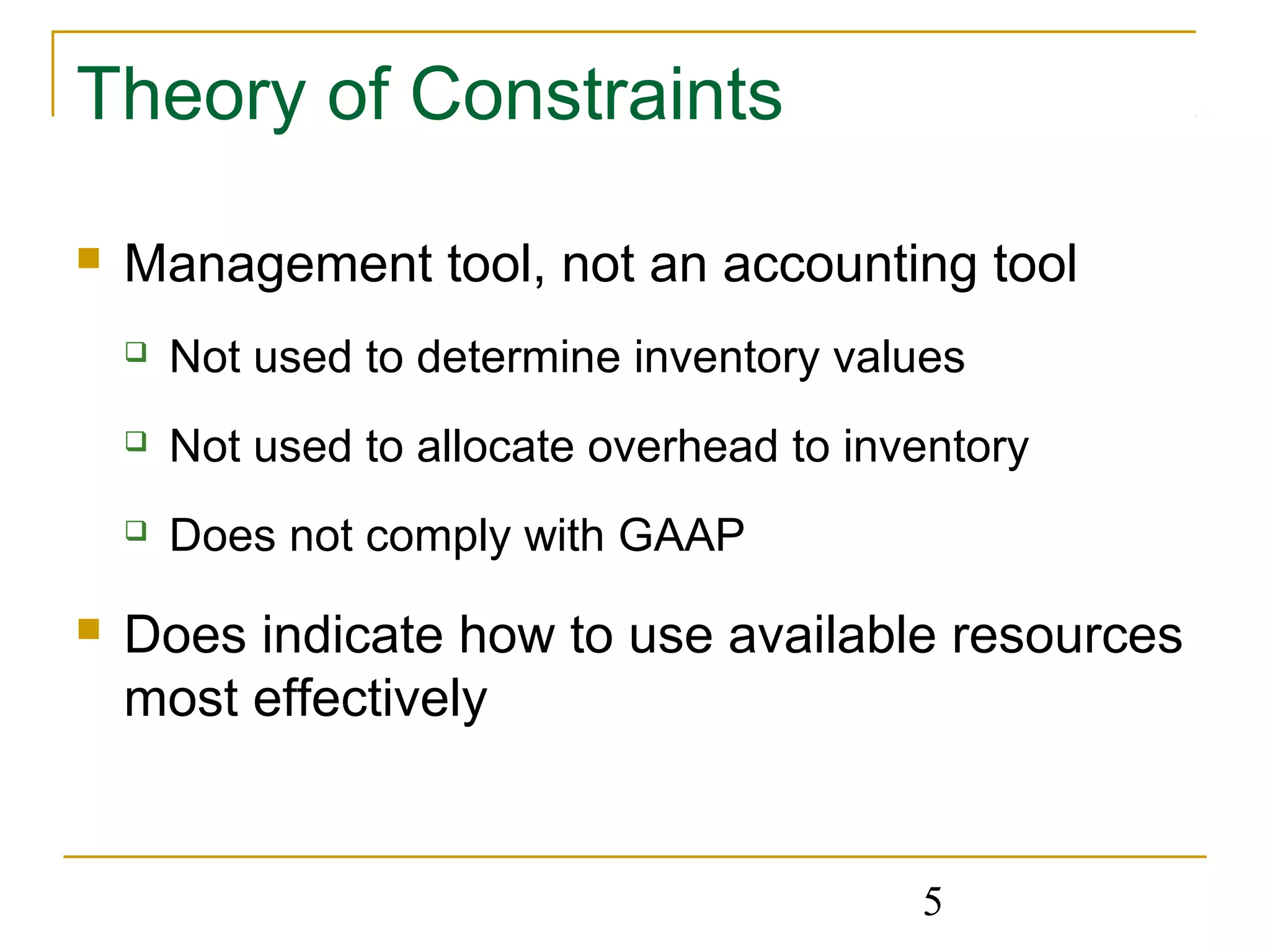
Theory of Constraints
 Management tool, not an accounting tool
 Not used to determine inventory values
 Not used to allocate overhead to inventory
 Does not comply with GAAP
 Does indicate how to use available resources
most effectively
6
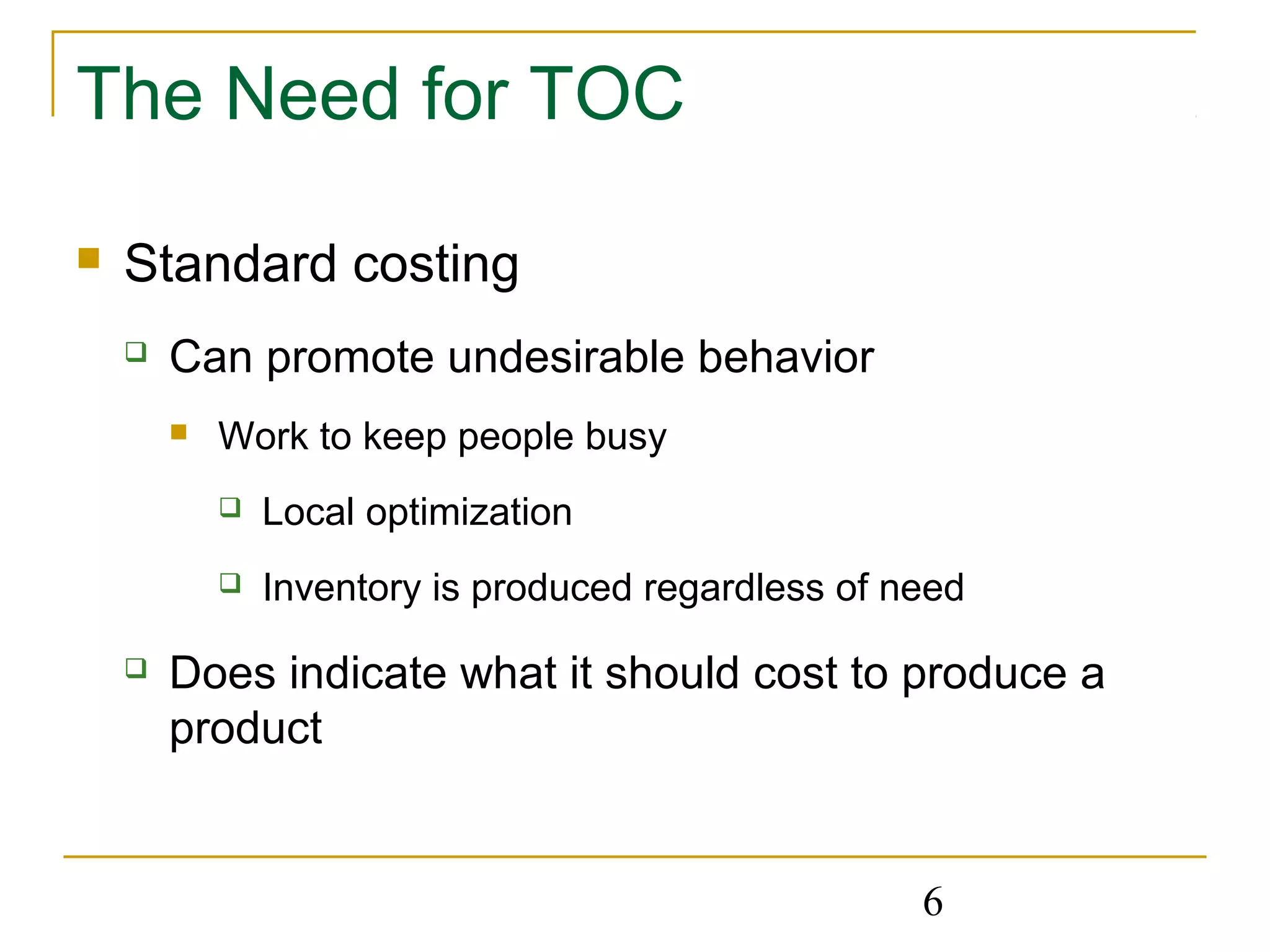
The Need for TOC
 Standard costing
 Can promote undesirable behavior
 Work to keep people busy
 Local optimization
 Inventory is produced regardless of need
 Does indicate what it should cost to produce a
product
7
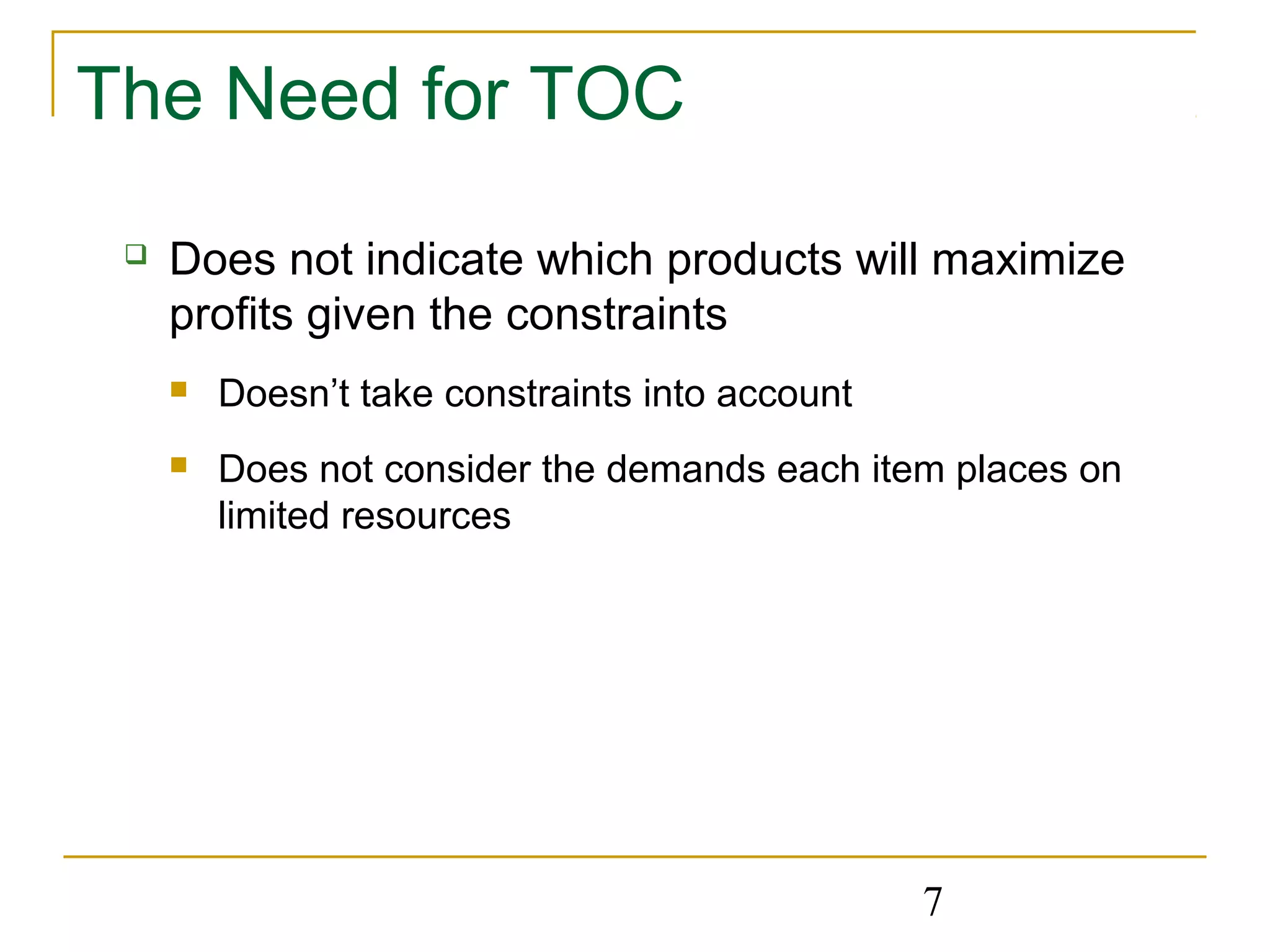
The Need for TOC
 Does not indicate which products will maximize
profits given the constraints
 Doesn’t take constraints into account
 Does not consider the demands each item places on
limited resources
8
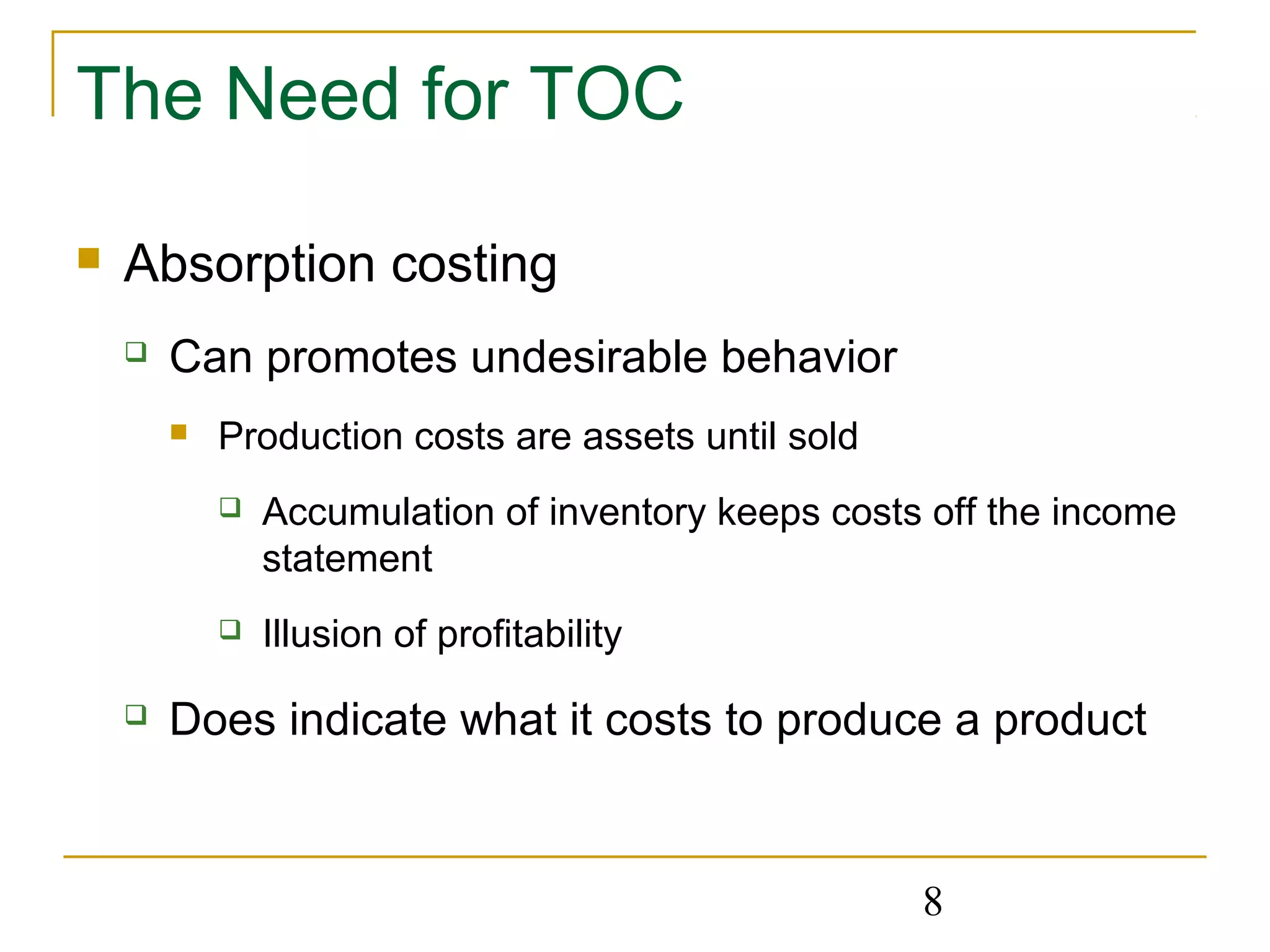
The Need for TOC
 Absorption costing
 Can promotes undesirable behavior
 Production costs are assets until sold
 Accumulation of inventory keeps costs off the income
statement
 Illusion of profitability
 Does indicate what it costs to produce a product
9
The Need for TOC
 Does not indicate which products will maximize
profits given the constraints
 Doesn’t take constraints into account
 Absorption cost does not consider the demands each
item places on limited resources
10
The Need for TOC
 Variable (direct) costing
 Identifies the incremental costs of producing a
product
 Identifies product that provides the greatest
contribution margin, or contribution margin per unit of
constrained resource
 Cannot deal with more than one constraining
resource at a time
11
The Need for TOC
 Traditional definition of variable cost doesn’t hold
in the short-run
 Labor, variable overhead aren’t really variable
on a day-to-day basis
 Some costs are truly variable in the short-run
 Material, commissions, delivery costs, out-of-
pocket selling costs, etc.
 Each additional unit produced or sold causes
more of the cost to be incurred
12
The Need for TOC
 Theory of Constraints
 Uses linear programming to determine best use of
limited resources
 Indicates what should be produced and in what
quantities
13
Theory of Constraints
 Constraining resource must be maximized
 All other operations must be geared toward this
goal
 May require suboptimization in other areas
 Upstream operations must provide only what the
constraint can handle
 Downstream operations will only receive what the
constraint can put out
14
Theory of Constraints
 Constraint must be kept operating at its full
capacity
 If not, the entire process slows further
 Focus is on maximizing throughput
 Sales – totally variable costs
 All other costs treated as fixed operational
expenses
 Cannot vary much in the short-run
15
Theory of Constraints
 Based on the concepts of drum, buffer and
ropes
 Drum
 Output of the constraint is the drumbeat
 Sets the tempo for other operations
 Tells upstream operations what to produce
 Tells downstream operations what to expect
16
Theory of Constraints
 Buffer
 Stockpile of work in process in front of constraint
 Precaution to keep constraint running if upstream
operations are interrupted
 Rope
 Sequence of processes prior to and including the
constraint
 Want to “pull” the rope at the maximum speed
 Speed of the constraint
17
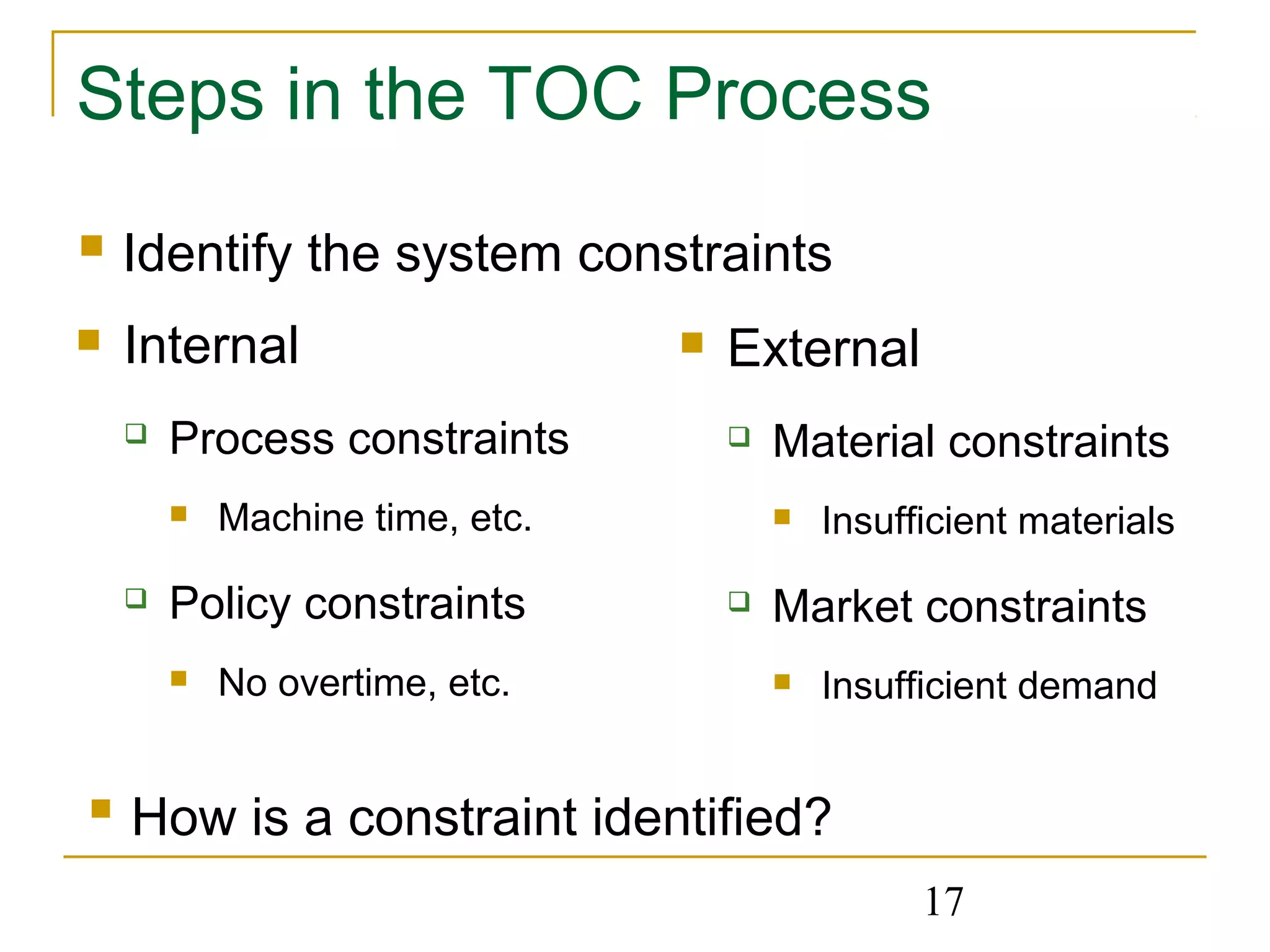
Steps in the TOC Process
 Internal
 Process constraints
 Machine time, etc.
 Policy constraints
 No overtime, etc.
 External
 Material constraints
 Insufficient materials
 Market constraints
 Insufficient demand
 Identify the system constraints
 How is a constraint identified?
18
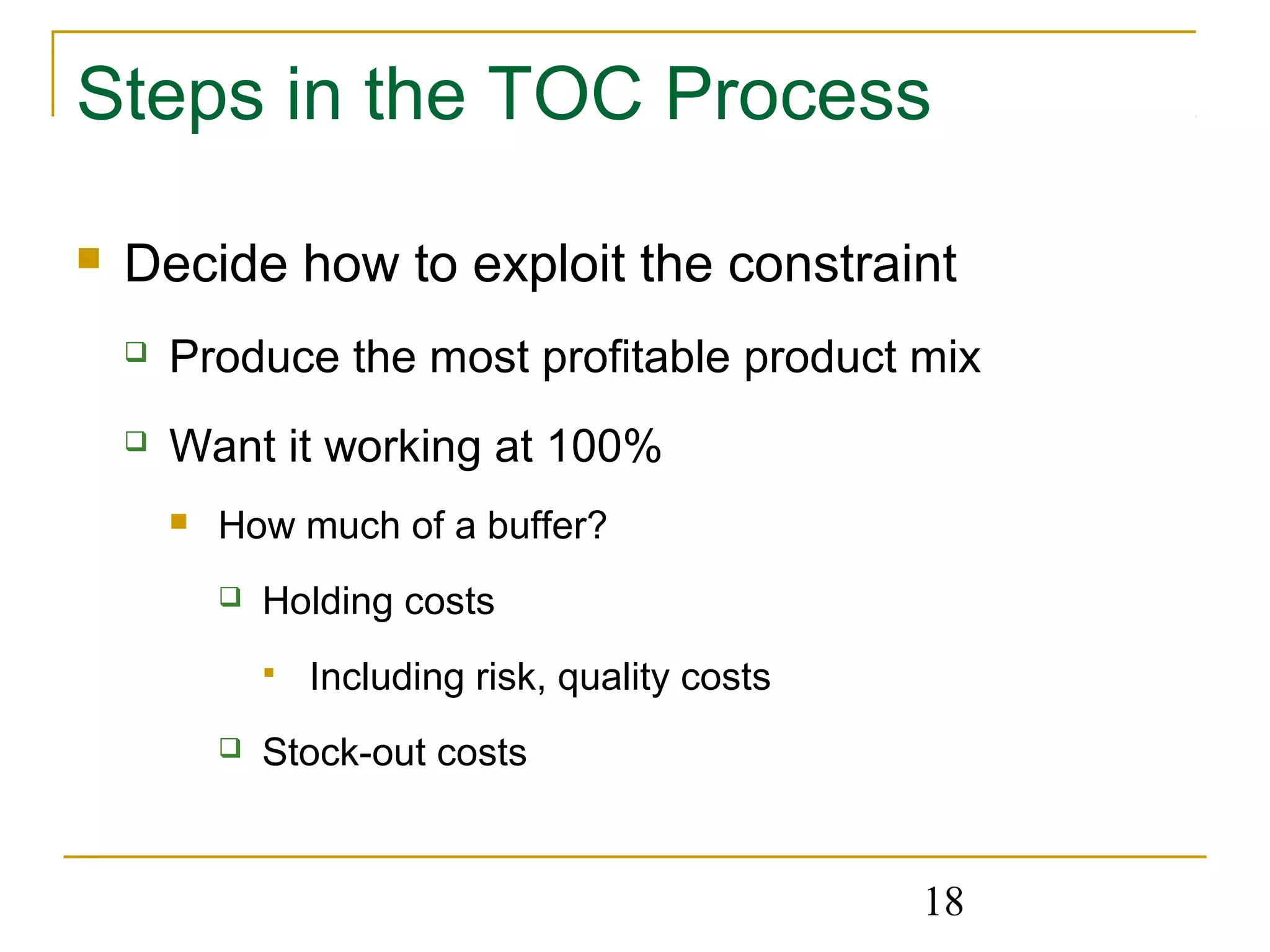
Steps in the TOC Process
 Decide how to exploit the constraint
 Produce the most profitable product mix
 Want it working at 100%
 How much of a buffer?
 Holding costs
 Including risk, quality costs
 Stock-out costs
19
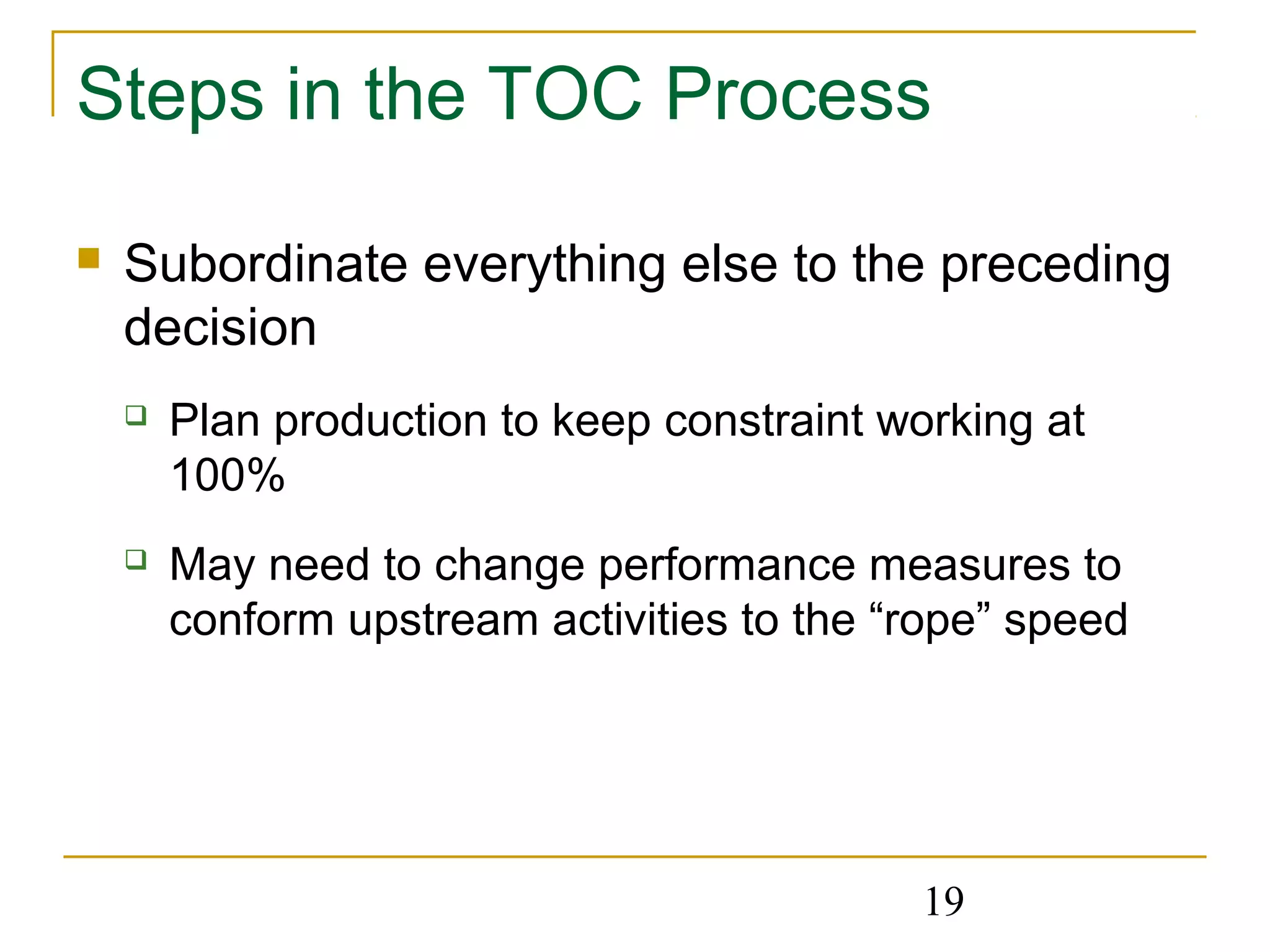
Steps in the TOC Process
 Subordinate everything else to the preceding
decision
 Plan production to keep constraint working at
100%
 May need to change performance measures to
conform upstream activities to the “rope” speed
20
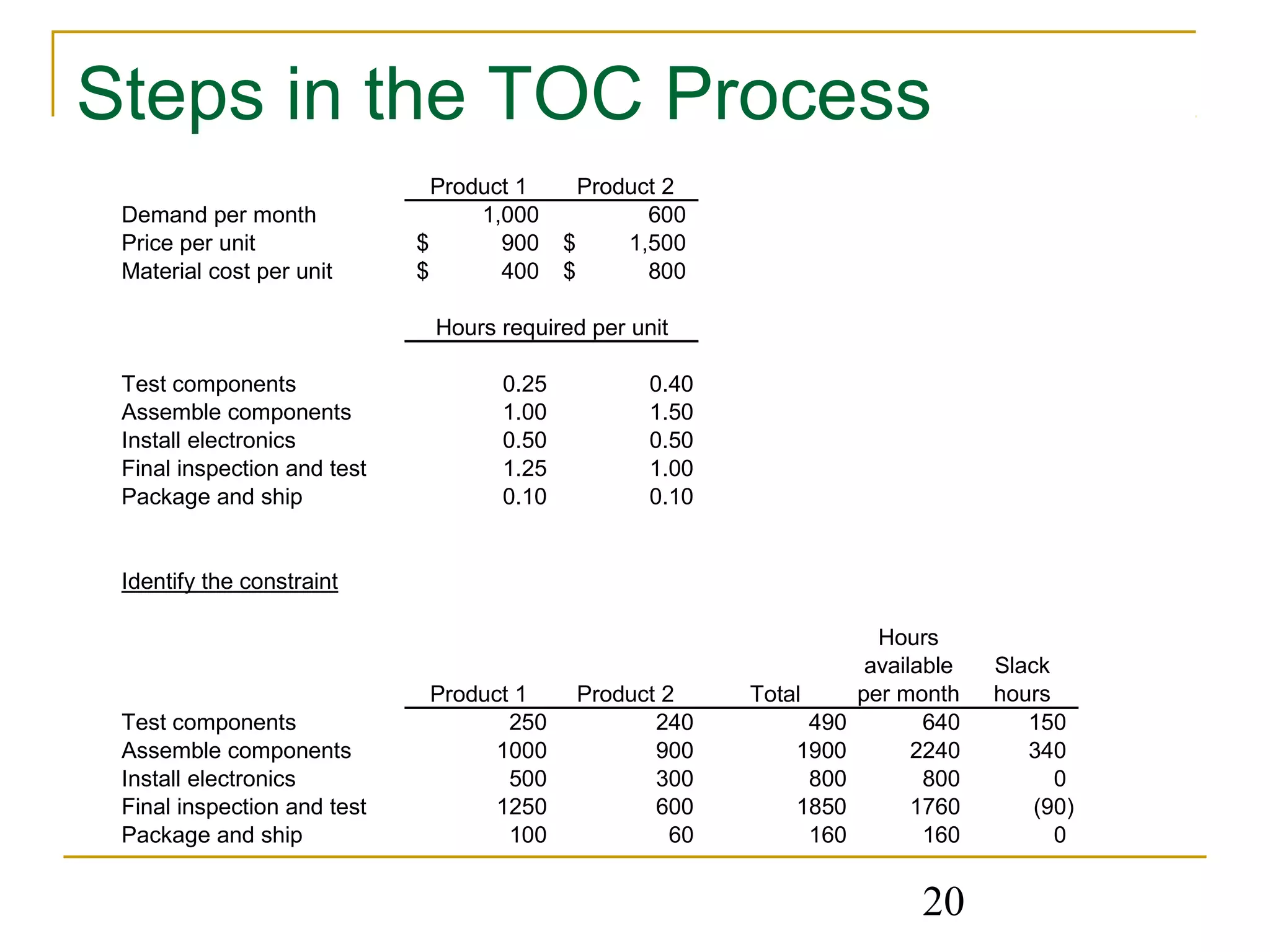
Steps in the TOC Process
Product 1 Product 2
Demand per month 1,000 600
Price per unit 900$ 1,500$
Material cost per unit 400$ 800$
Test components 0.25 0.40
Assemble components 1.00 1.50
Install electronics 0.50 0.50
Final inspection and test 1.25 1.00
Package and ship 0.10 0.10
Identify the constraint
Product 1 Product 2 Total
Hours
available
per month
Slack
hours
Test components 250 240 490 640 150
Assemble components 1000 900 1900 2240 340
Install electronics 500 300 800 800 0
Final inspection and test 1250 600 1850 1760 (90)
Package and ship 100 60 160 160 0
Hours required per unit
21
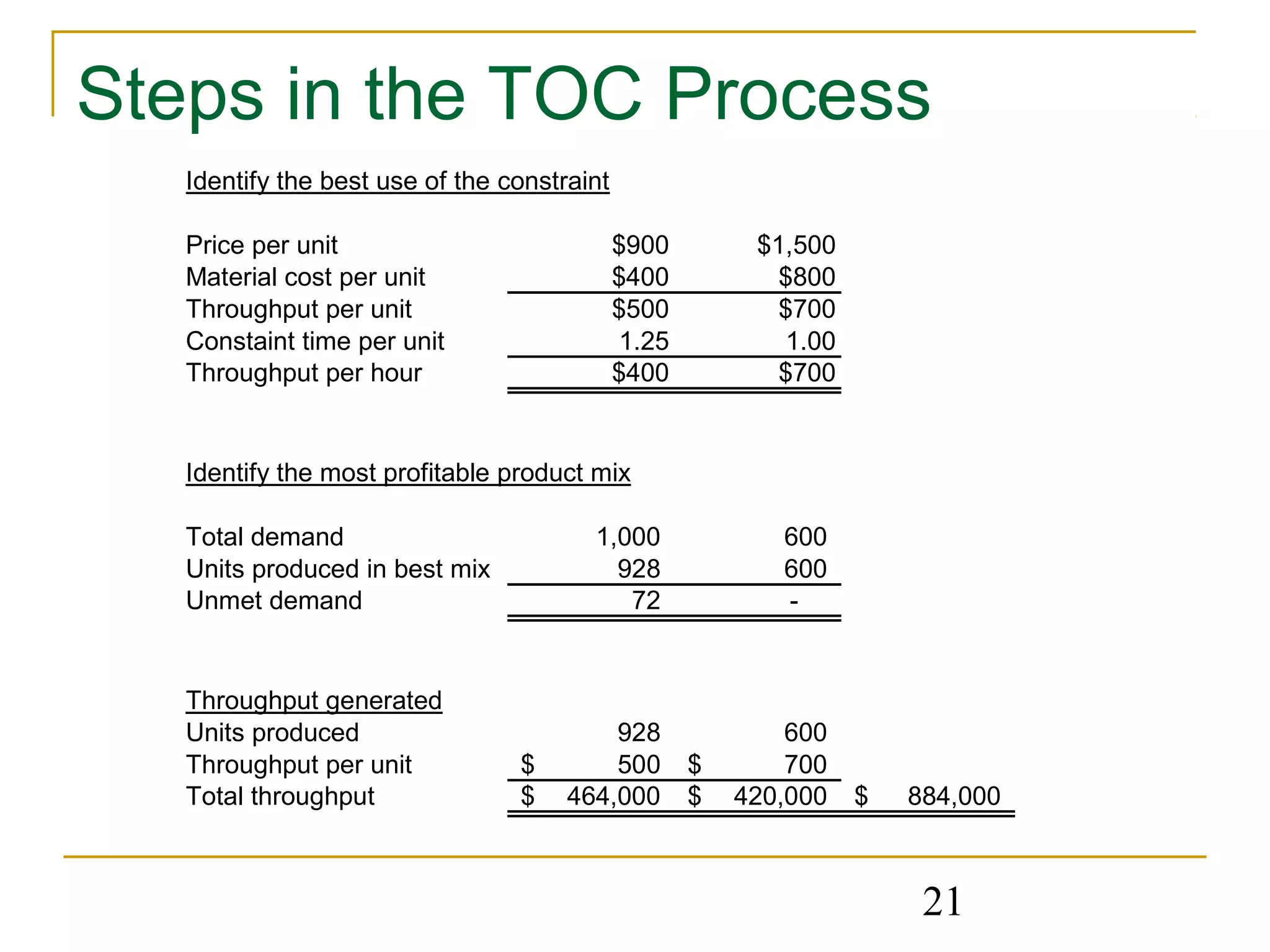
Steps in the TOC Process
Identify the best use of the constraint
Price per unit $900 $1,500
Material cost per unit $400 $800
Throughput per unit $500 $700
Constaint time per unit 1.25 1.00
Throughput per hour $400 $700
Identify the most profitable product mix
Total demand 1,000 600
Units produced in best mix 928 600
Unmet demand 72 -
Throughput generated
Units produced 928 600
Throughput per unit 500$ 700$
Total throughput 464,000$ 420,000$ 884,000$
22
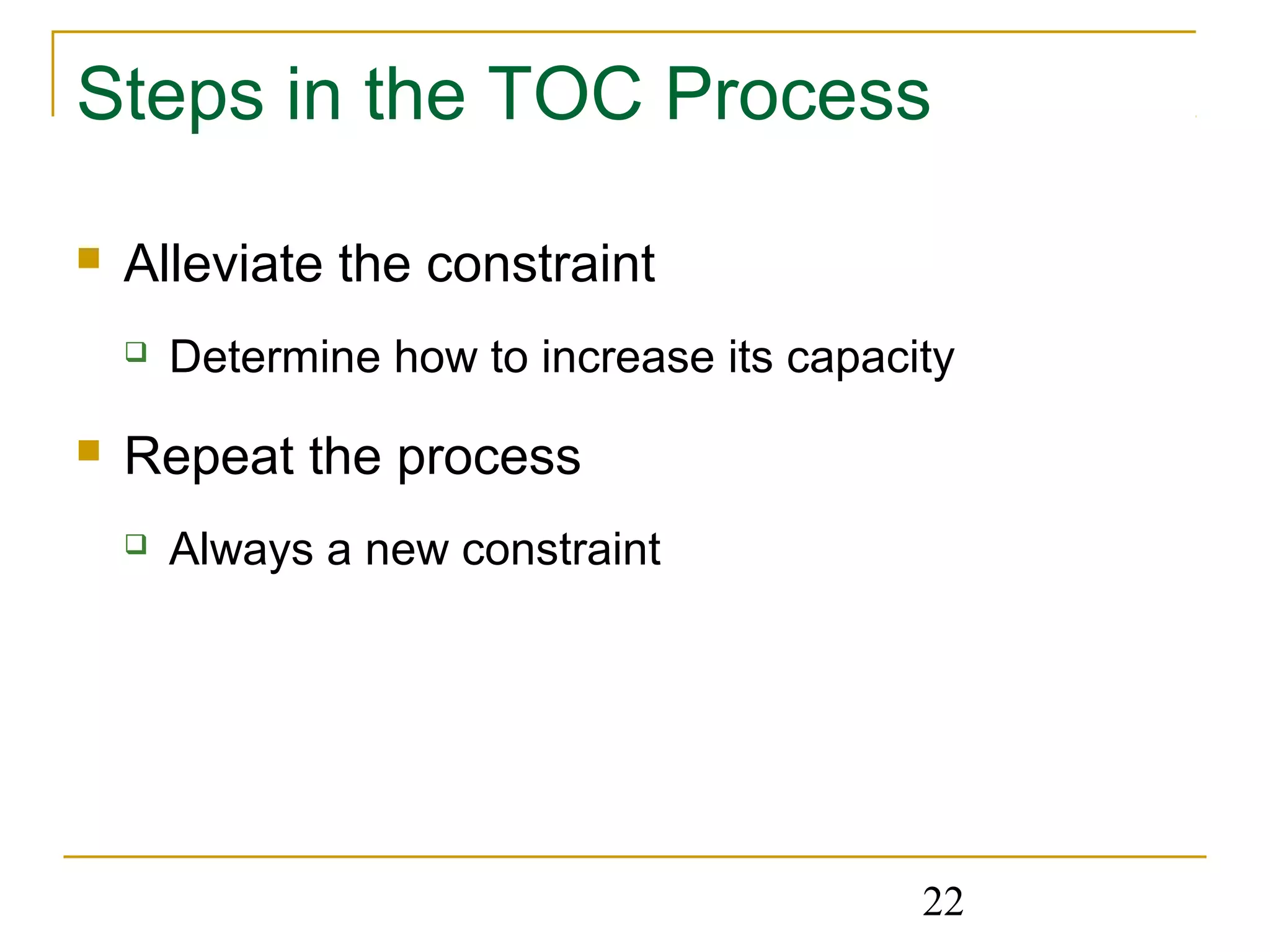
Steps in the TOC Process
 Alleviate the constraint
 Determine how to increase its capacity
 Repeat the process
 Always a new constraint
23
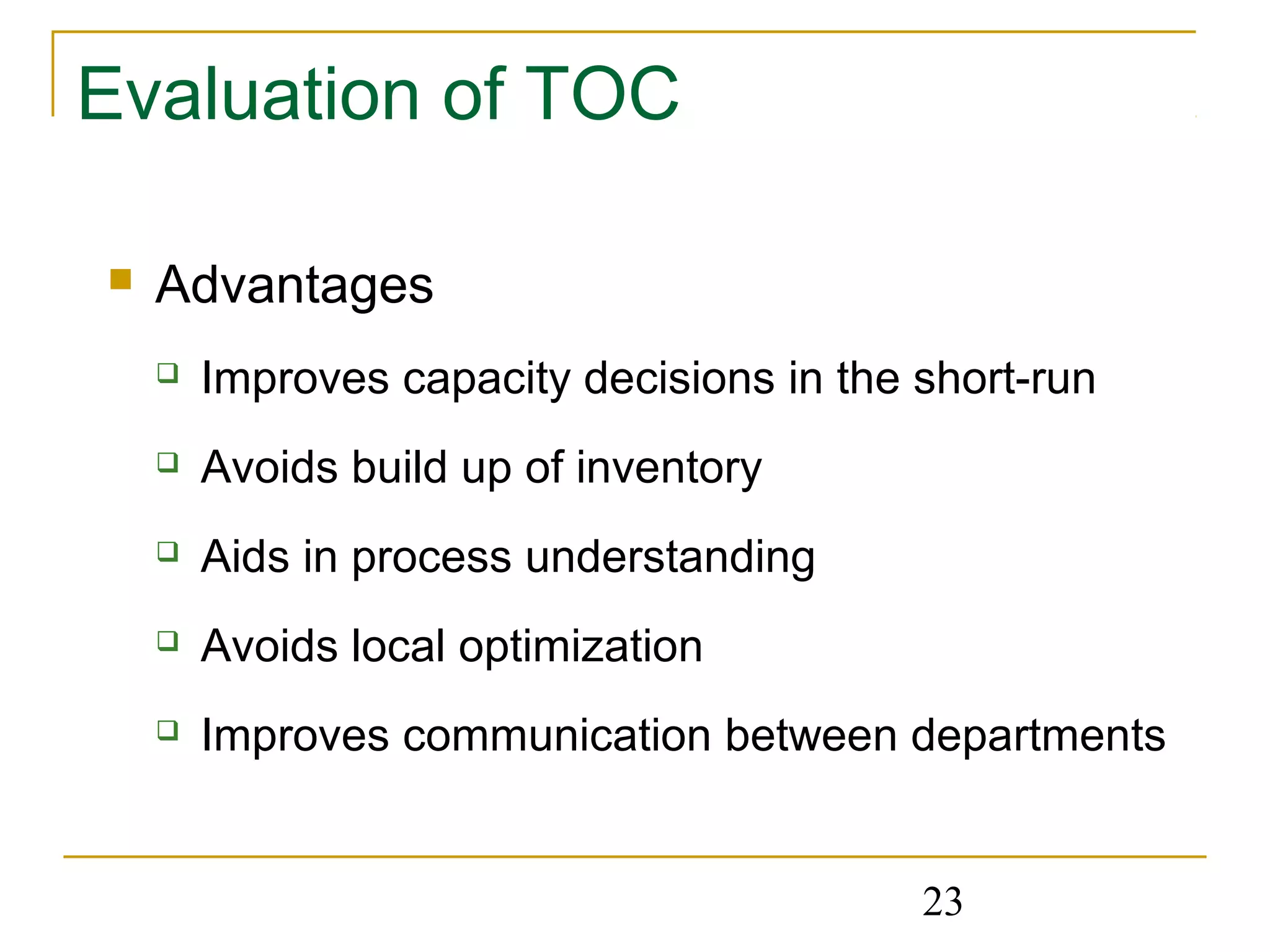
Evaluation of TOC
 Advantages
 Improves capacity decisions in the short-run
 Avoids build up of inventory
 Aids in process understanding
 Avoids local optimization
 Improves communication between departments
24
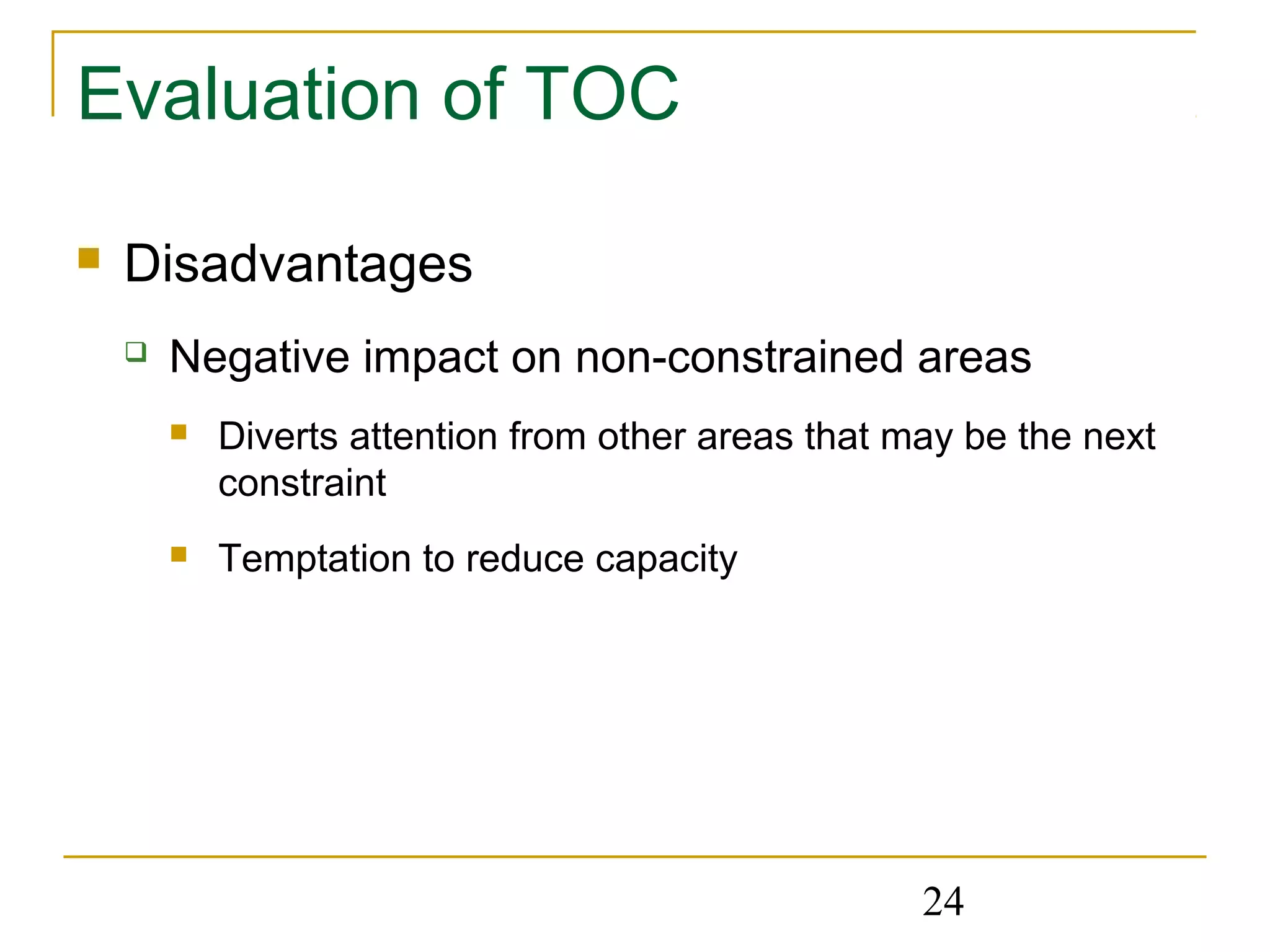
Evaluation of TOC
 Disadvantages
 Negative impact on non-constrained areas
 Diverts attention from other areas that may be the next
constraint
 Temptation to reduce capacity
25
Evaluation of TOC
 Ignores long-run considerations
 Introduction of new products
 Continuous improvement in non-constrained
areas
 May lead organization away from strategy
 Not a substitute for other accounting
methods

Theory of constraints

  • 1.
  • 2.
    2 Theory of Constraints Significance of bottlenecks  Maximum speed of the process is the speed of the slowest operation  Any improvements will be wasted unless the bottleneck is relieved  Bottlenecks must be identified and improved if the process is to be improved
  • 3.
    3 Theory of Constraints Purpose is to identify bottlenecks or other constraints and exploit them to the extent possible  Identification of constraints allows management to take action to alleviate the constraint in the future  Reduce cycle time  Time from receipt of customer order to shipment  Improve manufacturing cycle efficiency (MCE)  Processing time / total cycle time
  • 4.
    4 Theory of Constraints Assumes current constraints cannot be changed in the short-run  What should be produced now, with current resources, to maximize profits?  Question cannot be answered by traditional accounting methods
  • 5.
    5 Theory of Constraints Management tool, not an accounting tool  Not used to determine inventory values  Not used to allocate overhead to inventory  Does not comply with GAAP  Does indicate how to use available resources most effectively
  • 6.
    6 The Need forTOC  Standard costing  Can promote undesirable behavior  Work to keep people busy  Local optimization  Inventory is produced regardless of need  Does indicate what it should cost to produce a product
  • 7.
    7 The Need forTOC  Does not indicate which products will maximize profits given the constraints  Doesn’t take constraints into account  Does not consider the demands each item places on limited resources
  • 8.
    8 The Need forTOC  Absorption costing  Can promotes undesirable behavior  Production costs are assets until sold  Accumulation of inventory keeps costs off the income statement  Illusion of profitability  Does indicate what it costs to produce a product
  • 9.
    9 The Need forTOC  Does not indicate which products will maximize profits given the constraints  Doesn’t take constraints into account  Absorption cost does not consider the demands each item places on limited resources
  • 10.
    10 The Need forTOC  Variable (direct) costing  Identifies the incremental costs of producing a product  Identifies product that provides the greatest contribution margin, or contribution margin per unit of constrained resource  Cannot deal with more than one constraining resource at a time
  • 11.
    11 The Need forTOC  Traditional definition of variable cost doesn’t hold in the short-run  Labor, variable overhead aren’t really variable on a day-to-day basis  Some costs are truly variable in the short-run  Material, commissions, delivery costs, out-of- pocket selling costs, etc.  Each additional unit produced or sold causes more of the cost to be incurred
  • 12.
    12 The Need forTOC  Theory of Constraints  Uses linear programming to determine best use of limited resources  Indicates what should be produced and in what quantities
  • 13.
    13 Theory of Constraints Constraining resource must be maximized  All other operations must be geared toward this goal  May require suboptimization in other areas  Upstream operations must provide only what the constraint can handle  Downstream operations will only receive what the constraint can put out
  • 14.
    14 Theory of Constraints Constraint must be kept operating at its full capacity  If not, the entire process slows further  Focus is on maximizing throughput  Sales – totally variable costs  All other costs treated as fixed operational expenses  Cannot vary much in the short-run
  • 15.
    15 Theory of Constraints Based on the concepts of drum, buffer and ropes  Drum  Output of the constraint is the drumbeat  Sets the tempo for other operations  Tells upstream operations what to produce  Tells downstream operations what to expect
  • 16.
    16 Theory of Constraints Buffer  Stockpile of work in process in front of constraint  Precaution to keep constraint running if upstream operations are interrupted  Rope  Sequence of processes prior to and including the constraint  Want to “pull” the rope at the maximum speed  Speed of the constraint
  • 17.
    17 Steps in theTOC Process  Internal  Process constraints  Machine time, etc.  Policy constraints  No overtime, etc.  External  Material constraints  Insufficient materials  Market constraints  Insufficient demand  Identify the system constraints  How is a constraint identified?
  • 18.
    18 Steps in theTOC Process  Decide how to exploit the constraint  Produce the most profitable product mix  Want it working at 100%  How much of a buffer?  Holding costs  Including risk, quality costs  Stock-out costs
  • 19.
    19 Steps in theTOC Process  Subordinate everything else to the preceding decision  Plan production to keep constraint working at 100%  May need to change performance measures to conform upstream activities to the “rope” speed
  • 20.
    20 Steps in theTOC Process Product 1 Product 2 Demand per month 1,000 600 Price per unit 900$ 1,500$ Material cost per unit 400$ 800$ Test components 0.25 0.40 Assemble components 1.00 1.50 Install electronics 0.50 0.50 Final inspection and test 1.25 1.00 Package and ship 0.10 0.10 Identify the constraint Product 1 Product 2 Total Hours available per month Slack hours Test components 250 240 490 640 150 Assemble components 1000 900 1900 2240 340 Install electronics 500 300 800 800 0 Final inspection and test 1250 600 1850 1760 (90) Package and ship 100 60 160 160 0 Hours required per unit
  • 21.
    21 Steps in theTOC Process Identify the best use of the constraint Price per unit $900 $1,500 Material cost per unit $400 $800 Throughput per unit $500 $700 Constaint time per unit 1.25 1.00 Throughput per hour $400 $700 Identify the most profitable product mix Total demand 1,000 600 Units produced in best mix 928 600 Unmet demand 72 - Throughput generated Units produced 928 600 Throughput per unit 500$ 700$ Total throughput 464,000$ 420,000$ 884,000$
  • 22.
    22 Steps in theTOC Process  Alleviate the constraint  Determine how to increase its capacity  Repeat the process  Always a new constraint
  • 23.
    23 Evaluation of TOC Advantages  Improves capacity decisions in the short-run  Avoids build up of inventory  Aids in process understanding  Avoids local optimization  Improves communication between departments
  • 24.
    24 Evaluation of TOC Disadvantages  Negative impact on non-constrained areas  Diverts attention from other areas that may be the next constraint  Temptation to reduce capacity
  • 25.
    25 Evaluation of TOC Ignores long-run considerations  Introduction of new products  Continuous improvement in non-constrained areas  May lead organization away from strategy  Not a substitute for other accounting methods