Theory of Constraints
Dr. Seth Bates
Dr. Seth Bates
Advanced Manufacturing Methods
Department of Technology
College of Engineering
Seth P. Bates
Seth P. Bates The Theory of Constraints
The Theory of Constraints page
page 2
2
Theory of Constraints
Eliyahu
Eliyahu Goldratt
Goldratt
•
• The Theory of constraints was developed and
The Theory of constraints was developed and
popularized by manufacturing guru
popularized by manufacturing guru Eliyahu
Eliyahu M.
M.
Goldratt in 1984. Most people are first exposed to
the concepts through his book
the concepts through his book The Goal.
The Goal.
•
• In 1986
In 1986 Eliyahu
Eliyahu Goldratt formed the
Goldratt formed the Avraham
Avraham Y.
Y.
Goldratt Institute. This institute was formed to inform
people about TOC (The Theory of Constraints).
Seth P. Bates
Seth P. Bates The Theory of Constraints
The Theory of Constraints page
page 3
3
Dictionary Definition of a Constraint
1
1 the act of
the act of constraining
constraining
2
2 the state of being checked, restricted, or compelled to
the state of being checked, restricted, or compelled to
avoid or perform some action
<the
<the constraint
constraint and monotony of a monastic life
and monotony of a monastic life --
--
Matthew Arnold>
Matthew Arnold>
3
3 a
a constraining
constraining condition, agency, or force :
condition, agency, or force : CHECK
CHECK
<put legal
<put legal constraints
constraints on the board's activities>
on the board's activities>
Seth P. Bates
Seth P. Bates The Theory of Constraints
The Theory of Constraints page
page 4
4
TOC’s
TOC’s Definition of a Constraint
Definition of a Constraint
The most common question about the Theory of
Constraints (TOC) is, "Huh?"
Eli Goldratt defines a Constraint as, 'Anything that limits a
system from achieving higher performance verses its
goal.
goal.‘
‘
One definition used by Eli Goldratt for TOC (edited) is:
‘
‘A Thinking Process that enables people to invent
A Thinking Process that enables people to invent
simple solutions to seemingly complex problems.
simple solutions to seemingly complex problems.'
'
Seth P. Bates
Seth P. Bates The Theory of Constraints
The Theory of Constraints page
page 5
5
Here's another definition (from Larry Leach):
http://www.
http://www.srv
srv.net/~
.net/~lleach
lleach/TOC/defined.
/TOC/defined.htm
htm
The Theory of Constraints states that every system must have at
least one constraint limiting its output.
Consequences of the Theory:
1. The more complex the system, the less independent process
paths exist, so the lower the number of constraints. (Usually,
complex systems have only one constraint at a given time.)
2. A system of optimum processes can not be an optimum
system.
system.
3. An optimum system runs the constraint (or bottleneck) at
optimum capacity (focused on the goal of the system), and all
other process steps must have excess capacity.
Seth P. Bates
Seth P. Bates The Theory of Constraints
The Theory of Constraints page
page 6
6
TOC’s
TOC’s Definition of a Constraint
Definition of a Constraint
•
• A process or process step that limits throughput.
A process or process step that limits throughput.
•
• Anything that limits a system from achieving
Anything that limits a system from achieving
higher performance versus its goal.
•
• A constraint is a factor that limits the system
A constraint is a factor that limits the system
from getting more of whatever it strives.
Seth P. Bates
Seth P. Bates The Theory of Constraints
The Theory of Constraints page
page 7
7
What is TOC?
What is TOC?
•
• The core idea of the Theory of Constraints is that every real sy
The core idea of the Theory of Constraints is that every real system
stem
such as a profit
such as a profit-
-making enterprise must have at least one constraint.
making enterprise must have at least one constraint.
•
• The TOC is a thinking process that enables people to invent simp
The TOC is a thinking process that enables people to invent simple
le
solutions to seemingly complex problems.
•
• The Theory of Constraint states that every system must have at
The Theory of Constraint states that every system must have at
least one constraint limiting output.
•
• There is no choice in the matter; either you manage the constrai
There is no choice in the matter; either you manage the constraints
nts
or they mange you. The constraint will determine the output of
or they mange you. The constraint will determine the output of the
the
system whether they are acknowledged and managed, or not.
Seth P. Bates
Seth P. Bates The Theory of Constraints
The Theory of Constraints page
page 8
8
How does TOC help companies?
•
• Focuses improvement efforts where they
Focuses improvement efforts where they
will have the greatest immediate impact on
the bottom line.
the bottom line.
•
• Provides a reliable process that insists on
Provides a reliable process that insists on
follow through.
follow through.
Seth P. Bates
Seth P. Bates The Theory of Constraints
The Theory of Constraints page
page 9
9
Finding the focal point
•
• Before a company can properly focus,
Before a company can properly focus,
one necessary condition is that they
answer the following question:
What is the goal of a for
What is the goal of a for-
-profit enterprise?
profit enterprise?
Seth P. Bates
Seth P. Bates The Theory of Constraints
The Theory of Constraints page
page 10
10
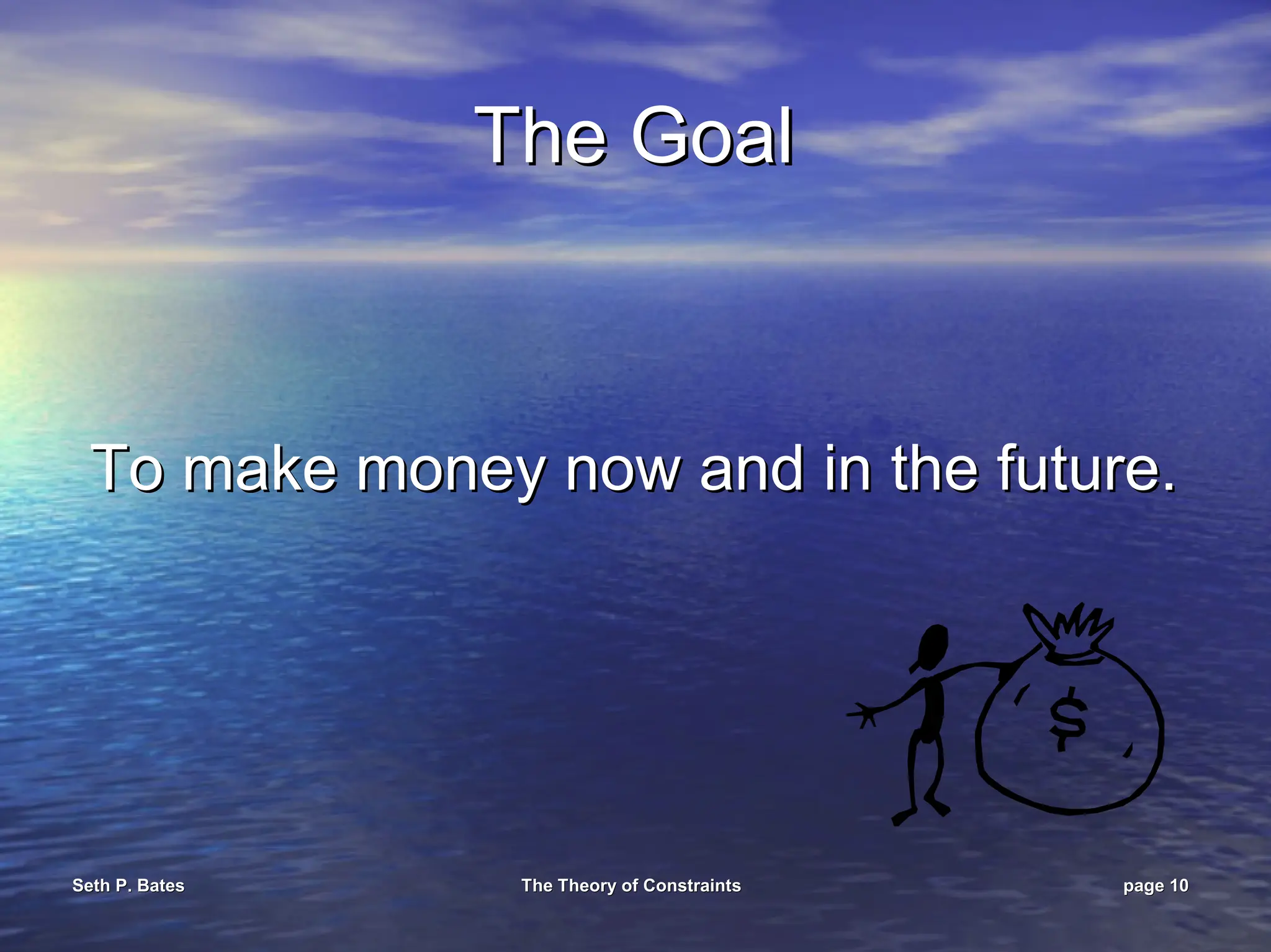
The Goal
The Goal
To make money now and in the future.
Seth P. Bates
Seth P. Bates The Theory of Constraints
The Theory of Constraints page
page 11
11
The Goal
The Goal (more)
(more)
•
• Some would say that the goal of a
Some would say that the goal of a
company is:
company is:
1)
1) To satisfy customers.
To satisfy customers.
2)
2) To provide satisfying jobs for employees.
To provide satisfying jobs for employees.
Seth P. Bates
Seth P. Bates The Theory of Constraints
The Theory of Constraints page
page 12
12
The Goal
The Goal (more)
(more)
•
• TOC Recognizes that only the owner can
TOC Recognizes that only the owner can
choose the goal, however, once chosen,
the other two ‘goals’ become conditions to
achieving the goal.
achieving the goal.
Seth P. Bates
Seth P. Bates The Theory of Constraints
The Theory of Constraints page
page 13
13
Measuring Progress
Measuring Progress
•
• Once the goal is identified, a necessary
Once the goal is identified, a necessary
condition to success in achieving the goal
is to identify which measurement(s) will be
used to judge progress.
Seth P. Bates
Seth P. Bates The Theory of Constraints
The Theory of Constraints page
page 14
14
What measurements should we use?
(Conventional Wisdom)
•
• Net Profit?
Net Profit?
•
• Efficiency?
Efficiency?
•
• Utilization?
Utilization?
•
• ROI
ROI (Return On Investment)
(Return On Investment)?
?
•
• Cash Flow?
Cash Flow?
Seth P. Bates
Seth P. Bates The Theory of Constraints
The Theory of Constraints page
page 15
15
What measurements should we use?
(TOC Wisdom)
(TOC Wisdom)
Throughput
Throughput
Inventory
Inventory
Operating Expense
Operating Expense
Seth P. Bates
Seth P. Bates The Theory of Constraints
The Theory of Constraints page
page 16
16
What is: Throughput
What is: Throughput
•
• The rate at which the system generates money through
The rate at which the system generates money through
sales minus raw materials and and purchased parts.
•
• All the money received from customers minus raw
All the money received from customers minus raw
materials cost.
materials cost.
•
• The rate at which the system makes money(sales minus
The rate at which the system makes money(sales minus
totally variable costs). Direct labor should not be
deducted in calculating Throughput. Sales are only
recognized when money is available to the firm. That is,
production for inventory is not a part of throughput
Seth P. Bates
Seth P. Bates The Theory of Constraints
The Theory of Constraints page
page 17
17
What is: Inventory
What is: Inventory
•
• All the money the system has invested in
All the money the system has invested in
purchasing things which it intends to sell.
Some insights
Some insights:
:
–
– Inventory is a liability, not an asset.
Inventory is a liability, not an asset.
–
– Raw materials and finished goods are inventory.
Raw materials and finished goods are inventory.
–
– Machines and fixtures (if owned) are inventory.
Machines and fixtures (if owned) are inventory.
–
– Scrap material that is to be sold is inventory until sold.
Scrap material that is to be sold is inventory until sold.
Seth P. Bates
Seth P. Bates The Theory of Constraints
The Theory of Constraints page
page 18
18
What is: Operating Expense
•
• All the money the system spends in order to
All the money the system spends in order to
turn inventory into throughput.
–
– All employee time is operating expense.
All employee time is operating expense.
–
– Depreciation of a machine is a operating expense.
Depreciation of a machine is a operating expense.
–
– Scrap material thrown away.
Scrap material thrown away.
–
– All expenses not deducted in arriving at throughput.
All expenses not deducted in arriving at throughput.
This includes direct labor and all operating and
maintenance expenses.
Seth P. Bates
Seth P. Bates The Theory of Constraints
The Theory of Constraints page
page 19
19
The Five Focusing Steps
•
• Identify a system's constraints
Identify a system's constraints
•
• Decide to exploit the system’s constraints
Decide to exploit the system’s constraints
•
• Subordinate everything else to the above decision
Subordinate everything else to the above decision
•
• Evaluate / Elevate the system’s constraints
Evaluate / Elevate the system’s constraints
•
• If in the previous steps a constraint has been broken, go
If in the previous steps a constraint has been broken, go
back to step 1. That is, find a new constraint.
•
• Warning: Do not allow inertia to cause a system
Warning: Do not allow inertia to cause a system
constraint.
constraint.
Seth P. Bates
Seth P. Bates The Theory of Constraints
The Theory of Constraints page
page 20
20
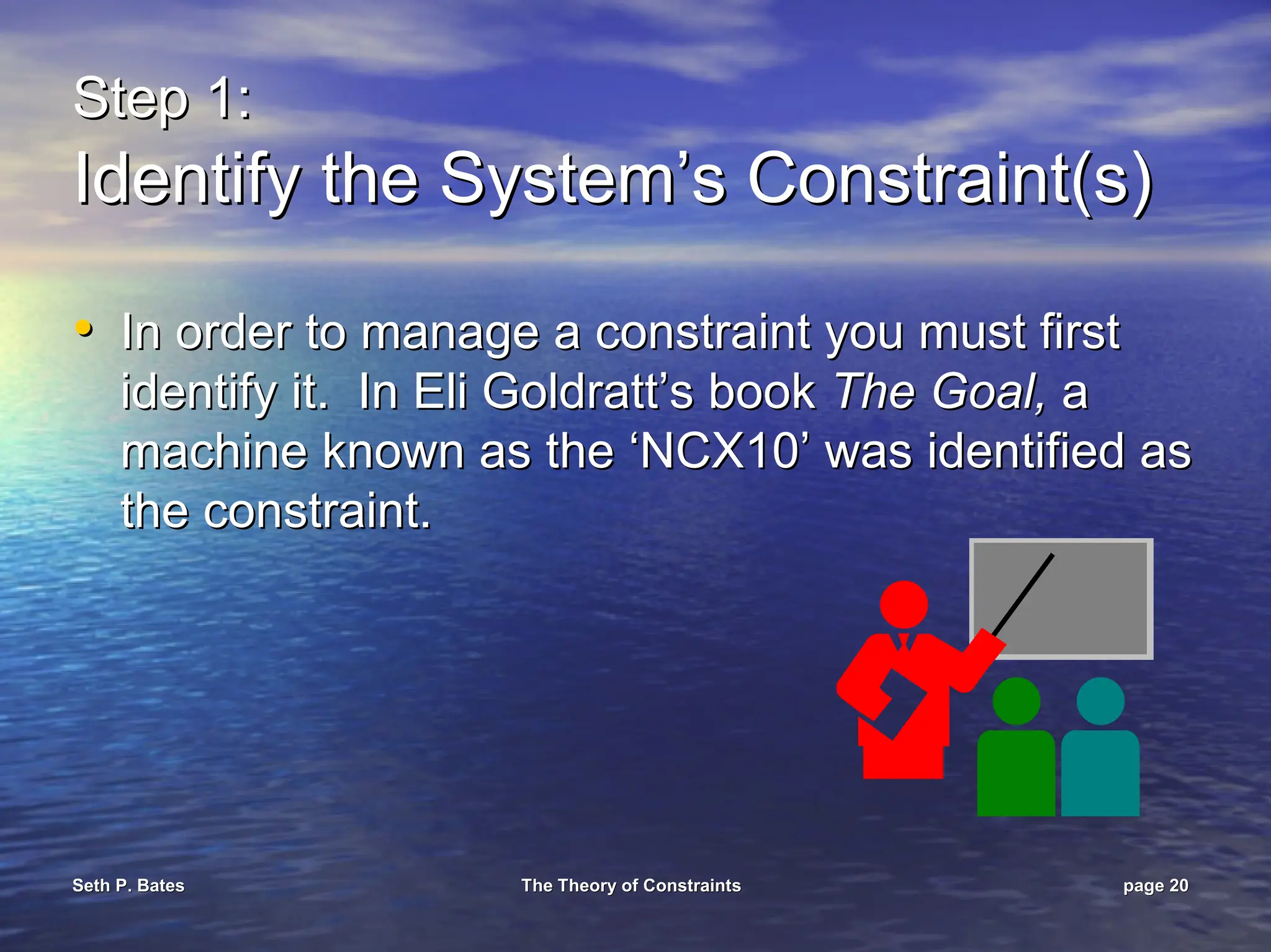
Step 1:
Step 1:
Identify the System’s Constraint(s)
•
• In order to manage a constraint you must first
In order to manage a constraint you must first
identify it. In Eli
identify it. In Eli Goldratt’s
Goldratt’s book
book The Goal,
The Goal, a
a
machine known as the ‘NCX10’ was identified as
the constraint.
the constraint.
Seth P. Bates
Seth P. Bates The Theory of Constraints
The Theory of Constraints page
page 21
21
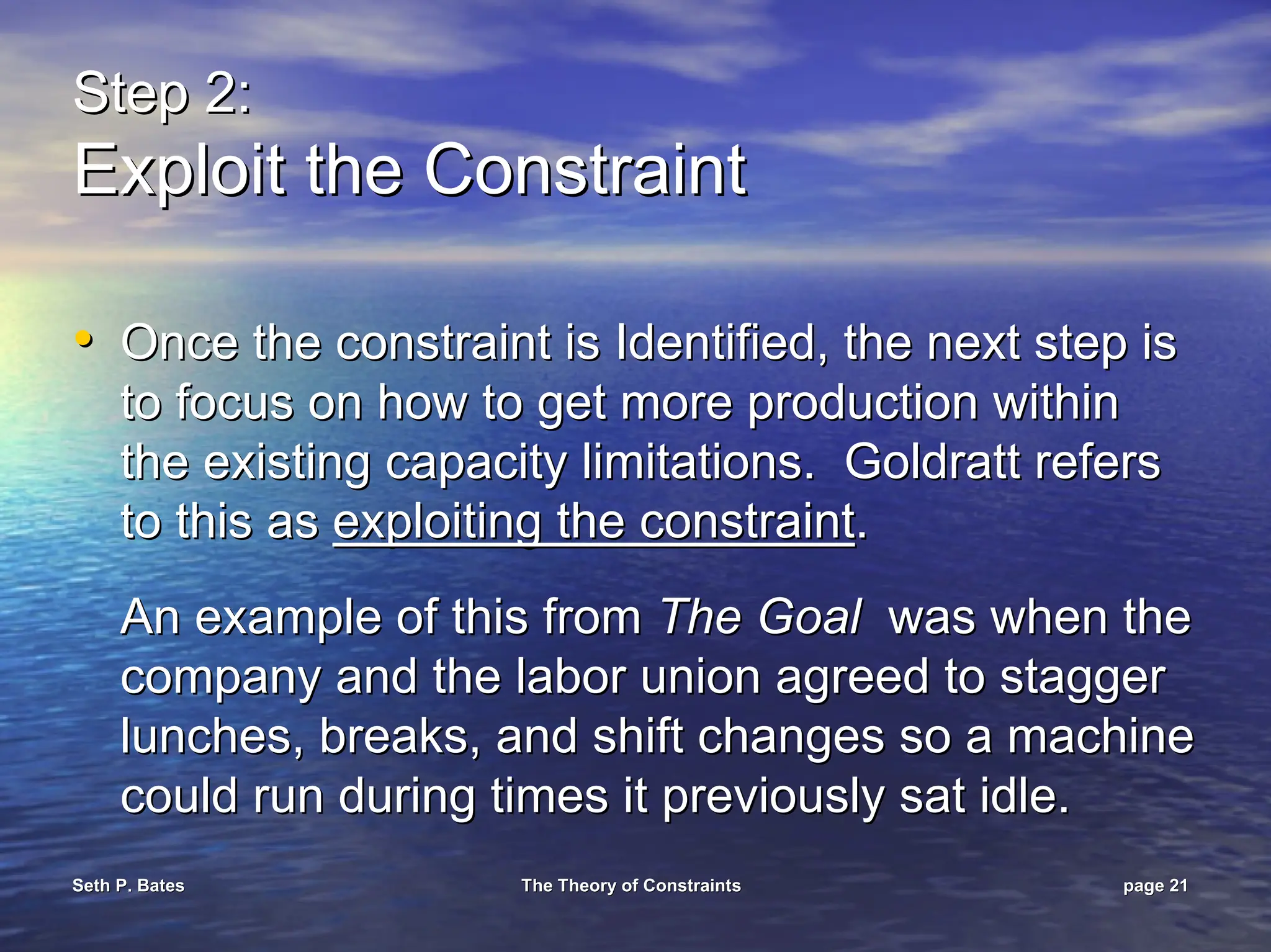
Step 2:
Step 2:
Exploit the Constraint
•
• Once the constraint is Identified, the next step is
Once the constraint is Identified, the next step is
to focus on how to get more production within
the existing capacity limitations. Goldratt refers
to this as
to this as exploiting the constraint
exploiting the constraint.
.
An example of this from
An example of this from The Goal
The Goal was when the
was when the
company and the labor union agreed to stagger
lunches, breaks, and shift changes so a machine
could run during times it previously sat idle.
Seth P. Bates
Seth P. Bates The Theory of Constraints
The Theory of Constraints page
page 22
22
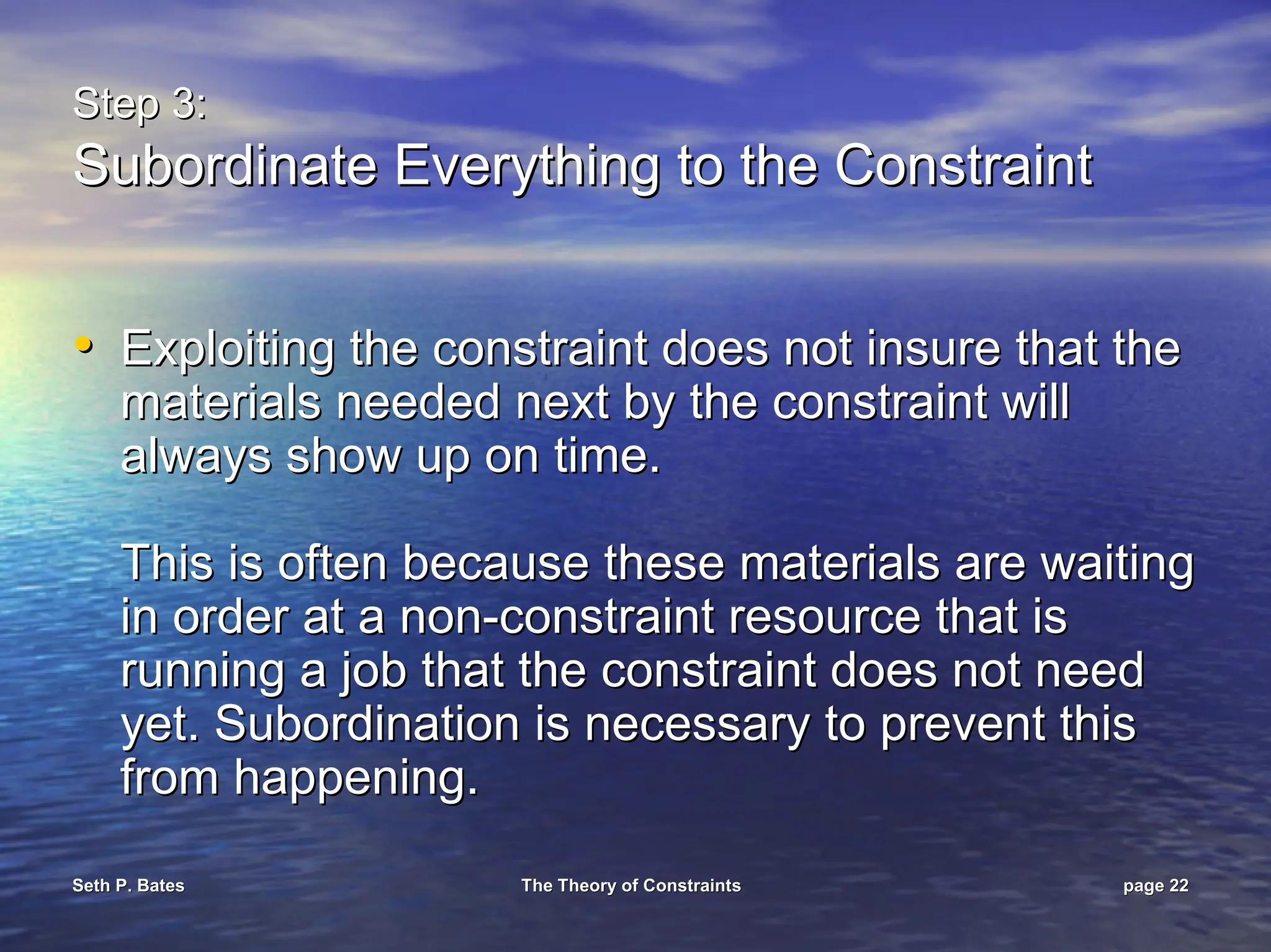
Step 3:
Step 3:
Subordinate Everything to the Constraint
•
• Exploiting the constraint does not insure that the
Exploiting the constraint does not insure that the
materials needed next by the constraint will
always show up on time.
This is often because these materials are waiting
in order at a non
in order at a non-
-constraint resource that is
constraint resource that is
running a job that the constraint does not need
yet. Subordination is necessary to prevent this
from happening.
from happening.
Seth P. Bates
Seth P. Bates The Theory of Constraints
The Theory of Constraints page
page 23
23
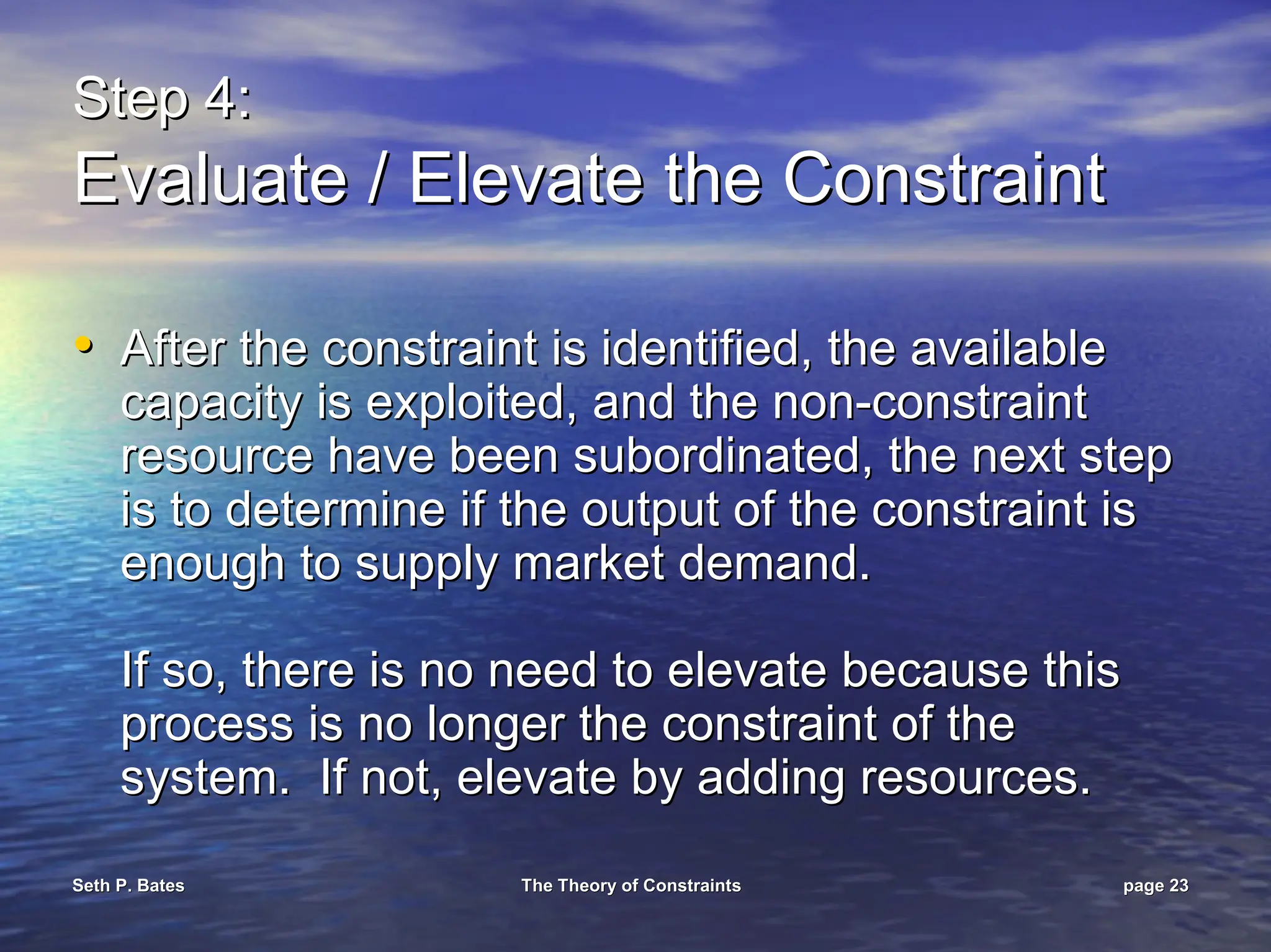
Step 4:
Step 4:
Evaluate / Elevate the Constraint
•
• After the constraint is identified, the available
After the constraint is identified, the available
capacity is exploited, and the non
capacity is exploited, and the non-
-constraint
constraint
resource have been subordinated, the next step
is to determine if the output of the constraint is
enough to supply market demand.
If so, there is no need to elevate because this
process is no longer the constraint of the
system. If not, elevate by adding resources.
Seth P. Bates
Seth P. Bates The Theory of Constraints
The Theory of Constraints page
page 24
24
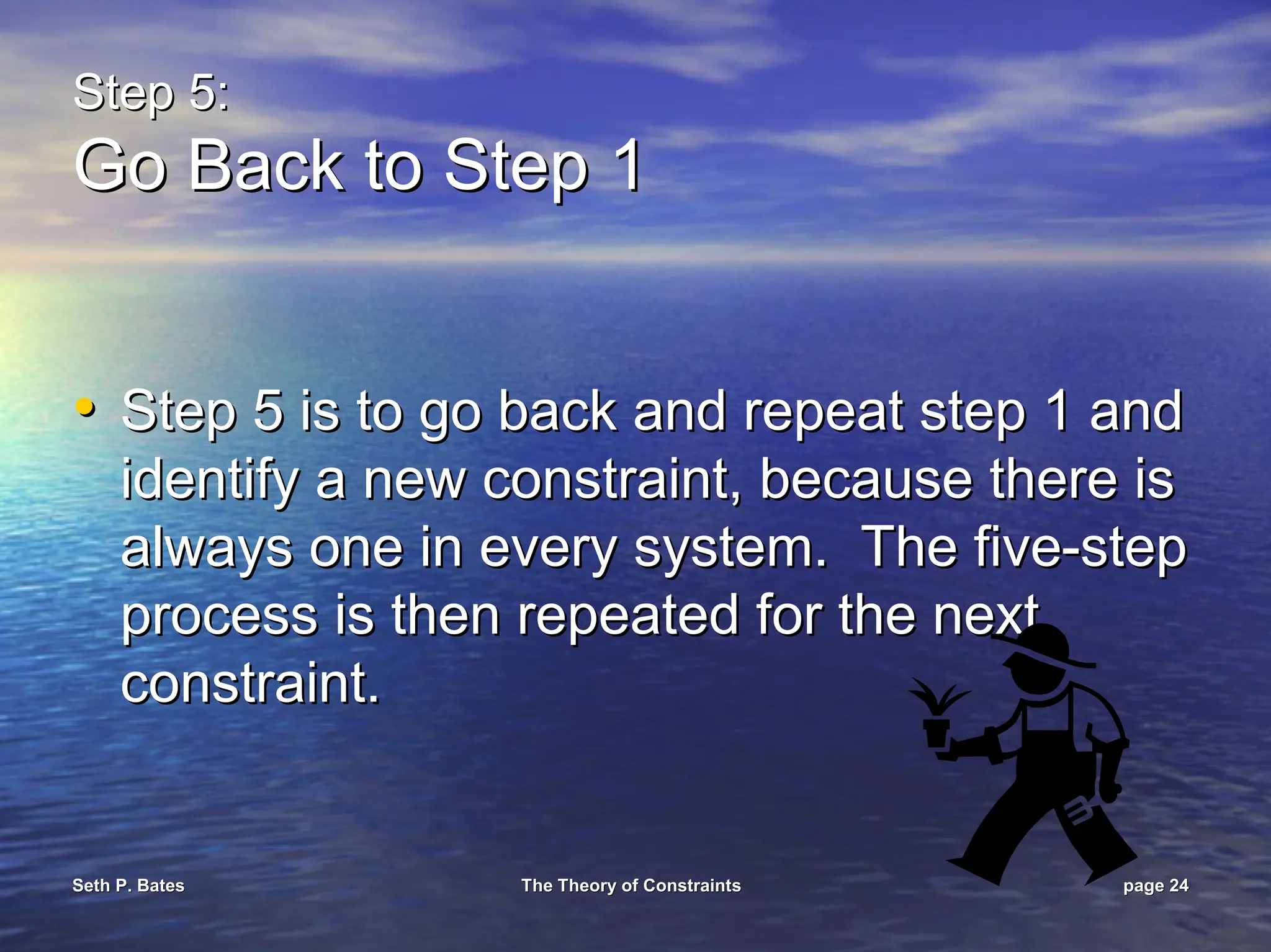
Step 5:
Step 5:
Go Back to Step 1
Go Back to Step 1
•
• Step 5 is to go back and repeat step 1 and
Step 5 is to go back and repeat step 1 and
identify a new constraint, because there is
always one in every system. The five
always one in every system. The five-
-step
step
process is then repeated for the next
constraint.
constraint.
Seth P. Bates
Seth P. Bates The Theory of Constraints
The Theory of Constraints page
page 25
25
The Process of Change
•
• Simply stated, the thinking process involves the
Simply stated, the thinking process involves the
rigorous application of effect
rigorous application of effect-
-cause
cause-
-effect logic
effect logic
to answer the following three questions
to answer the following three questions:
:
What to Change?
What to Change?
What to Change to?
What to Change to?
How to Cause the Change?
Seth P. Bates
Seth P. Bates The Theory of Constraints
The Theory of Constraints page
page 26
26
What to Change?
What to Change?
•
• Pinpoint the core problems.
Pinpoint the core problems.
The first question is equivalent to asking, “Where is the
constraint?” Since this process is generally used
when the constraint is not a physical resource, there
is usually not physical evidence (such as work in
process inventory) to point you to the constraint.
Instead, you have to map what is currently going on in
your system.
your system.
This leads to the “Current Reality Tree”.
Seth P. Bates
Seth P. Bates The Theory of Constraints
The Theory of Constraints page
page 27
27
the Current Reality Tree
•
• Instead of using physical evidence, you have to start with the
Instead of using physical evidence, you have to start with the
evidence that is available; the negative events that are apparen
evidence that is available; the negative events that are apparent in
t in
the system.
the system.
Examples include:
Examples include:
–
– Frequently shipping orders late
Frequently shipping orders late
–
– excessive amounts of inventory
excessive amounts of inventory
–
– lead times that are increasing
lead times that are increasing
–
– poor human relations within the organization.
poor human relations within the organization.
•
• Goldratt calls these Undesirable Effects, or
Goldratt calls these Undesirable Effects, or UDEs
UDEs. The challenge is
. The challenge is
to map out the interrelated web of cause
to map out the interrelated web of cause-
-and
and-
-effect that links the
effect that links the
undesirable effects together. Once completed, one is is general
undesirable effects together. Once completed, one is is generally
ly
able to identify a “core problem” at the bottom of the map.
Seth P. Bates
Seth P. Bates The Theory of Constraints
The Theory of Constraints page
page 28
28
What to Change to?
What to Change to?
•
• The first step in determining the answer to this
The first step in determining the answer to this
question is to understand why the core problem
exists.
exists.
It is assumed that managers are not dumb. If there is
an easy solution to this core problem it would have
been solved a long time ago. There must be some
conflict that underlies the core problem. Once this is
identified, the thinking process is used to develop a
breakthrough idea that will resolve a conflict. This is
done by using a tool known as evaporating clouds.
Seth P. Bates
Seth P. Bates The Theory of Constraints
The Theory of Constraints page
page 29
29
What to change to?
What to change to? (more)
(more)
•
• In order to do this you must use simple
In order to do this you must use simple
and practical solutions.
Seth P. Bates
Seth P. Bates The Theory of Constraints
The Theory of Constraints page
page 30
30
How to cause the change?
•
• In order to cause the change you must
In order to cause the change you must
induce the appropriate people to invent
such solutions. Using methods like the
Socratic method can have this effect.
Seth P. Bates
Seth P. Bates The Theory of Constraints
The Theory of Constraints page
page 31
31
Conclusion
Conclusion
•
• The Theory of Constraints is about two
The Theory of Constraints is about two
things:
things:
•
• Focus
Focus
•
• Follow through
Follow through
………..
………..
•
• and of course, making money!
and of course, making money!
Seth P. Bates
Seth P. Bates The Theory of Constraints
The Theory of Constraints page
page 32
32
Resources
Resources
•
• Levinson, William A., P.E., MBA.
Levinson, William A., P.E., MBA. Goldratt's
Goldratt's Theory of
Theory of
Constraints: Online Simulation
Constraints: Online Simulation, at
, at
http://www.ganesha.org/leading/toc.html
•
• Leach, Larry.
Leach, Larry.
http://www.
http://www.srv
srv.net/~
.net/~lleach
lleach/TOC/defined.
/TOC/defined.htm
htm
Seth P. Bates
Seth P. Bates The Theory of Constraints
The Theory of Constraints page
page 33
33
References
References
•
• Goldratt, Eli,
Goldratt, Eli, It’s Not Luck.
It’s Not Luck. The North
The North River Press, Great
River Press, Great
Barrington, MA, 1994
•
• Goldratt, Eli,
Goldratt, Eli, What Is This Thing Called The Theory Of
What Is This Thing Called The Theory Of
Constraints?
Constraints?, The North River Press, Great
, The North River Press, Great Barrrington
Barrrington,
,
MA, 1990
MA, 1990
•
• Dettmer
Dettmer, William,
, William, Eli M.
Eli M. Goldratt’s
Goldratt’s The Theory of
The Theory of
Constraints, A Systems Approach to Continuous
Improvement
Improvement,
, 1996, ASQC press
1996, ASQC press.
.

Theory of Contraints - Advanced Manufacturing Methods

  • 1.
    Theory of Constraints Theoryof Constraints Dr. Seth Bates Dr. Seth Bates Advanced Manufacturing Methods Advanced Manufacturing Methods Department of Technology Department of Technology College of Engineering College of Engineering
  • 2.
    Seth P. Bates SethP. Bates The Theory of Constraints The Theory of Constraints page page 2 2 Theory of Constraints Theory of Constraints Eliyahu Eliyahu Goldratt Goldratt • • The Theory of constraints was developed and The Theory of constraints was developed and popularized by manufacturing guru popularized by manufacturing guru Eliyahu Eliyahu M. M. Goldratt in 1984. Most people are first exposed to Goldratt in 1984. Most people are first exposed to the concepts through his book the concepts through his book The Goal. The Goal. • • In 1986 In 1986 Eliyahu Eliyahu Goldratt formed the Goldratt formed the Avraham Avraham Y. Y. Goldratt Institute. This institute was formed to inform Goldratt Institute. This institute was formed to inform people about TOC (The Theory of Constraints). people about TOC (The Theory of Constraints).
  • 3.
    Seth P. Bates SethP. Bates The Theory of Constraints The Theory of Constraints page page 3 3 Dictionary Definition of a Constraint Dictionary Definition of a Constraint 1 1 the act of the act of constraining constraining 2 2 the state of being checked, restricted, or compelled to the state of being checked, restricted, or compelled to avoid or perform some action avoid or perform some action <the <the constraint constraint and monotony of a monastic life and monotony of a monastic life -- -- Matthew Arnold> Matthew Arnold> 3 3 a a constraining constraining condition, agency, or force : condition, agency, or force : CHECK CHECK <put legal <put legal constraints constraints on the board's activities> on the board's activities>
  • 4.
    Seth P. Bates SethP. Bates The Theory of Constraints The Theory of Constraints page page 4 4 TOC’s TOC’s Definition of a Constraint Definition of a Constraint The most common question about the Theory of The most common question about the Theory of Constraints (TOC) is, "Huh?" Constraints (TOC) is, "Huh?" Eli Goldratt defines a Constraint as, 'Anything that limits a Eli Goldratt defines a Constraint as, 'Anything that limits a system from achieving higher performance verses its system from achieving higher performance verses its goal. goal.‘ ‘ One definition used by Eli Goldratt for TOC (edited) is: One definition used by Eli Goldratt for TOC (edited) is: ‘ ‘A Thinking Process that enables people to invent A Thinking Process that enables people to invent simple solutions to seemingly complex problems. simple solutions to seemingly complex problems.' '
  • 5.
    Seth P. Bates SethP. Bates The Theory of Constraints The Theory of Constraints page page 5 5 Here's another definition (from Larry Leach): Here's another definition (from Larry Leach): http://www. http://www.srv srv.net/~ .net/~lleach lleach/TOC/defined. /TOC/defined.htm htm The Theory of Constraints states that every system must have at The Theory of Constraints states that every system must have at least one constraint limiting its output. least one constraint limiting its output. Consequences of the Theory: Consequences of the Theory: 1. The more complex the system, the less independent process 1. The more complex the system, the less independent process paths exist, so the lower the number of constraints. (Usually, paths exist, so the lower the number of constraints. (Usually, complex systems have only one constraint at a given time.) complex systems have only one constraint at a given time.) 2. A system of optimum processes can not be an optimum 2. A system of optimum processes can not be an optimum system. system. 3. An optimum system runs the constraint (or bottleneck) at 3. An optimum system runs the constraint (or bottleneck) at optimum capacity (focused on the goal of the system), and all optimum capacity (focused on the goal of the system), and all other process steps must have excess capacity. other process steps must have excess capacity.
  • 6.
    Seth P. Bates SethP. Bates The Theory of Constraints The Theory of Constraints page page 6 6 TOC’s TOC’s Definition of a Constraint Definition of a Constraint • • A process or process step that limits throughput. A process or process step that limits throughput. • • Anything that limits a system from achieving Anything that limits a system from achieving higher performance versus its goal. higher performance versus its goal. • • A constraint is a factor that limits the system A constraint is a factor that limits the system from getting more of whatever it strives. from getting more of whatever it strives.
  • 7.
    Seth P. Bates SethP. Bates The Theory of Constraints The Theory of Constraints page page 7 7 What is TOC? What is TOC? • • The core idea of the Theory of Constraints is that every real sy The core idea of the Theory of Constraints is that every real system stem such as a profit such as a profit- -making enterprise must have at least one constraint. making enterprise must have at least one constraint. • • The TOC is a thinking process that enables people to invent simp The TOC is a thinking process that enables people to invent simple le solutions to seemingly complex problems. solutions to seemingly complex problems. • • The Theory of Constraint states that every system must have at The Theory of Constraint states that every system must have at least one constraint limiting output. least one constraint limiting output. • • There is no choice in the matter; either you manage the constrai There is no choice in the matter; either you manage the constraints nts or they mange you. The constraint will determine the output of or they mange you. The constraint will determine the output of the the system whether they are acknowledged and managed, or not. system whether they are acknowledged and managed, or not.
  • 8.
    Seth P. Bates SethP. Bates The Theory of Constraints The Theory of Constraints page page 8 8 How does TOC help companies? How does TOC help companies? • • Focuses improvement efforts where they Focuses improvement efforts where they will have the greatest immediate impact on will have the greatest immediate impact on the bottom line. the bottom line. • • Provides a reliable process that insists on Provides a reliable process that insists on follow through. follow through.
  • 9.
    Seth P. Bates SethP. Bates The Theory of Constraints The Theory of Constraints page page 9 9 Finding the focal point Finding the focal point • • Before a company can properly focus, Before a company can properly focus, one necessary condition is that they one necessary condition is that they answer the following question: answer the following question: What is the goal of a for What is the goal of a for- -profit enterprise? profit enterprise?
  • 10.
    Seth P. Bates SethP. Bates The Theory of Constraints The Theory of Constraints page page 10 10 The Goal The Goal To make money now and in the future. To make money now and in the future.
  • 11.
    Seth P. Bates SethP. Bates The Theory of Constraints The Theory of Constraints page page 11 11 The Goal The Goal (more) (more) • • Some would say that the goal of a Some would say that the goal of a company is: company is: 1) 1) To satisfy customers. To satisfy customers. 2) 2) To provide satisfying jobs for employees. To provide satisfying jobs for employees.
  • 12.
    Seth P. Bates SethP. Bates The Theory of Constraints The Theory of Constraints page page 12 12 The Goal The Goal (more) (more) • • TOC Recognizes that only the owner can TOC Recognizes that only the owner can choose the goal, however, once chosen, choose the goal, however, once chosen, the other two ‘goals’ become conditions to the other two ‘goals’ become conditions to achieving the goal. achieving the goal.
  • 13.
    Seth P. Bates SethP. Bates The Theory of Constraints The Theory of Constraints page page 13 13 Measuring Progress Measuring Progress • • Once the goal is identified, a necessary Once the goal is identified, a necessary condition to success in achieving the goal condition to success in achieving the goal is to identify which measurement(s) will be is to identify which measurement(s) will be used to judge progress. used to judge progress.
  • 14.
    Seth P. Bates SethP. Bates The Theory of Constraints The Theory of Constraints page page 14 14 What measurements should we use? What measurements should we use? (Conventional Wisdom) (Conventional Wisdom) • • Net Profit? Net Profit? • • Efficiency? Efficiency? • • Utilization? Utilization? • • ROI ROI (Return On Investment) (Return On Investment)? ? • • Cash Flow? Cash Flow?
  • 15.
    Seth P. Bates SethP. Bates The Theory of Constraints The Theory of Constraints page page 15 15 What measurements should we use? What measurements should we use? (TOC Wisdom) (TOC Wisdom) Throughput Throughput Inventory Inventory Operating Expense Operating Expense
  • 16.
    Seth P. Bates SethP. Bates The Theory of Constraints The Theory of Constraints page page 16 16 What is: Throughput What is: Throughput • • The rate at which the system generates money through The rate at which the system generates money through sales minus raw materials and and purchased parts. sales minus raw materials and and purchased parts. • • All the money received from customers minus raw All the money received from customers minus raw materials cost. materials cost. • • The rate at which the system makes money(sales minus The rate at which the system makes money(sales minus totally variable costs). Direct labor should not be totally variable costs). Direct labor should not be deducted in calculating Throughput. Sales are only deducted in calculating Throughput. Sales are only recognized when money is available to the firm. That is, recognized when money is available to the firm. That is, production for inventory is not a part of throughput production for inventory is not a part of throughput
  • 17.
    Seth P. Bates SethP. Bates The Theory of Constraints The Theory of Constraints page page 17 17 What is: Inventory What is: Inventory • • All the money the system has invested in All the money the system has invested in purchasing things which it intends to sell. purchasing things which it intends to sell. Some insights Some insights: : – – Inventory is a liability, not an asset. Inventory is a liability, not an asset. – – Raw materials and finished goods are inventory. Raw materials and finished goods are inventory. – – Machines and fixtures (if owned) are inventory. Machines and fixtures (if owned) are inventory. – – Scrap material that is to be sold is inventory until sold. Scrap material that is to be sold is inventory until sold.
  • 18.
    Seth P. Bates SethP. Bates The Theory of Constraints The Theory of Constraints page page 18 18 What is: Operating Expense What is: Operating Expense • • All the money the system spends in order to All the money the system spends in order to turn inventory into throughput. turn inventory into throughput. – – All employee time is operating expense. All employee time is operating expense. – – Depreciation of a machine is a operating expense. Depreciation of a machine is a operating expense. – – Scrap material thrown away. Scrap material thrown away. – – All expenses not deducted in arriving at throughput. All expenses not deducted in arriving at throughput. This includes direct labor and all operating and This includes direct labor and all operating and maintenance expenses. maintenance expenses.
  • 19.
    Seth P. Bates SethP. Bates The Theory of Constraints The Theory of Constraints page page 19 19 The Five Focusing Steps The Five Focusing Steps • • Identify a system's constraints Identify a system's constraints • • Decide to exploit the system’s constraints Decide to exploit the system’s constraints • • Subordinate everything else to the above decision Subordinate everything else to the above decision • • Evaluate / Elevate the system’s constraints Evaluate / Elevate the system’s constraints • • If in the previous steps a constraint has been broken, go If in the previous steps a constraint has been broken, go back to step 1. That is, find a new constraint. back to step 1. That is, find a new constraint. • • Warning: Do not allow inertia to cause a system Warning: Do not allow inertia to cause a system constraint. constraint.
  • 20.
    Seth P. Bates SethP. Bates The Theory of Constraints The Theory of Constraints page page 20 20 Step 1: Step 1: Identify the System’s Constraint(s) Identify the System’s Constraint(s) • • In order to manage a constraint you must first In order to manage a constraint you must first identify it. In Eli identify it. In Eli Goldratt’s Goldratt’s book book The Goal, The Goal, a a machine known as the ‘NCX10’ was identified as machine known as the ‘NCX10’ was identified as the constraint. the constraint.
  • 21.
    Seth P. Bates SethP. Bates The Theory of Constraints The Theory of Constraints page page 21 21 Step 2: Step 2: Exploit the Constraint Exploit the Constraint • • Once the constraint is Identified, the next step is Once the constraint is Identified, the next step is to focus on how to get more production within to focus on how to get more production within the existing capacity limitations. Goldratt refers the existing capacity limitations. Goldratt refers to this as to this as exploiting the constraint exploiting the constraint. . An example of this from An example of this from The Goal The Goal was when the was when the company and the labor union agreed to stagger company and the labor union agreed to stagger lunches, breaks, and shift changes so a machine lunches, breaks, and shift changes so a machine could run during times it previously sat idle. could run during times it previously sat idle.
  • 22.
    Seth P. Bates SethP. Bates The Theory of Constraints The Theory of Constraints page page 22 22 Step 3: Step 3: Subordinate Everything to the Constraint Subordinate Everything to the Constraint • • Exploiting the constraint does not insure that the Exploiting the constraint does not insure that the materials needed next by the constraint will materials needed next by the constraint will always show up on time. always show up on time. This is often because these materials are waiting This is often because these materials are waiting in order at a non in order at a non- -constraint resource that is constraint resource that is running a job that the constraint does not need running a job that the constraint does not need yet. Subordination is necessary to prevent this yet. Subordination is necessary to prevent this from happening. from happening.
  • 23.
    Seth P. Bates SethP. Bates The Theory of Constraints The Theory of Constraints page page 23 23 Step 4: Step 4: Evaluate / Elevate the Constraint Evaluate / Elevate the Constraint • • After the constraint is identified, the available After the constraint is identified, the available capacity is exploited, and the non capacity is exploited, and the non- -constraint constraint resource have been subordinated, the next step resource have been subordinated, the next step is to determine if the output of the constraint is is to determine if the output of the constraint is enough to supply market demand. enough to supply market demand. If so, there is no need to elevate because this If so, there is no need to elevate because this process is no longer the constraint of the process is no longer the constraint of the system. If not, elevate by adding resources. system. If not, elevate by adding resources.
  • 24.
    Seth P. Bates SethP. Bates The Theory of Constraints The Theory of Constraints page page 24 24 Step 5: Step 5: Go Back to Step 1 Go Back to Step 1 • • Step 5 is to go back and repeat step 1 and Step 5 is to go back and repeat step 1 and identify a new constraint, because there is identify a new constraint, because there is always one in every system. The five always one in every system. The five- -step step process is then repeated for the next process is then repeated for the next constraint. constraint.
  • 25.
    Seth P. Bates SethP. Bates The Theory of Constraints The Theory of Constraints page page 25 25 The Process of Change The Process of Change • • Simply stated, the thinking process involves the Simply stated, the thinking process involves the rigorous application of effect rigorous application of effect- -cause cause- -effect logic effect logic to answer the following three questions to answer the following three questions: : What to Change? What to Change? What to Change to? What to Change to? How to Cause the Change? How to Cause the Change?
  • 26.
    Seth P. Bates SethP. Bates The Theory of Constraints The Theory of Constraints page page 26 26 What to Change? What to Change? • • Pinpoint the core problems. Pinpoint the core problems. The first question is equivalent to asking, “Where is the The first question is equivalent to asking, “Where is the constraint?” Since this process is generally used constraint?” Since this process is generally used when the constraint is not a physical resource, there when the constraint is not a physical resource, there is usually not physical evidence (such as work in is usually not physical evidence (such as work in process inventory) to point you to the constraint. process inventory) to point you to the constraint. Instead, you have to map what is currently going on in Instead, you have to map what is currently going on in your system. your system. This leads to the “Current Reality Tree”. This leads to the “Current Reality Tree”.
  • 27.
    Seth P. Bates SethP. Bates The Theory of Constraints The Theory of Constraints page page 27 27 the Current Reality Tree the Current Reality Tree • • Instead of using physical evidence, you have to start with the Instead of using physical evidence, you have to start with the evidence that is available; the negative events that are apparen evidence that is available; the negative events that are apparent in t in the system. the system. Examples include: Examples include: – – Frequently shipping orders late Frequently shipping orders late – – excessive amounts of inventory excessive amounts of inventory – – lead times that are increasing lead times that are increasing – – poor human relations within the organization. poor human relations within the organization. • • Goldratt calls these Undesirable Effects, or Goldratt calls these Undesirable Effects, or UDEs UDEs. The challenge is . The challenge is to map out the interrelated web of cause to map out the interrelated web of cause- -and and- -effect that links the effect that links the undesirable effects together. Once completed, one is is general undesirable effects together. Once completed, one is is generally ly able to identify a “core problem” at the bottom of the map. able to identify a “core problem” at the bottom of the map.
  • 28.
    Seth P. Bates SethP. Bates The Theory of Constraints The Theory of Constraints page page 28 28 What to Change to? What to Change to? • • The first step in determining the answer to this The first step in determining the answer to this question is to understand why the core problem question is to understand why the core problem exists. exists. It is assumed that managers are not dumb. If there is It is assumed that managers are not dumb. If there is an easy solution to this core problem it would have an easy solution to this core problem it would have been solved a long time ago. There must be some been solved a long time ago. There must be some conflict that underlies the core problem. Once this is conflict that underlies the core problem. Once this is identified, the thinking process is used to develop a identified, the thinking process is used to develop a breakthrough idea that will resolve a conflict. This is breakthrough idea that will resolve a conflict. This is done by using a tool known as evaporating clouds. done by using a tool known as evaporating clouds.
  • 29.
    Seth P. Bates SethP. Bates The Theory of Constraints The Theory of Constraints page page 29 29 What to change to? What to change to? (more) (more) • • In order to do this you must use simple In order to do this you must use simple and practical solutions. and practical solutions.
  • 30.
    Seth P. Bates SethP. Bates The Theory of Constraints The Theory of Constraints page page 30 30 How to cause the change? How to cause the change? • • In order to cause the change you must In order to cause the change you must induce the appropriate people to invent induce the appropriate people to invent such solutions. Using methods like the such solutions. Using methods like the Socratic method can have this effect. Socratic method can have this effect.
  • 31.
    Seth P. Bates SethP. Bates The Theory of Constraints The Theory of Constraints page page 31 31 Conclusion Conclusion • • The Theory of Constraints is about two The Theory of Constraints is about two things: things: • • Focus Focus • • Follow through Follow through ……….. ……….. • • and of course, making money! and of course, making money!
  • 32.
    Seth P. Bates SethP. Bates The Theory of Constraints The Theory of Constraints page page 32 32 Resources Resources • • Levinson, William A., P.E., MBA. Levinson, William A., P.E., MBA. Goldratt's Goldratt's Theory of Theory of Constraints: Online Simulation Constraints: Online Simulation, at , at http://www.ganesha.org/leading/toc.html http://www.ganesha.org/leading/toc.html • • Leach, Larry. Leach, Larry. http://www. http://www.srv srv.net/~ .net/~lleach lleach/TOC/defined. /TOC/defined.htm htm
  • 33.
    Seth P. Bates SethP. Bates The Theory of Constraints The Theory of Constraints page page 33 33 References References • • Goldratt, Eli, Goldratt, Eli, It’s Not Luck. It’s Not Luck. The North The North River Press, Great River Press, Great Barrington, MA, 1994 Barrington, MA, 1994 • • Goldratt, Eli, Goldratt, Eli, What Is This Thing Called The Theory Of What Is This Thing Called The Theory Of Constraints? Constraints?, The North River Press, Great , The North River Press, Great Barrrington Barrrington, , MA, 1990 MA, 1990 • • Dettmer Dettmer, William, , William, Eli M. Eli M. Goldratt’s Goldratt’s The Theory of The Theory of Constraints, A Systems Approach to Continuous Constraints, A Systems Approach to Continuous Improvement Improvement, , 1996, ASQC press 1996, ASQC press. .