
ARTDECO(1925-1940)
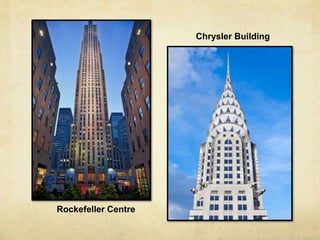
Exemplified by the geometric designs of famous
New York buildings such as the Chrysler Building
and Rockefeller Centre, Art Deco was the most
fashionable international design movement in
modern art from 1925 until the 1940s.
Like the earlier Arts and Crafts Movement, as well
as the curvilinear style of design known as Art
Nouveau, as well as the German Bauhaus design
school concept, Art Deco embraced all types of
art, including crafts as well as fine arts. It was
applied to decorative art like interior design,
furniture, jewelry, textiles, fashion and industrial
design, as well as to the applied art of
architecture and the visual arts of painting, and
graphics.
Rockefeller Centre
Chrysler Building
The word ART DECO derives from the 1925
Exposition Internationale des Arts Decoratifs
Industriels et Modernes, held in Paris. The show
was organized by an association of French artists
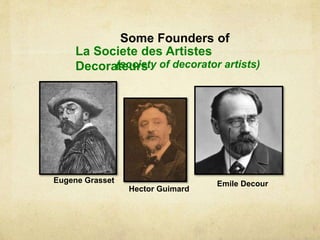
known as, La Societe des Artistes Decorateurs
(society of decorator artists), led by its founders
Hector Guimard (1867-1942), Eugene Grasset,
Raoul Lachenal, Paul Follot, Maurice Dufrene, and
Emile Decour, some of whom were previously
involved in Art Nouveau. Note however that the
term Art Deco was not widely used until
popularized by the art historian and critic Bevis
Hillier in her book Art Deco of the 20s and 30s
(1968).
Some Founders of
La Societe des Artistes
Decorateurs
Eugene Grasset
Hector Guimard
Emile Decour
(society of decorator artists)
The Art Deco style, adopted by architects and
designers around the world, spanned the
"Roaring Twenties", the Great Depression of the
early 1930s, and the years leading up to the
Second World War. It suffered a decline in
popularity during the late 30s and early 40s,
when it began to be seen as too gaudy and
ostentatious for wartime austerity, after which it
quickly fell out of fashion. The first resurgence
of interest in Art Deco occurred in the 1960s -
coincident with the movement's affect on Pop
Art - and then again in the 1980s, in line with
growing interest in graphic design. The style
appeared in a number of jewelry and fashion
ads.
The structure of Art Deco is founded on mathematical geometric
shapes which drew equally on Greco-Roman Classicism, the
faceted architectural forms of Babylon, Assyria, Ancient Egypt,
and Aztec Mexico - notably their ziggurats, pyramids and other
monumental structures - and Machine Age streamline designs
from aviation, the radio, and the skyscraper. In particular, Art
Deco designs are characterized by trapezoidal, zigzagged, and
triangular shapes, chevron patterns, stepped forms, sweeping
curves and sunburst motifs - the latter being visible in a number
of separate applications, including: shoes, car radiator grilles,
the Radio City Music Hall auditorium, and the spire of the
William van Alen Chrysler Building (1928-30) in New York.
New materials were also much in evidence, such as aluminum,
stainless steel, plastics, lacquer and inlaid wood. And while
continuing the use of high quality Art Nouveau materials, such
as moulded glass, horn, and ivory, Art Deco also introduced
exotic items like shark-skin, and zebra-skin.
Art Deco Characteristics, Materials
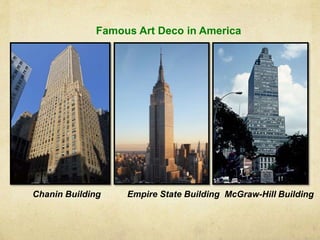
Famous Art Deco in America
Chanin Building Empire State Building McGraw-Hill Building
Reporter : Datur,

THEORY: Art Deco

  • 1.
  • 2.
    Exemplified by thegeometric designs of famous New York buildings such as the Chrysler Building and Rockefeller Centre, Art Deco was the most fashionable international design movement in modern art from 1925 until the 1940s. Like the earlier Arts and Crafts Movement, as well as the curvilinear style of design known as Art Nouveau, as well as the German Bauhaus design school concept, Art Deco embraced all types of art, including crafts as well as fine arts. It was applied to decorative art like interior design, furniture, jewelry, textiles, fashion and industrial design, as well as to the applied art of architecture and the visual arts of painting, and graphics.
  • 3.
  • 4.
    The word ARTDECO derives from the 1925 Exposition Internationale des Arts Decoratifs Industriels et Modernes, held in Paris. The show was organized by an association of French artists known as, La Societe des Artistes Decorateurs (society of decorator artists), led by its founders Hector Guimard (1867-1942), Eugene Grasset, Raoul Lachenal, Paul Follot, Maurice Dufrene, and Emile Decour, some of whom were previously involved in Art Nouveau. Note however that the term Art Deco was not widely used until popularized by the art historian and critic Bevis Hillier in her book Art Deco of the 20s and 30s (1968).
  • 5.
    Some Founders of LaSociete des Artistes Decorateurs Eugene Grasset Hector Guimard Emile Decour (society of decorator artists)
  • 6.
    The Art Decostyle, adopted by architects and designers around the world, spanned the "Roaring Twenties", the Great Depression of the early 1930s, and the years leading up to the Second World War. It suffered a decline in popularity during the late 30s and early 40s, when it began to be seen as too gaudy and ostentatious for wartime austerity, after which it quickly fell out of fashion. The first resurgence of interest in Art Deco occurred in the 1960s - coincident with the movement's affect on Pop Art - and then again in the 1980s, in line with growing interest in graphic design. The style appeared in a number of jewelry and fashion ads.
  • 7.
    The structure ofArt Deco is founded on mathematical geometric shapes which drew equally on Greco-Roman Classicism, the faceted architectural forms of Babylon, Assyria, Ancient Egypt, and Aztec Mexico - notably their ziggurats, pyramids and other monumental structures - and Machine Age streamline designs from aviation, the radio, and the skyscraper. In particular, Art Deco designs are characterized by trapezoidal, zigzagged, and triangular shapes, chevron patterns, stepped forms, sweeping curves and sunburst motifs - the latter being visible in a number of separate applications, including: shoes, car radiator grilles, the Radio City Music Hall auditorium, and the spire of the William van Alen Chrysler Building (1928-30) in New York. New materials were also much in evidence, such as aluminum, stainless steel, plastics, lacquer and inlaid wood. And while continuing the use of high quality Art Nouveau materials, such as moulded glass, horn, and ivory, Art Deco also introduced exotic items like shark-skin, and zebra-skin. Art Deco Characteristics, Materials
  • 8.
    Famous Art Decoin America Chanin Building Empire State Building McGraw-Hill Building
  • 9.