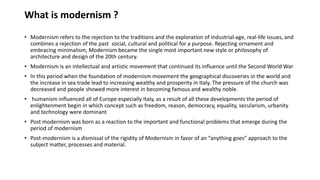
What is modernism?
• Modernism refers to the rejection to the traditions and the exploration of industrial-age, real-life issues, and
combines a rejection of the past social, cultural and political for a purpose. Rejecting ornament and
embracing minimalism, Modernism became the single most important new style or philosophy of
architecture and design of the 20th century.
• Modernism is an intellectual and artistic movement that continued its influence until the Second World War
• In this period when the foundation of modernism movement the geographical discoveries in the world and
the increase in sea trade lead to increasing wealthy and prosperity in Italy. The pressure of the church was
decreased and people showed more interest in becoming famous and wealthy noble.
• humanism influenced all of Europe especially Italy, as a result of all these developments the period of
enlightenment begin in which concept such as freedom, reason, democracy, equality, secularism, urbanity
and technology were dominant
• Post modernism was born as a reaction to the important and functional problems that emerge during the
period of modernism
• Post-modernism is a dismissal of the rigidity of Modernism in favor of an “anything goes” approach to the
subject matter, processes and material.
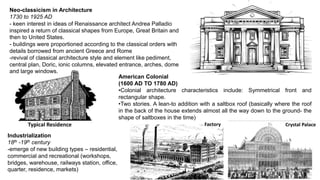
Neo-classicism in Architecture
1730to 1925 AD
- keen interest in ideas of Renaissance architect Andrea Palladio
inspired a return of classical shapes from Europe, Great Britain and
then to United States.
- buildings were proportioned according to the classical orders with
details borrowed from ancient Greece and Rome
-revival of classical architecture style and element like pediment,
central plan, Doric, ionic columns, elevated entrance, arches, dome
and large windows.
American Colonial
(1600 AD TO 1780 AD)
•Colonial architecture characteristics include: Symmetrical front and
rectangular shape.
•Two stories. A lean-to addition with a saltbox roof (basically where the roof
in the back of the house extends almost all the way down to the ground- the
shape of saltboxes in the time)
Industrialization
18th -19th century
-emerge of new building types – residential,
commercial and recreational (workshops,
bridges, warehouse, railways station, office,
quarter, residence, markets)
Typical Residence Factory Crystal Palace
5.
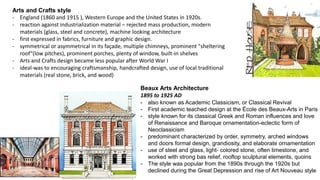
Arts and Craftsstyle
- England (1860 and 1915 ), Western Europe and the United States in 1920s.
- reaction against industrialization material – rejected mass production, modern
materials (glass, steel and concrete), machine looking architecture
- first expressed in fabrics, furniture and graphic design.
- symmetrical or asymmetrical in its façade, multiple chimneys, prominent "sheltering
roof“(low pitches), prominent porches, plenty of window, built-in shelves
- Arts and Crafts design became less popular after World War I
- ideal-was to encouraging craftsmanship, handcrafted design, use of local traditional
materials (real stone, brick, and wood)
Beaux Arts Architecture
1895 to 1925 AD
- also known as Academic Classicism, or Classical Revival
- First academic teached design at the École des Beaux-Arts in Paris
- style known for its classical Greek and Roman influences and love
of Renaissance and Baroque ornamentation-eclectic form of
Neoclassicism
- predominant characterized by order, symmetry, arched windows
and doors formal design, grandiosity, and elaborate ornamentation
- use of steel and glass, light- colored stone, often limestone, and
worked with strong bas relief, rooftop sculptural elements, quoins
- The style was popular from the 1890s through the 1920s but
declined during the Great Depression and rise of Art Nouveau style
6.
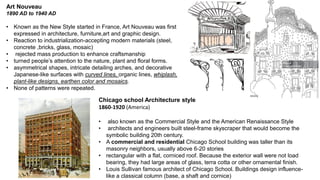
Art Nouveau
1890 ADto 1940 AD
• Known as the New Style started in France, Art Nouveau was first
expressed in architecture, furniture,art and graphic design.
• Reaction to industrialization-accepting modern materials (steel,
concrete ,bricks, glass, mosaic)
• rejected mass production to enhance craftsmanship
• turned people’s attention to the nature, plant and floral forms.
• asymmetrical shapes, intricate detailing arches, and decorative
Japanese-like surfaces with curved lines, organic lines, whiplash,
plant-like designs, earthen color and mosaics.
• None of patterns were repeated.
Chicago school Architecture style
1860-1920 (America)
• also known as the Commercial Style and the American Renaissance Style
• architects and engineers built steel-frame skyscraper that would become the
symbolic building 20th century.
• A commercial and residential Chicago School building was taller than its
masonry neighbors, usually above 6-20 stories
• rectangular with a flat, corniced roof. Because the exterior wall were not load
bearing, they had large areas of glass, terra cotta or other ornamental finish.
• Louis Sullivan famous architect of Chicago School. Buildings design influence-
like a classical column (base, a shaft and cornice)
7.
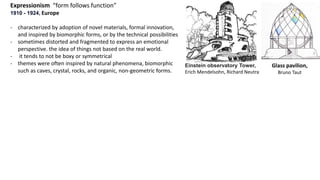
Expressionism “form followsfunction”
1910 - 1924, Europe
- characterized by adoption of novel materials, formal innovation,
and inspired by biomorphic forms, or by the technical possibilities
- sometimes distorted and fragmented to express an emotional
perspective. the idea of things not based on the real world.
- it tends to not be boxy or symmetrical
- themes were often inspired by natural phenomena, biomorphic
such as caves, crystal, rocks, and organic, non-geometric forms.
Glass pavilion,
Bruno Taut
Einstein observatory Tower,
Erich Mendelsohn, Richard Neutra
8.
Cubism
1907- 1914, France
-highly influential visual arts style created principally by the artists
Pablo Picasso and Georges Braque- France birthplace of Cubism
- initiated the idea of reducing a motif to most basic elements, and
presented in such a way the canvas’s is flat.
- Cubist style also became familiar to Russian
- Inspired by cubism-Suprematism and Constructivism were born.
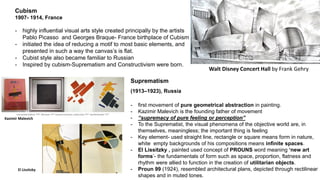
Suprematism
(1913–1923), Russia
- first movement of pure geometrical abstraction in painting.
- Kazimir Malevich is the founding father of movement
- “supremacy of pure feeling or perception”
- To the Suprematist, the visual phenomena of the objective world are, in
themselves, meaningless; the important thing is feeling
- Key element- used straight line, rectangle or square means form in nature,
white empty backgrounds of his compositions means infinite spaces.
- El Lissitzky , painted used concept of PROUNS word meaning ‘new art
forms’- the fundamentals of form such as space, proportion, flatness and
rhythm were allied to function in the creation of utilitarian objects.
- Proun 99 (1924), resembled architectural plans, depicted through rectilinear
shapes and in muted tones.
El Lissitzky
Kazimir Malevich
Walt Disney Concert Hall by Frank Gehry
9.
Constructivism
From1913, Russia
- -was an artistic and architectural theory that originated in Russia by Vladimir Tatlin.
- aimed to reflect modern industrial society and urban space. awareness of class divisions,
social inequalities, and revolution
- The movement rejected decorative stylization in favour of the industrial materials.
- stripped down, geometric forms and modest materials. Their visual language existed of
forms that they could draw with practical instruments like compasses and rulers.
Materials like wood, glass and metal were analyzed and judged on the basis of how
suitable they were for use in mass-produced objects and images.
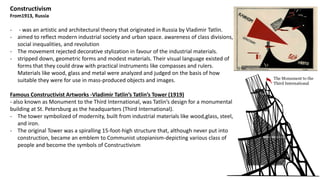
Famous Constructivist Artworks -Vladimir Tatlin’s Tatlin’s Tower (1919)
- also known as Monument to the Third International, was Tatlin’s design for a monumental
building at St. Petersburg as the headquarters (Third International).
- The tower symbolized of modernity, built from industrial materials like wood,glass, steel,
and iron.
- The original Tower was a spiralling 15-foot-high structure that, although never put into
construction, became an emblem to Communist utopianism-depicting various class of
people and become the symbols of Constructivism
10.
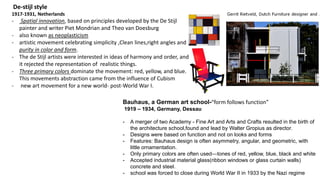
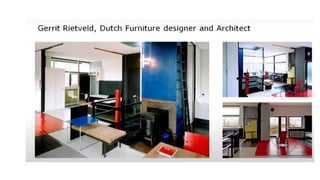
De-stijl style
1917-1931, Netherlands
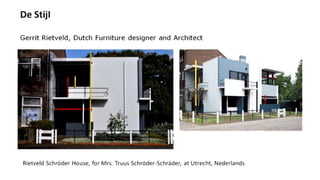
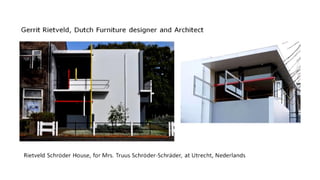
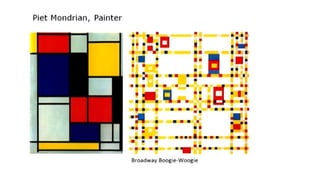
-Spatial innovation, based on principles developed by the De Stijl
painter and writer Piet Mondrian and Theo van Doesburg
- also known as neoplasticism
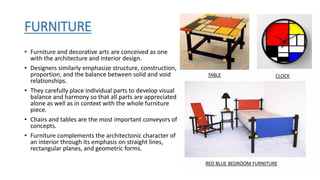
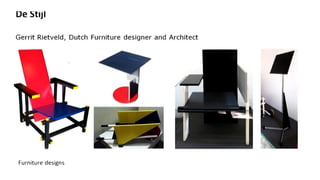
- artistic movement celebrating simplicity ,Clean lines,right angles and
purity in color and form.
- The de Stijl artists were interested in ideas of harmony and order, and
it rejected the representation of realistic things.
- Three primary colors dominate the movement: red, yellow, and blue.
This movements abstraction came from the influence of Cubism
- new art movement for a new world- post-World War I.
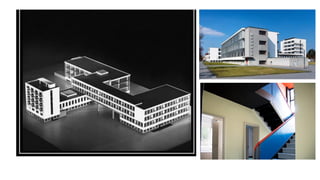
Bauhaus, a German art school-“form follows function”
1919 – 1934, Germany, Dessau
- A merger of two Academy - Fine Art and Arts and Crafts resulted in the birth of
the architecture school,found and lead by Walter Gropius as director.
- Designs were based on function and not on looks and forms
- Features: Bauhaus design is often asymmetry, angular, and geometric, with
little ornamentation.
- Only primary colors are often used—tones of red, yellow, blue, black and white
- Accepted industrial material glass(ribbon windows or glass curtain walls)
concrete and steel.
- school was forced to close during World War II in 1933 by the Nazi regime
11.
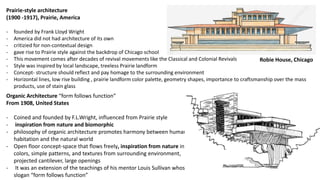
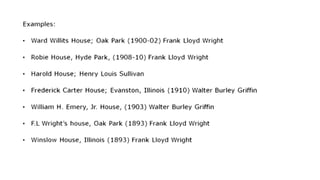
Prairie-style architecture
(1900 -1917),Prairie, America
- founded by Frank Lloyd Wright
- America did not had architecture of its own
- critizied for non-contextual design
- gave rise to Prairie style against the backdrop of Chicago school
- This movement comes after decades of revival movements like the Classical and Colonial Revivals
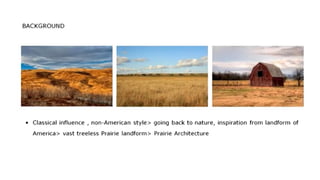
- Style was inspired by local landscape, treeless Prairie landform
- Concept- structure should reflect and pay homage to the surrounding environment
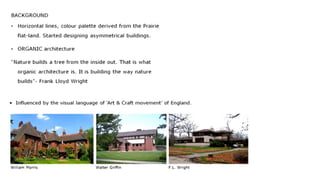
- Horizontal lines, low rise building , prairie landform color palette, geometry shapes, importance to craftsmanship over the mass
products, use of stain glass
Robie House, Chicago
Organic Architecture “form follows function”
From 1908, United States
- Coined and founded by F.L.Wright, influenced from Prairie style
- inspiration from nature and biomorphic
- philosophy of organic architecture promotes harmony between human
habitation and the natural world
- Open floor concept-space that flows freely, inspiration from nature in
colors, simple patterns, and textures from surrounding environment,
projected cantilever, large openings
- It was an extension of the teachings of his mentor Louis Sullivan whose
slogan “form follows function”
12.
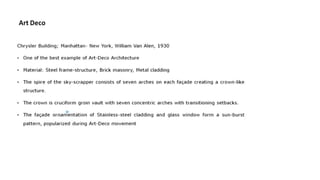
Art Deco Architecture-“form follows function”
1925 to 1937 AD, France
- Art Deco movement is the decorative arts and architecture originated in France and maturation
during the Exposition Internationale des Arts Décoratifs et Industriels Modernes held in Paris in
1925, and developed into a major style in Western Europe and the United States during the 1930s.
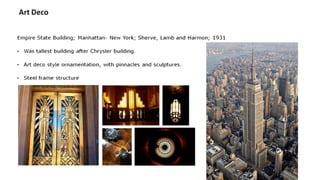
- Features: simple, clean shapes, often with a “streamlined” look; ornament that is geometric
forms, sunburst pattern; expensive materials( especially Bakelite; vita-glass; and ferroconcrete,
jade, gold, silver, ivory, obsidian, chrome, and rock crystal)
- Zigzag patterns and vertical lines create dramatic design
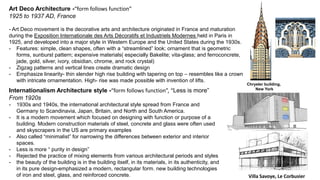
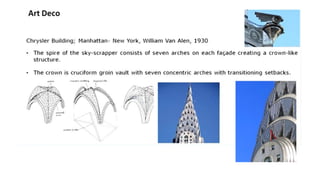
- Emphasize linearity- thin slender high rise building with tapering on top – resembles like a crown
with intricate ornamentation. High- rise was made possible with invention of lifts.
Chrysler building,
New York
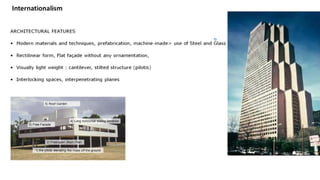
Internationalism Architecture style -“form follows function”, “Less is more”
From 1920s
- 1930s and 1940s, the international architectural style spread from France and
Germany to Scandinavia, Japan, Britain, and North and South America.
- It is a modern movement which focused on designing with function or purpose of a
building. Modern construction materials of steel, concrete and glass were often used
and skyscrapers in the US are primary examples
- Also called “minimalist” for narrowing the differences between exterior and interior
spaces.
- Less is more “ purity in design”
- Rejected the practice of mixing elements from various architectural periods and styles
- the beauty of the building is in the building itself, in its materials, in its authenticity, and
in its pure design-emphasized a modern, rectangular form. new building technologies
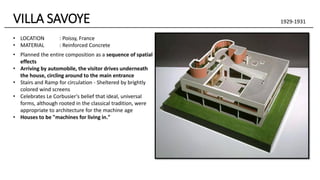
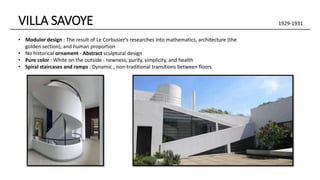
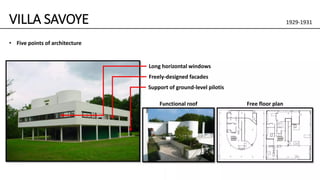
of iron and steel, glass, and reinforced concrete. Villa Savoye, Le Corbusier
14.
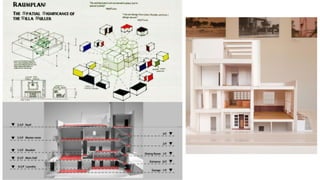
In the year1930, one magnificent and for its time period also daring building was finished. It is now known
as Villa Müller. Its architect, Adolf Loos, who was also the author of a famous essay “Ornament and
crime”, for the first time fully embraced his own concept of designing spaces. Raumplan.
Raumplan Theory : a solution where the spaces have different heights depending on the function
and the joints between the various volumes involves the creation of different levels.
Raumplan is a design of spaces. Three dimensional way of thinking about a building, which allows
precisely these immense experiences. Every space has different needs and different height requirement.
We can bring the space to a minimum where there is no need for it in order to waste it where we want to.
Whether it to be to impress guests or lift ones spirit.once the house is designed , the appropriate
openings are made, just like those of a musical instrument, so that it is filled with light.
A raumplan is a planning method based on discreet rooms and a dynamic section.
Raumplan theory of Adolf Loos
16.
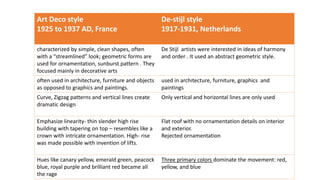
Art Deco style
1925to 1937 AD, France
De-stijl style
1917-1931, Netherlands
characterized by simple, clean shapes, often
with a “streamlined” look; geometric forms are
used for ornamentation, sunburst pattern . They
focused mainly in decorative arts
De Stijl artists were interested in ideas of harmony
and order . It used an abstract geometric style.
often used in architecture, furniture and objects
as opposed to graphics and paintings.
used in architecture, furniture, graphics and
paintings
Curve, Zigzag patterns and vertical lines create
dramatic design
Only vertical and horizontal lines are only used
Emphasize linearity- thin slender high rise
building with tapering on top – resembles like a
crown with intricate ornamentation. High- rise
was made possible with invention of lifts.
Flat roof with no ornamentation details on interior
and exterior.
Rejected ornamentation
Hues like canary yellow, emerald green, peacock
blue, royal purple and brilliant red became all
the rage
Three primary colors dominate the movement: red,
yellow, and blue
17.
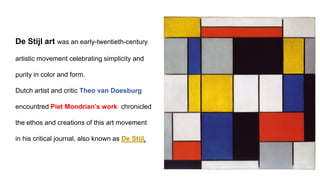
De Stijl artwas an early-twentieth-century
artistic movement celebrating simplicity and
purity in color and form.
Dutch artist and critic Theo van Doesburg
encountred Piet Mondrian’s work chronicled
the ethos and creations of this art movement
in his critical journal, also known as De Stijl.
18.
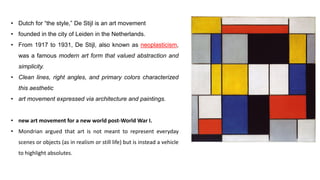
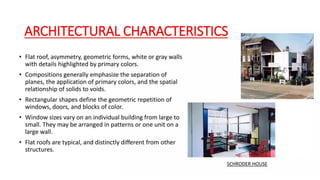
• Dutch for“the style,” De Stijl is an art movement
• founded in the city of Leiden in the Netherlands.
• From 1917 to 1931, De Stijl, also known as neoplasticism,
was a famous modern art form that valued abstraction and
simplicity.
• Clean lines, right angles, and primary colors characterized
this aesthetic
• art movement expressed via architecture and paintings.
• new art movement for a new world post-World War I.
• Mondrian argued that art is not meant to represent everyday
scenes or objects (as in realism or still life) but is instead a vehicle
to highlight absolutes.
26.
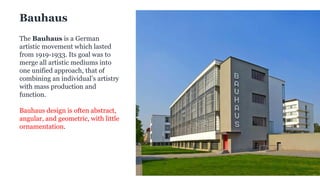
What is Bauhaus?
TheBauhaus is a German
artistic movement which lasted
from 1919-1933. Its goal was to
merge all artistic mediums into
one unified approach, that of
combining an individual’s artistry
with mass production and
function.
Bauhaus design is often abstract,
angular, and geometric, with little
ornamentation.
Bauhaus
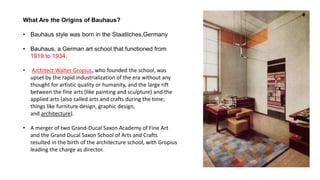
What Are theOrigins of Bauhaus?
• Bauhaus style was born in the Staatliches,Germany
• Bauhaus, a German art school that functioned from
1919 to 1934.
• Architect Walter Gropius, who founded the school, was
upset by the rapid industrialization of the era without any
thought for artistic quality or humanity, and the large rift
between the fine arts (like painting and sculpture) and the
applied arts (also called arts and crafts during the time;
things like furniture design, graphic design,
and architecture).
• A merger of two Grand-Ducal Saxon Academy of Fine Art
and the Grand Ducal Saxon School of Arts and Crafts
resulted in the birth of the architecture school, with Gropius
leading the charge as director.
29.
Modern Bauhaus architectureis characterized by:
1. Functional Shapes.
Bauhaus design features little to no embellishment or ornamentation, instead drawing attention to the streamlined desig
2. Simple Color Schemes.
Bauhaus design aims for cohesion and simplicity, so architectural color schemes are often limited to basic industrial
colors like white, gray, and beige. In interior design, primary colors are often used—tones of red, yellow, or blue—
sometimes all together but more often in focused, deliberate ways (such as a single red wall, or a yellow chair)
3. Industrial Material
incorporate the fewest different materials possible, all of which are considered industrial, modern materials
glass (especially in ribbon windows or glass curtain walls), concrete (especially in building design, and
steel (especially in appliances and objects like lamps and chairs).
4.Balanced Asymmetry.
Bauhaus architecture and design aimed for visual balance through asymmetry.
5.Holistic Design
Form follows function
31.
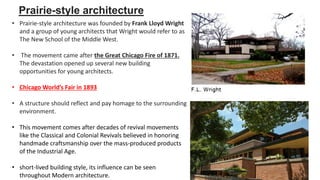
• Prairie-style architecturewas founded by Frank Lloyd Wright
and a group of young architects that Wright would refer to as
The New School of the Middle West.
• The movement came after the Great Chicago Fire of 1871.
The devastation opened up several new building
opportunities for young architects.
• Chicago World’s Fair in 1893
• A structure should reflect and pay homage to the surrounding
environment.
• This movement comes after decades of revival movements
like the Classical and Colonial Revivals believed in honoring
handmade craftsmanship over the mass-produced products
of the Industrial Age.
• short-lived building style, its influence can be seen
throughout Modern architecture.
Prairie-style architecture
.
35.
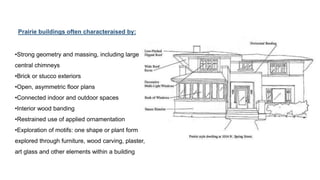
•Strong geometry andmassing, including large
central chimneys
•Brick or stucco exteriors
•Open, asymmetric floor plans
•Connected indoor and outdoor spaces
•Interior wood banding
•Restrained use of applied ornamentation
•Exploration of motifs: one shape or plant form
explored through furniture, wood carving, plaster,
art glass and other elements within a building
Prairie buildings often characteraised by:
36.
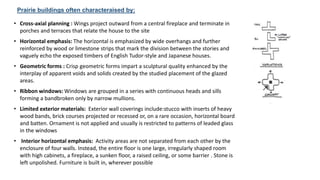
• Cross-axial planning: Wings project outward from a central fireplace and terminate in
porches and terraces that relate the house to the site
• Horizontal emphasis: The horizontal is emphasized by wide overhangs and further
reinforced by wood or limestone strips that mark the division between the stories and
vaguely echo the exposed timbers of English Tudor-style and Japanese houses.
• Geometric forms : Crisp geometric forms impart a sculptural quality enhanced by the
interplay of apparent voids and solids created by the studied placement of the glazed
areas.
• Ribbon windows: Windows are grouped in a series with continuous heads and sills
forming a bandbroken only by narrow mullions.
• Limited exterior materials: Exterior wall coverings include:stucco with inserts of heavy
wood bands, brick courses projected or recessed or, on a rare occasion, horizontal board
and batten. Ornament is not applied and usually is restricted to patterns of leaded glass
in the windows
• Interior horizontal emphasis: Activity areas are not separated from each other by the
enclosure of four walls. Instead, the entire floor is one large, irregularly shaped room
with high cabinets, a fireplace, a sunken floor, a raised ceiling, or some barrier . Stone is
left unpolished. Furniture is built in, wherever possible
Prairie buildings often characteraised by:
37.
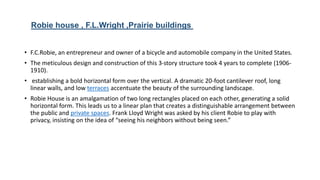
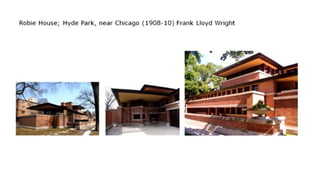
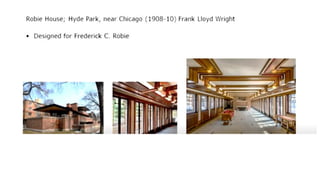
• F.C.Robie, anentrepreneur and owner of a bicycle and automobile company in the United States.
• The meticulous design and construction of this 3-story structure took 4 years to complete (1906-
1910).
• establishing a bold horizontal form over the vertical. A dramatic 20-foot cantilever roof, long
linear walls, and low terraces accentuate the beauty of the surrounding landscape.
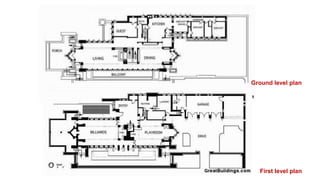
• Robie House is an amalgamation of two long rectangles placed on each other, generating a solid
horizontal form. This leads us to a linear plan that creates a distinguishable arrangement between
the public and private spaces. Frank Lloyd Wright was asked by his client Robie to play with
privacy, insisting on the idea of “seeing his neighbors without being seen.”
Robie house , F.L.Wright ,Prairie buildings
38.
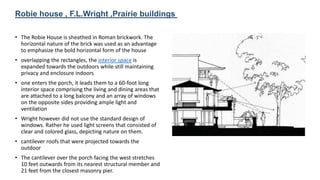
• The RobieHouse is sheathed in Roman brickwork. The
horizontal nature of the brick was used as an advantage
to emphasize the bold horizontal form of the house
• overlapping the rectangles, the interior space is
expanded towards the outdoors while still maintaining
privacy and enclosure indoors
• one enters the porch, it leads them to a 60-foot long
interior space comprising the living and dining areas that
are attached to a long balcony and an array of windows
on the opposite sides providing ample light and
ventilation
• Wright however did not use the standard design of
windows. Rather he used light screens that consisted of
clear and colored glass, depicting nature on them.
• cantilever roofs that were projected towards the
outdoor
• The cantilever over the porch facing the west stretches
10 feet outwards from its nearest structural member and
21 feet from the closest masonry pier.
Robie house , F.L.Wright ,Prairie buildings
- They hadlow pitched roof or flat cantilever roof with deep hangs
- Long row of casement window that further emphasized the horizontal theme (pure geomentry)
- Native materials and woodwork was stained , never painter, to bring out its natural beauty (purity of texture)
- Coined and founded by F.L.Wright, influenced from Prairie style
- inspiration from nature and biomorphic
- philosophy of organic architecture promotes harmony between human habitation and the natural world
- Open floor concept-space that flows freely, inspiration from nature in colors, simple patterns, and textures from
surrounding environment, projected cantilever, large openings
- It was an extension of the teachings of his mentor Louis Sullivan whose slogan “form follows function”
ORGANIC ARCHITECTURE
Examples of Organic architecture :
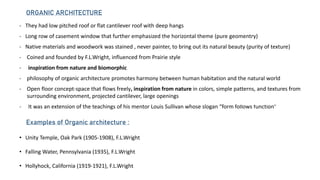
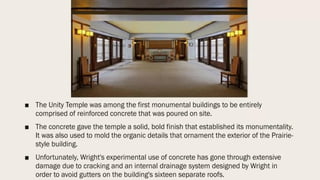
• Unity Temple, Oak Park (1905-1908), F.L.Wright
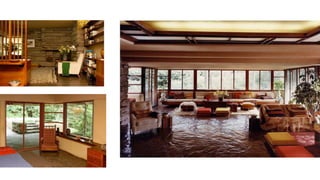
• Falling Water, Pennsylvania (1935), F.L.Wright
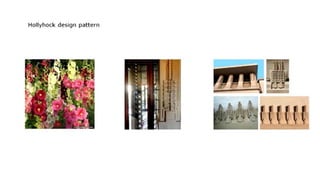
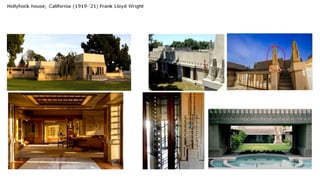
• Hollyhock, California (1919-1921), F.L.Wright
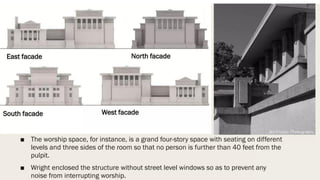
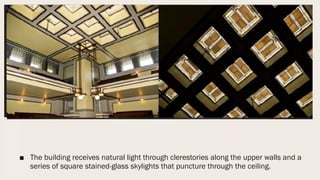
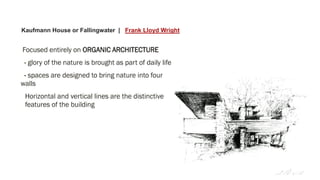
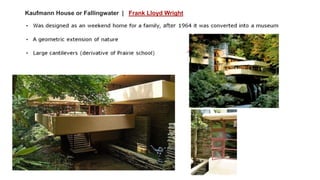
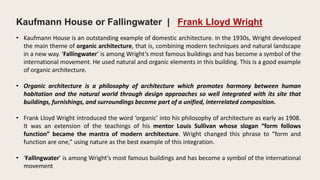
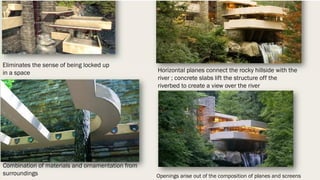
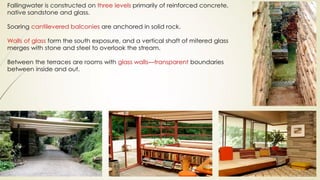
• Kaufmann Houseis an outstanding example of domestic architecture. In the 1930s, Wright developed
the main theme of organic architecture, that is, combining modern techniques and natural landscape
in a new way. ‘Fallingwater’ is among Wright’s most famous buildings and has become a symbol of the
international movement. He used natural and organic elements in this building. This is a good example
of organic architecture.
• Organic architecture is a philosophy of architecture which promotes harmony between human
habitation and the natural world through design approaches so well integrated with its site that
buildings, furnishings, and surroundings become part of a unified, interrelated composition.
• Frank Lloyd Wright introduced the word ‘organic’ into his philosophy of architecture as early as 1908.
It was an extension of the teachings of his mentor Louis Sullivan whose slogan “form follows
function” became the mantra of modern architecture. Wright changed this phrase to “form and
function are one,” using nature as the best example of this integration.
• ‘Fallingwater’ is among Wright’s most famous buildings and has become a symbol of the international
movement
Kaufmann House or Fallingwater | Frank Lloyd Wright
65.
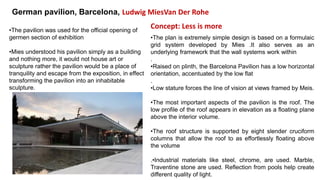
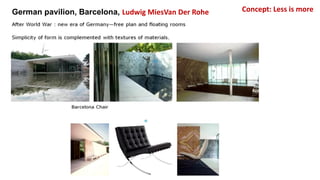
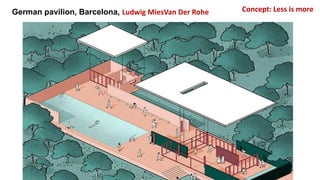
•The plan isextremely simple design is based on a formulaic
grid system developed by Mies .It also serves as an
underlying framework that the wall systems work within
.
•Raised on plinth, the Barcelona Pavilion has a low horizontal
orientation, accentuated by the low flat
.
•Low stature forces the line of vision at views framed by Meis.
•The most important aspects of the pavilion is the roof. The
low profile of the roof appears in elevation as a floating plane
above the interior volume.
•The roof structure is supported by eight slender cruciform
columns that allow the roof to as effortlessly floating above
the volume
.•Industrial materials like steel, chrome, are used. Marble,
Traventine stone are used. Reflection from pools help create
different quality of light.
•The pavilion was used for the official opening of
germen section of exhibition
•Mies understood his pavilion simply as a building
and nothing more, it would not house art or
sculpture rather the pavilion would be a place of
tranquility and escape from the exposition, in effect
transforming the pavilion into an inhabitable
sculpture.
German pavilion, Barcelona, Ludwig MiesVan Der Rohe
Concept: Less is more
66.
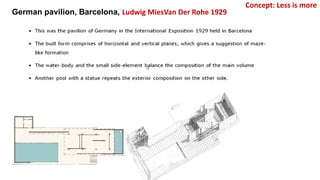
• German Pavilion,Barcelona, Spain
German pavilion, Barcelona, Ludwig MiesVan Der Rohe 1929
Concept: Less is more
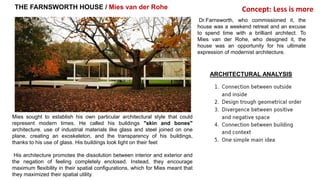
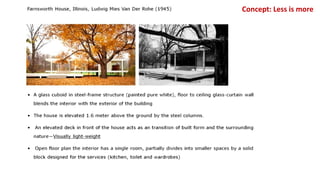
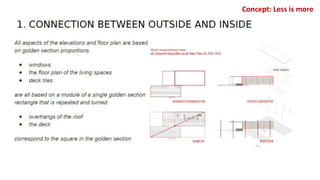
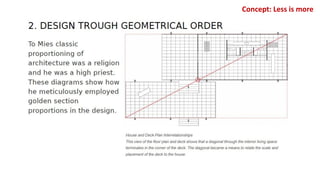
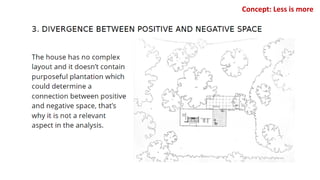
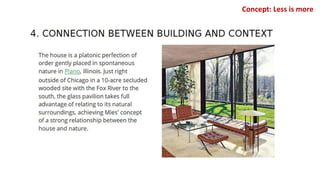
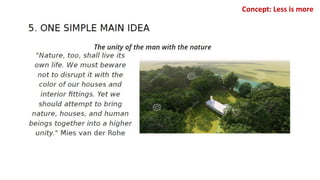
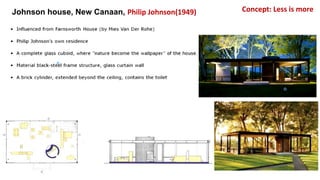
THE FARNSWORTH HOUSE/ Mies van der Rohe
Dr.Farnsworth, who commissioned it, the
house was a weekend retreat and an excuse
to spend time with a brilliant architect. To
Mies van der Rohe, who designed it, the
house was an opportunity for his ultimate
expression of modernist architecture.
ARCHITECTURAL ANALYSIS
Mies sought to establish his own particular architectural style that could
represent modern times. He called his buildings "skin and bones"
architecture. use of industrial materials like glass and steel joined on one
plane, creating an exoskeleton, and the transparency of his buildings,
thanks to his use of glass. His buildings look light on their feet
His architecture promotes the dissolution between interior and exterior and
the negation of feeling completely enclosed. Instead, they encourage
maximum flexibility in their spatial configurations, which for Mies meant that
they maximized their spatial utility.
Concept: Less is more