ART DECO
Chapter 3 | History of Modern Architecture | Year III Part II
Study of Architectural Theories Evolving Out of
Art Deco
Chapter 3 | History of Modern Architecture | Year III Part II
Department of Architecture
Pokhara Engineering College
Phirke, Pokhara
Kiran KC
ART DECO
Year III – Sem VI History of Modern Architecture
Artdeco
DEFINITION| ORIGIN| CHARACTERISTICS
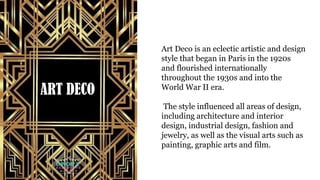
Art Deco is an eclectic artistic and design
style that began in Paris in the 1920s
and flourished internationally
throughout the 1930s and into the
World War II era.
The style influenced all areas of design,
including architecture and interior
design, industrial design, fashion and
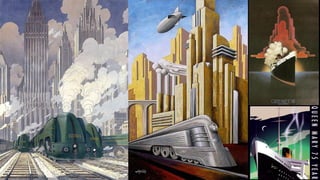
jewelry, as well as the visual arts such as
painting, graphic arts and film.
ART DECO
Year III – Sem VI History of Modern Architecture
Artdeco
DEFINITION| ORIGIN| CHARACTERISTICS
By the end of the 19th century in France, many of the notable
artists, architects, and designers who had played important roles
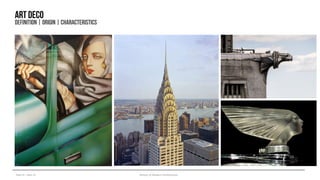
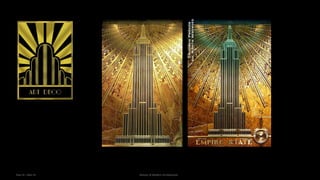
in the development of the Art Nouveau style recognized that it
was becoming increasingly passé.
At the close of a century that saw the Industrial Revolution take
hold, contemporary life became very different from a few
decades earlier. It was time for something new, something that
represent "20th Century“.
www.theartstory.org
Year III – Sem VI History of Modern Architecture
Artdeco
DEFINITION| ORIGIN| CHARACTERISTICS
From this desire to move into the new century in step with
innovation rather than being held back by nostalgia, a group of
French artistic innovators formed an organization called the
Societé des Artistes Décorateurs (The Society of Decorative
Artists).
The group was comprised of both well-known figures such as the
Art Nouveau-style designer and printmaker Eugene Grasset, and
the Art Nouveau architect Hector Guimard, along with emerging
decorative artists and designers such as Pierre Chareau and
Francis Jourdain. The French state supported and fostered this
direction of artistic activity.
www.theartstory.org
Year III – Sem VI History of Modern Architecture
Artdeco
DEFINITION| ORIGIN| CHARACTERISTICS
One of the major goals of the new group was to :
challenge the hierarchical structure of the visual arts
that relegated decorative artists to a lesser status than
the more classical painting and sculpting media.
www.theartstory.org
Year III – Sem VI History of Modern Architecture
Artdeco
DEFINITION| ORIGIN| CHARACTERISTICS
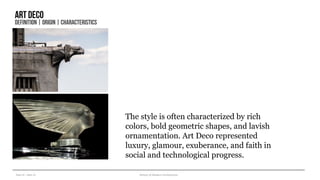
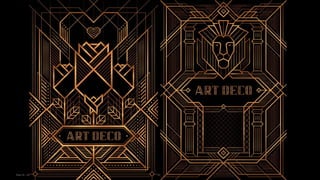
The style is often characterized by rich
colors, bold geometric shapes, and lavish
ornamentation. Art Deco represented
luxury, glamour, exuberance, and faith in
social and technological progress.
www.theartstory.org
Year III – Sem VI History of Modern Architecture
Artdeco
DEFINITION| ORIGIN| CHARACTERISTICS
Year III – Sem VI History of Modern Architecture
Artdeco
DEFINITION| ORIGIN| CHARACTERISTICS
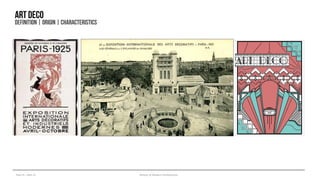
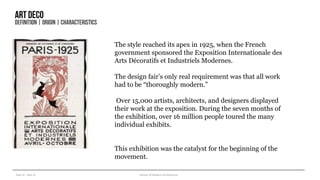
The style reached its apex in 1925, when the French
government sponsored the Exposition Internationale des
Arts Décoratifs et Industriels Modernes.
The design fair’s only real requirement was that all work
had to be “thoroughly modern.”
Over 15,000 artists, architects, and designers displayed
their work at the exposition. During the seven months of
the exhibition, over 16 million people toured the many
individual exhibits.
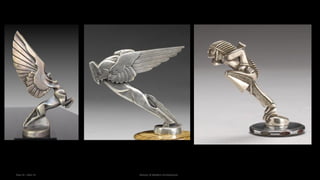
This exhibition was the catalyst for the beginning of the
movement.
Year III – Sem VI History of Modern Architecture
Artdeco
DEFINITION| ORIGIN| CHARACTERISTICS
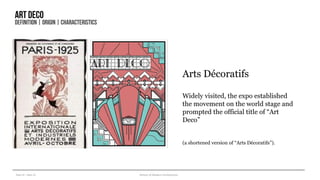
Arts Décoratifs
Widely visited, the expo established
the movement on the world stage and
prompted the official title of “Art
Deco”
(a shortened version of “Arts Décoratifs”).
Year III – Sem VI History of Modern Architecture
Artdeco vs art nouveau
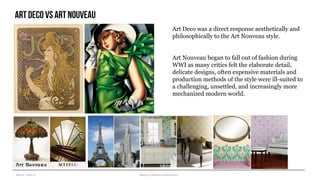
Art Deco was a direct response aesthetically and
philosophically to the Art Nouveau style.
Art Nouveau began to fall out of fashion during
WWI as many critics felt the elaborate detail,
delicate designs, often expensive materials and
production methods of the style were ill-suited to
a challenging, unsettled, and increasingly more
mechanized modern world.
Year III – Sem VI History of Modern Architecture
Artdeco vs art nouveau
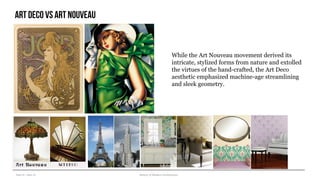
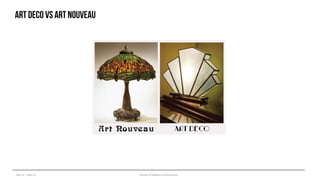
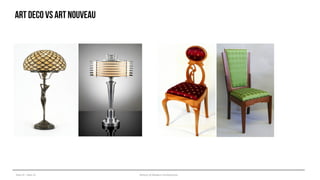
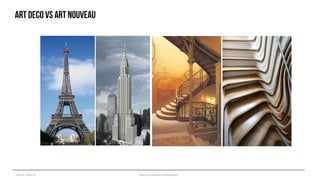
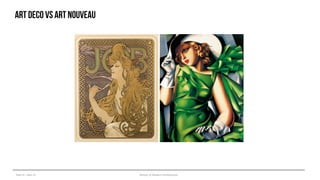
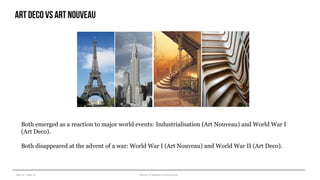
While the Art Nouveau movement derived its
intricate, stylized forms from nature and extolled
the virtues of the hand-crafted, the Art Deco
aesthetic emphasized machine-age streamlining
and sleek geometry.
Year III – Sem VI History of Modern Architecture
Artdeco vs art nouveau
Year III – Sem VI History of Modern Architecture
Artdeco vs art nouveau
Year III – Sem VI History of Modern Architecture
Artdeco vs art nouveau
Year III – Sem VI History of Modern Architecture
Artdeco vs art nouveau
Year III – Sem VI History of Modern Architecture
Artdeco vs art nouveau
Year III – Sem VI History of Modern Architecture
Artdeco vs art nouveau
Both emerged as a reaction to major world events: Industrialisation (Art Nouveau) and World War I
(Art Deco).
Both disappeared at the advent of a war: World War I (Art Nouveau) and World War II (Art Deco).
Year III – Sem VI History of Modern Architecture
Artdeco vs art nouveau
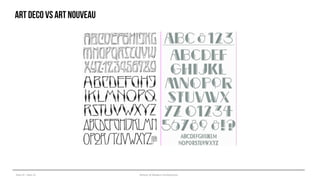
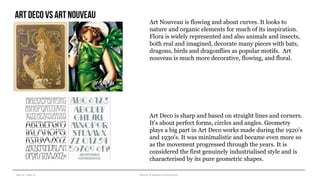
Art Nouveau is flowing and about curves. It looks to
nature and organic elements for much of its inspiration.
Flora is widely represented and also animals and insects,
both real and imagined, decorate many pieces with bats,
dragons, birds and dragonflies as popular motifs. Art
nouveau is much more decorative, flowing, and floral.
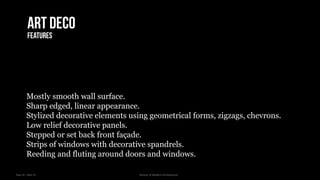
Art Deco is sharp and based on straight lines and corners.
It’s about perfect forms, circles and angles. Geometry
plays a big part in Art Deco works made during the 1920’s
and 1930’s. It was minimalistic and became even more so
as the movement progressed through the years. It is
considered the first genuinely industrialised style and is
characterised by its pure geometric shapes.
Year III – Sem VI History of Modern Architecture
Art deco
influences
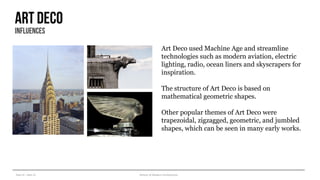
Art Deco used Machine Age and streamline
technologies such as modern aviation, electric
lighting, radio, ocean liners and skyscrapers for
inspiration.
The structure of Art Deco is based on
mathematical geometric shapes.
Other popular themes of Art Deco were
trapezoidal, zigzagged, geometric, and jumbled
shapes, which can be seen in many early works.
Year III – Sem VI History of Modern Architecture
Art deco
influences
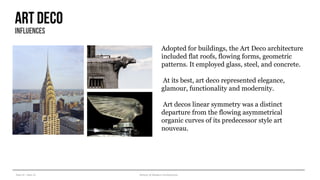
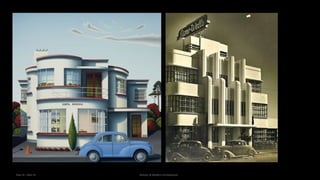
Adopted for buildings, the Art Deco architecture
included flat roofs, flowing forms, geometric
patterns. It employed glass, steel, and concrete.
At its best, art deco represented elegance,
glamour, functionality and modernity.
Art decos linear symmetry was a distinct
departure from the flowing asymmetrical
organic curves of its predecessor style art
nouveau.
Year III – Sem VI History of Modern Architecture
Art deco
influences
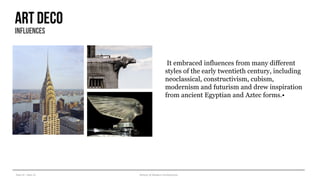
It embraced influences from many different
styles of the early twentieth century, including
neoclassical, constructivism, cubism,
modernism and futurism and drew inspiration
from ancient Egyptian and Aztec forms.•
Year III – Sem VI History of Modern Architecture
Art deco
Elements & properties
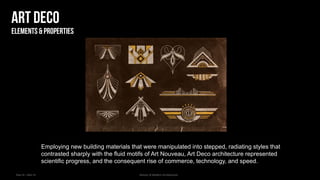
Employing new building materials that were manipulated into stepped, radiating styles that
contrasted sharply with the fluid motifs of Art Nouveau, Art Deco architecture represented
scientific progress, and the consequent rise of commerce, technology, and speed.
Year III – Sem VI History of Modern Architecture
Art deco
Elements & properties
Modern, opulent style, made Art Deco designs especially
suitable for the interiors of cinemas, ocean liners such as
the Queen Mary, and the architecture of train stations
across the United States.
Year III – Sem VI History of Modern Architecture
Art deco
Elements & properties
It endured throughout the Depression due to the practicality and
simplicity of its design, and its suggestion of better times ahead.
Year III – Sem VI History of Modern Architecture
Art deco
Elements & properties
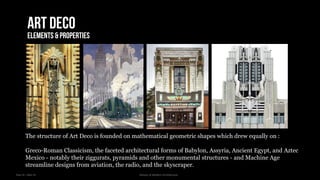
The structure of Art Deco is founded on mathematical geometric shapes which drew equally on :
Greco-Roman Classicism, the faceted architectural forms of Babylon, Assyria, Ancient Egypt, and Aztec
Mexico - notably their ziggurats, pyramids and other monumental structures - and Machine Age
streamline designs from aviation, the radio, and the skyscraper.
Year III – Sem VI History of Modern Architecture
Art deco
Elements & properties
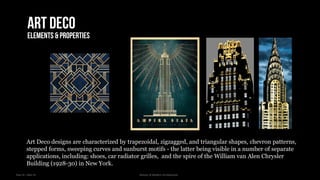
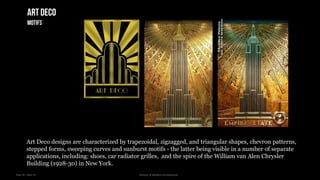
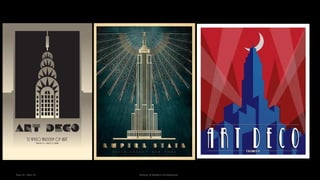
Art Deco designs are characterized by trapezoidal, zigzagged, and triangular shapes, chevron patterns,
stepped forms, sweeping curves and sunburst motifs - the latter being visible in a number of separate
applications, including: shoes, car radiator grilles, and the spire of the William van Alen Chrysler
Building (1928-30) in New York.
Year III – Sem VI History of Modern Architecture
Art deco
Elements & properties
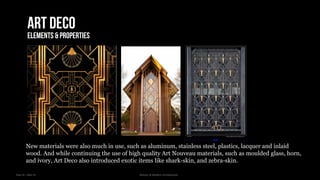
New materials were also much in use, such as aluminum, stainless steel, plastics, lacquer and inlaid
wood. And while continuing the use of high quality Art Nouveau materials, such as moulded glass, horn,
and ivory, Art Deco also introduced exotic items like shark-skin, and zebra-skin.
Year III – Sem VI History of Modern Architecture
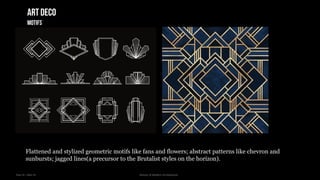
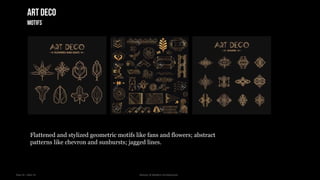
Flattened and stylized geometric motifs like fans and flowers; abstract patterns like chevron and
sunbursts; jagged lines(a precursor to the Brutalist styles on the horizon).
Artdeco
motifs
Year III – Sem VI History of Modern Architecture
Artdeco motifs
Year III – Sem VI History of Modern Architecture
Artdeco
motifs
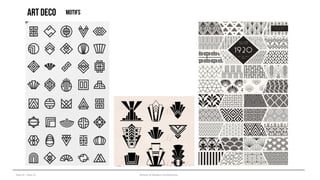
Flattened and stylized geometric motifs like fans and flowers; abstract
patterns like chevron and sunbursts; jagged lines.
Year III – Sem VI History of Modern Architecture
Art Deco designs are characterized by trapezoidal, zigzagged, and triangular shapes, chevron patterns,
stepped forms, sweeping curves and sunburst motifs - the latter being visible in a number of separate
applications, including: shoes, car radiator grilles, and the spire of the William van Alen Chrysler
Building (1928-30) in New York.
Artdeco
motifs
Year III – Sem VI History of Modern Architecture
Artdeco
colour
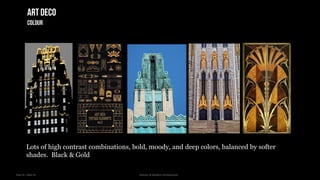
Lots of high contrast combinations, bold, moody, and deep colors, balanced by softer
shades. Black & Gold
Year III – Sem VI History of Modern Architecture
Art deco
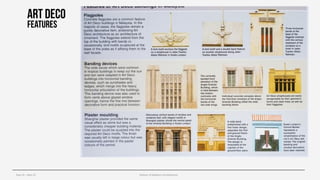
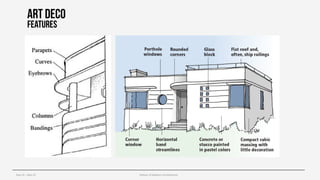
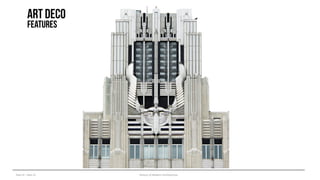
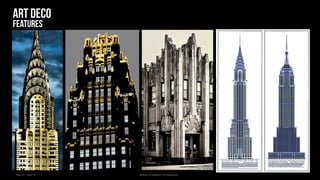
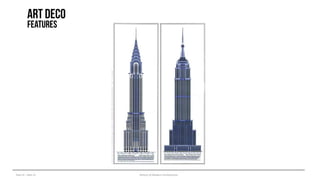
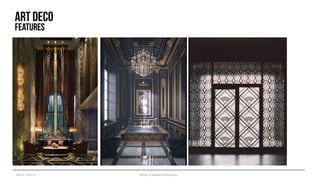
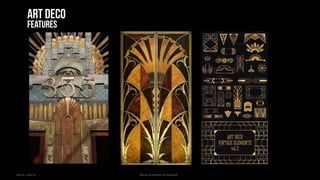
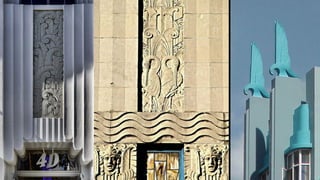
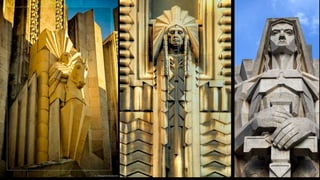
features
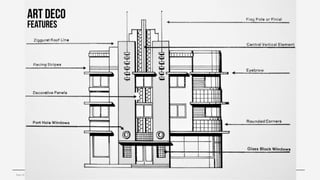
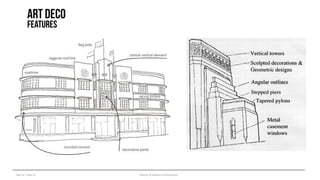
Mostly smooth wall surface.
Sharp edged, linear appearance.
Stylized decorative elements using geometrical forms, zigzags, chevrons.
Low relief decorative panels.
Stepped or set back front façade.
Strips of windows with decorative spandrels.
Reeding and fluting around doors and windows.
Year III – Sem VI History of Modern Architecture
Art deco
features
Year III – Sem VI History of Modern Architecture
Art deco
features
Year III – Sem VI History of Modern Architecture
Art deco
features
Year III – Sem VI History of Modern Architecture
Art deco
features
Year III – Sem VI History of Modern Architecture
Art deco
features
Year III – Sem VI History of Modern Architecture
Art deco
features
Year III – Sem VI History of Modern Architecture
Art deco
features
Year III – Sem VI History of Modern Architecture
Art deco
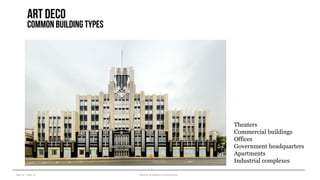
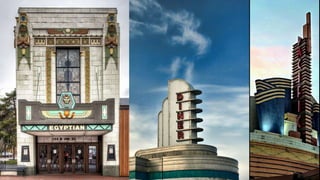
Common Building Types
Theaters
Commercial buildings
Offices
Government headquarters
Apartments
Industrial complexes
Year III – Sem VI History of Modern Architecture
Art deco
features
Year III – Sem VI History of Modern Architecture
Art deco
features
Year III – Sem VI History of Modern Architecture
Art deco
Elements & properties
Modern, opulent style, made Art Deco designs especially
suitable for the interiors of cinemas, ocean liners such as
the Queen Mary, and the architecture of train stations
across the United States.
Year III – Sem VI History of Modern Architecture
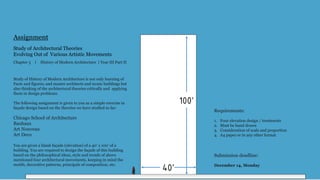
Study of Architectural Theories
Evolving Out of Various Artistic Movements
Chapter 3 | History of Modern Architecture | Year III Part II
Assignment
Study of History of Modern Architecture is not only learning of
Facts and figures; and master architects and iconic buildings but
also thinking of the architectural theories critically and applying
them in design problems.
The following assignment is given to you as a simple exercise in
façade design based on the theories we have studied so far:
Chicago School of Architecture
Bauhaus
Art Nouveau
Art Deco
You are given a blank façade (elevation) of a 40’ x 100’ of a
building. You are required to design the façade of this building
based on the philosophical ideas, style and trends of above
mentioned four architectural movements, keeping in mind the
motifs, decorative patterns, principals of composition, etc.
Requirements:
1. Four elevation design / treatments
2. Must be hand drawn
3. Consideration of scale and proportion
4. A4 paper or in any other format
Submission deadline:
December 14, Monday
40’
100’

Chapter 3.4_ Art Deco.pdf

  • 1.
    ART DECO Chapter 3| History of Modern Architecture | Year III Part II
  • 2.
    Study of ArchitecturalTheories Evolving Out of Art Deco Chapter 3 | History of Modern Architecture | Year III Part II Department of Architecture Pokhara Engineering College Phirke, Pokhara Kiran KC ART DECO
  • 3.
    Year III –Sem VI History of Modern Architecture Artdeco DEFINITION| ORIGIN| CHARACTERISTICS
  • 4.
    Art Deco isan eclectic artistic and design style that began in Paris in the 1920s and flourished internationally throughout the 1930s and into the World War II era. The style influenced all areas of design, including architecture and interior design, industrial design, fashion and jewelry, as well as the visual arts such as painting, graphic arts and film. ART DECO
  • 5.
    Year III –Sem VI History of Modern Architecture Artdeco DEFINITION| ORIGIN| CHARACTERISTICS By the end of the 19th century in France, many of the notable artists, architects, and designers who had played important roles in the development of the Art Nouveau style recognized that it was becoming increasingly passé. At the close of a century that saw the Industrial Revolution take hold, contemporary life became very different from a few decades earlier. It was time for something new, something that represent "20th Century“. www.theartstory.org
  • 6.
    Year III –Sem VI History of Modern Architecture Artdeco DEFINITION| ORIGIN| CHARACTERISTICS From this desire to move into the new century in step with innovation rather than being held back by nostalgia, a group of French artistic innovators formed an organization called the Societé des Artistes Décorateurs (The Society of Decorative Artists). The group was comprised of both well-known figures such as the Art Nouveau-style designer and printmaker Eugene Grasset, and the Art Nouveau architect Hector Guimard, along with emerging decorative artists and designers such as Pierre Chareau and Francis Jourdain. The French state supported and fostered this direction of artistic activity. www.theartstory.org
  • 7.
    Year III –Sem VI History of Modern Architecture Artdeco DEFINITION| ORIGIN| CHARACTERISTICS One of the major goals of the new group was to : challenge the hierarchical structure of the visual arts that relegated decorative artists to a lesser status than the more classical painting and sculpting media. www.theartstory.org
  • 8.
    Year III –Sem VI History of Modern Architecture Artdeco DEFINITION| ORIGIN| CHARACTERISTICS The style is often characterized by rich colors, bold geometric shapes, and lavish ornamentation. Art Deco represented luxury, glamour, exuberance, and faith in social and technological progress. www.theartstory.org
  • 9.
    Year III –Sem VI History of Modern Architecture Artdeco DEFINITION| ORIGIN| CHARACTERISTICS
  • 10.
    Year III –Sem VI History of Modern Architecture Artdeco DEFINITION| ORIGIN| CHARACTERISTICS The style reached its apex in 1925, when the French government sponsored the Exposition Internationale des Arts Décoratifs et Industriels Modernes. The design fair’s only real requirement was that all work had to be “thoroughly modern.” Over 15,000 artists, architects, and designers displayed their work at the exposition. During the seven months of the exhibition, over 16 million people toured the many individual exhibits. This exhibition was the catalyst for the beginning of the movement.
  • 11.
    Year III –Sem VI History of Modern Architecture Artdeco DEFINITION| ORIGIN| CHARACTERISTICS Arts Décoratifs Widely visited, the expo established the movement on the world stage and prompted the official title of “Art Deco” (a shortened version of “Arts Décoratifs”).
  • 12.
    Year III –Sem VI History of Modern Architecture Artdeco vs art nouveau Art Deco was a direct response aesthetically and philosophically to the Art Nouveau style. Art Nouveau began to fall out of fashion during WWI as many critics felt the elaborate detail, delicate designs, often expensive materials and production methods of the style were ill-suited to a challenging, unsettled, and increasingly more mechanized modern world.
  • 13.
    Year III –Sem VI History of Modern Architecture Artdeco vs art nouveau While the Art Nouveau movement derived its intricate, stylized forms from nature and extolled the virtues of the hand-crafted, the Art Deco aesthetic emphasized machine-age streamlining and sleek geometry.
  • 14.
    Year III –Sem VI History of Modern Architecture Artdeco vs art nouveau
  • 15.
    Year III –Sem VI History of Modern Architecture Artdeco vs art nouveau
  • 16.
    Year III –Sem VI History of Modern Architecture Artdeco vs art nouveau
  • 17.
    Year III –Sem VI History of Modern Architecture Artdeco vs art nouveau
  • 18.
    Year III –Sem VI History of Modern Architecture Artdeco vs art nouveau
  • 19.
    Year III –Sem VI History of Modern Architecture Artdeco vs art nouveau Both emerged as a reaction to major world events: Industrialisation (Art Nouveau) and World War I (Art Deco). Both disappeared at the advent of a war: World War I (Art Nouveau) and World War II (Art Deco).
  • 20.
    Year III –Sem VI History of Modern Architecture Artdeco vs art nouveau Art Nouveau is flowing and about curves. It looks to nature and organic elements for much of its inspiration. Flora is widely represented and also animals and insects, both real and imagined, decorate many pieces with bats, dragons, birds and dragonflies as popular motifs. Art nouveau is much more decorative, flowing, and floral. Art Deco is sharp and based on straight lines and corners. It’s about perfect forms, circles and angles. Geometry plays a big part in Art Deco works made during the 1920’s and 1930’s. It was minimalistic and became even more so as the movement progressed through the years. It is considered the first genuinely industrialised style and is characterised by its pure geometric shapes.
  • 21.
    Year III –Sem VI History of Modern Architecture Art deco influences Art Deco used Machine Age and streamline technologies such as modern aviation, electric lighting, radio, ocean liners and skyscrapers for inspiration. The structure of Art Deco is based on mathematical geometric shapes. Other popular themes of Art Deco were trapezoidal, zigzagged, geometric, and jumbled shapes, which can be seen in many early works.
  • 22.
    Year III –Sem VI History of Modern Architecture Art deco influences Adopted for buildings, the Art Deco architecture included flat roofs, flowing forms, geometric patterns. It employed glass, steel, and concrete. At its best, art deco represented elegance, glamour, functionality and modernity. Art decos linear symmetry was a distinct departure from the flowing asymmetrical organic curves of its predecessor style art nouveau.
  • 23.
    Year III –Sem VI History of Modern Architecture Art deco influences It embraced influences from many different styles of the early twentieth century, including neoclassical, constructivism, cubism, modernism and futurism and drew inspiration from ancient Egyptian and Aztec forms.•
  • 24.
    Year III –Sem VI History of Modern Architecture
  • 25.
    Year III –Sem VI History of Modern Architecture Art deco Elements & properties Employing new building materials that were manipulated into stepped, radiating styles that contrasted sharply with the fluid motifs of Art Nouveau, Art Deco architecture represented scientific progress, and the consequent rise of commerce, technology, and speed.
  • 26.
    Year III –Sem VI History of Modern Architecture Art deco Elements & properties Modern, opulent style, made Art Deco designs especially suitable for the interiors of cinemas, ocean liners such as the Queen Mary, and the architecture of train stations across the United States.
  • 27.
    Year III –Sem VI History of Modern Architecture Art deco Elements & properties It endured throughout the Depression due to the practicality and simplicity of its design, and its suggestion of better times ahead.
  • 28.
    Year III –Sem VI History of Modern Architecture Art deco Elements & properties The structure of Art Deco is founded on mathematical geometric shapes which drew equally on : Greco-Roman Classicism, the faceted architectural forms of Babylon, Assyria, Ancient Egypt, and Aztec Mexico - notably their ziggurats, pyramids and other monumental structures - and Machine Age streamline designs from aviation, the radio, and the skyscraper.
  • 29.
    Year III –Sem VI History of Modern Architecture Art deco Elements & properties Art Deco designs are characterized by trapezoidal, zigzagged, and triangular shapes, chevron patterns, stepped forms, sweeping curves and sunburst motifs - the latter being visible in a number of separate applications, including: shoes, car radiator grilles, and the spire of the William van Alen Chrysler Building (1928-30) in New York.
  • 30.
    Year III –Sem VI History of Modern Architecture Art deco Elements & properties New materials were also much in use, such as aluminum, stainless steel, plastics, lacquer and inlaid wood. And while continuing the use of high quality Art Nouveau materials, such as moulded glass, horn, and ivory, Art Deco also introduced exotic items like shark-skin, and zebra-skin.
  • 31.
    Year III –Sem VI History of Modern Architecture Flattened and stylized geometric motifs like fans and flowers; abstract patterns like chevron and sunbursts; jagged lines(a precursor to the Brutalist styles on the horizon). Artdeco motifs
  • 32.
    Year III –Sem VI History of Modern Architecture Artdeco motifs
  • 33.
    Year III –Sem VI History of Modern Architecture Artdeco motifs Flattened and stylized geometric motifs like fans and flowers; abstract patterns like chevron and sunbursts; jagged lines.
  • 34.
    Year III –Sem VI History of Modern Architecture Art Deco designs are characterized by trapezoidal, zigzagged, and triangular shapes, chevron patterns, stepped forms, sweeping curves and sunburst motifs - the latter being visible in a number of separate applications, including: shoes, car radiator grilles, and the spire of the William van Alen Chrysler Building (1928-30) in New York. Artdeco motifs
  • 35.
    Year III –Sem VI History of Modern Architecture Artdeco colour Lots of high contrast combinations, bold, moody, and deep colors, balanced by softer shades. Black & Gold
  • 36.
    Year III –Sem VI History of Modern Architecture
  • 37.
    Year III –Sem VI History of Modern Architecture Art deco features Mostly smooth wall surface. Sharp edged, linear appearance. Stylized decorative elements using geometrical forms, zigzags, chevrons. Low relief decorative panels. Stepped or set back front façade. Strips of windows with decorative spandrels. Reeding and fluting around doors and windows.
  • 38.
    Year III –Sem VI History of Modern Architecture Art deco features
  • 39.
    Year III –Sem VI History of Modern Architecture Art deco features
  • 40.
    Year III –Sem VI History of Modern Architecture Art deco features
  • 41.
    Year III –Sem VI History of Modern Architecture Art deco features
  • 42.
    Year III –Sem VI History of Modern Architecture Art deco features
  • 43.
    Year III –Sem VI History of Modern Architecture Art deco features
  • 44.
    Year III –Sem VI History of Modern Architecture Art deco features
  • 45.
    Year III –Sem VI History of Modern Architecture Art deco Common Building Types Theaters Commercial buildings Offices Government headquarters Apartments Industrial complexes
  • 46.
    Year III –Sem VI History of Modern Architecture
  • 47.
    Year III –Sem VI History of Modern Architecture Art deco features
  • 48.
    Year III –Sem VI History of Modern Architecture Art deco features
  • 49.
    Year III –Sem VI History of Modern Architecture
  • 50.
    Year III –Sem VI History of Modern Architecture
  • 51.
    Year III –Sem VI History of Modern Architecture Art deco Elements & properties Modern, opulent style, made Art Deco designs especially suitable for the interiors of cinemas, ocean liners such as the Queen Mary, and the architecture of train stations across the United States.
  • 52.
    Year III –Sem VI History of Modern Architecture
  • 53.
    Year III –Sem VI History of Modern Architecture
  • 54.
    Year III –Sem VI History of Modern Architecture
  • 55.
    Year III –Sem VI History of Modern Architecture
  • 56.
    Study of ArchitecturalTheories Evolving Out of Various Artistic Movements Chapter 3 | History of Modern Architecture | Year III Part II Assignment Study of History of Modern Architecture is not only learning of Facts and figures; and master architects and iconic buildings but also thinking of the architectural theories critically and applying them in design problems. The following assignment is given to you as a simple exercise in façade design based on the theories we have studied so far: Chicago School of Architecture Bauhaus Art Nouveau Art Deco You are given a blank façade (elevation) of a 40’ x 100’ of a building. You are required to design the façade of this building based on the philosophical ideas, style and trends of above mentioned four architectural movements, keeping in mind the motifs, decorative patterns, principals of composition, etc. Requirements: 1. Four elevation design / treatments 2. Must be hand drawn 3. Consideration of scale and proportion 4. A4 paper or in any other format Submission deadline: December 14, Monday 40’ 100’