

The Timeline Of
Democracy
Created by :
Maria Papamichael
Perifanou Chrisa
Jim Sakkas
Konstantinos Vogiatzoglou
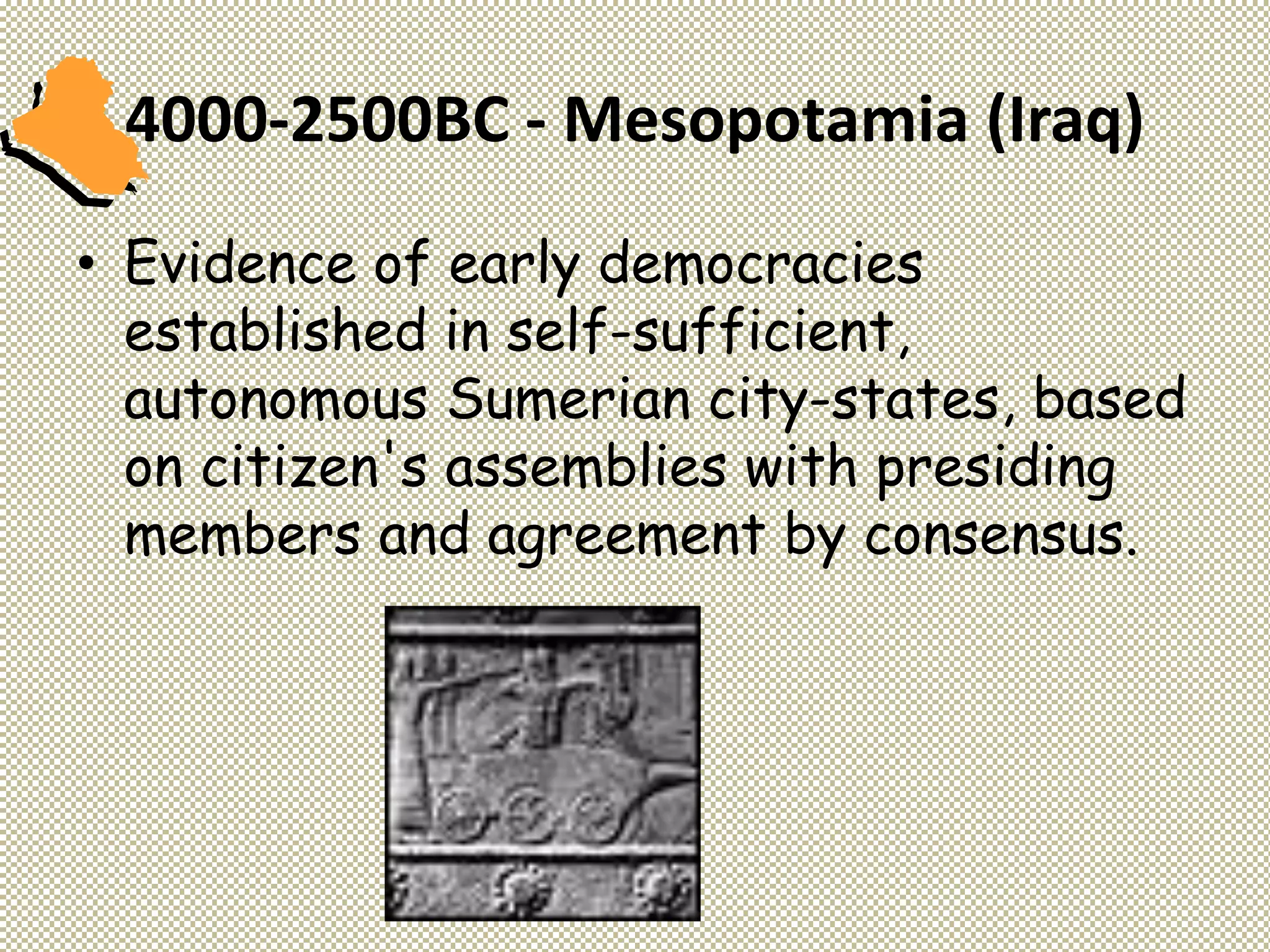
4000-2500BC - Mesopotamia (Iraq)
• Evidence of early democracies
established in self-sufficient,
autonomous Sumerian city-states, based
on citizen's assemblies with presiding
members and agreement by consensus.
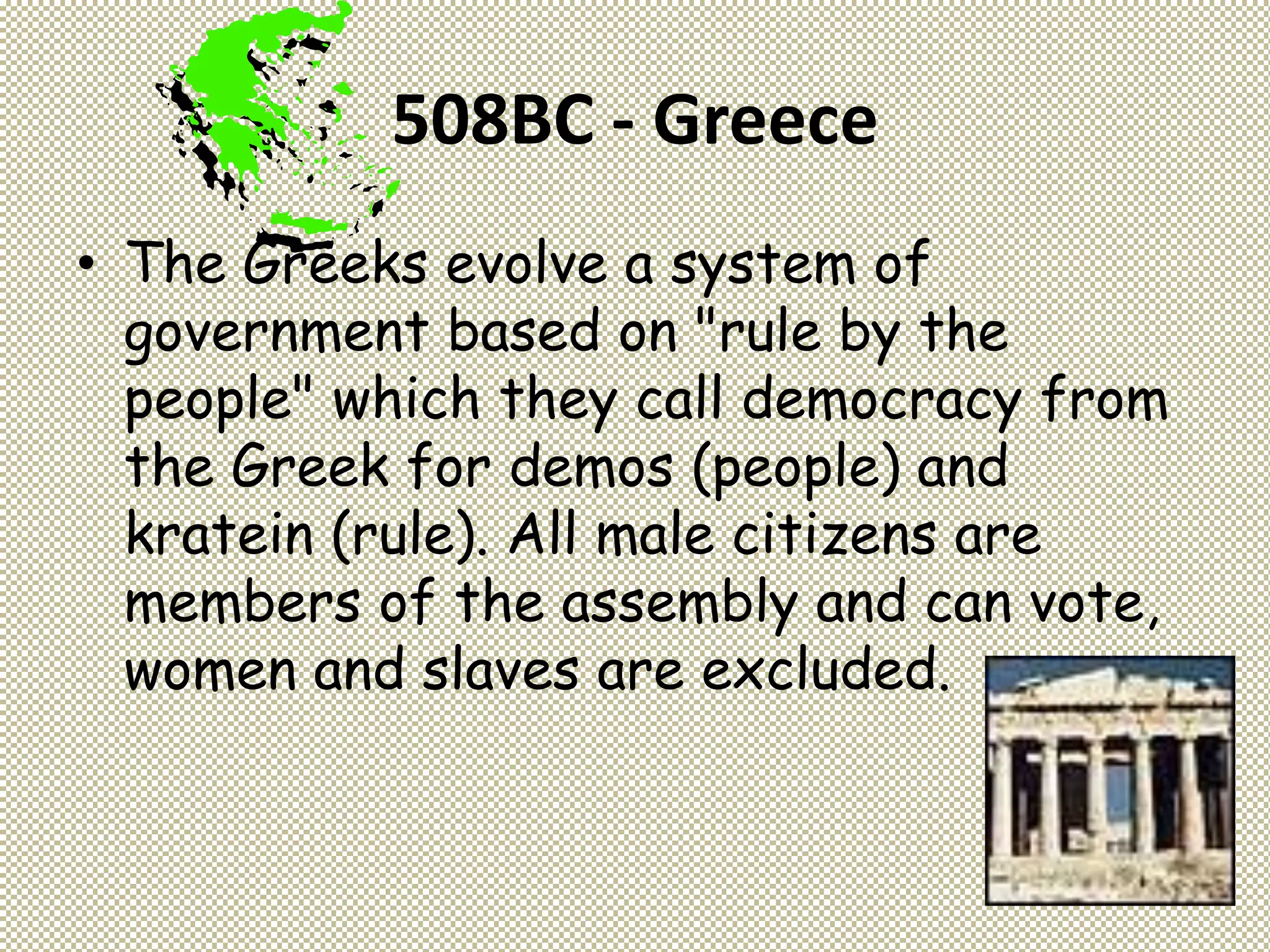
508BC - Greece
• The Greeks evolve a system of
government based on "rule by the
people" which they call democracy from
the Greek for demos (people) and
kratein (rule). All male citizens are
members of the assembly and can vote,
women and slaves are excluded.
510-27BC - Roman Italy
• Nobles are represented in the Senate
and commoners in the Assembly and
governmental power is divided between
them. The extent of the empire abroad,
and conflict at home, leads to the
decline of democracy in favor of strong
dictators.
"REPRESENTATIVE
DEMOCRACY" 1215 MID-20TH
CENTURY
This period saw the growth of greater representation of the
people and the freedom to vote within nation states.
Political parties were born and competitive elections and
suffrage for women became increasingly common.
Increasingly, democracy became based on written laws which
ensured fixed terms and secret ballots, backed by
independent judiciaries.
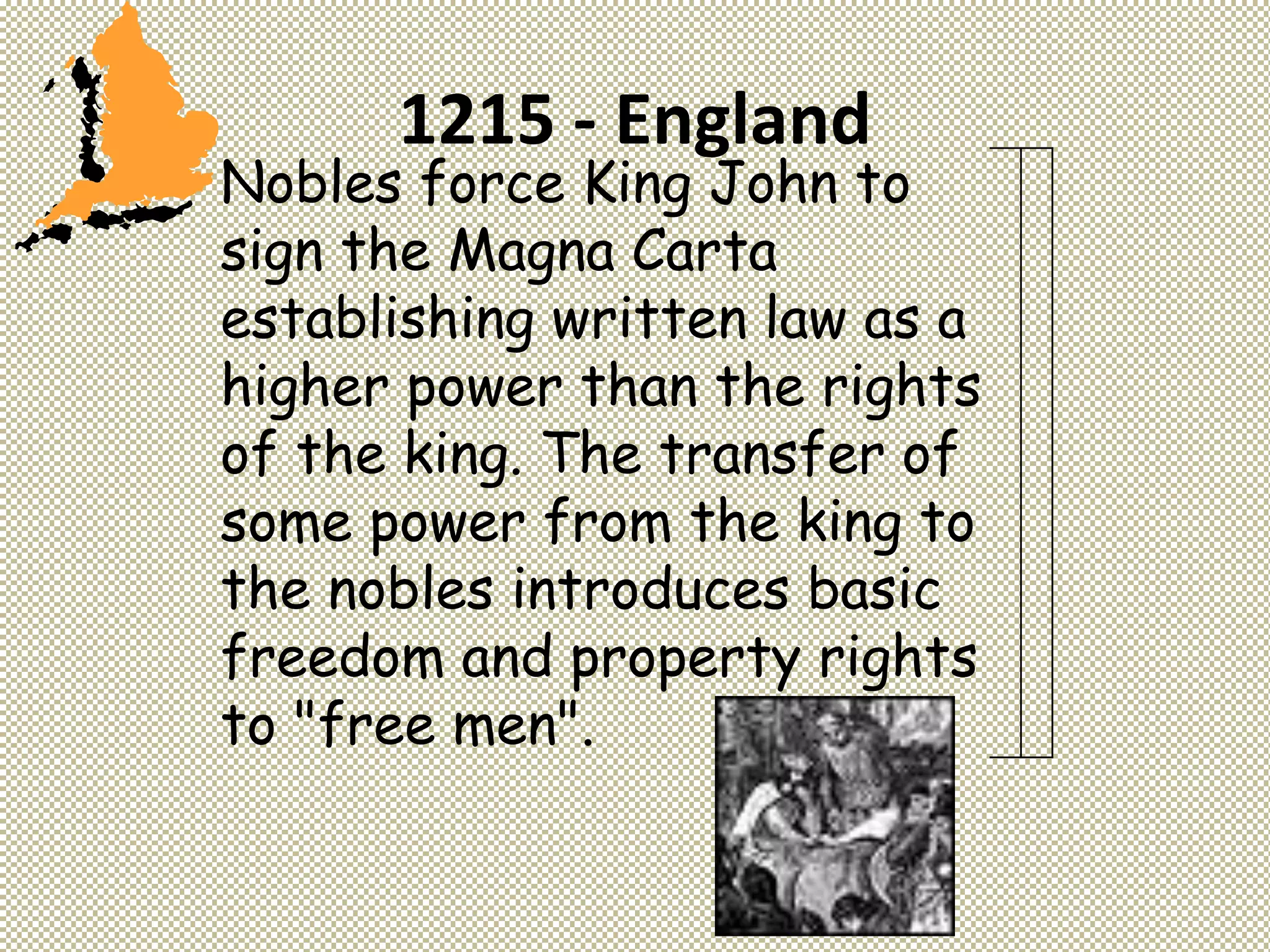
1215 - England
Nobles force King John to
sign the Magna Carta
establishing written law as a
higher power than the rights
of the king. The transfer of
some power from the king to
the nobles introduces basic
freedom and property rights
to "free men".
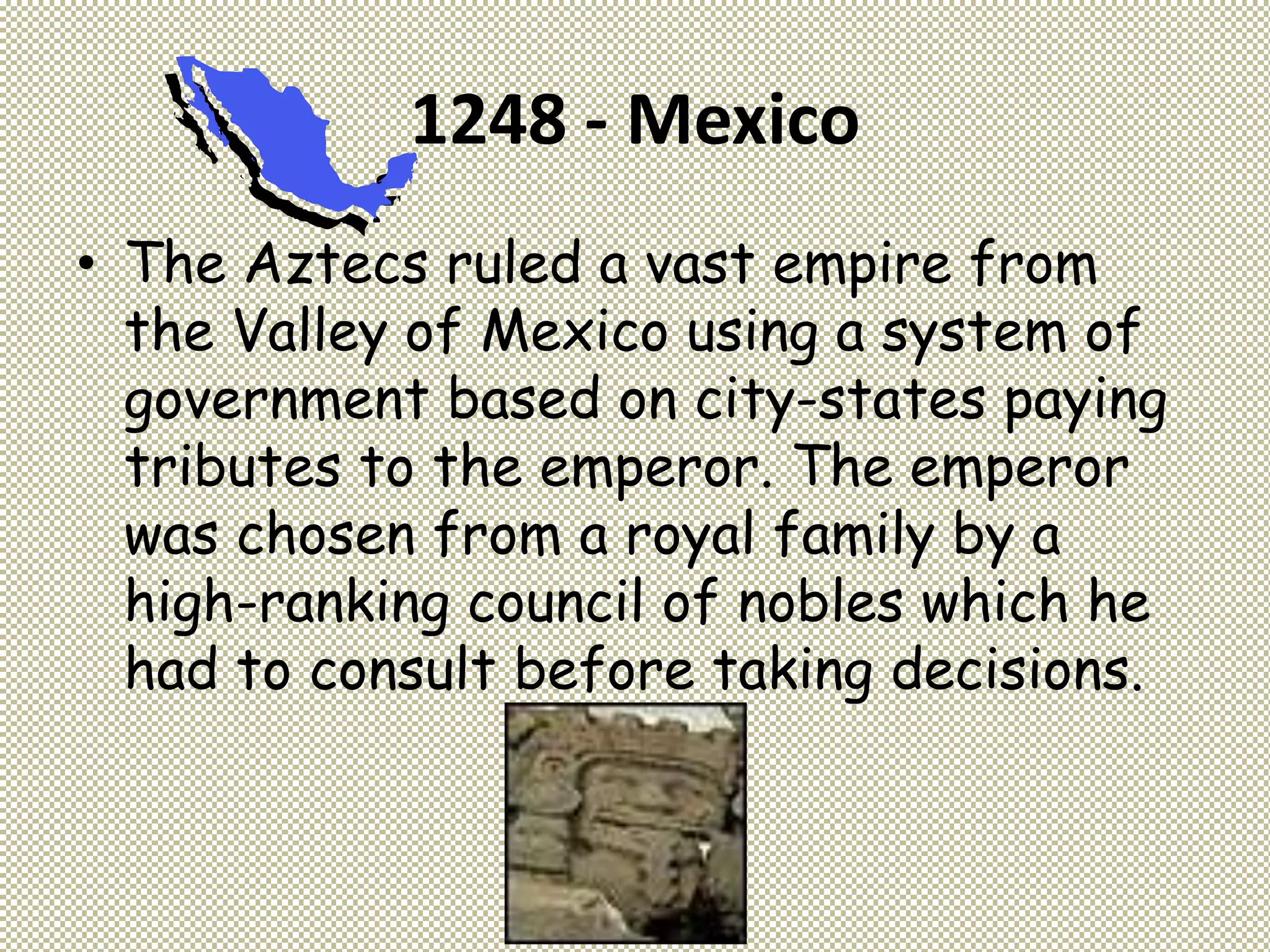
1248 - Mexico
• The Aztecs ruled a vast empire from
the Valley of Mexico using a system of
government based on city-states paying
tributes to the emperor. The emperor
was chosen from a royal family by a
high-ranking council of nobles which he
had to consult before taking decisions.
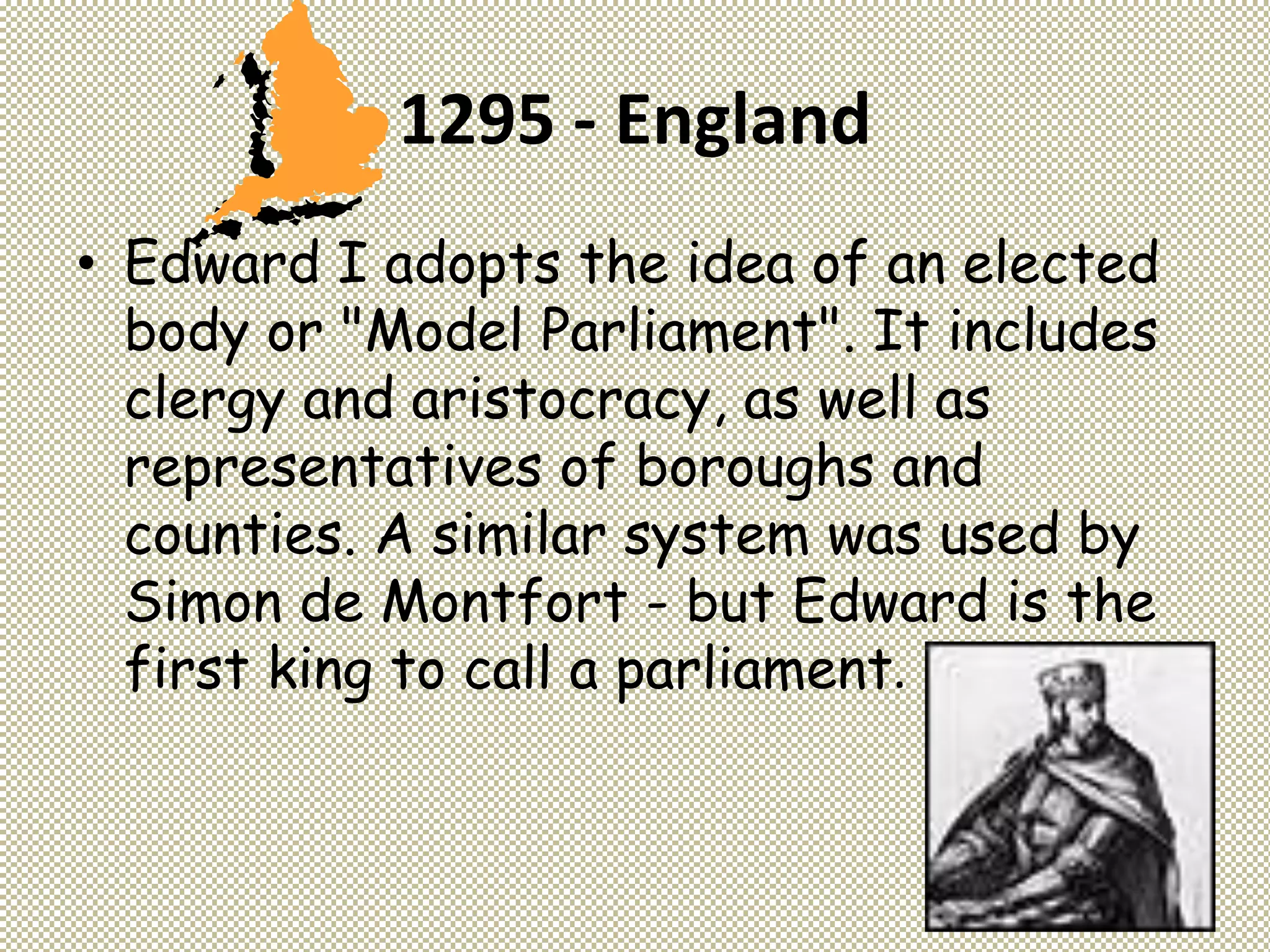
1295 - England
• Edward I adopts the idea of an elected
body or "Model Parliament". It includes
clergy and aristocracy, as well as
representatives of boroughs and
counties. A similar system was used by
Simon de Montfort - but Edward is the
first king to call a parliament.
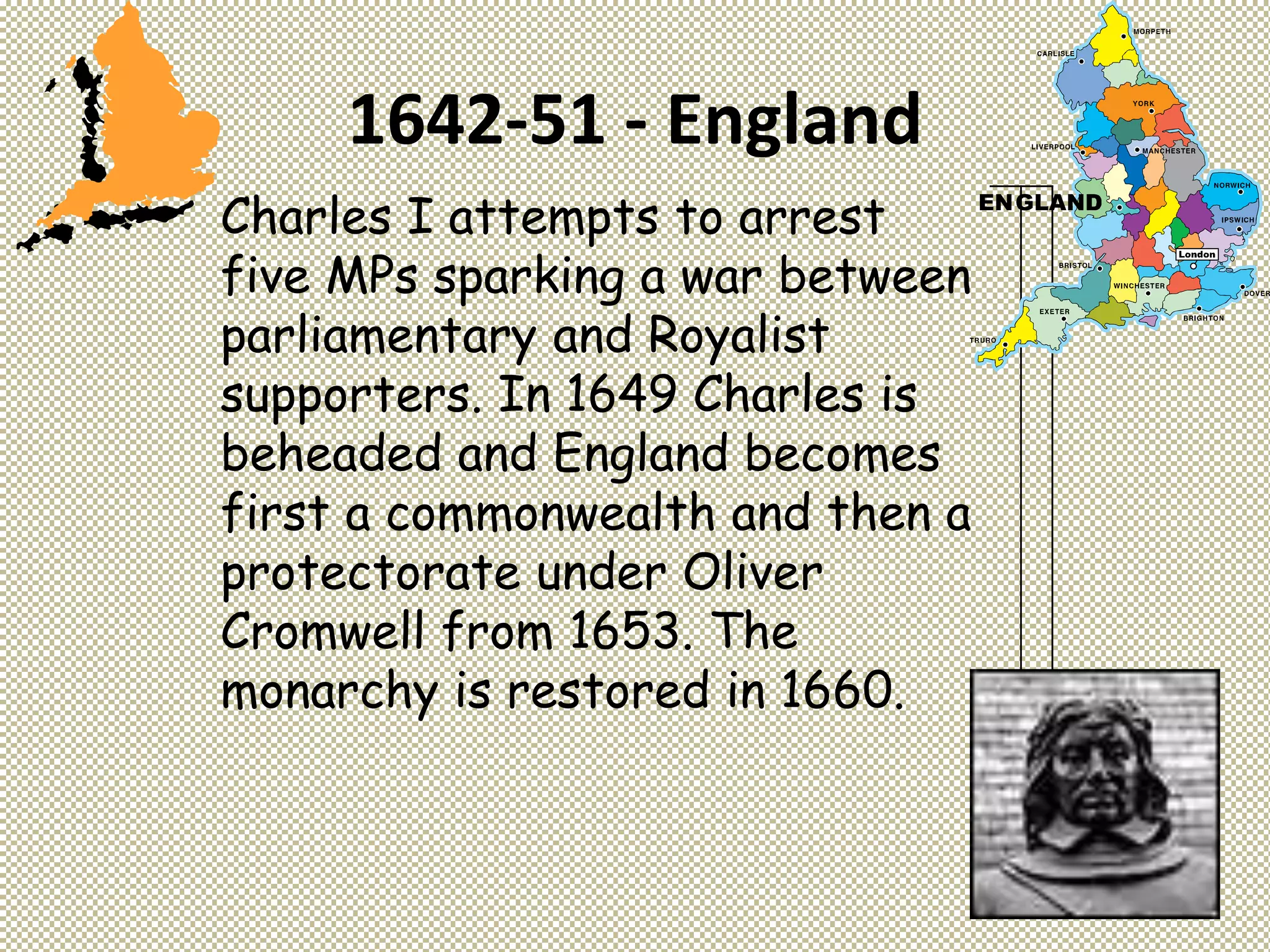
1642-51 - England
Charles I attempts to arrest
five MPs sparking a war between
parliamentary and Royalist
supporters. In 1649 Charles is
beheaded and England becomes
first a commonwealth and then a
protectorate under Oliver
Cromwell from 1653. The
monarchy is restored in 1660.
1679 - England
• Habeas Corpus Act is passed which
enshrines in law the rights of the
individual to legally challenge their
imprisonment by the authorities.
1689 - England
• The Bill of Rights legally establishes the
civil and political rights that an English
citizen living within a constitutional
monarchy ought to have. The Tory
faction, later the Conservatives,
emerges in this period, heralding the
birth of the party system.
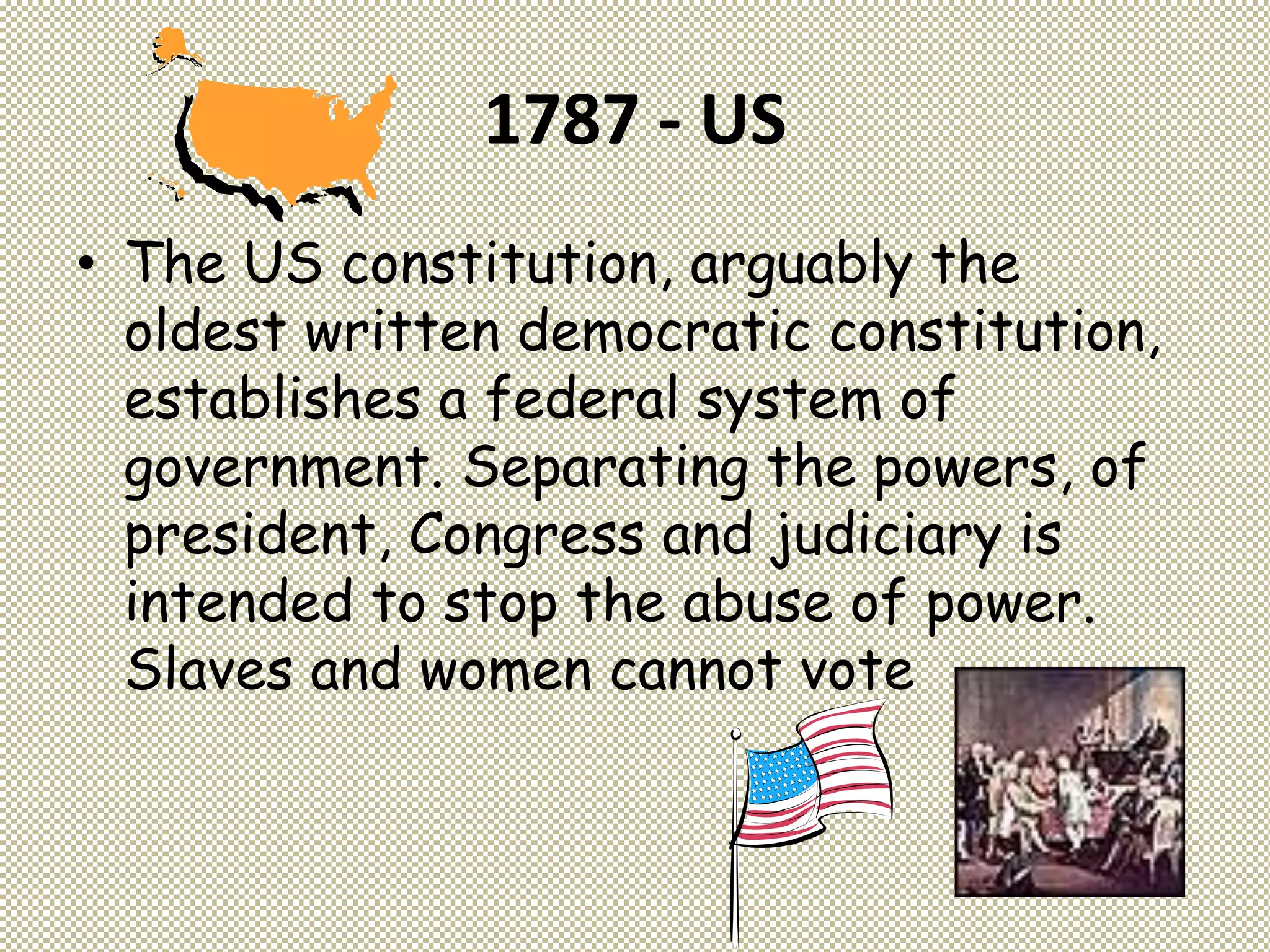
1787 - US
• The US constitution, arguably the
oldest written democratic constitution,
establishes a federal system of
government. Separating the powers, of
president, Congress and judiciary is
intended to stop the abuse of power.
Slaves and women cannot vote
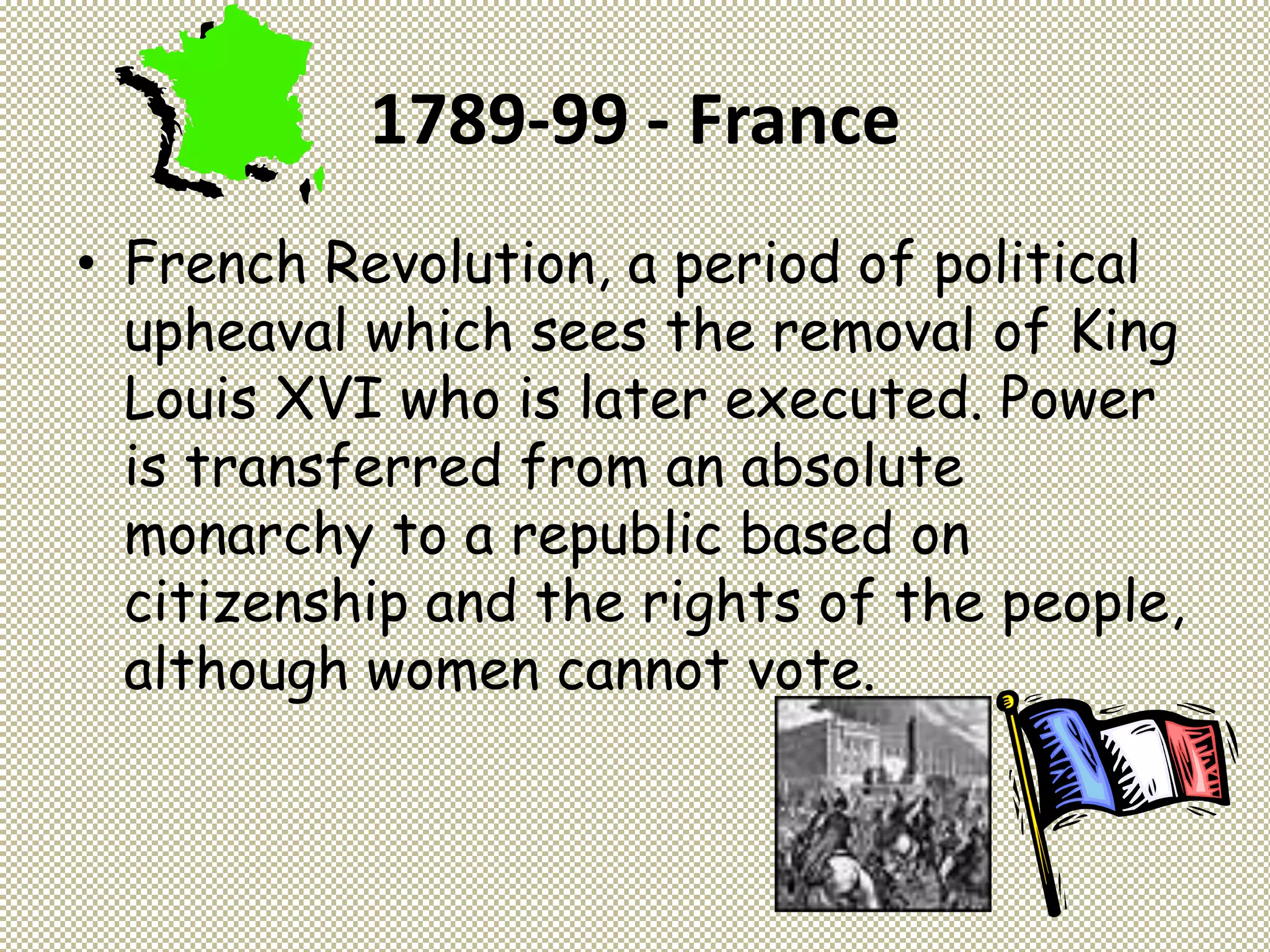
1789-99 - France
• French Revolution, a period of political
upheaval which sees the removal of King
Louis XVI who is later executed. Power
is transferred from an absolute
monarchy to a republic based on
citizenship and the rights of the people,
although women cannot vote.
1847 - Switzerland
• A brief civil war leads to a national
referendum, one of the first recorded
uses in modern history, on a new federal
constitution. Switzerland still holds
more referendums than any other
country.
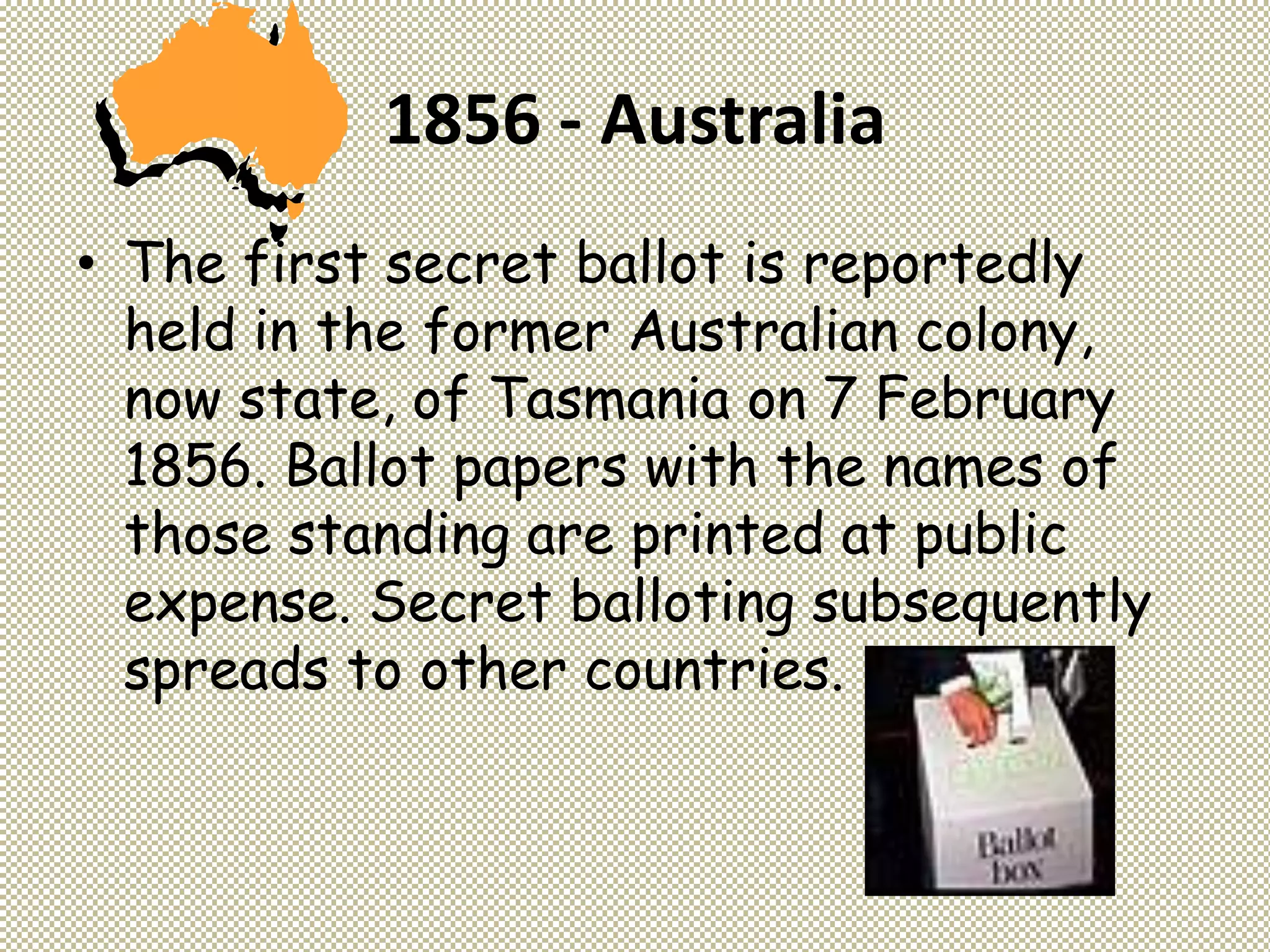
1856 - Australia
• The first secret ballot is reportedly
held in the former Australian colony,
now state, of Tasmania on 7 February
1856. Ballot papers with the names of
those standing are printed at public
expense. Secret balloting subsequently
spreads to other countries.
1867 - Britain
Second Reform Act virtually
doubles the size of the
electorate by increasing the
number of men who can vote.
All male householders are
given the right to vote and
lodgers paying £10 a year
rent.
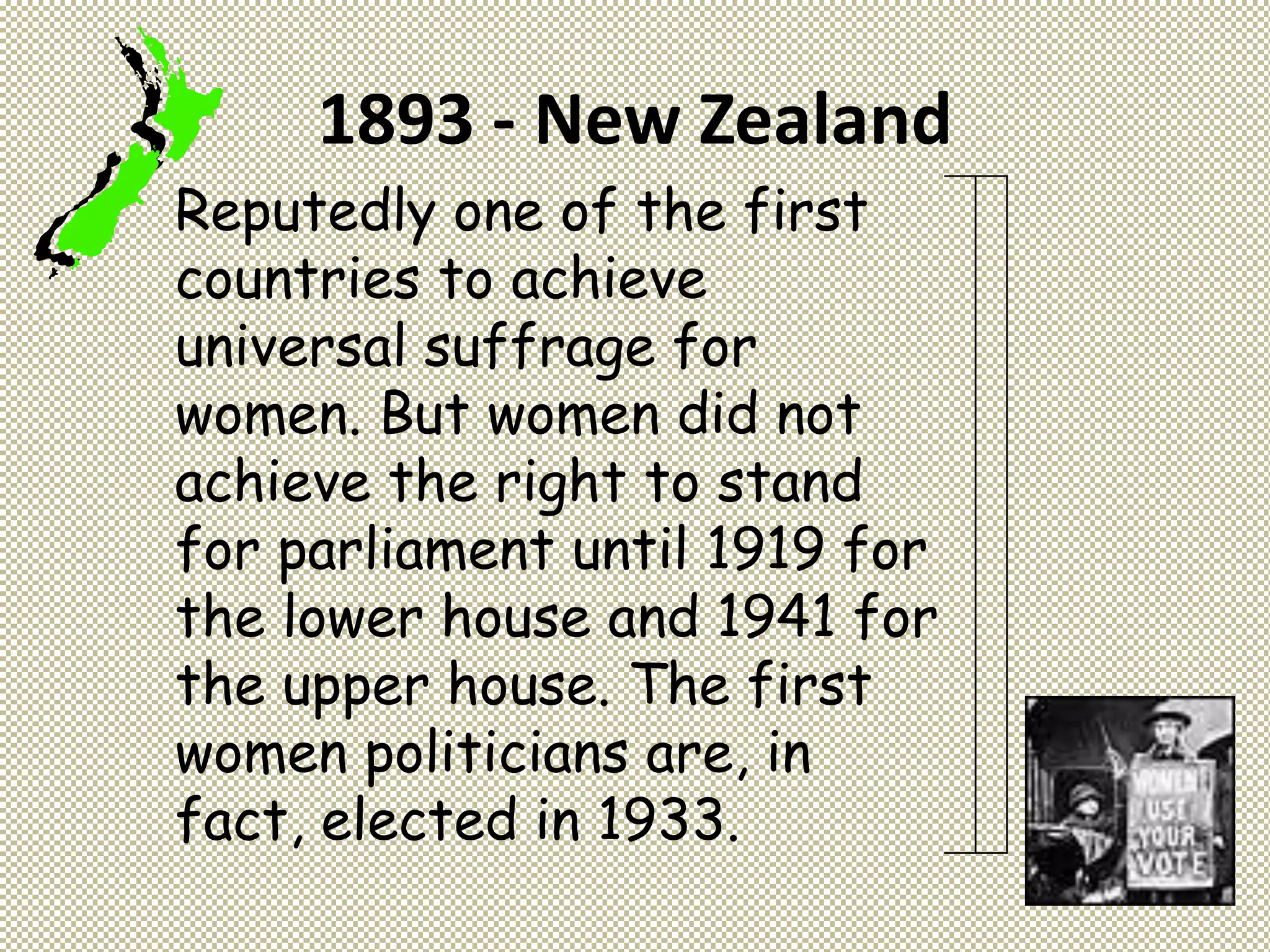
1893 - New Zealand
Reputedly one of the first
countries to achieve
universal suffrage for
women. But women did not
achieve the right to stand
for parliament until 1919 for
the lower house and 1941 for
the upper house. The first
women politicians are, in
fact, elected in 1933.
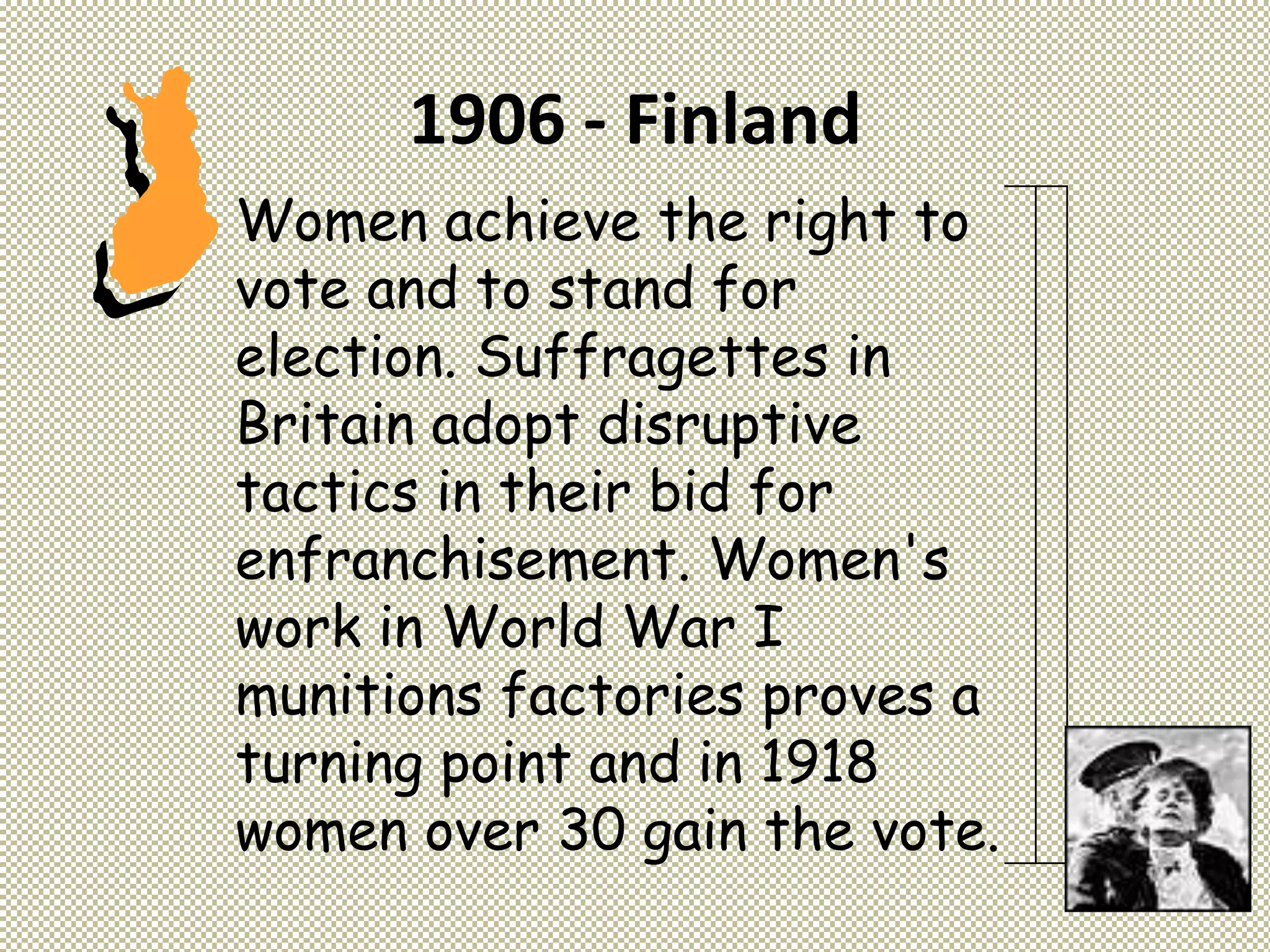
1906 - Finland
Women achieve the right to
vote and to stand for
election. Suffragettes in
Britain adopt disruptive
tactics in their bid for
enfranchisement. Women's
work in World War I
munitions factories proves a
turning point and in 1918
women over 30 gain the vote.
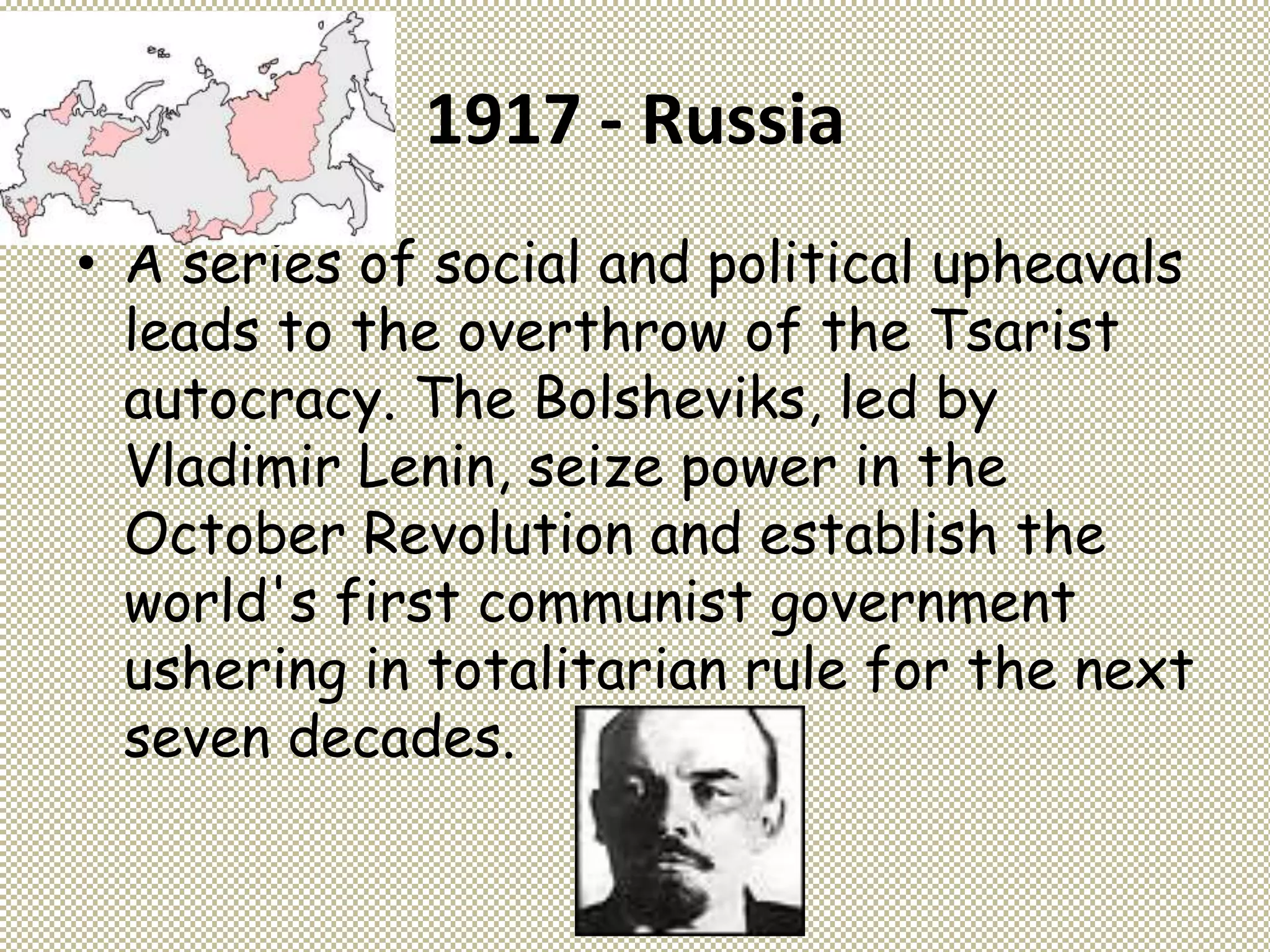
1917 - Russia
• A series of social and political upheavals
leads to the overthrow of the Tsarist
autocracy. The Bolsheviks, led by
Vladimir Lenin, seize power in the
October Revolution and establish the
world's first communist government
ushering in totalitarian rule for the next
seven decades.
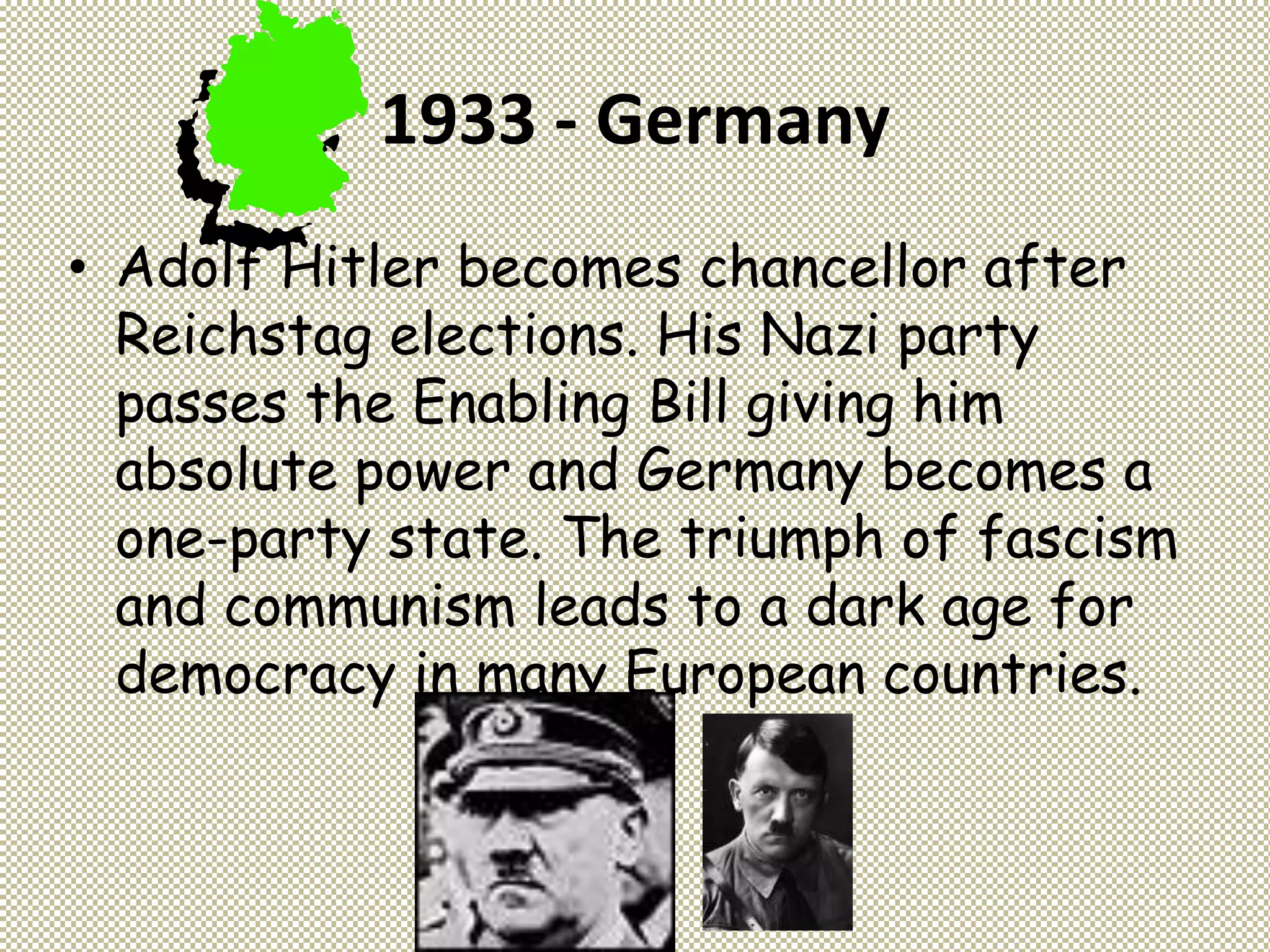
1933 - Germany
• Adolf Hitler becomes chancellor after
Reichstag elections. His Nazi party
passes the Enabling Bill giving him
absolute power and Germany becomes a
one-party state. The triumph of fascism
and communism leads to a dark age for
democracy in many European countries.
WHILE DECOLONISATION LED TO THE
BIRTH OF THE WORLD'S LARGEST
DEMOCRACY (INDIA), NATIONAL
INDEPENDENCE MOVEMENTS LED TO
MANY ONE-PARTY STATES AND
MILITARY REGIMES. THE END OF THE
CENTURY SAW DEMOCRACY
FLOURISHING IN EASTERN EUROPE AND
LATIN AMERICA AFTER DECADES OF
TOTALITARIANISM AND MILITARY
RULE.
"Modern Democracy"
mid-20th century
1947-India
• Indian independence marks the
beginning of the end of the British
Empire as anti-colonial nationalist
movements challenge the imperialist
power. Three years later India becomes
a republic and the largest democracy in
the world.
1948-South Africa
• Apartheid is a system of racial
segregation in South Africa developed
by Hendrik French Verwoerd, where
blacks are disenfranchised in "white"
South Africa and only allowed to vote in
the homelands, which are very poor
economically.
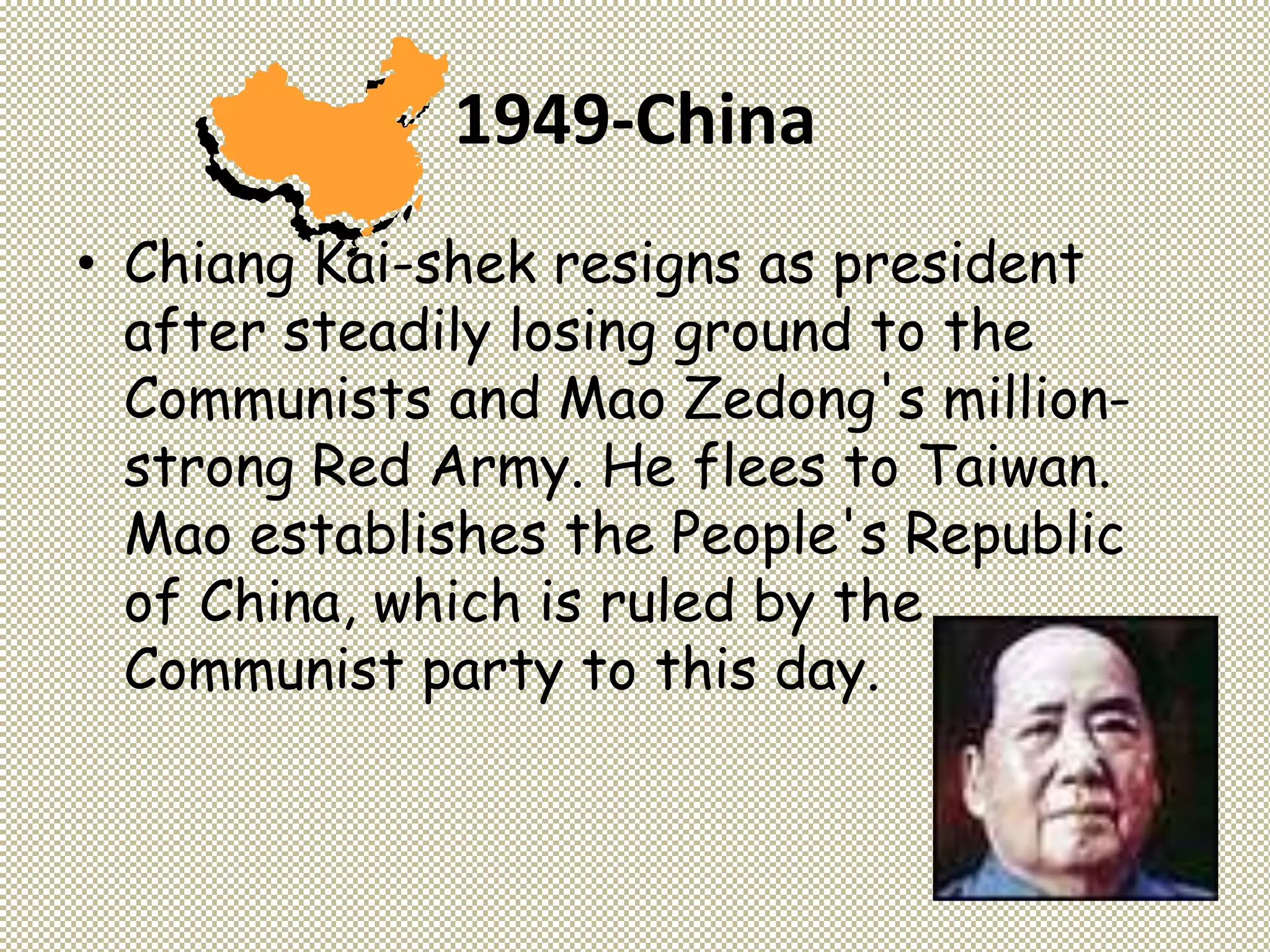
1949-China
• Chiang Kai-shek resigns as president
after steadily losing ground to the
Communists and Mao Zedong's million-
strong Red Army. He flees to Taiwan.
Mao establishes the People's Republic
of China, which is ruled by the
Communist party to this day.
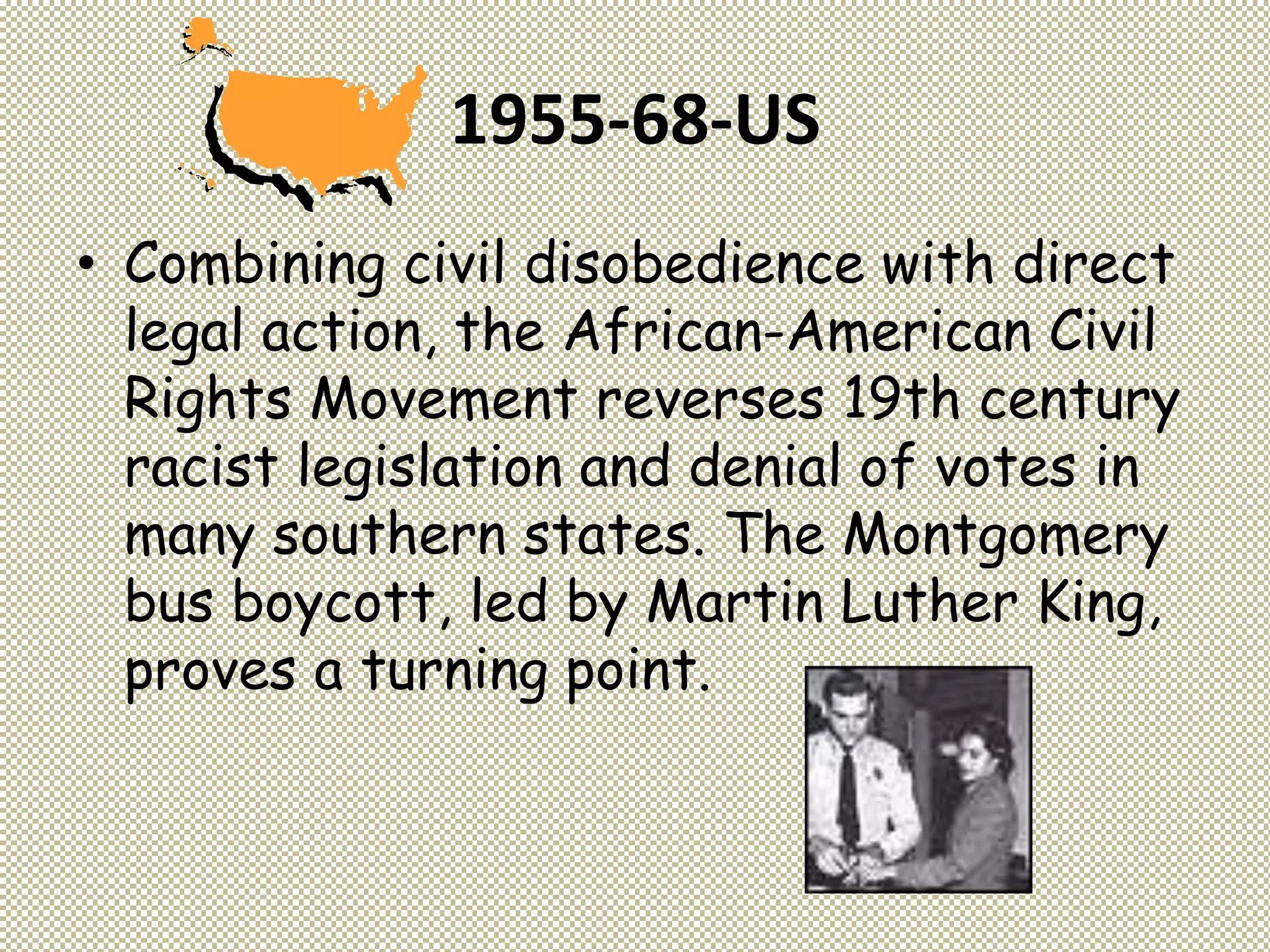
1955-68-US
• Combining civil disobedience with direct
legal action, the African-American Civil
Rights Movement reverses 19th century
racist legislation and denial of votes in
many southern states. The Montgomery
bus boycott, led by Martin Luther King,
proves a turning point.
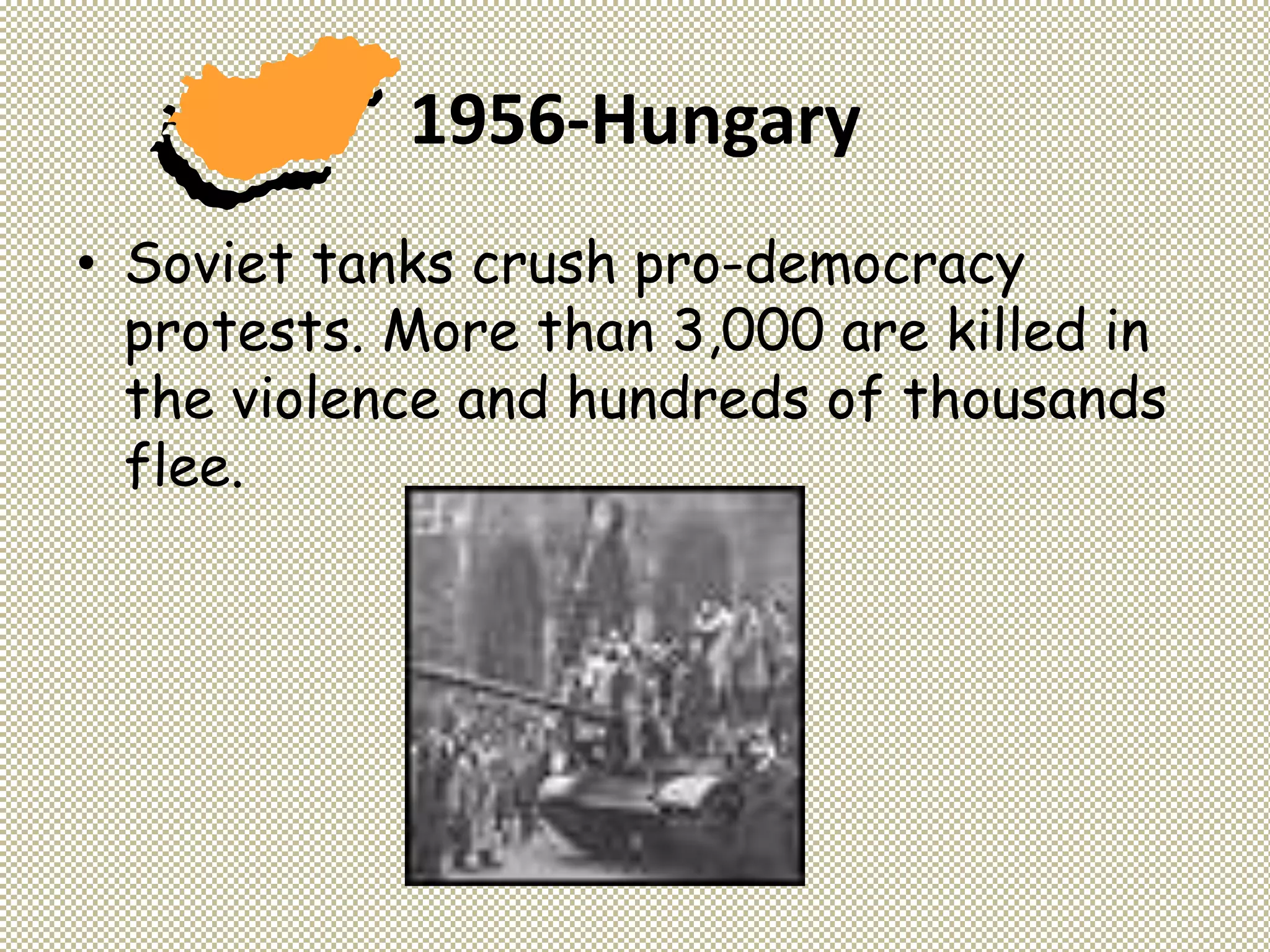
1956-Hungary
• Soviet tanks crush pro-democracy
protests. More than 3,000 are killed in
the violence and hundreds of thousands
flee.
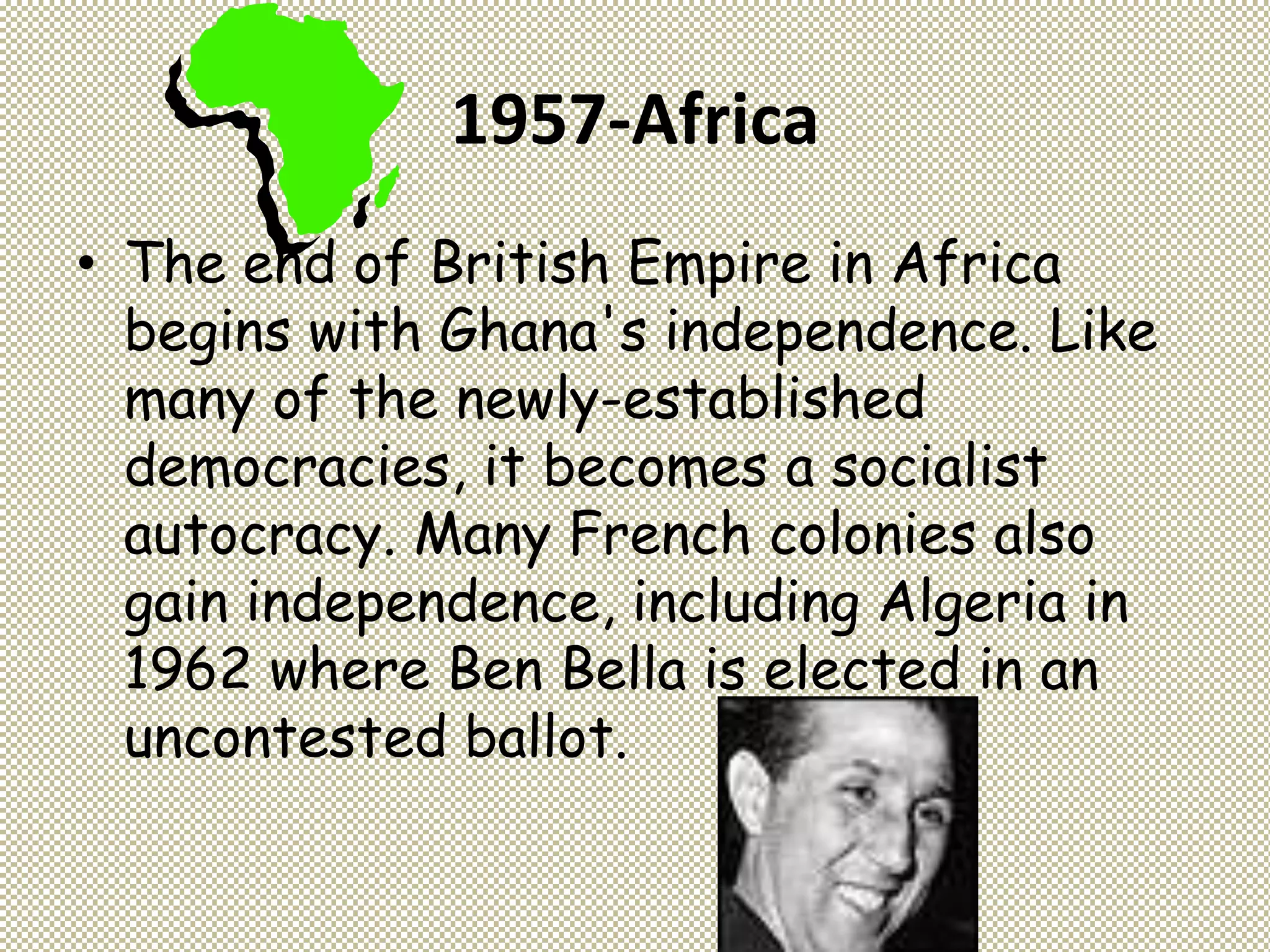
1957-Africa
• The end of British Empire in Africa
begins with Ghana's independence. Like
many of the newly-established
democracies, it becomes a socialist
autocracy. Many French colonies also
gain independence, including Algeria in
1962 where Ben Bella is elected in an
uncontested ballot.
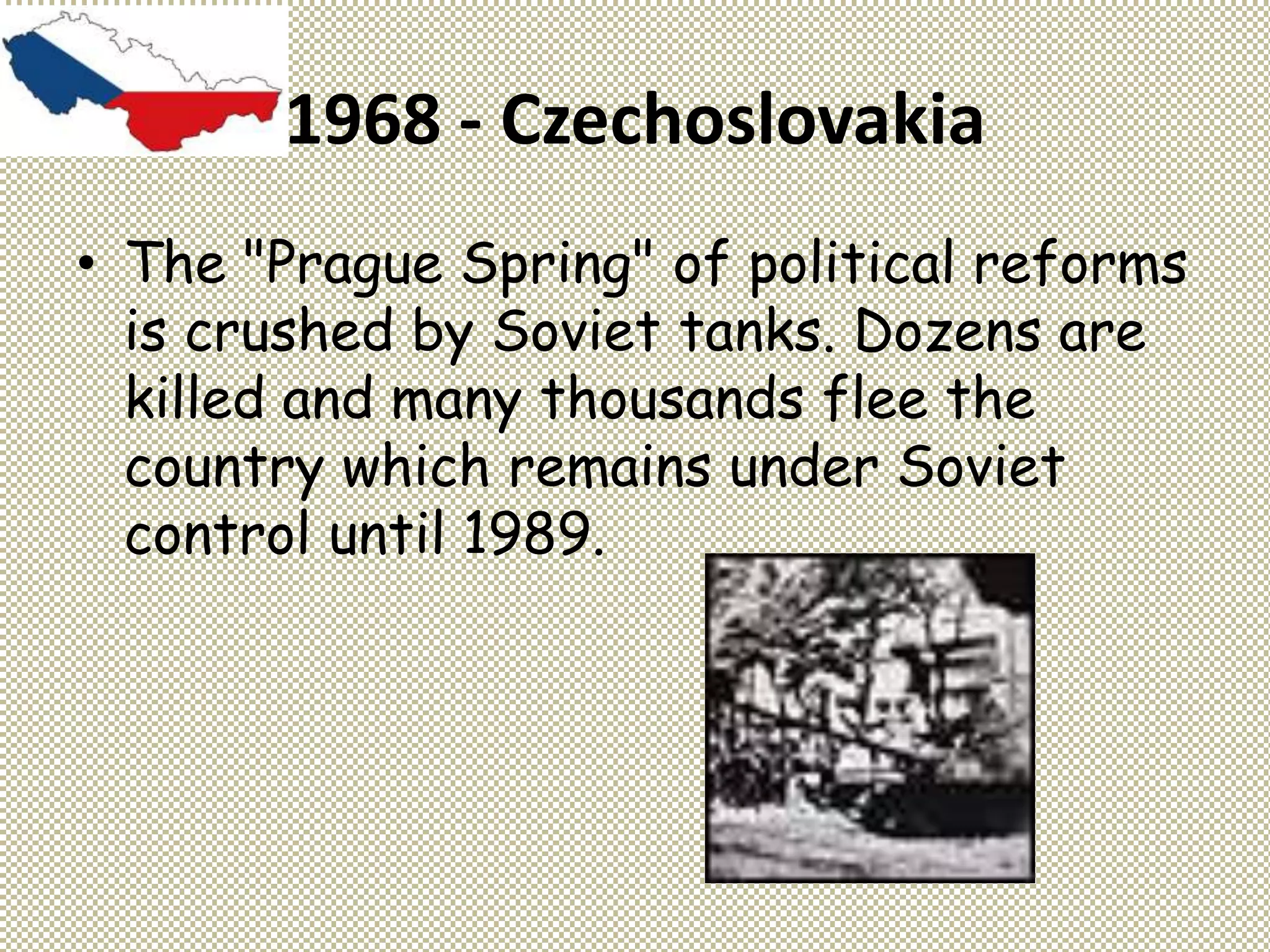
1968 - Czechoslovakia
• The "Prague Spring" of political reforms
is crushed by Soviet tanks. Dozens are
killed and many thousands flee the
country which remains under Soviet
control until 1989.
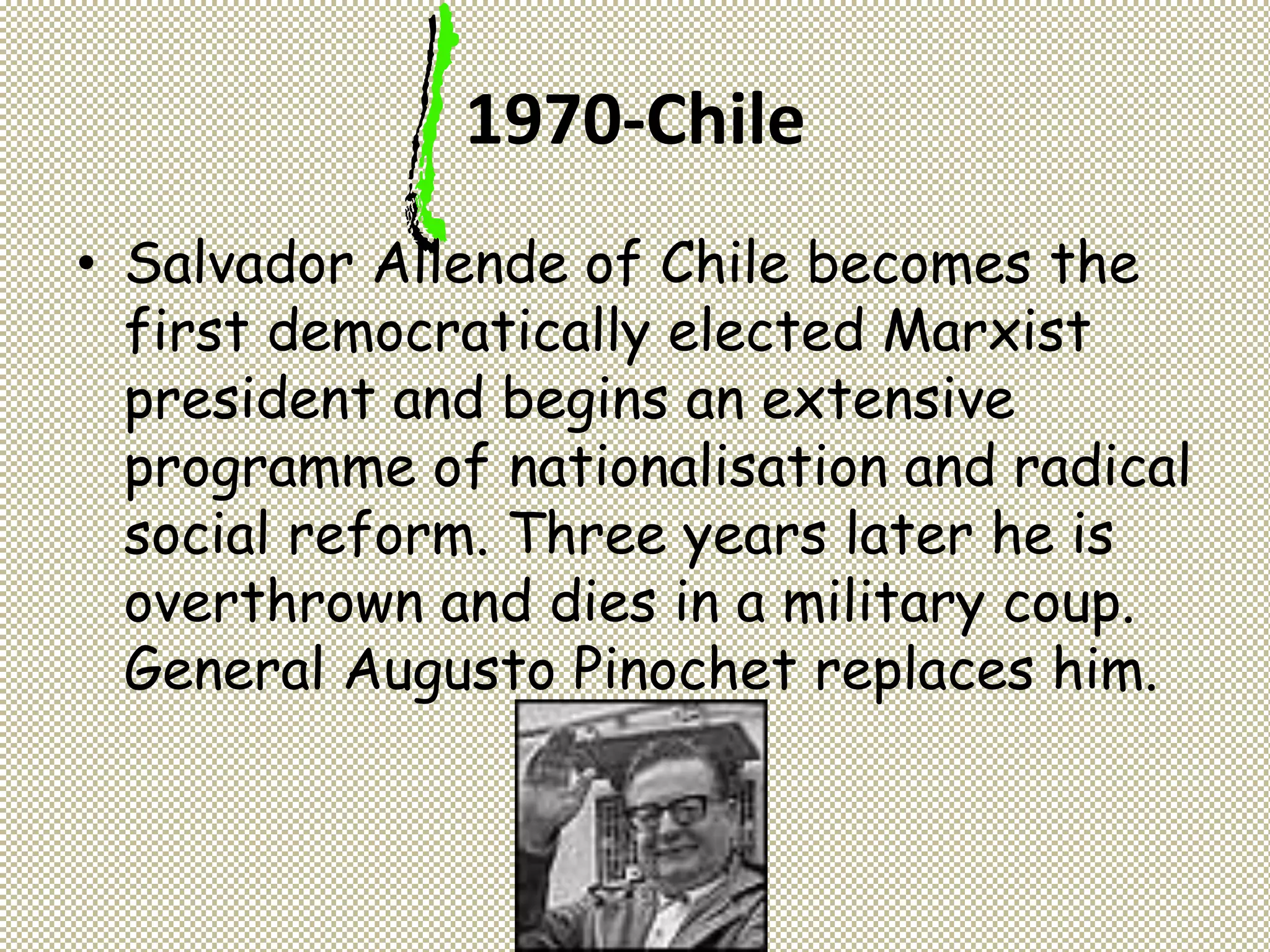
1970-Chile
• Salvador Allende of Chile becomes the
first democratically elected Marxist
president and begins an extensive
programme of nationalisation and radical
social reform. Three years later he is
overthrown and dies in a military coup.
General Augusto Pinochet replaces him.
USSR
• Mikhail Gorbachev becomes Soviet
leader, and launches "perestroika"
(reconstruction) reforms, but living
standards plummet. In 1991, as some
Soviet republics push for independence,
hardliners stage a coup. It fails, the
Soviet Union disintegrates and
Gorbachev is swept aside by Boris
Yeltsin.
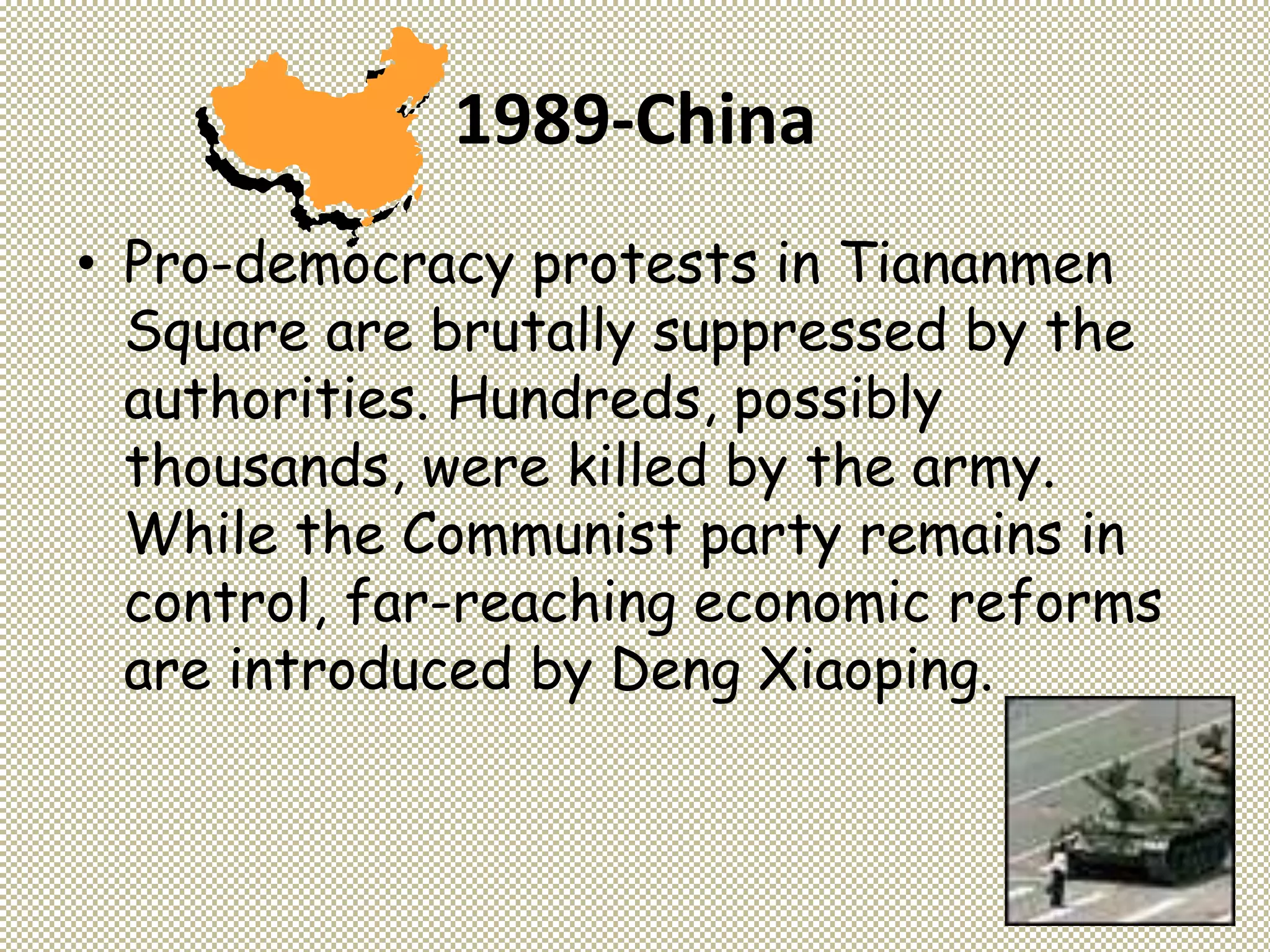
1989-China
• Pro-democracy protests in Tiananmen
Square are brutally suppressed by the
authorities. Hundreds, possibly
thousands, were killed by the army.
While the Communist party remains in
control, far-reaching economic reforms
are introduced by Deng Xiaoping.
1989 - Germany
• Hungary opens its border with Austria,
allowing thousands of East Germans to
escape to the West. After the Berlin
Wall falls, largely-peaceful
demonstrations in Czechoslovakia,
Bulgaria, Hungary and Romania lead to
the dismantling of one-party systems.
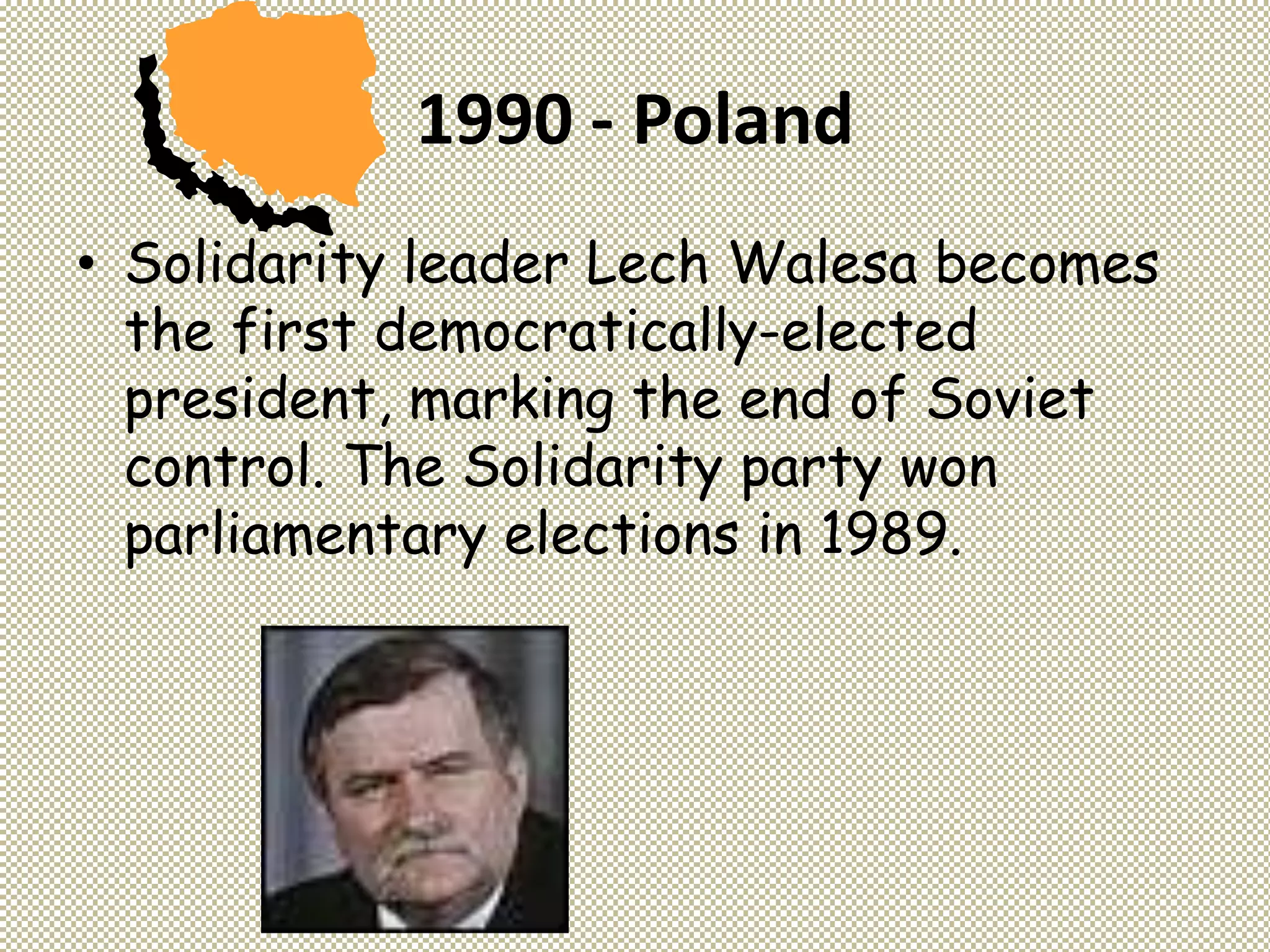
1990 - Poland
• Solidarity leader Lech Walesa becomes
the first democratically-elected
president, marking the end of Soviet
control. The Solidarity party won
parliamentary elections in 1989.
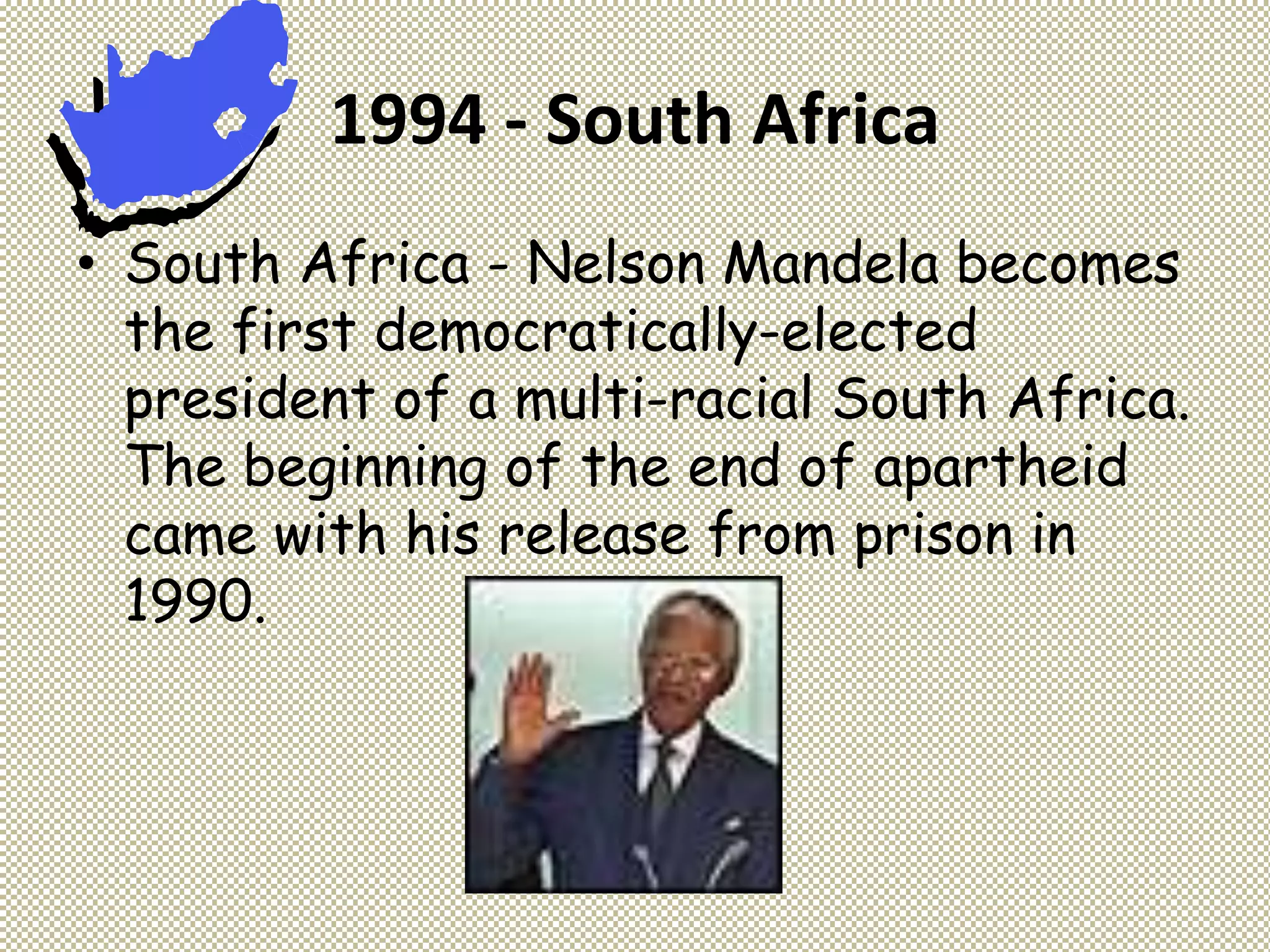
1994 - South Africa
• South Africa - Nelson Mandela becomes
the first democratically-elected
president of a multi-racial South Africa.
The beginning of the end of apartheid
came with his release from prison in
1990.
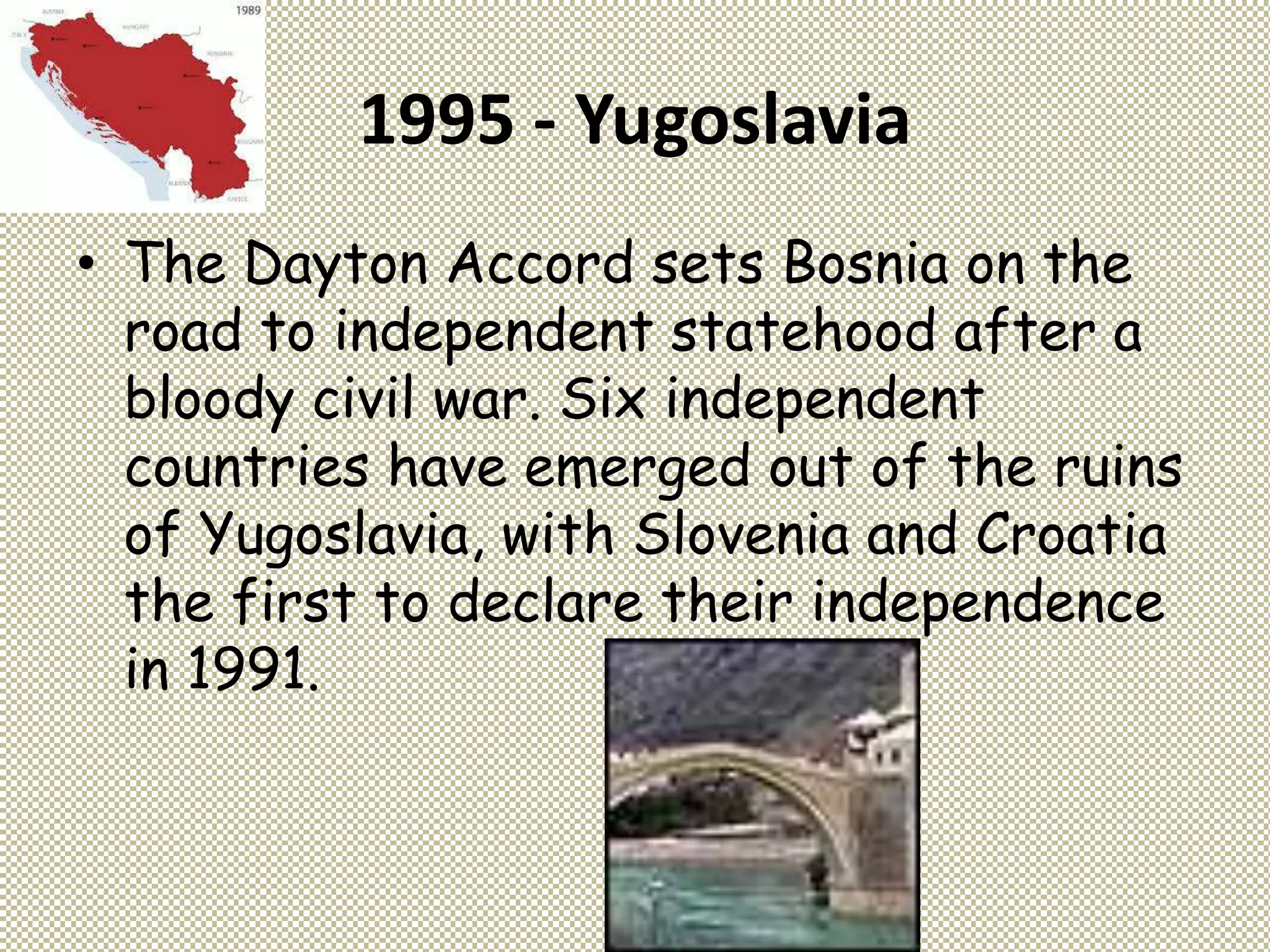
1995 - Yugoslavia
• The Dayton Accord sets Bosnia on the
road to independent statehood after a
bloody civil war. Six independent
countries have emerged out of the ruins
of Yugoslavia, with Slovenia and Croatia
the first to declare their independence
in 1991.
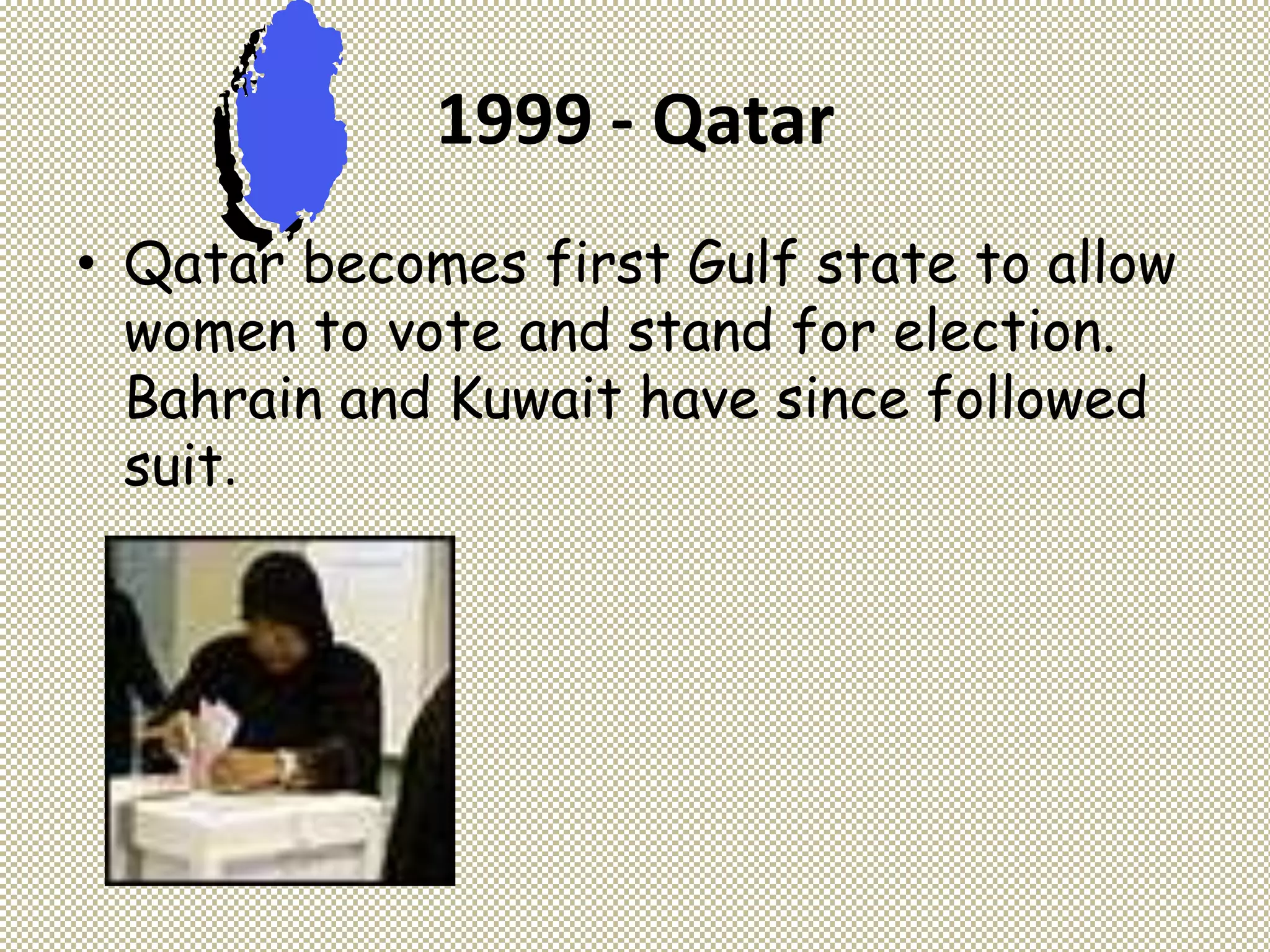
1999 - Qatar
• Qatar becomes first Gulf state to allow
women to vote and stand for election.
Bahrain and Kuwait have since followed
suit.
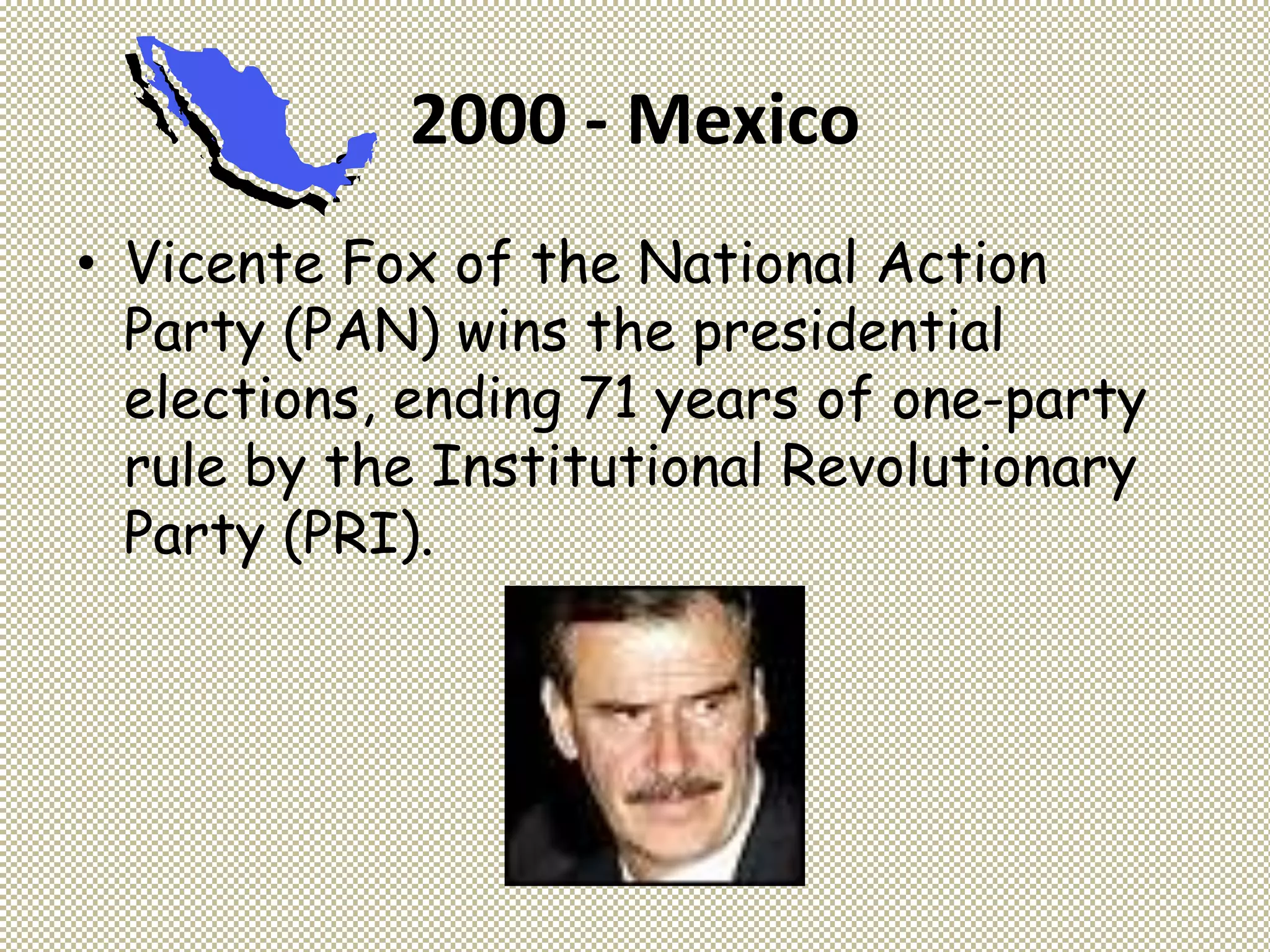
2000 - Mexico
• Vicente Fox of the National Action
Party (PAN) wins the presidential
elections, ending 71 years of one-party
rule by the Institutional Revolutionary
Party (PRI).
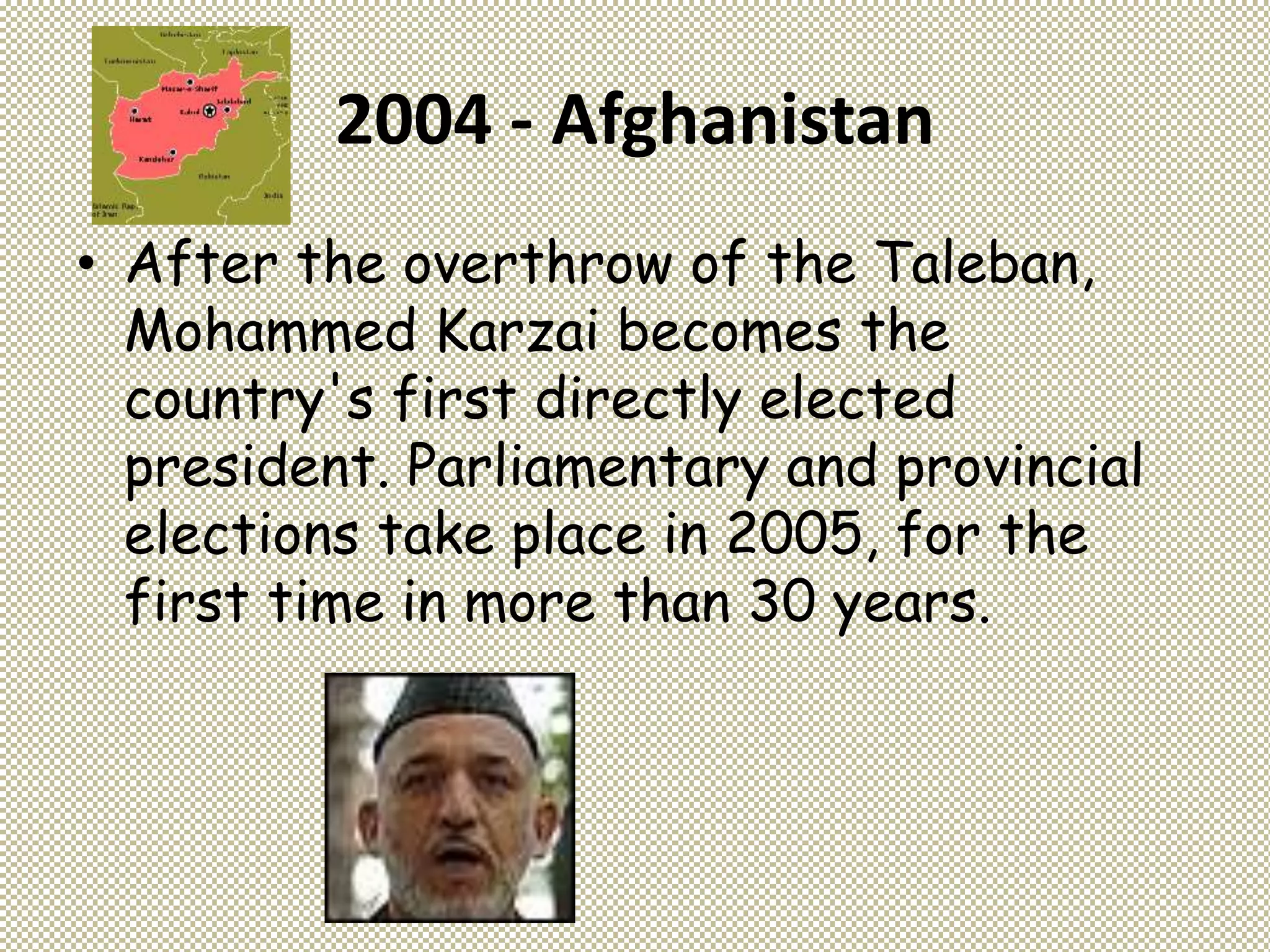
2004 - Afghanistan
• After the overthrow of the Taleban,
Mohammed Karzai becomes the
country's first directly elected
president. Parliamentary and provincial
elections take place in 2005, for the
first time in more than 30 years.
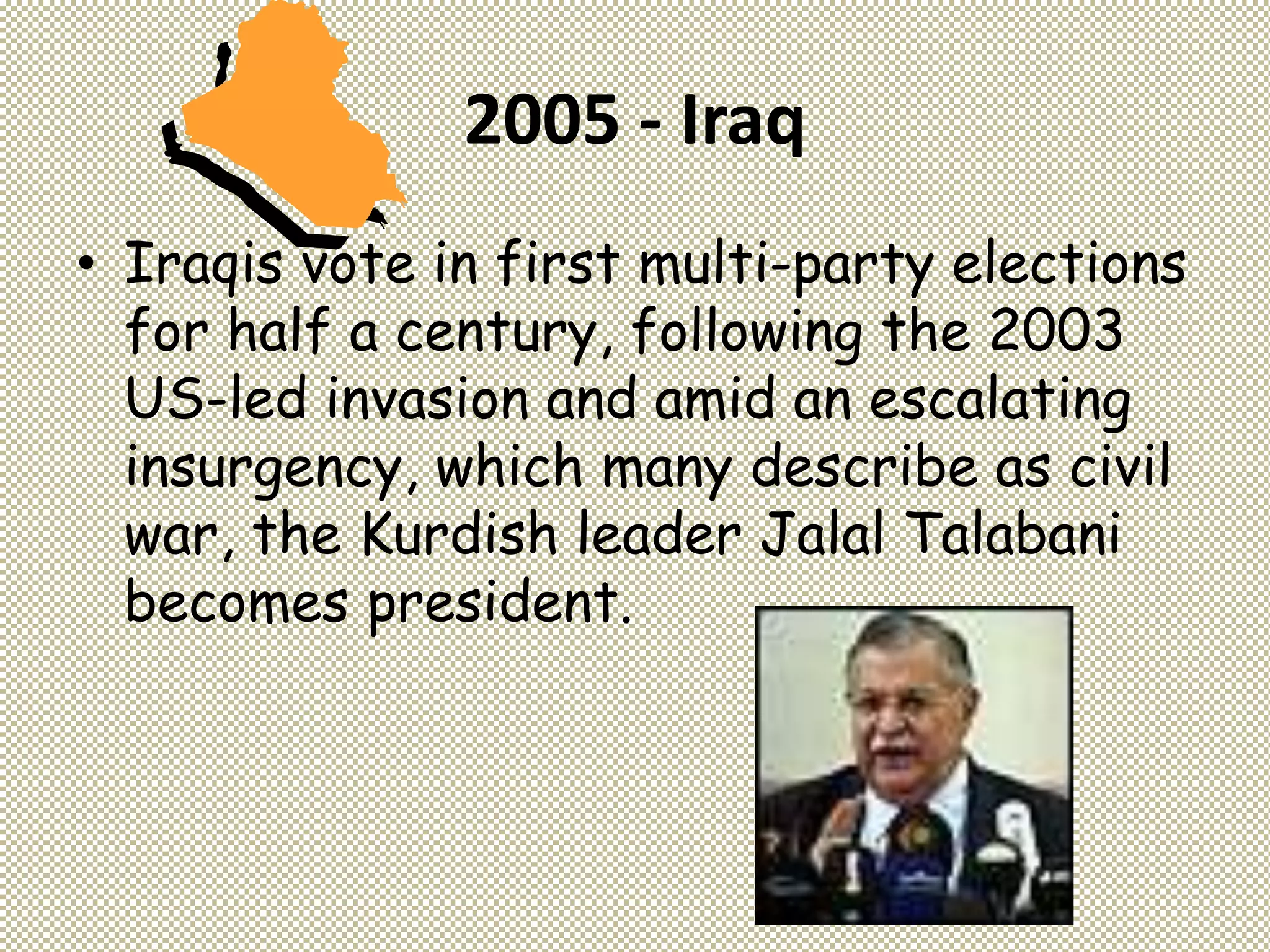
2005 - Iraq
• Iraqis vote in first multi-party elections
for half a century, following the 2003
US-led invasion and amid an escalating
insurgency, which many describe as civil
war, the Kurdish leader Jalal Talabani
becomes president.
Thanks for
Watching !!!!
Sources: BBC

The timeline of democracy

  • 1.
    The Timeline Of Democracy Createdby : Maria Papamichael Perifanou Chrisa Jim Sakkas Konstantinos Vogiatzoglou
  • 3.
    4000-2500BC - Mesopotamia(Iraq) • Evidence of early democracies established in self-sufficient, autonomous Sumerian city-states, based on citizen's assemblies with presiding members and agreement by consensus.
  • 4.
    508BC - Greece •The Greeks evolve a system of government based on "rule by the people" which they call democracy from the Greek for demos (people) and kratein (rule). All male citizens are members of the assembly and can vote, women and slaves are excluded.
  • 5.
    510-27BC - RomanItaly • Nobles are represented in the Senate and commoners in the Assembly and governmental power is divided between them. The extent of the empire abroad, and conflict at home, leads to the decline of democracy in favor of strong dictators.
  • 6.
    "REPRESENTATIVE DEMOCRACY" 1215 MID-20TH CENTURY Thisperiod saw the growth of greater representation of the people and the freedom to vote within nation states. Political parties were born and competitive elections and suffrage for women became increasingly common. Increasingly, democracy became based on written laws which ensured fixed terms and secret ballots, backed by independent judiciaries.
  • 7.
    1215 - England Noblesforce King John to sign the Magna Carta establishing written law as a higher power than the rights of the king. The transfer of some power from the king to the nobles introduces basic freedom and property rights to "free men".
  • 8.
    1248 - Mexico •The Aztecs ruled a vast empire from the Valley of Mexico using a system of government based on city-states paying tributes to the emperor. The emperor was chosen from a royal family by a high-ranking council of nobles which he had to consult before taking decisions.
  • 9.
    1295 - England •Edward I adopts the idea of an elected body or "Model Parliament". It includes clergy and aristocracy, as well as representatives of boroughs and counties. A similar system was used by Simon de Montfort - but Edward is the first king to call a parliament.
  • 10.
    1642-51 - England CharlesI attempts to arrest five MPs sparking a war between parliamentary and Royalist supporters. In 1649 Charles is beheaded and England becomes first a commonwealth and then a protectorate under Oliver Cromwell from 1653. The monarchy is restored in 1660.
  • 11.
    1679 - England •Habeas Corpus Act is passed which enshrines in law the rights of the individual to legally challenge their imprisonment by the authorities.
  • 12.
    1689 - England •The Bill of Rights legally establishes the civil and political rights that an English citizen living within a constitutional monarchy ought to have. The Tory faction, later the Conservatives, emerges in this period, heralding the birth of the party system.
  • 13.
    1787 - US •The US constitution, arguably the oldest written democratic constitution, establishes a federal system of government. Separating the powers, of president, Congress and judiciary is intended to stop the abuse of power. Slaves and women cannot vote
  • 14.
    1789-99 - France •French Revolution, a period of political upheaval which sees the removal of King Louis XVI who is later executed. Power is transferred from an absolute monarchy to a republic based on citizenship and the rights of the people, although women cannot vote.
  • 15.
    1847 - Switzerland •A brief civil war leads to a national referendum, one of the first recorded uses in modern history, on a new federal constitution. Switzerland still holds more referendums than any other country.
  • 16.
    1856 - Australia •The first secret ballot is reportedly held in the former Australian colony, now state, of Tasmania on 7 February 1856. Ballot papers with the names of those standing are printed at public expense. Secret balloting subsequently spreads to other countries.
  • 17.
    1867 - Britain SecondReform Act virtually doubles the size of the electorate by increasing the number of men who can vote. All male householders are given the right to vote and lodgers paying £10 a year rent.
  • 18.
    1893 - NewZealand Reputedly one of the first countries to achieve universal suffrage for women. But women did not achieve the right to stand for parliament until 1919 for the lower house and 1941 for the upper house. The first women politicians are, in fact, elected in 1933.
  • 19.
    1906 - Finland Womenachieve the right to vote and to stand for election. Suffragettes in Britain adopt disruptive tactics in their bid for enfranchisement. Women's work in World War I munitions factories proves a turning point and in 1918 women over 30 gain the vote.
  • 20.
    1917 - Russia •A series of social and political upheavals leads to the overthrow of the Tsarist autocracy. The Bolsheviks, led by Vladimir Lenin, seize power in the October Revolution and establish the world's first communist government ushering in totalitarian rule for the next seven decades.
  • 21.
    1933 - Germany •Adolf Hitler becomes chancellor after Reichstag elections. His Nazi party passes the Enabling Bill giving him absolute power and Germany becomes a one-party state. The triumph of fascism and communism leads to a dark age for democracy in many European countries.
  • 22.
    WHILE DECOLONISATION LEDTO THE BIRTH OF THE WORLD'S LARGEST DEMOCRACY (INDIA), NATIONAL INDEPENDENCE MOVEMENTS LED TO MANY ONE-PARTY STATES AND MILITARY REGIMES. THE END OF THE CENTURY SAW DEMOCRACY FLOURISHING IN EASTERN EUROPE AND LATIN AMERICA AFTER DECADES OF TOTALITARIANISM AND MILITARY RULE. "Modern Democracy" mid-20th century
  • 23.
    1947-India • Indian independencemarks the beginning of the end of the British Empire as anti-colonial nationalist movements challenge the imperialist power. Three years later India becomes a republic and the largest democracy in the world.
  • 24.
    1948-South Africa • Apartheidis a system of racial segregation in South Africa developed by Hendrik French Verwoerd, where blacks are disenfranchised in "white" South Africa and only allowed to vote in the homelands, which are very poor economically.
  • 25.
    1949-China • Chiang Kai-shekresigns as president after steadily losing ground to the Communists and Mao Zedong's million- strong Red Army. He flees to Taiwan. Mao establishes the People's Republic of China, which is ruled by the Communist party to this day.
  • 26.
    1955-68-US • Combining civildisobedience with direct legal action, the African-American Civil Rights Movement reverses 19th century racist legislation and denial of votes in many southern states. The Montgomery bus boycott, led by Martin Luther King, proves a turning point.
  • 27.
    1956-Hungary • Soviet tankscrush pro-democracy protests. More than 3,000 are killed in the violence and hundreds of thousands flee.
  • 28.
    1957-Africa • The endof British Empire in Africa begins with Ghana's independence. Like many of the newly-established democracies, it becomes a socialist autocracy. Many French colonies also gain independence, including Algeria in 1962 where Ben Bella is elected in an uncontested ballot.
  • 29.
    1968 - Czechoslovakia •The "Prague Spring" of political reforms is crushed by Soviet tanks. Dozens are killed and many thousands flee the country which remains under Soviet control until 1989.
  • 30.
    1970-Chile • Salvador Allendeof Chile becomes the first democratically elected Marxist president and begins an extensive programme of nationalisation and radical social reform. Three years later he is overthrown and dies in a military coup. General Augusto Pinochet replaces him.
  • 31.
    USSR • Mikhail Gorbachevbecomes Soviet leader, and launches "perestroika" (reconstruction) reforms, but living standards plummet. In 1991, as some Soviet republics push for independence, hardliners stage a coup. It fails, the Soviet Union disintegrates and Gorbachev is swept aside by Boris Yeltsin.
  • 32.
    1989-China • Pro-democracy protestsin Tiananmen Square are brutally suppressed by the authorities. Hundreds, possibly thousands, were killed by the army. While the Communist party remains in control, far-reaching economic reforms are introduced by Deng Xiaoping.
  • 33.
    1989 - Germany •Hungary opens its border with Austria, allowing thousands of East Germans to escape to the West. After the Berlin Wall falls, largely-peaceful demonstrations in Czechoslovakia, Bulgaria, Hungary and Romania lead to the dismantling of one-party systems.
  • 34.
    1990 - Poland •Solidarity leader Lech Walesa becomes the first democratically-elected president, marking the end of Soviet control. The Solidarity party won parliamentary elections in 1989.
  • 35.
    1994 - SouthAfrica • South Africa - Nelson Mandela becomes the first democratically-elected president of a multi-racial South Africa. The beginning of the end of apartheid came with his release from prison in 1990.
  • 36.
    1995 - Yugoslavia •The Dayton Accord sets Bosnia on the road to independent statehood after a bloody civil war. Six independent countries have emerged out of the ruins of Yugoslavia, with Slovenia and Croatia the first to declare their independence in 1991.
  • 37.
    1999 - Qatar •Qatar becomes first Gulf state to allow women to vote and stand for election. Bahrain and Kuwait have since followed suit.
  • 38.
    2000 - Mexico •Vicente Fox of the National Action Party (PAN) wins the presidential elections, ending 71 years of one-party rule by the Institutional Revolutionary Party (PRI).
  • 39.
    2004 - Afghanistan •After the overthrow of the Taleban, Mohammed Karzai becomes the country's first directly elected president. Parliamentary and provincial elections take place in 2005, for the first time in more than 30 years.
  • 40.
    2005 - Iraq •Iraqis vote in first multi-party elections for half a century, following the 2003 US-led invasion and amid an escalating insurgency, which many describe as civil war, the Kurdish leader Jalal Talabani becomes president.
  • 41.