Democracy &
Democratization
Will the trend continue?
Democracy:
• Basic Rights
− Do these have to be protected in a written
constitution?
• Competitive Elections
− Which is the better electoral system?

Way of counting the votes
• Rule of Law
• Capitalism and Affluence
− Is this necessary?
Common and Not So Common Themes
Elections determine who governs but Not ALL are ALIKE
– Electoral systems:

Direct v. indirect
− U.S. & France elect their chief executives
− Great Britain and Germany do not

Proportional v. plurality (single member districts)
− German Bundestag gives half its seats
proportionally
− U.S. & Great Britain use “first past the post”
− Separation of powers (U.S.) v. fusion of powers
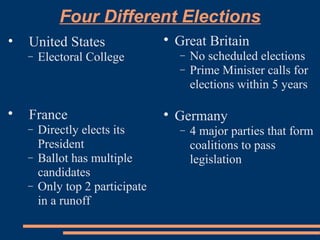
Four Different Elections
• United States
− Electoral College

France
− Directly elects its
President
− Ballot has multiple
candidates
− Only top 2 participate
in a runoff

Great Britain
− No scheduled elections
− Prime Minister calls for
elections within 5 years

Germany
− 4 major parties that form
coalitions to pass
legislation
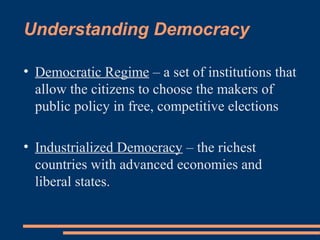
Understanding Democracy
• Democratic Regime – a set of institutions that
allow the citizens to choose the makers of
public policy in free, competitive elections
• Industrialized Democracy – the richest
countries with advanced economies and
liberal states.
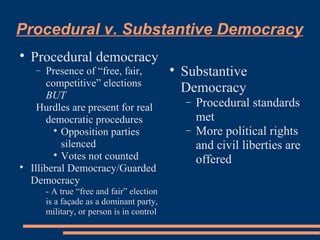
Procedural v. Substantive Democracy

Procedural democracy
− Presence of “free, fair,
competitive” elections
BUT
Hurdles are present for real
democratic procedures

Opposition parties
silenced

Votes not counted

Illiberal Democracy/Guarded
Democracy
- A true “free and fair” election
is a façade as a dominant party,
military, or person is in control

Substantive
Democracy
− Procedural standards
met
− More political rights
and civil liberties are
offered
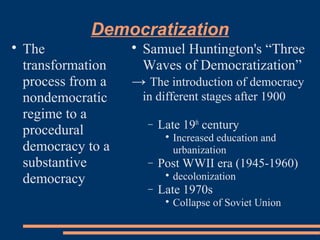
Democratization

The
transformation
process from a
nondemocratic
regime to a
procedural
democracy to a
substantive
democracy

Samuel Huntington's “Three
Waves of Democratization”
→ The introduction of democracy
in different stages after 1900
− Late 19th
century

Increased education and
urbanization
− Post WWII era (1945-1960)

decolonization
− Late 1970s

Collapse of Soviet Union
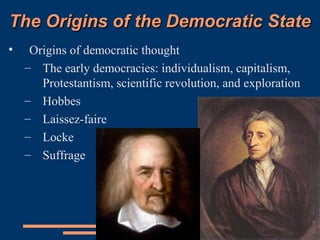
The Origins of the Democratic StateThe Origins of the Democratic State
• Origins of democratic thought
– The early democracies: individualism, capitalism,
Protestantism, scientific revolution, and exploration
– Hobbes
– Laissez-faire
– Locke
– Suffrage
The Origins of the Democratic StateThe Origins of the Democratic State
• Building Democracies
– In Europe and North America, the way democracy
developed was largely a result of the way countries
and their rulers handled four great transformations
over the last five hundred years:
• The creation of the nation and state itself
• The role of religion in society and government
• The development of pressures for democracy
• The Industrial Revolution
– Cleavages (social divisions)
– Authoritarian Leaders, Fascism, and WWII
– The Cold War
The Emergence of the Early
Modern State
http://www.democracyweb.org/young/young3.php
Read about the early modern state
Political Culture and Participation
• The Civic Culture
− Legitimacy: government v. regime
• Political Parties and Elections
− Catch-all Parties
• New Divisions
– Gender
– Post-materialist

3rd
generation affluence – reasonable
assumption of productive careers

Vote on “higher-order” values
• Interest Groups
• Political Protest
The Democratic StateThe Democratic State
• Presidential and parliamentary systems
– Presidential: three branches of power used to prevent abuse of
power (only in the U.S.) → lengthy legislative process
– Parliamentary: secure majority party or coalition, the prime
minister rarely has to compromise, which allows their
government to act more quickly and decisively

Fused, not separated
• Cabinet responsibility – principle that requires a prime
minister and government to retain the support of a
parliamentary majority
• Votes of confidence – a vote in which the members express
their support for (or opposition to) the government’s
policies. If it loses, the government must resign
Democracy and Public PolicyDemocracy and Public Policy
• The interventionist state – governments in
industrialized democracies that pursue an active
economic policy
– Basic health care
– Subsidized and/or free education
– Unemployment compensation
– Pensions and other programs
Alternatives to Democracy
• Authoritarianism - power depends on the
coercive force of the political authorities
• Oligarchies - power is held by only a few,
usually wealthy people
• Totalitarianism - a political system in which
the state controls all aspects of public and
private life

Gov unit2 ppt

  • 1.
  • 2.
    Democracy: • Basic Rights −Do these have to be protected in a written constitution? • Competitive Elections − Which is the better electoral system?  Way of counting the votes • Rule of Law • Capitalism and Affluence − Is this necessary?
  • 3.
    Common and NotSo Common Themes Elections determine who governs but Not ALL are ALIKE – Electoral systems:  Direct v. indirect − U.S. & France elect their chief executives − Great Britain and Germany do not  Proportional v. plurality (single member districts) − German Bundestag gives half its seats proportionally − U.S. & Great Britain use “first past the post” − Separation of powers (U.S.) v. fusion of powers
  • 4.
    Four Different Elections •United States − Electoral College  France − Directly elects its President − Ballot has multiple candidates − Only top 2 participate in a runoff  Great Britain − No scheduled elections − Prime Minister calls for elections within 5 years  Germany − 4 major parties that form coalitions to pass legislation
  • 5.
    Understanding Democracy • DemocraticRegime – a set of institutions that allow the citizens to choose the makers of public policy in free, competitive elections • Industrialized Democracy – the richest countries with advanced economies and liberal states.
  • 6.
    Procedural v. SubstantiveDemocracy  Procedural democracy − Presence of “free, fair, competitive” elections BUT Hurdles are present for real democratic procedures  Opposition parties silenced  Votes not counted  Illiberal Democracy/Guarded Democracy - A true “free and fair” election is a façade as a dominant party, military, or person is in control  Substantive Democracy − Procedural standards met − More political rights and civil liberties are offered
  • 7.
    Democratization  The transformation process from a nondemocratic regimeto a procedural democracy to a substantive democracy  Samuel Huntington's “Three Waves of Democratization” → The introduction of democracy in different stages after 1900 − Late 19th century  Increased education and urbanization − Post WWII era (1945-1960)  decolonization − Late 1970s  Collapse of Soviet Union
  • 8.
    The Origins ofthe Democratic StateThe Origins of the Democratic State • Origins of democratic thought – The early democracies: individualism, capitalism, Protestantism, scientific revolution, and exploration – Hobbes – Laissez-faire – Locke – Suffrage
  • 9.
    The Origins ofthe Democratic StateThe Origins of the Democratic State • Building Democracies – In Europe and North America, the way democracy developed was largely a result of the way countries and their rulers handled four great transformations over the last five hundred years: • The creation of the nation and state itself • The role of religion in society and government • The development of pressures for democracy • The Industrial Revolution – Cleavages (social divisions) – Authoritarian Leaders, Fascism, and WWII – The Cold War
  • 10.
    The Emergence ofthe Early Modern State http://www.democracyweb.org/young/young3.php Read about the early modern state
  • 11.
    Political Culture andParticipation • The Civic Culture − Legitimacy: government v. regime • Political Parties and Elections − Catch-all Parties • New Divisions – Gender – Post-materialist  3rd generation affluence – reasonable assumption of productive careers  Vote on “higher-order” values • Interest Groups • Political Protest
  • 12.
    The Democratic StateTheDemocratic State • Presidential and parliamentary systems – Presidential: three branches of power used to prevent abuse of power (only in the U.S.) → lengthy legislative process – Parliamentary: secure majority party or coalition, the prime minister rarely has to compromise, which allows their government to act more quickly and decisively  Fused, not separated • Cabinet responsibility – principle that requires a prime minister and government to retain the support of a parliamentary majority • Votes of confidence – a vote in which the members express their support for (or opposition to) the government’s policies. If it loses, the government must resign
  • 13.
    Democracy and PublicPolicyDemocracy and Public Policy • The interventionist state – governments in industrialized democracies that pursue an active economic policy – Basic health care – Subsidized and/or free education – Unemployment compensation – Pensions and other programs
  • 14.
    Alternatives to Democracy •Authoritarianism - power depends on the coercive force of the political authorities • Oligarchies - power is held by only a few, usually wealthy people • Totalitarianism - a political system in which the state controls all aspects of public and private life