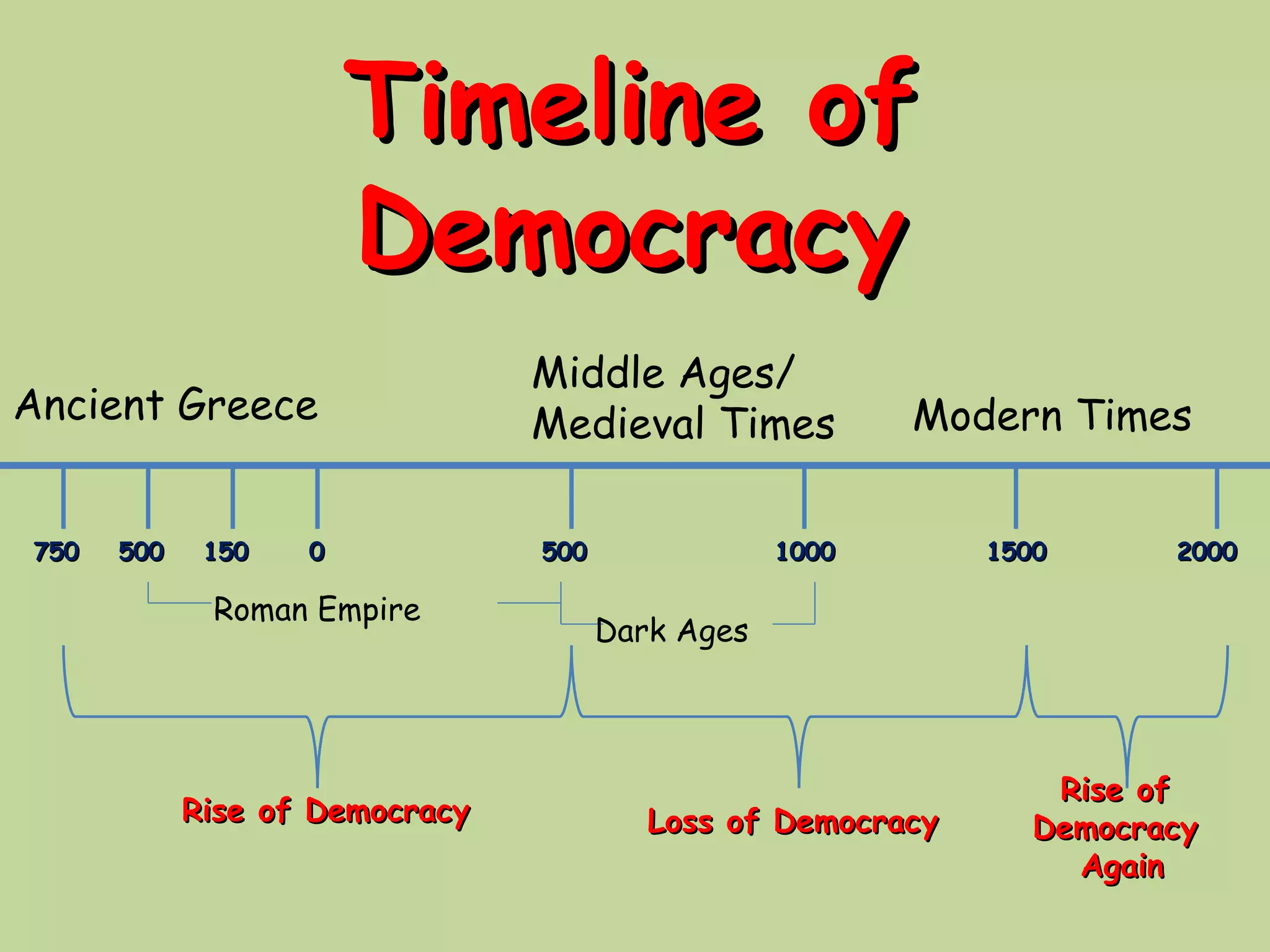
Ancient Greece Middle Ages/ Medieval Times Modern Times 750 500 150 0 500 1000 1500 2000 Roman Empire Dark Ages Rise of Democracy Loss of Democracy Rise of  Democracy  Again Timeline of Democracy
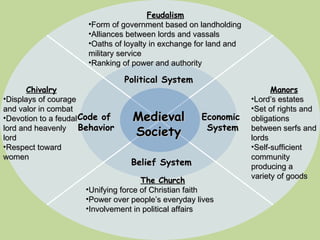
Medieval Society Political System Belief System Economic  System Code of  Behavior Feudalism Form of government based on landholding Alliances between lords and vassals Oaths of loyalty in exchange for land and military service Ranking of power and authority The Church Unifying force of Christian faith Power over people’s everyday lives Involvement in political affairs Chivalry Displays of courage and valor in combat Devotion to a feudal lord and heavenly lord Respect toward women Manors Lord’s estates Set of rights and obligations between serfs and lords Self-sufficient community producing a variety of goods
Europe in the Middle Ages The Church The great Gothic cathedrals that soared heavenward were symbols of the Church’s power.  Yet this power did not go unchallenged.  For decades, kings and popes engaged in power struggles. Crusades Although the First Crusade captured Jerusalem, later Crusades accomplished little.
Farming Better farming methods, such as the three field system and the use of horses, made it possible for farmers to grow more food.  This brought a population increase in the Middle Ages. Trade & Towns As people moved from farms into towns, trade expanded and guilds formed for both merchants and artisans. Hundred Years’ War The Hundreds Years’ War further weakened feudal power.  The longbow doomed armored knights.
Government England and France developed strong central governments in which arose the first stirrings of democracy in medieval Europe.  This can be seen in Parliament and the Estates General. Learning Europe’s first universities developed in the Middle Ages.  Interest in learning grew in part as a result of the rediscovery of Greek writings. The Bubonic Plague The bubonic plague killed millions and weakened the manorial economy.

Timeline of Democracy

  • 1.
    Ancient Greece MiddleAges/ Medieval Times Modern Times 750 500 150 0 500 1000 1500 2000 Roman Empire Dark Ages Rise of Democracy Loss of Democracy Rise of Democracy Again Timeline of Democracy
  • 2.
    Medieval Society PoliticalSystem Belief System Economic System Code of Behavior Feudalism Form of government based on landholding Alliances between lords and vassals Oaths of loyalty in exchange for land and military service Ranking of power and authority The Church Unifying force of Christian faith Power over people’s everyday lives Involvement in political affairs Chivalry Displays of courage and valor in combat Devotion to a feudal lord and heavenly lord Respect toward women Manors Lord’s estates Set of rights and obligations between serfs and lords Self-sufficient community producing a variety of goods
  • 3.
    Europe in theMiddle Ages The Church The great Gothic cathedrals that soared heavenward were symbols of the Church’s power. Yet this power did not go unchallenged. For decades, kings and popes engaged in power struggles. Crusades Although the First Crusade captured Jerusalem, later Crusades accomplished little.
  • 4.
    Farming Better farmingmethods, such as the three field system and the use of horses, made it possible for farmers to grow more food. This brought a population increase in the Middle Ages. Trade & Towns As people moved from farms into towns, trade expanded and guilds formed for both merchants and artisans. Hundred Years’ War The Hundreds Years’ War further weakened feudal power. The longbow doomed armored knights.
  • 5.
    Government England andFrance developed strong central governments in which arose the first stirrings of democracy in medieval Europe. This can be seen in Parliament and the Estates General. Learning Europe’s first universities developed in the Middle Ages. Interest in learning grew in part as a result of the rediscovery of Greek writings. The Bubonic Plague The bubonic plague killed millions and weakened the manorial economy.