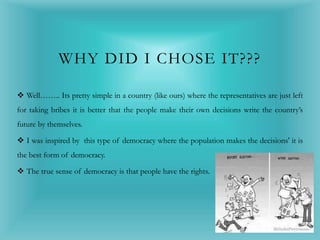
Direct democracy allows individuals to directly decide on policy initiatives, differing from representative democracies where elected representatives make those decisions. Key components include initiatives and referendums, enabling public proposals and binding votes. Historically, it was practiced in ancient Athens and Rome, and modern examples include Switzerland's system that combines direct and representative elements.
![WHAT IS IT????
Direct democracy (also known as pure democracy) is a form of
democracy in which people decide policy initiatives directly. This differs
from the majority of modern Western-style democracies, which are
representative democracies.
Direct democracy is similar to, but distinct from, representative
democracy, in which people vote for representatives who then enact policy
initiatives.[2]](https://image.slidesharecdn.com/directdemocracy-180124120342/85/Direct-Democracy-in-The-world-2-320.jpg)
![HOW IS IT DIFFERENT???
Direct democracy is similar to, but distinct from, representative democracy, in
which people vote for representatives who then enact policy initiatives.[2]
Most countries that are representative democracies allow for only three forms
of political action that provide limited direct democracy: referendum (plebiscite),
initiative, and recall. The first two forms—referendums and initiatives—are
examples of direct legislation.[3]](https://image.slidesharecdn.com/directdemocracy-180124120342/85/Direct-Democracy-in-The-world-3-320.jpg)
![WHAT ARE THE MAIN
FEATURES???
Power of Initiative allows members of the general public to propose specific statutory
measures or constitutional reforms to the government and, as with referendums, the vote may
be binding or simply advisory. Initiatives may be direct or indirect: With the direct initiative, a
successful proposition is placed directly on the ballot to be subject to vote (as exemplified by
California's system).[3] With an indirect initiative, a successful proposition is first presented to
the legislature for their consideration; however, if no acceptable action is taken after a
designated period of time, the proposition moves to direct popular vote. Such a form of
indirect initiative is utilized by Switzerland for constitutional amendments.[3]
Power of Recall gives the public the power to remove elected officials from office before
the end of their term, although this is very rare in modern democracies.[8]](https://image.slidesharecdn.com/directdemocracy-180124120342/85/Direct-Democracy-in-The-world-4-320.jpg)
![WHERE WAS IT
PRACTISED???
The earliest known direct democracy is said to be the Athenian democracy in the 5th century BC, although it was not
an inclusive democracy: women, foreigners, and slaves were excluded from it. The main bodies in the Athenian
democracy were the assembly, composed of male citizens; the boulê, composed of 500 citizens; and the law courts,
composed of a massive number of jurors chosen by lot, with no judges. There were only about 30,000 male citizens, but
several thousand of them were politically active in each year, and many of them quite regularly for years on end. The
Athenian democracy was direct not only in the sense that decisions were made by the assembled people, but also in the
sense that the people through the assembly, boulê, and law courts controlled the entire political process and a large
proportion of citizens were involved constantly in the public business.[10] Modern democracies, being representative, not
direct, do not resemble the Athenian system.
Also relevant to the history of direct democracy is the history of Ancient Rome, specifically the Roman Republic,
beginning around 509 BC.[11] Rome displayed many aspects of democracy, both direct and indirect, from the era of
Roman monarchy all the way to the collapse of the Roman Empire.](https://image.slidesharecdn.com/directdemocracy-180124120342/85/Direct-Democracy-in-The-world-5-320.jpg)
![SOME EXAMPLE IN
MODERN WORLD
One nation to use this system is Switzerland it uses this along with representative
democracy. In the below way
Compulsory referendum subjects the legislation drafted by political elites to a binding
popular vote. This is the most common form of direct legislation. Popular referendum
(also known as abrogative or facultative) empowers citizens to make a petition that calls
existing legislation to a citizens' vote. Institutions specify the time frame for a valid petition
and the number of signatures required, and may require signatures from diverse
communities to protect minority interests.[3] This form of direct democracy effectively
grants the voting public a veto on laws adopted by the elected legislature](https://image.slidesharecdn.com/directdemocracy-180124120342/85/Direct-Democracy-in-The-world-8-320.jpg)