The Task of the Translator
Walter Benjamin
Presented by Parisa Mehran
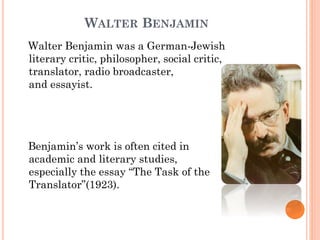
WALTER BENJAMIN
Walter Benjamin was a German-Jewish
literary critic, philosopher, social critic,
translator, radio broadcaster,
and essayist.
Benjamin’s work is often cited in
academic and literary studies,
especially the essay “The Task of the
Translator”(1923).
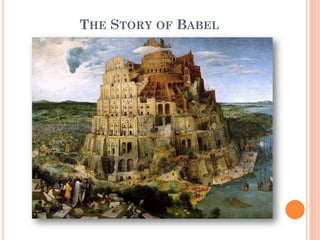
THE STORY OF BABEL
THE TASK OF THE TRANSLATOR
Benjamin starts his essay by: “In the appreciation of
a work of art or an art form, consideration of the
receiver never proves fruitful….No poem is intended
for the reader, no picture for the beholder, no
symphony for the listener.”
ACCORDING TO BENJAMIN:
 A translation does not exist to give readers an
understanding of the meaning or information of the
original.
 It is not the highest praise of a translation to say that
it reads as if it had originally been written in the
target language.
 The true translator does not bring the text to the
reader, making it as palatable and digestible as
possible. Instead, the new role of the translator is to
keep all the foreignness of the original text.
 The literary translator is not a mere messenger
or cipher of codes; he or she is a co-creator with
the author.
 True translation is closer to the act of creation
than to any passive attempt at transmission.
 A literary work has a “pure language” and the
task of the translator is to release this pure
language which is under the spell of another, to
liberate the language imprisoned in a work in his
re-creation of that work.
 Translation exists separately but in conjunction
with the original, coming after it, emerging from
its “afterlife” but also giving the original
“continued life.” This recreation assures survival
of the original work.
“A real translation is transparent; it does not
cover the original, does not black its light, but
allows the pure language, as though reinforced
by its own medium to shine upon the original all
the more fully.”
Thank you for your
attention!

The Task of the Translator

  • 1.
    The Task ofthe Translator Walter Benjamin Presented by Parisa Mehran
  • 2.
    WALTER BENJAMIN Walter Benjaminwas a German-Jewish literary critic, philosopher, social critic, translator, radio broadcaster, and essayist. Benjamin’s work is often cited in academic and literary studies, especially the essay “The Task of the Translator”(1923).
  • 3.
  • 4.
    THE TASK OFTHE TRANSLATOR Benjamin starts his essay by: “In the appreciation of a work of art or an art form, consideration of the receiver never proves fruitful….No poem is intended for the reader, no picture for the beholder, no symphony for the listener.”
  • 5.
    ACCORDING TO BENJAMIN: A translation does not exist to give readers an understanding of the meaning or information of the original.  It is not the highest praise of a translation to say that it reads as if it had originally been written in the target language.  The true translator does not bring the text to the reader, making it as palatable and digestible as possible. Instead, the new role of the translator is to keep all the foreignness of the original text.
  • 6.
     The literarytranslator is not a mere messenger or cipher of codes; he or she is a co-creator with the author.  True translation is closer to the act of creation than to any passive attempt at transmission.  A literary work has a “pure language” and the task of the translator is to release this pure language which is under the spell of another, to liberate the language imprisoned in a work in his re-creation of that work.
  • 7.
     Translation existsseparately but in conjunction with the original, coming after it, emerging from its “afterlife” but also giving the original “continued life.” This recreation assures survival of the original work.
  • 8.
    “A real translationis transparent; it does not cover the original, does not black its light, but allows the pure language, as though reinforced by its own medium to shine upon the original all the more fully.”
  • 9.
    Thank you foryour attention!