BIOGRAPHY Pound was born in Hailey, Idaho, but grew up and was educated mainly in Pennsylvania American poet and writer Ezra Pound had a great influence on the development of poetry in the 20th century. One of the driving forces of the Modernism movement, in particular, Imagism and Vorticism. He did not only write poems to be admired for their originality, but he also encouraged the careers of other authors, including literary greats T.S. Eliot, James Joyce and Ernest Hemingway.
Early Life  Ezra Loomis Pound  grew  up in Wyncote, near Philadelphia. He went to the University of Pennsylvania at the age of 16 before pursuing studies at Hamilton College, Indiana.
Early Life  He left for Europe and briefly stayed in Venice, Italy, where he wrote his first collection of poems,  A Lume Spento , and had it published. He moved to London, met Ford Madox Ford,  James Joyce  and Wyndham Lewis, and published  Exultations  in 1909. He also quickly established himself as a strong advocate of experimental literature. He used his contacts to support and get the work of T.S. Eliot and James Joyce published for the first time.
Stay in Paris  In 1920, at 35 years old, Pound moved to Paris. He had already begun his masterpiece, the sequence of 30 poems known as  The Cantos.  This work was long and complex, more so difficult to understand. It occupied Ezra Pound for most of his life. In it, he makes references to a wide range of characters, events and books from the past. Notably, Pound wanted  The Cantos  to be an epic for his time, a similar fashion to the works of the great writers Homer and Dante.
Stay in Italy  By 1925, in his 40s, Pound settled in Italy, a country whose history and literature he had always loved. He stayed in Italy when World War II began and made a series of radio broadcasts that blamed the Jewish people for causing the war. After the war ended, Pound was arrested by the US Army because of his involvement with the fascist Italian government.
After being released, he spent 12 years in an American mental hospital, where he continued to write great poetry before returning to live in Italy.
Despite moments of defiance, his last years were overshadowed by self-doubt and consciousness of his 'errors and wrecks'. In rare public utterances he condemned The Cantos as a failure, a view he seems not consistently to have held; but the poem was never completed. In 1969 he concluded its publication with Drafts and Fragments of Cantos CX-CXVII: thirty-two pages of verse, mostly serene but poignant in its fragmentation.
Death Pound died on November 1, 1972, in Venice. According to Katherine Anne Porter, "Pound was one of the most opinionated and unselfish men who ever lived, and he made friends and enemies everywhere by the simple exercise of the classic American constitutional right of free speech." ( The Letters of E.P., 1907-1941 , review in  New York Times Book Review , 29 Oct. 1950)
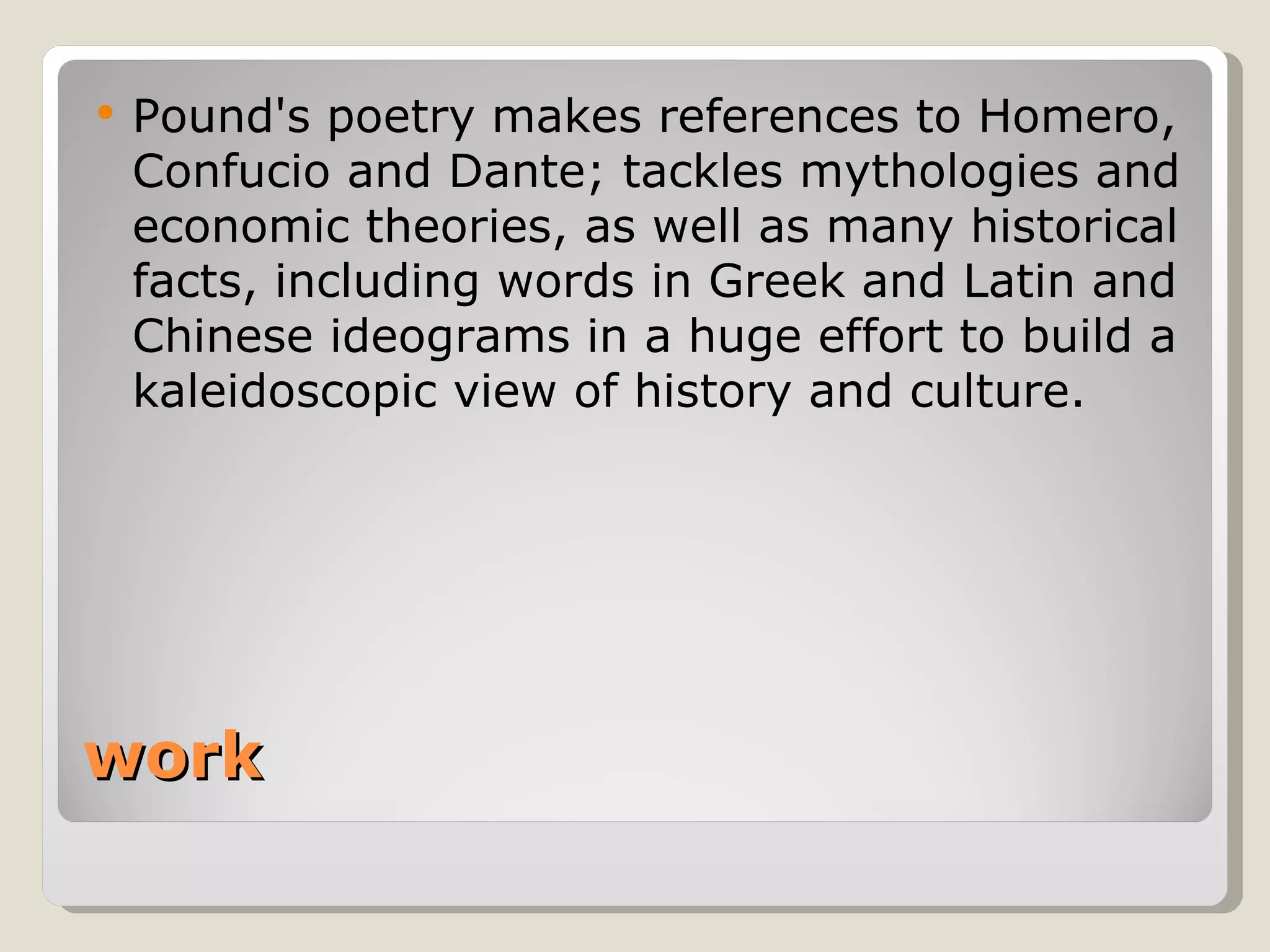
work Pound's poetry makes references to Homero, Confucio and Dante; tackles mythologies and economic theories, as well as many historical facts, including words in Greek and Latin and Chinese ideograms in a huge effort to build a kaleidoscopic view of history and culture.
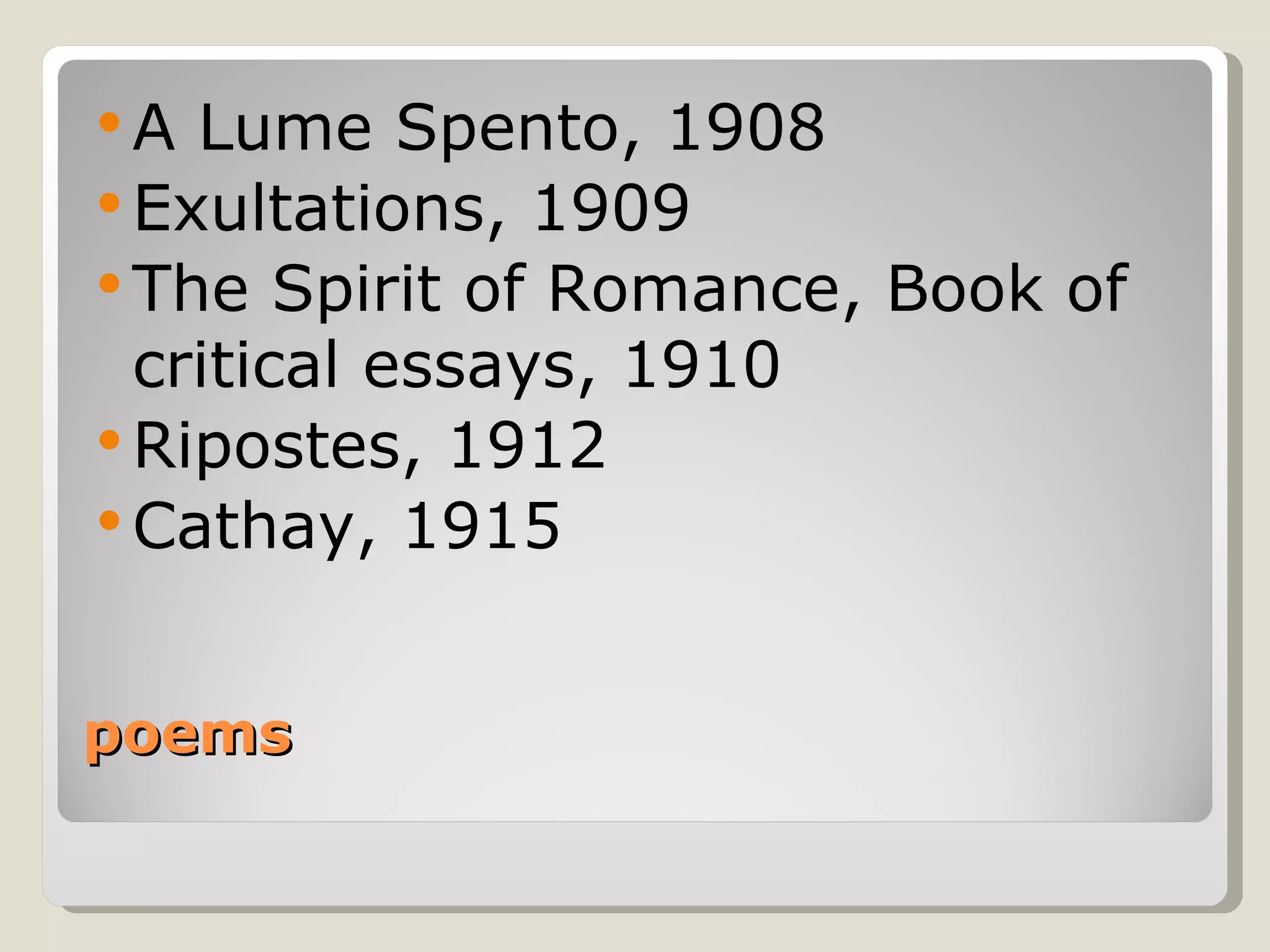
poems A Lume Spento, 1908  Exultations, 1909  The Spirit of Romance, Book of critical essays, 1910  Ripostes, 1912  Cathay, 1915
poems Homage to Sextus Propertius, 1917  The Cantos, 19917-1968 (unfinished)  Hugh Selwyn Mauberley, 1920  Personae, 1926, shorter poems of Ezra Pound  'If This be Treason…", 1948  The Pisan Cantos, 1948
 

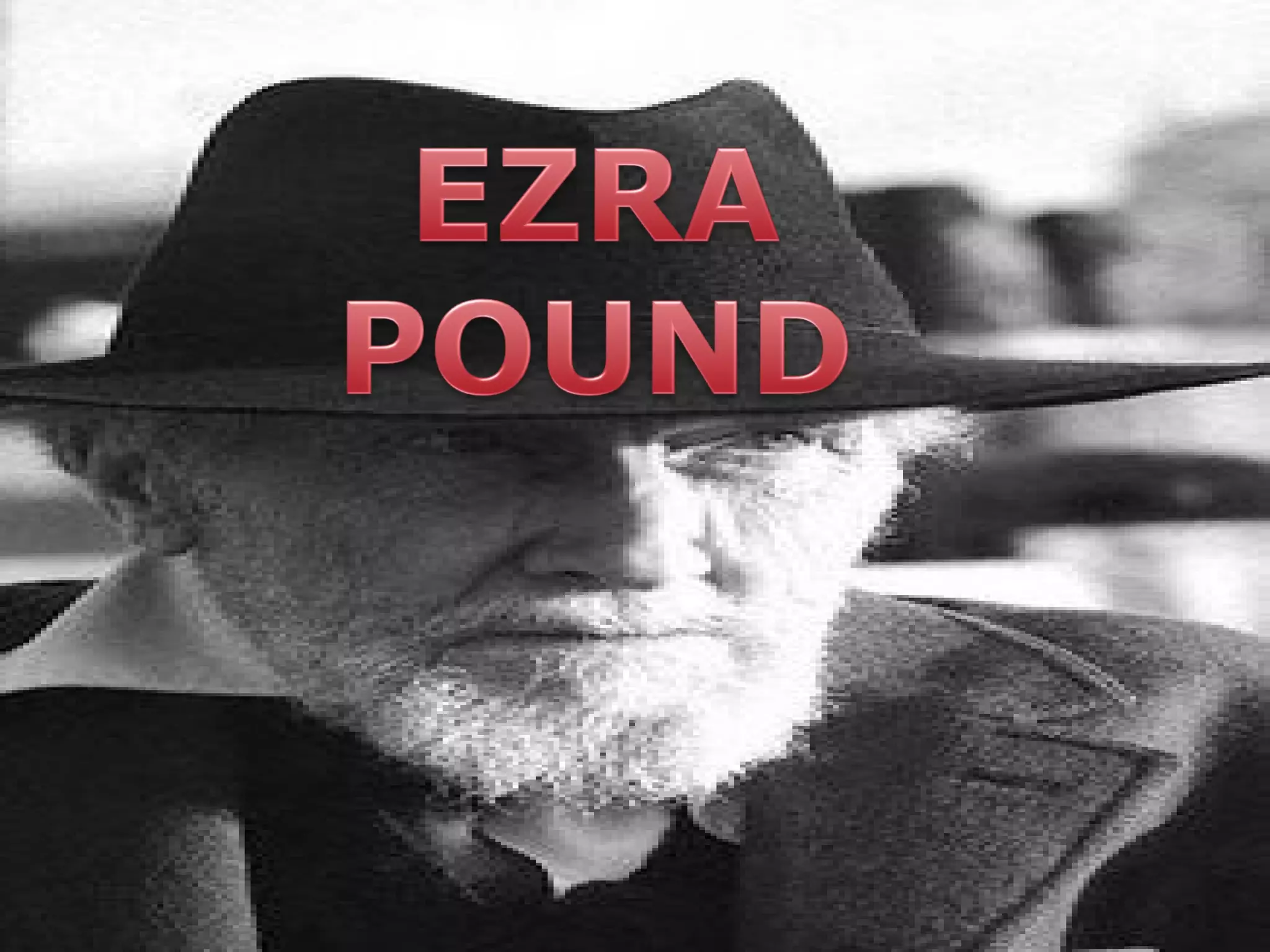
Ezra Pound

  • 1.
  • 2.
    BIOGRAPHY Pound wasborn in Hailey, Idaho, but grew up and was educated mainly in Pennsylvania American poet and writer Ezra Pound had a great influence on the development of poetry in the 20th century. One of the driving forces of the Modernism movement, in particular, Imagism and Vorticism. He did not only write poems to be admired for their originality, but he also encouraged the careers of other authors, including literary greats T.S. Eliot, James Joyce and Ernest Hemingway.
  • 3.
    Early Life Ezra Loomis Pound grew up in Wyncote, near Philadelphia. He went to the University of Pennsylvania at the age of 16 before pursuing studies at Hamilton College, Indiana.
  • 4.
    Early Life He left for Europe and briefly stayed in Venice, Italy, where he wrote his first collection of poems, A Lume Spento , and had it published. He moved to London, met Ford Madox Ford, James Joyce and Wyndham Lewis, and published Exultations in 1909. He also quickly established himself as a strong advocate of experimental literature. He used his contacts to support and get the work of T.S. Eliot and James Joyce published for the first time.
  • 5.
    Stay in Paris In 1920, at 35 years old, Pound moved to Paris. He had already begun his masterpiece, the sequence of 30 poems known as The Cantos. This work was long and complex, more so difficult to understand. It occupied Ezra Pound for most of his life. In it, he makes references to a wide range of characters, events and books from the past. Notably, Pound wanted The Cantos to be an epic for his time, a similar fashion to the works of the great writers Homer and Dante.
  • 6.
    Stay in Italy By 1925, in his 40s, Pound settled in Italy, a country whose history and literature he had always loved. He stayed in Italy when World War II began and made a series of radio broadcasts that blamed the Jewish people for causing the war. After the war ended, Pound was arrested by the US Army because of his involvement with the fascist Italian government.
  • 7.
    After being released,he spent 12 years in an American mental hospital, where he continued to write great poetry before returning to live in Italy.
  • 8.
    Despite moments ofdefiance, his last years were overshadowed by self-doubt and consciousness of his 'errors and wrecks'. In rare public utterances he condemned The Cantos as a failure, a view he seems not consistently to have held; but the poem was never completed. In 1969 he concluded its publication with Drafts and Fragments of Cantos CX-CXVII: thirty-two pages of verse, mostly serene but poignant in its fragmentation.
  • 9.
    Death Pound diedon November 1, 1972, in Venice. According to Katherine Anne Porter, "Pound was one of the most opinionated and unselfish men who ever lived, and he made friends and enemies everywhere by the simple exercise of the classic American constitutional right of free speech." ( The Letters of E.P., 1907-1941 , review in New York Times Book Review , 29 Oct. 1950)
  • 10.
    work Pound's poetrymakes references to Homero, Confucio and Dante; tackles mythologies and economic theories, as well as many historical facts, including words in Greek and Latin and Chinese ideograms in a huge effort to build a kaleidoscopic view of history and culture.
  • 11.
    poems A LumeSpento, 1908 Exultations, 1909 The Spirit of Romance, Book of critical essays, 1910 Ripostes, 1912 Cathay, 1915
  • 12.
    poems Homage toSextus Propertius, 1917 The Cantos, 19917-1968 (unfinished) Hugh Selwyn Mauberley, 1920 Personae, 1926, shorter poems of Ezra Pound 'If This be Treason…", 1948 The Pisan Cantos, 1948
  • 13.