DP Environmental systems
     and societies
                Topic 2
             The ecosystem
2.4 BIOMES
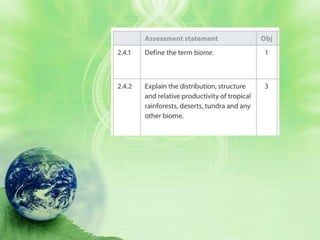
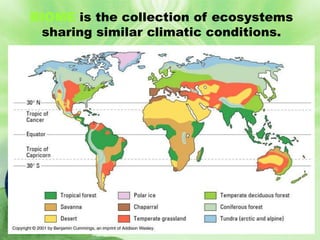
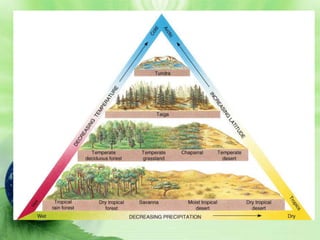
BIOME is the collection of ecosystems
 sharing similar climatic conditions.
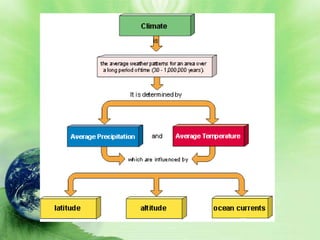
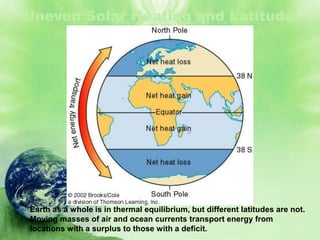
Uneven Solar Heating and Latitude


Earth as a whole is in thermal equilibrium, but different latitudes are not.
Moving masses of air and ocean currents transport energy from
locations with a surplus to those with a deficit.
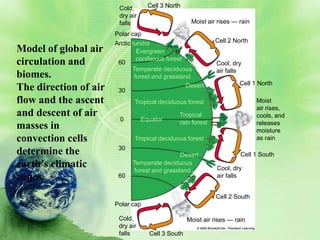
Cold,       Cell 3 North
                        dry air
                        falls                       Moist air rises — rain
                       Polar cap
                       Arctic tundra                         Cell 2 North
Model of global air             Evergreen
                                coniferous forest
circulation and         60                                    Cool, dry
                              Temperate deciduous             air falls
biomes.                        forest and grassland
                                                                      Cell 1 North
The direction of air    30
                                                  Desert

flow and the ascent           Tropical deciduous forest                      Moist
                                                                             air rises,
and descent of air                             Tropical                      cools, and
                        0         Equator      rain forest                   releases
masses in                                                                    moisture
convection cells              Tropical deciduous forest                      as rain
                        30
determine the                                 Desert                   Cell 1 South
earth’s climatic             Temperate deciduous
                             forest and grassland             Cool, dry
zones.                  60                                    air falls


                                                             Cell 2 South
                       Polar cap

                        Cold,                      Moist air rises — rain
                        dry air
                        falls       Cell 3 South
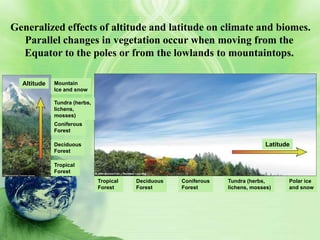
Generalized effects of altitude and latitude on climate and biomes.
  Parallel changes in vegetation occur when moving from the
  Equator to the poles or from the lowlands to mountaintops.

  Altitude   Mountain
             Ice and snow

             Tundra (herbs,
             lichens,
             mosses)
             Coniferous
             Forest

             Deciduous                                                         Latitude
             Forest

             Tropical
             Forest
                              Tropical   Deciduous   Coniferous   Tundra (herbs,      Polar ice
                              Forest     Forest      Forest       lichens, mosses)    and snow
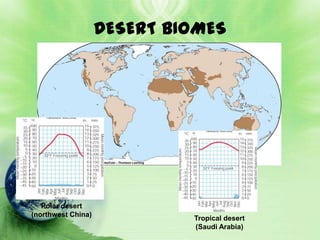
DESERT BIOMES


   Polar desert
(northwest China)
                             Tropical desert
                             (Saudi Arabia)
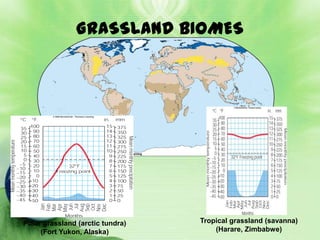
GRASSLAND BIOMES


Polar grassland (arctic tundra)   Tropical grassland (savanna)
     (Fort Yukon, Alaska)             (Harare, Zimbabwe)
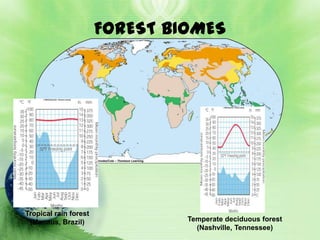
FOREST BIOMES


Tropical rain forest
 (Manaus, Brazil)               Temperate deciduous forest
                                  (Nashville, Tennessee)
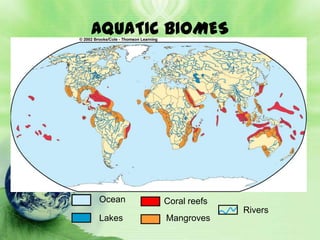
AQUATIC BIOMES


Ocean   Coral reefs
                      Rivers
Lakes   Mangroves
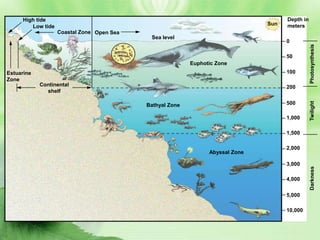
High tide                                                                       Depth in
                                                                               Sun   meters
        Low tide
                   Coastal Zone Open Sea
                                            Sea level
                                                                                     0


                                                                                                Photosynthesis
                                                                                     50
                                                          Euphotic Zone
Estuarine                                                                            100
Zone
            Continental                                                              200
              shelf


                                                                                                Twilight
                                           Bathyal Zone                              500

                                                                                     1,000

                                                                                     1,500

                                                                                     2,000
                                                                Abyssal Zone

                                                                                     3,000


                                                                                                Darkness
                                                                                     4,000


                                                                                     5,000

                                                                                     10,000
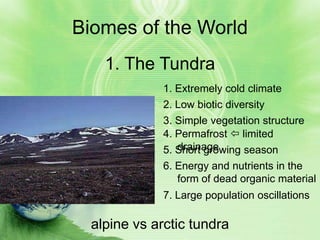
Biomes of the World
    1. The Tundra
              1. Extremely cold climate
              2. Low biotic diversity
              3. Simple vegetation structure
              4. Permafrost  limited
                 drainage
              5. Short growing season
              6. Energy and nutrients in the
                 form of dead organic material
              7. Large population oscillations

  alpine vs arctic tundra
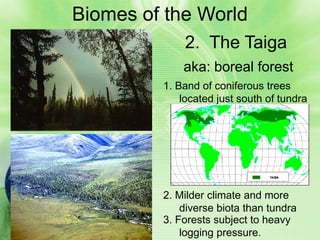
Biomes of the World
             2. The Taiga
             aka: boreal forest
         1. Band of coniferous trees
             located just south of tundra


         2. Milder climate and more
             diverse biota than tundra
         3. Forests subject to heavy
             logging pressure.
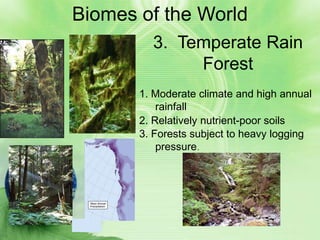
Biomes of the World
         3. Temperate Rain
              Forest
       1. Moderate climate and high annual
           rainfall
       2. Relatively nutrient-poor soils
       3. Forests subject to heavy logging
           pressure.
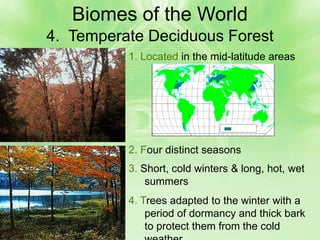
Biomes of the World
4. Temperate Deciduous Forest
          1. Located in the mid-latitude areas


          2. Four distinct seasons
          3. Short, cold winters & long, hot, wet
              summers
          4. Trees adapted to the winter with a
              period of dormancy and thick bark
              to protect them from the cold
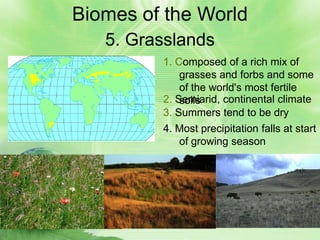
Biomes of the World
   5. Grasslands
         1. Composed of a rich mix of
             grasses and forbs and some
             of the world's most fertile
         2. Semiarid, continental climate
             soils
         3. Summers tend to be dry
         4. Most precipitation falls at start
             of growing season
Biomes of the World
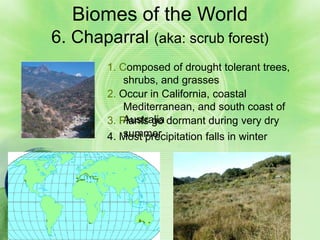
6. Chaparral (aka: scrub forest)
        1. Composed of drought tolerant trees,
            shrubs, and grasses
        2. Occur in California, coastal
            Mediterranean, and south coast of
            Australia
        3. Plants go dormant during very dry
            summer
        4. Most precipitation falls in winter
Biomes of the World
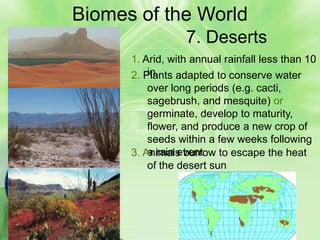
                  7. Deserts
      1. Arid, with annual rainfall less than 10
          in.
      2. Plants adapted to conserve water
          over long periods (e.g. cacti,
          sagebrush, and mesquite) or
          germinate, develop to maturity,
          flower, and produce a new crop of
          seeds within a few weeks following
          a rain event
      3. Animals burrow to escape the heat
          of the desert sun
Biomes of the World
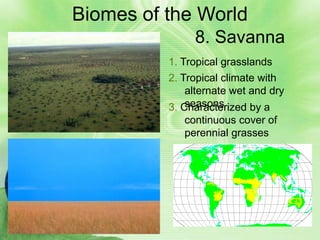
               8. Savanna
          1. Tropical grasslands
          2. Tropical climate with
              alternate wet and dry
              seasons
          3. Characterized by a
             continuous cover of
             perennial grasses
Biomes of the World
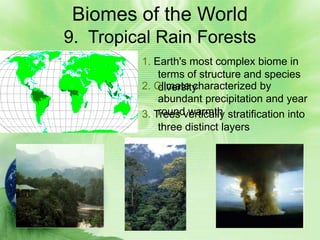
9. Tropical Rain Forests
         1. Earth's most complex biome in
             terms of structure and species
         2. Climate characterized by
             diversity
             abundant precipitation and year
             round warmth
         3. Trees vertically stratification into
             three distinct layers
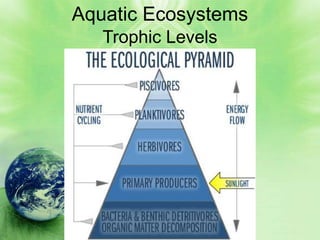
Aquatic Ecosystems
   Trophic Levels
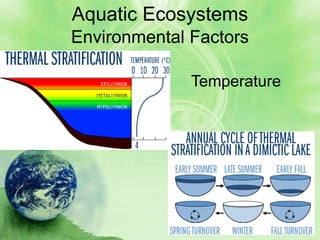
Aquatic Ecosystems
Environmental Factors

              Temperature
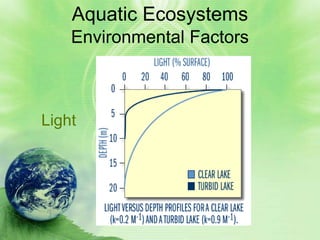
Aquatic Ecosystems
    Environmental Factors


Light
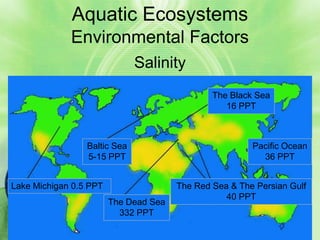
Aquatic Ecosystems
             Environmental Factors
                              Salinity
                                               The Black Sea
                                                  16 PPT


                 Baltic Sea                             Pacific Ocean
                 5-15 PPT                                 36 PPT


Lake Michigan 0.5 PPT                  The Red Sea & The Persian Gulf
                                                  40 PPT
                        The Dead Sea
                          332 PPT
Aquatic Ecosystems
  Environmental Factors

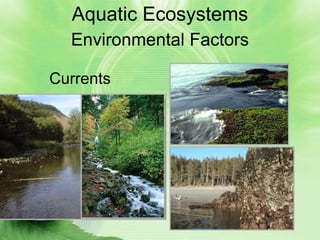
Currents
Aquatic Ecosystems
Environmental Factors
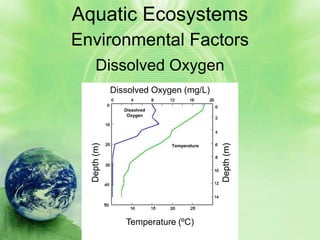
      Dissolved Oxygen
              Dissolved Oxygen (mg/L)

                 Dissolved
                  Oxygen
  Depth (m)


                                           Depth (m)
                             Temperature


                 Temperature (ºC)
Aquatic Ecosystems
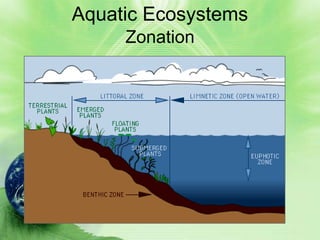
     Zonation
Aquatic Ecosystems
  Human Impacts

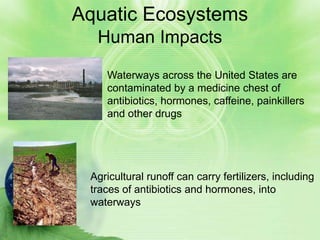
    Waterways across the United States are
    contaminated by a medicine chest of
    antibiotics, hormones, caffeine, painkillers
    and other drugs


 Agricultural runoff can carry fertilizers, including
 traces of antibiotics and hormones, into
 waterways

The ecosystem 2.4

  • 1.
    DP Environmental systems and societies Topic 2 The ecosystem
  • 2.
  • 4.
    BIOME is thecollection of ecosystems sharing similar climatic conditions.
  • 6.
    Uneven Solar Heatingand Latitude Earth as a whole is in thermal equilibrium, but different latitudes are not. Moving masses of air and ocean currents transport energy from locations with a surplus to those with a deficit.
  • 7.
    Cold, Cell 3 North dry air falls Moist air rises — rain Polar cap Arctic tundra Cell 2 North Model of global air Evergreen coniferous forest circulation and 60 Cool, dry Temperate deciduous air falls biomes. forest and grassland Cell 1 North The direction of air 30 Desert flow and the ascent Tropical deciduous forest Moist air rises, and descent of air Tropical cools, and 0 Equator rain forest releases masses in moisture convection cells Tropical deciduous forest as rain 30 determine the Desert Cell 1 South earth’s climatic Temperate deciduous forest and grassland Cool, dry zones. 60 air falls Cell 2 South Polar cap Cold, Moist air rises — rain dry air falls Cell 3 South
  • 8.
    Generalized effects ofaltitude and latitude on climate and biomes. Parallel changes in vegetation occur when moving from the Equator to the poles or from the lowlands to mountaintops. Altitude Mountain Ice and snow Tundra (herbs, lichens, mosses) Coniferous Forest Deciduous Latitude Forest Tropical Forest Tropical Deciduous Coniferous Tundra (herbs, Polar ice Forest Forest Forest lichens, mosses) and snow
  • 10.
    DESERT BIOMES Polar desert (northwest China) Tropical desert (Saudi Arabia)
  • 11.
    GRASSLAND BIOMES Polar grassland(arctic tundra) Tropical grassland (savanna) (Fort Yukon, Alaska) (Harare, Zimbabwe)
  • 12.
    FOREST BIOMES Tropical rainforest (Manaus, Brazil) Temperate deciduous forest (Nashville, Tennessee)
  • 13.
    AQUATIC BIOMES Ocean Coral reefs Rivers Lakes Mangroves
  • 14.
    High tide Depth in Sun meters Low tide Coastal Zone Open Sea Sea level 0 Photosynthesis 50 Euphotic Zone Estuarine 100 Zone Continental 200 shelf Twilight Bathyal Zone 500 1,000 1,500 2,000 Abyssal Zone 3,000 Darkness 4,000 5,000 10,000
  • 15.
    Biomes of theWorld 1. The Tundra 1. Extremely cold climate 2. Low biotic diversity 3. Simple vegetation structure 4. Permafrost  limited drainage 5. Short growing season 6. Energy and nutrients in the form of dead organic material 7. Large population oscillations alpine vs arctic tundra
  • 16.
    Biomes of theWorld 2. The Taiga aka: boreal forest 1. Band of coniferous trees located just south of tundra 2. Milder climate and more diverse biota than tundra 3. Forests subject to heavy logging pressure.
  • 17.
    Biomes of theWorld 3. Temperate Rain Forest 1. Moderate climate and high annual rainfall 2. Relatively nutrient-poor soils 3. Forests subject to heavy logging pressure.
  • 18.
    Biomes of theWorld 4. Temperate Deciduous Forest 1. Located in the mid-latitude areas 2. Four distinct seasons 3. Short, cold winters & long, hot, wet summers 4. Trees adapted to the winter with a period of dormancy and thick bark to protect them from the cold
  • 19.
    Biomes of theWorld 5. Grasslands 1. Composed of a rich mix of grasses and forbs and some of the world's most fertile 2. Semiarid, continental climate soils 3. Summers tend to be dry 4. Most precipitation falls at start of growing season
  • 20.
    Biomes of theWorld 6. Chaparral (aka: scrub forest) 1. Composed of drought tolerant trees, shrubs, and grasses 2. Occur in California, coastal Mediterranean, and south coast of Australia 3. Plants go dormant during very dry summer 4. Most precipitation falls in winter
  • 21.
    Biomes of theWorld 7. Deserts 1. Arid, with annual rainfall less than 10 in. 2. Plants adapted to conserve water over long periods (e.g. cacti, sagebrush, and mesquite) or germinate, develop to maturity, flower, and produce a new crop of seeds within a few weeks following a rain event 3. Animals burrow to escape the heat of the desert sun
  • 22.
    Biomes of theWorld 8. Savanna 1. Tropical grasslands 2. Tropical climate with alternate wet and dry seasons 3. Characterized by a continuous cover of perennial grasses
  • 23.
    Biomes of theWorld 9. Tropical Rain Forests 1. Earth's most complex biome in terms of structure and species 2. Climate characterized by diversity abundant precipitation and year round warmth 3. Trees vertically stratification into three distinct layers
  • 24.
    Aquatic Ecosystems Trophic Levels
  • 25.
  • 26.
    Aquatic Ecosystems Environmental Factors Light
  • 27.
    Aquatic Ecosystems Environmental Factors Salinity The Black Sea 16 PPT Baltic Sea Pacific Ocean 5-15 PPT 36 PPT Lake Michigan 0.5 PPT The Red Sea & The Persian Gulf 40 PPT The Dead Sea 332 PPT
  • 28.
    Aquatic Ecosystems Environmental Factors Currents
  • 29.
    Aquatic Ecosystems Environmental Factors Dissolved Oxygen Dissolved Oxygen (mg/L) Dissolved Oxygen Depth (m) Depth (m) Temperature Temperature (ºC)
  • 30.
  • 31.
    Aquatic Ecosystems Human Impacts Waterways across the United States are contaminated by a medicine chest of antibiotics, hormones, caffeine, painkillers and other drugs Agricultural runoff can carry fertilizers, including traces of antibiotics and hormones, into waterways