Prepared by:
Shirley P. Valera
Objective
 Infer that the sun
is the center of the
solar system.
Objective
 Name the planets and
other heavenly bodies
in the solar system.
Objective
Describe
the sun.
Objective
 Thank God for the
sun that gives us
energy.
Question
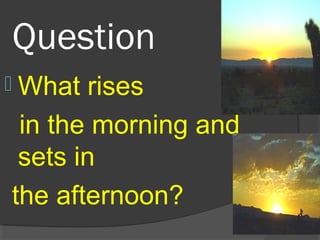
 What rises
in the morning and
sets in
the afternoon?
Group work
Question
 What do you know
about the sun? Where
it is in the solar
system? What it is
made of?
Reporting
Sun
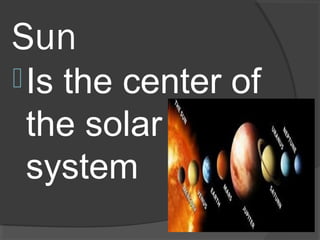
Is the center of
the solar
system
I wondered why
there are objects
in space?
How did the sun
and other
member of the
solar system
begin?
How were they
formed?
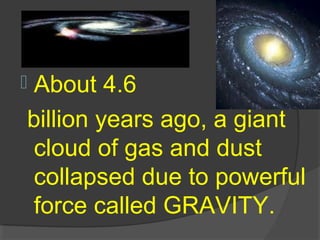
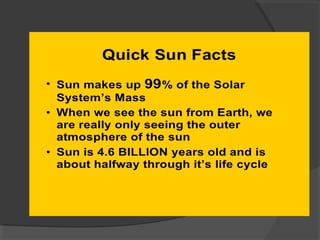
 About 4.6
billion years ago, a giant
cloud of gas and dust
collapsed due to powerful
force called GRAVITY.
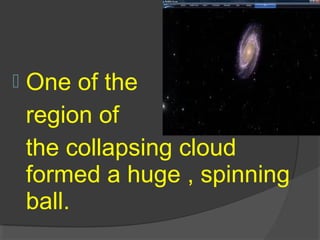
 One of the
region of
the collapsing cloud
formed a huge , spinning
ball.
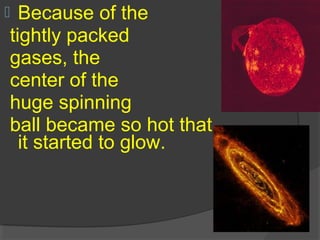
 Because of the
tightly packed
gases, the
center of the
huge spinning
ball became so hot that
it started to glow.
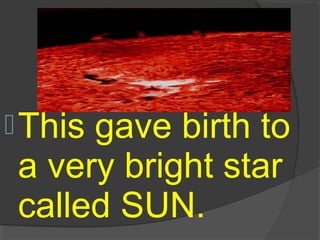
This gave birth to
a very bright star
called SUN.
Read page 355
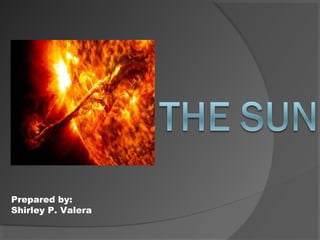
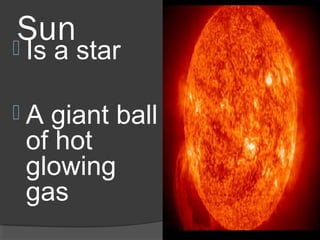
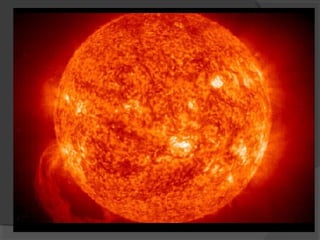
Sun Is a star
 A giant ball
of hot
glowing
gas
Sun
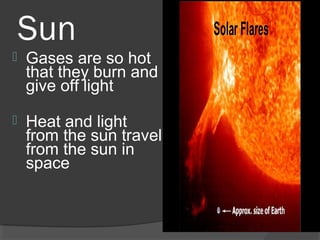
 Gases are so hot
that they burn and
give off light
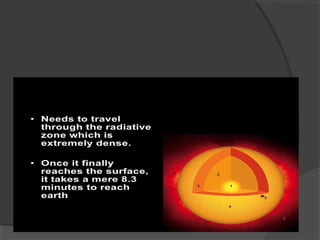
 Heat and light
from the sun travel
from the sun in
space
Sun
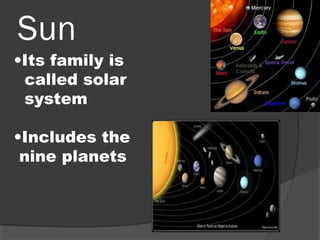
•Its family is
called solar
system
•Includes the
nine planets
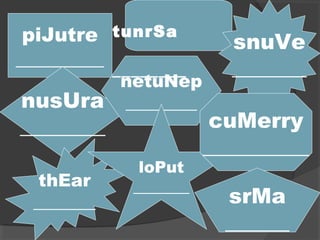
piJutre
_________
nusUra
________
netuNep
________
thEar
_______
snuVe
_______
loPut
_______
cuMerry
__________
tunrSa
________
srMa
______
 There are two main classes
of planets in the solar system
–
_ _ _ _ _ _ _ (oussega) and
_ _ _ _ _ _ _ _ _ _. (rrestetial)
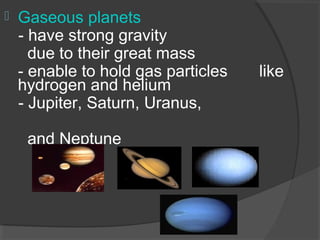
 Gaseous planets
- have strong gravity
due to their great mass
- enable to hold gas particles like
hydrogen and helium
- Jupiter, Saturn, Uranus,
and Neptune
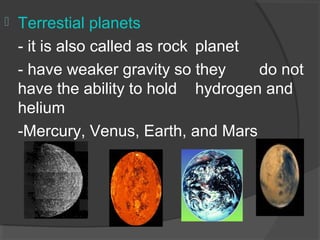
 Terrestial planets
- it is also called as rock planet
- have weaker gravity so they do not
have the ability to hold hydrogen and
helium
-Mercury, Venus, Earth, and Mars
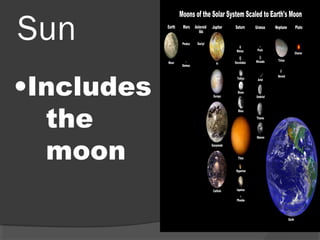
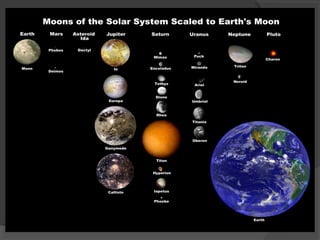
Sun
•Includes
the
moon
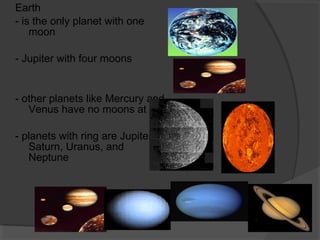
Earth
- is the only planet with one
moon
- Jupiter with four moons
- other planets like Mercury and
Venus have no moons at all
- planets with ring are Jupiter,
Saturn, Uranus, and
Neptune
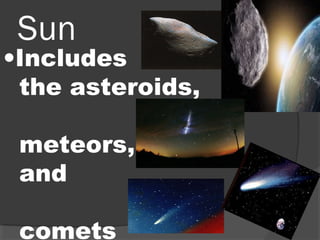
Sun
•Includes
the asteroids,
meteors,
and
comets
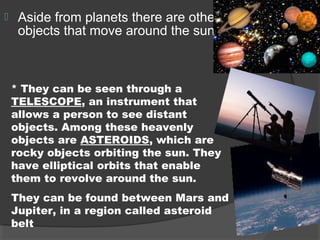
 Aside from planets there are other
objects that move around the sun.
* They can be seen through a
TELESCOPE, an instrument that
allows a person to see distant
objects. Among these heavenly
objects are ASTEROIDS, which are
rocky objects orbiting the sun. They
have elliptical orbits that enable
them to revolve around the sun.
They can be found between Mars and
Jupiter, in a region called asteroid
belt
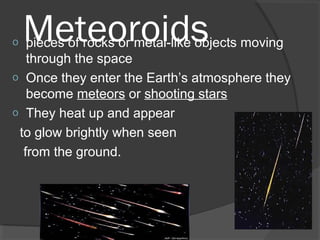
Meteoroidso pieces of rocks or metal-like objects moving
through the space
o Once they enter the Earth’s atmosphere they
become meteors or shooting stars
o They heat up and appear
to glow brightly when seen
from the ground.
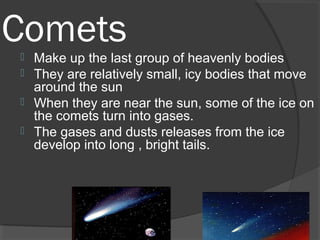
Comets Make up the last group of heavenly bodies
 They are relatively small, icy bodies that move
around the sun
 When they are near the sun, some of the ice on
the comets turn into gases.
 The gases and dusts releases from the ice
develop into long , bright tails.
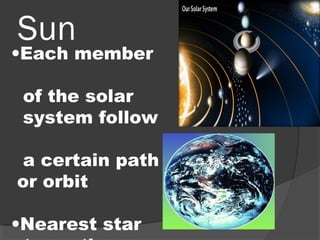
Sun
•Each member
of the solar
system follow
a certain path
or orbit
•Nearest star
Earth
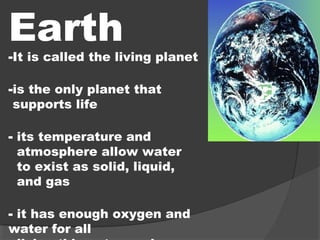
-It is called the living planet
-is the only planet that
supports life
- its temperature and
atmosphere allow water
to exist as solid, liquid,
and gas
- it has enough oxygen and
water for all
Sun
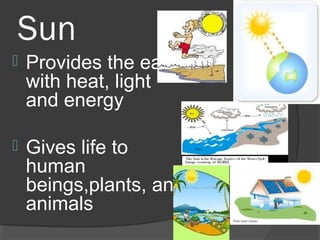
 Provides the earth
with heat, light
and energy
 Gives life to
human
beings,plants, and
animals
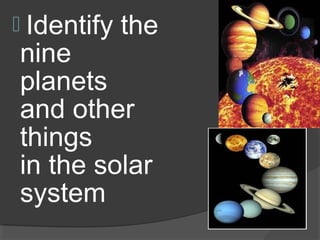
 Identify the
nine
planets
and other
things
in the solar
system
Activity
Study the model / illustration of the solar
system.
a. Observe the sun very early early in the
morning and at noon time . Use dark
glasses.
b. stay under the sun for five
minutes.
c. feel your head and skin.
Try this
Try This
 What to know:
1. what compose the solar
system?
2. what is the sun?
 What to use model of the solar
system smoke glass
What did you learn?
1. What is the center of the solar system?
2. What is the first four planets?
3. What are the last five planets?
4. What planet where we live in?
5. What other things are there in the
solar system aside from the planets?
6. How do the members of the solar system move
around the sun?
7. Name the six members of the solar system?
8. Describe the sun.
9. How did your head and skin feel when you were
under the sun?
10. Where did the heat come from?
11. What does the sun give?
Discussion
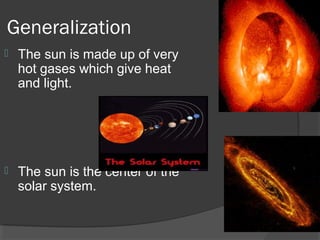
Generalization
 The sun is made up of very
hot gases which give heat
and light.
 The sun is the center of the
solar system.
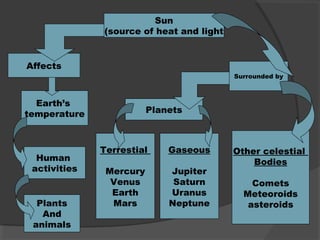
Sun
(source of heat and light
Surrounded by
Planets
Terrestial
Mercury
Venus
Earth
Mars
Gaseous
Jupiter
Saturn
Uranus
Neptune
Other celestial
Bodies
Comets
Meteoroids
asteroids
Affects
Earth’s
temperature
Human
activities
Plants
And
animals
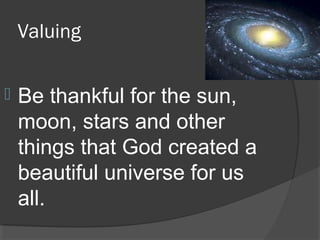
Valuing
 Be thankful for the sun,
moon, stars and other
things that God created a
beautiful universe for us
all.
Evaluation
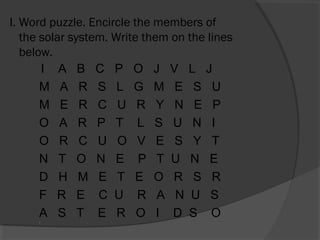
I. Word puzzle. Encircle the members of
the solar system. Write them on the lines
below.
I A B C P O J V L J
M A R S L G M E S U
M E R C U R Y N E P
O A R P T L S U N I
O R C U O V E S Y T
N T O N E P T U N E
D H M E T E O R S R
F R E C U R A N U S
A S T E R O I D S O

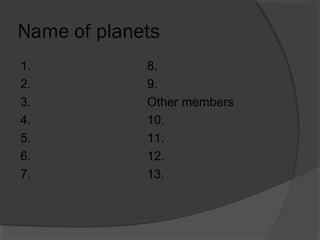
Name of planets
1. 8.
2. 9.
3. Other members
4. 10.
5. 11.
6. 12.
7. 13.
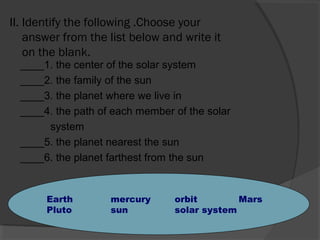
II. Identify the following .Choose your
answer from the list below and write it
on the blank.
____1. the center of the solar system
____2. the family of the sun
____3. the planet where we live in
____4. the path of each member of the solar
system
____5. the planet nearest the sun
____6. the planet farthest from the sun
Earth mercury orbit Mars
Pluto sun solar system
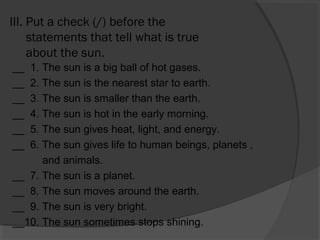
III. Put a check (/) before the
statements that tell what is true
about the sun.
__ 1. The sun is a big ball of hot gases.
__ 2. The sun is the nearest star to earth.
__ 3. The sun is smaller than the earth.
__ 4. The sun is hot in the early morning.
__ 5. The sun gives heat, light, and energy.
__ 6. The sun gives life to human beings, planets ,
and animals.
__ 7. The sun is a planet.
__ 8. The sun moves around the earth.
__ 9. The sun is very bright.
__10. The sun sometimes stops shining.
The sun 2015
The sun 2015
The sun 2015
The sun 2015
The sun 2015
The sun 2015
The sun 2015
The sun 2015
The sun 2015
The sun 2015
The sun 2015
The sun 2015
The sun 2015

The sun 2015

  • 1.
  • 2.
    Objective  Infer thatthe sun is the center of the solar system.
  • 3.
    Objective  Name theplanets and other heavenly bodies in the solar system.
  • 4.
  • 5.
    Objective  Thank Godfor the sun that gives us energy.
  • 6.
    Question  What rises inthe morning and sets in the afternoon?
  • 7.
  • 8.
    Question  What doyou know about the sun? Where it is in the solar system? What it is made of?
  • 9.
  • 10.
    Sun Is the centerof the solar system
  • 11.
    I wondered why thereare objects in space? How did the sun and other member of the solar system begin? How were they formed?
  • 12.
     About 4.6 billionyears ago, a giant cloud of gas and dust collapsed due to powerful force called GRAVITY.
  • 13.
     One ofthe region of the collapsing cloud formed a huge , spinning ball.
  • 14.
     Because ofthe tightly packed gases, the center of the huge spinning ball became so hot that it started to glow.
  • 15.
    This gave birthto a very bright star called SUN.
  • 16.
  • 17.
    Sun Is astar  A giant ball of hot glowing gas
  • 18.
    Sun  Gases areso hot that they burn and give off light  Heat and light from the sun travel from the sun in space
  • 19.
    Sun •Its family is calledsolar system •Includes the nine planets
  • 20.
  • 21.
     There aretwo main classes of planets in the solar system – _ _ _ _ _ _ _ (oussega) and _ _ _ _ _ _ _ _ _ _. (rrestetial)
  • 22.
     Gaseous planets -have strong gravity due to their great mass - enable to hold gas particles like hydrogen and helium - Jupiter, Saturn, Uranus, and Neptune
  • 23.
     Terrestial planets -it is also called as rock planet - have weaker gravity so they do not have the ability to hold hydrogen and helium -Mercury, Venus, Earth, and Mars
  • 24.
  • 26.
    Earth - is theonly planet with one moon - Jupiter with four moons - other planets like Mercury and Venus have no moons at all - planets with ring are Jupiter, Saturn, Uranus, and Neptune
  • 27.
  • 28.
     Aside fromplanets there are other objects that move around the sun. * They can be seen through a TELESCOPE, an instrument that allows a person to see distant objects. Among these heavenly objects are ASTEROIDS, which are rocky objects orbiting the sun. They have elliptical orbits that enable them to revolve around the sun. They can be found between Mars and Jupiter, in a region called asteroid belt
  • 29.
    Meteoroidso pieces ofrocks or metal-like objects moving through the space o Once they enter the Earth’s atmosphere they become meteors or shooting stars o They heat up and appear to glow brightly when seen from the ground.
  • 30.
    Comets Make upthe last group of heavenly bodies  They are relatively small, icy bodies that move around the sun  When they are near the sun, some of the ice on the comets turn into gases.  The gases and dusts releases from the ice develop into long , bright tails.
  • 31.
    Sun •Each member of thesolar system follow a certain path or orbit •Nearest star
  • 32.
    Earth -It is calledthe living planet -is the only planet that supports life - its temperature and atmosphere allow water to exist as solid, liquid, and gas - it has enough oxygen and water for all
  • 33.
    Sun  Provides theearth with heat, light and energy  Gives life to human beings,plants, and animals
  • 34.
     Identify the nine planets andother things in the solar system
  • 35.
  • 36.
    Study the model/ illustration of the solar system. a. Observe the sun very early early in the morning and at noon time . Use dark glasses. b. stay under the sun for five minutes. c. feel your head and skin. Try this
  • 37.
    Try This  Whatto know: 1. what compose the solar system? 2. what is the sun?  What to use model of the solar system smoke glass
  • 38.
    What did youlearn? 1. What is the center of the solar system? 2. What is the first four planets? 3. What are the last five planets? 4. What planet where we live in? 5. What other things are there in the solar system aside from the planets? 6. How do the members of the solar system move around the sun? 7. Name the six members of the solar system? 8. Describe the sun. 9. How did your head and skin feel when you were under the sun? 10. Where did the heat come from? 11. What does the sun give?
  • 39.
  • 40.
    Generalization  The sunis made up of very hot gases which give heat and light.  The sun is the center of the solar system.
  • 41.
    Sun (source of heatand light Surrounded by Planets Terrestial Mercury Venus Earth Mars Gaseous Jupiter Saturn Uranus Neptune Other celestial Bodies Comets Meteoroids asteroids Affects Earth’s temperature Human activities Plants And animals
  • 42.
    Valuing  Be thankfulfor the sun, moon, stars and other things that God created a beautiful universe for us all.
  • 43.
  • 44.
    I. Word puzzle.Encircle the members of the solar system. Write them on the lines below. I A B C P O J V L J M A R S L G M E S U M E R C U R Y N E P O A R P T L S U N I O R C U O V E S Y T N T O N E P T U N E D H M E T E O R S R F R E C U R A N U S A S T E R O I D S O 
  • 45.
    Name of planets 1.8. 2. 9. 3. Other members 4. 10. 5. 11. 6. 12. 7. 13.
  • 46.
    II. Identify thefollowing .Choose your answer from the list below and write it on the blank. ____1. the center of the solar system ____2. the family of the sun ____3. the planet where we live in ____4. the path of each member of the solar system ____5. the planet nearest the sun ____6. the planet farthest from the sun Earth mercury orbit Mars Pluto sun solar system
  • 47.
    III. Put acheck (/) before the statements that tell what is true about the sun. __ 1. The sun is a big ball of hot gases. __ 2. The sun is the nearest star to earth. __ 3. The sun is smaller than the earth. __ 4. The sun is hot in the early morning. __ 5. The sun gives heat, light, and energy. __ 6. The sun gives life to human beings, planets , and animals. __ 7. The sun is a planet. __ 8. The sun moves around the earth. __ 9. The sun is very bright. __10. The sun sometimes stops shining.