The planets make up only
0.135 % of the mass in our
solar system. The Sun
dominates, accounting for
99.86 % of the entire solar
system's mass.
Did you know that…?
SOLAR SYSTEMS, GALAXIES AND THE
UNIVERSE
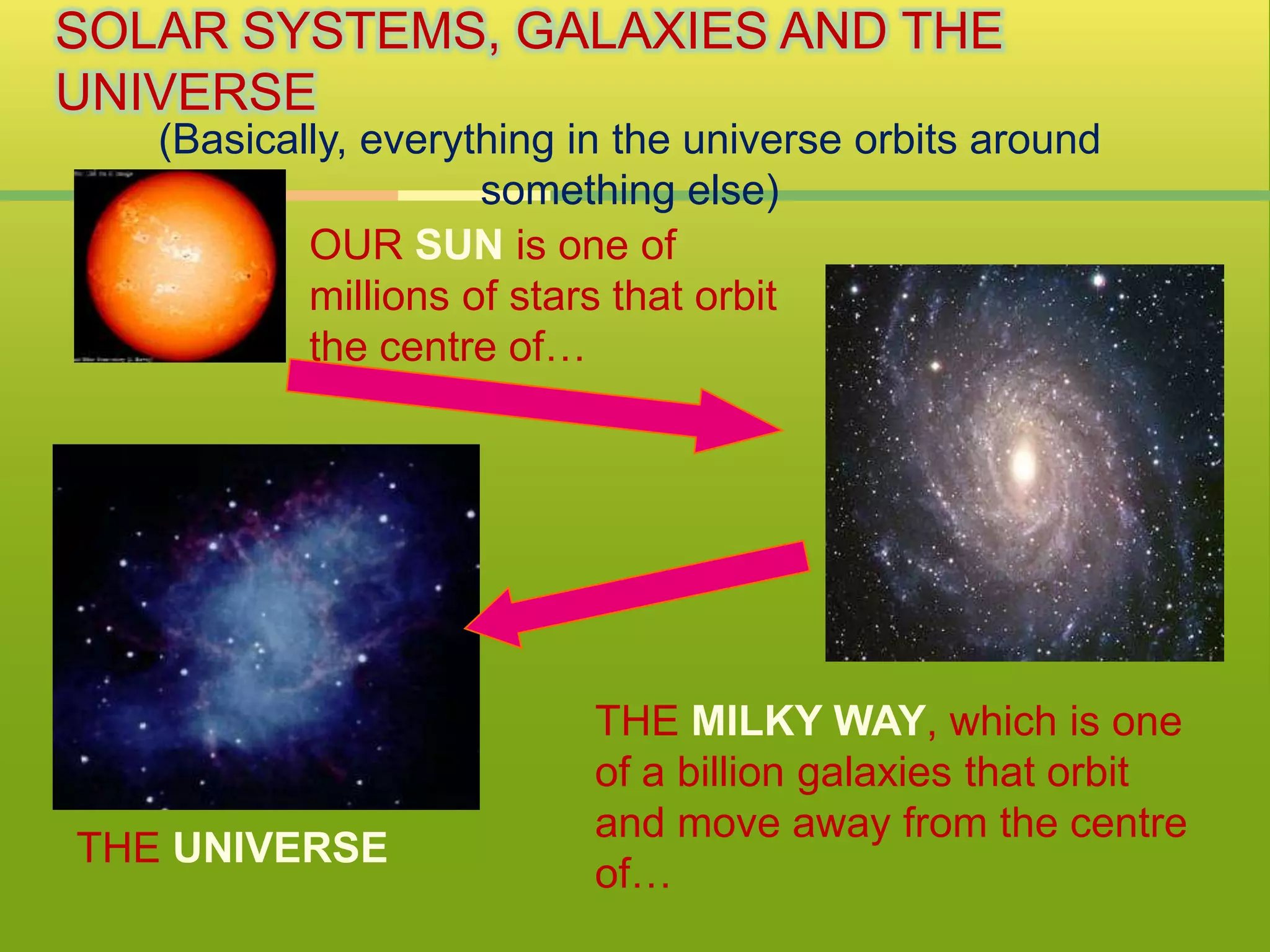
OUR SUN is one of
millions of stars that orbit
the centre of…
THE MILKY WAY, which is one
of a billion galaxies that orbit
and move away from the centre
of…
THE UNIVERSE
(Basically, everything in the universe orbits around
something else)
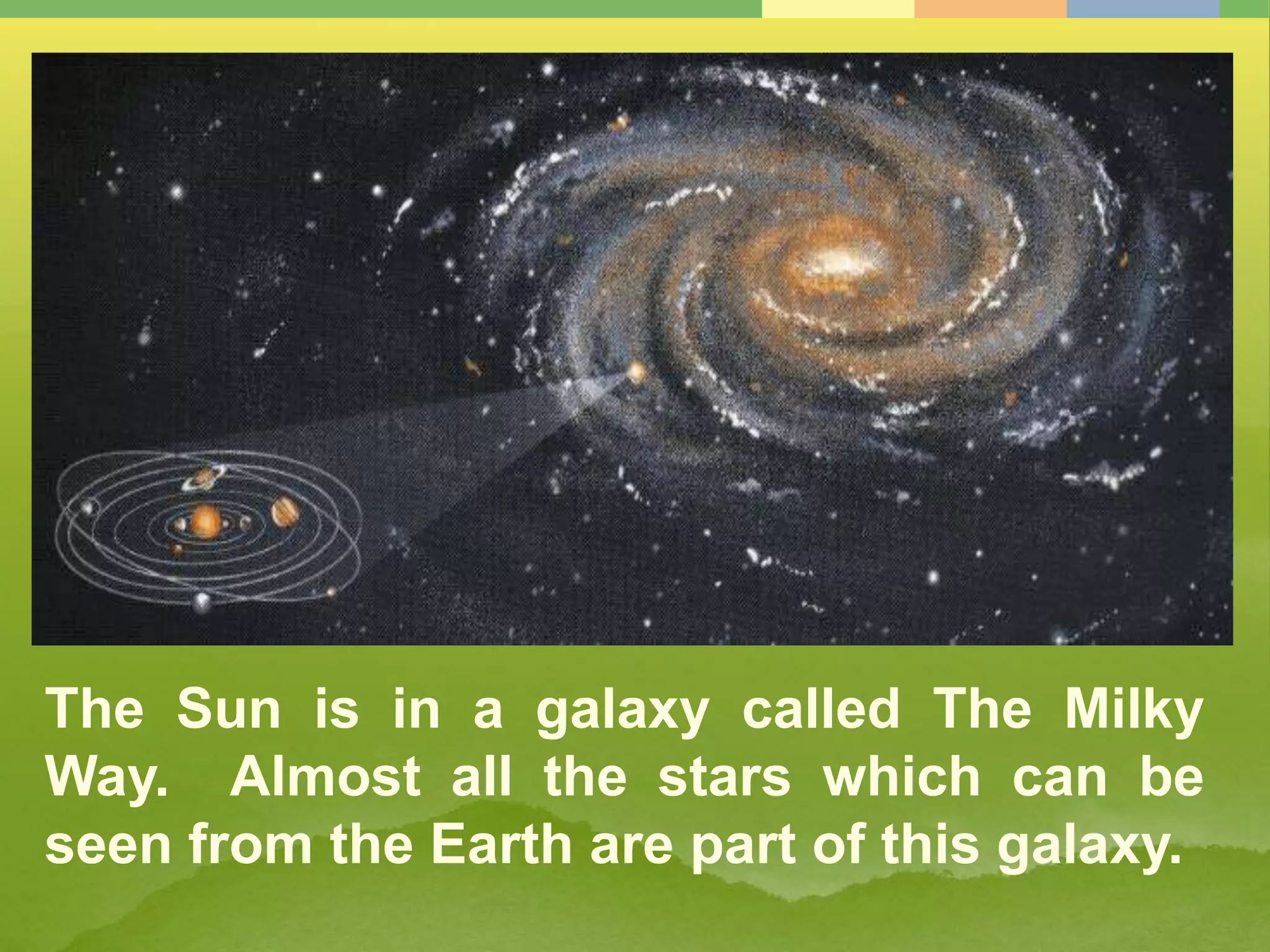
The Sun is in a galaxy called The Milky
Way. Almost all the stars which can be
seen from the Earth are part of this galaxy.
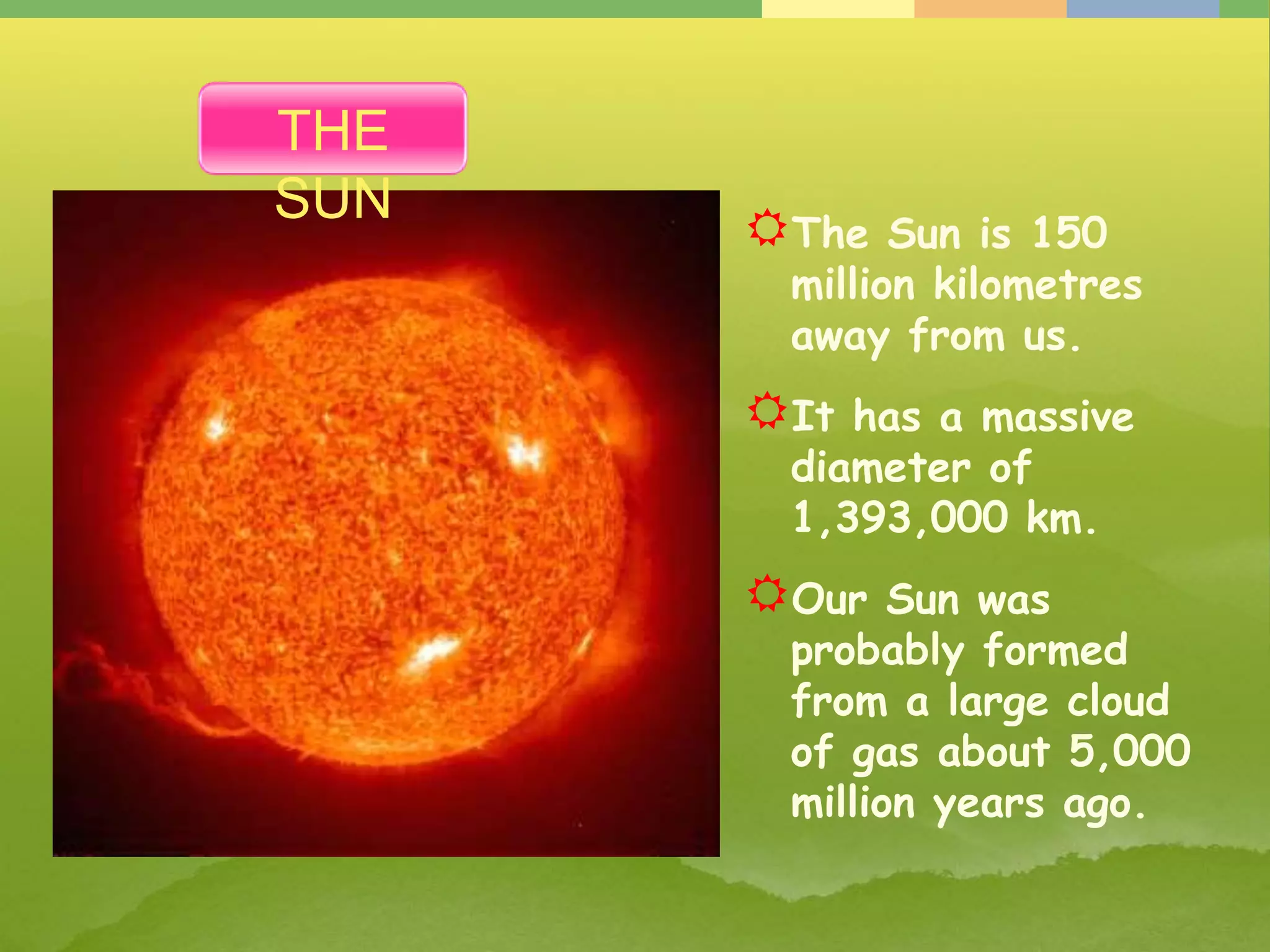
The Sun is 150
million kilometres
away from us.
It has a massive
diameter of
1,393,000 km.
Our Sun was
probably formed
from a large cloud
of gas about 5,000
million years ago.
THE
SUN
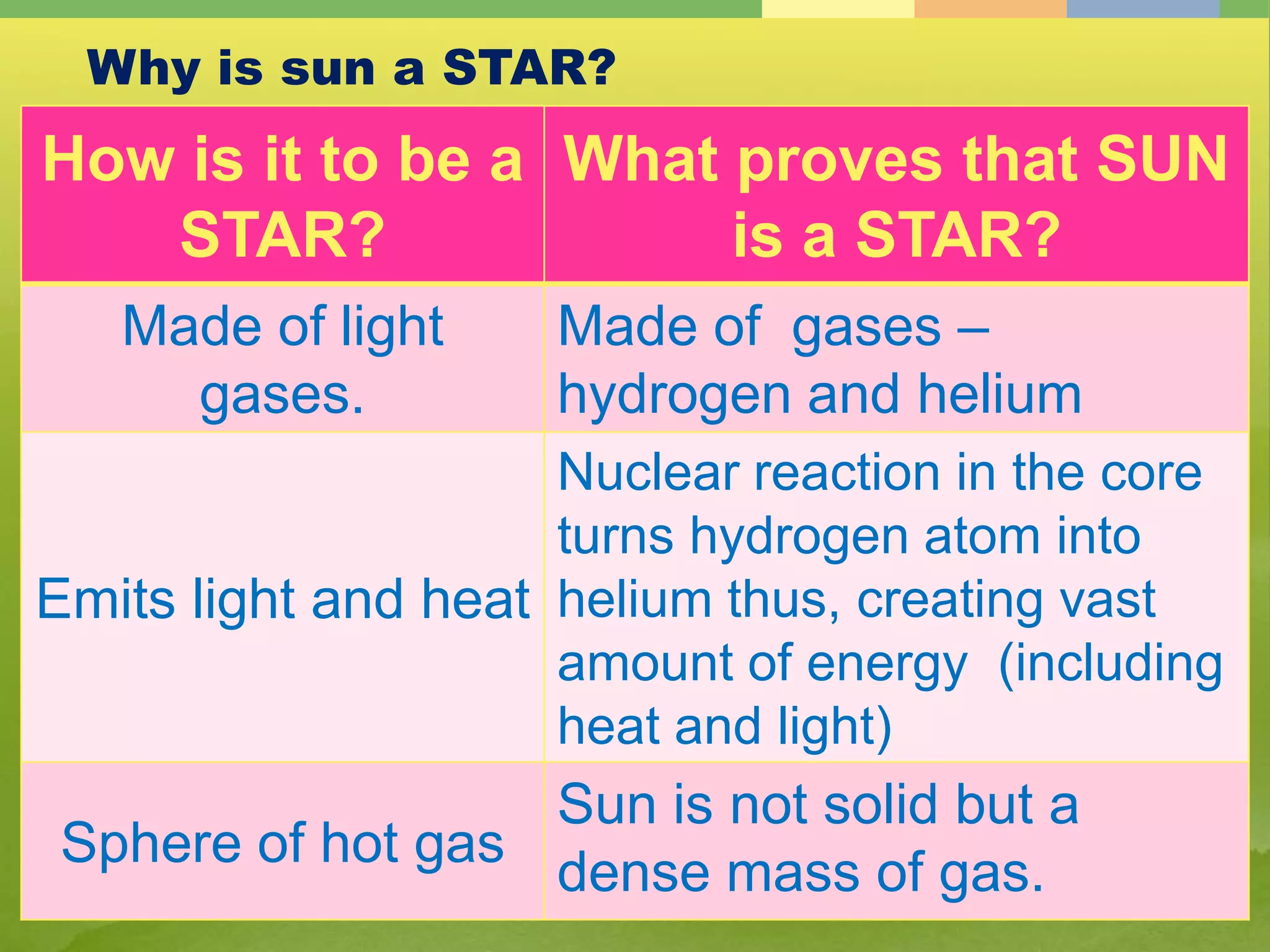
Why is sun a STAR?
How is it to be a
STAR?
What proves that SUN
is a STAR?
Made of light
gases.
Made of gases –
hydrogen and helium
Emits light and heat
Nuclear reaction in the core
turns hydrogen atom into
helium thus, creating vast
amount of energy (including
heat and light)
Sphere of hot gas
Sun is not solid but a
dense mass of gas.
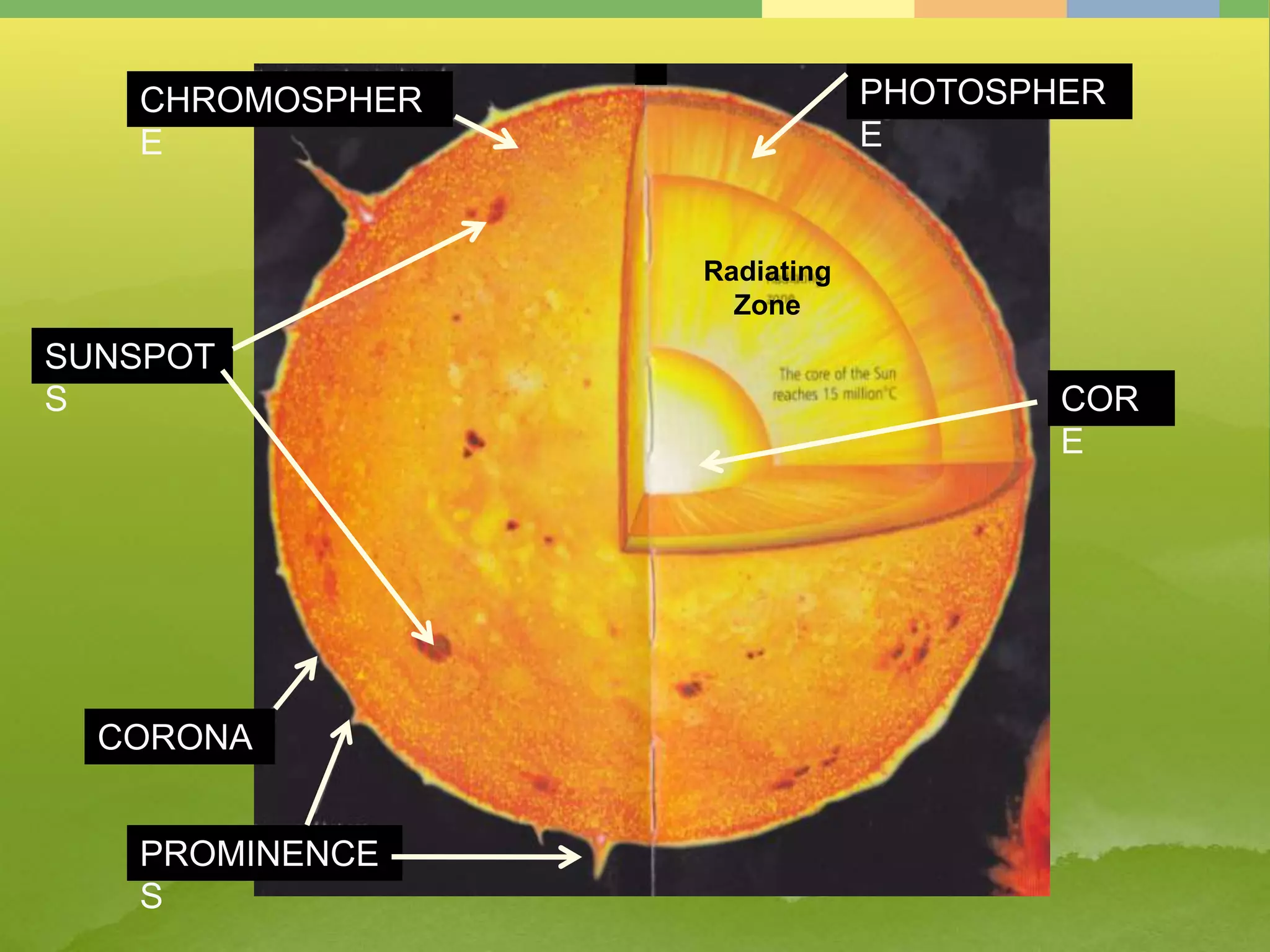
CHROMOSPHER
E
PHOTOSPHER
E
CORONA
COR
E
PROMINENCE
S
Radiating
Zone
SUNSPOT
S
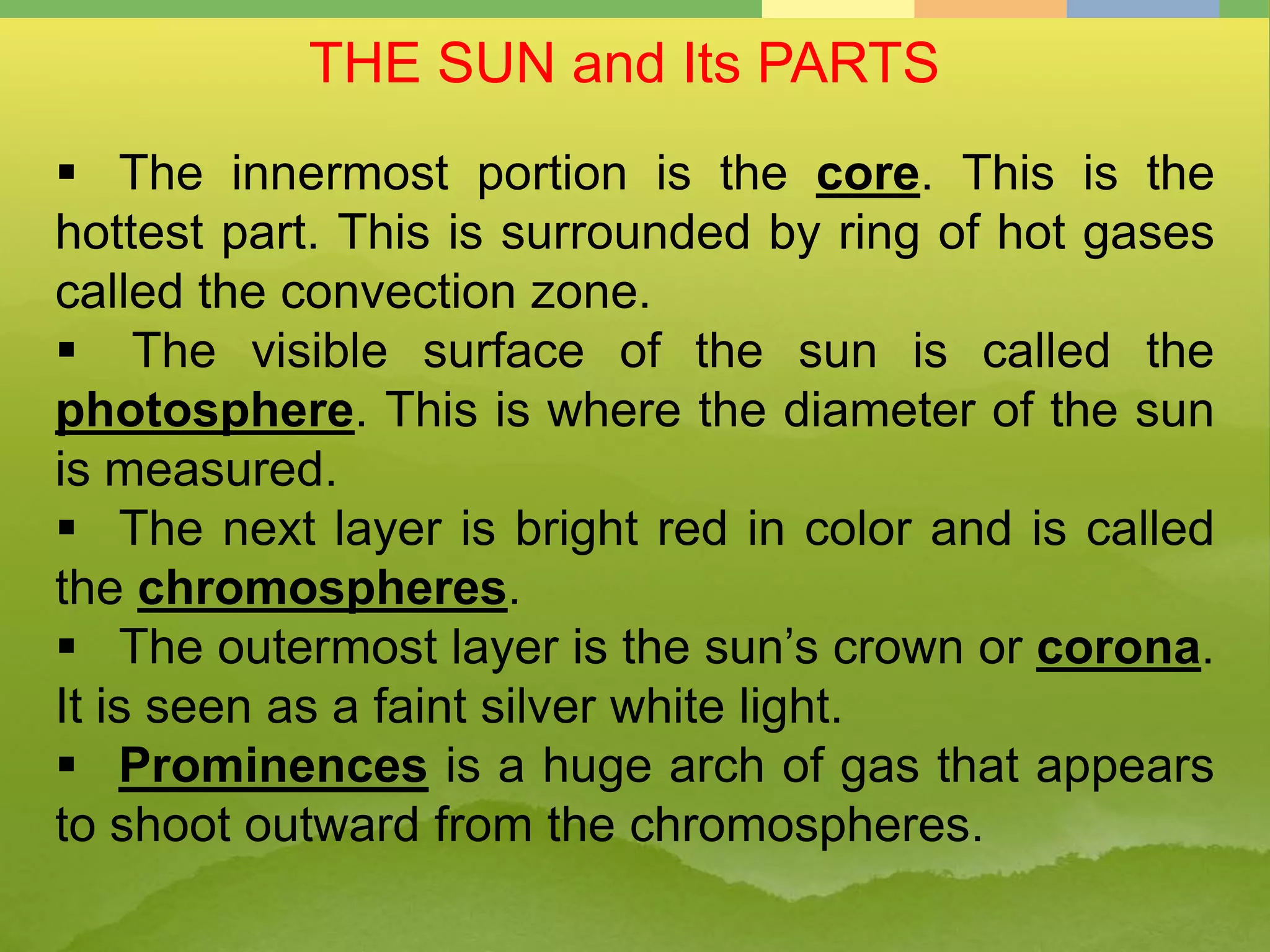
THE SUN and Its PARTS
 The innermost portion is the core. This is the
hottest part. This is surrounded by ring of hot gases
called the convection zone.
 The visible surface of the sun is called the
photosphere. This is where the diameter of the sun
is measured.
 The next layer is bright red in color and is called
the chromospheres.
 The outermost layer is the sun’s crown or corona.
It is seen as a faint silver white light.
 Prominences is a huge arch of gas that appears
to shoot outward from the chromospheres.
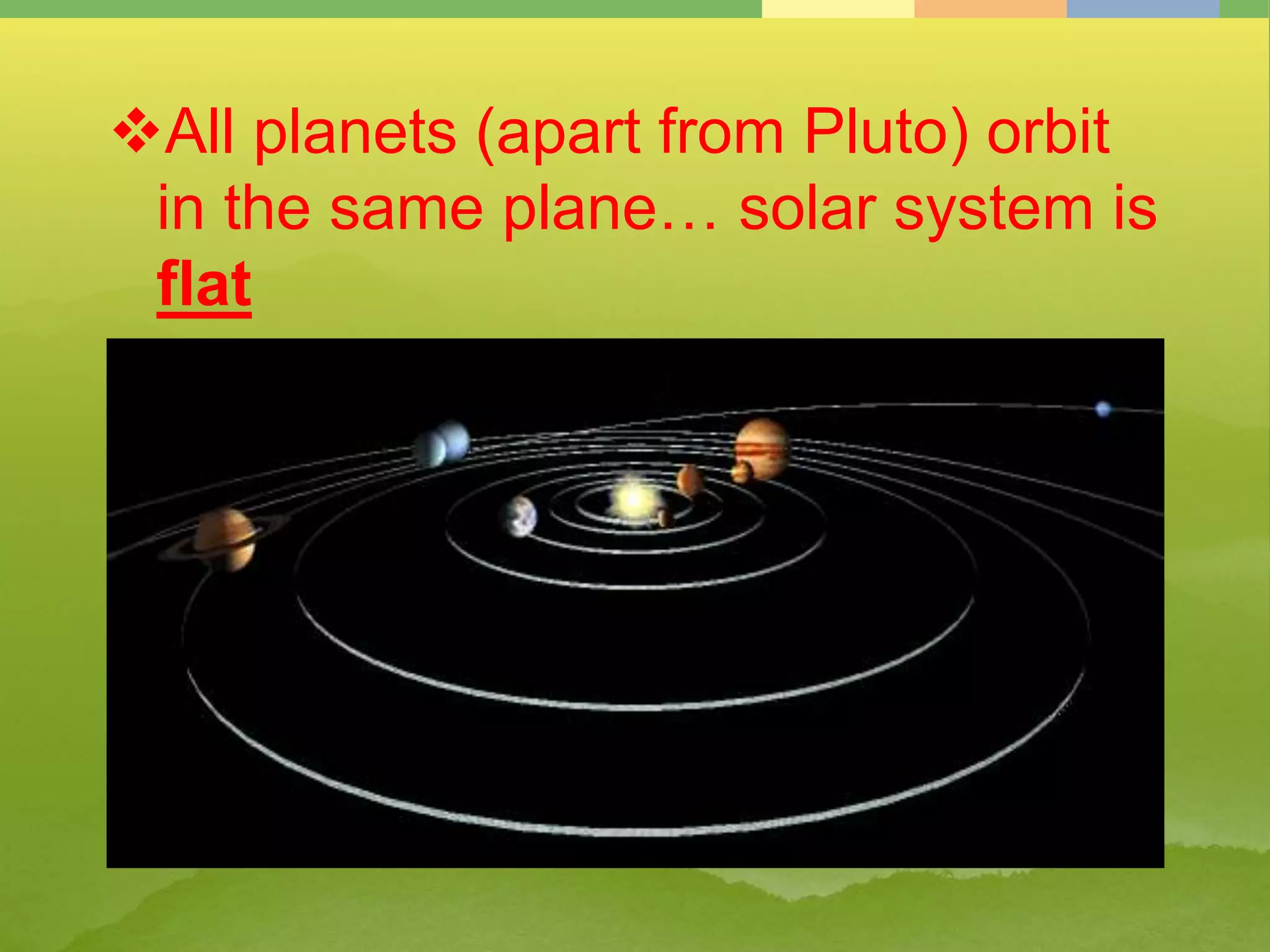
All planets (apart from Pluto) orbit
in the same plane… solar system is
flat
All planets orbit the Sun in same
sense.
The Sun and all planets (apart from
Venus and Uranus) rotate in the
same sense as the planets orbit the
Sun.
Inner planets are small and
rocky, but outer planets are large
and gassy.
Planets’ orbits are elliptical
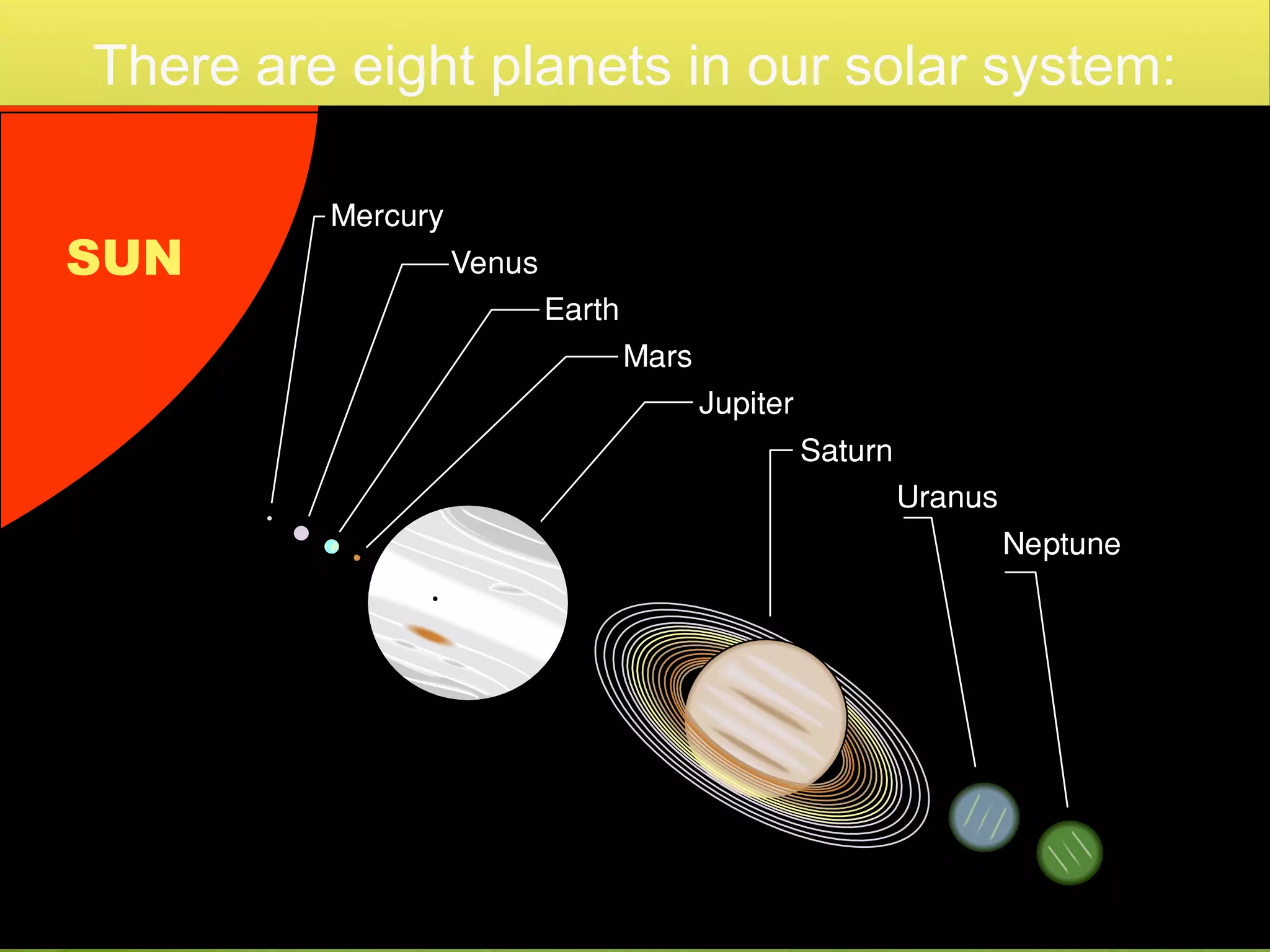
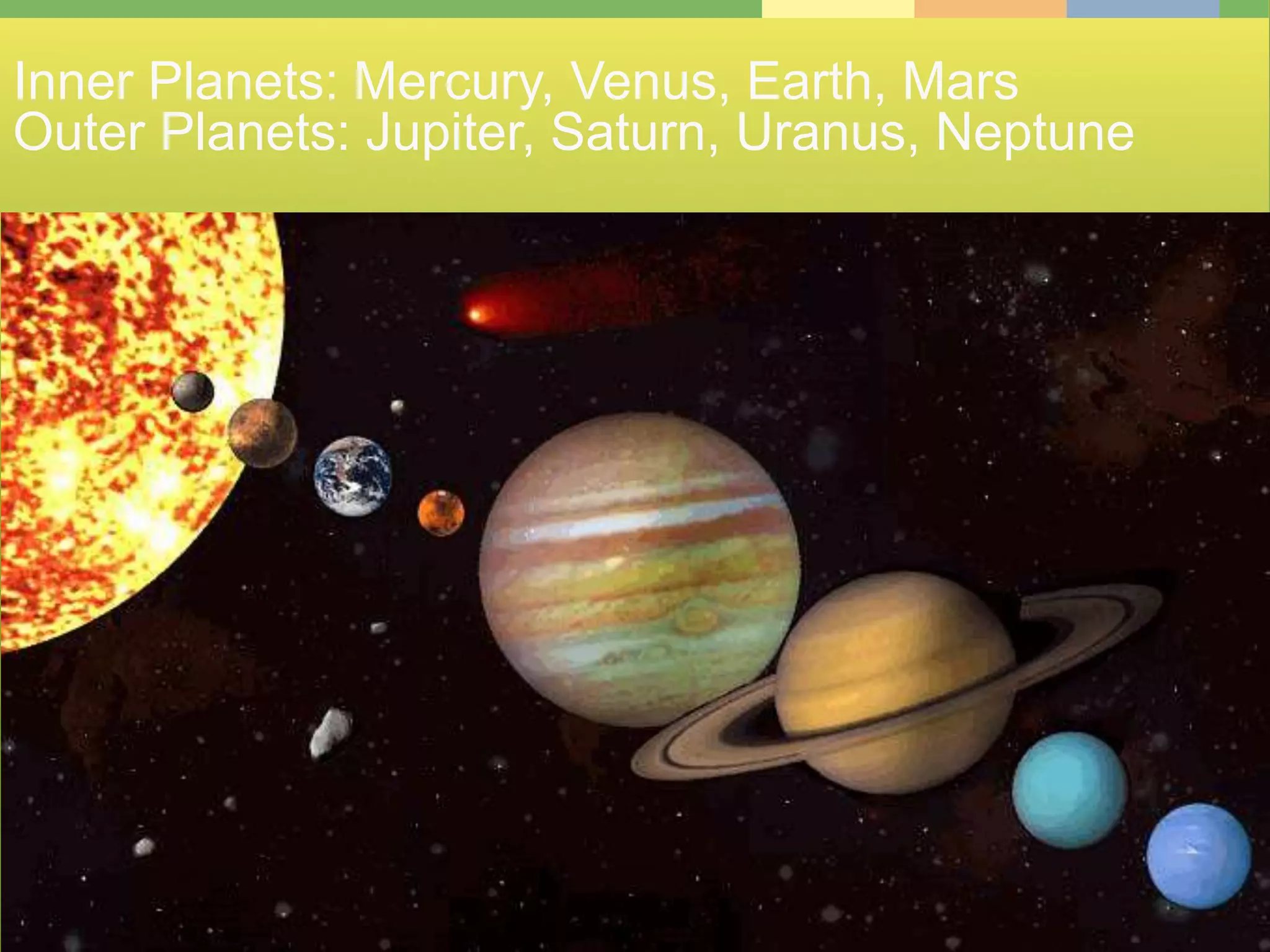
There are eight planets in our solar system:
SUN
Inner Planets: Mercury, Venus, Earth, Mars
Outer Planets: Jupiter, Saturn, Uranus, Neptune
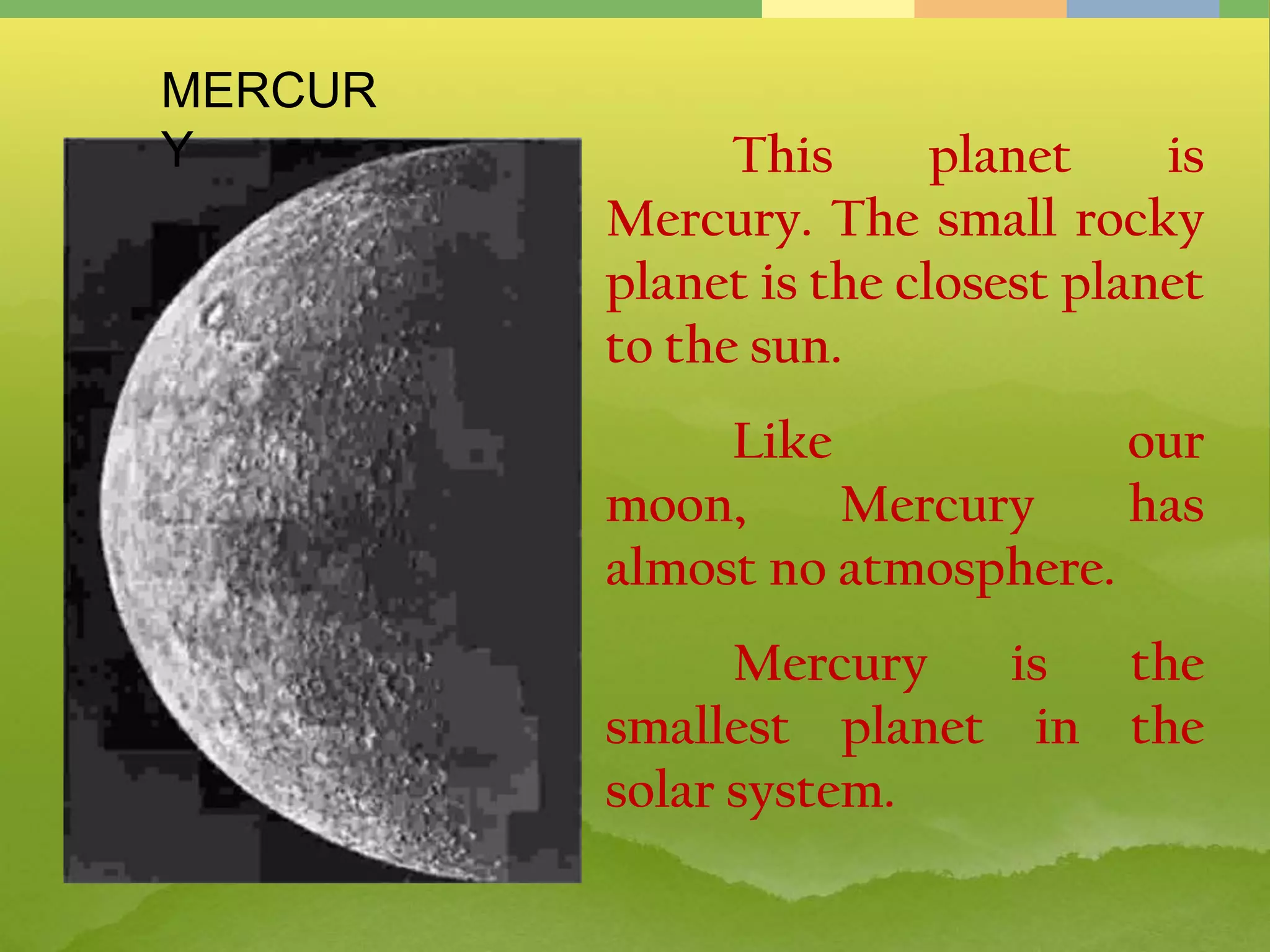
This planet is
Mercury. The small rocky
planet is the closest planet
to the sun.
Like our
moon, Mercury has
almost no atmosphere.
Mercury is the
smallest planet in the
solar system.
MERCUR
Y
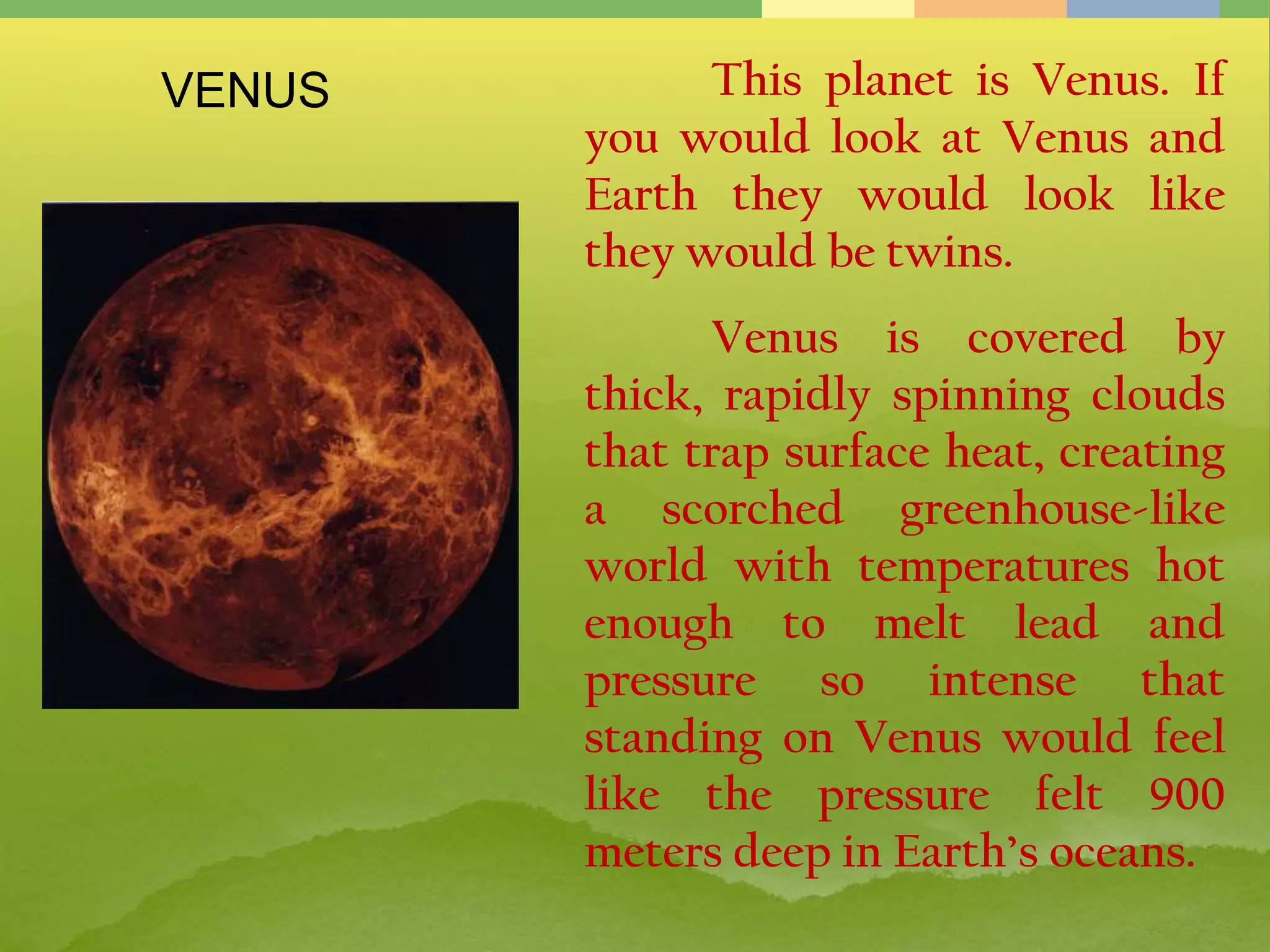
This planet is Venus. If
you would look at Venus and
Earth they would look like
they would be twins.
Venus is covered by
thick, rapidly spinning clouds
that trap surface heat, creating
a scorched greenhouse-like
world with temperatures hot
enough to melt lead and
pressure so intense that
standing on Venus would feel
like the pressure felt 900
meters deep in Earth’s oceans.
VENUS
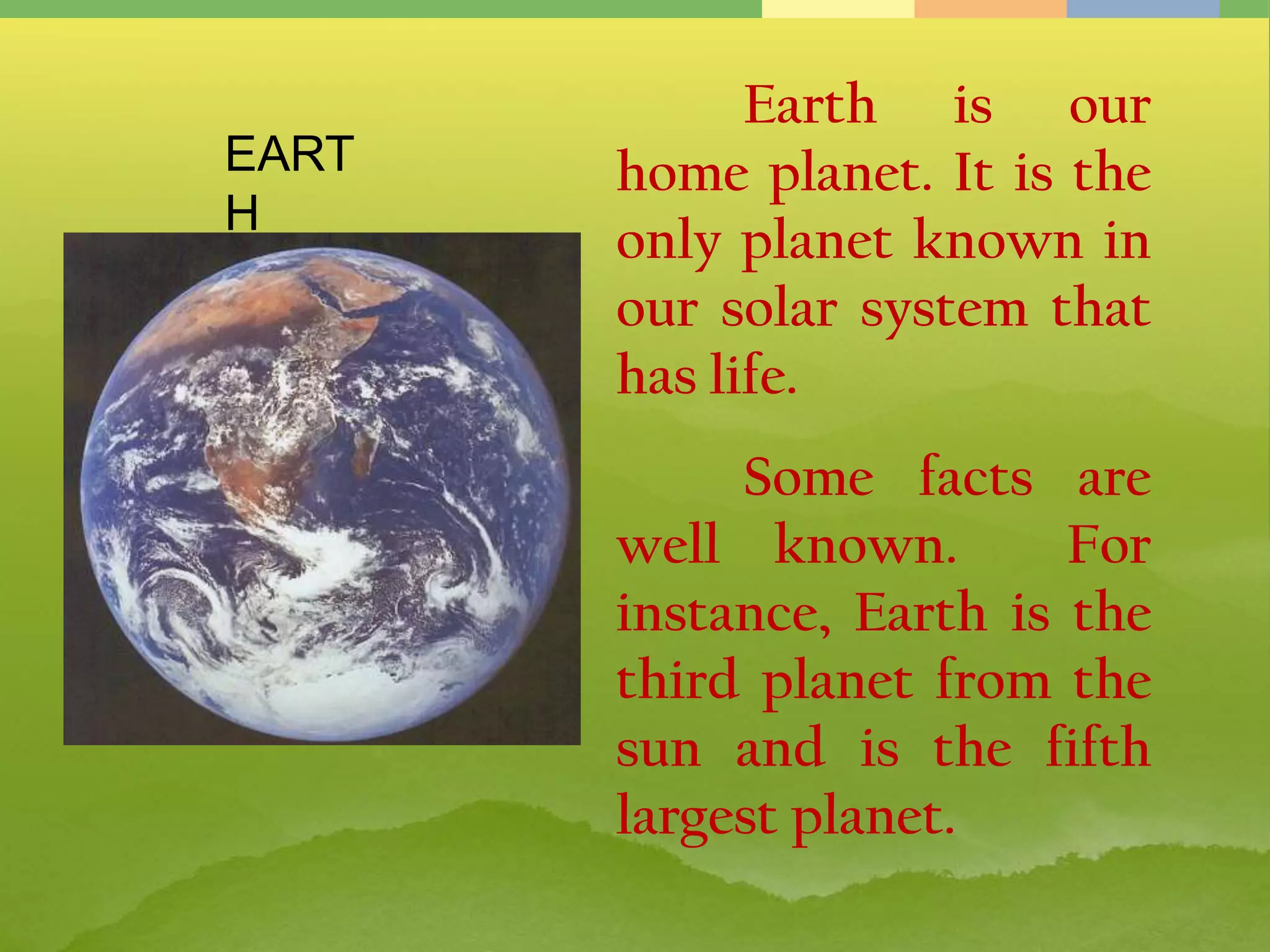
Earth is our
home planet. It is the
only planet known in
our solar system that
has life.
Some facts are
well known. For
instance, Earth is the
third planet from the
sun and is the fifth
largest planet.
EART
H
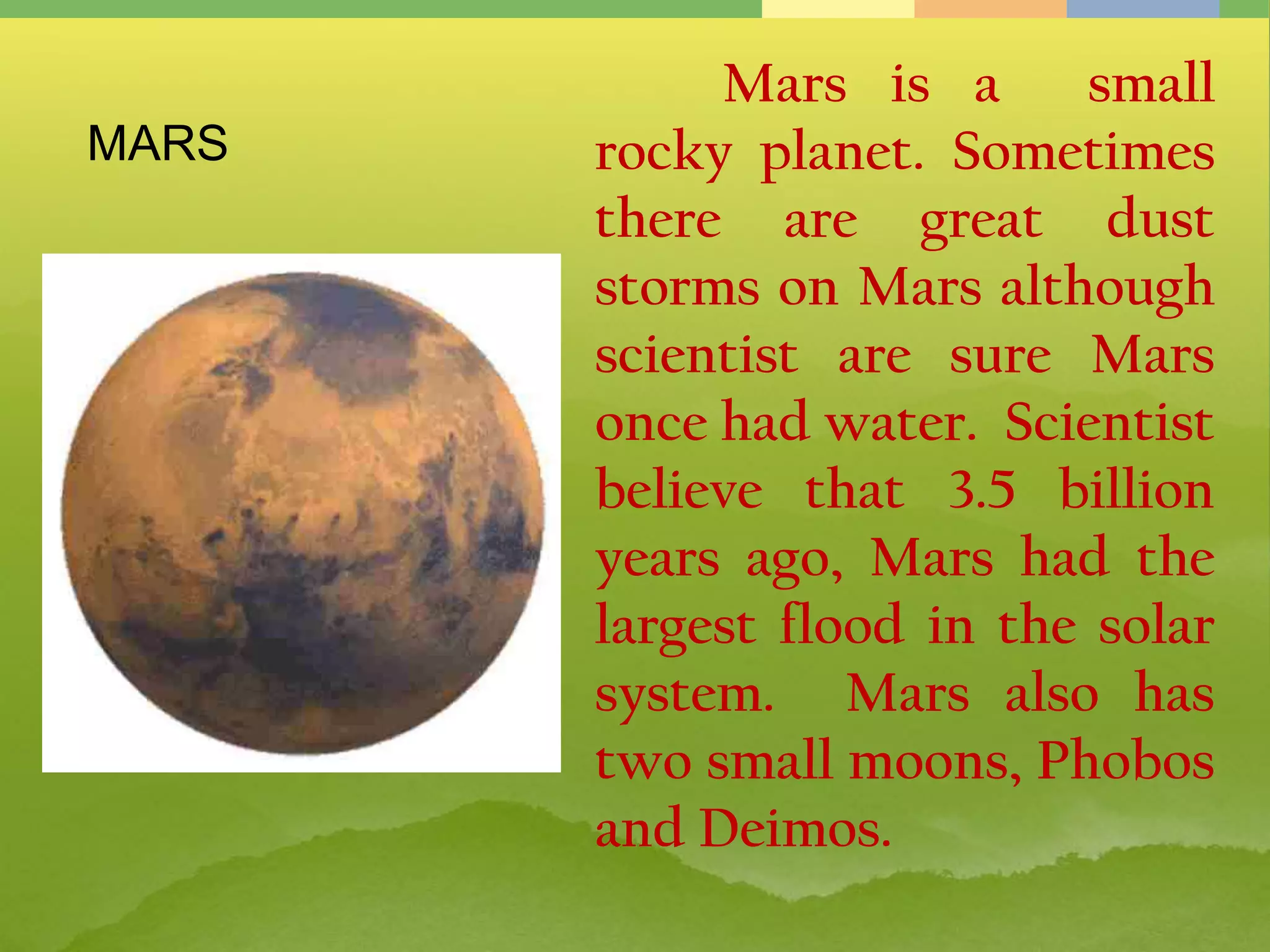
Mars is a small
rocky planet. Sometimes
there are great dust
storms on Mars although
scientist are sure Mars
once had water. Scientist
believe that 3.5 billion
years ago, Mars had the
largest flood in the solar
system. Mars also has
two small moons, Phobos
and Deimos.
MARS
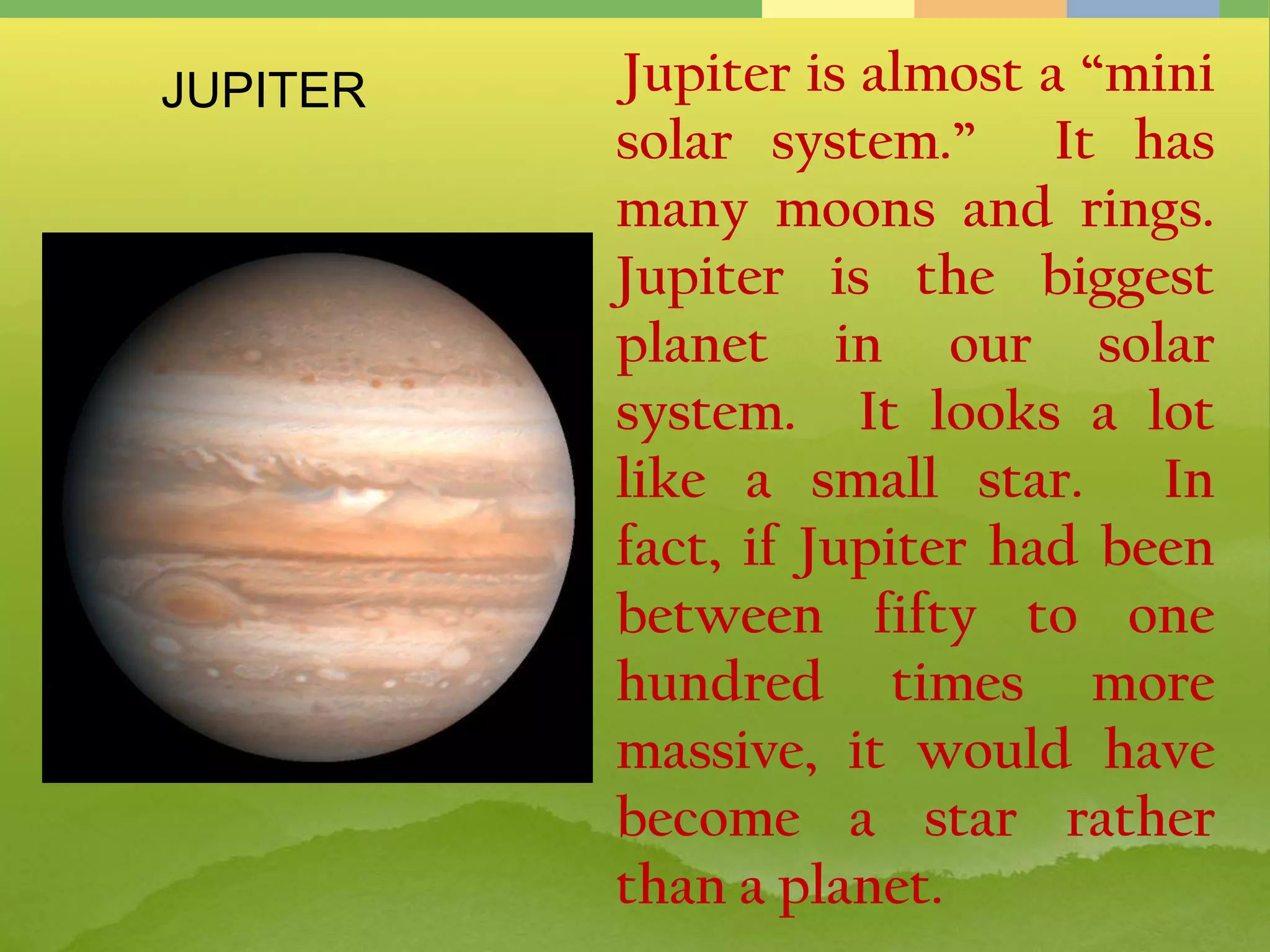
Jupiter is almost a “mini
solar system.” It has
many moons and rings.
Jupiter is the biggest
planet in our solar
system. It looks a lot
like a small star. In
fact, if Jupiter had been
between fifty to one
hundred times more
massive, it would have
become a star rather
than a planet.
JUPITER
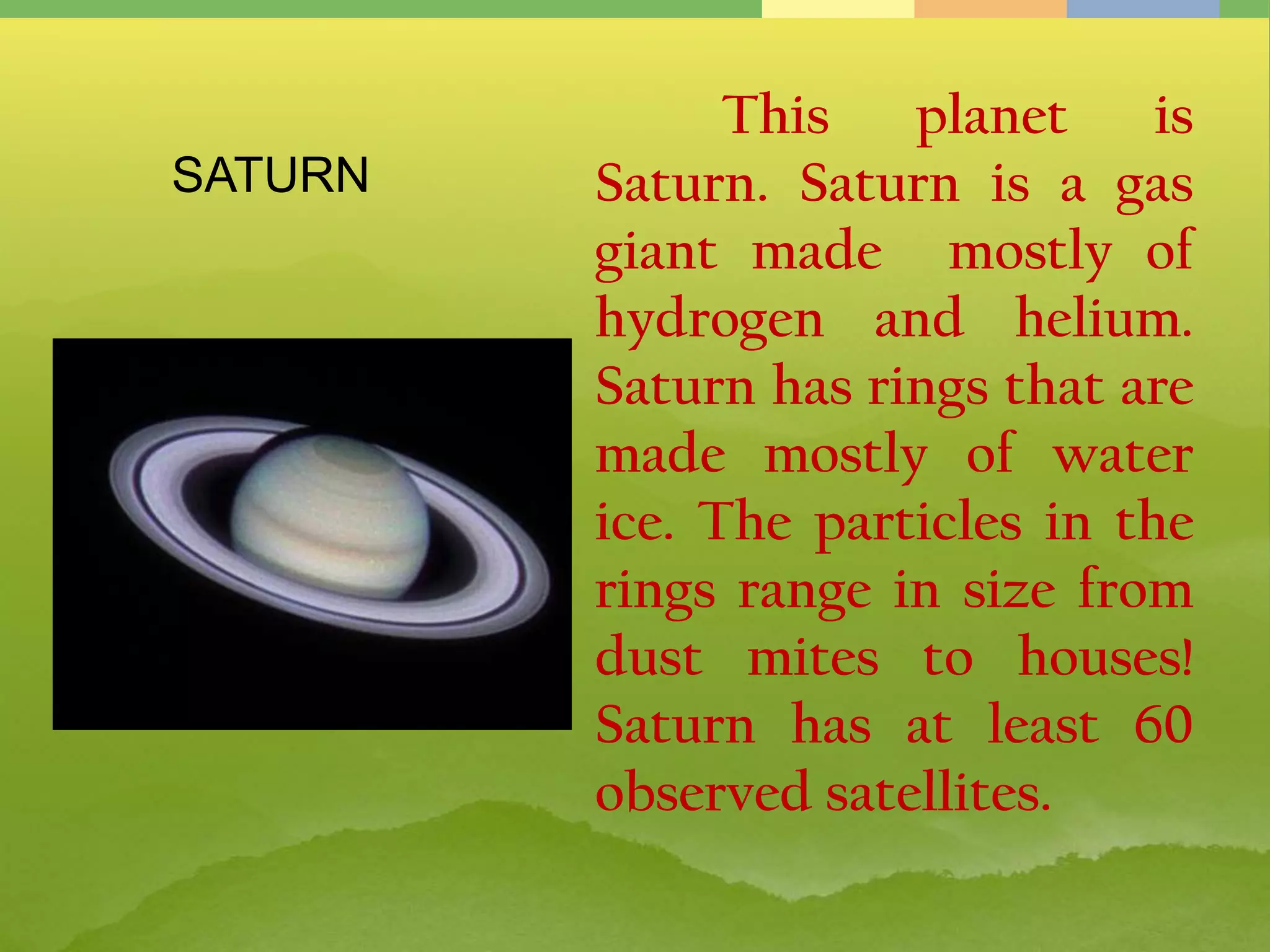
This planet is
Saturn. Saturn is a gas
giant made mostly of
hydrogen and helium.
Saturn has rings that are
made mostly of water
ice. The particles in the
rings range in size from
dust mites to houses!
Saturn has at least 60
observed satellites.
SATURN
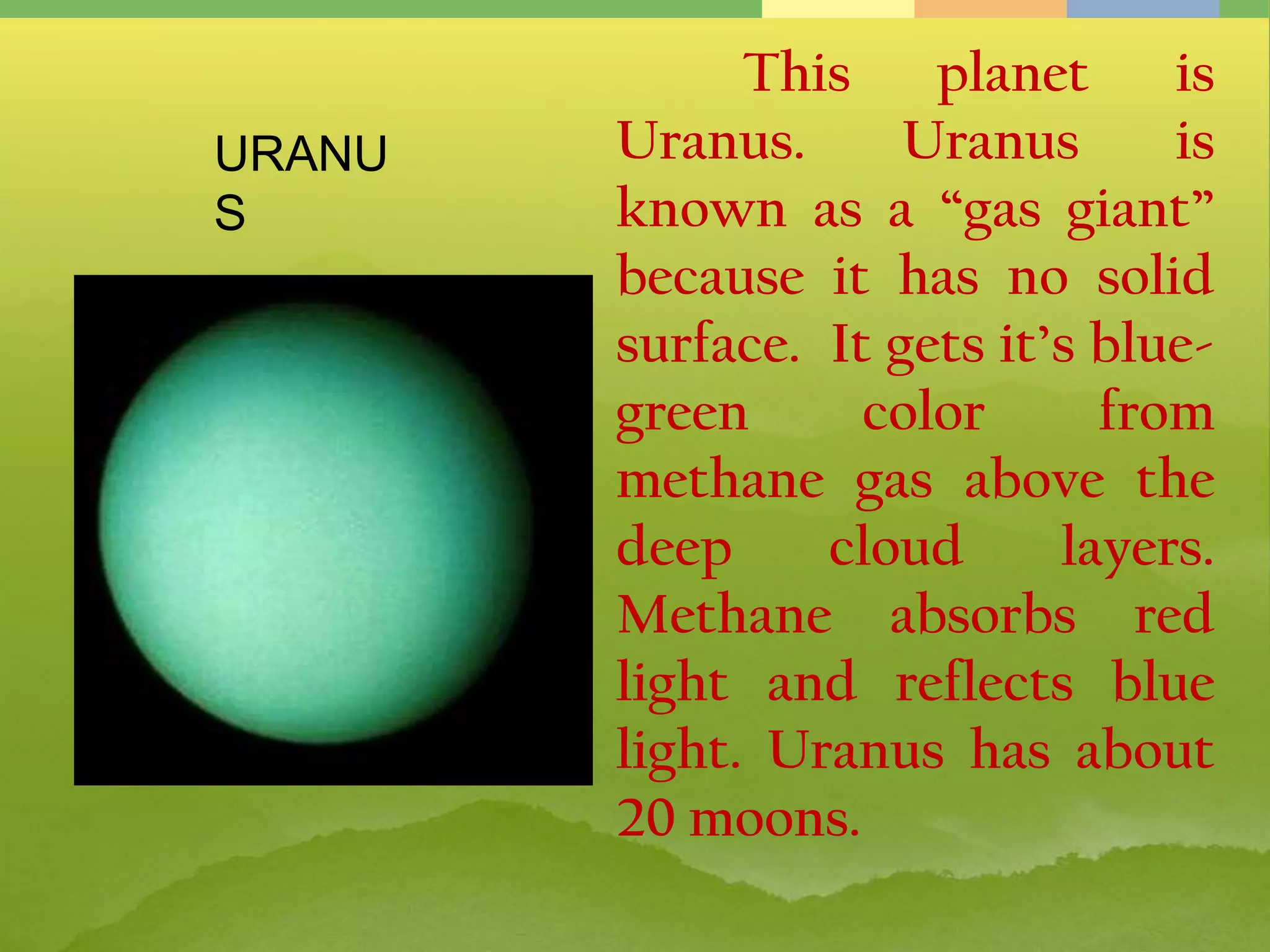
This planet is
Uranus. Uranus is
known as a “gas giant”
because it has no solid
surface. It gets it’s blue-
green color from
methane gas above the
deep cloud layers.
Methane absorbs red
light and reflects blue
light. Uranus has about
20 moons.
URANU
S
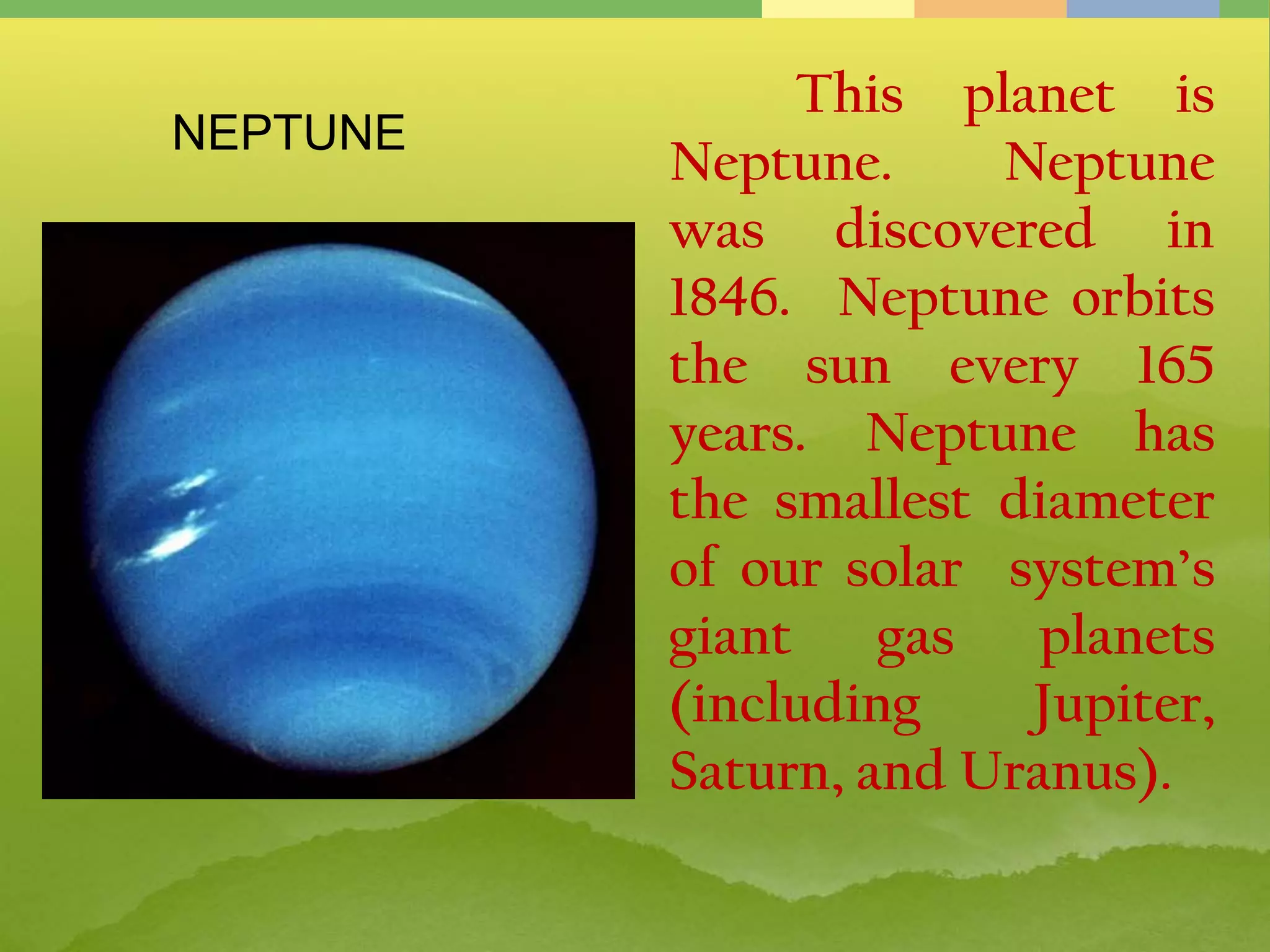
This planet is
Neptune. Neptune
was discovered in
1846. Neptune orbits
the sun every 165
years. Neptune has
the smallest diameter
of our solar system’s
giant gas planets
(including Jupiter,
Saturn, and Uranus).
NEPTUNE
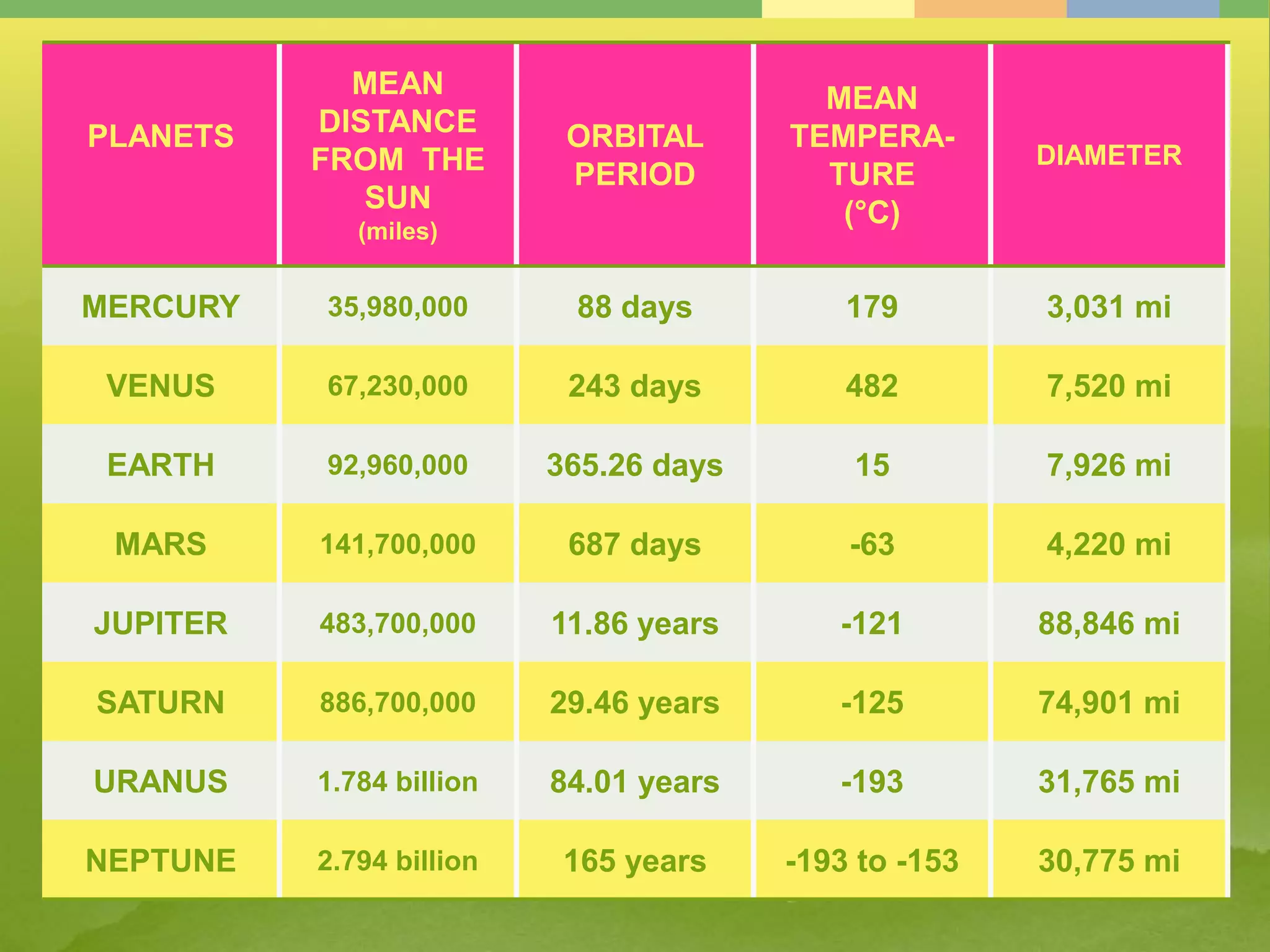
PLANETS
MEAN
DISTANCE
FROM THE
SUN
(miles)
ORBITAL
PERIOD
MEAN
TEMPERA-
TURE
(°C)
DIAMETER
MERCURY 35,980,000 88 days 179 3,031 mi
VENUS 67,230,000 243 days 482 7,520 mi
EARTH 92,960,000 365.26 days 15 7,926 mi
MARS 141,700,000 687 days -63 4,220 mi
JUPITER 483,700,000 11.86 years -121 88,846 mi
SATURN 886,700,000 29.46 years -125 74,901 mi
URANUS 1.784 billion 84.01 years -193 31,765 mi
NEPTUNE 2.794 billion 165 years -193 to -153 30,775 mi
Asteroids - are millions of small
planet-like bodies. Asteroids are
not a star. They are rock,
irregularly-shaped objects. They
are minor planets. Their sizes
differ. They are found between
the orbits of Mars and Jupiter.
 Meteoroids – are small pieces of stone or
metal travelling in space. Most meteoroids
are fragments from comets or asteroids that
broke off from crashes in space with other
objects. A few are actually chunks that blew
of the Moon or Mars after an asteroid hit.
When a meteoroid enters the earth’s
atmosphere, it usually burns up completely.
This streak of light is called a meteor, or
shooting star. If a piece of a meteoroid
survives its trip through our atmosphere and
lands on earth, it is called a meteorite.
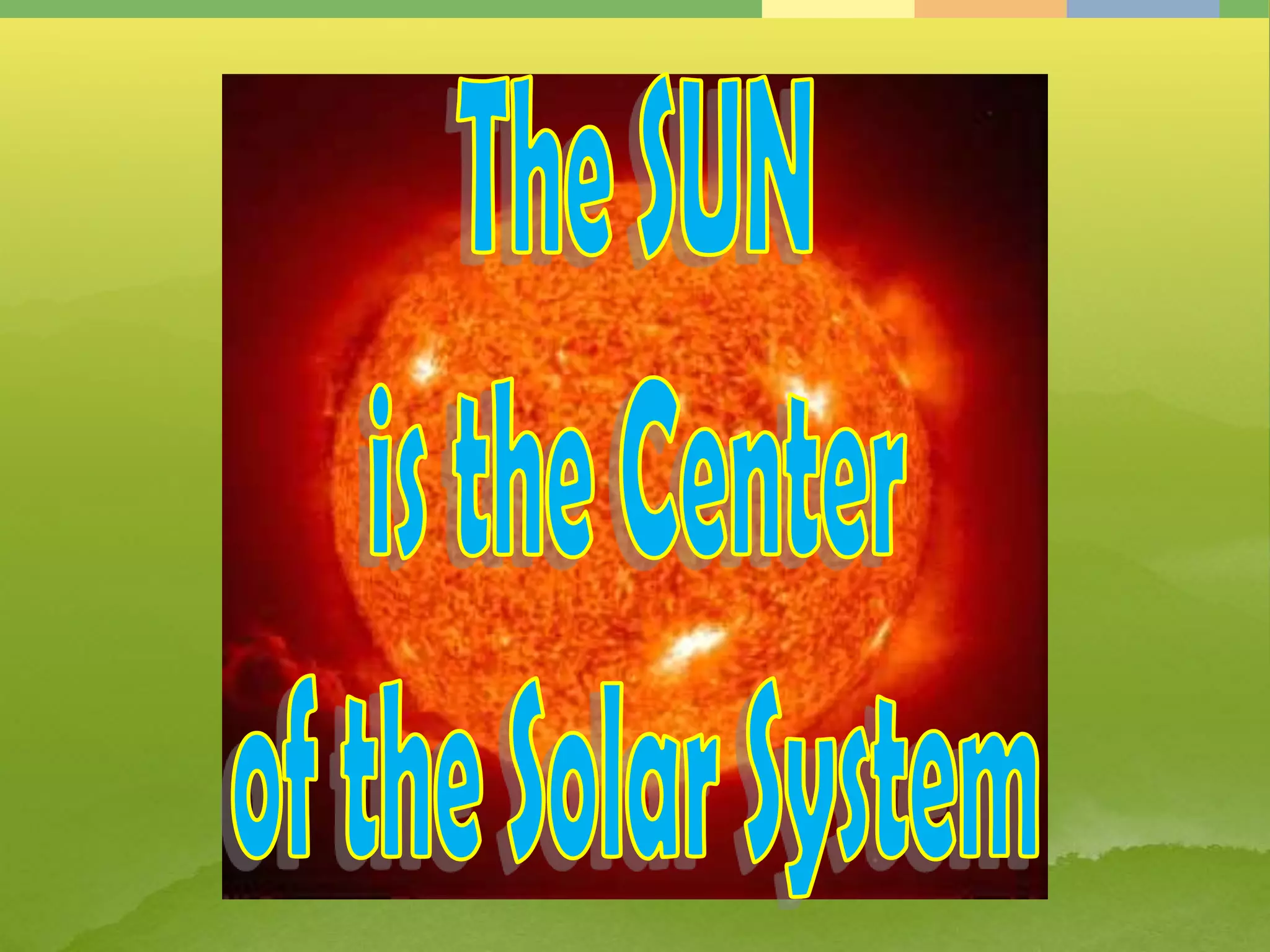
 The sun is the center of the solar
system.
 The sun is the only star in the solar
system.
 The sun is a sphere of hot, light
gases (hydrogen and helium) which
emits light and heat.
 There are 4 layers of the sun from
the center: the core, the
photosphere, the chromospheres
and the corona.
 There are 8 planets in the solar
system – (inner)
Mercury, Venus, Earth, Mars, (ou
ter)
Jupiter, Saturn, Uranus, Neptune
 Inner planets are rocky while
outer planets are gaseous.
 Planets differ in their distances
from the sun, sizes and
temperature.
 The distance of a planet from the
sun affects its period of
revolution. The nearer the planet
to the sun, the shorter its period of
revolution; the farther the planet
from the sun, the longer its period
of revolution.
 Earth is the only planet where life
exists.
 Earth is the densest planet.
 Surface or cloud temperature of the
planets differ depending on their
distances from the sun. Thus, the
closest the planet to the sun, the
hottest is its temperature.
 Although Mercury is the nearest to
the sun, Venus is the hottest
because Venus is covered with
thick clouds of carbon dioxide
which traps the heat absorbed from
the sun.
Thank you!!!
Marites M. Aday
Master Teacher I
Naujan West
signing off….

My solar system

  • 2.
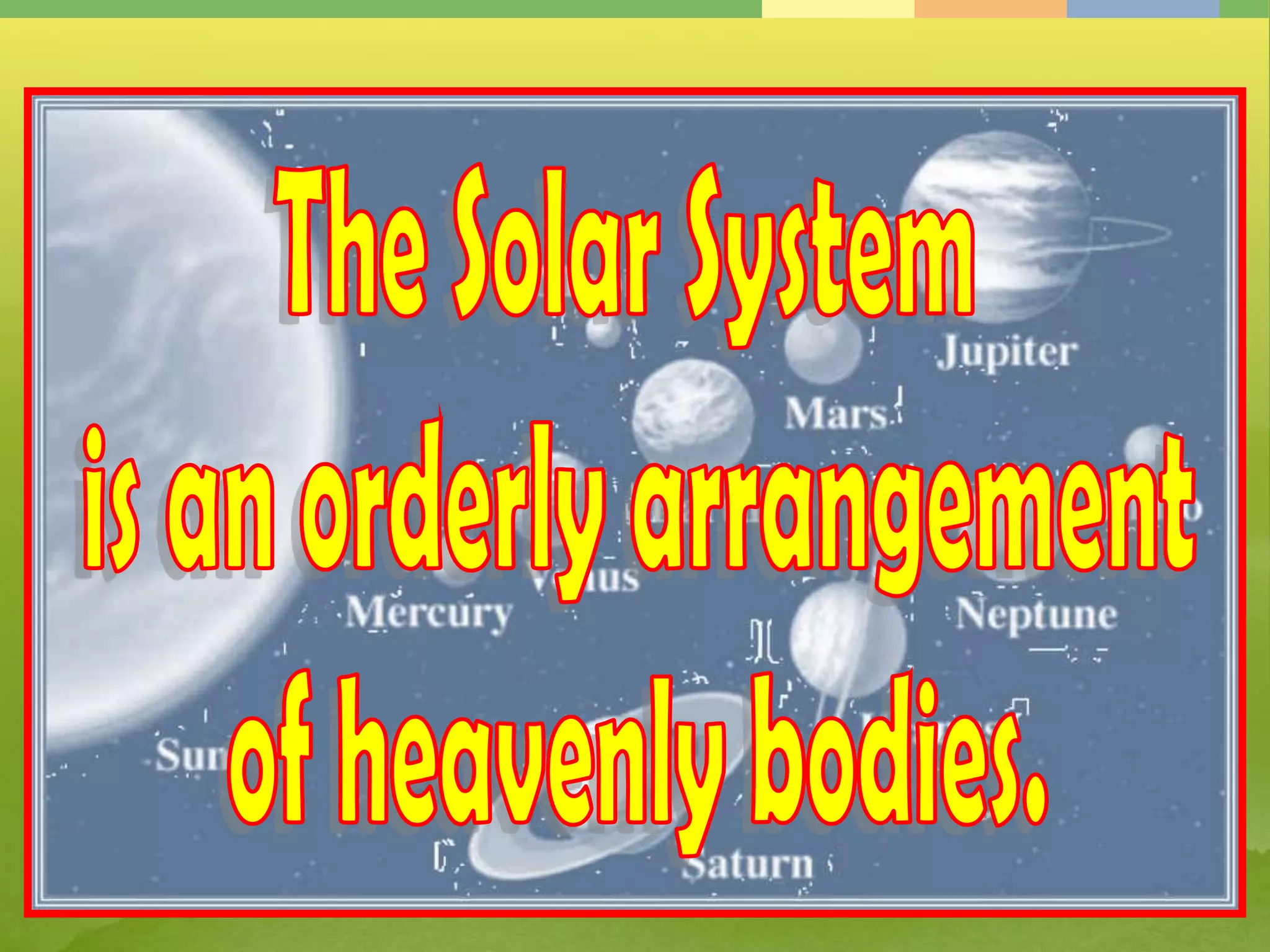
    The planets makeup only 0.135 % of the mass in our solar system. The Sun dominates, accounting for 99.86 % of the entire solar system's mass. Did you know that…?
  • 3.
    SOLAR SYSTEMS, GALAXIESAND THE UNIVERSE OUR SUN is one of millions of stars that orbit the centre of… THE MILKY WAY, which is one of a billion galaxies that orbit and move away from the centre of… THE UNIVERSE (Basically, everything in the universe orbits around something else)
  • 4.
    The Sun isin a galaxy called The Milky Way. Almost all the stars which can be seen from the Earth are part of this galaxy.
  • 5.
    The Sun is150 million kilometres away from us. It has a massive diameter of 1,393,000 km. Our Sun was probably formed from a large cloud of gas about 5,000 million years ago. THE SUN
  • 6.
    Why is suna STAR? How is it to be a STAR? What proves that SUN is a STAR? Made of light gases. Made of gases – hydrogen and helium Emits light and heat Nuclear reaction in the core turns hydrogen atom into helium thus, creating vast amount of energy (including heat and light) Sphere of hot gas Sun is not solid but a dense mass of gas.
  • 7.
  • 8.
    THE SUN andIts PARTS  The innermost portion is the core. This is the hottest part. This is surrounded by ring of hot gases called the convection zone.  The visible surface of the sun is called the photosphere. This is where the diameter of the sun is measured.  The next layer is bright red in color and is called the chromospheres.  The outermost layer is the sun’s crown or corona. It is seen as a faint silver white light.  Prominences is a huge arch of gas that appears to shoot outward from the chromospheres.
  • 10.
    All planets (apartfrom Pluto) orbit in the same plane… solar system is flat
  • 11.
    All planets orbitthe Sun in same sense. The Sun and all planets (apart from Venus and Uranus) rotate in the same sense as the planets orbit the Sun. Inner planets are small and rocky, but outer planets are large and gassy. Planets’ orbits are elliptical
  • 12.
    There are eightplanets in our solar system: SUN
  • 13.
    Inner Planets: Mercury,Venus, Earth, Mars Outer Planets: Jupiter, Saturn, Uranus, Neptune
  • 14.
    This planet is Mercury.The small rocky planet is the closest planet to the sun. Like our moon, Mercury has almost no atmosphere. Mercury is the smallest planet in the solar system. MERCUR Y
  • 15.
    This planet isVenus. If you would look at Venus and Earth they would look like they would be twins. Venus is covered by thick, rapidly spinning clouds that trap surface heat, creating a scorched greenhouse-like world with temperatures hot enough to melt lead and pressure so intense that standing on Venus would feel like the pressure felt 900 meters deep in Earth’s oceans. VENUS
  • 16.
    Earth is our homeplanet. It is the only planet known in our solar system that has life. Some facts are well known. For instance, Earth is the third planet from the sun and is the fifth largest planet. EART H
  • 17.
    Mars is asmall rocky planet. Sometimes there are great dust storms on Mars although scientist are sure Mars once had water. Scientist believe that 3.5 billion years ago, Mars had the largest flood in the solar system. Mars also has two small moons, Phobos and Deimos. MARS
  • 18.
    Jupiter is almosta “mini solar system.” It has many moons and rings. Jupiter is the biggest planet in our solar system. It looks a lot like a small star. In fact, if Jupiter had been between fifty to one hundred times more massive, it would have become a star rather than a planet. JUPITER
  • 19.
    This planet is Saturn.Saturn is a gas giant made mostly of hydrogen and helium. Saturn has rings that are made mostly of water ice. The particles in the rings range in size from dust mites to houses! Saturn has at least 60 observed satellites. SATURN
  • 20.
    This planet is Uranus.Uranus is known as a “gas giant” because it has no solid surface. It gets it’s blue- green color from methane gas above the deep cloud layers. Methane absorbs red light and reflects blue light. Uranus has about 20 moons. URANU S
  • 21.
    This planet is Neptune.Neptune was discovered in 1846. Neptune orbits the sun every 165 years. Neptune has the smallest diameter of our solar system’s giant gas planets (including Jupiter, Saturn, and Uranus). NEPTUNE
  • 22.
    PLANETS MEAN DISTANCE FROM THE SUN (miles) ORBITAL PERIOD MEAN TEMPERA- TURE (°C) DIAMETER MERCURY 35,980,00088 days 179 3,031 mi VENUS 67,230,000 243 days 482 7,520 mi EARTH 92,960,000 365.26 days 15 7,926 mi MARS 141,700,000 687 days -63 4,220 mi JUPITER 483,700,000 11.86 years -121 88,846 mi SATURN 886,700,000 29.46 years -125 74,901 mi URANUS 1.784 billion 84.01 years -193 31,765 mi NEPTUNE 2.794 billion 165 years -193 to -153 30,775 mi
  • 23.
    Asteroids - aremillions of small planet-like bodies. Asteroids are not a star. They are rock, irregularly-shaped objects. They are minor planets. Their sizes differ. They are found between the orbits of Mars and Jupiter.
  • 25.
     Meteoroids –are small pieces of stone or metal travelling in space. Most meteoroids are fragments from comets or asteroids that broke off from crashes in space with other objects. A few are actually chunks that blew of the Moon or Mars after an asteroid hit. When a meteoroid enters the earth’s atmosphere, it usually burns up completely. This streak of light is called a meteor, or shooting star. If a piece of a meteoroid survives its trip through our atmosphere and lands on earth, it is called a meteorite.
  • 26.
     The sunis the center of the solar system.  The sun is the only star in the solar system.  The sun is a sphere of hot, light gases (hydrogen and helium) which emits light and heat.  There are 4 layers of the sun from the center: the core, the photosphere, the chromospheres and the corona.
  • 27.
     There are8 planets in the solar system – (inner) Mercury, Venus, Earth, Mars, (ou ter) Jupiter, Saturn, Uranus, Neptune  Inner planets are rocky while outer planets are gaseous.  Planets differ in their distances from the sun, sizes and temperature.
  • 28.
     The distanceof a planet from the sun affects its period of revolution. The nearer the planet to the sun, the shorter its period of revolution; the farther the planet from the sun, the longer its period of revolution.  Earth is the only planet where life exists.  Earth is the densest planet.
  • 29.
     Surface orcloud temperature of the planets differ depending on their distances from the sun. Thus, the closest the planet to the sun, the hottest is its temperature.  Although Mercury is the nearest to the sun, Venus is the hottest because Venus is covered with thick clouds of carbon dioxide which traps the heat absorbed from the sun.
  • 31.
    Thank you!!! Marites M.Aday Master Teacher I Naujan West signing off….