CASE-BASED LEARNING ON WEB USING QUESTIONING
    TECHNIQUES AND REFLECTIVE THINKING UPON
  CRITICAL THINKING OF UNDERGRADUATE STUDENTS !


                                                          Danucha Saleewong!
                                                         Faculty of Education,!
                                                    Valaya Alongkorn Rajabhat
                                                           University, Thailand!
                                                                                   !
                                                Praweenya Suwannatthachote!
                                                        Faculty of Education,!
                                            Chulalongkorn University, Thailand!
Edmedia 2012: 26-29 June 2012 Denver, USA                                          !
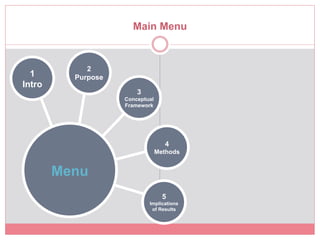
Main Menu!

             2
  1       Purpose
Intro
                        3
                    Conceptual
                    Framework


                                   4
                                 Methods


        Menu
                                   5
                            Implications
                             of Results
Introduction!


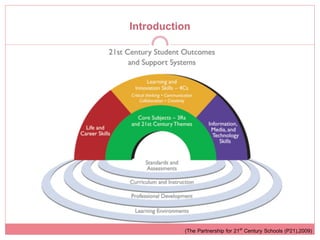
           (The Partnership for 21st Century Schools (P21),2009)!
Introduction!

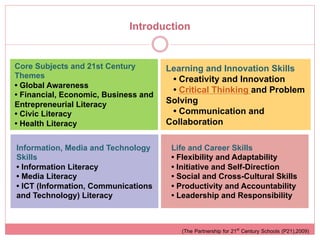
Core Subjects and 21st Century        Learning and Innovation Skills
Themes                                 • Creativity and Innovation
• Global Awareness
                                       • Critical Thinking and Problem
• Financial, Economic, Business and
Entrepreneurial Literacy              Solving
• Civic Literacy                       • Communication and
• Health Literacy                     Collaboration

Information, Media and Technology      Life and Career Skills
Skills                                 • Flexibility and Adaptability
• Information Literacy                 • Initiative and Self-Direction
• Media Literacy                       • Social and Cross-Cultural Skills
• ICT (Information, Communications     • Productivity and Accountability
and Technology) Literacy               • Leadership and Responsibility


                                         (The Partnership for 21st Century Schools (P21),2009)!
Introduction!


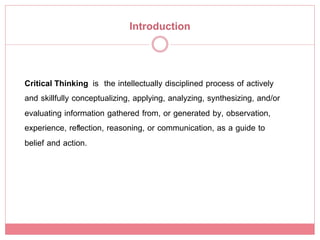
Critical Thinking is the intellectually disciplined process of actively
and skillfully conceptualizing, applying, analyzing, synthesizing, and/or
evaluating information gathered from, or generated by, observation,
experience, reflection, reasoning, or communication, as a guide to
belief and action.!
Introduction!

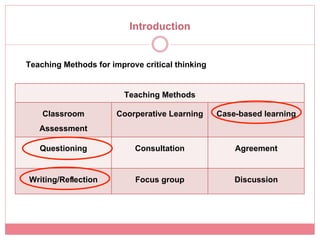
Teaching Methods for improve critical thinking!

                         Teaching Methods!
    Classroom          Coorperative Learning!     Case-based learning!
   Assessment!
   Questioning!             Consultation!             Agreement!

Writing/Reflection!          Focus group!              Discussion!
Introduction!


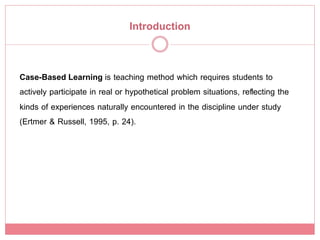
Case-Based Learning is teaching method which requires students to
actively participate in real or hypothetical problem situations, reflecting the
kinds of experiences naturally encountered in the discipline under study
(Ertmer & Russell, 1995, p. 24). !
Research Question!


-  how students can develop critical thinking skills using the method of
   case-based learning on web using questioning techniques and reflective
   thinking upon critical thinking !

-  how to use the questioning technique and reflective thinking which they
   can develop the critical thinking of students best!
Purpose!


-  To study effect of case-based learning on web using questioning
   techniques and reflective thinking upon critical thinking !

-  To study effect of use the difference questioning technique and reflective
   thinking which they can develop the critical thinking of students best!
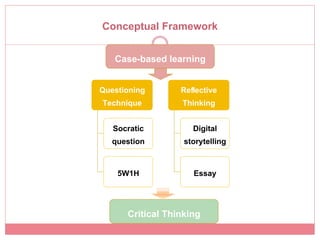
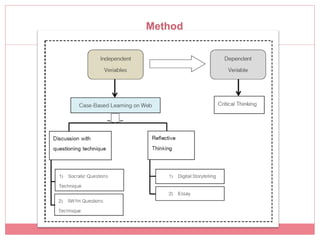
Conceptual Framework!

   Case-based learning !

Questioning         Reflective
 Technique!         Thinking!

   Socratic            Digital
   question!         storytelling!

    5W1H!               Essay!


       Critical Thinking !
Method!

Experimental Research !
!
Data collection : Quantitative data and Qualitative data!
!
Participants!
!
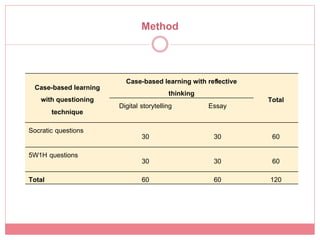
Two classes of undergraduate students (n=120), 60 students in each class,
from Communication Arts at university in Thailand by Purposive Sampling. !
Method!

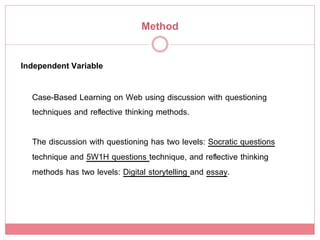
Independent Variable!

  Case-Based Learning on Web using discussion with questioning
  techniques and reflective thinking methods.!
  !
  The discussion with questioning has two levels: Socratic questions
  technique and 5W1H questions technique, and reflective thinking
  methods has two levels: Digital storytelling and essay.!
Method!
Method!


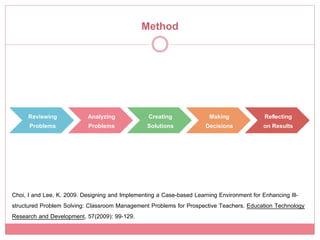
     Reviewing             Analyzing            Creating              Making              Reflecting
     Problems!             Problems!            Solutions!           Decisions!           on Results!


Choi, I and Lee, K. 2009. Designing and Implementing a Case-based Learning Environment for Enhancing Ill-
structured Problem Solving: Classroom Management Problems for Prospective Teachers. Education Technology
Research and Development, 57(2009): 99-129.!
Method!
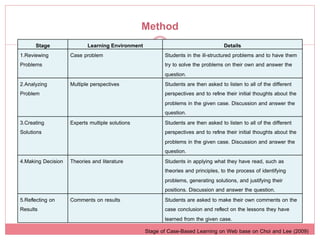
      Stage!              Learning Environment!                                      Details !
1.Reviewing         Case problem!                        Students in the ill-structured problems and to have them
Problems!                                                try to solve the problems on their own and answer the
                                                         question.!
2.Analyzing         Multiple perspectives!               Students are then asked to listen to all of the different
Problem!                                                 perspectives and to refine their initial thoughts about the
                                                         problems in the given case. Discussion and answer the
                                                         question.!
3.Creating          Experts multiple solutions!          Students are then asked to listen to all of the different
Solutions!                                               perspectives and to refine their initial thoughts about the
                                                         problems in the given case. Discussion and answer the
                                                         question.!
4.Making Decision! Theories and literature!              Students in applying what they have read, such as
                                                         theories and principles, to the process of identifying
                                                         problems, generating solutions, and justifying their
                                                         positions. Discussion and answer the question.!
5.Reflecting on      Comments on results!                 Students are asked to make their own comments on the
Results!                                                 case conclusion and reflect on the lessons they have
                                                         learned from the given case. !
                                                  Stage of Case-Based Learning on Web base on Choi and Lee (2009)!
Method!


                          Case-based learning with reflective
  Case-based learning
                                           thinking!
   with questioning                                            Total!
                        Digital storytelling!        Essay!
      technique!
Socratic questions!
                              30!                   30!         60!
5W1H questions!
                              30!                   30!         60!
Total!                        60!                   60!        120!
Method!
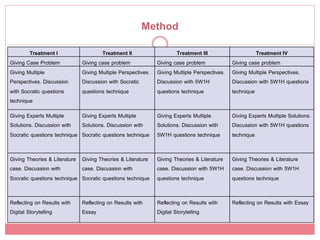
        Treatment I!                 Treatment II!                   Treatment III!                     Treatment IV!
Giving Case Problem!         Giving case problem!            Giving case problem!            Giving case problem!
Giving Multiple              Giving Multiple Perspectives.   Giving Multiple Perspectives.   Giving Multiple Perspectives.
Perspectives. Discussion     Discussion with Socratic        Discussion with 5W1H            Discussion with 5W1H questions
with Socratic questions      questions technique!            questions technique!            technique!
technique!
Giving Experts Multiple       Giving Experts Multiple       Giving Experts Multiple          Giving Experts Multiple Solutions.
Solutions. Discussion with Solutions. Discussion with       Solutions. Discussion with       Discussion with 5W1H questions
Socratic questions technique! Socratic questions technique! 5W1H questions technique!        technique!


Giving Theories & Literature Giving Theories & Literature Giving Theories & Literature       Giving Theories & Literature
case. Discussion with         case. Discussion with         case. Discussion with 5W1H       case. Discussion with 5W1H
Socratic questions technique! Socratic questions technique! questions technique!             questions technique!


Reflecting on Results with    Reflecting on Results with       Reflecting on Results with       Reflecting on Results with Essay!
Digital Storytelling!        Essay!                          Digital Storytelling!
Method!

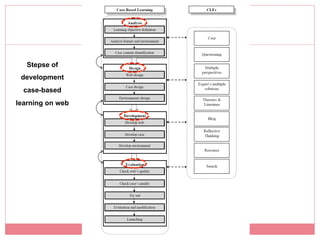
    Stepse of
  development
   case-based
learning on web!
Method!
Method!
Method!
Method!
Method!
Method!
Method!
Implications of Results

this research would help develop a critical thinking, as well as, help
guarantee that using technology-based instructional strategies would help
develop advanced and in-depth knowledge of learners!
CASE-BASED LEARNING ON WEB USING QUESTIONING
  TECHNIQUES AND REFLECTIVE THINKING UPON
CRITICAL THINKING OF UNDERGRADUATE STUDENTS !


                                 Danucha Saleewong!
                               nuchcha_s@hotmail.com !
               Thank You!                 !
                             Praweenya Suwannatthachote!
                                praweenya@gmail.com!

Present danucha

  • 1.
    CASE-BASED LEARNING ONWEB USING QUESTIONING TECHNIQUES AND REFLECTIVE THINKING UPON CRITICAL THINKING OF UNDERGRADUATE STUDENTS ! Danucha Saleewong! Faculty of Education,! Valaya Alongkorn Rajabhat University, Thailand! ! Praweenya Suwannatthachote! Faculty of Education,! Chulalongkorn University, Thailand! Edmedia 2012: 26-29 June 2012 Denver, USA !
  • 2.
    Main Menu! 2 1 Purpose Intro 3 Conceptual Framework 4 Methods Menu 5 Implications of Results
  • 3.
    Introduction! (The Partnership for 21st Century Schools (P21),2009)!
  • 4.
    Introduction! Core Subjects and21st Century Learning and Innovation Skills Themes • Creativity and Innovation • Global Awareness • Critical Thinking and Problem • Financial, Economic, Business and Entrepreneurial Literacy Solving • Civic Literacy • Communication and • Health Literacy Collaboration Information, Media and Technology Life and Career Skills Skills • Flexibility and Adaptability • Information Literacy • Initiative and Self-Direction • Media Literacy • Social and Cross-Cultural Skills • ICT (Information, Communications • Productivity and Accountability and Technology) Literacy • Leadership and Responsibility (The Partnership for 21st Century Schools (P21),2009)!
  • 5.
    Introduction! Critical Thinking isthe intellectually disciplined process of actively and skillfully conceptualizing, applying, analyzing, synthesizing, and/or evaluating information gathered from, or generated by, observation, experience, reflection, reasoning, or communication, as a guide to belief and action.!
  • 6.
    Introduction! Teaching Methods forimprove critical thinking! Teaching Methods! Classroom Coorperative Learning! Case-based learning! Assessment! Questioning! Consultation! Agreement! Writing/Reflection! Focus group! Discussion!
  • 7.
    Introduction! Case-Based Learning isteaching method which requires students to actively participate in real or hypothetical problem situations, reflecting the kinds of experiences naturally encountered in the discipline under study (Ertmer & Russell, 1995, p. 24). !
  • 8.
    Research Question! -  howstudents can develop critical thinking skills using the method of case-based learning on web using questioning techniques and reflective thinking upon critical thinking ! -  how to use the questioning technique and reflective thinking which they can develop the critical thinking of students best!
  • 9.
    Purpose! -  To studyeffect of case-based learning on web using questioning techniques and reflective thinking upon critical thinking ! -  To study effect of use the difference questioning technique and reflective thinking which they can develop the critical thinking of students best!
  • 10.
    Conceptual Framework! Case-based learning ! Questioning Reflective Technique! Thinking! Socratic Digital question! storytelling! 5W1H! Essay! Critical Thinking !
  • 11.
    Method! Experimental Research ! ! Datacollection : Quantitative data and Qualitative data! ! Participants! ! Two classes of undergraduate students (n=120), 60 students in each class, from Communication Arts at university in Thailand by Purposive Sampling. !
  • 12.
    Method! Independent Variable! Case-Based Learning on Web using discussion with questioning techniques and reflective thinking methods.! ! The discussion with questioning has two levels: Socratic questions technique and 5W1H questions technique, and reflective thinking methods has two levels: Digital storytelling and essay.!
  • 13.
  • 14.
    Method! Reviewing Analyzing Creating Making Reflecting Problems! Problems! Solutions! Decisions! on Results! Choi, I and Lee, K. 2009. Designing and Implementing a Case-based Learning Environment for Enhancing Ill- structured Problem Solving: Classroom Management Problems for Prospective Teachers. Education Technology Research and Development, 57(2009): 99-129.!
  • 15.
    Method! Stage! Learning Environment! Details ! 1.Reviewing Case problem! Students in the ill-structured problems and to have them Problems! try to solve the problems on their own and answer the question.! 2.Analyzing Multiple perspectives! Students are then asked to listen to all of the different Problem! perspectives and to refine their initial thoughts about the problems in the given case. Discussion and answer the question.! 3.Creating Experts multiple solutions! Students are then asked to listen to all of the different Solutions! perspectives and to refine their initial thoughts about the problems in the given case. Discussion and answer the question.! 4.Making Decision! Theories and literature! Students in applying what they have read, such as theories and principles, to the process of identifying problems, generating solutions, and justifying their positions. Discussion and answer the question.! 5.Reflecting on Comments on results! Students are asked to make their own comments on the Results! case conclusion and reflect on the lessons they have learned from the given case. ! Stage of Case-Based Learning on Web base on Choi and Lee (2009)!
  • 16.
    Method! Case-based learning with reflective Case-based learning thinking! with questioning Total! Digital storytelling! Essay! technique! Socratic questions! 30! 30! 60! 5W1H questions! 30! 30! 60! Total! 60! 60! 120!
  • 17.
    Method! Treatment I! Treatment II! Treatment III! Treatment IV! Giving Case Problem! Giving case problem! Giving case problem! Giving case problem! Giving Multiple Giving Multiple Perspectives. Giving Multiple Perspectives. Giving Multiple Perspectives. Perspectives. Discussion Discussion with Socratic Discussion with 5W1H Discussion with 5W1H questions with Socratic questions questions technique! questions technique! technique! technique! Giving Experts Multiple Giving Experts Multiple Giving Experts Multiple Giving Experts Multiple Solutions. Solutions. Discussion with Solutions. Discussion with Solutions. Discussion with Discussion with 5W1H questions Socratic questions technique! Socratic questions technique! 5W1H questions technique! technique! Giving Theories & Literature Giving Theories & Literature Giving Theories & Literature Giving Theories & Literature case. Discussion with case. Discussion with case. Discussion with 5W1H case. Discussion with 5W1H Socratic questions technique! Socratic questions technique! questions technique! questions technique! Reflecting on Results with Reflecting on Results with Reflecting on Results with Reflecting on Results with Essay! Digital Storytelling! Essay! Digital Storytelling!
  • 18.
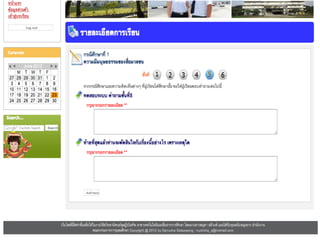
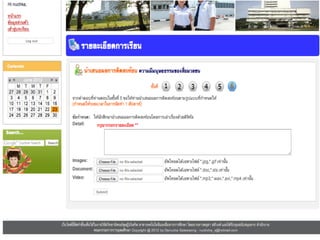
    Method! Stepse of development case-based learning on web!
  • 19.
  • 20.
  • 21.
  • 22.
  • 23.
  • 24.
  • 25.
  • 26.
    Implications of Results thisresearch would help develop a critical thinking, as well as, help guarantee that using technology-based instructional strategies would help develop advanced and in-depth knowledge of learners!
  • 27.
    CASE-BASED LEARNING ONWEB USING QUESTIONING TECHNIQUES AND REFLECTIVE THINKING UPON CRITICAL THINKING OF UNDERGRADUATE STUDENTS ! Danucha Saleewong! nuchcha_s@hotmail.com ! Thank You! ! Praweenya Suwannatthachote! praweenya@gmail.com!