The Slikipedia Project Richard Smyth/Abaris Brautigan Naomi Malone/Eirene Janus LIBRARIES AND IMMERSIVE LEARNING ENVIRONMENTS IN 3-D VIRTUAL WORLDS 6 December 2007
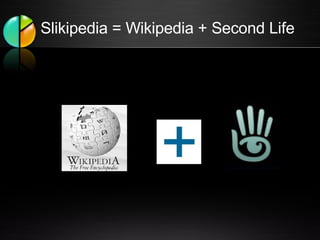
Slikipedia = Wikipedia + Second Life
Vision Objects in SL that allow for collaborative editing 3D Environment as Allegorical Infoscape Collective Intelligence manifest in spatialized form Precedent:  Wikitecture  http:// youtube.com/watch?v =Z3eWKIJxzyc
Theory Grammatology Theory and History of Communicative Practices Orality (Songlines/Storytracking):  embedding stories in space Literacy (Memory Palace/Mnemonics):  embedding argumentative topics in space “ Electracy”:  augmenting enhanced understanding of brain as “emotional thinking machine”
Theory Cognitive Science Conceptual Metaphor/Metaphorical Concept:  Mind = Body Moving Through Space Thinking is Moving Ideas are Locations A Line of Thought is a Path Understanding is Following 3D Environment becomes Allegorical Infoscape
Big Idea #1: Electracy literacy : print culture :: electracy : digital culture single term avoids multiple phrases (digital literacy, media literacy, information literacy, computer literacy, critical literacy, participatory media literacy, new literacies) avoids contradiction in root of “literacy” ( littera  – letter) literacy : analytical mind :: electracy : affective body literacy augments reasoning:  creation of “texts” electracy augments emotioning:  creation of “felts” technology as “mnemonic prosthesis”
Big Idea #2: Library as Conversation “ Knowledge is created through conversation” “ Conversations can take place between friends and colleagues in the ‘here and now.’ But they can also take place over centuries, with the participants changing but the theme remaining the same, and the conversation being recorded in thousands of artifacts, like books, pictures, and digital files.” “ The implication of this rather abstract concept is that libraries are in the conversation business.” from  Participatory Networks:  The Library as Conversation”  (Lankes, Silverstein, Nicholson) http://ptbed.org/ParticiaptoryNetworks.pdf
Learning as a Communal Activity " Conversation is the engine of knowledge.  It's the generative activity of civilization." Andrew Hinton, "Architectures for Conversation", IA Summit 2007   Top-Down Hierarchy (i.e. traditional classroom) vs. Emergent Organic Network (friends, crowds)   Slikipedia Learning Environment:  Using the slikipedia platform, students are a community of practice who collaborate to produce knowledge closer to emergent organic network, but the top-down hierarchy is still needed.
The Slikipedia Platform "I created the platform, and then I got out of the way.  Sometimes, the best thing you can do is get out of the way." Craig Newmark, creator of Craigslist   The platform and rules of engagement are provided by the learning organization (university, library, etc.) and a community of practice develops around the area of interest (topic or project for conversation) Our model:  The topic of conversation (platform) is Just War Theory.  Rules of engagement are the tools that the participants use to create/edit/share their knowledge. based on Wikitecture tree model ( http:// youtube.com/watch?v =Z3eWKIJxzyc )
Slikipedia Community of Practice The concept of a  community of practice  refers to the process of social learning that occurs when people who have a common interest in some subject or problem collaborate over an extended period to share ideas, find solutions, and build innovations. It refers as well to the stable group that is formed from such regular interactions.  The learner interacts with the knowledge, the learning environment, and with other learners  to create and edit their interpretations of knowledge collaboratively    ‘ a shared canvas where every splash of paint contributed by one user provides a richer tapestry for the next user to modify or build on.’ (from "Wikitecture 2.0:  Designing the Architecture of Architectural Design Collaboration" http://studiowikitecture.files.wordpress.com/2007/04/wikitecture-20-program-and-protocol.pdf )
Slikipedia Interface/Implementation SL in-world interface: 3D Wiki Tree, with branches for major components and leaves as offshoots from those components-hovers over parcel to allow for freedom of evolution.   HUD and/or central input device where participants input/view/add comments/vote, etc.  Website to record meeting transcripts, blog, post videos and documents deriving from the project
Design Considerations Quality control & Accountability - collaborative review process   Does communal thought bring about better knowledge than individual intellect? (See "Digital Maoism" by Jaron Lanier  http://www.edge.org/3rd_culture/lanier06/lanier06_index.html  ) Program & Protocols  http://studiowikitecture.wikispaces.com/Wikitecture+2.0+-+Program+and+Protocol  
Contact Information Richard Smyth [email_address] Abaris Brautigan in SL Naomi Malone [email_address] Eirene Janus in SL Locus of Experiment:  http://slurl.com/secondlife/Clearwater%20Beach/128/128/0

The Slikipedia Project

  • 1.
    The Slikipedia ProjectRichard Smyth/Abaris Brautigan Naomi Malone/Eirene Janus LIBRARIES AND IMMERSIVE LEARNING ENVIRONMENTS IN 3-D VIRTUAL WORLDS 6 December 2007
  • 2.
  • 3.
    Vision Objects inSL that allow for collaborative editing 3D Environment as Allegorical Infoscape Collective Intelligence manifest in spatialized form Precedent: Wikitecture http:// youtube.com/watch?v =Z3eWKIJxzyc
  • 4.
    Theory Grammatology Theoryand History of Communicative Practices Orality (Songlines/Storytracking): embedding stories in space Literacy (Memory Palace/Mnemonics): embedding argumentative topics in space “ Electracy”: augmenting enhanced understanding of brain as “emotional thinking machine”
  • 5.
    Theory Cognitive ScienceConceptual Metaphor/Metaphorical Concept: Mind = Body Moving Through Space Thinking is Moving Ideas are Locations A Line of Thought is a Path Understanding is Following 3D Environment becomes Allegorical Infoscape
  • 6.
    Big Idea #1:Electracy literacy : print culture :: electracy : digital culture single term avoids multiple phrases (digital literacy, media literacy, information literacy, computer literacy, critical literacy, participatory media literacy, new literacies) avoids contradiction in root of “literacy” ( littera – letter) literacy : analytical mind :: electracy : affective body literacy augments reasoning: creation of “texts” electracy augments emotioning: creation of “felts” technology as “mnemonic prosthesis”
  • 7.
    Big Idea #2:Library as Conversation “ Knowledge is created through conversation” “ Conversations can take place between friends and colleagues in the ‘here and now.’ But they can also take place over centuries, with the participants changing but the theme remaining the same, and the conversation being recorded in thousands of artifacts, like books, pictures, and digital files.” “ The implication of this rather abstract concept is that libraries are in the conversation business.” from Participatory Networks: The Library as Conversation” (Lankes, Silverstein, Nicholson) http://ptbed.org/ParticiaptoryNetworks.pdf
  • 8.
    Learning as aCommunal Activity " Conversation is the engine of knowledge.  It's the generative activity of civilization." Andrew Hinton, "Architectures for Conversation", IA Summit 2007   Top-Down Hierarchy (i.e. traditional classroom) vs. Emergent Organic Network (friends, crowds)   Slikipedia Learning Environment:  Using the slikipedia platform, students are a community of practice who collaborate to produce knowledge closer to emergent organic network, but the top-down hierarchy is still needed.
  • 9.
    The Slikipedia Platform"I created the platform, and then I got out of the way.  Sometimes, the best thing you can do is get out of the way." Craig Newmark, creator of Craigslist   The platform and rules of engagement are provided by the learning organization (university, library, etc.) and a community of practice develops around the area of interest (topic or project for conversation) Our model:  The topic of conversation (platform) is Just War Theory.  Rules of engagement are the tools that the participants use to create/edit/share their knowledge. based on Wikitecture tree model ( http:// youtube.com/watch?v =Z3eWKIJxzyc )
  • 10.
    Slikipedia Community ofPractice The concept of a community of practice refers to the process of social learning that occurs when people who have a common interest in some subject or problem collaborate over an extended period to share ideas, find solutions, and build innovations. It refers as well to the stable group that is formed from such regular interactions. The learner interacts with the knowledge, the learning environment, and with other learners  to create and edit their interpretations of knowledge collaboratively    ‘ a shared canvas where every splash of paint contributed by one user provides a richer tapestry for the next user to modify or build on.’ (from "Wikitecture 2.0:  Designing the Architecture of Architectural Design Collaboration" http://studiowikitecture.files.wordpress.com/2007/04/wikitecture-20-program-and-protocol.pdf )
  • 11.
    Slikipedia Interface/Implementation SLin-world interface: 3D Wiki Tree, with branches for major components and leaves as offshoots from those components-hovers over parcel to allow for freedom of evolution.   HUD and/or central input device where participants input/view/add comments/vote, etc. Website to record meeting transcripts, blog, post videos and documents deriving from the project
  • 12.
    Design Considerations Qualitycontrol & Accountability - collaborative review process   Does communal thought bring about better knowledge than individual intellect? (See "Digital Maoism" by Jaron Lanier http://www.edge.org/3rd_culture/lanier06/lanier06_index.html  ) Program & Protocols http://studiowikitecture.wikispaces.com/Wikitecture+2.0+-+Program+and+Protocol  
  • 13.
    Contact Information RichardSmyth [email_address] Abaris Brautigan in SL Naomi Malone [email_address] Eirene Janus in SL Locus of Experiment: http://slurl.com/secondlife/Clearwater%20Beach/128/128/0