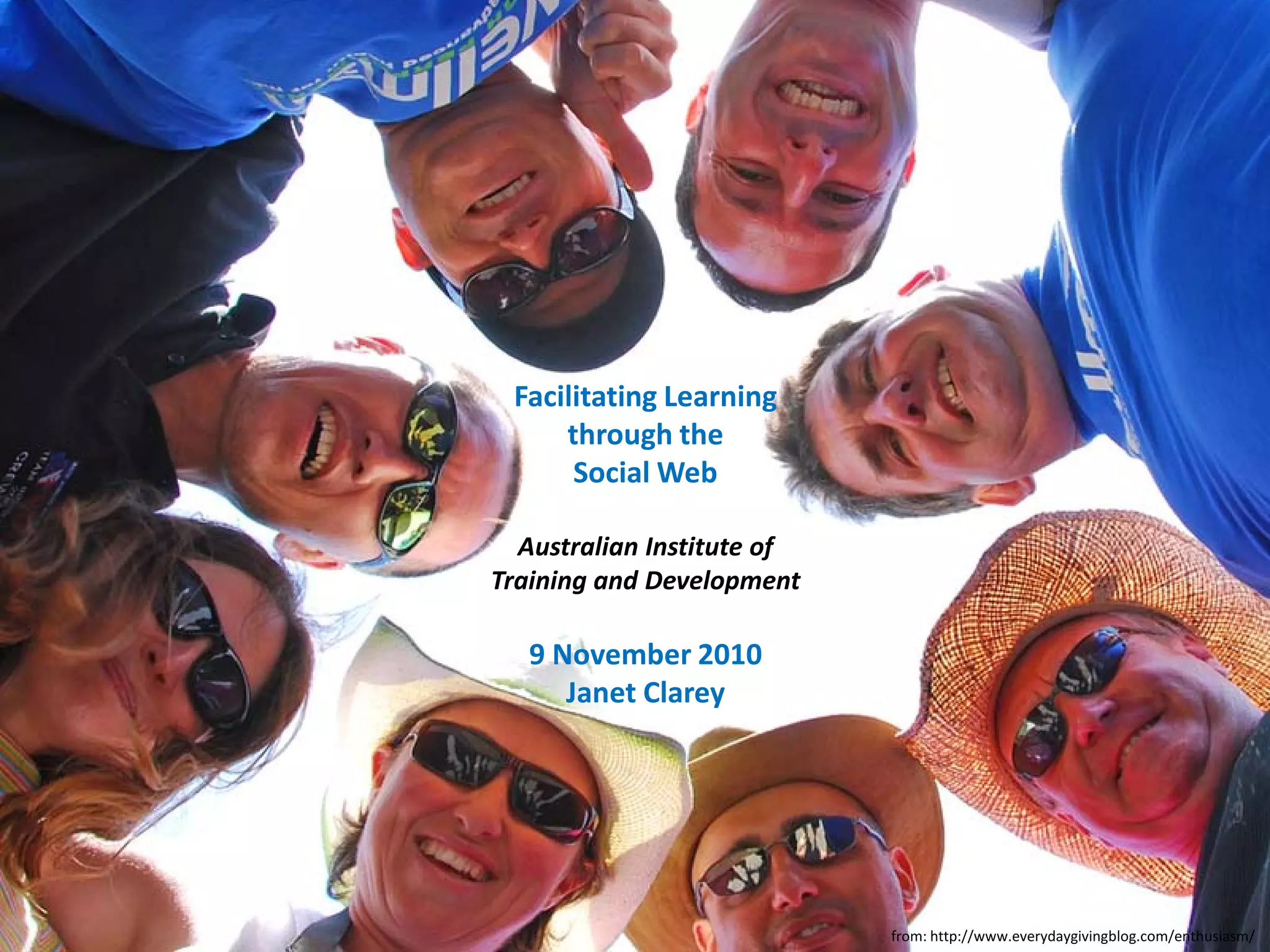
Facilitating Learning
     through the
      Social Web

  Australian Institute of
Training and Development

   9 November 2010
      Janet Clarey


                            from: http://www.everydaygivingblog.com/enthusiasm/
agenda
•   complexity of identity.
•   loose definitions.
•   what’s the same and what’s different?
•   social design and technical design.
•   new roles.
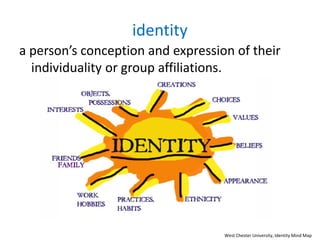
identity
a person’s conception and expression of their
  individuality or group affiliations.


                                   West Chester University, Identity Mind Map
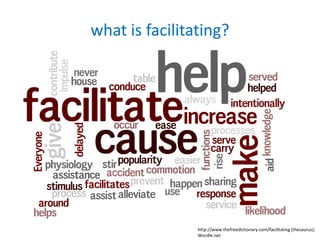
what is facilitating?


                http://www.thefreedictionary.com/facilitating (thesaurus);
                Wordle.net
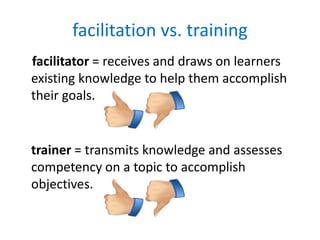
facilitation vs. training
facilitator = receives and draws on learners
existing knowledge to help them accomplish
their goals.


trainer = transmits knowledge and assesses
competency on a topic to accomplish
objectives.
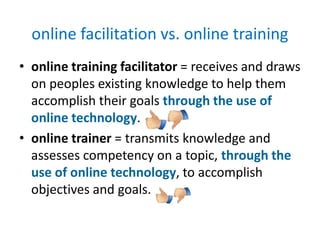
online facilitation vs. online training
• online training facilitator = receives and draws
  on peoples existing knowledge to help them
  accomplish their goals through the use of
  online technology.
• online trainer = transmits knowledge and
  assesses competency on a topic, through the
  use of online technology, to accomplish
  objectives and goals.
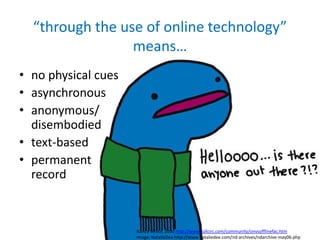
“through the use of online technology”
                 means…
• no physical cues
• asynchronous
• anonymous/
  disembodied
• text-based
• permanent
  record


                     Nancy White, 2000 http://www.fullcirc.com/community/onvsofflinefac.htm
                     Image: NatalieDee http://www.nataliedee.com/nd-archives/ndarchive-may06.php
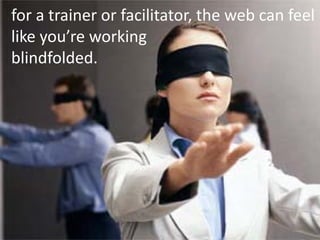
for a trainer or facilitator, the web can feel
like you’re working
blindfolded.
the individual
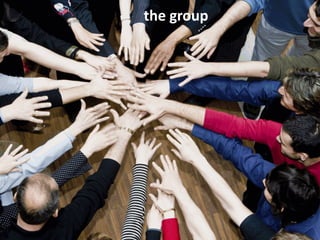
the group
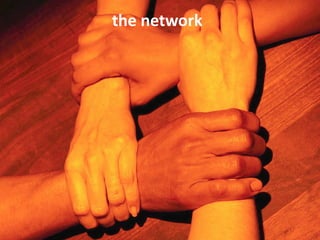
the network
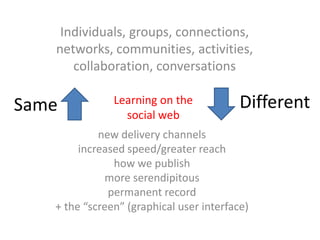
Individuals, groups, connections,
   networks, communities, activities,
      collaboration, conversations

Same           Learning on the            Different
                 social web
            new delivery channels
        increased speed/greater reach
               how we publish
             more serendipitous
              permanent record
   + the “screen” (graphical user interface)
Tech + Social:
     Technology has
fundamentally changed how
   we can be together

             Nancy White/Full Circle Associates and Matt Moore/Innotecture
             Designing for online communities: thinking about social and technical design
the technical design
   “…we are not in the business of pushing
  technology. We find solutions after we have
  identified the problems.”


                                 Quote: Nick Finck, UX (user experience) professional.
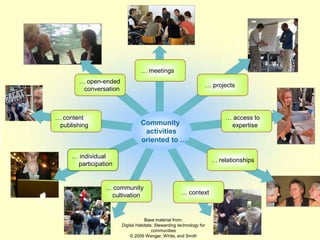
… meetings
       … open-ended
                                                                     … projects
        conversation


… content                                                                  … access to
 publishing                     Community                                   expertise
                                 activities
                                oriented to …

     … individual
                                                                       … relationships
      participation


                … community
                 cultivation                         … context


                                   Base material from:
                       Digital Habitats: Stewarding technology for
                                       communities
                           © 2009 Wenger, White, and Smith
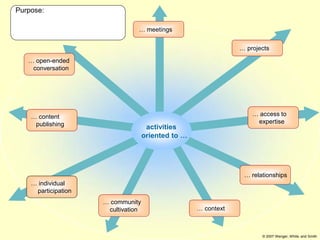
Purpose:

                                … meetings

                                                                … projects

   … open-ended
    conversation


    … content                                                       … access to
     publishing                                                      expertise
                                     activities
                                    oriented to …


                                                                 … relationships
    … individual
     participation
                     … community
                      cultivation                   … context


                                                                       © 2007 Wenger, White, and Smith
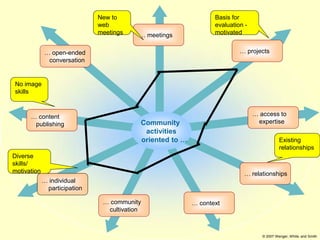
New to                             Basis for
                              web                                evaluation -
                              meetings    … meetings             motivated


             … open-ended                                                 … projects
              conversation


No image
skills


      … content                                                                 … access to
       publishing                         Community                              expertise
                                           activities
                                          oriented to …                                     Existing
                                                                                            relationships
Diverse
skills/
motivation                                                                 … relationships
             … individual
              participation

                               … community                … context
                                cultivation


                                                                                   © 2007 Wenger, White, and Smith
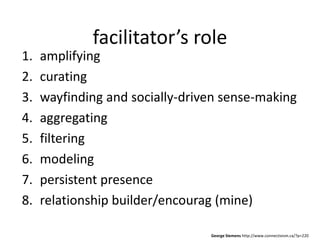
facilitator’s role
1.   amplifying
2.   curating
3.   wayfinding and socially-driven sense-making
4.   aggregating
5.   filtering
6.   modeling
7.   persistent presence
8.   relationship builder/encourag (mine)

                                 George Siemens http://www.connectivism.ca/?p=220
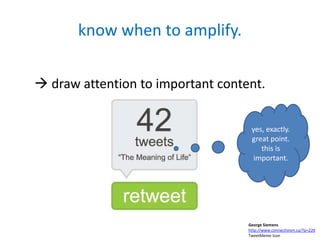
know when to amplify.

 draw attention to important content.


                                    yes, exactly.
                                    great point.
                                       this is
                                     important.


                                   George Siemens
                                   http://www.connectivism.ca/?p=220
                                   TweetMeme Icon
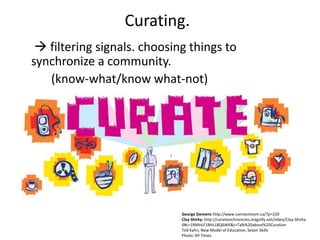
Curating.
  filtering signals. choosing things to
synchronize a community.
   (know-what/know what-not)


                             George Siemens http://www.connectivism.ca/?p=220
                             Clay Shirky: http://curationchronicles.magnify.net/video/Clay-Shirky-
                             6#c=1RMHLF18HLLBQ6WK&t=Talk%20about%20Curation
                             Ted Kahn, New Model of Education, Seven Skills
                             Photo: NY Times
“know-who”/“wayfinding”
              George Siemens http://www.connectivism.ca/?p=220
              Ted Kahn, New Model of Education, Seven Skills
              Photo: NY Times
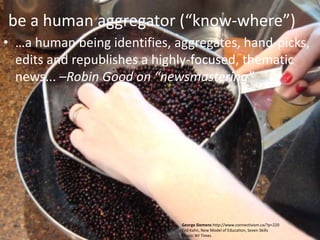
be a human aggregator (“know-where”)
• …a human being identifies, aggregates, hand-picks,
  edits and republishes a highly-focused, thematic
  news... –Robin Good on “newsmastering”


                              George Siemens http://www.connectivism.ca/?p=220
                              Ted Kahn, New Model of Education, Seven Skills
                              Photo: NY Times
provide a filtered stream
      (“what-if”)


            George Siemens http://www.connectivism.ca/?p=220
            Ted Kahn, New Model of Education, Seven Skills
            Photo: NY Times
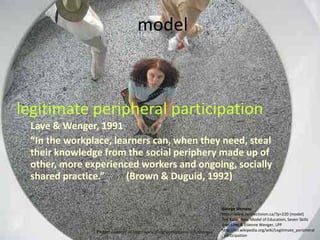
model


legitimate peripheral participation
 Lave & Wenger, 1991
 “In the workplace, learners can, when they need, steal
 their knowledge from the social periphery made up of
 other, more experienced workers and ongoing, socially
 shared practice.”     (Brown & Duguid, 1992)

                                                                                George Siemens
                                                                                http://www.connectivism.ca/?p=220 (model)
                                                                                Ted Kahn, New Model of Education, Seven Skills
                                                                                Jean Lave & Etienne Wenger, LPP
               Picture courtesy of http://www.flickr.com/photos/rollerboogie/   http://en.wikipedia.org/wiki/Legitimate_peripheral
                                                                                _participation
relationships.
social presence…being there
(“know-why…and care-why”)
    George Siemens http://www.connectivism.ca/?p=220
    Photo: http://pickmeyard.wordpress.com/
    Ted Kahn, New Model of Education, Seven Skills
Tech + Social:
     Technology has
fundamentally changed how
   we can be together

             Nancy White/Full Circle Associates and Matt Moore/Innotecture
             Designing for online communities: thinking about social and technical design
summary
• importance of identity.
• keeping the “old” good stuff, adding new
  good stuff.
• social design (purpose) + technical design.
• new roles
Let’s Connect

facebook.com/janet.clarey
     twitter.com/jclarey
  linkedin.com/in/jclarey
       janetclarey.com
     jclarey@gmail.com

        Thank You

    9 November 2010

Facilitating Lea

  • 1.
    Facilitating Learning through the Social Web Australian Institute of Training and Development 9 November 2010 Janet Clarey from: http://www.everydaygivingblog.com/enthusiasm/
  • 2.
    agenda • complexity of identity. • loose definitions. • what’s the same and what’s different? • social design and technical design. • new roles.
  • 3.
    identity a person’s conceptionand expression of their individuality or group affiliations. West Chester University, Identity Mind Map
  • 4.
    what is facilitating? http://www.thefreedictionary.com/facilitating (thesaurus); Wordle.net
  • 5.
    facilitation vs. training facilitator= receives and draws on learners existing knowledge to help them accomplish their goals. trainer = transmits knowledge and assesses competency on a topic to accomplish objectives.
  • 6.
    online facilitation vs.online training • online training facilitator = receives and draws on peoples existing knowledge to help them accomplish their goals through the use of online technology. • online trainer = transmits knowledge and assesses competency on a topic, through the use of online technology, to accomplish objectives and goals.
  • 7.
    “through the useof online technology” means… • no physical cues • asynchronous • anonymous/ disembodied • text-based • permanent record Nancy White, 2000 http://www.fullcirc.com/community/onvsofflinefac.htm Image: NatalieDee http://www.nataliedee.com/nd-archives/ndarchive-may06.php
  • 8.
    for a traineror facilitator, the web can feel like you’re working blindfolded.
  • 9.
  • 10.
  • 11.
  • 12.
    Individuals, groups, connections, networks, communities, activities, collaboration, conversations Same Learning on the Different social web new delivery channels increased speed/greater reach how we publish more serendipitous permanent record + the “screen” (graphical user interface)
  • 13.
    Tech + Social: Technology has fundamentally changed how we can be together Nancy White/Full Circle Associates and Matt Moore/Innotecture Designing for online communities: thinking about social and technical design
  • 14.
    the technical design  “…we are not in the business of pushing technology. We find solutions after we have identified the problems.” Quote: Nick Finck, UX (user experience) professional.
  • 15.
    … meetings … open-ended … projects conversation … content … access to publishing Community expertise activities oriented to … … individual … relationships participation … community cultivation … context Base material from: Digital Habitats: Stewarding technology for communities © 2009 Wenger, White, and Smith
  • 16.
    Purpose: … meetings … projects … open-ended conversation … content … access to publishing expertise activities oriented to … … relationships … individual participation … community cultivation … context © 2007 Wenger, White, and Smith
  • 17.
    New to Basis for web evaluation - meetings … meetings motivated … open-ended … projects conversation No image skills … content … access to publishing Community expertise activities oriented to … Existing relationships Diverse skills/ motivation … relationships … individual participation … community … context cultivation © 2007 Wenger, White, and Smith
  • 18.
    facilitator’s role 1. amplifying 2. curating 3. wayfinding and socially-driven sense-making 4. aggregating 5. filtering 6. modeling 7. persistent presence 8. relationship builder/encourag (mine) George Siemens http://www.connectivism.ca/?p=220
  • 19.
    know when toamplify.  draw attention to important content. yes, exactly. great point. this is important. George Siemens http://www.connectivism.ca/?p=220 TweetMeme Icon
  • 20.
    Curating.  filteringsignals. choosing things to synchronize a community. (know-what/know what-not) George Siemens http://www.connectivism.ca/?p=220 Clay Shirky: http://curationchronicles.magnify.net/video/Clay-Shirky- 6#c=1RMHLF18HLLBQ6WK&t=Talk%20about%20Curation Ted Kahn, New Model of Education, Seven Skills Photo: NY Times
  • 21.
    “know-who”/“wayfinding” George Siemens http://www.connectivism.ca/?p=220 Ted Kahn, New Model of Education, Seven Skills Photo: NY Times
  • 22.
    be a humanaggregator (“know-where”) • …a human being identifies, aggregates, hand-picks, edits and republishes a highly-focused, thematic news... –Robin Good on “newsmastering” George Siemens http://www.connectivism.ca/?p=220 Ted Kahn, New Model of Education, Seven Skills Photo: NY Times
  • 23.
    provide a filteredstream (“what-if”) George Siemens http://www.connectivism.ca/?p=220 Ted Kahn, New Model of Education, Seven Skills Photo: NY Times
  • 24.
    model legitimate peripheral participation Lave & Wenger, 1991 “In the workplace, learners can, when they need, steal their knowledge from the social periphery made up of other, more experienced workers and ongoing, socially shared practice.” (Brown & Duguid, 1992) George Siemens http://www.connectivism.ca/?p=220 (model) Ted Kahn, New Model of Education, Seven Skills Jean Lave & Etienne Wenger, LPP Picture courtesy of http://www.flickr.com/photos/rollerboogie/ http://en.wikipedia.org/wiki/Legitimate_peripheral _participation
  • 25.
  • 26.
    social presence…being there (“know-why…andcare-why”) George Siemens http://www.connectivism.ca/?p=220 Photo: http://pickmeyard.wordpress.com/ Ted Kahn, New Model of Education, Seven Skills
  • 27.
    Tech + Social: Technology has fundamentally changed how we can be together Nancy White/Full Circle Associates and Matt Moore/Innotecture Designing for online communities: thinking about social and technical design
  • 28.
    summary • importance ofidentity. • keeping the “old” good stuff, adding new good stuff. • social design (purpose) + technical design. • new roles
  • 29.
    Let’s Connect facebook.com/janet.clarey twitter.com/jclarey linkedin.com/in/jclarey janetclarey.com jclarey@gmail.com Thank You 9 November 2010