
Digital Media
Visitor Engagement in the Museum
Merel van der Vaart - @MerelVaart
Amsterdam School for Heritage & Memory Studies
Allard Pierson Museum
PhD Research:
Mediating the Museum:
The impact of on-gallery technology
on visitors' engagement with museum objects
(How) can technology help visitors engage with museum objects?
meSch
Material Encounters
with Digital Cultural Heritage
“meSch aims to co-design novel platforms
for the creation of tangible digital exhibits
at heritage sites”
Digital Artifacts Tangible Interaction Co-creation
Part 1: Theory
• Technology & Museums
• The Museum Visit
• Technology & Visitor Engagement
Part 2: Practice
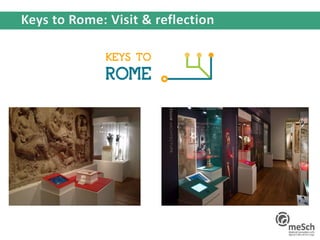
• Visit the exhibition Keys to Rome
Part 3: Reflection
• Discussion
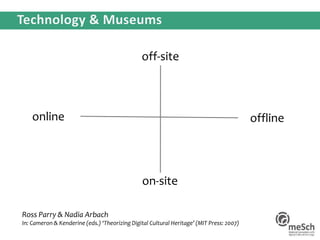
Ross Parry & Nadia Arbach
In: Cameron & Kenderine (eds.) ‘Theorizing Digital Cultural Heritage’ (MIT Press: 2007)
online offline
off-site
on-site
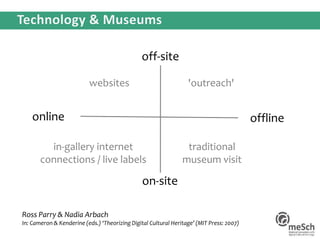
Ross Parry & Nadia Arbach
In: Cameron & Kenderine (eds.) ‘Theorizing Digital Cultural Heritage’ (MIT Press: 2007)
websites 'outreach'
in-gallery internet
connections / live labels
traditional
museum visit
online offline
off-site
on-site
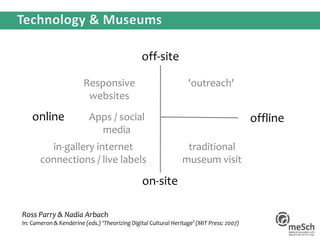
Ross Parry & Nadia Arbach
In: Cameron & Kenderine (eds.) ‘Theorizing Digital Cultural Heritage’ (MIT Press: 2007)
Responsive
websites
'outreach'
in-gallery internet
connections / live labels
traditional
museum visit
Apps / social
media
online offline
off-site
on-site
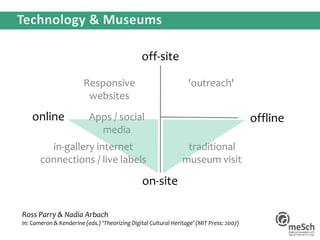
Ross Parry & Nadia Arbach
In: Cameron & Kenderine (eds.) ‘Theorizing Digital Cultural Heritage’ (MIT Press: 2007)
Responsive
websites
'outreach'
in-gallery internet
connections / live labels
traditional
museum visit
Apps / social
media
online offline
off-site
on-site
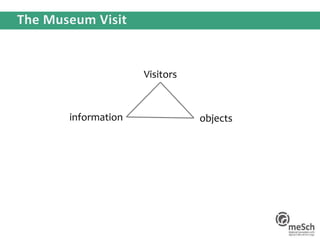
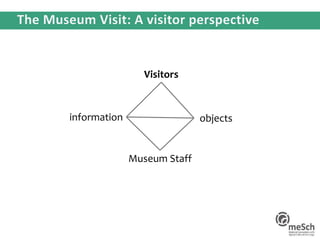
Visitors
information objects
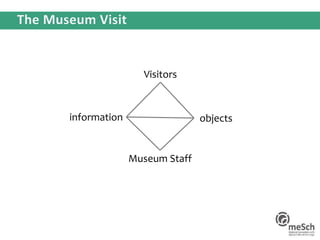
Visitors
information objects
Museum Staff
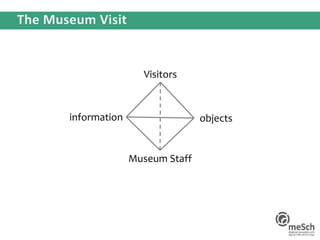
Visitors
information objects
Museum Staff
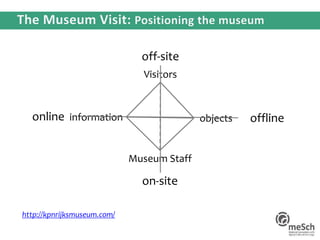
Visitors
information objects
Museum Staff
online offline
off-site
on-site
http://kpnrijksmuseum.com/
Visitors
information objects
Museum Staff
“Visitors are under no obligation to engage with free-choice
exhibition environments…
… and yet they do.”
Tiina Roppola
‘Designing for the Museum Visitor Experience’ (Routledge: 2012)
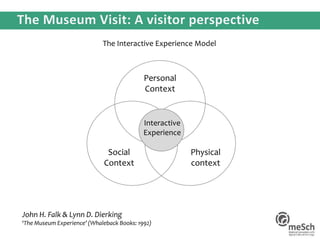
John H. Falk & Lynn D. Dierking
‘The Museum Experience’ (Whaleback Books: 1992)
The Interactive Experience Model
Physical
context
Social
Context
Personal
Context
Interactive
Experience
“on average, visitors use exhibitions at a rate of
200 to 400 square feet / 18,6 to 37,2 m2 per minute.”
The museum visit is a continuous decision-making process.
On average, visitors’ pace is high, because they only stop at a
small selection of all displays.
Beverly Serrell
‘Paying Attention: The Duration and Allocation of Visitors’ Time in Museum Exhibitions’
in Curator: The Museum Journal 40/2 (California Academy of Science: 1997)
“attention is selective
(…)
attention has focusing power
(…)
the capacity of attention is limited.”
Stephen Bitgood
‘The role of attention in designing effective interpretive labels’
in Journal of Interpretation Research 5/2 (National Association for Interpretation: 2000)
Visitors decide when and how they want to visit the museum.
Visitors have their own agenda when visiting the museum.
Visitors decide how to engage with exhibits & displays.
Some visitors like being guided, some don’t.
Visiting museums is exhausting & people know it.
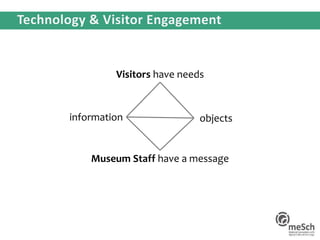
Visitors have needs
information objects
Museum Staff have a message
Museum staff:
Rich content, complexity, multimedial, layered narratives,
visitor-led exploration.
Visitor:
What does it do & how will I benefit?
How does it work?
How much attention (time/energy) is required?
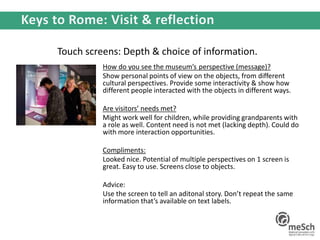
Touch screens: Depth & choice of information.
How do you see the museum’s perspective (message)?
Show personal points of view on the objects, from different
cultural perspectives. Provide some interactivity & show how
different people interacted with the objects in different ways.
Are visitors’ needs met?
Might work well for children, while providing grandparents with
a role as well. Content need is not met (lacking depth). Could do
with more interaction opportunities.
Compliments:
Looked nice. Potential of multiple perspectives on 1 screen is
great. Easy to use. Screens close to objects.
Advice:
Use the screen to tell an aditonal story. Don’t repeat the same
information that’s available on text labels.
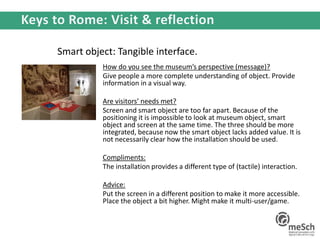
Smart object: Tangible interface.
How do you see the museum’s perspective (message)?
Give people a more complete understanding of object. Provide
information in a visual way.
Are visitors’ needs met?
Screen and smart object are too far apart. Because of the
positioning it is impossible to look at museum object, smart
object and screen at the same time. The three should be more
integrated, because now the smart object lacks added value. It is
not necessarily clear how the installation should be used.
Compliments:
The installation provides a different type of (tactile) interaction.
Advice:
Put the screen in a different position to make it more accessible.
Place the object a bit higher. Might make it multi-user/game.
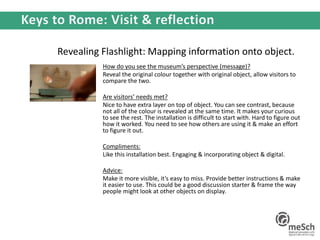
Revealing Flashlight: Mapping information onto object.
How do you see the museum’s perspective (message)?
Reveal the original colour together with original object, allow visitors to
compare the two.
Are visitors’ needs met?
Nice to have extra layer on top of object. You can see contrast, because
not all of the colour is revealed at the same time. It makes your curious
to see the rest. The installation is difficult to start with. Hard to figure out
how it worked. You need to see how others are using it & make an effort
to figure it out.
Compliments:
Like this installation best. Engaging & incorporating object & digital.
Advice:
Make it more visible, it’s easy to miss. Provide better instructions & make
it easier to use. This could be a good discussion starter & frame the way
people might look at other objects on display.
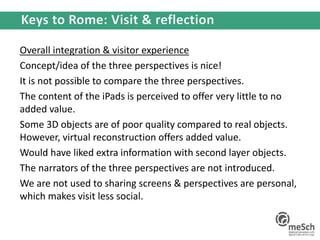
Overall integration & visitor experience
Concept/idea of the three perspectives is nice!
It is not possible to compare the three perspectives.
The content of the iPads is perceived to offer very little to no
added value.
Some 3D objects are of poor quality compared to real objects.
However, virtual reconstruction offers added value.
Would have liked extra information with second layer objects.
The narrators of the three perspectives are not introduced.
We are not used to sharing screens & perspectives are personal,
which makes visit less social.
The project (2013-2017) receives funding from the European Community’s Seventh
Framework Programme ‘ICT for access to cultural resources’ (ICT Call 9: FP7-ICT-
2011-9) under the Grant Agreement 600851.

Digital Media & Museum Visitor Engagement

  • 2.
    Digital Media Visitor Engagementin the Museum Merel van der Vaart - @MerelVaart Amsterdam School for Heritage & Memory Studies Allard Pierson Museum
  • 3.
    PhD Research: Mediating theMuseum: The impact of on-gallery technology on visitors' engagement with museum objects (How) can technology help visitors engage with museum objects?
  • 4.
    meSch Material Encounters with DigitalCultural Heritage “meSch aims to co-design novel platforms for the creation of tangible digital exhibits at heritage sites” Digital Artifacts Tangible Interaction Co-creation
  • 5.
    Part 1: Theory •Technology & Museums • The Museum Visit • Technology & Visitor Engagement Part 2: Practice • Visit the exhibition Keys to Rome Part 3: Reflection • Discussion
  • 6.
    Ross Parry &Nadia Arbach In: Cameron & Kenderine (eds.) ‘Theorizing Digital Cultural Heritage’ (MIT Press: 2007) online offline off-site on-site
  • 7.
    Ross Parry &Nadia Arbach In: Cameron & Kenderine (eds.) ‘Theorizing Digital Cultural Heritage’ (MIT Press: 2007) websites 'outreach' in-gallery internet connections / live labels traditional museum visit online offline off-site on-site
  • 8.
    Ross Parry &Nadia Arbach In: Cameron & Kenderine (eds.) ‘Theorizing Digital Cultural Heritage’ (MIT Press: 2007) Responsive websites 'outreach' in-gallery internet connections / live labels traditional museum visit Apps / social media online offline off-site on-site
  • 9.
    Ross Parry &Nadia Arbach In: Cameron & Kenderine (eds.) ‘Theorizing Digital Cultural Heritage’ (MIT Press: 2007) Responsive websites 'outreach' in-gallery internet connections / live labels traditional museum visit Apps / social media online offline off-site on-site
  • 10.
  • 11.
  • 12.
  • 13.
    Visitors information objects Museum Staff onlineoffline off-site on-site http://kpnrijksmuseum.com/
  • 14.
  • 15.
    “Visitors are underno obligation to engage with free-choice exhibition environments… … and yet they do.” Tiina Roppola ‘Designing for the Museum Visitor Experience’ (Routledge: 2012)
  • 16.
    John H. Falk& Lynn D. Dierking ‘The Museum Experience’ (Whaleback Books: 1992) The Interactive Experience Model Physical context Social Context Personal Context Interactive Experience
  • 17.
    “on average, visitorsuse exhibitions at a rate of 200 to 400 square feet / 18,6 to 37,2 m2 per minute.” The museum visit is a continuous decision-making process. On average, visitors’ pace is high, because they only stop at a small selection of all displays. Beverly Serrell ‘Paying Attention: The Duration and Allocation of Visitors’ Time in Museum Exhibitions’ in Curator: The Museum Journal 40/2 (California Academy of Science: 1997)
  • 18.
    “attention is selective (…) attentionhas focusing power (…) the capacity of attention is limited.” Stephen Bitgood ‘The role of attention in designing effective interpretive labels’ in Journal of Interpretation Research 5/2 (National Association for Interpretation: 2000)
  • 19.
    Visitors decide whenand how they want to visit the museum. Visitors have their own agenda when visiting the museum. Visitors decide how to engage with exhibits & displays. Some visitors like being guided, some don’t. Visiting museums is exhausting & people know it.
  • 20.
    Visitors have needs informationobjects Museum Staff have a message
  • 21.
    Museum staff: Rich content,complexity, multimedial, layered narratives, visitor-led exploration. Visitor: What does it do & how will I benefit? How does it work? How much attention (time/energy) is required?
  • 23.
    Touch screens: Depth& choice of information. How do you see the museum’s perspective (message)? Show personal points of view on the objects, from different cultural perspectives. Provide some interactivity & show how different people interacted with the objects in different ways. Are visitors’ needs met? Might work well for children, while providing grandparents with a role as well. Content need is not met (lacking depth). Could do with more interaction opportunities. Compliments: Looked nice. Potential of multiple perspectives on 1 screen is great. Easy to use. Screens close to objects. Advice: Use the screen to tell an aditonal story. Don’t repeat the same information that’s available on text labels.
  • 24.
    Smart object: Tangibleinterface. How do you see the museum’s perspective (message)? Give people a more complete understanding of object. Provide information in a visual way. Are visitors’ needs met? Screen and smart object are too far apart. Because of the positioning it is impossible to look at museum object, smart object and screen at the same time. The three should be more integrated, because now the smart object lacks added value. It is not necessarily clear how the installation should be used. Compliments: The installation provides a different type of (tactile) interaction. Advice: Put the screen in a different position to make it more accessible. Place the object a bit higher. Might make it multi-user/game.
  • 25.
    Revealing Flashlight: Mappinginformation onto object. How do you see the museum’s perspective (message)? Reveal the original colour together with original object, allow visitors to compare the two. Are visitors’ needs met? Nice to have extra layer on top of object. You can see contrast, because not all of the colour is revealed at the same time. It makes your curious to see the rest. The installation is difficult to start with. Hard to figure out how it worked. You need to see how others are using it & make an effort to figure it out. Compliments: Like this installation best. Engaging & incorporating object & digital. Advice: Make it more visible, it’s easy to miss. Provide better instructions & make it easier to use. This could be a good discussion starter & frame the way people might look at other objects on display.
  • 26.
    Overall integration &visitor experience Concept/idea of the three perspectives is nice! It is not possible to compare the three perspectives. The content of the iPads is perceived to offer very little to no added value. Some 3D objects are of poor quality compared to real objects. However, virtual reconstruction offers added value. Would have liked extra information with second layer objects. The narrators of the three perspectives are not introduced. We are not used to sharing screens & perspectives are personal, which makes visit less social.
  • 27.
    The project (2013-2017)receives funding from the European Community’s Seventh Framework Programme ‘ICT for access to cultural resources’ (ICT Call 9: FP7-ICT- 2011-9) under the Grant Agreement 600851.