The ‘Scale up challenge’: simulation
for authentic learning
• Heidi Singleton (@blueprintteach)
• Debbie Holley (@debbieholley1)
Department of Nursing Sciences, Bournemouth University
Please do tweet to #ELESIG #altc
"We predict digital collaboration platforms, artificial intelligence, and
immersive, mixed reality will be powerful tools to address key teacher
needs..."
The class of 2030 and life-ready learning: the technology imperative Image credits: Debbie Holley
BU Festival of Learning 2018
Jisc
The Jisc 'Student digital experience insights survey' was
recently released, summarising the experiences of over
20,000 HE students at a range of 28 HE institutions.
One surprising finding was that only 20% of students
gain any 'real life' simulation experiences as part of
their degree, and these tend to be in engineering
design and healthcare.
Link to JISC report:
https://www.jisc.ac.uk/sites/default/files/student-dei-
he-report-2020.pdf
Scaling Innovation:
theory paper
• Dede and Coburn: five dimensions of
scaling:
• depth, sustainability, spread,
ownership, and evolution
• Design based research feeds into
successful scaling of innovation
• And can help with leverage 'deep
change'
• And the most difficult bit! cherished
values, attitudes and beliefs need to
be ‘unlearned’ to enable ownership
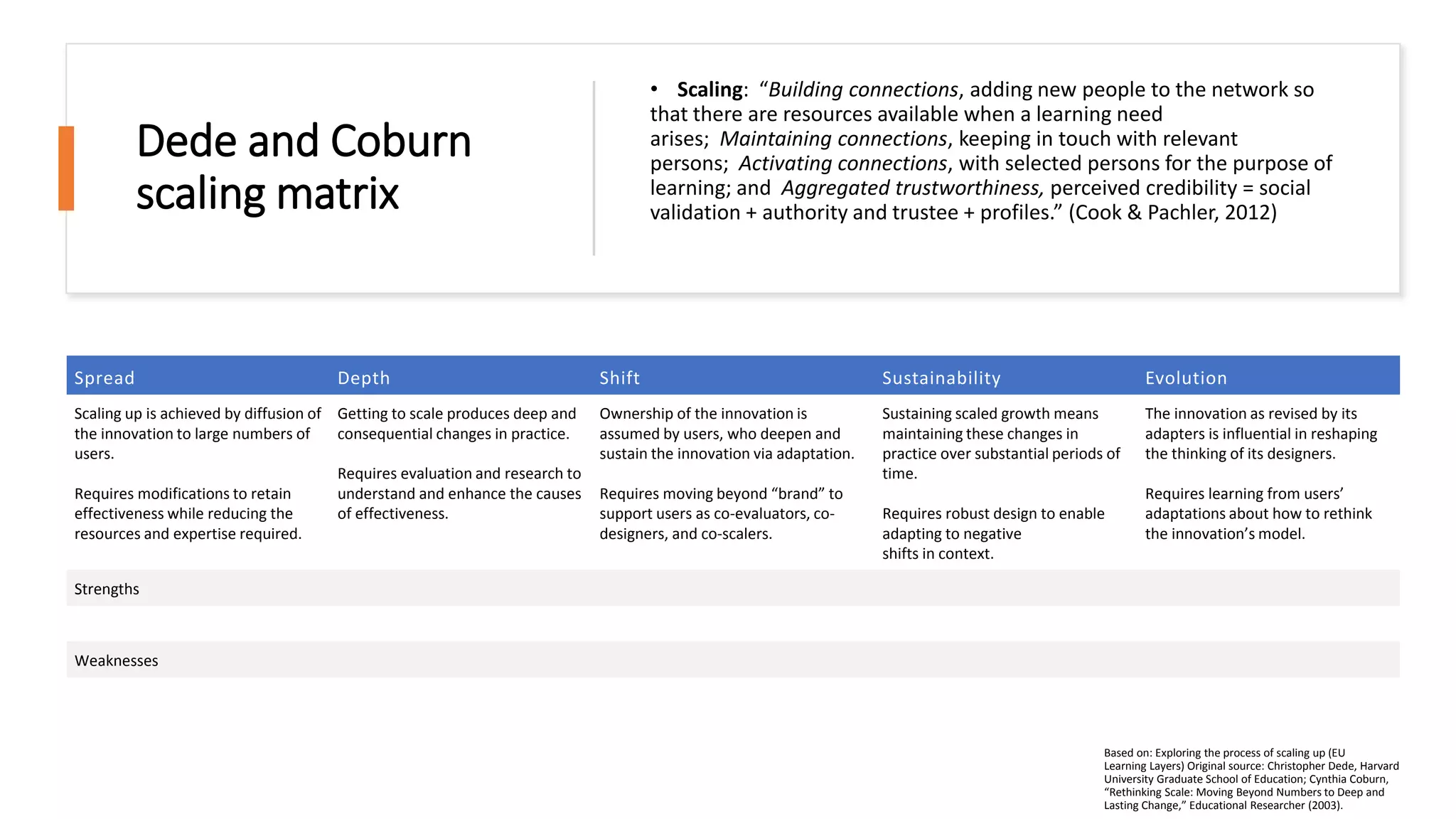
Dede and Coburn
scaling matrix
• Scaling: “Building connections, adding new people to the network so
that there are resources available when a learning need
arises; Maintaining connections, keeping in touch with relevant
persons; Activating connections, with selected persons for the purpose of
learning; and Aggregated trustworthiness, perceived credibility = social
validation + authority and trustee + profiles.” (Cook & Pachler, 2012)
Based on: Exploring the process of scaling up (EU
Learning Layers) Original source: Christopher Dede, Harvard
University Graduate School of Education; Cynthia Coburn,
“Rethinking Scale: Moving Beyond Numbers to Deep and
Lasting Change,” Educational Researcher (2003).
Spread Depth Shift Sustainability Evolution
Scaling up is achieved by diffusion of
the innovation to large numbers of
users.
Requires modifications to retain
effectiveness while reducing the
resources and expertise required.
Getting to scale produces deep and
consequential changes in practice.
Requires evaluation and research to
understand and enhance the causes
of effectiveness.
Ownership of the innovation is
assumed by users, who deepen and
sustain the innovation via adaptation.
Requires moving beyond “brand” to
support users as co-evaluators, co-
designers, and co-scalers.
Sustaining scaled growth means
maintaining these changes in
practice over substantial periods of
time.
Requires robust design to enable
adapting to negative
shifts in context.
The innovation as revised by its
adapters is influential in reshaping
the thinking of its designers.
Requires learning from users’
adaptations about how to rethink
the innovation’s model.
Strengths
Weaknesses
Engaging our students:
the boundaries have
changed post Covid 19
Embedding digital technologies in
learning, teaching and assessment
are complex, and rethinking the
roles of educators has been at the
foreground.
In chat, share your experiences of
whether educators in your
institution have rethought their
practice, or are they hoping to slide
back to 'the way we were?'
Image Credit: University of Arizona Libraries
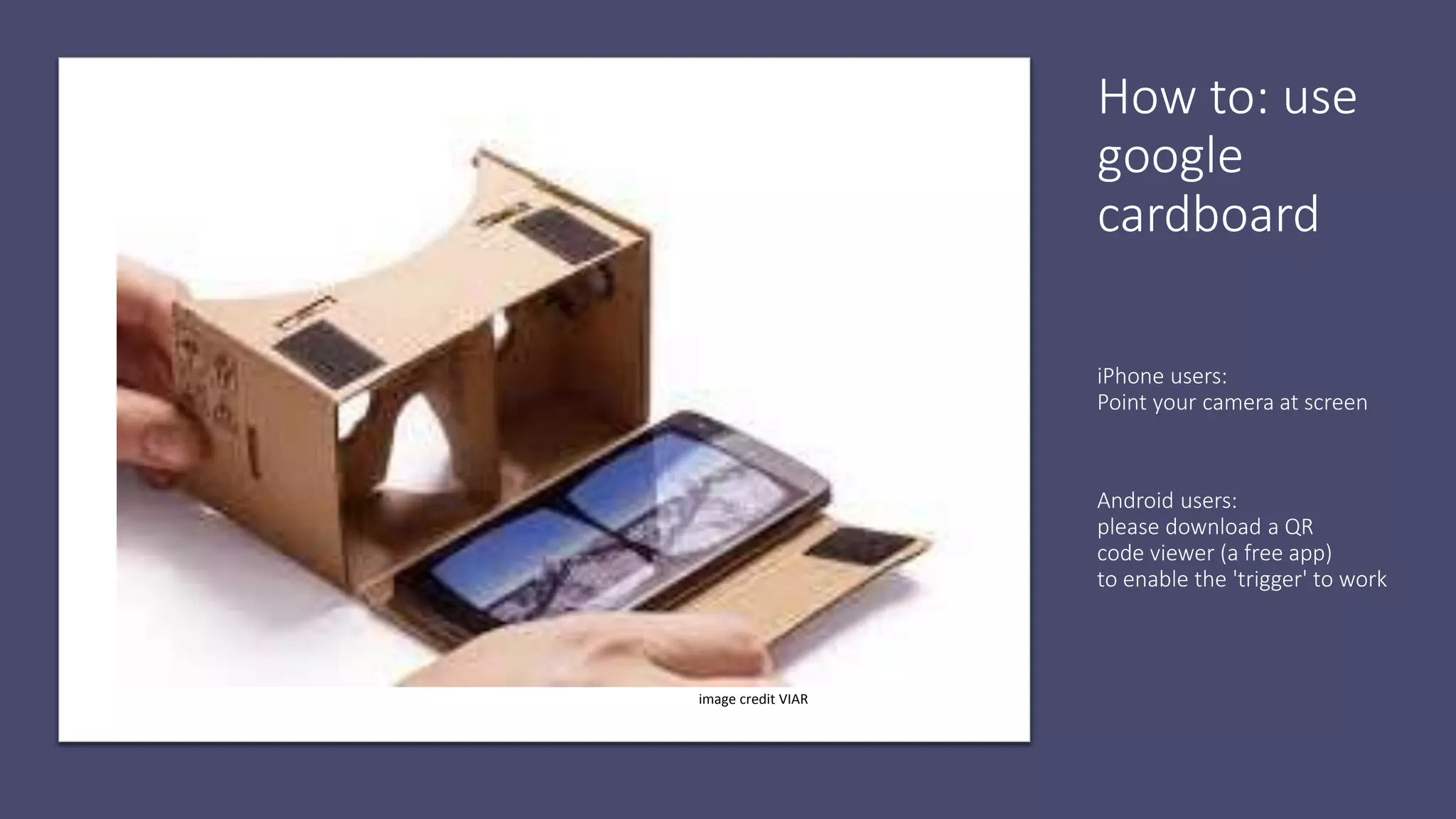
How to: use
google
cardboard
iPhone users:
Point your camera at screen
Android users:
please download a QR
code viewer (a free app)
to enable the 'trigger' to work
image credit VIAR
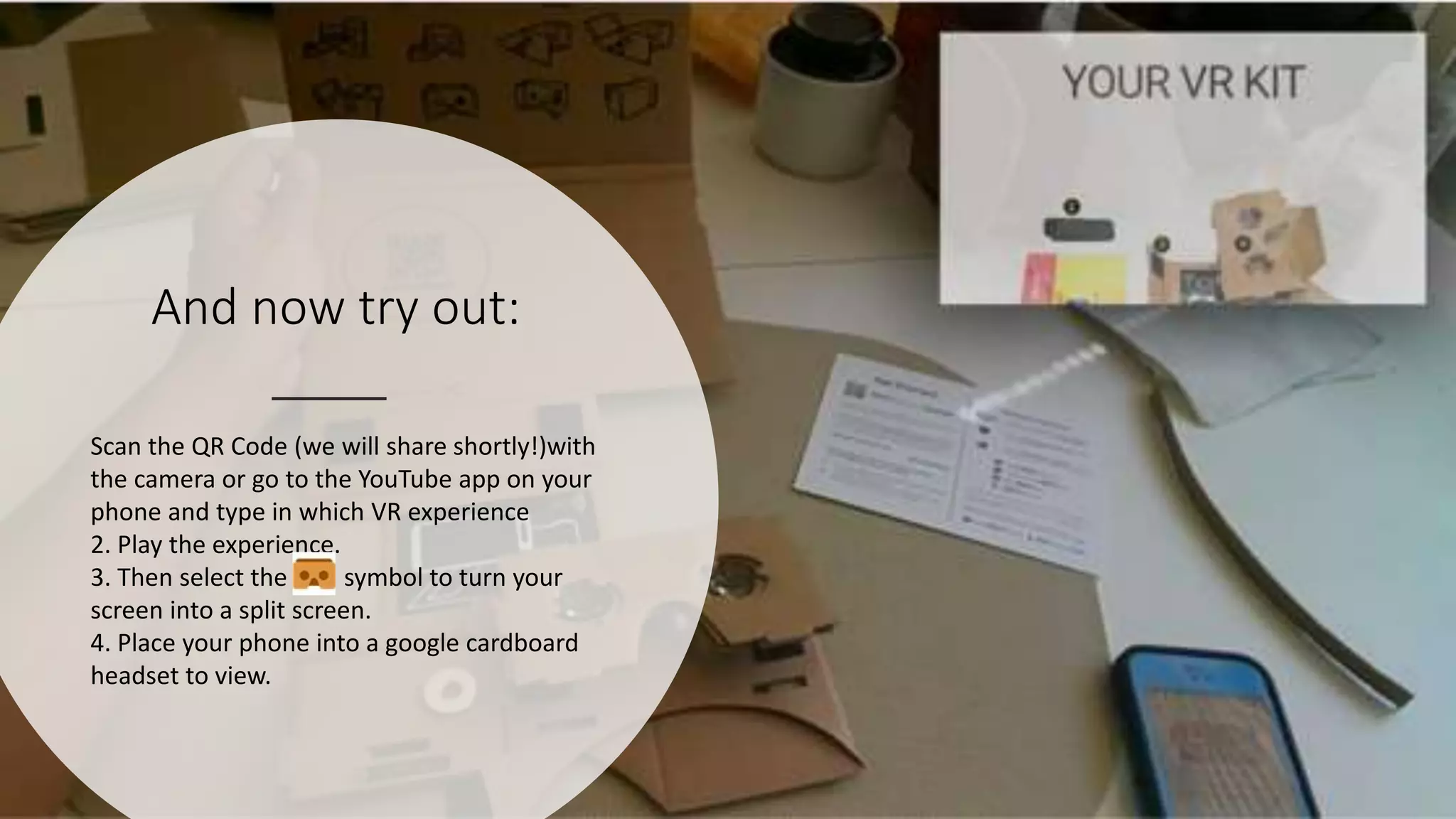
And now try out:
Scan the QR Code (we will share shortly!)with
the camera or go to the YouTube app on your
phone and type in which VR experience
2. Play the experience.
3. Then select the symbol to turn your
screen into a split screen.
4. Place your phone into a google cardboard
headset to view.
And try out: relaxation
This is the link:
https://www.youtube.com/watch?
v=7AkbUfZjS5k&t=60s
And a more health related
one we use with students
https://www.youtube.com
/watch?v=XKbwmTG8chQ
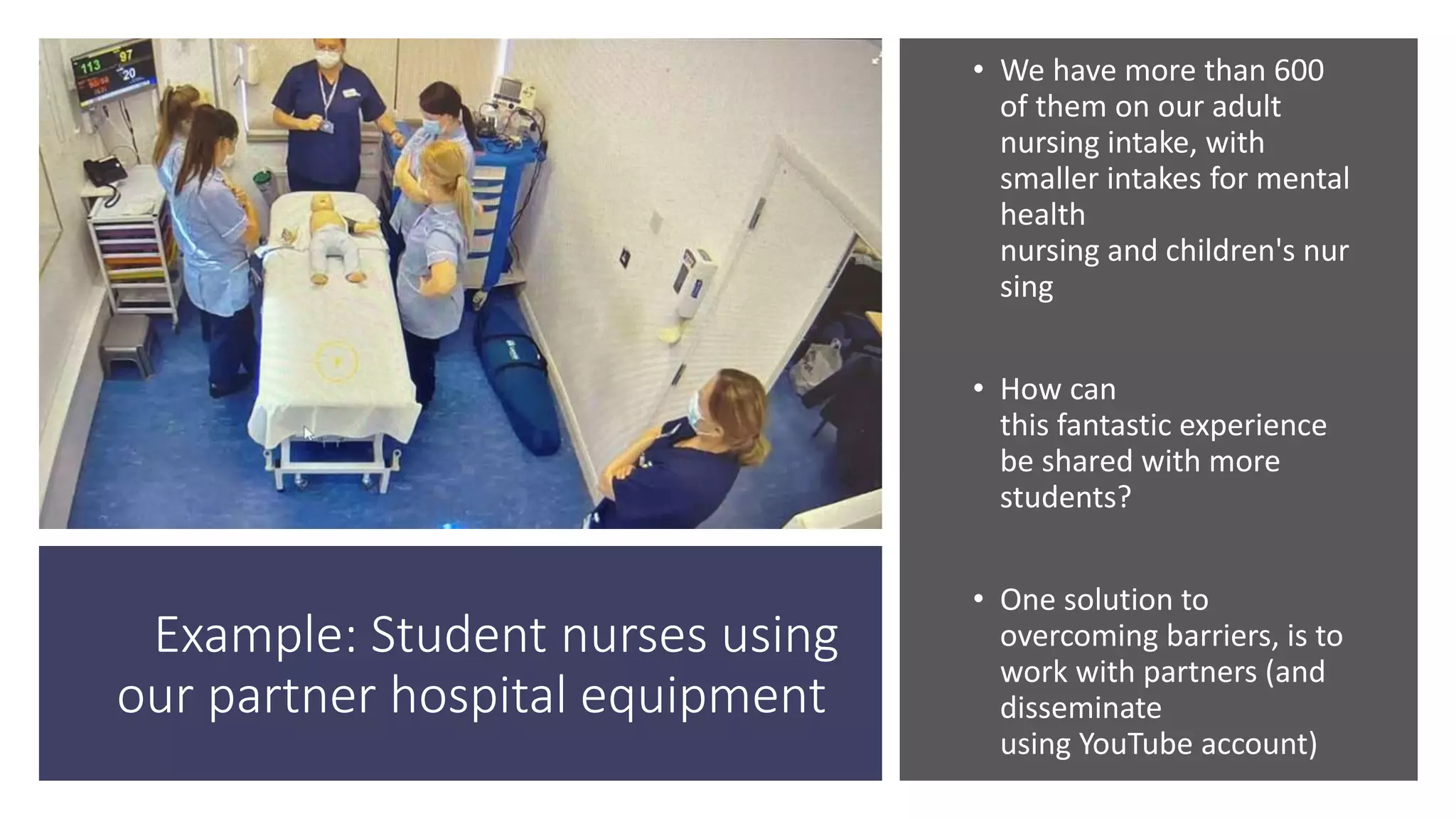
Example: Student nurses using
our partner hospital equipment
• We have more than 600
of them on our adult
nursing intake, with
smaller intakes for mental
health
nursing and children's nur
sing
• How can
this fantastic experience
be shared with more
students?
• One solution to
overcoming barriers, is to
work with partners (and
disseminate
using YouTube account)
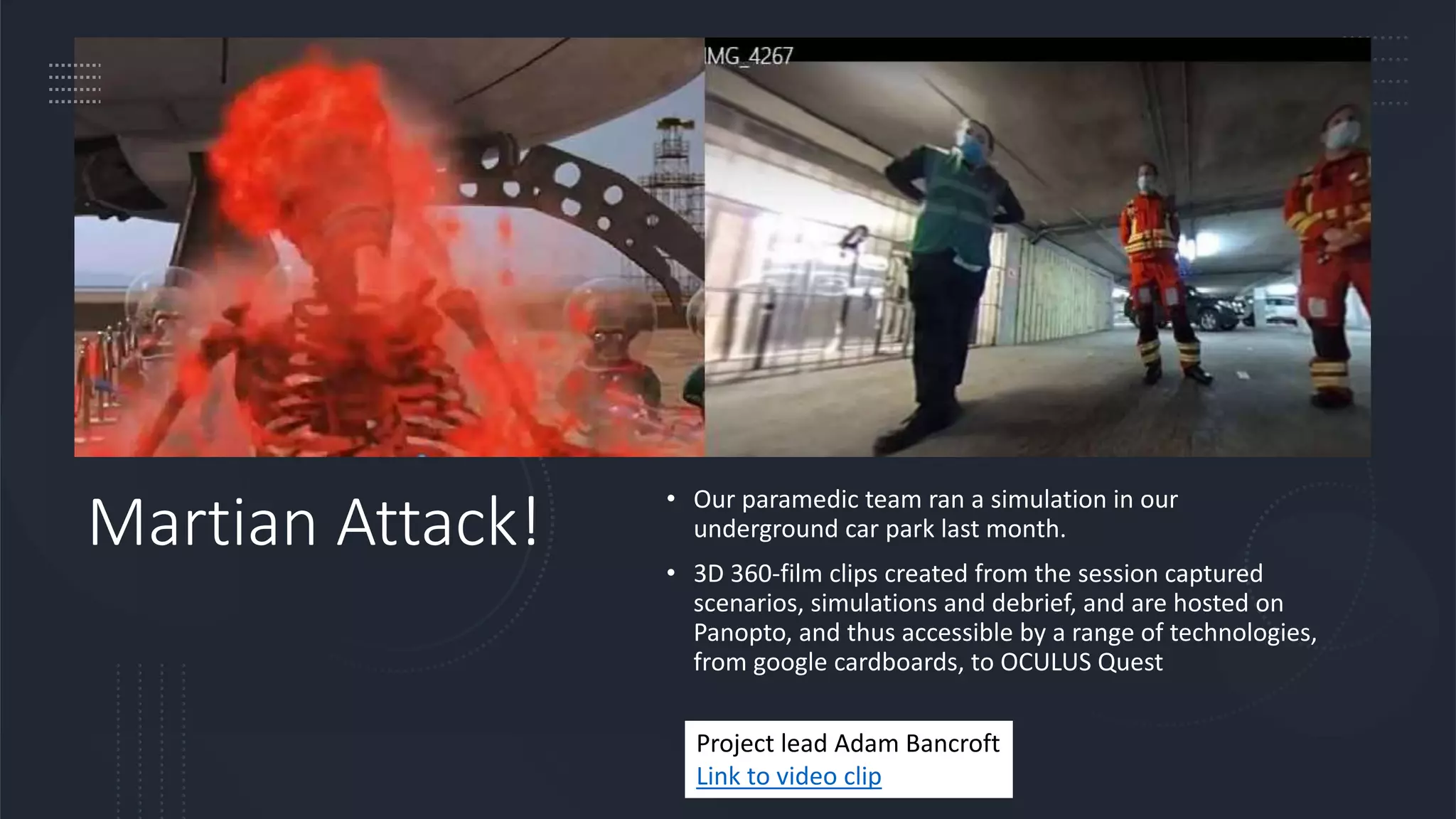
Martian Attack!
• Our paramedic team ran a simulation in our
underground car park last month.
• 3D 360-film clips created from the session captured
scenarios, simulations and debrief, and are hosted on
Panopto, and thus accessible by a range of technologies,
from google cardboards, to OCULUS Quest
Project lead Adam Bancroft
Link to video clip
Mentimeter
Menti code: 7092 2921
https://www.menti.com/cys1bupamq
Pause for discussion
Using Virtual Reality: does it work in large group
teaching settings?
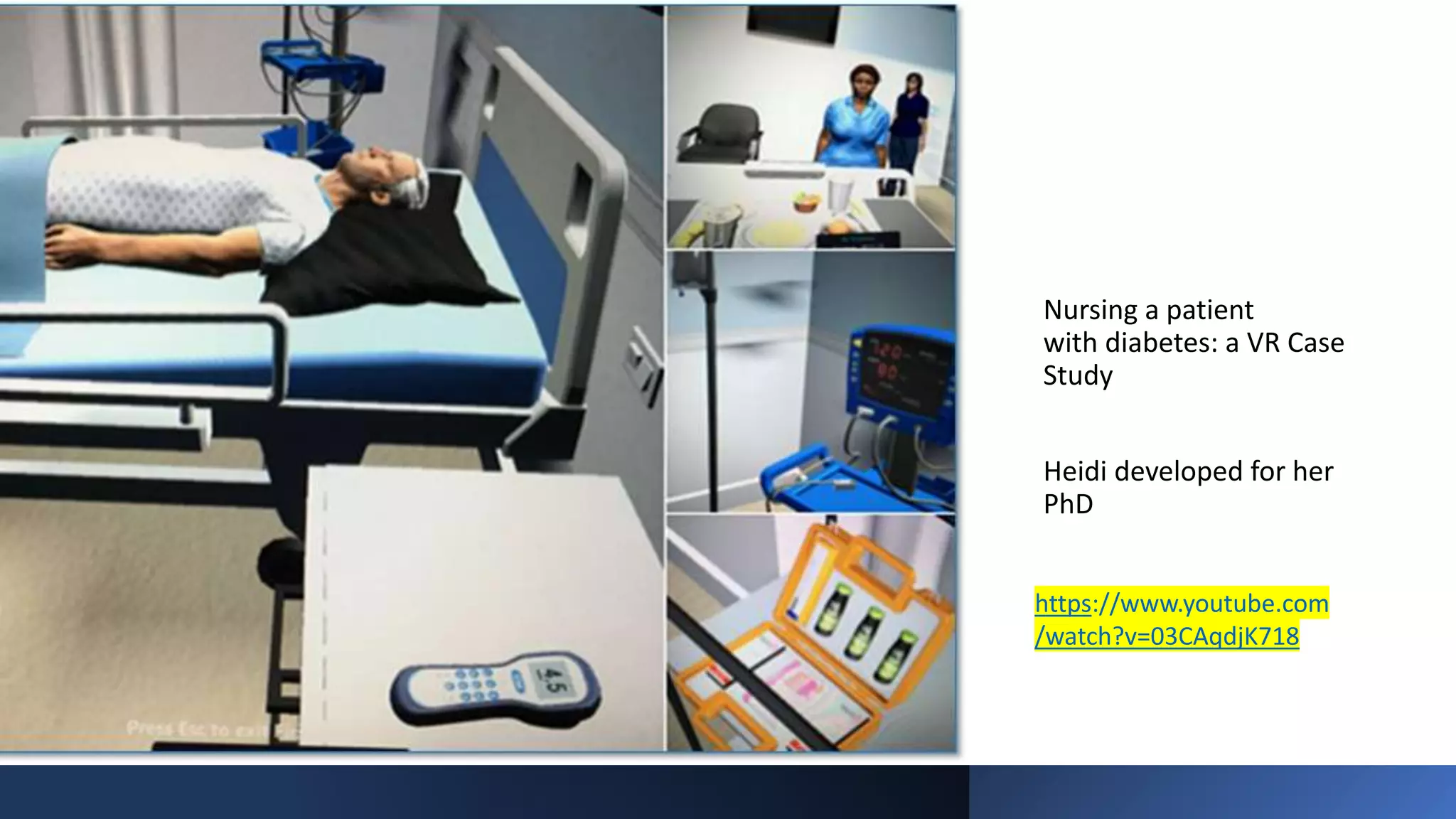
Nursing a patient
with diabetes: a VR Case
Study
Heidi developed for her
PhD
https://www.youtube.com
/watch?v=03CAqdjK718
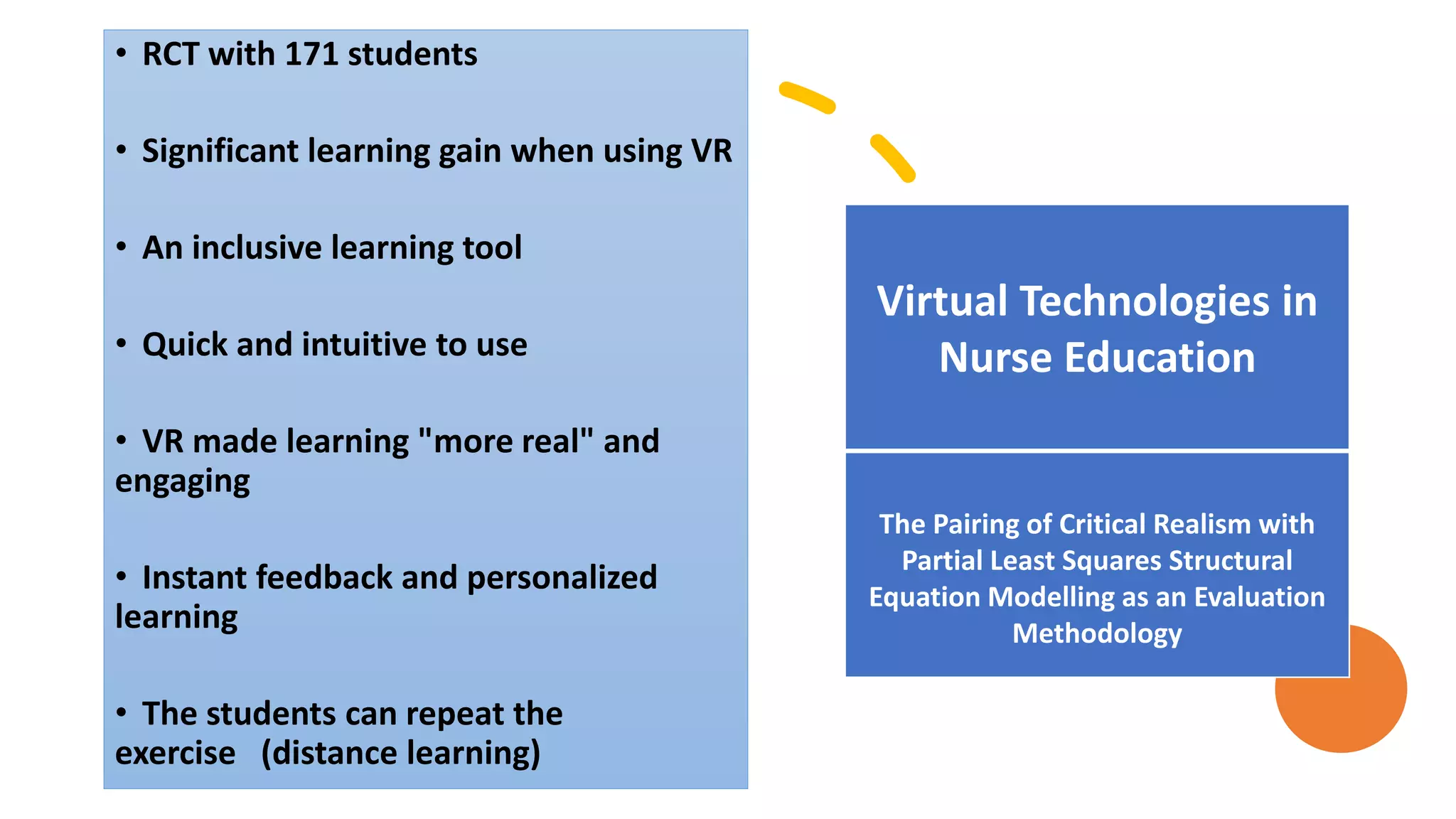
• RCT with 171 students
• Significant learning gain when using VR
• An inclusive learning tool
• Quick and intuitive to use
• VR made learning "more real" and
engaging
• Instant feedback and personalized
learning
• The students can repeat the
exercise (distance learning)
Virtual Technologies in
Nurse Education
The Pairing of Critical Realism with
Partial Least Squares Structural
Equation Modelling as an Evaluation
Methodology
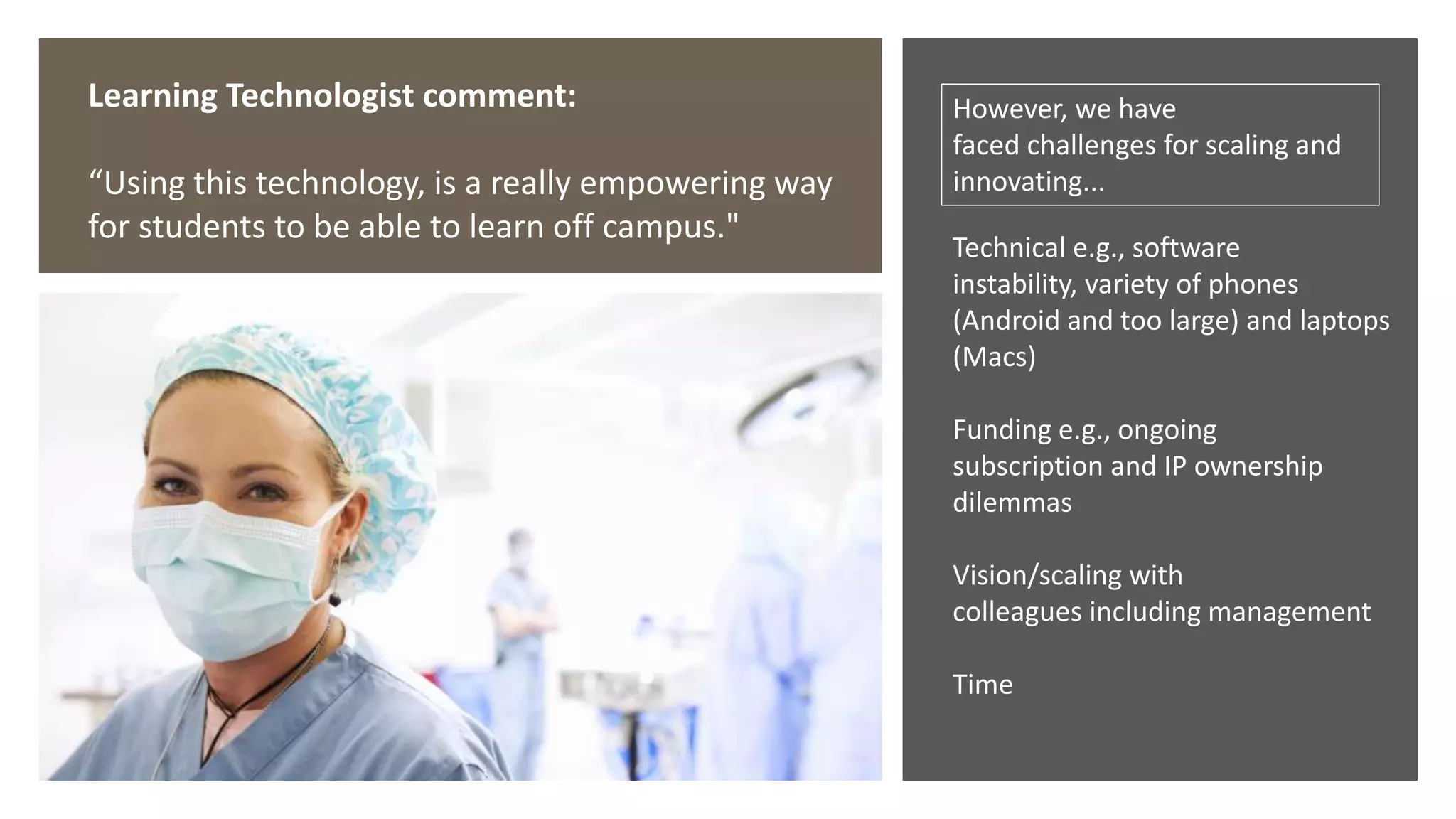
Learning Technologist comment:
“Using this technology, is a really empowering way
for students to be able to learn off campus."
However, we have
faced challenges for scaling and
innovating...
Technical e.g., software
instability, variety of phones
(Android and too large) and laptops
(Macs)
Funding e.g., ongoing
subscription and IP ownership
dilemmas
Vision/scaling with
colleagues including management
Time
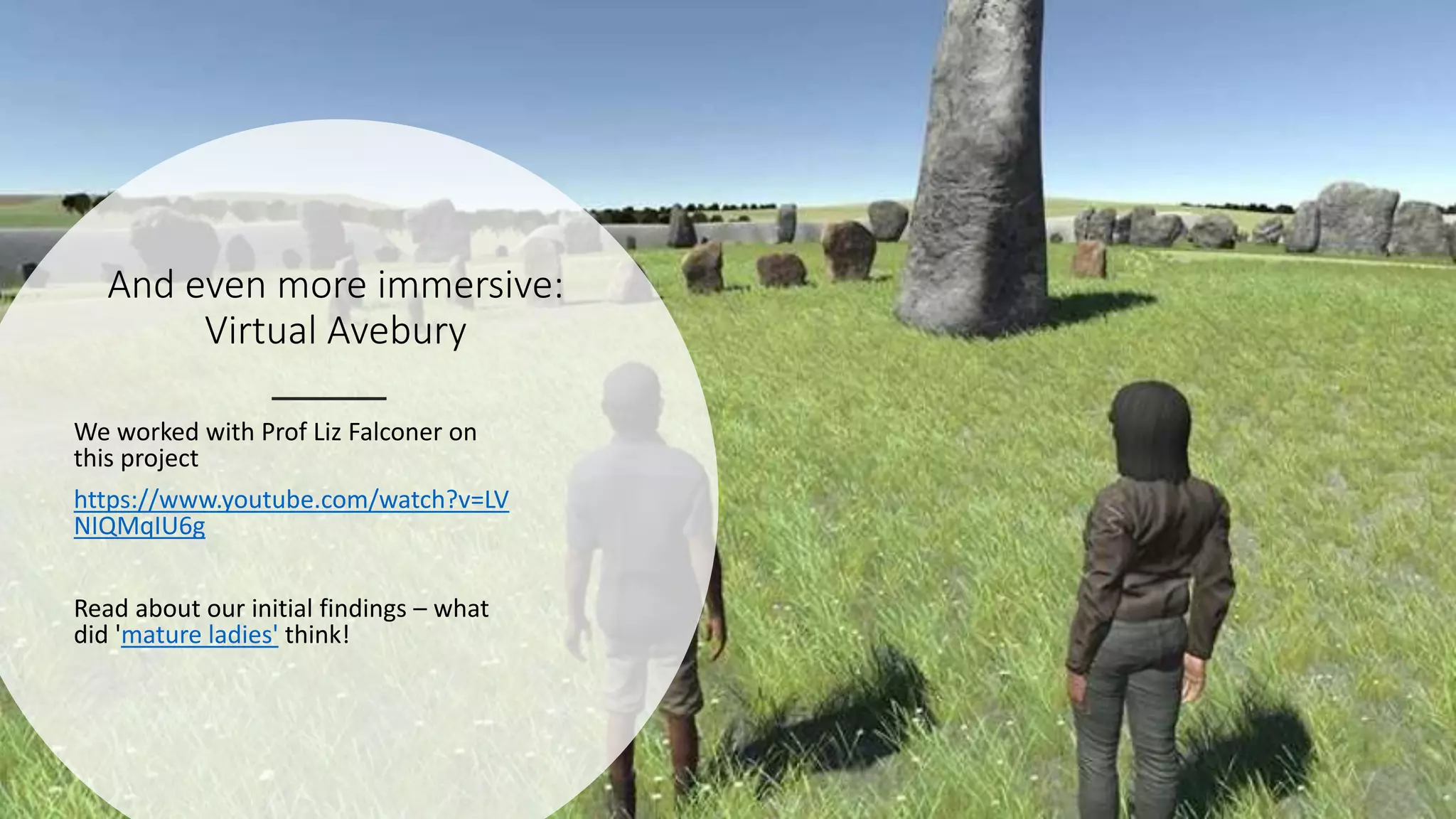
And even more immersive:
Virtual Avebury
We worked with Prof Liz Falconer on
this project
https://www.youtube.com/watch?v=LV
NIQMqIU6g
Read about our initial findings – what
did 'mature ladies' think!
Concluding discussions: sharing practice and any
questions
Resources
• Holley D., Hobbs M. (2019) Augmented Reality for Education. In: Peters M., Heraud R.
(eds) Encyclopedia of Educational Innovation. Springer, Singapore https://doi.org/10.1007/978-981-
13-2262-4 Online ISBN 978-981-13-2262-4
• Holley, D (2017) Bournemouth University: a new vision for learning case study in JISC Developing
organisational approaches to digital capability JISC 4 May 2017
• https://www.jisc.ac.uk/guides/developing-organisational-approaches-to-digital-capability/
Heidi: a range of papers underway from her doctorate
• https://microsites.bournemouth.ac.uk/flie/2017/06/21/introducing-heidi-singleton-our-new-phd-
student-on-immersive-worlds-augmented-reality-and-tools-for-learning-innovation/
• https://microsites.bournemouth.ac.uk/flie/2019/02/01/what-did-mental-health-nursing-students-
think-of-vr-deteriorating-patient/
• https://microsites.bournemouth.ac.uk/cel/2016/10/26/cels-workshop-on-augmented-an
• Thanks to daden limited for the creation of the resources!
Heidi and Janet video of using VR for Nursing diabetes:
https://www.youtube.com/watch?v=AKpw1RbZ1hA
Prof Liz Falconer talking about Virtual Avebury:
https://www.youtube.com/watch?v=LVNIQMqIU6g

The ‘Scale up challenge’: simulation for authentic learning

  • 1.
    The ‘Scale upchallenge’: simulation for authentic learning • Heidi Singleton (@blueprintteach) • Debbie Holley (@debbieholley1) Department of Nursing Sciences, Bournemouth University Please do tweet to #ELESIG #altc "We predict digital collaboration platforms, artificial intelligence, and immersive, mixed reality will be powerful tools to address key teacher needs..." The class of 2030 and life-ready learning: the technology imperative Image credits: Debbie Holley BU Festival of Learning 2018
  • 2.
    Jisc The Jisc 'Studentdigital experience insights survey' was recently released, summarising the experiences of over 20,000 HE students at a range of 28 HE institutions. One surprising finding was that only 20% of students gain any 'real life' simulation experiences as part of their degree, and these tend to be in engineering design and healthcare. Link to JISC report: https://www.jisc.ac.uk/sites/default/files/student-dei- he-report-2020.pdf
  • 3.
    Scaling Innovation: theory paper •Dede and Coburn: five dimensions of scaling: • depth, sustainability, spread, ownership, and evolution • Design based research feeds into successful scaling of innovation • And can help with leverage 'deep change' • And the most difficult bit! cherished values, attitudes and beliefs need to be ‘unlearned’ to enable ownership
  • 4.
    Dede and Coburn scalingmatrix • Scaling: “Building connections, adding new people to the network so that there are resources available when a learning need arises; Maintaining connections, keeping in touch with relevant persons; Activating connections, with selected persons for the purpose of learning; and Aggregated trustworthiness, perceived credibility = social validation + authority and trustee + profiles.” (Cook & Pachler, 2012) Based on: Exploring the process of scaling up (EU Learning Layers) Original source: Christopher Dede, Harvard University Graduate School of Education; Cynthia Coburn, “Rethinking Scale: Moving Beyond Numbers to Deep and Lasting Change,” Educational Researcher (2003). Spread Depth Shift Sustainability Evolution Scaling up is achieved by diffusion of the innovation to large numbers of users. Requires modifications to retain effectiveness while reducing the resources and expertise required. Getting to scale produces deep and consequential changes in practice. Requires evaluation and research to understand and enhance the causes of effectiveness. Ownership of the innovation is assumed by users, who deepen and sustain the innovation via adaptation. Requires moving beyond “brand” to support users as co-evaluators, co- designers, and co-scalers. Sustaining scaled growth means maintaining these changes in practice over substantial periods of time. Requires robust design to enable adapting to negative shifts in context. The innovation as revised by its adapters is influential in reshaping the thinking of its designers. Requires learning from users’ adaptations about how to rethink the innovation’s model. Strengths Weaknesses
  • 5.
    Engaging our students: theboundaries have changed post Covid 19 Embedding digital technologies in learning, teaching and assessment are complex, and rethinking the roles of educators has been at the foreground. In chat, share your experiences of whether educators in your institution have rethought their practice, or are they hoping to slide back to 'the way we were?'
  • 6.
    Image Credit: Universityof Arizona Libraries
  • 7.
    How to: use google cardboard iPhoneusers: Point your camera at screen Android users: please download a QR code viewer (a free app) to enable the 'trigger' to work image credit VIAR
  • 8.
    And now tryout: Scan the QR Code (we will share shortly!)with the camera or go to the YouTube app on your phone and type in which VR experience 2. Play the experience. 3. Then select the symbol to turn your screen into a split screen. 4. Place your phone into a google cardboard headset to view.
  • 9.
    And try out:relaxation This is the link: https://www.youtube.com/watch? v=7AkbUfZjS5k&t=60s
  • 10.
    And a morehealth related one we use with students https://www.youtube.com /watch?v=XKbwmTG8chQ
  • 11.
    Example: Student nursesusing our partner hospital equipment • We have more than 600 of them on our adult nursing intake, with smaller intakes for mental health nursing and children's nur sing • How can this fantastic experience be shared with more students? • One solution to overcoming barriers, is to work with partners (and disseminate using YouTube account)
  • 12.
    Martian Attack! • Ourparamedic team ran a simulation in our underground car park last month. • 3D 360-film clips created from the session captured scenarios, simulations and debrief, and are hosted on Panopto, and thus accessible by a range of technologies, from google cardboards, to OCULUS Quest Project lead Adam Bancroft Link to video clip
  • 13.
    Mentimeter Menti code: 70922921 https://www.menti.com/cys1bupamq
  • 14.
  • 15.
    Using Virtual Reality:does it work in large group teaching settings?
  • 16.
    Nursing a patient withdiabetes: a VR Case Study Heidi developed for her PhD https://www.youtube.com /watch?v=03CAqdjK718
  • 17.
    • RCT with171 students • Significant learning gain when using VR • An inclusive learning tool • Quick and intuitive to use • VR made learning "more real" and engaging • Instant feedback and personalized learning • The students can repeat the exercise (distance learning) Virtual Technologies in Nurse Education The Pairing of Critical Realism with Partial Least Squares Structural Equation Modelling as an Evaluation Methodology
  • 18.
    Learning Technologist comment: “Usingthis technology, is a really empowering way for students to be able to learn off campus." However, we have faced challenges for scaling and innovating... Technical e.g., software instability, variety of phones (Android and too large) and laptops (Macs) Funding e.g., ongoing subscription and IP ownership dilemmas Vision/scaling with colleagues including management Time
  • 19.
    And even moreimmersive: Virtual Avebury We worked with Prof Liz Falconer on this project https://www.youtube.com/watch?v=LV NIQMqIU6g Read about our initial findings – what did 'mature ladies' think!
  • 20.
    Concluding discussions: sharingpractice and any questions
  • 21.
    Resources • Holley D.,Hobbs M. (2019) Augmented Reality for Education. In: Peters M., Heraud R. (eds) Encyclopedia of Educational Innovation. Springer, Singapore https://doi.org/10.1007/978-981- 13-2262-4 Online ISBN 978-981-13-2262-4 • Holley, D (2017) Bournemouth University: a new vision for learning case study in JISC Developing organisational approaches to digital capability JISC 4 May 2017 • https://www.jisc.ac.uk/guides/developing-organisational-approaches-to-digital-capability/ Heidi: a range of papers underway from her doctorate • https://microsites.bournemouth.ac.uk/flie/2017/06/21/introducing-heidi-singleton-our-new-phd- student-on-immersive-worlds-augmented-reality-and-tools-for-learning-innovation/ • https://microsites.bournemouth.ac.uk/flie/2019/02/01/what-did-mental-health-nursing-students- think-of-vr-deteriorating-patient/ • https://microsites.bournemouth.ac.uk/cel/2016/10/26/cels-workshop-on-augmented-an • Thanks to daden limited for the creation of the resources! Heidi and Janet video of using VR for Nursing diabetes: https://www.youtube.com/watch?v=AKpw1RbZ1hA Prof Liz Falconer talking about Virtual Avebury: https://www.youtube.com/watch?v=LVNIQMqIU6g