Professional
Discourse in the
Age of AI: An
Interactive
Writing
Workshop
facilitated by Profs Carol Clark
and Debbie Holley FHSS
Wednesday 30th April 2025
Today:
Focus on writing
• Creative tasks and Gen AI tasks
• Ideas for writers block – for you
and to share with your students
• Invitation to create a blog post
from the session and have it
published
Photo by Etienne
Girardet on Unsplash
How do you like to write?
Why do you write?
Task 1 getting started?
The genre task
Once upon a time, you were walking across a
beautiful beach when looking out to sea you saw
a.... now select a genre, and freewrite for three
minutes...
Thriller/comedy/romance/horror/sci-fi/ epic/fairytale/
fantasy/crime/history
• then link the final sentence into your 'real' writing
• Based on Peter Elbows' work and English, (2011)
1. What is the primary
function of Generative AI?
A. Analysing statistical data
B. Creating new content such as text, images, or
audio
C. Managing hardware systems
Photo by Cash
Macanaya on Unsplash
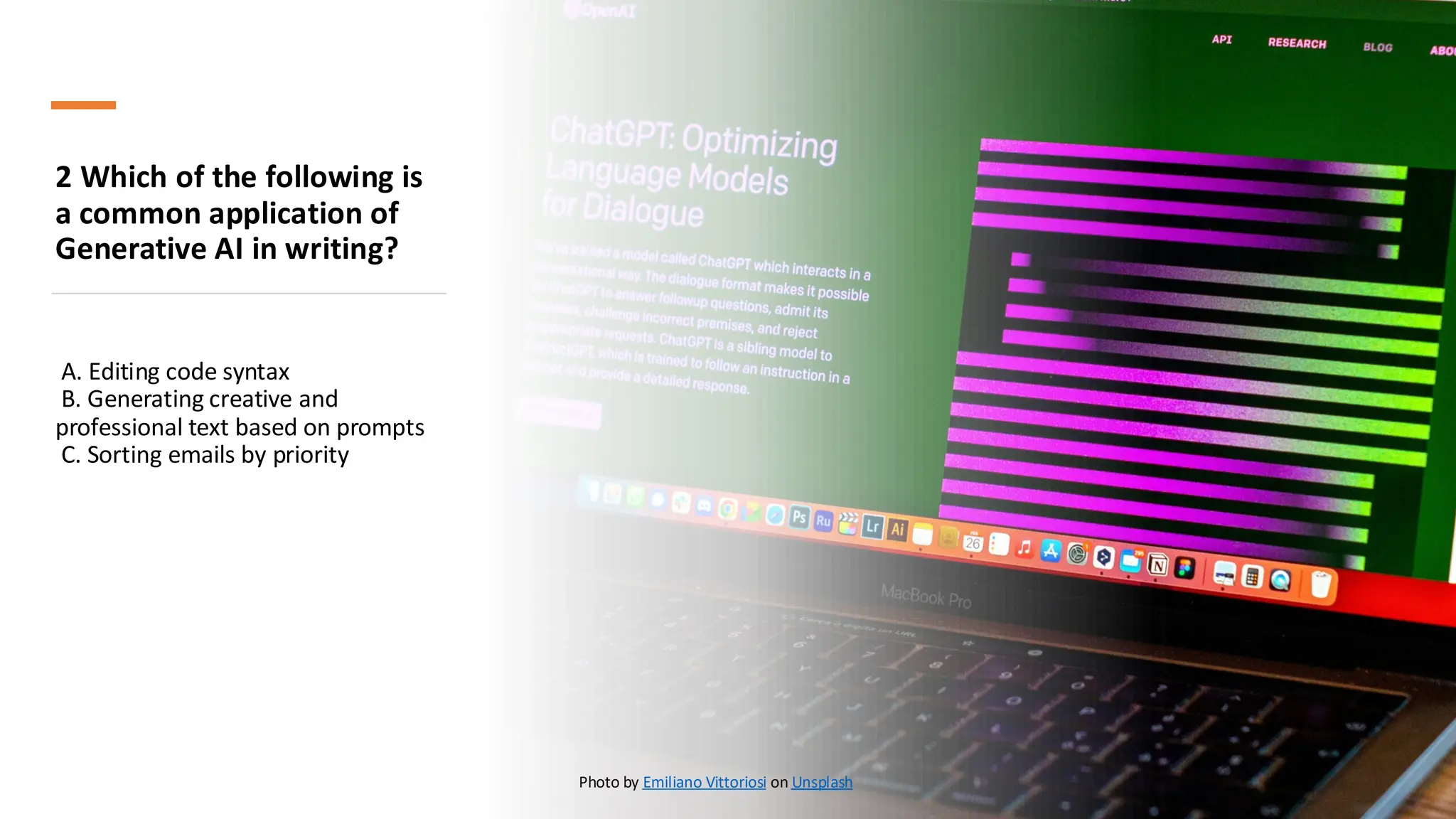
2 Which of the following is
a common application of
Generative AI in writing?
A. Editing code syntax
B. Generating creative and
professional text based on prompts
C. Sorting emails by priority
Photo by Emiliano Vittoriosi on Unsplash
3. What is one potential
ethical concern with using
Generative AI?
A. It consumes too little processing
power
B. It always provides correct
information
C. It may produce biased or
inaccurate outputs
Photo by ZHENYU LUO on Unsplash
Which technology underlies
many Generative AI tools,
such as ChatGPT?
A. Blockchain
B. Transformer-based neural
networks
C. Spreadsheet formulas
Photo by Steve
Johnson on Unsplash
5. How can
Generative AI
support
professional
writing?
A. By replacing human decision-making
B. By generating contextual drafts and assisting with structure
C. By reducing the need for communication skills
Photo by Igor
Omilaev on Unsplash
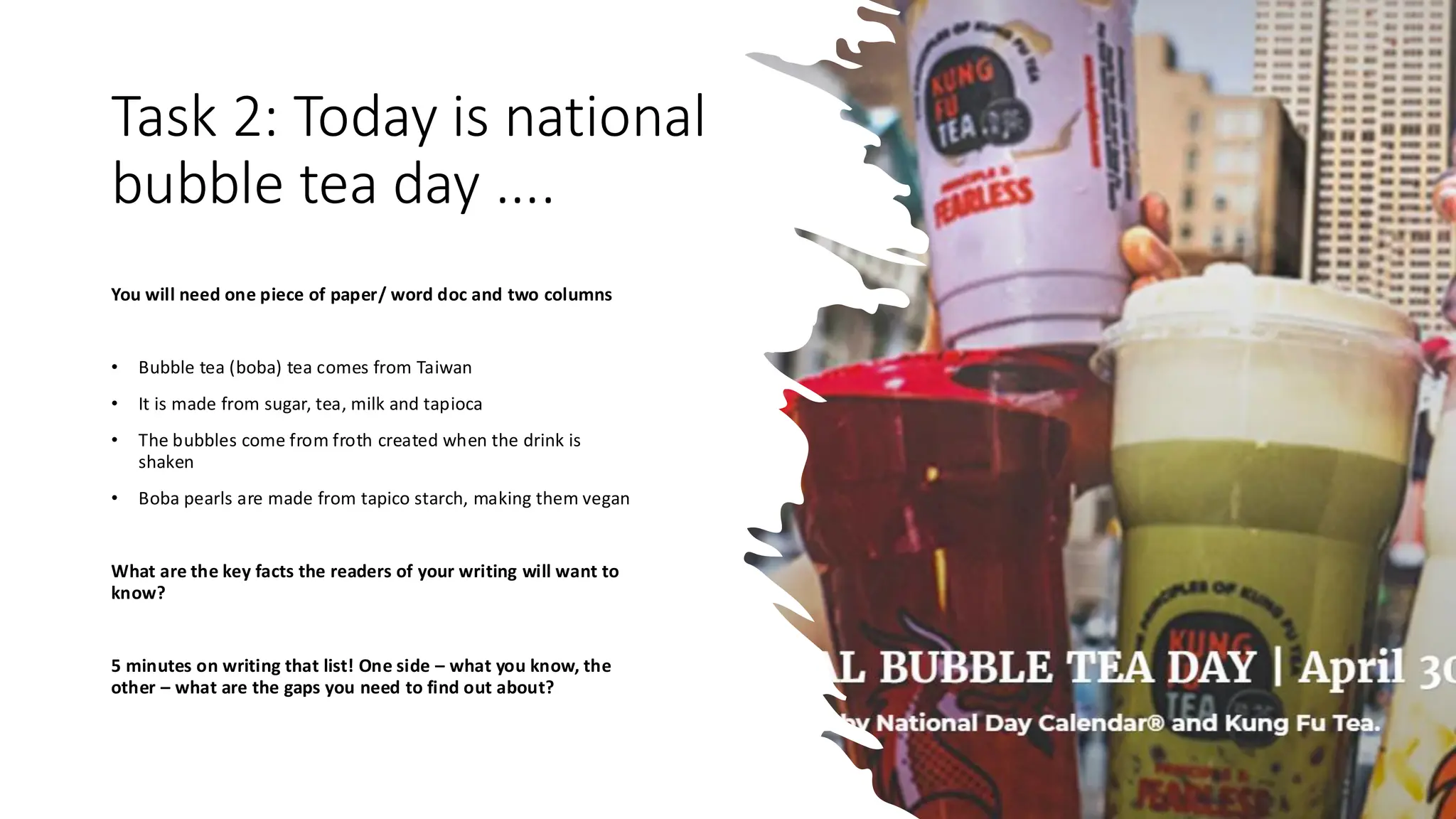
Task 2: Today is national
bubble tea day ....
You will need one piece of paper/ word doc and two columns
• Bubble tea (boba) tea comes from Taiwan
• It is made from sugar, tea, milk and tapioca
• The bubbles come from froth created when the drink is
shaken
• Boba pearls are made from tapico starch, making them vegan
What are the key facts the readers of your writing will want to
know?
5 minutes on writing that list! One side – what you know, the
other – what are the gaps you need to find out about?
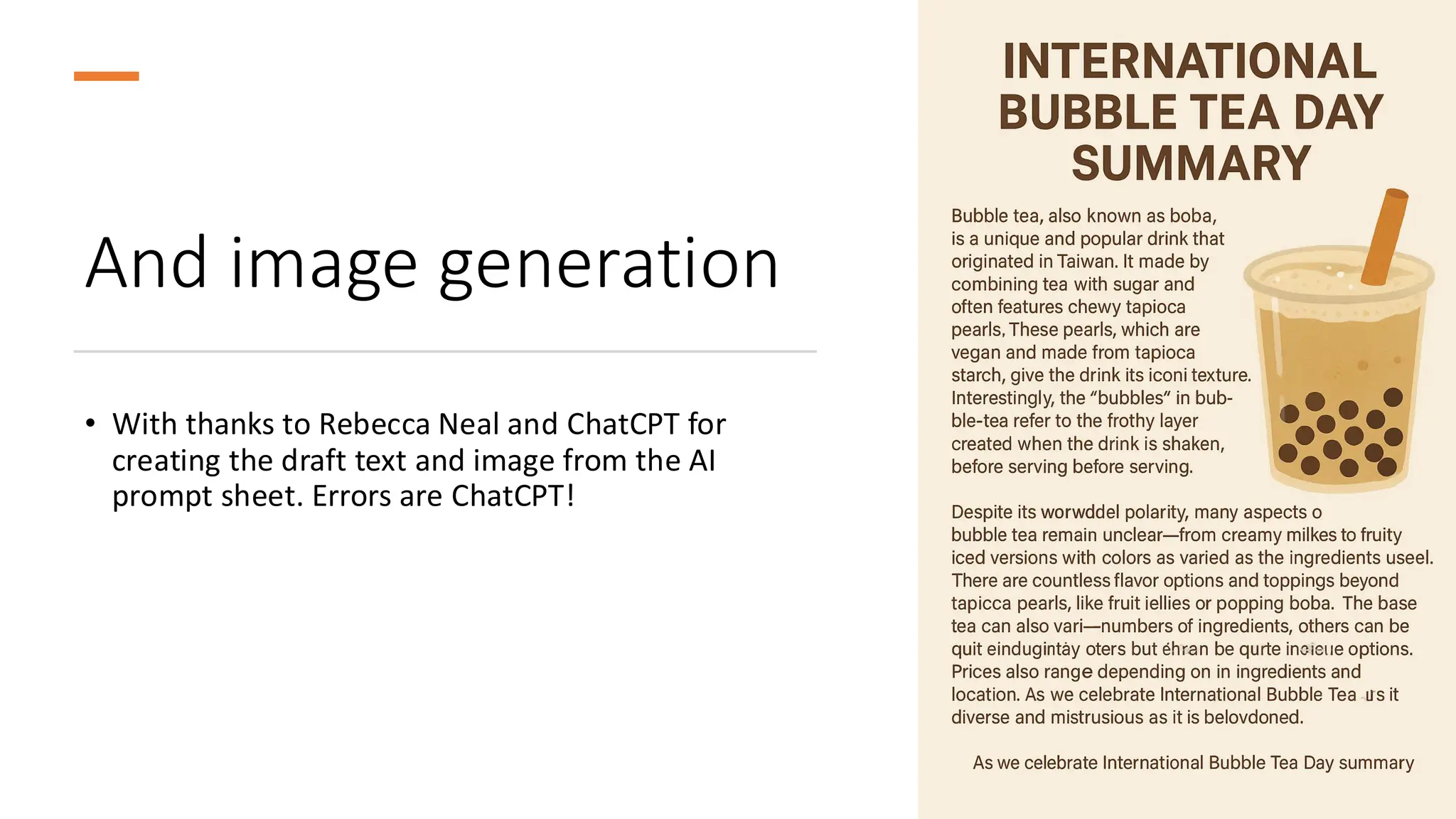
And image generation
• With thanks to Rebecca Neal and ChatCPT for
creating the draft text and image from the AI
prompt sheet. Errors are ChatCPT!
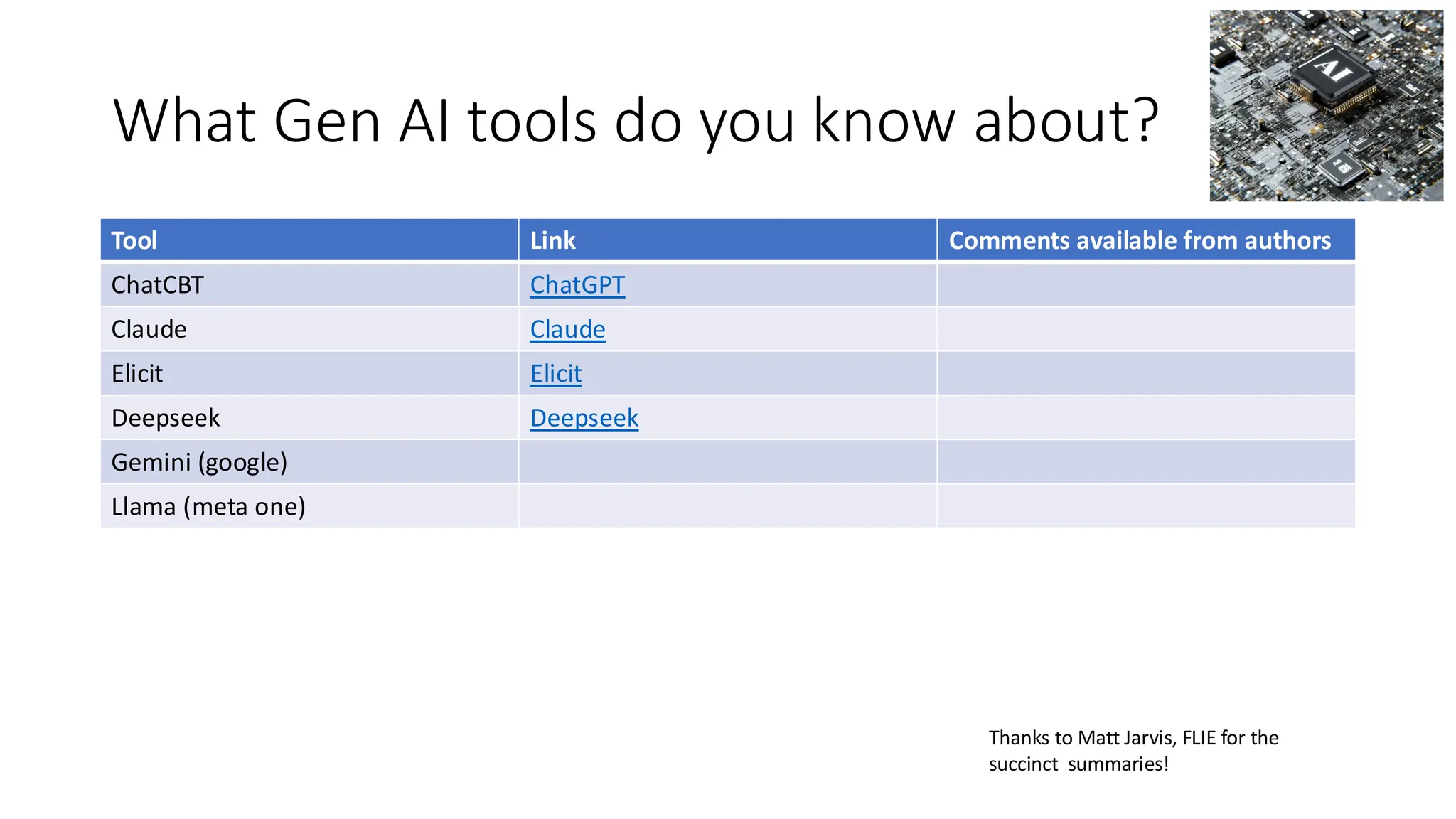
What Gen AI tools do you know about?
Tool Link Comments available from authors
ChatCBT ChatGPT
Claude Claude
Elicit Elicit
Deepseek Deepseek
Gemini (google)
Llama (meta one)
Thanks to Matt Jarvis, FLIE for the
succinct summaries!
So lets try
out Gen AI!
Photo by Nick Morrison on Unsplash
Lets consider
abstracts
Abstracts:
10.20 There shall be an abstract of approximately 300 words on a single page
bound into the thesis. The abstract should be single line spaced. The abstract
should state the nature and scope of the work undertaken and of the
contribution to knowledge in the discipline. The abstract should normally
contain four separate paragraphs which shall clearly state:
(a) what was investigated and why;
(b) how the topic was investigated;
(c) what was found;
(d) what conclusions were drawn from the evidence
Anglia Ruskin research degree regulations 2019
Badley, G.F., 2020. Why and how academics write. Qualitative Inquiry, 26(3-4),
pp.247-256. Available online:
https://journals.sagepub.com/doi/pdf/10.1177/1077800418810722
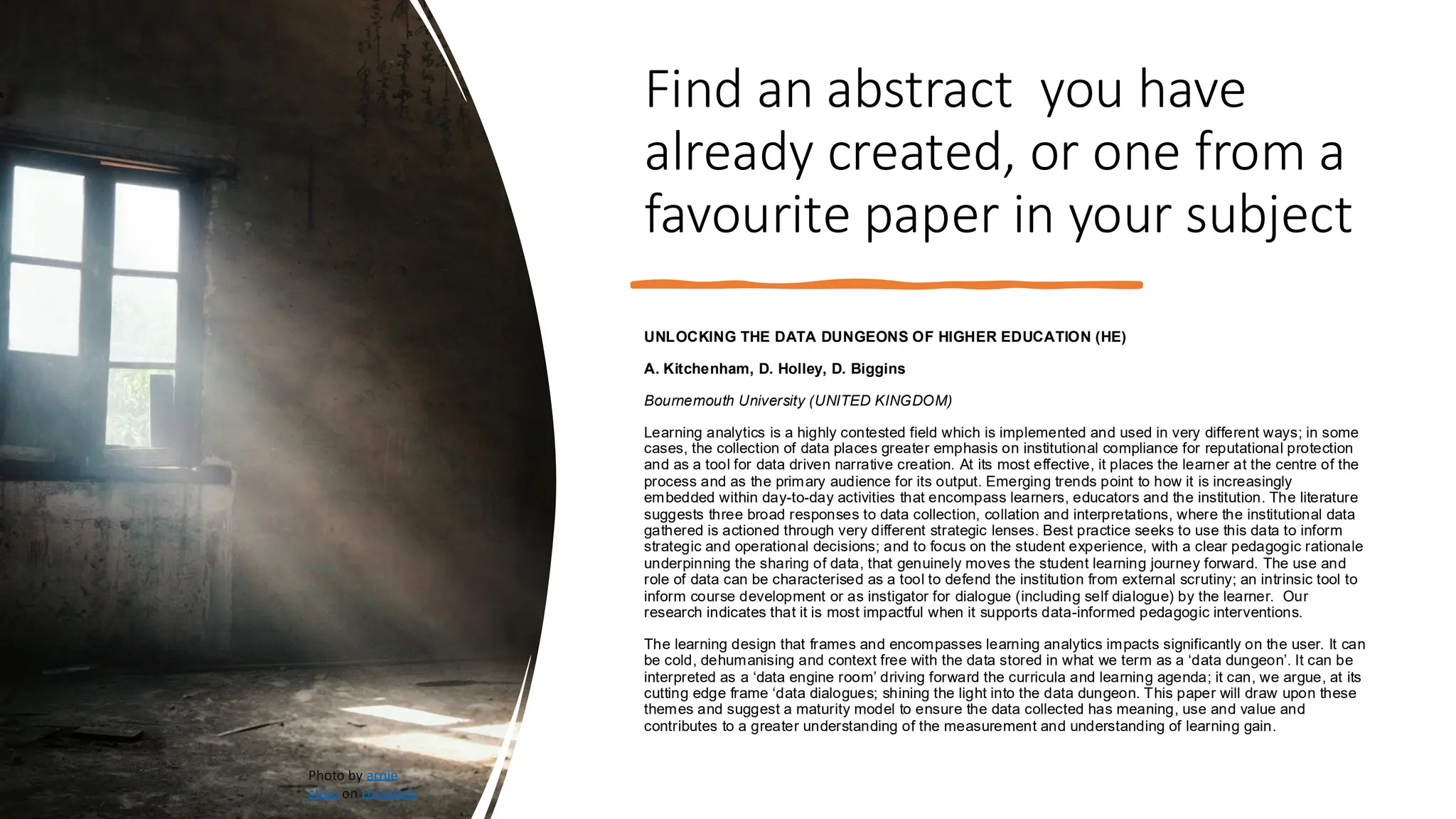
Find an abstract you have
already created, or one from a
favourite paper in your subject
UNLOCKING THE DATA DUNGEONS OF HIGHER EDUCATION (HE)
A. Kitchenham, D. Holley, D. Biggins
Bournemouth University (UNITED KINGDOM)
Learning analytics is a highly contested field which is implemented and used in very different ways; in some
cases, the collection of data places greater emphasis on institutional compliance for reputational protection
and as a tool for data driven narrative creation. At its most effective, it places the learner at the centre of the
process and as the primary audience for its output. Emerging trends point to how it is increasingly
embedded within day-to-day activities that encompass learners, educators and the institution. The literature
suggests three broad responses to data collection, collation and interpretations, where the institutional data
gathered is actioned through very different strategic lenses. Best practice seeks to use this data to inform
strategic and operational decisions; and to focus on the student experience, with a clear pedagogic rationale
underpinning the sharing of data, that genuinely moves the student learning journey forward. The use and
role of data can be characterised as a tool to defend the institution from external scrutiny; an intrinsic tool to
inform course development or as instigator for dialogue (including self dialogue) by the learner. Our
research indicates that it is most impactful when it supports data-informed pedagogic interventions.
The learning design that frames and encompasses learning analytics impacts significantly on the user. It can
be cold, dehumanising and context free with the data stored in what we term as a ‘data dungeon’. It can be
interpreted as a ‘data engine room’ driving forward the curricula and learning agenda; it can, we argue, at its
cutting edge frame ‘data dialogues; shining the light into the data dungeon. This paper will draw upon these
themes and suggest a maturity model to ensure the data collected has meaning, use and value and
contributes to a greater understanding of the measurement and understanding of learning gain.
Photo by arnie
chou on Unsplash
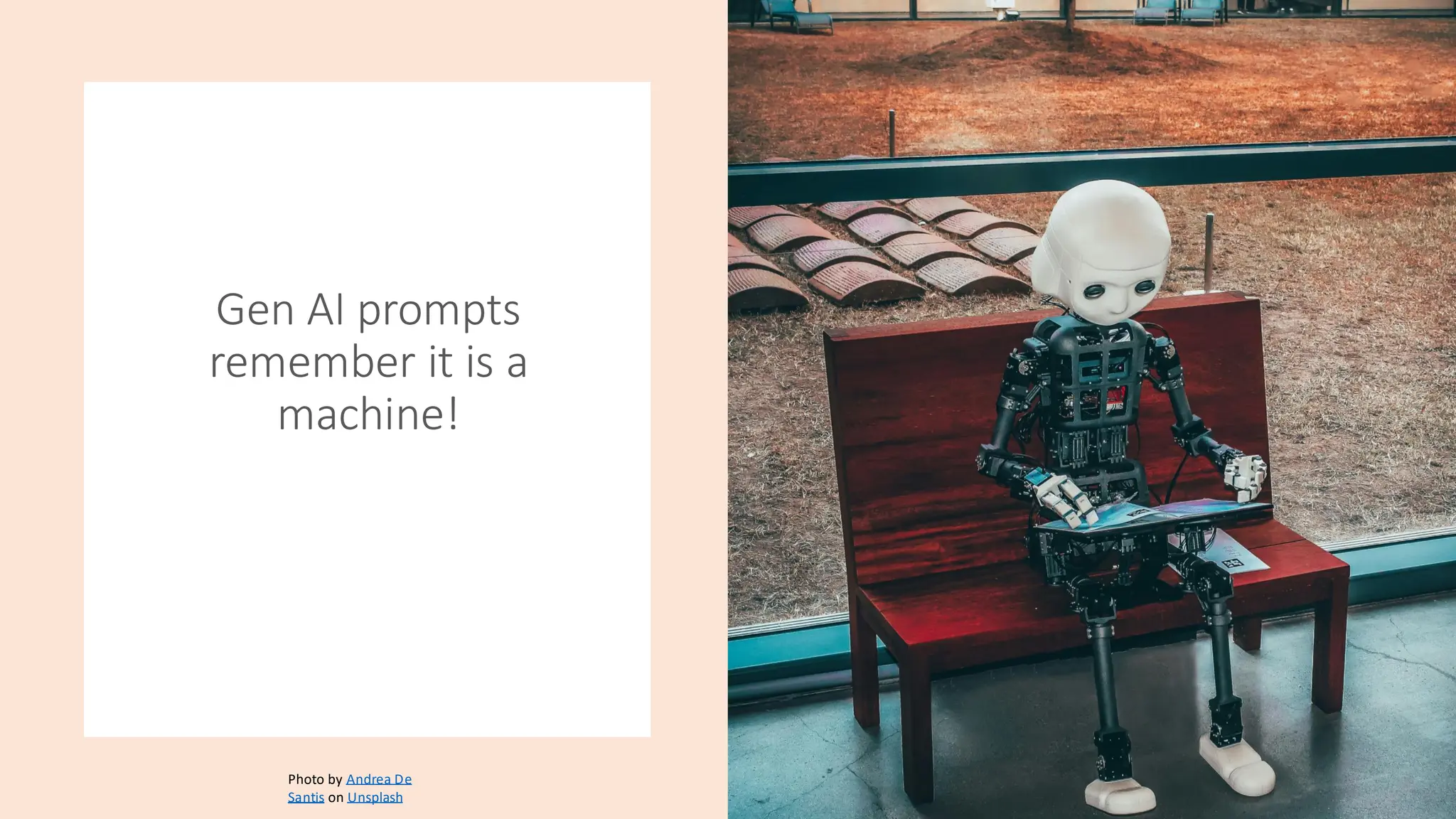
Gen AI prompts
remember it is a
machine!
Photo by Andrea De
Santis on Unsplash
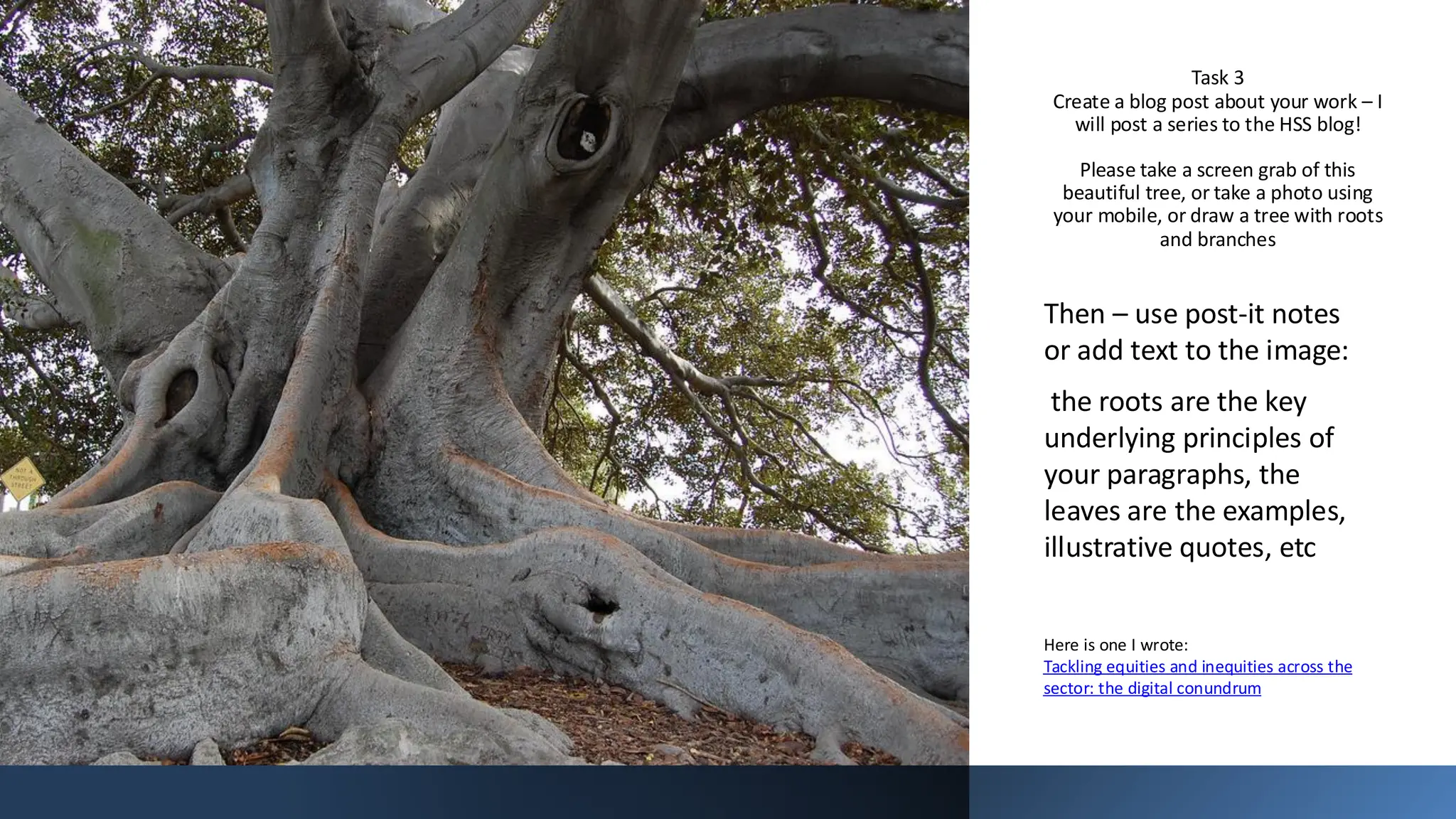
Task 3
Create a blog post about your work – I
will post a series to the HSS blog!
Please take a screen grab of this
beautiful tree, or take a photo using
your mobile, or draw a tree with roots
and branches
Then – use post-it notes
or add text to the image:
the roots are the key
underlying principles of
your paragraphs, the
leaves are the examples,
illustrative quotes, etc
Here is one I wrote:
Tackling equities and inequities across the
sector: the digital conundrum
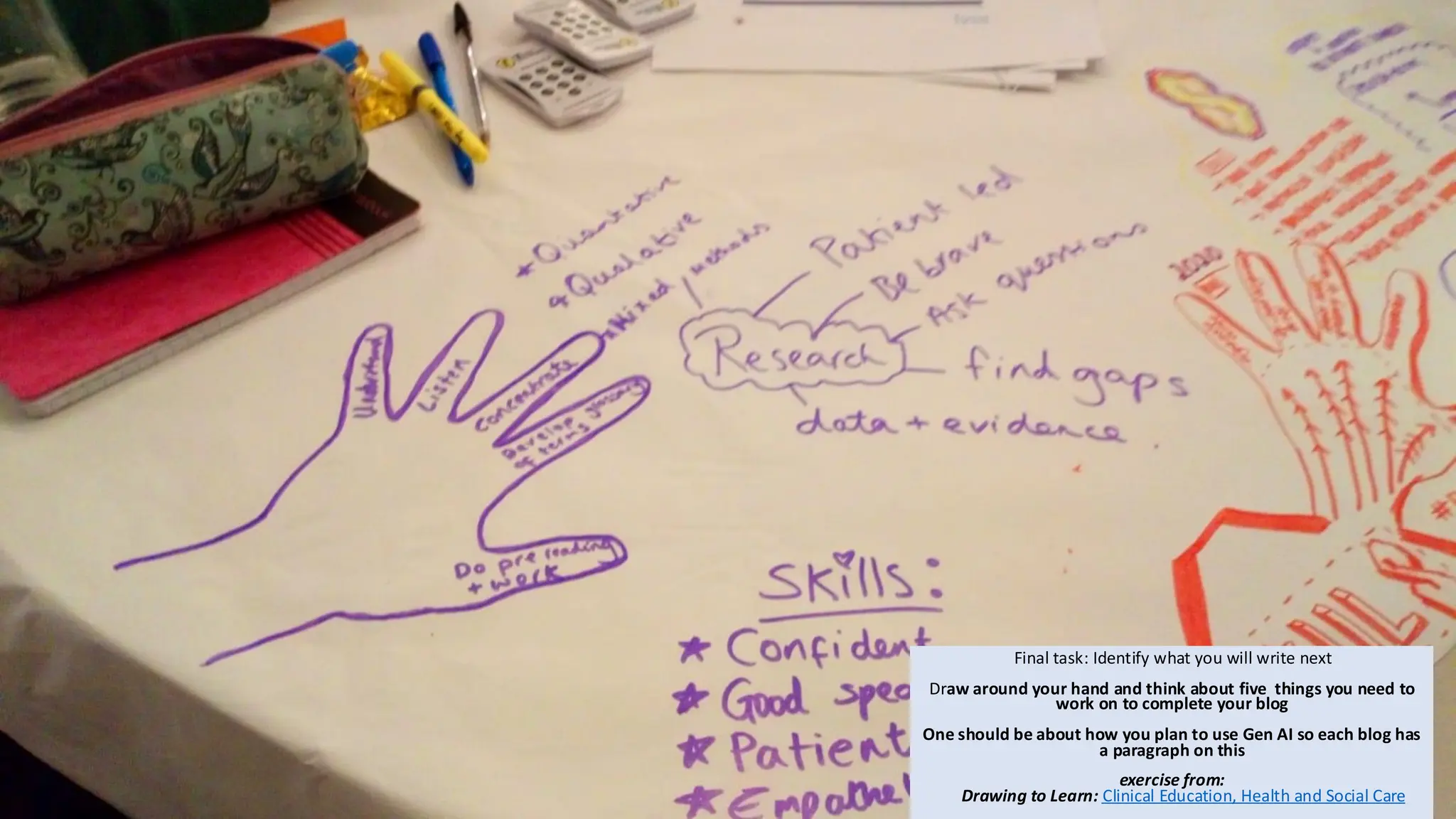
Final task: Identify what you will write next
Draw around your hand and think about five things you need to
work on to complete your blog
One should be about how you plan to use Gen AI so each blog has
a paragraph on this
exercise from:
Drawing to Learn: Clinical Education, Health and Social Care
Some final
thoughts
and
resources
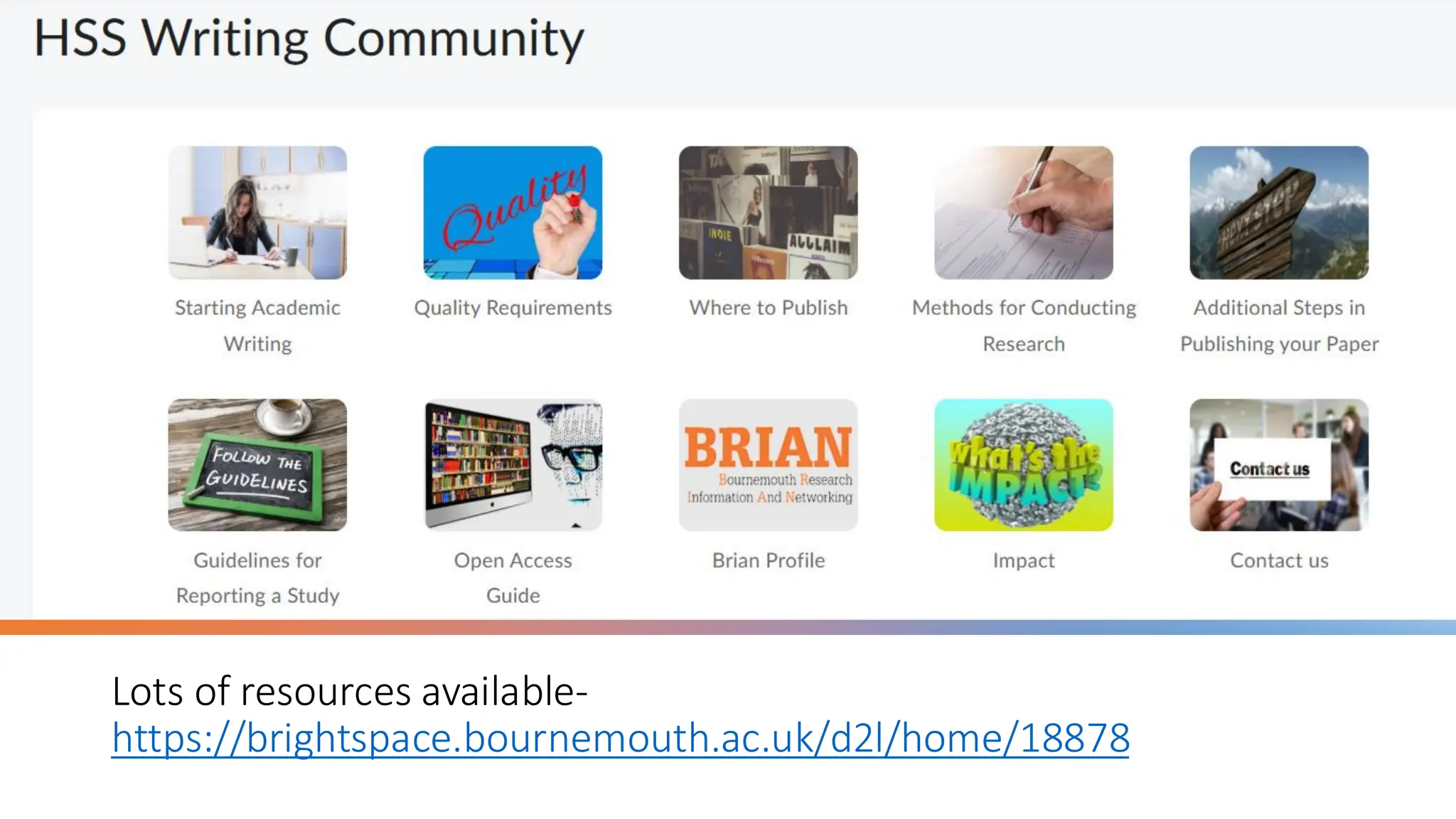
Lots of resources available-
https://brightspace.bournemouth.ac.uk/d2l/home/18878
Changing our writing
practices
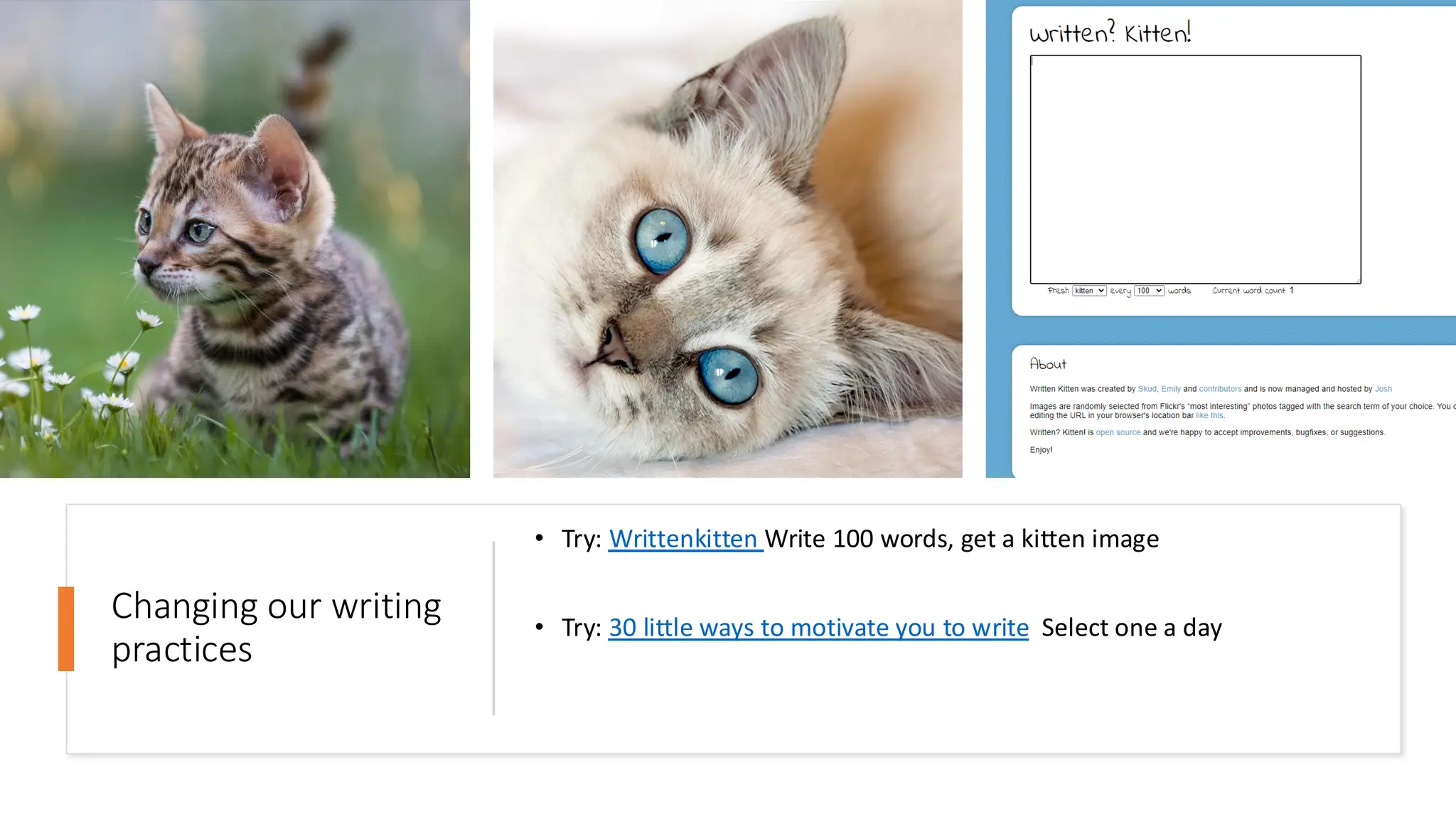
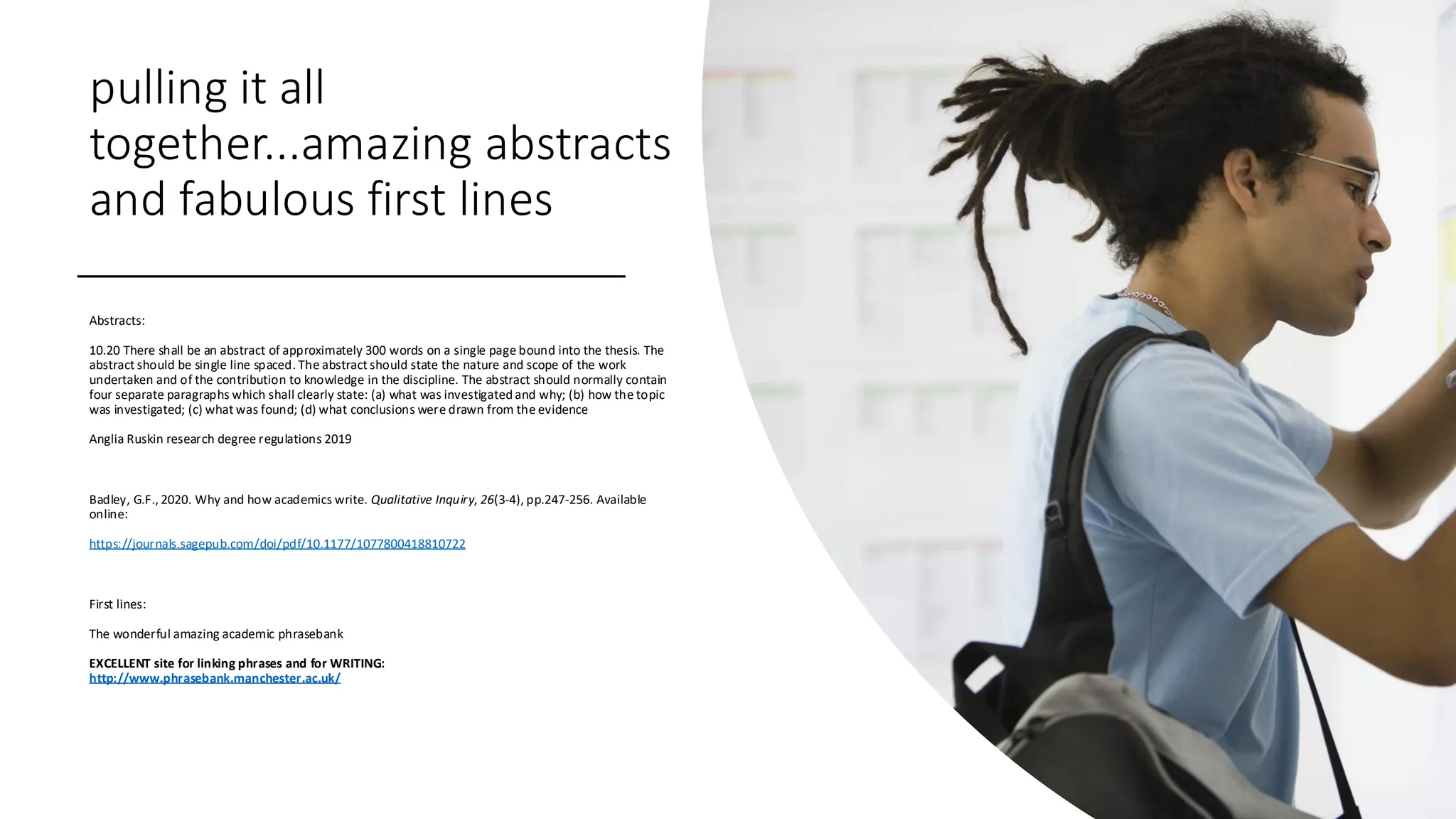
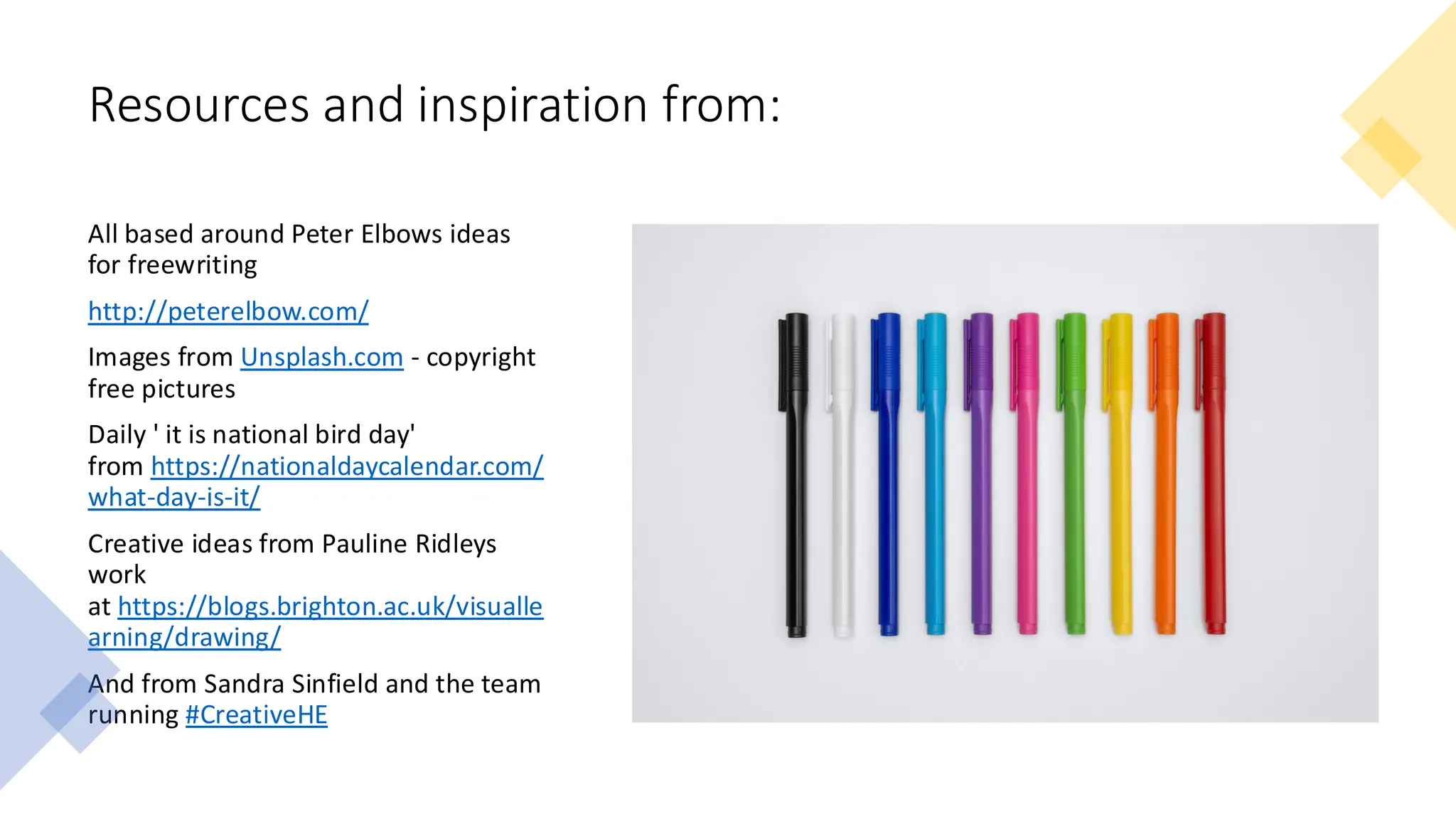
• Try: Writtenkitten Write 100 words, get a kitten image
• Try: 30 little ways to motivate you to write Select one a day
Reflecting on
distraction
• “The consequence [of writing] is that you must start
by writing the wrong meanings in the wrong words;
but keep writing until you get to the right meanings in
the right words. Only in the end will you know what
you are saying.” —Peter Elbow
• https://www.phrasebank.manchester.ac.uk/
• https://writingcenter.unc.edu/tips-and-
tools/conciseness-handout/
pulling it all
together...amazing abstracts
and fabulous first lines
Abstracts:
10.20 There shall be an abstract of approximately 300 words on a single page bound into the thesis. The
abstract should be single line spaced. The abstract should state the nature and scope of the work
undertaken and of the contribution to knowledge in the discipline. The abstract should normally contain
four separate paragraphs which shall clearly state: (a) what was investigated and why; (b) how the topic
was investigated; (c) what was found; (d) what conclusions were drawn from the evidence
Anglia Ruskin research degree regulations 2019
Badley, G.F., 2020. Why and how academics write. Qualitative Inquiry, 26(3-4), pp.247-256. Available
online:
https://journals.sagepub.com/doi/pdf/10.1177/1077800418810722
First lines:
The wonderful amazing academic phrasebank
EXCELLENT site for linking phrases and for WRITING:
http://www.phrasebank.manchester.ac.uk/
Resources and inspiration from:
All based around Peter Elbows ideas
for freewriting
http://peterelbow.com/
Images from Unsplash.com - copyright
free pictures
Daily ' it is national bird day'
from https://nationaldaycalendar.com/
what-day-is-it/
Creative ideas from Pauline Ridleys
work
at https://blogs.brighton.ac.uk/visualle
arning/drawing/
And from Sandra Sinfield and the team
running #CreativeHE

Professional Discourse in the Age of AI: An Interactive Writing Workshop

  • 1.
    Professional Discourse in the Ageof AI: An Interactive Writing Workshop facilitated by Profs Carol Clark and Debbie Holley FHSS Wednesday 30th April 2025
  • 2.
    Today: Focus on writing •Creative tasks and Gen AI tasks • Ideas for writers block – for you and to share with your students • Invitation to create a blog post from the session and have it published Photo by Etienne Girardet on Unsplash
  • 3.
    How do youlike to write?
  • 4.
    Why do youwrite?
  • 5.
    Task 1 gettingstarted? The genre task Once upon a time, you were walking across a beautiful beach when looking out to sea you saw a.... now select a genre, and freewrite for three minutes... Thriller/comedy/romance/horror/sci-fi/ epic/fairytale/ fantasy/crime/history • then link the final sentence into your 'real' writing • Based on Peter Elbows' work and English, (2011)
  • 6.
    1. What isthe primary function of Generative AI? A. Analysing statistical data B. Creating new content such as text, images, or audio C. Managing hardware systems Photo by Cash Macanaya on Unsplash
  • 7.
    2 Which ofthe following is a common application of Generative AI in writing? A. Editing code syntax B. Generating creative and professional text based on prompts C. Sorting emails by priority Photo by Emiliano Vittoriosi on Unsplash
  • 8.
    3. What isone potential ethical concern with using Generative AI? A. It consumes too little processing power B. It always provides correct information C. It may produce biased or inaccurate outputs Photo by ZHENYU LUO on Unsplash
  • 9.
    Which technology underlies manyGenerative AI tools, such as ChatGPT? A. Blockchain B. Transformer-based neural networks C. Spreadsheet formulas Photo by Steve Johnson on Unsplash
  • 10.
    5. How can GenerativeAI support professional writing? A. By replacing human decision-making B. By generating contextual drafts and assisting with structure C. By reducing the need for communication skills Photo by Igor Omilaev on Unsplash
  • 11.
    Task 2: Todayis national bubble tea day .... You will need one piece of paper/ word doc and two columns • Bubble tea (boba) tea comes from Taiwan • It is made from sugar, tea, milk and tapioca • The bubbles come from froth created when the drink is shaken • Boba pearls are made from tapico starch, making them vegan What are the key facts the readers of your writing will want to know? 5 minutes on writing that list! One side – what you know, the other – what are the gaps you need to find out about?
  • 12.
    And image generation •With thanks to Rebecca Neal and ChatCPT for creating the draft text and image from the AI prompt sheet. Errors are ChatCPT!
  • 13.
    What Gen AItools do you know about? Tool Link Comments available from authors ChatCBT ChatGPT Claude Claude Elicit Elicit Deepseek Deepseek Gemini (google) Llama (meta one) Thanks to Matt Jarvis, FLIE for the succinct summaries!
  • 14.
    So lets try outGen AI! Photo by Nick Morrison on Unsplash
  • 15.
    Lets consider abstracts Abstracts: 10.20 Thereshall be an abstract of approximately 300 words on a single page bound into the thesis. The abstract should be single line spaced. The abstract should state the nature and scope of the work undertaken and of the contribution to knowledge in the discipline. The abstract should normally contain four separate paragraphs which shall clearly state: (a) what was investigated and why; (b) how the topic was investigated; (c) what was found; (d) what conclusions were drawn from the evidence Anglia Ruskin research degree regulations 2019 Badley, G.F., 2020. Why and how academics write. Qualitative Inquiry, 26(3-4), pp.247-256. Available online: https://journals.sagepub.com/doi/pdf/10.1177/1077800418810722
  • 16.
    Find an abstractyou have already created, or one from a favourite paper in your subject UNLOCKING THE DATA DUNGEONS OF HIGHER EDUCATION (HE) A. Kitchenham, D. Holley, D. Biggins Bournemouth University (UNITED KINGDOM) Learning analytics is a highly contested field which is implemented and used in very different ways; in some cases, the collection of data places greater emphasis on institutional compliance for reputational protection and as a tool for data driven narrative creation. At its most effective, it places the learner at the centre of the process and as the primary audience for its output. Emerging trends point to how it is increasingly embedded within day-to-day activities that encompass learners, educators and the institution. The literature suggests three broad responses to data collection, collation and interpretations, where the institutional data gathered is actioned through very different strategic lenses. Best practice seeks to use this data to inform strategic and operational decisions; and to focus on the student experience, with a clear pedagogic rationale underpinning the sharing of data, that genuinely moves the student learning journey forward. The use and role of data can be characterised as a tool to defend the institution from external scrutiny; an intrinsic tool to inform course development or as instigator for dialogue (including self dialogue) by the learner. Our research indicates that it is most impactful when it supports data-informed pedagogic interventions. The learning design that frames and encompasses learning analytics impacts significantly on the user. It can be cold, dehumanising and context free with the data stored in what we term as a ‘data dungeon’. It can be interpreted as a ‘data engine room’ driving forward the curricula and learning agenda; it can, we argue, at its cutting edge frame ‘data dialogues; shining the light into the data dungeon. This paper will draw upon these themes and suggest a maturity model to ensure the data collected has meaning, use and value and contributes to a greater understanding of the measurement and understanding of learning gain. Photo by arnie chou on Unsplash
  • 17.
    Gen AI prompts rememberit is a machine! Photo by Andrea De Santis on Unsplash
  • 18.
    Task 3 Create ablog post about your work – I will post a series to the HSS blog! Please take a screen grab of this beautiful tree, or take a photo using your mobile, or draw a tree with roots and branches Then – use post-it notes or add text to the image: the roots are the key underlying principles of your paragraphs, the leaves are the examples, illustrative quotes, etc Here is one I wrote: Tackling equities and inequities across the sector: the digital conundrum
  • 19.
    Final task: Identifywhat you will write next Draw around your hand and think about five things you need to work on to complete your blog One should be about how you plan to use Gen AI so each blog has a paragraph on this exercise from: Drawing to Learn: Clinical Education, Health and Social Care
  • 20.
  • 21.
    Lots of resourcesavailable- https://brightspace.bournemouth.ac.uk/d2l/home/18878
  • 22.
    Changing our writing practices •Try: Writtenkitten Write 100 words, get a kitten image • Try: 30 little ways to motivate you to write Select one a day
  • 23.
    Reflecting on distraction • “Theconsequence [of writing] is that you must start by writing the wrong meanings in the wrong words; but keep writing until you get to the right meanings in the right words. Only in the end will you know what you are saying.” —Peter Elbow • https://www.phrasebank.manchester.ac.uk/ • https://writingcenter.unc.edu/tips-and- tools/conciseness-handout/
  • 24.
    pulling it all together...amazingabstracts and fabulous first lines Abstracts: 10.20 There shall be an abstract of approximately 300 words on a single page bound into the thesis. The abstract should be single line spaced. The abstract should state the nature and scope of the work undertaken and of the contribution to knowledge in the discipline. The abstract should normally contain four separate paragraphs which shall clearly state: (a) what was investigated and why; (b) how the topic was investigated; (c) what was found; (d) what conclusions were drawn from the evidence Anglia Ruskin research degree regulations 2019 Badley, G.F., 2020. Why and how academics write. Qualitative Inquiry, 26(3-4), pp.247-256. Available online: https://journals.sagepub.com/doi/pdf/10.1177/1077800418810722 First lines: The wonderful amazing academic phrasebank EXCELLENT site for linking phrases and for WRITING: http://www.phrasebank.manchester.ac.uk/
  • 25.
    Resources and inspirationfrom: All based around Peter Elbows ideas for freewriting http://peterelbow.com/ Images from Unsplash.com - copyright free pictures Daily ' it is national bird day' from https://nationaldaycalendar.com/ what-day-is-it/ Creative ideas from Pauline Ridleys work at https://blogs.brighton.ac.uk/visualle arning/drawing/ And from Sandra Sinfield and the team running #CreativeHE