WE ARE TALKING
ABOUT
 DEFINITION
 DIFFRENCE BETWEENVIRTUAL AND AUGMENTED
REALITY
 USE OF AUGMENTED REALITY
 WIKITUDE
 LAYAR
 GOOGLE GLASS
 ADVANTAGES AND DISADVANTAGES OF
AUGMENTED REALITY.
DEFINITON OF AUGMENTED
REALITY.
 Abbreviated as AR, Augmented Reality is a type of virtual
reality that aims to duplicate the world’s environment in
a computer. An augmented reality system generates a
composite view for the user that is the combination of
real scene generated by the computer that augments the
scene additional information.
A BETTER UNDERSTANDING.
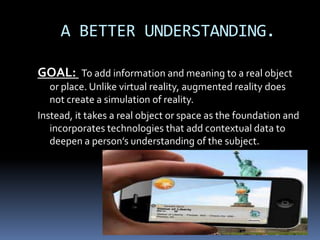
GOAL: To add information and meaning to a real object
or place. Unlike virtual reality, augmented reality does
not create a simulation of reality.
Instead, it takes a real object or space as the foundation and
incorporates technologies that add contextual data to
deepen a person’s understanding of the subject.
DIFFERENCE BETWEEN VIRTUAL
AND AUGMENTED
 VIRTUAL REALITY: It is based upon a complete
simulation of a real world environment which the user
can explore and interact with by means of a head
mounted display (HMD) and input device.
 AUGMENTED REALITY:The user sees the real world but
with the addition of computer generated images which
are overlaid on various objects within the real world.
 Virtual reality replaces the real with
the artificial whereas augmented reality
enhances real life with artificial images.
 Augmented reality is available via mobile phones in
particular smart phones such as the iPhone.These
phones have GPRS .
 Handheld devices such as smart phones and the iPad are
other ways to use augmented reality.They contain
software, sensors, a compass and small digital projectors
which display images onto real world objects.
WHERE DO WE USE
AUGMENTED REALITY?
In today’s world wherever we go , Augmented
Reality follows.
 ARCHEOLOGY:
 ARCHITECTURE.
 ART:
 COMMERCE:
 CONTRUCTION:
 EDUCATION:
 GAMING:
 MEDICAL:
 Other than these, Augmented Reality is used
in military, navigation, office workplace,
sports and entertainment, television and
tourism.
WIKITUDE
 Wikitude is a mobile augmented reality software which
is developed by the Austrian company.It was first
published in October 2008 as freeware.
 It displays information about the users' surroundings in a
mobile camera view, including Image Recognition and 3D
Modeling.
 Wikitude was the first publicly available application that
used a location-based approach to Augmented Reality.
LAYAR.
 Layar is a Dutch company based in Amsterdam, founded
in 2009 by Raimo van der Klein, Claire Boonstra and
Maarten Lens-FitzGerald.They have created a mobile
browser called Layar.The browser allows users to find
various items based upon augmented reality technology.
GOOGLE GLASS.
 Google Glass (styled "GLΛSS") is a wearable
computer with an optical head-mounted display (OHMD)
that is being developed by Google inThe Project
Glass research and development project , with the
mission of producing a mass-market ubiquitous
computer.Google Glass displays information in a smart
phone-like hands-free format, that can interact with the
Internet via natural language voice commands.
ADVANTAGES OF AUGMENTED
REALITY
 Although augmented reality ideas may be residing in the
back of the minds of many marketing heads and social
media agency directors, the possibilities of the new
technology can bring numerous benefits.The concept of
augmented reality is one that is lost on many people, but
its appeal is nonetheless there for all to see.
 Perhaps the first successful example of such marketing
techniques can be seen in the “Hero” movie from
Sweden, which takes an image of the user and uses it to
portray them as a public hero within a video.
 IT IS UNIQUE:The novelty factor of such application will
obviously wear off as more and more are created and used,
but for the meantime the onus is on brand to make most of
this existing technology and extend it from infancy.
 PERSONALISATION:The concept of uploading your own
media, such as image helps to create a highly personalized
piece of media for the user. It relates to them which is far
more engaging than a standard video game.
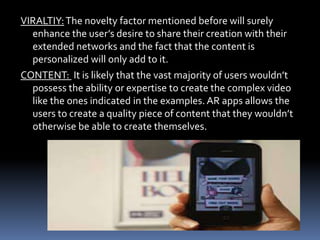
VIRALTIY:The novelty factor mentioned before will surely
enhance the user’s desire to share their creation with their
extended networks and the fact that the content is
personalized will only add to it.
CONTENT: It is likely that the vast majority of users wouldn’t
possess the ability or expertise to create the complex video
like the ones indicated in the examples. AR apps allows the
users to create a quality piece of content that they wouldn’t
otherwise be able to create themselves.
DISADVANTAGES OF AUGMENTED
REALTIY
 PROFILING: The use of facial recognition technology,
combined with geo-location and augmented data will lead to a
seamless integration of our online and offline lives
 UNAUTHORISED AUGMENTED
ADVERTISING:Advertisers and tech companies are drooling
over the possibilities of monetizing objects & spaces in the
physical world by augmenting digital ads onto them in real-
time.
 AUGMENTED BEHAVIORAL
TARGETTING:
Ad targeting based on real world behavior using a combination of
geo-location data & publicly self-disclosed information via
social media services is just around the corner
 PHYSICAL DANGER:Augmented Reality, like any
mobile media technology presents some real physical
safety issues.
 SPAMS:Yes — where there is a marketing opportunity,
there will be spam, deceptive advertising techniques and
social engineering tricks to dupe gullible consumers into
paying for things they don’t really need.
WE CONCLUDE.
Augmented Reality is still very
much in the experimental bucket for most brands
and most of the implementation so far are still
gimmicky.
PROJECT BY
 VANDIT SHAH- 1212038
 CHIREN MEHTA- 1212039

Augmentation

  • 2.
    WE ARE TALKING ABOUT DEFINITION  DIFFRENCE BETWEENVIRTUAL AND AUGMENTED REALITY  USE OF AUGMENTED REALITY  WIKITUDE  LAYAR  GOOGLE GLASS  ADVANTAGES AND DISADVANTAGES OF AUGMENTED REALITY.
  • 3.
    DEFINITON OF AUGMENTED REALITY. Abbreviated as AR, Augmented Reality is a type of virtual reality that aims to duplicate the world’s environment in a computer. An augmented reality system generates a composite view for the user that is the combination of real scene generated by the computer that augments the scene additional information.
  • 4.
    A BETTER UNDERSTANDING. GOAL:To add information and meaning to a real object or place. Unlike virtual reality, augmented reality does not create a simulation of reality. Instead, it takes a real object or space as the foundation and incorporates technologies that add contextual data to deepen a person’s understanding of the subject.
  • 5.
    DIFFERENCE BETWEEN VIRTUAL ANDAUGMENTED  VIRTUAL REALITY: It is based upon a complete simulation of a real world environment which the user can explore and interact with by means of a head mounted display (HMD) and input device.  AUGMENTED REALITY:The user sees the real world but with the addition of computer generated images which are overlaid on various objects within the real world.  Virtual reality replaces the real with the artificial whereas augmented reality enhances real life with artificial images.
  • 6.
     Augmented realityis available via mobile phones in particular smart phones such as the iPhone.These phones have GPRS .  Handheld devices such as smart phones and the iPad are other ways to use augmented reality.They contain software, sensors, a compass and small digital projectors which display images onto real world objects.
  • 7.
    WHERE DO WEUSE AUGMENTED REALITY? In today’s world wherever we go , Augmented Reality follows.
  • 8.
  • 9.
  • 10.
     Other thanthese, Augmented Reality is used in military, navigation, office workplace, sports and entertainment, television and tourism.
  • 11.
    WIKITUDE  Wikitude isa mobile augmented reality software which is developed by the Austrian company.It was first published in October 2008 as freeware.  It displays information about the users' surroundings in a mobile camera view, including Image Recognition and 3D Modeling.  Wikitude was the first publicly available application that used a location-based approach to Augmented Reality.
  • 12.
    LAYAR.  Layar isa Dutch company based in Amsterdam, founded in 2009 by Raimo van der Klein, Claire Boonstra and Maarten Lens-FitzGerald.They have created a mobile browser called Layar.The browser allows users to find various items based upon augmented reality technology.
  • 13.
    GOOGLE GLASS.  GoogleGlass (styled "GLΛSS") is a wearable computer with an optical head-mounted display (OHMD) that is being developed by Google inThe Project Glass research and development project , with the mission of producing a mass-market ubiquitous computer.Google Glass displays information in a smart phone-like hands-free format, that can interact with the Internet via natural language voice commands.
  • 14.
    ADVANTAGES OF AUGMENTED REALITY Although augmented reality ideas may be residing in the back of the minds of many marketing heads and social media agency directors, the possibilities of the new technology can bring numerous benefits.The concept of augmented reality is one that is lost on many people, but its appeal is nonetheless there for all to see.  Perhaps the first successful example of such marketing techniques can be seen in the “Hero” movie from Sweden, which takes an image of the user and uses it to portray them as a public hero within a video.
  • 15.
     IT ISUNIQUE:The novelty factor of such application will obviously wear off as more and more are created and used, but for the meantime the onus is on brand to make most of this existing technology and extend it from infancy.  PERSONALISATION:The concept of uploading your own media, such as image helps to create a highly personalized piece of media for the user. It relates to them which is far more engaging than a standard video game.
  • 16.
    VIRALTIY:The novelty factormentioned before will surely enhance the user’s desire to share their creation with their extended networks and the fact that the content is personalized will only add to it. CONTENT: It is likely that the vast majority of users wouldn’t possess the ability or expertise to create the complex video like the ones indicated in the examples. AR apps allows the users to create a quality piece of content that they wouldn’t otherwise be able to create themselves.
  • 17.
    DISADVANTAGES OF AUGMENTED REALTIY PROFILING: The use of facial recognition technology, combined with geo-location and augmented data will lead to a seamless integration of our online and offline lives  UNAUTHORISED AUGMENTED ADVERTISING:Advertisers and tech companies are drooling over the possibilities of monetizing objects & spaces in the physical world by augmenting digital ads onto them in real- time.  AUGMENTED BEHAVIORAL TARGETTING: Ad targeting based on real world behavior using a combination of geo-location data & publicly self-disclosed information via social media services is just around the corner
  • 18.
     PHYSICAL DANGER:AugmentedReality, like any mobile media technology presents some real physical safety issues.  SPAMS:Yes — where there is a marketing opportunity, there will be spam, deceptive advertising techniques and social engineering tricks to dupe gullible consumers into paying for things they don’t really need.
  • 19.
    WE CONCLUDE. Augmented Realityis still very much in the experimental bucket for most brands and most of the implementation so far are still gimmicky.
  • 21.
    PROJECT BY  VANDITSHAH- 1212038  CHIREN MEHTA- 1212039