Virtual Reality for Education -
BlockchainAppsDeveloper
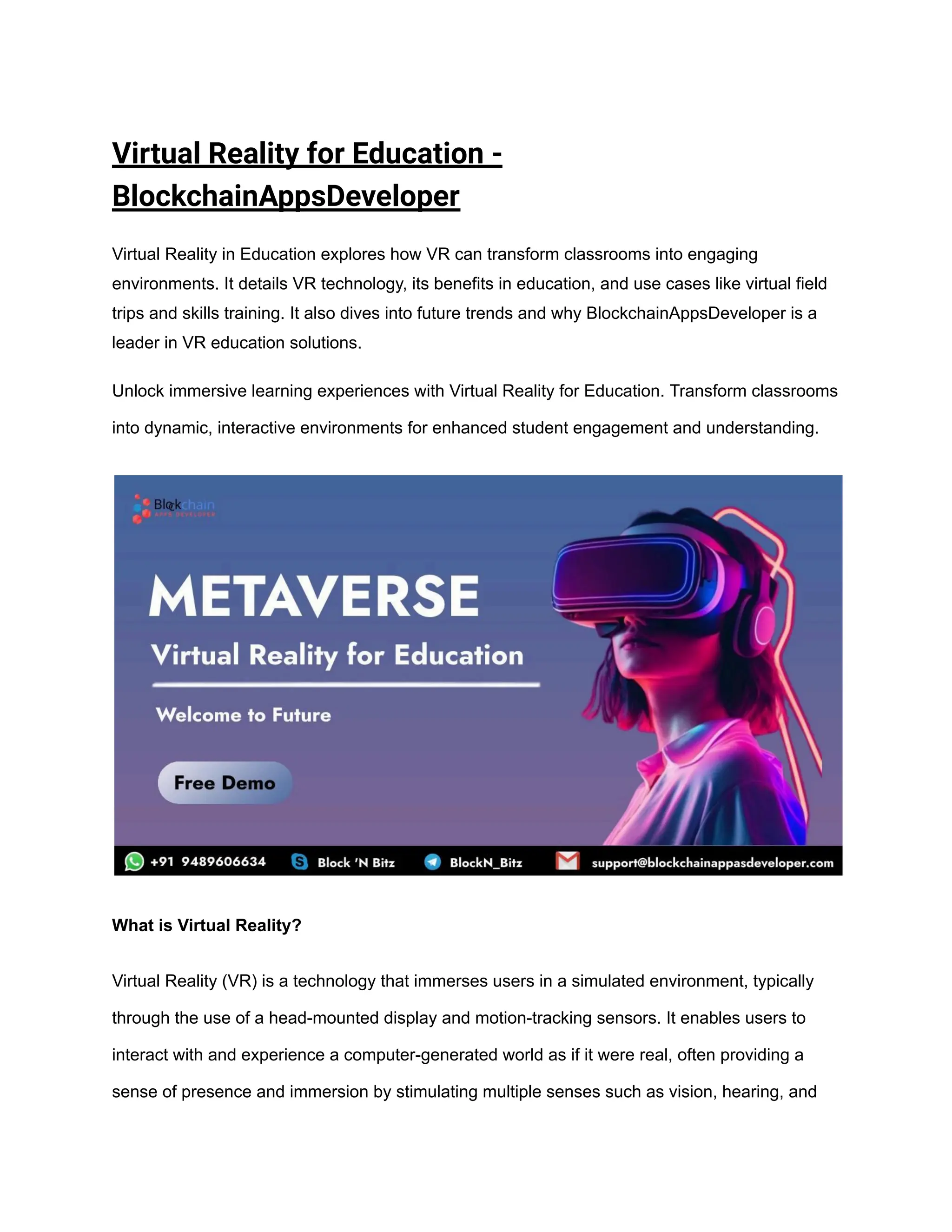
Virtual Reality in Education explores how VR can transform classrooms into engaging
environments. It details VR technology, its benefits in education, and use cases like virtual field
trips and skills training. It also dives into future trends and why BlockchainAppsDeveloper is a
leader in VR education solutions.
Unlock immersive learning experiences with Virtual Reality for Education. Transform classrooms
into dynamic, interactive environments for enhanced student engagement and understanding.
What is Virtual Reality?
Virtual Reality (VR) is a technology that immerses users in a simulated environment, typically
through the use of a head-mounted display and motion-tracking sensors. It enables users to
interact with and experience a computer-generated world as if it were real, often providing a
sense of presence and immersion by stimulating multiple senses such as vision, hearing, and
sometimes touch. VR applications range from entertainment and gaming to training simulations,
education, and therapeutic interventions.
VR in education
Virtual reality (VR) technology has opened up new possibilities in the field of education. By
creating immersive, interactive environments, VR allows students to explore and experience
concepts in a hands-on, engaging manner. From virtual field trips to historical simulations,
scientific visualizations, and interactive training scenarios, VR offers a unique way to bring
abstract ideas to life, facilitating better understanding and retention. Also, VR can provide safe
environments for practicing real-world skills, such as surgical procedures or equipment
operations, without risking harm. As VR technology continues to advance and become more
accessible, its integration into educational settings holds the potential to revolutionize teaching
and learning approaches, making education more experiential and captivating.
Our All-Inclusive virtual learning Solutions
BlockchainAppsDeveloper is a leading VR development company, dedicated to providing
all-inclusive virtual learning solutions that revolutionize education. Our expertise in VR
technology allows us to create immersive and engaging educational experiences tailored to the
specific needs of each institution.
Virtual Classrooms: Immersive environments where students and teachers can interact in real
time, and conduct lectures, discussions, and group activities.
Interactive Simulations: Engaging simulations that allow students to explore complex
concepts, perform experiments, and interact with realistic scenarios.
Virtual Laboratories: Digital labs where students can conduct experiments, manipulate virtual
equipment, and practice scientific techniques safely and efficiently.
Field Trips and Tours: Virtual excursions to historical sites, natural wonders, museums, and
cultural landmarks, thereby providing immersive learning experiences without leaving the
classroom.
Skill Training Modules: Practical training modules for vocational skills, technical subjects, and
professional development that offer hands-on practice in a virtual environment.
Language Learning Environments: Interactive language immersion programs that enable
students to practice conversation, vocabulary, and cultural understanding in realistic settings.
Virtual Internships and Workshops: Virtual experiences that simulate real-world work
environments, allowing students to gain industry-specific skills, collaborate with professionals,
and solve practical challenges.
Custom Content Development: Tailored VR content creation services to meet specific
educational objectives, curriculum requirements, and learning outcomes across subjects and
grade levels.
Assessment and Progress Tracking: Tools for evaluating student performance, tracking
progress, and providing personalized feedback within the VR learning environment.
Teacher Training and Support: Resources, workshops, and professional development
opportunities for educators to integrate VR technology effectively into their teaching practices
and enhance student engagement.
Benefits of VR in Education
Virtual Reality (VR) technology has the potential to revolutionize the educational experience by
providing immersive and interactive learning environments. Here are some key benefits of using
VR in education:
Immersive learning experiences
● Increased engagement and motivation
● Experiential learning
● Customized learning experiences
● Safe environment for training
● Remote and accessible learning
● Cost-effective simulations
Use Cases and Examples
Here are some use cases and examples of how Virtual Reality (VR) is being utilized in
education:
● Virtual Field Trips:
VR allows students to virtually visit historical sites, museums, and landmarks around the world
without leaving the classroom.
Example: Students can explore ancient ruins like Machu Picchu or the Great Pyramids of Giza,
gaining a deeper understanding of these cultural and historical sites.
● Science and Biology Simulations:
VR creates immersive simulations of scientific concepts, biological processes, and molecular
structures.
Example: Students can journey through the human body, observing the intricate details of
organs, cells, and biological systems.
● Astronomy and Space Exploration:
VR transports students to different planets, stars, and galaxies, providing a unique perspective
on astronomical concepts.
Example: Students can experience walking on the surface of Mars or witnessing the birth of a
star in a distant galaxy.
● Vocational and Skill Training:
VR simulations provide hands-on training for various vocational skills, such as welding,
construction, or equipment operation.
Example: Automotive technicians can practice complex repair procedures in a safe, virtual
environment before working on actual vehicles.
● Language and Cultural Immersion:
VR creates immersive language learning experiences by simulating real-world scenarios and
cultural environments.
Example: Students learning a new language can practice conversations with virtual characters
in simulated settings, such as a marketplace or restaurant.
● Medical and Healthcare Education:
VR revolutionizes medical training by allowing students to practice surgical procedures, patient
interactions, and emergencies.
Example: Nursing students can experience realistic scenarios involving patient care, triage, and
emergency response.
● Architecture and Design:
VR serves as a powerful tool for visualizing and exploring architectural designs, that enable
students to understand spatial relationships and design principles.
Example: Architecture students can virtually walk through and interact with their 3D building
designs before construction.
● Virtual Laboratories:
VR recreates laboratory environments by enabling students to conduct virtual experiments and
simulations without the need for physical lab equipment.
Example: Chemistry students can perform virtual experiments involving hazardous materials or
complex setups in a safe, controlled environment.
● Collaborative Learning Spaces:
VR facilitates collaborative learning experiences by creating virtual classrooms or meeting
spaces where students from different locations can interact and work together.
Example: Students from different schools or countries can collaborate on group projects or
participate in virtual discussions within a shared VR environment.
Future Trends and Developments
Here are some potential future trends and developments in Virtual Reality (VR) for education:
● Increased Accessibility and Affordability
VR technology will become more accessible and affordable. This will lead to wider adoption in
educational institutions at all levels, from elementary schools to universities.
● Web-based VR Solutions
The development of web-based VR solutions will further increase accessibility. Students will be
able to experience VR content without the need for dedicated hardware.
● Immersive Collaborative Environments
Future VR systems will enable more seamless and natural collaboration between students and
instructors. This will facilitate group projects, discussions, and virtual classrooms.
● Adaptive and Personalized Learning
VR experiences will be tailored to individual learning styles, abilities, and preferences. Artificial
Intelligence (AI) and machine learning will be integrated to analyze student performance and
adapt the VR environment accordingly.
● Augmented Reality (AR) Integration
The integration of AR with VR will enhance the learning experience. It will blend virtual elements
with the real-world environment. Students will interact with 3D models, simulations, or virtual
objects overlaid in their physical surroundings.
● Multisensory Experiences
Future VR systems will incorporate multisensory feedback, such as haptic feedback (touch),
olfactory cues (smell), and spatial audio. This will create more immersive and realistic
experiences.
● Brain-Computer Interfaces (BCI)
The integration of BCI technology with VR will enable direct communication between the user's
brain and the virtual environment. This may allow for more intuitive and natural interactions in
areas like cognitive training and neuroscience education.
● Extended Reality (XR) Ecosystems
The convergence of VR, AR, and other emerging technologies will lead to the development of
integrated XR ecosystems for education. These ecosystems will provide seamless transitions
between different modalities (virtual, augmented, and mixed reality) based on the learning
context and requirements.
● Gamification and Immersive Storytelling
The use of gamification techniques and immersive storytelling in VR educational experiences
will enhance engagement, motivation, and retention. Narrative-driven learning experiences will
make abstract concepts more relatable and memorable.
● Virtual Field Trips and Cultural Experiences
VR will facilitate virtual field trips to remote or inaccessible locations, enabling students to
explore different cultures, historical sites, and natural environments in an immersive way.
Why choose BlockchainAppsDeveloper for virtual reality education solutions?
BlockchainAppsDeveloper is a leading VR Development Company that offers first-rate virtual
reality (VR) education solutions. We are experts in merging blockchain technology with VR
development, which ensures that our solutions are innovative, secure, and transparent. We
have a team of professionals with expertise in both fields, allowing us to create customised VR
experiences that meet the specific needs of educational institutions. Our topmost priority is
quality, which means that our VR solutions are not only engaging but also effective in enhancing
learning outcomes. We provide ongoing support and assistance throughout the development
process and beyond, as we are committed to client satisfaction. By partnering with us, you can
expect cutting-edge VR education solutions that are customized, secure, and backed by a team
of experts dedicated to your success.
Other Services , we offer :
1) Blockchain Development
2) AI Development
3) Generative AI Development
4) Metaverse Development
5) Cryptocurrency Exchange Development
Source : https://www.blockchainappsdeveloper.com/virtual-reality-for-education

Virtual Reality for Education - BlockchainAppsDeveloper (1).pdf

  • 1.
    Virtual Reality forEducation - BlockchainAppsDeveloper Virtual Reality in Education explores how VR can transform classrooms into engaging environments. It details VR technology, its benefits in education, and use cases like virtual field trips and skills training. It also dives into future trends and why BlockchainAppsDeveloper is a leader in VR education solutions. Unlock immersive learning experiences with Virtual Reality for Education. Transform classrooms into dynamic, interactive environments for enhanced student engagement and understanding. What is Virtual Reality? Virtual Reality (VR) is a technology that immerses users in a simulated environment, typically through the use of a head-mounted display and motion-tracking sensors. It enables users to interact with and experience a computer-generated world as if it were real, often providing a sense of presence and immersion by stimulating multiple senses such as vision, hearing, and
  • 2.
    sometimes touch. VRapplications range from entertainment and gaming to training simulations, education, and therapeutic interventions. VR in education Virtual reality (VR) technology has opened up new possibilities in the field of education. By creating immersive, interactive environments, VR allows students to explore and experience concepts in a hands-on, engaging manner. From virtual field trips to historical simulations, scientific visualizations, and interactive training scenarios, VR offers a unique way to bring abstract ideas to life, facilitating better understanding and retention. Also, VR can provide safe environments for practicing real-world skills, such as surgical procedures or equipment operations, without risking harm. As VR technology continues to advance and become more accessible, its integration into educational settings holds the potential to revolutionize teaching and learning approaches, making education more experiential and captivating. Our All-Inclusive virtual learning Solutions BlockchainAppsDeveloper is a leading VR development company, dedicated to providing all-inclusive virtual learning solutions that revolutionize education. Our expertise in VR technology allows us to create immersive and engaging educational experiences tailored to the specific needs of each institution. Virtual Classrooms: Immersive environments where students and teachers can interact in real time, and conduct lectures, discussions, and group activities. Interactive Simulations: Engaging simulations that allow students to explore complex concepts, perform experiments, and interact with realistic scenarios. Virtual Laboratories: Digital labs where students can conduct experiments, manipulate virtual equipment, and practice scientific techniques safely and efficiently.
  • 3.
    Field Trips andTours: Virtual excursions to historical sites, natural wonders, museums, and cultural landmarks, thereby providing immersive learning experiences without leaving the classroom. Skill Training Modules: Practical training modules for vocational skills, technical subjects, and professional development that offer hands-on practice in a virtual environment. Language Learning Environments: Interactive language immersion programs that enable students to practice conversation, vocabulary, and cultural understanding in realistic settings. Virtual Internships and Workshops: Virtual experiences that simulate real-world work environments, allowing students to gain industry-specific skills, collaborate with professionals, and solve practical challenges. Custom Content Development: Tailored VR content creation services to meet specific educational objectives, curriculum requirements, and learning outcomes across subjects and grade levels. Assessment and Progress Tracking: Tools for evaluating student performance, tracking progress, and providing personalized feedback within the VR learning environment. Teacher Training and Support: Resources, workshops, and professional development opportunities for educators to integrate VR technology effectively into their teaching practices and enhance student engagement. Benefits of VR in Education Virtual Reality (VR) technology has the potential to revolutionize the educational experience by providing immersive and interactive learning environments. Here are some key benefits of using VR in education: Immersive learning experiences
  • 4.
    ● Increased engagementand motivation ● Experiential learning ● Customized learning experiences ● Safe environment for training ● Remote and accessible learning ● Cost-effective simulations Use Cases and Examples Here are some use cases and examples of how Virtual Reality (VR) is being utilized in education: ● Virtual Field Trips: VR allows students to virtually visit historical sites, museums, and landmarks around the world without leaving the classroom. Example: Students can explore ancient ruins like Machu Picchu or the Great Pyramids of Giza, gaining a deeper understanding of these cultural and historical sites. ● Science and Biology Simulations: VR creates immersive simulations of scientific concepts, biological processes, and molecular structures. Example: Students can journey through the human body, observing the intricate details of organs, cells, and biological systems. ● Astronomy and Space Exploration: VR transports students to different planets, stars, and galaxies, providing a unique perspective on astronomical concepts. Example: Students can experience walking on the surface of Mars or witnessing the birth of a star in a distant galaxy.
  • 5.
    ● Vocational andSkill Training: VR simulations provide hands-on training for various vocational skills, such as welding, construction, or equipment operation. Example: Automotive technicians can practice complex repair procedures in a safe, virtual environment before working on actual vehicles. ● Language and Cultural Immersion: VR creates immersive language learning experiences by simulating real-world scenarios and cultural environments. Example: Students learning a new language can practice conversations with virtual characters in simulated settings, such as a marketplace or restaurant. ● Medical and Healthcare Education: VR revolutionizes medical training by allowing students to practice surgical procedures, patient interactions, and emergencies. Example: Nursing students can experience realistic scenarios involving patient care, triage, and emergency response. ● Architecture and Design: VR serves as a powerful tool for visualizing and exploring architectural designs, that enable students to understand spatial relationships and design principles. Example: Architecture students can virtually walk through and interact with their 3D building designs before construction. ● Virtual Laboratories: VR recreates laboratory environments by enabling students to conduct virtual experiments and simulations without the need for physical lab equipment.
  • 6.
    Example: Chemistry studentscan perform virtual experiments involving hazardous materials or complex setups in a safe, controlled environment. ● Collaborative Learning Spaces: VR facilitates collaborative learning experiences by creating virtual classrooms or meeting spaces where students from different locations can interact and work together. Example: Students from different schools or countries can collaborate on group projects or participate in virtual discussions within a shared VR environment. Future Trends and Developments Here are some potential future trends and developments in Virtual Reality (VR) for education: ● Increased Accessibility and Affordability VR technology will become more accessible and affordable. This will lead to wider adoption in educational institutions at all levels, from elementary schools to universities. ● Web-based VR Solutions The development of web-based VR solutions will further increase accessibility. Students will be able to experience VR content without the need for dedicated hardware. ● Immersive Collaborative Environments Future VR systems will enable more seamless and natural collaboration between students and instructors. This will facilitate group projects, discussions, and virtual classrooms. ● Adaptive and Personalized Learning VR experiences will be tailored to individual learning styles, abilities, and preferences. Artificial Intelligence (AI) and machine learning will be integrated to analyze student performance and adapt the VR environment accordingly.
  • 7.
    ● Augmented Reality(AR) Integration The integration of AR with VR will enhance the learning experience. It will blend virtual elements with the real-world environment. Students will interact with 3D models, simulations, or virtual objects overlaid in their physical surroundings. ● Multisensory Experiences Future VR systems will incorporate multisensory feedback, such as haptic feedback (touch), olfactory cues (smell), and spatial audio. This will create more immersive and realistic experiences. ● Brain-Computer Interfaces (BCI) The integration of BCI technology with VR will enable direct communication between the user's brain and the virtual environment. This may allow for more intuitive and natural interactions in areas like cognitive training and neuroscience education. ● Extended Reality (XR) Ecosystems The convergence of VR, AR, and other emerging technologies will lead to the development of integrated XR ecosystems for education. These ecosystems will provide seamless transitions between different modalities (virtual, augmented, and mixed reality) based on the learning context and requirements. ● Gamification and Immersive Storytelling The use of gamification techniques and immersive storytelling in VR educational experiences will enhance engagement, motivation, and retention. Narrative-driven learning experiences will make abstract concepts more relatable and memorable. ● Virtual Field Trips and Cultural Experiences
  • 8.
    VR will facilitatevirtual field trips to remote or inaccessible locations, enabling students to explore different cultures, historical sites, and natural environments in an immersive way. Why choose BlockchainAppsDeveloper for virtual reality education solutions? BlockchainAppsDeveloper is a leading VR Development Company that offers first-rate virtual reality (VR) education solutions. We are experts in merging blockchain technology with VR development, which ensures that our solutions are innovative, secure, and transparent. We have a team of professionals with expertise in both fields, allowing us to create customised VR experiences that meet the specific needs of educational institutions. Our topmost priority is quality, which means that our VR solutions are not only engaging but also effective in enhancing learning outcomes. We provide ongoing support and assistance throughout the development process and beyond, as we are committed to client satisfaction. By partnering with us, you can expect cutting-edge VR education solutions that are customized, secure, and backed by a team of experts dedicated to your success. Other Services , we offer : 1) Blockchain Development 2) AI Development 3) Generative AI Development 4) Metaverse Development 5) Cryptocurrency Exchange Development Source : https://www.blockchainappsdeveloper.com/virtual-reality-for-education