T.T.T P.P.P
Course: SLA
Presented by: Osama Alkasim
Date: 29th, August. 2019
Teaching Approaches:
(T.T.T & P.P.P)
1. Definitions.
2. Stages.
3. Advantages.
4. disadvantages.
* Practical applications.
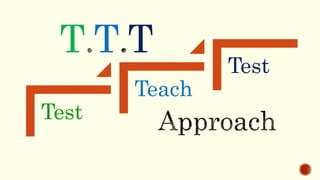
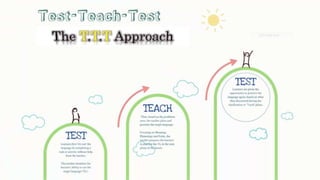
Test
Teach
Test
T T T
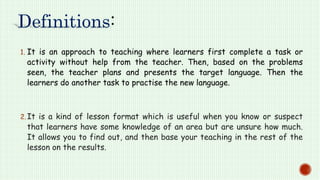
Definitions
1. It is an approach to teaching where learners first complete a task or
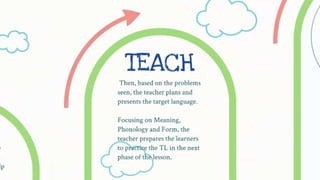
activity without help from the teacher. Then, based on the problems
seen, the teacher plans and presents the target language. Then the
learners do another task to practise the new language.
2.It is a kind of lesson format which is useful when you know or suspect
that learners have some knowledge of an area but are unsure how much.
It allows you to find out, and then base your teaching in the rest of the
lesson on the results.
Stages:
1- Prior Test:
•Teacher first has to introduce the topic within a minute then simply set a task.
•The task helps the teacher to detect learners' lack of knowledge.
•Tests or tasks in this stage are done through group work using non-composing activities like: (match –
choose – fill the gaps).
2- Teach:
•Teachers make clarifications based on the previous test.
•Teacher clarify and present using drills and teaching aids.
•Repetitions are done in group or chorus drills.
•The teacher divides sentences to words and words to syllables in order to be accurate.
•Correct grammar and pronunciation is highlighted according to students’ mistakes through the previous
test.
3- Final Test:
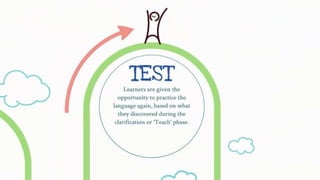
•This test is based on what learners have learnt from the previous teaching stage.
•Teacher can manage discussions and emphasize on accurate language usage.
•Learners now can put words together and form sentences into practice.
:
 Teacher bases his/her target language lesson on the results of the first test.
 Testing not only tests the students' and teachers' performances but it also influences the
students' motivation to learn as well.
 Students become aware of their knowledge of the TL first, fill up the missing part of the TL
then practice to understand its use.
 Bondjema (2014) explains that: “TTT is a useful approach as it enables teachers to identify
the specific needs of learners concerning a language area and address this need suitably.”
 It can be particularly useful at intermediate levels and above, where learners may have seen
language before, but have specific problems with it, and also in mixed level classes to help
identify objectives for each individual.
Woodward (2010) :
“In terms of opportunities for learning, the first 'test' stage offers students a chance to try
to remember and use what they have remembered. The 'teach' stage may offer exposure to
new language and some chances to notice features of language and the second 'test' could give
the chance for use and refine level.”
 Corder (1973) writes that “language tests are measuring instruments and they
are applied to learners not to teaching materials or teachers.”
 Tests are directly related to the learners which tell the teacher about how
much the learner has achieved and how and how much his/her learning is
different from others.
:
 Learners may get discouraged at the first stage of this method if they are unable to
complete the activity or if they make a mistake.
 Can be time-consuming in the first part.
 Can be difficult to prepare with some structures.
 Can be difficult for beginners.
 Learners may need to have some knowledge of grammar terminology.
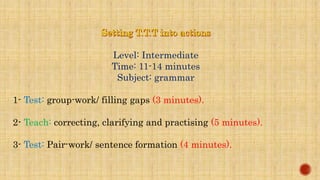
Level: Intermediate
Time: 11-14 minutes
Subject: grammar
1- Test: group-work/ filling gaps (3 minutes).
2- Teach: correcting, clarifying and practising (5 minutes).
3- Test: Pair-work/ sentence formation (4 minutes).
PPP
 During the 1950s, an approach emerged in the United Kingdom based on
behaviourist teaching practices known as PPP, which soon popularized the field
of language teaching and employed by many professional schools throughout the
world.
 As its name suggests, PPP is divided into three phases, moving from tight
teacher control towards greater learner freedom.
 Some writers used its name to refer to a specific method that focuses only on
oral skills, but it can also be applied more broadly to a family of related methods
which rely on the progression from presentation, through controlled practice, to
free production.
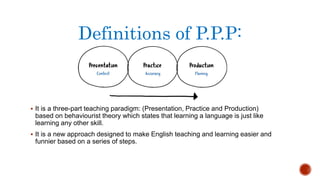
Definitions of P.P.P:
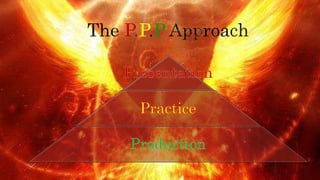
 It is a three-part teaching paradigm: (Presentation, Practice and Production)
based on behaviourist theory which states that learning a language is just like
learning any other skill.
 It is a new approach designed to make English teaching and learning easier and
funnier based on a series of steps.
Stages:
 Presentation stage:
The teacher begins the lesson by setting up a situation, either eliciting or modeling some
language that the situation calls for. Presentation may consist of model sentences, short
dialogues illustrating target items, either read from the textbook, heard on the tape or acted
out by the teacher.
 Practice stage:
Students practice the new language in a controlled way. They drill -sentences or dialogues by
repeating after the teacher or the tape, in chorus and individually, until they can say them
correctly. Other practice activities are matching parts of sentences, completing sentences or
dialogues and asking and answering questions using the target language.
 Production stage:
Students are encouraged to use the new language in a freer way, either for their own purposes
and meanings or in a similar context introduced by the teacher. It can be a role play, a
simulation activity or a communication task.
Advantages
 It raises language learners’ capability of producing grammatical
language chunks through excessive pattern practice and repetition
drills.
 It helps learners to produce language through keeping teacher talk time
to minimum and promoting student talk time.
 It encourages independence during production.
 It is easier to prepare and it is good for new teachers.
 It is easier for learners to remain focused and follow this type of a
lesson.
Disadvantages
 It does not allow for recapitulation.
 Too much teacher talking time during the presentation.
 Therefore, students are easily distracted or get bored while
presentation stage.
 It is very controlled and can be teacher centered.
 The production stage doesn't necessarily involve real communication.
Level: Beginners
Time: 11-14 minutes
Subject: grammar through conversation
1- Presentation: explaining/ reading (3 minutes).
2- Practice: Video watching and practice/ pair-work and chorus
repetition (4 minutes).
3- Production: Pair-work/ conversation (6 minutes).
Teaching approaches (ttt) & (ppp)

Teaching approaches (ttt) & (ppp)

  • 1.
    T.T.T P.P.P Course: SLA Presentedby: Osama Alkasim Date: 29th, August. 2019
  • 2.
    Teaching Approaches: (T.T.T &P.P.P) 1. Definitions. 2. Stages. 3. Advantages. 4. disadvantages. * Practical applications.
  • 3.
  • 4.
    Definitions 1. It isan approach to teaching where learners first complete a task or activity without help from the teacher. Then, based on the problems seen, the teacher plans and presents the target language. Then the learners do another task to practise the new language. 2.It is a kind of lesson format which is useful when you know or suspect that learners have some knowledge of an area but are unsure how much. It allows you to find out, and then base your teaching in the rest of the lesson on the results.
  • 9.
    Stages: 1- Prior Test: •Teacherfirst has to introduce the topic within a minute then simply set a task. •The task helps the teacher to detect learners' lack of knowledge. •Tests or tasks in this stage are done through group work using non-composing activities like: (match – choose – fill the gaps). 2- Teach: •Teachers make clarifications based on the previous test. •Teacher clarify and present using drills and teaching aids. •Repetitions are done in group or chorus drills. •The teacher divides sentences to words and words to syllables in order to be accurate. •Correct grammar and pronunciation is highlighted according to students’ mistakes through the previous test. 3- Final Test: •This test is based on what learners have learnt from the previous teaching stage. •Teacher can manage discussions and emphasize on accurate language usage. •Learners now can put words together and form sentences into practice.
  • 10.
    :  Teacher baseshis/her target language lesson on the results of the first test.  Testing not only tests the students' and teachers' performances but it also influences the students' motivation to learn as well.  Students become aware of their knowledge of the TL first, fill up the missing part of the TL then practice to understand its use.  Bondjema (2014) explains that: “TTT is a useful approach as it enables teachers to identify the specific needs of learners concerning a language area and address this need suitably.”  It can be particularly useful at intermediate levels and above, where learners may have seen language before, but have specific problems with it, and also in mixed level classes to help identify objectives for each individual.
  • 11.
    Woodward (2010) : “Interms of opportunities for learning, the first 'test' stage offers students a chance to try to remember and use what they have remembered. The 'teach' stage may offer exposure to new language and some chances to notice features of language and the second 'test' could give the chance for use and refine level.”  Corder (1973) writes that “language tests are measuring instruments and they are applied to learners not to teaching materials or teachers.”  Tests are directly related to the learners which tell the teacher about how much the learner has achieved and how and how much his/her learning is different from others.
  • 13.
    :  Learners mayget discouraged at the first stage of this method if they are unable to complete the activity or if they make a mistake.  Can be time-consuming in the first part.  Can be difficult to prepare with some structures.  Can be difficult for beginners.  Learners may need to have some knowledge of grammar terminology.
  • 14.
    Level: Intermediate Time: 11-14minutes Subject: grammar 1- Test: group-work/ filling gaps (3 minutes). 2- Teach: correcting, clarifying and practising (5 minutes). 3- Test: Pair-work/ sentence formation (4 minutes).
  • 15.
  • 16.
     During the1950s, an approach emerged in the United Kingdom based on behaviourist teaching practices known as PPP, which soon popularized the field of language teaching and employed by many professional schools throughout the world.  As its name suggests, PPP is divided into three phases, moving from tight teacher control towards greater learner freedom.  Some writers used its name to refer to a specific method that focuses only on oral skills, but it can also be applied more broadly to a family of related methods which rely on the progression from presentation, through controlled practice, to free production.
  • 17.
    Definitions of P.P.P: It is a three-part teaching paradigm: (Presentation, Practice and Production) based on behaviourist theory which states that learning a language is just like learning any other skill.  It is a new approach designed to make English teaching and learning easier and funnier based on a series of steps.
  • 18.
    Stages:  Presentation stage: Theteacher begins the lesson by setting up a situation, either eliciting or modeling some language that the situation calls for. Presentation may consist of model sentences, short dialogues illustrating target items, either read from the textbook, heard on the tape or acted out by the teacher.  Practice stage: Students practice the new language in a controlled way. They drill -sentences or dialogues by repeating after the teacher or the tape, in chorus and individually, until they can say them correctly. Other practice activities are matching parts of sentences, completing sentences or dialogues and asking and answering questions using the target language.  Production stage: Students are encouraged to use the new language in a freer way, either for their own purposes and meanings or in a similar context introduced by the teacher. It can be a role play, a simulation activity or a communication task.
  • 19.
    Advantages  It raiseslanguage learners’ capability of producing grammatical language chunks through excessive pattern practice and repetition drills.  It helps learners to produce language through keeping teacher talk time to minimum and promoting student talk time.  It encourages independence during production.  It is easier to prepare and it is good for new teachers.  It is easier for learners to remain focused and follow this type of a lesson.
  • 20.
    Disadvantages  It doesnot allow for recapitulation.  Too much teacher talking time during the presentation.  Therefore, students are easily distracted or get bored while presentation stage.  It is very controlled and can be teacher centered.  The production stage doesn't necessarily involve real communication.
  • 21.
    Level: Beginners Time: 11-14minutes Subject: grammar through conversation 1- Presentation: explaining/ reading (3 minutes). 2- Practice: Video watching and practice/ pair-work and chorus repetition (4 minutes). 3- Production: Pair-work/ conversation (6 minutes).