UNIVERSIDAD PEDAGÓGICA EXPERIMENTAL LIBERTADOR INSTITUTO PEDAGÓGICO DE CARACAS DEPARTAMENTO DE IDIOMAS MODERNOS ESPECIALIDAD INGLÉS CÁTEDRA DE LINGÜÍSTICA METODOLOGÍA DE LA ENSEÑANZA DEL INGLÉS COMO LENGUA EXTRANJERA LESSON PLANNING Caracas, June, 2010
Content What is a lesson plan? Basic questions Objectives Stages of a lesson Warm  Up/Review Introduction Presentation Comprehension Check Guided Practice Communicative Practice Evaluation Application Materials/Resources Lesson Procedure Introduction Main Activity Closure/Conclusion Reinforcement of Learning:  Follow up Activities/Lessons Timing Assessment/Evaluation
What is a lesson plan (LP)? A lesson plan is a framework for a lesson. It sets out  what  the teacher hopes to achieve over the course of the lesson and  how  s/he hopes to achieve it.  Mostly written. Not compulsory. Clearly shows what happens at any particular time in the lesson. May be not very practical. Experience dictate quickness in the creation of LP. Experienced teachers may not need detailed lesson planning. Experienced teachers: take time & think through their lessons before they enter the classroom.
Basic questions Where are your students going? How are they going to get there? How will you know when they've arrived?   While planning, use the questions  above to guide you during each stage.
Objectives What your students will do to acquire further knowledge and skills. Drawn from broader aims of the program. Achieved over a well defined time period.  Questions: What will students be able to do during this lesson?  Under what conditions will students' performance be accomplished? What is the degree or criterion on the basis of which satisfactory attainment of the objectives will be judged? How will students demonstrate that they have learned and understood the objectives of the lesson?
Stages of a lesson (1) Warm Up/Review An initial lesson stage in which content from previous lessons is reviewed and/or a brainstorming or interactive task which gets the students think about a new topic. Introduction An initial lesson stage in which the teacher states the objective of the lesson and tells students what they will be doing. This should occur after the warm-up stage of the lesson.
Stages of a lesson (2) Presentation Any presentation of a new learning objective should be preceded by an introduction.  For presenting new language, the teacher may explain, model and/or drill the new information, language functions, or language forms which students will be using in that lesson.  For presenting skills, the teacher should begin with a pre-skill stage .
Stages of a lesson (3) Comprehension Check It is an essential part of the presentation stage in which the teacher confirms student’s understanding of what has just been taught before going on to the practice stage. Guided Practice It is a mid-lesson stage in which  students begin to use the new  language in a short, controlled activity. This should occur after the presentation stage of the lesson and before the communicative practice, or while-skill stage.
Stages of a lesson (3) Communicative Practice It is a mid-lesson stage in which students use the language they have been practicing to complete a communicative task, usually in pairs or groups. This should occur after the guided practice or after-skill stage of the lesson.
Stages of a lesson (5) Evaluation It is a final lesson stage in which students demonstrate their knowledge of what they have learned by  showing ,  explaining ,  analyzing  or  reflecting  on what they have learned during the lesson. Application It is a final lesson stage in which students  extend  their knowledge of the  lesson’s material  to a  new situation or  apply their knowledge to complete a new and  different activity .
Materials & Resources To carry out the plan, the teacher must decide about: a) preparation time, resources, and management. b) materials, books, worksheets, equipment, resources, etc. Note : Do not forget to include full citations of textbooks or story books used, worksheets, and any other special considerations.
Lesson Procedure (1) How to replicate the lesson and achieve the planned  objectives . Suggestions on  how to proceed  with implementation of the lesson plan.  It also focuses on  what  the teacher should have students  do   during the lesson .  Basically divided into three components:  an introduction, a main activity closure.
 
Lesson Procedure (3) Main Activity What is the focus of the lesson?  How would you describe the flow    of the lesson to another teacher    who will replicate it? What does the teacher do to    facilitate learning and manage    the various activities? How can this material be presented to ensure each student will benefit from the learning experience?
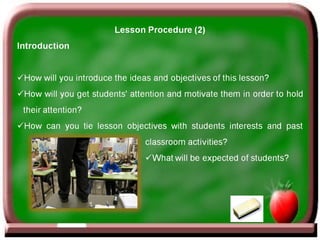
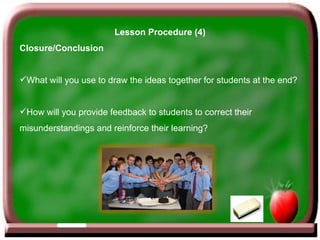
Lesson Procedure (4) Closure/Conclusion What will you use to draw the ideas together for students at the end? How will you provide feedback to students to correct their misunderstandings and reinforce their learning?
Follow up Lessons/Activities What activities might you suggest for enrichment and remediation? What lessons might follow as a result of this lesson?
Timing This section of the LP  focuses on the  time  of  the  class allotted  for each one  of the stages/activities  you  are  planning to perform .
Assessment/Evaluation (1) This section assures if your students have arrived at their intended destination, based on evidence. Three ideas: Students' work is gathered, and assessed by using some kind of grading based on the objectives of the lesson.  You could also replicate some of the activities practiced before with less guidance as during the lesson. You could always quiz students on various concepts and problems as well.
Some questions we may ask in this section.. How to evaluate the objectives?  Have students practiced what they were taught and asked to do? Practice Assessment/Evaluation (2)
 

Lesson Planning

  • 1.
    UNIVERSIDAD PEDAGÓGICA EXPERIMENTALLIBERTADOR INSTITUTO PEDAGÓGICO DE CARACAS DEPARTAMENTO DE IDIOMAS MODERNOS ESPECIALIDAD INGLÉS CÁTEDRA DE LINGÜÍSTICA METODOLOGÍA DE LA ENSEÑANZA DEL INGLÉS COMO LENGUA EXTRANJERA LESSON PLANNING Caracas, June, 2010
  • 2.
    Content What isa lesson plan? Basic questions Objectives Stages of a lesson Warm Up/Review Introduction Presentation Comprehension Check Guided Practice Communicative Practice Evaluation Application Materials/Resources Lesson Procedure Introduction Main Activity Closure/Conclusion Reinforcement of Learning: Follow up Activities/Lessons Timing Assessment/Evaluation
  • 3.
    What is alesson plan (LP)? A lesson plan is a framework for a lesson. It sets out what the teacher hopes to achieve over the course of the lesson and how s/he hopes to achieve it. Mostly written. Not compulsory. Clearly shows what happens at any particular time in the lesson. May be not very practical. Experience dictate quickness in the creation of LP. Experienced teachers may not need detailed lesson planning. Experienced teachers: take time & think through their lessons before they enter the classroom.
  • 4.
    Basic questions Whereare your students going? How are they going to get there? How will you know when they've arrived? While planning, use the questions above to guide you during each stage.
  • 5.
    Objectives What yourstudents will do to acquire further knowledge and skills. Drawn from broader aims of the program. Achieved over a well defined time period. Questions: What will students be able to do during this lesson? Under what conditions will students' performance be accomplished? What is the degree or criterion on the basis of which satisfactory attainment of the objectives will be judged? How will students demonstrate that they have learned and understood the objectives of the lesson?
  • 6.
    Stages of alesson (1) Warm Up/Review An initial lesson stage in which content from previous lessons is reviewed and/or a brainstorming or interactive task which gets the students think about a new topic. Introduction An initial lesson stage in which the teacher states the objective of the lesson and tells students what they will be doing. This should occur after the warm-up stage of the lesson.
  • 7.
    Stages of alesson (2) Presentation Any presentation of a new learning objective should be preceded by an introduction. For presenting new language, the teacher may explain, model and/or drill the new information, language functions, or language forms which students will be using in that lesson. For presenting skills, the teacher should begin with a pre-skill stage .
  • 8.
    Stages of alesson (3) Comprehension Check It is an essential part of the presentation stage in which the teacher confirms student’s understanding of what has just been taught before going on to the practice stage. Guided Practice It is a mid-lesson stage in which students begin to use the new language in a short, controlled activity. This should occur after the presentation stage of the lesson and before the communicative practice, or while-skill stage.
  • 9.
    Stages of alesson (3) Communicative Practice It is a mid-lesson stage in which students use the language they have been practicing to complete a communicative task, usually in pairs or groups. This should occur after the guided practice or after-skill stage of the lesson.
  • 10.
    Stages of alesson (5) Evaluation It is a final lesson stage in which students demonstrate their knowledge of what they have learned by showing , explaining , analyzing or reflecting on what they have learned during the lesson. Application It is a final lesson stage in which students extend their knowledge of the lesson’s material to a new situation or apply their knowledge to complete a new and different activity .
  • 11.
    Materials & ResourcesTo carry out the plan, the teacher must decide about: a) preparation time, resources, and management. b) materials, books, worksheets, equipment, resources, etc. Note : Do not forget to include full citations of textbooks or story books used, worksheets, and any other special considerations.
  • 12.
    Lesson Procedure (1)How to replicate the lesson and achieve the planned objectives . Suggestions on how to proceed with implementation of the lesson plan. It also focuses on what the teacher should have students do during the lesson . Basically divided into three components: an introduction, a main activity closure.
  • 13.
  • 14.
    Lesson Procedure (3)Main Activity What is the focus of the lesson? How would you describe the flow of the lesson to another teacher who will replicate it? What does the teacher do to facilitate learning and manage the various activities? How can this material be presented to ensure each student will benefit from the learning experience?
  • 15.
    Lesson Procedure (4)Closure/Conclusion What will you use to draw the ideas together for students at the end? How will you provide feedback to students to correct their misunderstandings and reinforce their learning?
  • 16.
    Follow up Lessons/ActivitiesWhat activities might you suggest for enrichment and remediation? What lessons might follow as a result of this lesson?
  • 17.
    Timing This sectionof the LP focuses on the time of the class allotted for each one of the stages/activities you are planning to perform .
  • 18.
    Assessment/Evaluation (1) Thissection assures if your students have arrived at their intended destination, based on evidence. Three ideas: Students' work is gathered, and assessed by using some kind of grading based on the objectives of the lesson. You could also replicate some of the activities practiced before with less guidance as during the lesson. You could always quiz students on various concepts and problems as well.
  • 19.
    Some questions wemay ask in this section.. How to evaluate the objectives? Have students practiced what they were taught and asked to do? Practice Assessment/Evaluation (2)
  • 20.