



Persuasive Speech
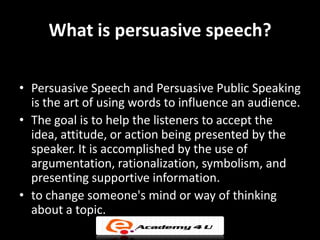
What is persuasive speech?

• Persuasive Speech and Persuasive Public Speaking
  is the art of using words to influence an audience.
• The goal is to help the listeners to accept the
  idea, attitude, or action being presented by the
  speaker. It is accomplished by the use of
  argumentation, rationalization, symbolism, and
  presenting supportive information.
• to change someone's mind or way of thinking
  about a topic.
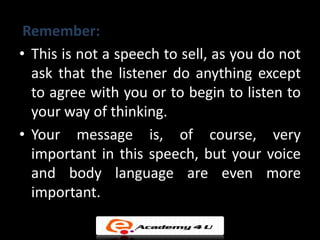
Remember:
• This is not a speech to sell, as you do not
  ask that the listener do anything except
  to agree with you or to begin to listen to
  your way of thinking.
• Your message is, of course, very
  important in this speech, but your voice
  and body language are even more
  important.
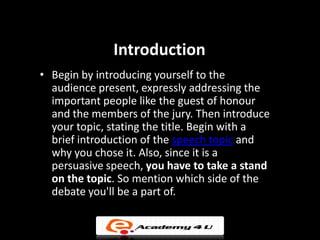
Introduction
• Begin by introducing yourself to the
  audience present, expressly addressing the
  important people like the guest of honour
  and the members of the jury. Then introduce
  your topic, stating the title. Begin with a
  brief introduction of the speech topic and
  why you chose it. Also, since it is a
  persuasive speech, you have to take a stand
  on the topic. So mention which side of the
  debate you'll be a part of.
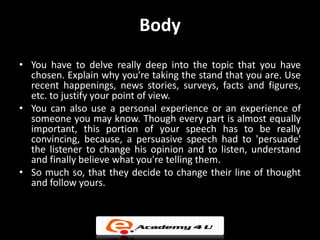
Body
• You have to delve really deep into the topic that you have
  chosen. Explain why you're taking the stand that you are. Use
  recent happenings, news stories, surveys, facts and figures,
  etc. to justify your point of view.
• You can also use a personal experience or an experience of
  someone you may know. Though every part is almost equally
  important, this portion of your speech has to be really
  convincing, because, a persuasive speech had to 'persuade'
  the listener to change his opinion and to listen, understand
  and finally believe what you're telling them.
• So much so, that they decide to change their line of thought
  and follow yours.
Conclusion

• Now, you're nearing the end of your speech. You
  have the audience gripped. But you need to leave
  a powerful impression. For this you need to have
  a strong conclusion, which makes the right use of
  firm and effective language. And when spoken
  with the right amount of passion and the right
  intonation, this will have a lingering effect in the
  minds of the audience.
• There are several
  important aspects of
  presentation to keep in
  mind:
• Body language - make sure that you have a proper
  posture. If your shoulders are sagging and your legs
  are crossed, you will not appear as being sincere and
  people just will not accept your message.
• Articulation - articulation means how your total
  vocal process works. There are several steps to this
  entire process. First, you need air from the lungs,
  your vocal cords in your larynx must be working, your
  mouth and tongue must be in sync, and you have to
  make sure that you have got some saliva in your
  mouth to keep things oiled.
• Pitch - pitch refers to the highs and lows of your
  voice. Whatever you do, avoid a monotone!
• Speed - your speed, or pace, is an important variable
  to control. Between 140-160 words per minute is the
  normal pace for a persuasive speech.
• Pauses - the pause, or caesura, is a critical persuasive
  tool. When you want to emphasize a certain word,
  just pause for one second before; this highlights the
  word.
• Volume - volume is another good tool for
  persuasive speech, but you should use it
  with caution. If you scream all the way
  through your speech, people will become
  accustomed to it and it will lose its
  effectiveness.

• Pronunciation - pronounce each word.
  Avoid slang, except to make a point, and
  do not slur your words. Avoid saying, "you
  know."
• Now, let’s look at the example slide
  below on PERSUASIVE SPEECH.

  ‘Why should students join theatre in
university?’

Group Project :

Pick any interesting topic and persuade
your classmates by using power point
slides as shown in the example.

Persuasive speeach

  • 1.
  • 2.
    What is persuasivespeech? • Persuasive Speech and Persuasive Public Speaking is the art of using words to influence an audience. • The goal is to help the listeners to accept the idea, attitude, or action being presented by the speaker. It is accomplished by the use of argumentation, rationalization, symbolism, and presenting supportive information. • to change someone's mind or way of thinking about a topic.
  • 3.
    Remember: • This isnot a speech to sell, as you do not ask that the listener do anything except to agree with you or to begin to listen to your way of thinking. • Your message is, of course, very important in this speech, but your voice and body language are even more important.
  • 4.
    Introduction • Begin byintroducing yourself to the audience present, expressly addressing the important people like the guest of honour and the members of the jury. Then introduce your topic, stating the title. Begin with a brief introduction of the speech topic and why you chose it. Also, since it is a persuasive speech, you have to take a stand on the topic. So mention which side of the debate you'll be a part of.
  • 5.
    Body • You haveto delve really deep into the topic that you have chosen. Explain why you're taking the stand that you are. Use recent happenings, news stories, surveys, facts and figures, etc. to justify your point of view. • You can also use a personal experience or an experience of someone you may know. Though every part is almost equally important, this portion of your speech has to be really convincing, because, a persuasive speech had to 'persuade' the listener to change his opinion and to listen, understand and finally believe what you're telling them. • So much so, that they decide to change their line of thought and follow yours.
  • 6.
    Conclusion • Now, you'renearing the end of your speech. You have the audience gripped. But you need to leave a powerful impression. For this you need to have a strong conclusion, which makes the right use of firm and effective language. And when spoken with the right amount of passion and the right intonation, this will have a lingering effect in the minds of the audience.
  • 7.
    • There areseveral important aspects of presentation to keep in mind:
  • 8.
    • Body language- make sure that you have a proper posture. If your shoulders are sagging and your legs are crossed, you will not appear as being sincere and people just will not accept your message. • Articulation - articulation means how your total vocal process works. There are several steps to this entire process. First, you need air from the lungs, your vocal cords in your larynx must be working, your mouth and tongue must be in sync, and you have to make sure that you have got some saliva in your mouth to keep things oiled.
  • 9.
    • Pitch -pitch refers to the highs and lows of your voice. Whatever you do, avoid a monotone! • Speed - your speed, or pace, is an important variable to control. Between 140-160 words per minute is the normal pace for a persuasive speech. • Pauses - the pause, or caesura, is a critical persuasive tool. When you want to emphasize a certain word, just pause for one second before; this highlights the word.
  • 10.
    • Volume -volume is another good tool for persuasive speech, but you should use it with caution. If you scream all the way through your speech, people will become accustomed to it and it will lose its effectiveness. • Pronunciation - pronounce each word. Avoid slang, except to make a point, and do not slur your words. Avoid saying, "you know."
  • 11.
    • Now, let’slook at the example slide below on PERSUASIVE SPEECH. ‘Why should students join theatre in university?’ Group Project : Pick any interesting topic and persuade your classmates by using power point slides as shown in the example.