ORGANIZING AND
DELIVERING A
PERSUASIVE
SPEECH
PERSUASIVE SPEECH
Persuasive speaking is the form of communication that people of diverse
backgrounds mostly engage in. This kind of speech can center on any
arguably interesting topic under the sun. When you deliver your persuasive
speech, your primary goal is to influence the thoughts, feelings, actions,
and behavior or attitudes of your listeners (Gamble & Gamble, 2012).
Likewise, you also aim to change their perception and convince them that
your argument is more important, practical, attainable, or feasible.
Adapt your persuasive speech
to your audience
Adapting to a favorable audience
• A favorable audience means most of the listeners agree
with you
• need to sustain and build on their favorable attitude.
Adapting to a neutral audience
• A NEUTRAL AUDIENCE IS ONE IN WHICH THE MAJORITY OF
THE LISTENERS HAVE NOT REACHED A DECISION ABOUT
YOUR THESIS.
• tHEY WILL LISTEN TO ALL SIDES OF AN ARGUMENT EQUALLY,
SO YOU NEED TO GIVE THEM INFORMATION TO PERSUADE
THEM TO TAKE A STAND.
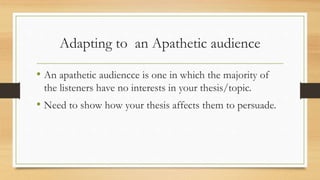
Adapting to an Apathetic audience
• An apathetic audiencce is one in which the majority of
the listeners have no interests in your thesis/topic.
• Need to show how your thesis affects them to persuade.
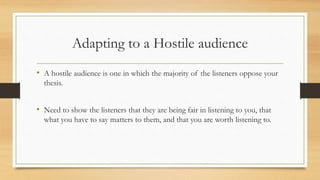
Adapting to a Hostile audience
• A hostile audience is one in which the majority of the listeners oppose your
thesis.
• Need to show the listeners that they are being fair in listening to you, that
what you have to say matters to them, and that you are worth listening to.
How are you going to influence the
thoughts, feelings, actions, and
behavior or attitudes of your
listeners ?
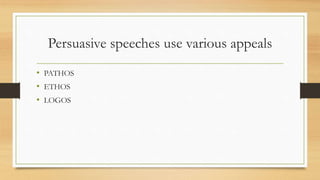
Persuasive speeches use various appeals
• PATHOS
• ETHOS
• LOGOS
EMOTIONAL APPEAL (PATHOS)
• cite specifics
• use vivid language
• include personal references
Establish your character and ethics (ETHOS)
• show you are competent to be talking about your topic
• be sincere and genuine in your delivery
• be energetic and enthusiastic about your topic
• prove you are a credible voice on your topic
Apply logical reasoning (LOGOS)
• Use reasons supported by evidence to explain/justify your thesis.
evidence from your life experience
evidence from your research
evidence from other people
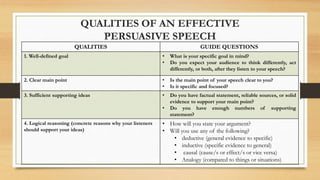
QUALITIES GUIDE QUESTIONS
1. Well-defined goal • What is your specific goal in mind?
• Do you expect your audience to think differently, act
differently, or both, after they listen to your speech?
2. Clear main point • Is the main point of your speech clear to you?
• Is it specific and focused?
3. Sufficient supporting ideas • Do you have factual statement, reliable sources, or solid
evidence to support your main point?
• Do you have enough numbers of supporting
statement?
4. Logical reasoning (concrete reasons why your listeners
should support your ideas)
• How will you state your argument?
• Will you use any of the following?
• deductive (general evidence to specific)
• inductive (specific evidence to general)
• causal (cause/s or effect/s or vice versa)
• Analogy (compared to things or situations)
QUALITIES OF AN EFFECTIVE
PERSUASIVE SPEECH
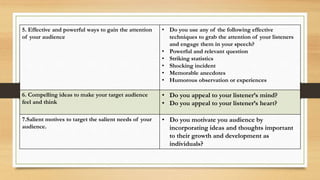
5. Effective and powerful ways to gain the attention
of your audience
• Do you use any of the following effective
techniques to grab the attention of your listeners
and engage them in your speech?
• Powerful and relevant question
• Striking statistics
• Shocking incident
• Memorable anecdotes
• Humorous observation or experiences
6. Compelling ideas to make your target audience
feel and think
• Do you appeal to your listener’s mind?
• Do you appeal to your listener’s heart?
7.Salient motives to target the salient needs of your
audience.
• Do you motivate you audience by
incorporating ideas and thoughts important
to their growth and development as
individuals?
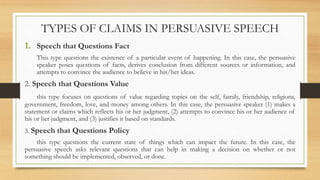
1. Speech that Questions Fact
This type questions the existence of a particular event of happening. In this case, the persuasive
speaker poses questions of facts, derives conclusion from different sources or information, and
attempts to convince the audience to believe in his/her ideas.
2. Speech that Questions Value
this type focuses on questions of value regarding topics on the self, family, friendship, religions,
government, freedom, love, and money among others. In this case, the persuasive speaker (1) makes a
statement or claims which reflects his or her judgment, (2) attempts to convince his or her audience of
his or her judgment, and (3) justifies it based on standards.
3. Speech that Questions Policy
this type questions the current state of things which can impact the future. In this case, the
persuasive speech asks relevant questions that can help in making a decision on whether or not
something should be implemented, observed, or done.
TYPES OF CLAIMS IN PERSUASIVE SPEECH
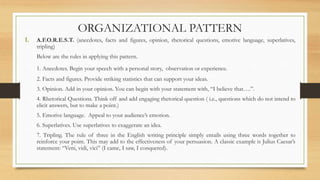
ORGANIZATIONAL PATTERN
1. A.F.O.R.E.S.T. (anecdotes, facts and figures, opinion, rhetorical questions, emotive language, superlatives,
tripling)
Below are the rules in applying this pattern.
1. Anecdotes. Begin your speech with a personal story, observation or experience.
2. Facts and figures. Provide striking statistics that can support your ideas.
3. Opinion. Add in your opinion. You can begin with your statement with, “I believe that….”.
4. Rhetorical Questions. Think off and add engaging rhetorical question ( i.e., questions which do not intend to
elicit answers, but to make a point.)
5. Emotive language. Appeal to your audience’s emotion.
6. Superlatives. Use superlatives to exaggerate an idea.
7. Tripling. The rule of three in the English writing principle simply entails using three words together to
reinforce your point. This may add to the effectiveness of your persuasion. A classic example is Julius Caesar’s
statement: “Veni, vidi, vici” (I came, I saw, I conquered).
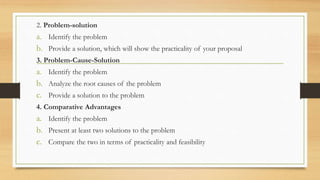
2. Problem-solution
a. Identify the problem
b. Provide a solution, which will show the practicality of your proposal
3. Problem-Cause-Solution
a. Identify the problem
b. Analyze the root causes of the problem
c. Provide a solution to the problem
4. Comparative Advantages
a. Identify the problem
b. Present at least two solutions to the problem
c. Compare the two in terms of practicality and feasibility
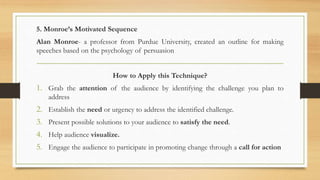
5. Monroe’s Motivated Sequence
Alan Monroe- a professor from Purdue University, created an outline for making
speeches based on the psychology of persuasion
How to Apply this Technique?
1. Grab the attention of the audience by identifying the challenge you plan to
address
2. Establish the need or urgency to address the identified challenge.
3. Present possible solutions to your audience to satisfy the need.
4. Help audience visualize.
5. Engage the audience to participate in promoting change through a call for action
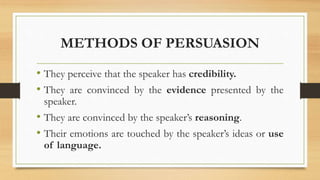
METHODS OF PERSUASION
• They perceive that the speaker has credibility.
• They are convinced by the evidence presented by the
speaker.
• They are convinced by the speaker’s reasoning.
• Their emotions are touched by the speaker’s ideas or use
of language.
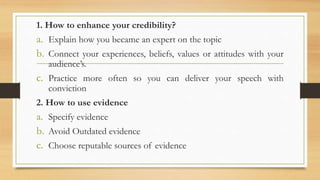
1. How to enhance your credibility?
a. Explain how you became an expert on the topic
b. Connect your experiences, beliefs, values or attitudes with your
audience’s.
c. Practice more often so you can deliver your speech with
conviction
2. How to use evidence
a. Specify evidence
b. Avoid Outdated evidence
c. Choose reputable sources of evidence
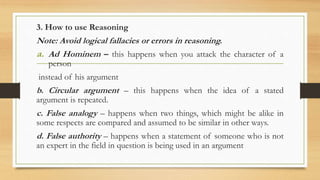
3. How to use Reasoning
Note: Avoid logical fallacies or errors in reasoning.
a. Ad Hominem – this happens when you attack the character of a
person
instead of his argument
b. Circular argument – this happens when the idea of a stated
argument is repeated.
c. False analogy – happens when two things, which might be alike in
some respects are compared and assumed to be similar in other ways.
d. False authority – happens when a statement of someone who is not
an expert in the field in question is being used in an argument
e. False Cause and effect – happens when the connection
between two consecutive events are not clear
f. Hasty generalization – happens when a conclusion is
drawn from insufficient evidence
g. Red Herring – happens when the answer does not
address the question
4. How to Use Emotional Appeal
a. Internalize what you are saying.
b. Use emotion appropriately.

123.pptx

  • 1.
  • 2.
    PERSUASIVE SPEECH Persuasive speakingis the form of communication that people of diverse backgrounds mostly engage in. This kind of speech can center on any arguably interesting topic under the sun. When you deliver your persuasive speech, your primary goal is to influence the thoughts, feelings, actions, and behavior or attitudes of your listeners (Gamble & Gamble, 2012). Likewise, you also aim to change their perception and convince them that your argument is more important, practical, attainable, or feasible.
  • 3.
    Adapt your persuasivespeech to your audience
  • 4.
    Adapting to afavorable audience • A favorable audience means most of the listeners agree with you • need to sustain and build on their favorable attitude.
  • 5.
    Adapting to aneutral audience • A NEUTRAL AUDIENCE IS ONE IN WHICH THE MAJORITY OF THE LISTENERS HAVE NOT REACHED A DECISION ABOUT YOUR THESIS. • tHEY WILL LISTEN TO ALL SIDES OF AN ARGUMENT EQUALLY, SO YOU NEED TO GIVE THEM INFORMATION TO PERSUADE THEM TO TAKE A STAND.
  • 6.
    Adapting to anApathetic audience • An apathetic audiencce is one in which the majority of the listeners have no interests in your thesis/topic. • Need to show how your thesis affects them to persuade.
  • 7.
    Adapting to aHostile audience • A hostile audience is one in which the majority of the listeners oppose your thesis. • Need to show the listeners that they are being fair in listening to you, that what you have to say matters to them, and that you are worth listening to.
  • 8.
    How are yougoing to influence the thoughts, feelings, actions, and behavior or attitudes of your listeners ?
  • 9.
    Persuasive speeches usevarious appeals • PATHOS • ETHOS • LOGOS
  • 10.
    EMOTIONAL APPEAL (PATHOS) •cite specifics • use vivid language • include personal references
  • 11.
    Establish your characterand ethics (ETHOS) • show you are competent to be talking about your topic • be sincere and genuine in your delivery • be energetic and enthusiastic about your topic • prove you are a credible voice on your topic
  • 12.
    Apply logical reasoning(LOGOS) • Use reasons supported by evidence to explain/justify your thesis. evidence from your life experience evidence from your research evidence from other people
  • 13.
    QUALITIES GUIDE QUESTIONS 1.Well-defined goal • What is your specific goal in mind? • Do you expect your audience to think differently, act differently, or both, after they listen to your speech? 2. Clear main point • Is the main point of your speech clear to you? • Is it specific and focused? 3. Sufficient supporting ideas • Do you have factual statement, reliable sources, or solid evidence to support your main point? • Do you have enough numbers of supporting statement? 4. Logical reasoning (concrete reasons why your listeners should support your ideas) • How will you state your argument? • Will you use any of the following? • deductive (general evidence to specific) • inductive (specific evidence to general) • causal (cause/s or effect/s or vice versa) • Analogy (compared to things or situations) QUALITIES OF AN EFFECTIVE PERSUASIVE SPEECH
  • 14.
    5. Effective andpowerful ways to gain the attention of your audience • Do you use any of the following effective techniques to grab the attention of your listeners and engage them in your speech? • Powerful and relevant question • Striking statistics • Shocking incident • Memorable anecdotes • Humorous observation or experiences 6. Compelling ideas to make your target audience feel and think • Do you appeal to your listener’s mind? • Do you appeal to your listener’s heart? 7.Salient motives to target the salient needs of your audience. • Do you motivate you audience by incorporating ideas and thoughts important to their growth and development as individuals?
  • 15.
    1. Speech thatQuestions Fact This type questions the existence of a particular event of happening. In this case, the persuasive speaker poses questions of facts, derives conclusion from different sources or information, and attempts to convince the audience to believe in his/her ideas. 2. Speech that Questions Value this type focuses on questions of value regarding topics on the self, family, friendship, religions, government, freedom, love, and money among others. In this case, the persuasive speaker (1) makes a statement or claims which reflects his or her judgment, (2) attempts to convince his or her audience of his or her judgment, and (3) justifies it based on standards. 3. Speech that Questions Policy this type questions the current state of things which can impact the future. In this case, the persuasive speech asks relevant questions that can help in making a decision on whether or not something should be implemented, observed, or done. TYPES OF CLAIMS IN PERSUASIVE SPEECH
  • 16.
    ORGANIZATIONAL PATTERN 1. A.F.O.R.E.S.T.(anecdotes, facts and figures, opinion, rhetorical questions, emotive language, superlatives, tripling) Below are the rules in applying this pattern. 1. Anecdotes. Begin your speech with a personal story, observation or experience. 2. Facts and figures. Provide striking statistics that can support your ideas. 3. Opinion. Add in your opinion. You can begin with your statement with, “I believe that….”. 4. Rhetorical Questions. Think off and add engaging rhetorical question ( i.e., questions which do not intend to elicit answers, but to make a point.) 5. Emotive language. Appeal to your audience’s emotion. 6. Superlatives. Use superlatives to exaggerate an idea. 7. Tripling. The rule of three in the English writing principle simply entails using three words together to reinforce your point. This may add to the effectiveness of your persuasion. A classic example is Julius Caesar’s statement: “Veni, vidi, vici” (I came, I saw, I conquered).
  • 17.
    2. Problem-solution a. Identifythe problem b. Provide a solution, which will show the practicality of your proposal 3. Problem-Cause-Solution a. Identify the problem b. Analyze the root causes of the problem c. Provide a solution to the problem 4. Comparative Advantages a. Identify the problem b. Present at least two solutions to the problem c. Compare the two in terms of practicality and feasibility
  • 18.
    5. Monroe’s MotivatedSequence Alan Monroe- a professor from Purdue University, created an outline for making speeches based on the psychology of persuasion How to Apply this Technique? 1. Grab the attention of the audience by identifying the challenge you plan to address 2. Establish the need or urgency to address the identified challenge. 3. Present possible solutions to your audience to satisfy the need. 4. Help audience visualize. 5. Engage the audience to participate in promoting change through a call for action
  • 19.
    METHODS OF PERSUASION •They perceive that the speaker has credibility. • They are convinced by the evidence presented by the speaker. • They are convinced by the speaker’s reasoning. • Their emotions are touched by the speaker’s ideas or use of language.
  • 20.
    1. How toenhance your credibility? a. Explain how you became an expert on the topic b. Connect your experiences, beliefs, values or attitudes with your audience’s. c. Practice more often so you can deliver your speech with conviction 2. How to use evidence a. Specify evidence b. Avoid Outdated evidence c. Choose reputable sources of evidence
  • 21.
    3. How touse Reasoning Note: Avoid logical fallacies or errors in reasoning. a. Ad Hominem – this happens when you attack the character of a person instead of his argument b. Circular argument – this happens when the idea of a stated argument is repeated. c. False analogy – happens when two things, which might be alike in some respects are compared and assumed to be similar in other ways. d. False authority – happens when a statement of someone who is not an expert in the field in question is being used in an argument
  • 22.
    e. False Causeand effect – happens when the connection between two consecutive events are not clear f. Hasty generalization – happens when a conclusion is drawn from insufficient evidence g. Red Herring – happens when the answer does not address the question 4. How to Use Emotional Appeal a. Internalize what you are saying. b. Use emotion appropriately.