
What’s a persuasive essay?


A persuasive essay holds hand of logical and reason to convince people that one
idea is more legitimate than another one. It attempts to persuade the reader to
adopt a certain point of view or to take a particular action. The thesis statement
needs to be supported by strong and solid evidence by stating facts, giving
logically argumented reasons, using examples, and quoting experts.
Watch the movie scene and answer the
                             questions:
What are the similarities between a debate and an academic writing?
What are some steps you should follow when you debate or write a persuasive
essay?
What else do you need to do in order to plan an effective persuasive essay?


1- Choose your position, Which side of the issue are you going to write bout?
Where do you stand? Know the purpose of your essay.

2- Prepare yourself by researching your topic. A persuasive essay must provide
specific and convincing evidence. Often it is necessary to go beyond your own
knowledge and experience.

4- Stucture your essay.Figure out what evidence to include and in what order you
will present.

3- Read and be well informed about your topic. Use different media to research
and add your own knowledge of a topic, read thoroughly about it.
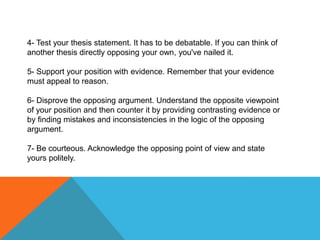
4- Test your thesis statement. It has to be debatable. If you can think of
another thesis directly opposing your own, you've nailed it.

5- Support your position with evidence. Remember that your evidence
must appeal to reason.

6- Disprove the opposing argument. Understand the opposite viewpoint
of your position and then counter it by providing contrasting evidence or
by finding mistakes and inconsistencies in the logic of the opposing
argument.

7- Be courteous. Acknowledge the opposing point of view and state
yours politely.
Memory challenge
How many of the tips can you remember?
Watch a second scene and notice which different ways the debaters use to support
their arguments:


( ) Facts
( ) Statistics
( ) Quotes
( ) Examples
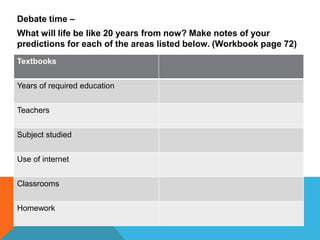
Debate time –
What will life be like 20 years from now? Make notes of your
predictions for each of the areas listed below. (Workbook page 72)
Textbooks


Years of required education


Teachers


Subject studied


Use of internet


Classrooms


Homework
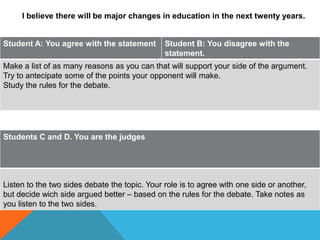
I believe there will be major changes in education in the next twenty years.


Student A: You agree with the statement        Student B: You disagree with the
                                               statement.
Make a list of as many reasons as you can that will support your side of the argument.
Try to antecipate some of the points your opponent will make.
Study the rules for the debate.


Students C and D. You are the judges


Listen to the two sides debate the topic. Your role is to agree with one side or another,
but decide wich side argued better – based on the rules for the debate. Take notes as
you listen to the two sides.
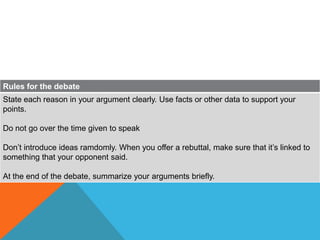
Rules for the debate
State each reason in your argument clearly. Use facts or other data to support your
points.

Do not go over the time given to speak

Don’t introduce ideas ramdomly. When you offer a rebuttal, make sure that it’s linked to
something that your opponent said.

At the end of the debate, summarize your arguments briefly.
Writing – Workbook 72

Advanced 5 b

  • 2.
    What’s a persuasiveessay? A persuasive essay holds hand of logical and reason to convince people that one idea is more legitimate than another one. It attempts to persuade the reader to adopt a certain point of view or to take a particular action. The thesis statement needs to be supported by strong and solid evidence by stating facts, giving logically argumented reasons, using examples, and quoting experts.
  • 3.
    Watch the moviescene and answer the questions: What are the similarities between a debate and an academic writing? What are some steps you should follow when you debate or write a persuasive essay?
  • 4.
    What else doyou need to do in order to plan an effective persuasive essay? 1- Choose your position, Which side of the issue are you going to write bout? Where do you stand? Know the purpose of your essay. 2- Prepare yourself by researching your topic. A persuasive essay must provide specific and convincing evidence. Often it is necessary to go beyond your own knowledge and experience. 4- Stucture your essay.Figure out what evidence to include and in what order you will present. 3- Read and be well informed about your topic. Use different media to research and add your own knowledge of a topic, read thoroughly about it.
  • 5.
    4- Test yourthesis statement. It has to be debatable. If you can think of another thesis directly opposing your own, you've nailed it. 5- Support your position with evidence. Remember that your evidence must appeal to reason. 6- Disprove the opposing argument. Understand the opposite viewpoint of your position and then counter it by providing contrasting evidence or by finding mistakes and inconsistencies in the logic of the opposing argument. 7- Be courteous. Acknowledge the opposing point of view and state yours politely.
  • 6.
    Memory challenge How manyof the tips can you remember?
  • 7.
    Watch a secondscene and notice which different ways the debaters use to support their arguments: ( ) Facts ( ) Statistics ( ) Quotes ( ) Examples
  • 8.
    Debate time – Whatwill life be like 20 years from now? Make notes of your predictions for each of the areas listed below. (Workbook page 72) Textbooks Years of required education Teachers Subject studied Use of internet Classrooms Homework
  • 9.
    I believe therewill be major changes in education in the next twenty years. Student A: You agree with the statement Student B: You disagree with the statement. Make a list of as many reasons as you can that will support your side of the argument. Try to antecipate some of the points your opponent will make. Study the rules for the debate. Students C and D. You are the judges Listen to the two sides debate the topic. Your role is to agree with one side or another, but decide wich side argued better – based on the rules for the debate. Take notes as you listen to the two sides.
  • 10.
    Rules for thedebate State each reason in your argument clearly. Use facts or other data to support your points. Do not go over the time given to speak Don’t introduce ideas ramdomly. When you offer a rebuttal, make sure that it’s linked to something that your opponent said. At the end of the debate, summarize your arguments briefly.
  • 11.