Ozone, Ano
Yun?!
Presented by:
Marlowe M. Chica
Objectives of this Session
The objective of this session is to
understand:
• What is Ozone
• Why is it soooooooooooo important
• What is Ozone Depletion
• What can we do to prevent Ozone
Depletion
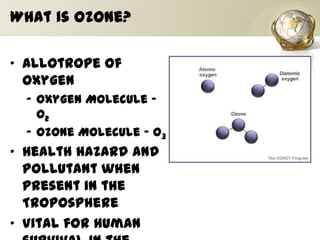
What is Ozone?
• Allotrope of
Oxygen
– Oxygen Molecule –
O2
– Ozone Molecule – O3
• Health hazard and
pollutant when
present in the
Troposphere
• Vital for human
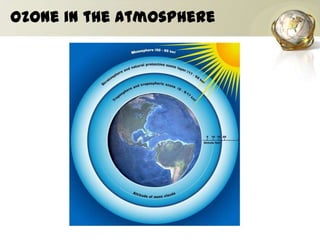
Ozone in the Atmosphere
Ozone Layer
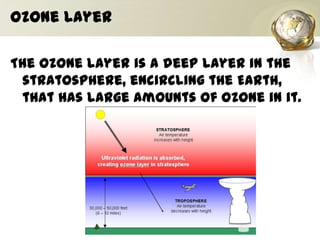
The ozone layer is a deep layer in the
stratosphere, encircling the Earth,
that has large amounts of ozone in it.
Ozone Layer
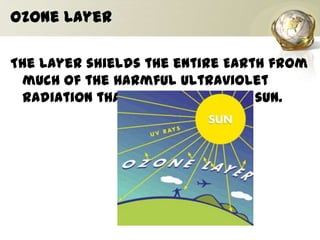
The layer shields the entire Earth from
much of the harmful ultraviolet
radiation that comes from the sun.
Why Protect the Ozone Layer?
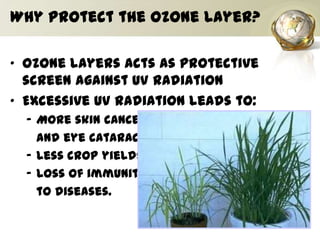
• Ozone layers acts as protective
screen against UV radiation
• Excessive UV radiation leads to:
– More skin cancers
and eye cataracts.
– Less crop yields
– Loss of immunity
to diseases.
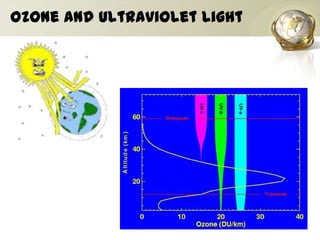
Ozone and Ultraviolet Light
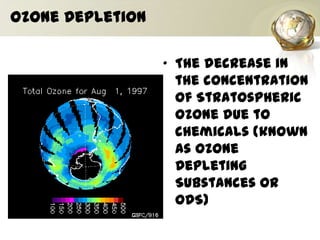
Ozone Depletion
• The decrease in
the concentration
of Stratospheric
Ozone due to
chemicals (known
as Ozone
Depleting
Substances or
ODS)
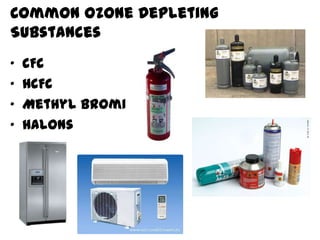
Common Ozone Depleting
Substances
• CFC
• HCFC
• Methyl Bromide
• Halons
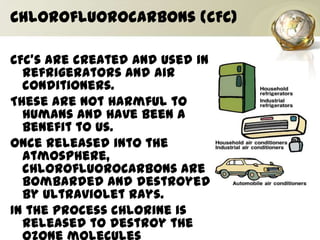
Chlorofluorocarbons (CFC)
CFC’s are created and used in
refrigerators and air
conditioners.
These are not harmful to
humans and have been a
benefit to us.
Once released into the
atmosphere,
chlorofluorocarbons are
bombarded and destroyed
by ultraviolet rays.
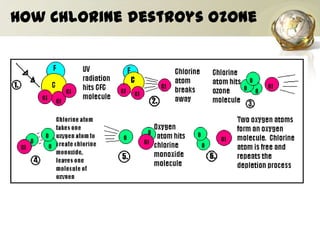
In the process chlorine is
released to destroy the
How Chlorine destroys Ozone
Policy Responses to Ozone
Depletion
• Coordinating
committee on Ozone
Layer (CCOL)
established by UNEP
in the 1970’s
• Vienna Convention
for the protection
of the ozone layer
held in 1985
Policy Responses to Ozone
Depletion
• Montreal Protocol
to ban substances
that deplete the
ozone layer (ODS)
held in 1987
• Amendments to the
Montreal Protocol:
London - 1990,
Copenhagen - 1992
Montreal - 1997. and
Beijing, 1999
• 158 countries signed
the Beijing
amendment,
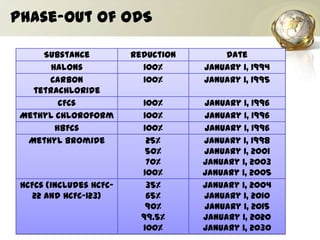
Phase-out of ODS
Substance Reduction Date
Halons 100% January 1, 1994
Carbon
tetrachloride
100% January 1, 1995
CFCs 100% January 1, 1996
Methyl chloroform 100% January 1, 1996
HBFCs 100% January 1, 1996
Methyl bromide 25%
50%
70%
100%
January 1, 1998
January 1, 2001
January 1, 2003
January 1, 2005
HCFCs (includes HCFC-
22 and HCFC-123)
35%
65%
90%
99.5%
100%
January 1, 2004
January 1, 2010
January 1, 2015
January 1, 2020
January 1, 2030
Ozone Protection – Doing our
Part
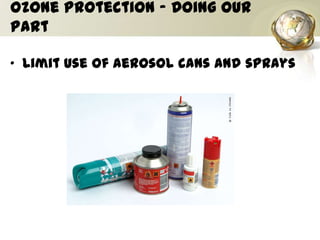
• Limit use of aerosol cans and sprays
Ozone Protection – Doing our
Part
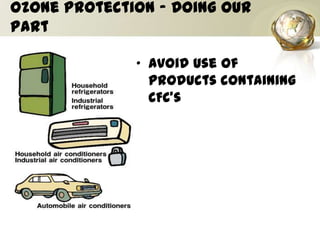
• Avoid use of
products containing
CFC’s
Ozone Protection – Doing our
Part
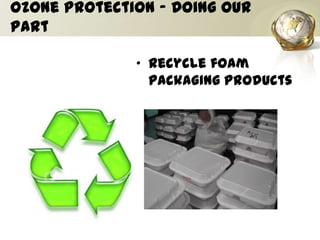
• Recycle foam
packaging products
Any Questions?

The Ozone Layer

  • 1.
  • 2.
    Objectives of thisSession The objective of this session is to understand: • What is Ozone • Why is it soooooooooooo important • What is Ozone Depletion • What can we do to prevent Ozone Depletion
  • 3.
    What is Ozone? •Allotrope of Oxygen – Oxygen Molecule – O2 – Ozone Molecule – O3 • Health hazard and pollutant when present in the Troposphere • Vital for human
  • 4.
    Ozone in theAtmosphere
  • 5.
    Ozone Layer The ozonelayer is a deep layer in the stratosphere, encircling the Earth, that has large amounts of ozone in it.
  • 6.
    Ozone Layer The layershields the entire Earth from much of the harmful ultraviolet radiation that comes from the sun.
  • 7.
    Why Protect theOzone Layer? • Ozone layers acts as protective screen against UV radiation • Excessive UV radiation leads to: – More skin cancers and eye cataracts. – Less crop yields – Loss of immunity to diseases.
  • 8.
  • 9.
    Ozone Depletion • Thedecrease in the concentration of Stratospheric Ozone due to chemicals (known as Ozone Depleting Substances or ODS)
  • 10.
    Common Ozone Depleting Substances •CFC • HCFC • Methyl Bromide • Halons
  • 11.
    Chlorofluorocarbons (CFC) CFC’s arecreated and used in refrigerators and air conditioners. These are not harmful to humans and have been a benefit to us. Once released into the atmosphere, chlorofluorocarbons are bombarded and destroyed by ultraviolet rays. In the process chlorine is released to destroy the
  • 12.
  • 13.
    Policy Responses toOzone Depletion • Coordinating committee on Ozone Layer (CCOL) established by UNEP in the 1970’s • Vienna Convention for the protection of the ozone layer held in 1985
  • 14.
    Policy Responses toOzone Depletion • Montreal Protocol to ban substances that deplete the ozone layer (ODS) held in 1987 • Amendments to the Montreal Protocol: London - 1990, Copenhagen - 1992 Montreal - 1997. and Beijing, 1999 • 158 countries signed the Beijing amendment,
  • 15.
    Phase-out of ODS SubstanceReduction Date Halons 100% January 1, 1994 Carbon tetrachloride 100% January 1, 1995 CFCs 100% January 1, 1996 Methyl chloroform 100% January 1, 1996 HBFCs 100% January 1, 1996 Methyl bromide 25% 50% 70% 100% January 1, 1998 January 1, 2001 January 1, 2003 January 1, 2005 HCFCs (includes HCFC- 22 and HCFC-123) 35% 65% 90% 99.5% 100% January 1, 2004 January 1, 2010 January 1, 2015 January 1, 2020 January 1, 2030
  • 16.
    Ozone Protection –Doing our Part • Limit use of aerosol cans and sprays
  • 17.
    Ozone Protection –Doing our Part • Avoid use of products containing CFC’s
  • 18.
    Ozone Protection –Doing our Part • Recycle foam packaging products
  • 19.

Editor's Notes

  • #9 UV-A (400-315 nm)UV-B (315-280 nm)UV-C (280-100 nm)UV-C, which would be very harmful to humans, is entirely screened out by ozone at around 35 km altitudeUV-B radiation can be harmful to the skin and is the main cause of sunburn; excessive exposure can also cause genetic damage, resulting in problems such as skin cancer. The ozone layer is very effective at screening out UV-B; for radiation with a wavelength of 290 nm, the intensity at Earth's surface is 350 billion times weaker than at the top of the atmosphere. Nevertheless, some UV-B reaches the surface. Most UV-A reaches the surface; this radiation is significantly less harmful, although it can potentially cause genetic damage