WHAT IS THE OZONE LAYER?
Ozone is a gas composed of three
oxygen molecules which can be
hazardous to our health on the
ground, but in the upper
atmosphere it protects us by
soaking up ultraviolet radiation
from the sun.
Without it, the planet's surface
would be exposed to dangerous
levels of UV-B rays which can
shred DNA, leading to mutations
that cause cancers.
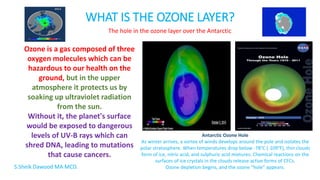
The hole in the ozone layer over the Antarctic
Antarctic Ozone Hole
As winter arrives, a vortex of winds develops around the pole and isolates the
polar stratosphere. When temperatures drop below -78°C (-109°F), thin clouds
form of ice, nitric acid, and sulphuric acid mixtures. Chemical reactions on the
surfaces of ice crystals in the clouds release active forms of CFCs.
Ozone depletion begins, and the ozone “hole” appears.S.Sheik Dawood MA MCD.
Top 10 facts about Ozone
United Nations General Assembly in 1994 designated September 16 as International Day for Preservation of Ozone Layer.
1. Ozone was first discovered and isolated by the German-Swiss chemist Christian Friedrich Schönbein in 1839.
2. Ozone is a pale blue gas with a distinctive pungent smell.
3. Schönbein named it ozone from the Greek verb ozein, meaning to smell.
4. One molecule of ozone consists of three oxygen atoms. A molecule of oxygen has only two atoms.
5. The bracing smell of seaside air which people often think is ozone is in fact dimethyl sulphide produced from rotting
seaweed.
6. Ozone near ground level may be harmful. A component of smog, it can lead to breathing disorders and chest pain.
7. Harmful ground-level ozone is produced by car and truck exhausts and natural gas production.
8. Good ozone is ozone in the ozone layer of the atmosphere, 10-20 miles high, which protects us from harmful UVB rays
from the Sun.
9. The Montreal Protocol to ban ozone-depleting chemicals such as CFCs was signed in 1989.
10. Latest results show that the ozone hole over Antarctica is showing signs of shrinking.
Christian Friedrich Schönbein, 1799 – 1868. German-Swiss chemist.
WHAT IS THE OZONE LAYER?
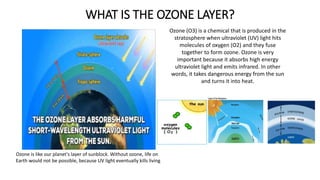
Ozone is like our planet's layer of sunblock. Without ozone, life on
Earth would not be possible, because UV light eventually kills living
Ozone (O3) is a chemical that is produced in the
stratosphere when ultraviolet (UV) light hits
molecules of oxygen (O2) and they fuse
together to form ozone. Ozone is very
important because it absorbs high energy
ultraviolet light and emits infrared. In other
words, it takes dangerous energy from the sun
and turns it into heat.
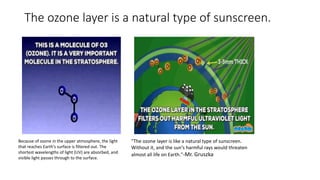
The ozone layer is a natural type of sunscreen.
Because of ozone in the upper atmosphere, the light
that reaches Earth's surface is filtered out. The
shortest wavelengths of light (UV) are absorbed, and
visible light passes through to the surface.
"The ozone layer is like a natural type of sunscreen.
Without it, and the sun's harmful rays would threaten
almost all life on Earth."-Mr. Gruszka
How do CFCs (chlorofluorocarbons) affect ozone molecules?
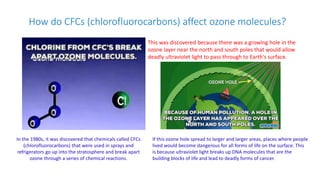
In the 1980s, it was discovered that chemicals called CFCs
(chlorofluorocarbons) that were used in sprays and
refrigerators go up into the stratosphere and break apart
ozone through a series of chemical reactions.
This was discovered because there was a growing hole in the
ozone layer near the north and south poles that would allow
deadly ultraviolet light to pass through to Earth's surface.
If this ozone hole spread to larger and larger areas, places where people
lived would become dangerous for all forms of life on the surface. This
is because ultraviolet light breaks up DNA molecules that are the
building blocks of life and lead to deadly forms of cancer.
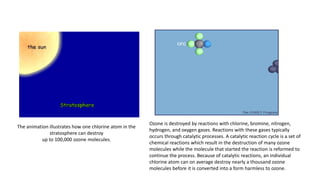
The animation illustrates how one chlorine atom in the
stratosphere can destroy
up to 100,000 ozone molecules.
Ozone is destroyed by reactions with chlorine, bromine, nitrogen,
hydrogen, and oxygen gases. Reactions with these gases typically
occurs through catalytic processes. A catalytic reaction cycle is a set of
chemical reactions which result in the destruction of many ozone
molecules while the molecule that started the reaction is reformed to
continue the process. Because of catalytic reactions, an individual
chlorine atom can on average destroy nearly a thousand ozone
molecules before it is converted into a form harmless to ozone.
How has the hole in the ozone layer changed over the years?
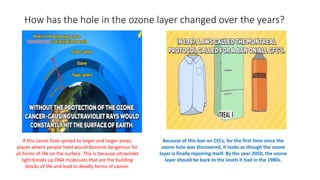
If this ozone hole spread to larger and larger areas,
places where people lived would become dangerous for
all forms of life on the surface. This is because ultraviolet
light breaks up DNA molecules that are the building
blocks of life and lead to deadly forms of cancer.
Because of this ban on CFCs, for the first time since the
ozone hole was discovered, it looks as though the ozone
layer is finally repairing itself. By the year 2050, the ozone
layer should be back to the levels it had in the 1980s.
How can we protect the ozone layer?
This treaty is an excellent example of what is possible if
countries of the world all agree to changes in order to
preserve nature and ultimately save themselves.
Can this be a model for nations to decrease their
greenhouse gas emissions?
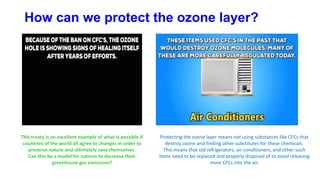
Protecting the ozone layer means not using substances like CFCs that
destroy ozone and finding other substitutes for these chemicals.
This means that old refrigerators, air conditioners, and other such
items need to be replaced and properly disposed of to avoid releasing
more CFCs into the air.
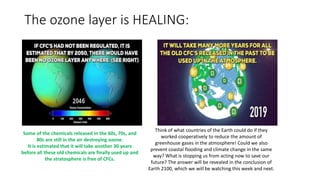
The ozone layer is HEALING:
Some of the chemicals released in the 60s, 70s, and
80s are still in the air destroying ozone.
It is estimated that it will take another 30 years
before all these old chemicals are finally used up and
the stratosphere is free of CFCs.
Think of what countries of the Earth could do if they
worked cooperatively to reduce the amount of
greenhouse gases in the atmosphere! Could we also
prevent coastal flooding and climate change in the same
way? What is stopping us from acting now to save our
future? The answer will be revealed in the conclusion of
Earth 2100, which we will be watching this week and next.
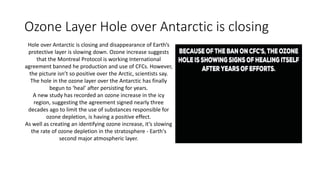
Ozone Layer Hole over Antarctic is closing
Hole over Antarctic is closing and disappearance of Earth’s
protective layer is slowing down. Ozone increase suggests
that the Montreal Protocol is working International
agreement banned he production and use of CFCs. However,
the picture isn’t so positive over the Arctic, scientists say.
The hole in the ozone layer over the Antarctic has finally
begun to ‘heal’ after persisting for years.
A new study has recorded an ozone increase in the icy
region, suggesting the agreement signed nearly three
decades ago to limit the use of substances responsible for
ozone depletion, is having a positive effect.
As well as creating an identifying ozone increase, it’s slowing
the rate of ozone depletion in the stratosphere - Earth's
second major atmospheric layer.
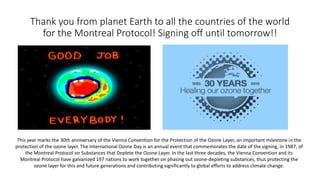
Thank you from planet Earth to all the countries of the world
for the Montreal Protocol! Signing off until tomorrow!!
This year marks the 30th anniversary of the Vienna Convention for the Protection of the Ozone Layer, an important milestone in the
protection of the ozone layer. The International Ozone Day is an annual event that commemorates the date of the signing, in 1987, of
the Montreal Protocol on Substances that Deplete the Ozone Layer. In the last three decades, the Vienna Convention and its
Montreal Protocol have galvanized 197 nations to work together on phasing out ozone-depleting substances, thus protecting the
ozone layer for this and future generations and contributing significantly to global efforts to address climate change.
The Montreal Protocol is one of the most successful and effective environmental treaties ever negotiated and implemented.
The Montreal Protocol on Substances that Deplete the Ozone Layer aimed to ban the global
production and use of ozone-damaging chemicals including CFCs, HCFCs and halon.
From the start, negotiation relied heavily on leadership and innovative approaches.
Much negotiation was held in small, informal groups.
This enabled a genuine exchange of views and the opportunity to take some issues on trust,
such as the subsequent development of the Multilateral Fund.
The people negotiating the treaty also included scientists,
which lent credibility.
Thank you from planet Earth to all the countries of the world for the Montreal Protocol!
The Montreal Protocol is one of the most successful and effective
environmental treaties ever negotiated and implemented
Thank you from planet Earth to all the countries of the world
for the Montreal Protocol
Making it to be successful !

Ozone

  • 2.
    WHAT IS THEOZONE LAYER? Ozone is a gas composed of three oxygen molecules which can be hazardous to our health on the ground, but in the upper atmosphere it protects us by soaking up ultraviolet radiation from the sun. Without it, the planet's surface would be exposed to dangerous levels of UV-B rays which can shred DNA, leading to mutations that cause cancers. The hole in the ozone layer over the Antarctic Antarctic Ozone Hole As winter arrives, a vortex of winds develops around the pole and isolates the polar stratosphere. When temperatures drop below -78°C (-109°F), thin clouds form of ice, nitric acid, and sulphuric acid mixtures. Chemical reactions on the surfaces of ice crystals in the clouds release active forms of CFCs. Ozone depletion begins, and the ozone “hole” appears.S.Sheik Dawood MA MCD.
  • 3.
    Top 10 factsabout Ozone United Nations General Assembly in 1994 designated September 16 as International Day for Preservation of Ozone Layer. 1. Ozone was first discovered and isolated by the German-Swiss chemist Christian Friedrich Schönbein in 1839. 2. Ozone is a pale blue gas with a distinctive pungent smell. 3. Schönbein named it ozone from the Greek verb ozein, meaning to smell. 4. One molecule of ozone consists of three oxygen atoms. A molecule of oxygen has only two atoms. 5. The bracing smell of seaside air which people often think is ozone is in fact dimethyl sulphide produced from rotting seaweed. 6. Ozone near ground level may be harmful. A component of smog, it can lead to breathing disorders and chest pain. 7. Harmful ground-level ozone is produced by car and truck exhausts and natural gas production. 8. Good ozone is ozone in the ozone layer of the atmosphere, 10-20 miles high, which protects us from harmful UVB rays from the Sun. 9. The Montreal Protocol to ban ozone-depleting chemicals such as CFCs was signed in 1989. 10. Latest results show that the ozone hole over Antarctica is showing signs of shrinking. Christian Friedrich Schönbein, 1799 – 1868. German-Swiss chemist.
  • 4.
    WHAT IS THEOZONE LAYER? Ozone is like our planet's layer of sunblock. Without ozone, life on Earth would not be possible, because UV light eventually kills living Ozone (O3) is a chemical that is produced in the stratosphere when ultraviolet (UV) light hits molecules of oxygen (O2) and they fuse together to form ozone. Ozone is very important because it absorbs high energy ultraviolet light and emits infrared. In other words, it takes dangerous energy from the sun and turns it into heat.
  • 5.
    The ozone layeris a natural type of sunscreen. Because of ozone in the upper atmosphere, the light that reaches Earth's surface is filtered out. The shortest wavelengths of light (UV) are absorbed, and visible light passes through to the surface. "The ozone layer is like a natural type of sunscreen. Without it, and the sun's harmful rays would threaten almost all life on Earth."-Mr. Gruszka
  • 6.
    How do CFCs(chlorofluorocarbons) affect ozone molecules? In the 1980s, it was discovered that chemicals called CFCs (chlorofluorocarbons) that were used in sprays and refrigerators go up into the stratosphere and break apart ozone through a series of chemical reactions. This was discovered because there was a growing hole in the ozone layer near the north and south poles that would allow deadly ultraviolet light to pass through to Earth's surface. If this ozone hole spread to larger and larger areas, places where people lived would become dangerous for all forms of life on the surface. This is because ultraviolet light breaks up DNA molecules that are the building blocks of life and lead to deadly forms of cancer.
  • 7.
    The animation illustrateshow one chlorine atom in the stratosphere can destroy up to 100,000 ozone molecules. Ozone is destroyed by reactions with chlorine, bromine, nitrogen, hydrogen, and oxygen gases. Reactions with these gases typically occurs through catalytic processes. A catalytic reaction cycle is a set of chemical reactions which result in the destruction of many ozone molecules while the molecule that started the reaction is reformed to continue the process. Because of catalytic reactions, an individual chlorine atom can on average destroy nearly a thousand ozone molecules before it is converted into a form harmless to ozone.
  • 8.
    How has thehole in the ozone layer changed over the years? If this ozone hole spread to larger and larger areas, places where people lived would become dangerous for all forms of life on the surface. This is because ultraviolet light breaks up DNA molecules that are the building blocks of life and lead to deadly forms of cancer. Because of this ban on CFCs, for the first time since the ozone hole was discovered, it looks as though the ozone layer is finally repairing itself. By the year 2050, the ozone layer should be back to the levels it had in the 1980s.
  • 9.
    How can weprotect the ozone layer? This treaty is an excellent example of what is possible if countries of the world all agree to changes in order to preserve nature and ultimately save themselves. Can this be a model for nations to decrease their greenhouse gas emissions? Protecting the ozone layer means not using substances like CFCs that destroy ozone and finding other substitutes for these chemicals. This means that old refrigerators, air conditioners, and other such items need to be replaced and properly disposed of to avoid releasing more CFCs into the air.
  • 10.
    The ozone layeris HEALING: Some of the chemicals released in the 60s, 70s, and 80s are still in the air destroying ozone. It is estimated that it will take another 30 years before all these old chemicals are finally used up and the stratosphere is free of CFCs. Think of what countries of the Earth could do if they worked cooperatively to reduce the amount of greenhouse gases in the atmosphere! Could we also prevent coastal flooding and climate change in the same way? What is stopping us from acting now to save our future? The answer will be revealed in the conclusion of Earth 2100, which we will be watching this week and next.
  • 11.
    Ozone Layer Holeover Antarctic is closing Hole over Antarctic is closing and disappearance of Earth’s protective layer is slowing down. Ozone increase suggests that the Montreal Protocol is working International agreement banned he production and use of CFCs. However, the picture isn’t so positive over the Arctic, scientists say. The hole in the ozone layer over the Antarctic has finally begun to ‘heal’ after persisting for years. A new study has recorded an ozone increase in the icy region, suggesting the agreement signed nearly three decades ago to limit the use of substances responsible for ozone depletion, is having a positive effect. As well as creating an identifying ozone increase, it’s slowing the rate of ozone depletion in the stratosphere - Earth's second major atmospheric layer.
  • 12.
    Thank you fromplanet Earth to all the countries of the world for the Montreal Protocol! Signing off until tomorrow!! This year marks the 30th anniversary of the Vienna Convention for the Protection of the Ozone Layer, an important milestone in the protection of the ozone layer. The International Ozone Day is an annual event that commemorates the date of the signing, in 1987, of the Montreal Protocol on Substances that Deplete the Ozone Layer. In the last three decades, the Vienna Convention and its Montreal Protocol have galvanized 197 nations to work together on phasing out ozone-depleting substances, thus protecting the ozone layer for this and future generations and contributing significantly to global efforts to address climate change.
  • 13.
    The Montreal Protocolis one of the most successful and effective environmental treaties ever negotiated and implemented. The Montreal Protocol on Substances that Deplete the Ozone Layer aimed to ban the global production and use of ozone-damaging chemicals including CFCs, HCFCs and halon. From the start, negotiation relied heavily on leadership and innovative approaches. Much negotiation was held in small, informal groups. This enabled a genuine exchange of views and the opportunity to take some issues on trust, such as the subsequent development of the Multilateral Fund. The people negotiating the treaty also included scientists, which lent credibility. Thank you from planet Earth to all the countries of the world for the Montreal Protocol!
  • 14.
    The Montreal Protocolis one of the most successful and effective environmental treaties ever negotiated and implemented Thank you from planet Earth to all the countries of the world for the Montreal Protocol Making it to be successful !