Ozone Depletion
What is the “ozone layer?”
How does it protect us?
How did it come about?
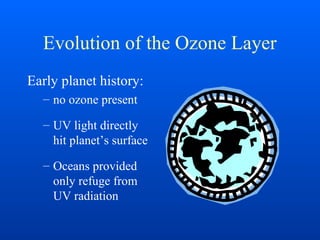
Evolution of the Ozone Layer
Early planet history:
– no ozone present
– UV light directly
hit planet’s surface
– Oceans provided
only refuge from
UV radiation
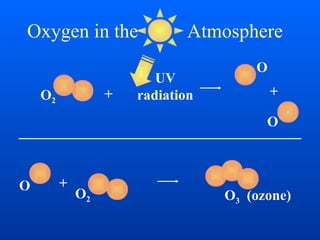
Oxygen in the Atmosphere
UV
radiation+O2
O
O
+
O +
O2 O3 (ozone)
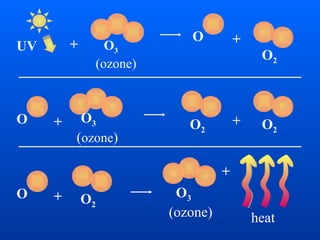
UV O3
(ozone)
O +
O2
O + O3
(ozone)
O2 O2
+
O + O2
O3
(ozone)
+
heat
+
Dynamic Equilibrium
creation of ozone
breakdown of
ozone
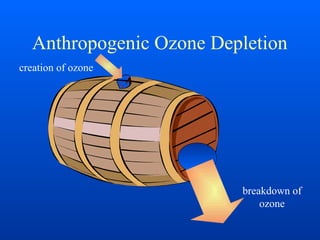
Anthropogenic Ozone Depletion
creation of ozone
breakdown of
ozone
Modern Impacts to Ozone
Chlorofluorocarbons (CFCs)
• What are they?
• How do they impact the ozone layer?
Development of CFCs
1928: DuPont scientists develop CFCs
“ideal compounds” for
refrigerants and propellants
WHY??
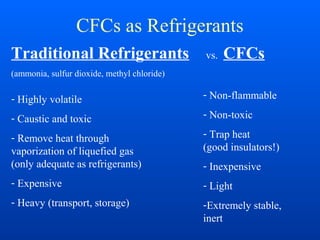
CFCs as Refrigerants
vs. CFCs
- Non-flammable
- Non-toxic
- Trap heat
(good insulators!)
- Inexpensive
- Light
-Extremely stable,
inert
Traditional Refrigerants
(ammonia, sulfur dioxide, methyl chloride)
- Highly volatile
- Caustic and toxic
- Remove heat through
vaporization of liquefied gas
(only adequate as refrigerants)
- Expensive
- Heavy (transport, storage)
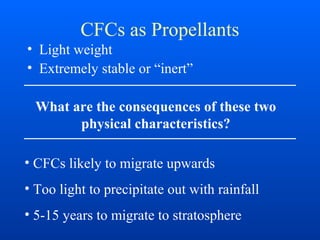
CFCs as Propellants
• Light weight
• Extremely stable or “inert”
What are the consequences of these two
physical characteristics?
• CFCs likely to migrate upwards
• Too light to precipitate out with rainfall
• 5-15 years to migrate to stratosphere
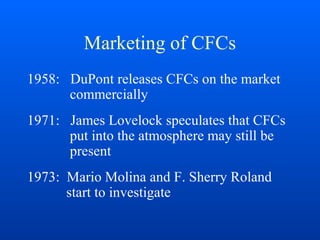
Marketing of CFCs
1958: DuPont releases CFCs on the market
commercially
1971: James Lovelock speculates that CFCs
put into the atmosphere may still be
present
1973: Mario Molina and F. Sherry Roland
start to investigate
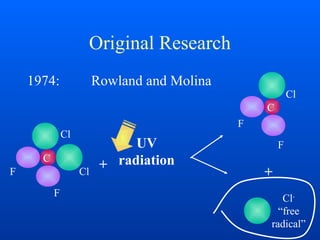
Original Research
1974: Rowland and Molina
UV
radiation+Cl
Cl
F
F
C
C
Cl
F
F
+
Cl-
“free
radical”
Cl-
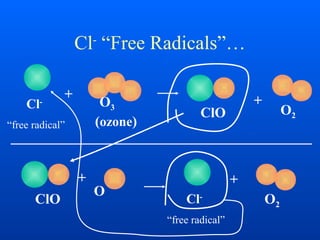
“Free Radicals”…
Cl-
“free radical”
O3
(ozone)
+
O2ClO
+
ClO
+
O
Cl-
“free radical”
+
O2
In the news…
1974: Molina and Rowland publish their
hypothesis in Nature.
New York Times runs front page
DuPont responds with study
showing that CFCs in troposphere
are benign
High Risk and Political Savvy
1975:200% increase in CFC use from
1968, only eight years
1979:The FDA, EPA ban non-essential
uses of CFCs !
First time substance EVER banned
without direct proof of harm
1982:20 other countries join US in ban of CFCs
Scientific Controversies
1982: British science teams in Antarctica
observe 20% decline in O3 layer
US scientists relying on TOMS
(Total Ozone Mapping
Spectrometer) measurements from
space claim to observe nothing
Scientific Evidence
1983: British scientists observe 30%
reduction in ozone layer.
US scientists claims no reduction.
1985: British observe 50% reduction.
US claims no reduction.
US re-tests and confirms.
WHY THE SCIENTIFIC SNAFUS??
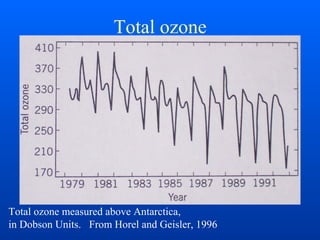
Total ozone
Total ozone measured above Antarctica,
in Dobson Units. From Horel and Geisler, 1996
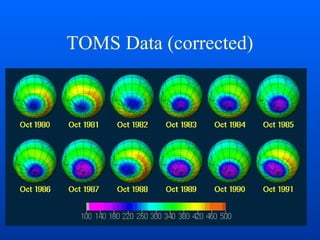
TOMS Data (corrected)
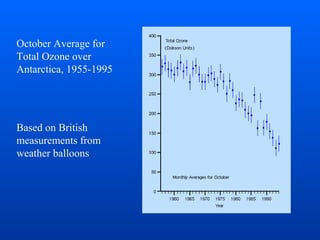
October Average for
Total Ozone over
Antarctica, 1955-1995
Based on British
measurements from
weather balloons
Understanding the Science
1986: DuPont scientists continue to
argue that tropospheric ozone
(smog) will migrate up and “fill
the ozone hole” in the
stratosphere
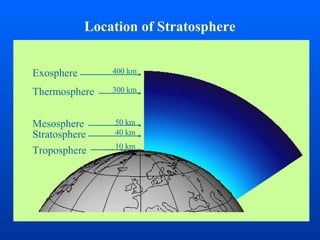
Why doesn’t this theory fly?
Location of Stratosphere
Thermosphere
Exosphere
Troposphere
Mesosphere
Stratosphere
10 km
40 km
50 km
300 km
400 km
Montreal Protocol Landmark
1987: 2 yrs of intensive research reveal
that ozone hole is anthropogenic
1988: UN hold meeting in Montreal
45 Nations sign to reduce CFC use
by 50% by year 2000.
Developing countries’ efforts
would be ‘subsidized’
Two steps forward…
1990- Follow up meetings result in:
1992: Industrialized nations: total ban by 2000
Developing nations: ban by 2010, with
assistance from developed nations
US agrees to complete phaseout by 1996;
DuPont to halt production by 1997
1995: Rowland and Molina receive Nobel Prize
One step back…
1995: Congress challenges ozone science:
Junk science gains credibility
despite scientific consensus of
anthropogenic causes of O3 depletion
1996: Ban begins but black market for CFCs appear
WHY?
CFC substitutes (HFC) break down faster, but still
pose problems for ozone depletion
Modern Impacts to Ozone (2)
Methyl Bromide
• What is it?
• Challenges to Montreal Protocol
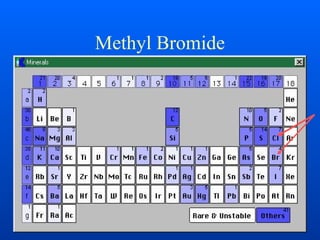
Methyl Bromide
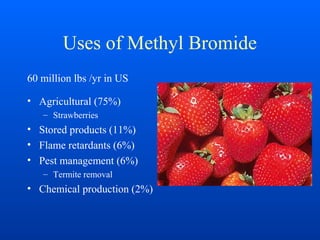
Uses of Methyl Bromide
60 million lbs /yr in US
• Agricultural (75%)
– Strawberries
• Stored products (11%)
• Flame retardants (6%)
• Pest management (6%)
– Termite removal
• Chemical production (2%)
Schedule for Elimination
1991: Designated Class I ozone depleter
in Montreal Protocol
1997: Agreed to following schedule
Developed Countries—elimination by 2005
Developing Countries—elimination by 2015
Requests for “Critical Use Exemptions”
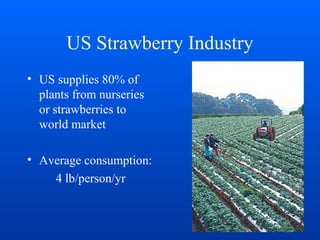
US Strawberry Industry
• US supplies 80% of
plants from nurseries
or strawberries to
world market
• Average consumption:
4 lb/person/yr
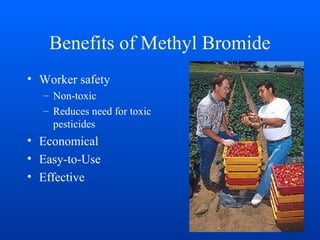
Benefits of Methyl Bromide
• Worker safety
– Non-toxic
– Reduces need for toxic
pesticides
• Economical
• Easy-to-Use
• Effective
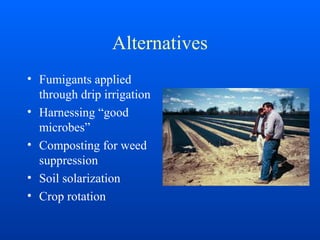
Alternatives
• Fumigants applied
through drip irrigation
• Harnessing “good
microbes”
• Composting for weed
suppression
• Soil solarization
• Crop rotation
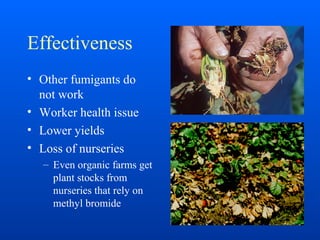
Effectiveness
• Other fumigants do
not work
• Worker health issue
• Lower yields
• Loss of nurseries
– Even organic farms get
plant stocks from
nurseries that rely on
methyl bromide
CFCs vs MEBr
Why did one industry eventually support
ban while another is struggling and begging
for exemptions?
Methyl Bromide CFCs
-no viable alternatives -DuPont developed HFCs
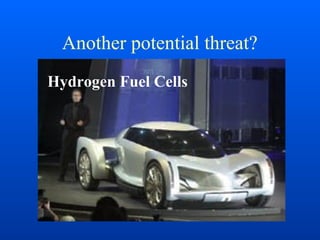
Another potential threat?
Hydrogen Fuel Cells
Production of Hydrogen
• Anticipate that 10% of all hydrogen
manufactured will leak into the atmosphere
during production, storage and transport.
• Current loss is higher
• Estimate: 60 million tons / year
• Roughly doubles current input (all sources)
Hydrogen chemistry
• Hydrogen is light—rises rapidly to
stratosphere
• Reacts with oxygen to form water
• A “wetter” atmosphere would cool the
lower stratosphere, especially around Poles
• Increase in water vapor is catalyst for ozone
depletion by freeing Cl free radicals
Spatial and Temporal Patterns
• Poles have greater ozone loss than other
regions:
– Colder
– More vapor formation
– Also: polar vortex
• Particularly severe in polar spring (October)
• Increased hydrogen would enhance this
phenomenon
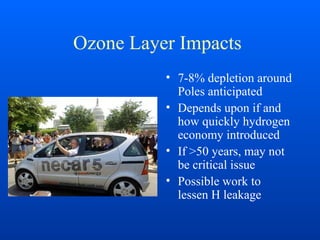
Ozone Layer Impacts
• 7-8% depletion around
Poles anticipated
• Depends upon if and
how quickly hydrogen
economy introduced
• If >50 years, may not
be critical issue
• Possible work to
lessen H leakage
Current Status of Ozone Hole
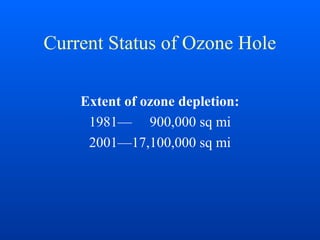
Extent of ozone depletion:
1981— 900,000 sq mi
2001—17,100,000 sq mi
Location of Ozone Losses
Ozone loss extends beyond Antarctica and
Arctic Polar regions
Ozone loss over US currently 5% below
normal rates
Current Rate of Ozone Depletion
• Decrease in rate of ozone depletion (since 1997)
• Slowing of buildup of harmful Cl-
from CFCs
• Ozone hole is still growing, but…
Models anticipate restoration of “normal”
balance of ozone in stratosphere by 2050
Impacts of Ozone Depletion
Human Health
• Skin cancer
• Melanoma
• Cataracts
• Immune system function
• Increased incidence,
severity and duration of
infectious diseases
• Reduced efficacy of
vaccinations
Ecological Health
• Pathogen locally up &
down
• Biodiversity locally up &
down
• Aquatic organisms
adversely impacted
• Decreased biomass
productivity
• Polar systems especially
vulnerable
Impacts of Ozone Depletion
Economic
• Plastics
– designed with stabilizers to withstand UV radiation of
certain intensity
– replacement of key medical equipment and supplies,
decreased lifespan of plastics
• Manufacturing practices
• Agriculture
• Consumer costs and burdens
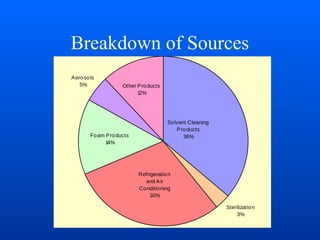
Breakdown of Sources
Sterilization
3%
Aerosols
5%
Refrigeration
and Air
Conditioning
30%
Other Products
12%
Solvent Cleaning
Products
36%Foam Products
14%
Success Story
What characteristics define ozone depletion
“an environmental success story ?”

Ozone depletion

  • 1.
    Ozone Depletion What isthe “ozone layer?” How does it protect us? How did it come about?
  • 2.
    Evolution of theOzone Layer Early planet history: – no ozone present – UV light directly hit planet’s surface – Oceans provided only refuge from UV radiation
  • 3.
    Oxygen in theAtmosphere UV radiation+O2 O O + O + O2 O3 (ozone)
  • 4.
    UV O3 (ozone) O + O2 O+ O3 (ozone) O2 O2 + O + O2 O3 (ozone) + heat +
  • 5.
    Dynamic Equilibrium creation ofozone breakdown of ozone
  • 6.
    Anthropogenic Ozone Depletion creationof ozone breakdown of ozone
  • 7.
    Modern Impacts toOzone Chlorofluorocarbons (CFCs) • What are they? • How do they impact the ozone layer?
  • 8.
    Development of CFCs 1928:DuPont scientists develop CFCs “ideal compounds” for refrigerants and propellants WHY??
  • 9.
    CFCs as Refrigerants vs.CFCs - Non-flammable - Non-toxic - Trap heat (good insulators!) - Inexpensive - Light -Extremely stable, inert Traditional Refrigerants (ammonia, sulfur dioxide, methyl chloride) - Highly volatile - Caustic and toxic - Remove heat through vaporization of liquefied gas (only adequate as refrigerants) - Expensive - Heavy (transport, storage)
  • 10.
    CFCs as Propellants •Light weight • Extremely stable or “inert” What are the consequences of these two physical characteristics? • CFCs likely to migrate upwards • Too light to precipitate out with rainfall • 5-15 years to migrate to stratosphere
  • 11.
    Marketing of CFCs 1958:DuPont releases CFCs on the market commercially 1971: James Lovelock speculates that CFCs put into the atmosphere may still be present 1973: Mario Molina and F. Sherry Roland start to investigate
  • 12.
    Original Research 1974: Rowlandand Molina UV radiation+Cl Cl F F C C Cl F F + Cl- “free radical”
  • 13.
  • 14.
    In the news… 1974:Molina and Rowland publish their hypothesis in Nature. New York Times runs front page DuPont responds with study showing that CFCs in troposphere are benign
  • 15.
    High Risk andPolitical Savvy 1975:200% increase in CFC use from 1968, only eight years 1979:The FDA, EPA ban non-essential uses of CFCs ! First time substance EVER banned without direct proof of harm 1982:20 other countries join US in ban of CFCs
  • 16.
    Scientific Controversies 1982: Britishscience teams in Antarctica observe 20% decline in O3 layer US scientists relying on TOMS (Total Ozone Mapping Spectrometer) measurements from space claim to observe nothing
  • 17.
    Scientific Evidence 1983: Britishscientists observe 30% reduction in ozone layer. US scientists claims no reduction. 1985: British observe 50% reduction. US claims no reduction. US re-tests and confirms. WHY THE SCIENTIFIC SNAFUS??
  • 18.
    Total ozone Total ozonemeasured above Antarctica, in Dobson Units. From Horel and Geisler, 1996
  • 19.
  • 20.
    October Average for TotalOzone over Antarctica, 1955-1995 Based on British measurements from weather balloons
  • 21.
    Understanding the Science 1986:DuPont scientists continue to argue that tropospheric ozone (smog) will migrate up and “fill the ozone hole” in the stratosphere Why doesn’t this theory fly?
  • 22.
  • 23.
    Montreal Protocol Landmark 1987:2 yrs of intensive research reveal that ozone hole is anthropogenic 1988: UN hold meeting in Montreal 45 Nations sign to reduce CFC use by 50% by year 2000. Developing countries’ efforts would be ‘subsidized’
  • 24.
    Two steps forward… 1990-Follow up meetings result in: 1992: Industrialized nations: total ban by 2000 Developing nations: ban by 2010, with assistance from developed nations US agrees to complete phaseout by 1996; DuPont to halt production by 1997 1995: Rowland and Molina receive Nobel Prize
  • 25.
    One step back… 1995:Congress challenges ozone science: Junk science gains credibility despite scientific consensus of anthropogenic causes of O3 depletion 1996: Ban begins but black market for CFCs appear WHY? CFC substitutes (HFC) break down faster, but still pose problems for ozone depletion
  • 26.
    Modern Impacts toOzone (2) Methyl Bromide • What is it? • Challenges to Montreal Protocol
  • 27.
  • 28.
    Uses of MethylBromide 60 million lbs /yr in US • Agricultural (75%) – Strawberries • Stored products (11%) • Flame retardants (6%) • Pest management (6%) – Termite removal • Chemical production (2%)
  • 29.
    Schedule for Elimination 1991:Designated Class I ozone depleter in Montreal Protocol 1997: Agreed to following schedule Developed Countries—elimination by 2005 Developing Countries—elimination by 2015 Requests for “Critical Use Exemptions”
  • 30.
    US Strawberry Industry •US supplies 80% of plants from nurseries or strawberries to world market • Average consumption: 4 lb/person/yr
  • 31.
    Benefits of MethylBromide • Worker safety – Non-toxic – Reduces need for toxic pesticides • Economical • Easy-to-Use • Effective
  • 32.
    Alternatives • Fumigants applied throughdrip irrigation • Harnessing “good microbes” • Composting for weed suppression • Soil solarization • Crop rotation
  • 33.
    Effectiveness • Other fumigantsdo not work • Worker health issue • Lower yields • Loss of nurseries – Even organic farms get plant stocks from nurseries that rely on methyl bromide
  • 34.
    CFCs vs MEBr Whydid one industry eventually support ban while another is struggling and begging for exemptions? Methyl Bromide CFCs -no viable alternatives -DuPont developed HFCs
  • 35.
  • 36.
    Production of Hydrogen •Anticipate that 10% of all hydrogen manufactured will leak into the atmosphere during production, storage and transport. • Current loss is higher • Estimate: 60 million tons / year • Roughly doubles current input (all sources)
  • 37.
    Hydrogen chemistry • Hydrogenis light—rises rapidly to stratosphere • Reacts with oxygen to form water • A “wetter” atmosphere would cool the lower stratosphere, especially around Poles • Increase in water vapor is catalyst for ozone depletion by freeing Cl free radicals
  • 38.
    Spatial and TemporalPatterns • Poles have greater ozone loss than other regions: – Colder – More vapor formation – Also: polar vortex • Particularly severe in polar spring (October) • Increased hydrogen would enhance this phenomenon
  • 39.
    Ozone Layer Impacts •7-8% depletion around Poles anticipated • Depends upon if and how quickly hydrogen economy introduced • If >50 years, may not be critical issue • Possible work to lessen H leakage
  • 40.
    Current Status ofOzone Hole Extent of ozone depletion: 1981— 900,000 sq mi 2001—17,100,000 sq mi
  • 41.
    Location of OzoneLosses Ozone loss extends beyond Antarctica and Arctic Polar regions Ozone loss over US currently 5% below normal rates
  • 42.
    Current Rate ofOzone Depletion • Decrease in rate of ozone depletion (since 1997) • Slowing of buildup of harmful Cl- from CFCs • Ozone hole is still growing, but… Models anticipate restoration of “normal” balance of ozone in stratosphere by 2050
  • 43.
    Impacts of OzoneDepletion Human Health • Skin cancer • Melanoma • Cataracts • Immune system function • Increased incidence, severity and duration of infectious diseases • Reduced efficacy of vaccinations Ecological Health • Pathogen locally up & down • Biodiversity locally up & down • Aquatic organisms adversely impacted • Decreased biomass productivity • Polar systems especially vulnerable
  • 44.
    Impacts of OzoneDepletion Economic • Plastics – designed with stabilizers to withstand UV radiation of certain intensity – replacement of key medical equipment and supplies, decreased lifespan of plastics • Manufacturing practices • Agriculture • Consumer costs and burdens
  • 45.
    Breakdown of Sources Sterilization 3% Aerosols 5% Refrigeration andAir Conditioning 30% Other Products 12% Solvent Cleaning Products 36%Foam Products 14%
  • 46.
    Success Story What characteristicsdefine ozone depletion “an environmental success story ?”

Editor's Notes

  • #2 History of ozone depletion begins long before: the Montreal Protocol the advent of CFCs and even the beginnings of refrigeration History of Ozone Layer begins more than a billion years ago, and its story Represents one of the key pre-conditions needed for the evolution of life on land
  • #3 Without the ozone layer: (1) Surface of earth was sterilized of most life forms due to mutagenic properties of UV radiation (2) The atmosphere had very little oxygen—it was primarily sequestered in cycles with H2O in the ocean (3) Ocean was only barrier that sheltered potential life from full extent of effects of radiation (4) Evolution gradually brought forth single-celled algae that were able to survive and reproduce by transforming the sun’s energy via photosynthesis. (5) A key result of the photosynthesis is ___________… respiration that produces oxygen. (6) The proliferation of single-celled algal life led to a build-up of oxygen in the atmosphere
  • #4 An oxygen molecule consists of two oxygen molecules. When an oxygen molecule (O2) is struck by UV radiation, it splits into two separate oxygen atoms Free oxygen molecules can then combine with oxygen molecules to create ozone, or O3. Over hundreds of millions of years, more and more ozone began to build up in the earth’s atmosphere, which is 10-30 miles above the earth’s surface and begins to form the ozone layer.
  • #5 Once in the atmosphere, the oxygen atoms and molecules behave in predictable ways, especially because ozone is highly unstable (e.g., almost any opportunity to break down, it will). There are three primary reactions that occur: Ozone absorbs UV radiation and is broken down into O and O2. Some of these free oxygen atoms then either combine with other ozone to form more oxygen: Or…. They recombine with existing oxygen to re-form ozone and release heat into the atmosphere. It is in this way that the stratospheric ozone “shields” us from UV radiation. It doesn’t really “reflect” the heat like a mirror, but rather absorbs it and transforms it into heat which is released back into space. In addition to ozone break down from UV radiation, there are other natural causes of its breakdown: nitrogen and chlorine are released from oceans in fine sea mist, which will react with ozone. volcanic activity release chlorine, hydrogen, and nitrogen which will also react with ozone. The process of O3 breaking into its constituents O2 and O, and cycling back again, is a natural process. Over the course of one billion or so years, the stratosphere has reached a dynamic equilibrium between the oxygen compounds.
  • #6 You can think of the break down and creation of O3 in the stratosphere as a bucket or water tank (or wine barrel, as shown here), that is being filled and is releasing water (or wine) at the same rate. This creation and break down has been in balance for close to one billion years.
  • #7 Only in this century has human activity threatened this balance by speeding up the destruction of ozone, or in other words, by increasing the amount of wine or water that is leaking out of the barrel. Remember: Before the creation of the ozone layer, much of the UV radiation reaching the planet was able to actually contact the earth’s surface. The ocean was the only way for life to survive under these early conditions. In the billion or so years of stasis during which the ozone layer was protecting the surface waters and land from the mutagenic effects of radiation, multicellular life evolved and flourished. Currently, the ozone layer screens out 99% of the harmful radiation that enters the upper atmosphere from reaching the planet surface. Now, before we switch to modern impacts to this system, break for questions…
  • #8 Modern day concerns about ozone layer is result primarily of ozone depletion in the stratosphere by compounds known as chlorofluorocarbons, or CFCs.
  • #9 First of all, let’s examine what transpired over last 75 years. DuPont scientists found that CFCs were remarkable compounds. WHY??
  • #11 The fact that the CFCs are lightweight and inert suggest that over time they will migrate upwards and not be washed out of the atmosphere into the oceans or terrestrial systems where being inert would be useful. Helium balloon as analogy—lighter than air—keeps rising… Nothing happens to the CFCs until they reach the stratosphere where they encounter intense UV radiation. HOWEVER: it could take anywhere from 5 to 15 years for a CFC molecule to migrate to the stratosphere. CONSEQUENTLY: even through we recently stopped releasing CFCs, it will still be some time before we can expect to begin to stabilize…
  • #13 Rowland and Molina in 1974 speculated that UV radiation could break loose a chlorine atom from a CFC molecule. That newly “freed” chlorine atom could then break down the protective ozone.
  • #14 So the chlorine is a “free radical” (like a free agent in baseball). Their hypothesis—after following its logical chemistry—was that this free radical would then create chlorine oxide, which is unstable. It naturally attracts single oxygen atoms, thereby producing an oxygen molecule and once again freeing the free radical! This produces a self-perpetuating cycle that can continuously break down ozone molecules. In other words, a single molecule of CFC, once it reaches the stratosphere, could break down more than 100,000 molecules of ozone as the chlorine continuously frees itself. This short, elegant study was the basis for awarding these two men the Nobel Prize in Chemistry in 1995 for their research findings in this groundbreaking study.
  • #15 Keep in mind, too, that there is distrust at all levels in the country—Watergate just rocked the political scene, Vietnam was still an open wound in the nation, and the country was suffering from an energy crisis that was extremely costly. The media jumped on this research.
  • #16 This is absolutely amazing to see. This ban came in under the Carter Administration, placing Carter at the forefront of environmental leaders in recent history.
  • #17 So scientists are finding different results… This is an interesting switch from the more insightful political responses observed
  • #18 Why did the US scientists consistently observe no loss in the stratospheric ozone layer over Antarctica? This is a fascinating story of science and uncertainty. Engineers recognized that small variations are natural, but large variations are likely to be indicators of instrumentation error and consequently were used as a barometer of the calibration of the equipment. As as example, you do not expect a person to have a fever of 110 or 112 degrees. It is simply too extreme. So, you program your computer to dump any data that claim a human has a fever of 110. However, if a rare disease causes extreme spike fevers, they would never be detected by reading the data alone. Despite the political will that had earlier hit the nation, the political climate had changed and a more conservative feeling was in the air. Many were unwilling to believe that the British scientists with such dire warnings could possibly be accurate. What happened then? Faced with the reality of an “ozone hole,” the general public and the scientific community become alarmed. Scientists were faced with uncertainty (prefer lots of time to validate findings) Public and politicians wanted immediate answers and clean solutions Big issue: was the Antarctic Ozone Hole natural or anthropogenic in origin??
  • #20 Total Ozone Mapping Spectrometer Twelve year period (1980-1991) with data from the polar spring (October) only
  • #22 Ozone is highly reactive, and must be “created” in the same part of the atmosphere. CFCs will migrate to the stratosphere, and will react with local ozone and oxygen molecules and atoms, but the ozone will not migrate from one level to another.
  • #23 (Terry: ozone good up high / bad nearby)
  • #24 Anthropogenic evidence: Substantiated in 1996: HCl and HF detected in upper stratosphere, and HF is not found in nature at all… WHY was the signing of the Montreal Protocol a landmark event from an environmental standpoint? International agreement to solve international problem Efforts made and recognized that all must contribute, despite heavy burden on developing countries. Given ‘subsidized’ phase outs that were supported by developing and industrialized nations. Pro-active stance on problem with potentially high risks prior to full scientific evidence of how to halt process
  • #26 In 1997: dozens of people in US convicted of smuggling CFCs into the country. Trade estimated at $150-300 M / year, mostly from Mexico (developing countries: Still legal to produce CFCs) In Europe, estimates 10,000 tons per year enter illegally, mostly from Russia WHY? --lots of propellant options --alternative available for refrigerants, but expensive to adapt equipment $200-800 to adapt car AC unit to accommodate alternative DuPont disappointed that sales of alternatives lower than expected. EXPECTATION: That black market will decrease as equipment switches over to accept alternatives…
  • #31 Nurseries certify plants clean of all pathogens and are liable for plant health. One single nursery plant can produce 100 million other plants before being destroyed under the CA certification program. Loss of methyl bromide would likely shut down the nurseries. CA nurseries supply plants throughout the US, but also supply Canada (which in turn supplies Florida), Mexico, Argentina, and various South American strawberry industries, as well as supplying the Spanish nursery industry with plants which in turn supplies western Europe, including France, Italy, Greece, Morocco, Tunisia, Portugal. Strawberry plants are in the ground less than one year. Therefore, new disease-free plants must be put in every year. To plant ~ forty acres of strawberries, a grower will purchase about one acre of nursery stock. This will cost ~ $500,000, not including costs to harvest. Strawberry growers depend on certified plants, income depends on plants being pathogen-free.
  • #33 Applying fumigants through drip irrigation: (1) reduces worker exposure, and (2) decreases total cost Problems: Telone 35 requires a buffer zone and has a maximum use/per region Good microbes: work either by: using nutrients that would otherwise be taken up by harmful bacteria or: rhizobacteria may colonize sites on roots, edging out pathogenic competitors Composting works adequately for weed control, but temperature issues remain concern as foster some fungal growth. Soil solariztion works on some plant pathogens (Agrobacterium tumefaciens) but not on others: Pseudomonas solanacearum. Crop rotation on farms (not nurseries) to control nematodes and fungal diseases. In Eastern and Midwestern farms, can be rotated with other crops because of small farm size and short growing season which knocks out many pathogens each year during cold weather. An additional benefit allows strawberries in these regions to be grown with squash or corn each year. At larger acreages, crop rotation is not economically feasible, and warmer climates support pathogenic growth year round.
  • #34 “So far, there are no viable alternatives that works as well or as consistently as methyl bromide. Some of the most promising alternatives are those that are already restricted in use for other reasons, such as worker health and ecological concerns.” Curt Gaines, Lassen Canyon Nurseries, Redding CA (Central Valley) Other alternatives show effective use and strawberry production after the first year, but lower yields after the 3rd, 4th, and subsequent years. Upper photo shows evidence of nematodes attacking plants: Ditelynchus spp. and Patylenchus spp. Below: strawberry wilt caused by fungus: Phytophthora (a) Most potent and fast acting root pathogen threatening industry; (b) Extremely problematic at nursery level, (c ) Also affects fruiting plants in the fields Other slower acting pathogens (fungal, bacterial and viral) of concern are roots “nibblers:” Pythium, Rhizoctonia, Cylindrocarpon.
  • #35 DuPont was able to generate alternatives that were effective in a timely fashion Allowed ability to save face and claim support of environment DuPont can’t be viewed as evil, but rather protecting corporate (and investor) interests. Strawberry growers seen less evil because of the All-American view of farmers, but equally embattled. Development and costs of research is extraordinary. If anything, strawberry industry at fault for failing to use any alternatives when MEBr introduced. Have lost resistance to all sorts of bacterial and fungal pathogens. Need to re-work alternatives, but takes time to develop (and relies on growth). In comparison, chemical research from scratch is not as problematic because don’t lose pathogenic resistance.
  • #36 US has pledged $1.2B to develop commercially viable hydrogen fueled vehicles… “Non-polluting” fuel could widen ozone hole. Use of fuel cell, which converts energy of burning H directly into electricity, would drastically reduce greenhouse gases NOx SOx CO and reduce pollutants like particulate matter in exhaust.
  • #40 Basically, hydrogen is a catalyst only. Since hydrogen cannot complete the reactions that reduce ozone levels itself, the only reason that this would be a problem is if ozone-depleting chemicals are still present in the stratosphere. Should hydrogen fuel come to pass, but no Cl- free radicals or Br- free radicals are present in the stratosphere—the presence or absence of hydrogen would not be an issue.
  • #44 Immune system function includes autoimmune diseases, allergies, etc… Infectious diseases: especially HPV (human papilloma virus which is currently rampant in young women and is known to cause cervical cancer).
  • #47 What features define this as a success story?