International Ozone Day
Presented by
Sahil Abbas
B.Tech (CSE)
Content
• Ozone
• Dobson Units
• Ozone layer
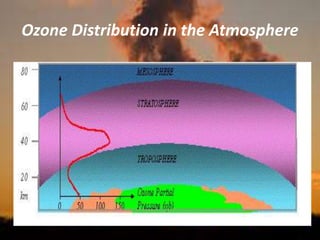
• Ozone Distribution in the Atmosphere
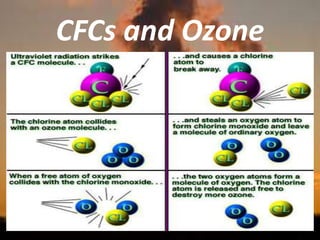
• CFCs: Ozone Depleting Substances
• Ultra-Violet Radiation
• The Ozone Hole
• Antarctic Ozone Hole
• Montreal Protocol
Ozone
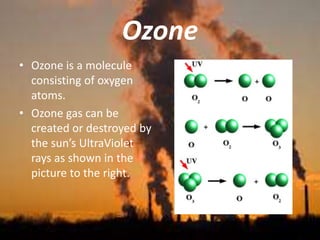
• Ozone is a molecule
consisting of oxygen
atoms.
• Ozone gas can be
created or destroyed by
the sun’s UltraViolet
rays as shown in the
picture to the right.
Ozone is…
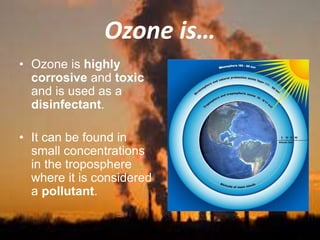
• Ozone is highly
corrosive and toxic
and is used as a
disinfectant.
• It can be found in
small concentrations
in the troposphere
where it is considered
a pollutant.
Dobson Units
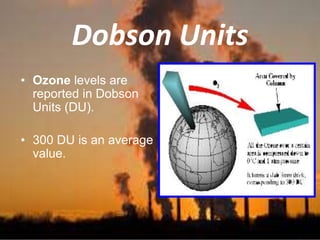
• Ozone levels are
reported in Dobson
Units (DU).
• 300 DU is an average
value.
What is the ozone layer?
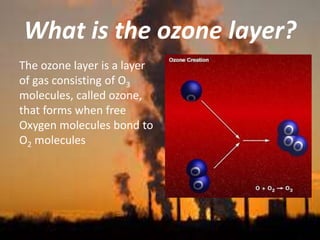
The ozone layer is a layer
of gas consisting of O3
molecules, called ozone,
that forms when free
Oxygen molecules bond to
O2 molecules
Where is the ozone layer?
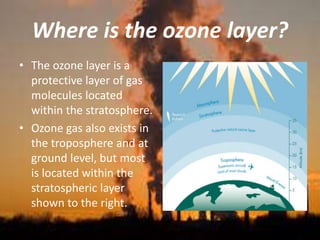
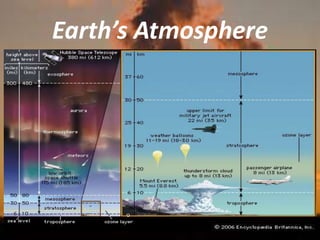
• The ozone layer is a
protective layer of gas
molecules located
within the stratosphere.
• Ozone gas also exists in
the troposphere and at
ground level, but most
is located within the
stratospheric layer
shown to the right.
Earth’s Atmosphere
Ozone Distribution in the Atmosphere
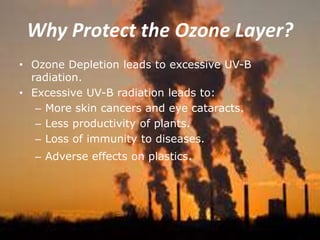
Why Protect the Ozone Layer?
• Ozone Depletion leads to excessive UV-B
radiation.
• Excessive UV-B radiation leads to:
– More skin cancers and eye cataracts.
– Less productivity of plants.
– Loss of immunity to diseases.
– Adverse effects on plastics.
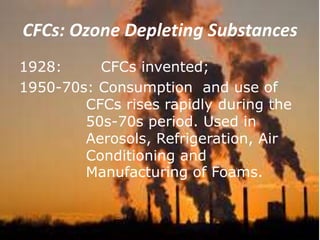
CFCs: Ozone Depleting Substances
1928: CFCs invented;
1950-70s: Consumption and use of
CFCs rises rapidly during the
50s-70s period. Used in
Aerosols, Refrigeration, Air
Conditioning and
Manufacturing of Foams.
CFCs and Ozone
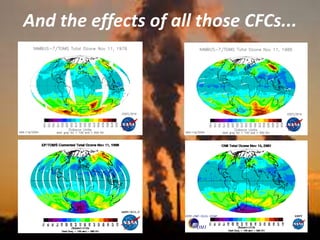
And the effects of all those CFCs...
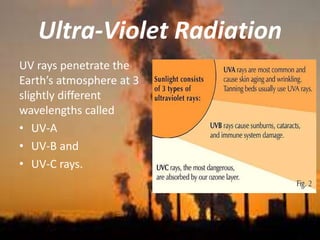
Ultra-Violet Radiation
UV rays penetrate the
Earth’s atmosphere at 3
slightly different
wavelengths called
• UV-A
• UV-B and
• UV-C rays.
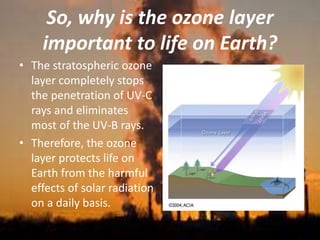
So, why is the ozone layer
important to life on Earth?
• The stratospheric ozone
layer completely stops
the penetration of UV-C
rays and eliminates
most of the UV-B rays.
• Therefore, the ozone
layer protects life on
Earth from the harmful
effects of solar radiation
on a daily basis.
How are we as humans affecting
the ozone layer?
• Since 1928, Chlorofluorocarbons have been
produced, originally as nonflammable
refrigerants for use in refrigerators, and
eventually for use in fire extinguishers, dry
cleaning agents, pesticides, degreasers,
adhesives, and as propellants for aerosol
products.
• As these CFCs have been released into the
atmosphere, the level of ozone in the
stratosphere has decreased.
• CFCs have an estimated lifespan of more than
100 years.
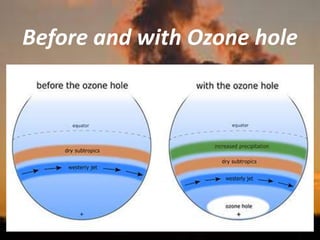
Before and with Ozone hole
The Ozone Hole
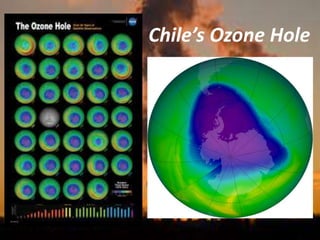
• Since the 1970’s the ozone hole has been
increasing in size over the Antarctic.
• For the first time, in September of 2000, the
ozone hole became so large it actually left
populated areas of southern Chile fully
exposed to the effects of the Sun’s UV rays.
Chile’s Ozone Hole
How does ozone depletion
affect global warming and
ultimately climate change?
• As ozone levels in the stratosphere are
depleted, more solar radiation penetrates the
Earth’s atmosphere.
• This affect results in an increase in solar
radiation reaching the Earth’s surface adding
to an increase in surface temperature.
• In turn, global warming actually results in a
warming of the troposphere, but a cooling of
the stratosphere, hindering the ozone layer’s
natural chemistry for repairs.
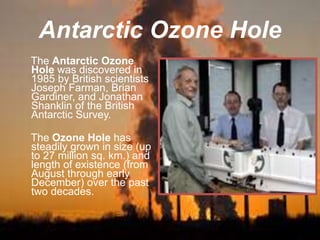
Antarctic Ozone Hole
The Antarctic Ozone
Hole was discovered in
1985 by British scientists
Joseph Farman, Brian
Gardiner, and Jonathan
Shanklin of the British
Antarctic Survey.
The Ozone Hole has
steadily grown in size (up
to 27 million sq. km.) and
length of existence (from
August through early
December) over the past
two decades.
What is the Montreal Protocol?
• The Montreal Protocol is a landmark
international agreement designed to
protect the stratospheric ozone
layer.
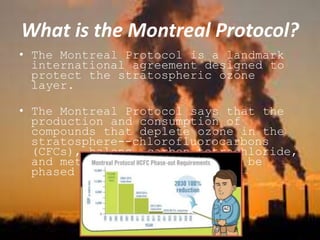
• The Montreal Protocol says that the
production and consumption of
compounds that deplete ozone in the
stratosphere--chlorofluorocarbons
(CFCs), halons, carbon tetrachloride,
and methyl chloroform--are to be
phased out by 2030.
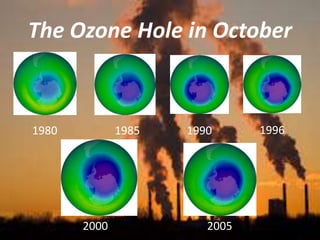
The Ozone Hole in October
1980 1985 1990 1996
2000 2005
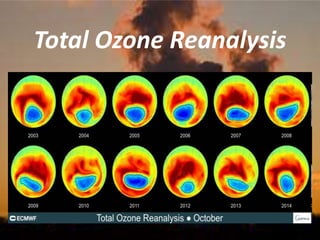
Total Ozone Reanalysis
So what are we doing about it?
• After the discovery of ozone depletion in the late 1970’s, many countries
agreed that something must be done worldwide to stop the production of
man-made, ozone harmful products.
• The international community adopted the Vienna Convention in 1985
followed by the Montreal Protocol in 1987.
• The latest reports confirm that it has led to the phasing out of about 95%
of the consumption of ozone-depleting substances (ODS) listed in the
agreement. In turn, this has led to the prospect of the ozone layer
recovering by 2050 to 2075.
• Furthermore, the phasing out of ozone-depleting substances has helped
to fight climate change since many of these chemicals are also powerful
greenhouse gases. According to a recent study, the phasing out of
substances under the Protocol led to more reductions in greenhouse gases
than what is foreseen under the Kyoto Protocol.
International ozone day

International ozone day

  • 1.
    International Ozone Day Presentedby Sahil Abbas B.Tech (CSE)
  • 2.
    Content • Ozone • DobsonUnits • Ozone layer • Ozone Distribution in the Atmosphere • CFCs: Ozone Depleting Substances • Ultra-Violet Radiation • The Ozone Hole • Antarctic Ozone Hole • Montreal Protocol
  • 3.
    Ozone • Ozone isa molecule consisting of oxygen atoms. • Ozone gas can be created or destroyed by the sun’s UltraViolet rays as shown in the picture to the right.
  • 4.
    Ozone is… • Ozoneis highly corrosive and toxic and is used as a disinfectant. • It can be found in small concentrations in the troposphere where it is considered a pollutant.
  • 5.
    Dobson Units • Ozonelevels are reported in Dobson Units (DU). • 300 DU is an average value.
  • 6.
    What is theozone layer? The ozone layer is a layer of gas consisting of O3 molecules, called ozone, that forms when free Oxygen molecules bond to O2 molecules
  • 7.
    Where is theozone layer? • The ozone layer is a protective layer of gas molecules located within the stratosphere. • Ozone gas also exists in the troposphere and at ground level, but most is located within the stratospheric layer shown to the right.
  • 8.
  • 9.
    Ozone Distribution inthe Atmosphere
  • 10.
    Why Protect theOzone Layer? • Ozone Depletion leads to excessive UV-B radiation. • Excessive UV-B radiation leads to: – More skin cancers and eye cataracts. – Less productivity of plants. – Loss of immunity to diseases. – Adverse effects on plastics.
  • 11.
    CFCs: Ozone DepletingSubstances 1928: CFCs invented; 1950-70s: Consumption and use of CFCs rises rapidly during the 50s-70s period. Used in Aerosols, Refrigeration, Air Conditioning and Manufacturing of Foams.
  • 12.
  • 13.
    And the effectsof all those CFCs...
  • 14.
    Ultra-Violet Radiation UV rayspenetrate the Earth’s atmosphere at 3 slightly different wavelengths called • UV-A • UV-B and • UV-C rays.
  • 15.
    So, why isthe ozone layer important to life on Earth? • The stratospheric ozone layer completely stops the penetration of UV-C rays and eliminates most of the UV-B rays. • Therefore, the ozone layer protects life on Earth from the harmful effects of solar radiation on a daily basis.
  • 16.
    How are weas humans affecting the ozone layer? • Since 1928, Chlorofluorocarbons have been produced, originally as nonflammable refrigerants for use in refrigerators, and eventually for use in fire extinguishers, dry cleaning agents, pesticides, degreasers, adhesives, and as propellants for aerosol products. • As these CFCs have been released into the atmosphere, the level of ozone in the stratosphere has decreased. • CFCs have an estimated lifespan of more than 100 years.
  • 17.
    Before and withOzone hole
  • 18.
    The Ozone Hole •Since the 1970’s the ozone hole has been increasing in size over the Antarctic. • For the first time, in September of 2000, the ozone hole became so large it actually left populated areas of southern Chile fully exposed to the effects of the Sun’s UV rays.
  • 19.
  • 20.
    How does ozonedepletion affect global warming and ultimately climate change? • As ozone levels in the stratosphere are depleted, more solar radiation penetrates the Earth’s atmosphere. • This affect results in an increase in solar radiation reaching the Earth’s surface adding to an increase in surface temperature. • In turn, global warming actually results in a warming of the troposphere, but a cooling of the stratosphere, hindering the ozone layer’s natural chemistry for repairs.
  • 21.
    Antarctic Ozone Hole TheAntarctic Ozone Hole was discovered in 1985 by British scientists Joseph Farman, Brian Gardiner, and Jonathan Shanklin of the British Antarctic Survey. The Ozone Hole has steadily grown in size (up to 27 million sq. km.) and length of existence (from August through early December) over the past two decades.
  • 22.
    What is theMontreal Protocol? • The Montreal Protocol is a landmark international agreement designed to protect the stratospheric ozone layer. • The Montreal Protocol says that the production and consumption of compounds that deplete ozone in the stratosphere--chlorofluorocarbons (CFCs), halons, carbon tetrachloride, and methyl chloroform--are to be phased out by 2030.
  • 23.
    The Ozone Holein October 1980 1985 1990 1996 2000 2005
  • 24.
  • 25.
    So what arewe doing about it? • After the discovery of ozone depletion in the late 1970’s, many countries agreed that something must be done worldwide to stop the production of man-made, ozone harmful products. • The international community adopted the Vienna Convention in 1985 followed by the Montreal Protocol in 1987. • The latest reports confirm that it has led to the phasing out of about 95% of the consumption of ozone-depleting substances (ODS) listed in the agreement. In turn, this has led to the prospect of the ozone layer recovering by 2050 to 2075. • Furthermore, the phasing out of ozone-depleting substances has helped to fight climate change since many of these chemicals are also powerful greenhouse gases. According to a recent study, the phasing out of substances under the Protocol led to more reductions in greenhouse gases than what is foreseen under the Kyoto Protocol.