OSI Reference Model
Why to learn OSI reference Model?
The answer is too simple that It tells us
that how communication takes place
between computers on internet but how??
Nowadays, When we talk about
communication of computer we got to
know a term communication protocols.
What are they??
Set of rules which defines the rules
followed by all involved in the process of
communication but what are they
actually??
What if someone is using some other
rules/Protocols?
If it is necessary to communicate with
computers following totally different
protocols then we have to connect a device
called Gateway between such systems.
Gateways are computers loaded with special
software, which do the job of translation
work from one protocol to other so that
communication between heterogeneous
systems may take place.
The Seven-layer Architecture of the OSI model
PHYSICAL LAYER
TRANSMISSION MEDIUM
From Data link Layer To Data link Layer
• Physical layer is the bottom layer of OSI
model
• It is responsible for the actual physical
connection between the devices. Such
physical connection may be made by using
twisted pair cable, fiber-optic, coaxial cable or
wireless communication.
• Physical layer is concerned with transmitting
raw bits over a communication channel.
Function of Physical layer
• Transforming bits into signals
• Bit Synchronization
• Provides physical characteristics of interfaces
and medium
• Bit rate control
• Line configuration
• Transmission mode
• Physical topologies
• Multiplexing
• Circuit switching
DATA LINK LAYER
Functions of Data link layer
• Framing
• Physical Addressing
• Flow control
• Error control
• Access Control
• Feedback
Network Layer
Functions of Network layer
• Logical Addressing
• Routing
Transport Layer
• Transport layer provides two types of services
• Connection oriented
• Connectionless
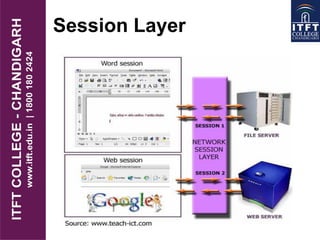
Session Layer
Function of Transport layer
• Segmentation of message into packet and
reassembly of packets into message
• Connection management
• Service point addressing
• Flow control
• Error control
Function of Session layer
• Establishment, maintaining and ending a
session
• Dialog control
• Dialog separation or Synchronization
Presentation Layer
• Different computers may use different coding
schemes for data transmission. For example
some computers may send the most
significant bit of a byte first and least
significant bit last and in some other
computers it may be other way round, the
sequence may be different at byte level also.
The job of the presentation layer is to do the
job of code translation and present the data
in the format used at the destination
computer.
Functions of presentation
layer
• Data Presentation or Translation
• Data Encryption
• Data compression
Application Layer
• This is the layer with which users have direct
interface. At the transmitting computer the
message originates at this layer and at the
destination computer the message is finally
received by this layer and presented to the
user in desired format. The data packets at
the application layer are known as messages
Functions of Application Layer
• Network Virtual Terminal
• File transfer, access and management (FTAM)
• Mail services
• Directory services
THANKS
HOUSE IS OPEN FOR QUERIES

ITFT_Osi reference model

  • 1.
  • 2.
    Why to learnOSI reference Model? The answer is too simple that It tells us that how communication takes place between computers on internet but how??
  • 3.
    Nowadays, When wetalk about communication of computer we got to know a term communication protocols. What are they?? Set of rules which defines the rules followed by all involved in the process of communication but what are they actually??
  • 4.
    What if someoneis using some other rules/Protocols? If it is necessary to communicate with computers following totally different protocols then we have to connect a device called Gateway between such systems. Gateways are computers loaded with special software, which do the job of translation work from one protocol to other so that communication between heterogeneous systems may take place.
  • 5.
  • 6.
    PHYSICAL LAYER TRANSMISSION MEDIUM FromData link Layer To Data link Layer
  • 7.
    • Physical layeris the bottom layer of OSI model • It is responsible for the actual physical connection between the devices. Such physical connection may be made by using twisted pair cable, fiber-optic, coaxial cable or wireless communication. • Physical layer is concerned with transmitting raw bits over a communication channel.
  • 8.
    Function of Physicallayer • Transforming bits into signals • Bit Synchronization • Provides physical characteristics of interfaces and medium • Bit rate control • Line configuration • Transmission mode • Physical topologies • Multiplexing • Circuit switching
  • 9.
  • 10.
    Functions of Datalink layer • Framing • Physical Addressing • Flow control • Error control • Access Control • Feedback
  • 11.
  • 12.
    Functions of Networklayer • Logical Addressing • Routing
  • 13.
    Transport Layer • Transportlayer provides two types of services • Connection oriented • Connectionless
  • 14.
  • 15.
    Function of Transportlayer • Segmentation of message into packet and reassembly of packets into message • Connection management • Service point addressing • Flow control • Error control
  • 16.
    Function of Sessionlayer • Establishment, maintaining and ending a session • Dialog control • Dialog separation or Synchronization
  • 17.
    Presentation Layer • Differentcomputers may use different coding schemes for data transmission. For example some computers may send the most significant bit of a byte first and least significant bit last and in some other computers it may be other way round, the sequence may be different at byte level also. The job of the presentation layer is to do the job of code translation and present the data in the format used at the destination computer.
  • 18.
    Functions of presentation layer •Data Presentation or Translation • Data Encryption • Data compression
  • 19.
    Application Layer • Thisis the layer with which users have direct interface. At the transmitting computer the message originates at this layer and at the destination computer the message is finally received by this layer and presented to the user in desired format. The data packets at the application layer are known as messages
  • 20.
    Functions of ApplicationLayer • Network Virtual Terminal • File transfer, access and management (FTAM) • Mail services • Directory services
  • 21.