OSI Reference Model
Mrs. G.Chandraprabha,M.Sc.,M.Phil.,
Assistant Professor,
Department of Information Technology,
V.V.Vanniaperumal College for Women,
Virudhunagar
0
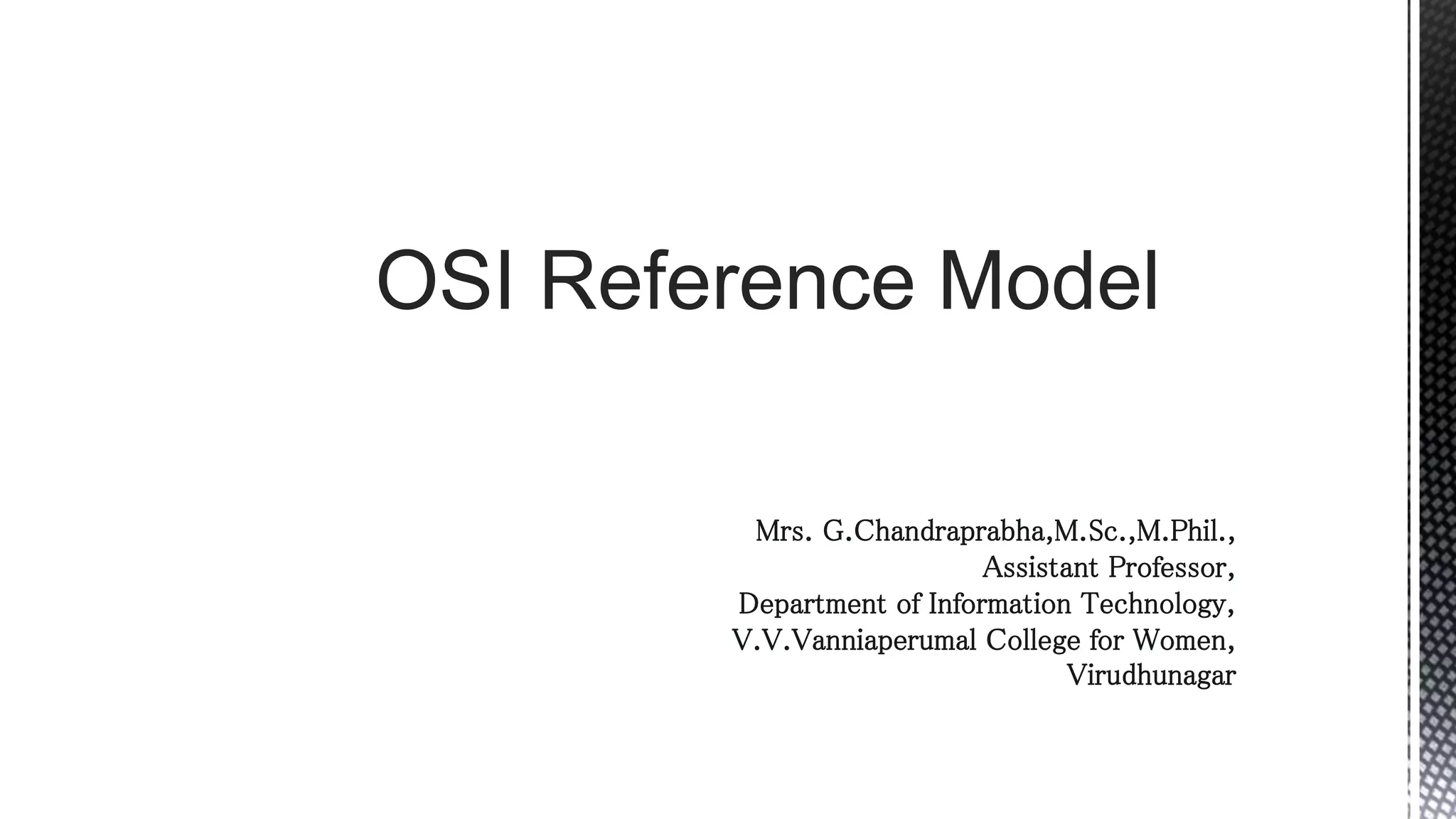
THE SEVEN LAYERS OF OSI REFERENCE MODEL1
2

 The physical layer deals with the physical characteristics of the
transmission medium.
 It defines
functional
the electrical, mechanical,
specifications for activating, maintaining,
procedural, and
and
deactivating the physical link between end systems.
Such characteristics as voltage levels, timing of voltage
changes, physical data rates, maximum transmission distances, physical
connectors, and other similar attributes are defined by physical layer
specifications.
9
 The data link layer provides access to the networking media and
physical transmission across the media and this enables the data
to locate its intended destination on a network.
 The data link layer provides reliable transit of data across a
physical link by using the Media Access Control (MAC) addresses.
 The data link layer uses the MAC address to define a hardware or
data link address in order for multiple stations to share the same
medium and still uniquely identify each other.
 Concerned with network topology, network access, error
notification, ordered delivery of frames, and flow control.
 Examples :- Ethernet, Frame Relay, FDDI.
8
any endpoint can be
 Defines end-to-end delivery of packets.
 Defines logical addressing so that
identified.
 Defines how routing works and how routes are learned so that
the packets can be delivered.
 The network layer also defines how to fragment a packet into
smaller packets to accommodate different media.
 Routers operate at Layer 3.
 Examples :- IP, IPX, AppleTalk.
7
 The transport layer regulates information flow to ensure end-to-end
connectivity between host applications reliably and accurately.
 The transport layer segments data from the sending host's system and
reassembles the data into a data stream on the receiving host's system.
 The boundary between the transport layer and the session layer can be
thought of as the boundary between application protocols and data-flow
protocols. Whereas the application, presentation, and session layers are
concerned with application issues, the lower four layers are concerned
with data transport issues.
 Layer 4 protocols include TCP (Transmission Control Protocol) and UDP
(User Datagram Protocol).
6
 The session layer defines how to start, control and end
conversations (called sessions) between applications.
 This includes the control and management of multiple bi-
directional messages using dialogue control.
 It also synchronizes dialogue between two hosts' presentation layers
and manages their data exchange.
 The session layer offers provisions for efficient data transfer.
 Examples :- SQL, ASP(AppleTalk Session Protocol).
5
 The presentation layer ensures that the information that the
application layer of one system sends out is readable by the
application layer of another system.
 If necessary, the presentation layer translates between
multiple data formats by using a common format.
 Provides encryption and compression of data.
 Examples :- JPEG, MPEG, ASCII, EBCDIC, HTML.
4
 The application layer is the OSI layer that is closest to the user.
 It provides network services to the user’s applications.
 It differs from the other layers in that it does not provide services to any
other OSI layer, but rather, only to applications outside the OSI model.
 Examples of such applications are spreadsheet programs, word
processing programs, and bank terminal programs.
 The application layer establishes the availability of intended
communication partners, synchronizes and establishes agreement on
procedures for error recovery and control of data integrity.
4
Osi reference model

Osi reference model

  • 1.
    OSI Reference Model Mrs.G.Chandraprabha,M.Sc.,M.Phil., Assistant Professor, Department of Information Technology, V.V.Vanniaperumal College for Women, Virudhunagar 0
  • 2.
    THE SEVEN LAYERSOF OSI REFERENCE MODEL1
  • 3.
  • 4.
      The physicallayer deals with the physical characteristics of the transmission medium.  It defines functional the electrical, mechanical, specifications for activating, maintaining, procedural, and and deactivating the physical link between end systems. Such characteristics as voltage levels, timing of voltage changes, physical data rates, maximum transmission distances, physical connectors, and other similar attributes are defined by physical layer specifications. 9
  • 5.
     The datalink layer provides access to the networking media and physical transmission across the media and this enables the data to locate its intended destination on a network.  The data link layer provides reliable transit of data across a physical link by using the Media Access Control (MAC) addresses.  The data link layer uses the MAC address to define a hardware or data link address in order for multiple stations to share the same medium and still uniquely identify each other.  Concerned with network topology, network access, error notification, ordered delivery of frames, and flow control.  Examples :- Ethernet, Frame Relay, FDDI. 8
  • 6.
    any endpoint canbe  Defines end-to-end delivery of packets.  Defines logical addressing so that identified.  Defines how routing works and how routes are learned so that the packets can be delivered.  The network layer also defines how to fragment a packet into smaller packets to accommodate different media.  Routers operate at Layer 3.  Examples :- IP, IPX, AppleTalk. 7
  • 7.
     The transportlayer regulates information flow to ensure end-to-end connectivity between host applications reliably and accurately.  The transport layer segments data from the sending host's system and reassembles the data into a data stream on the receiving host's system.  The boundary between the transport layer and the session layer can be thought of as the boundary between application protocols and data-flow protocols. Whereas the application, presentation, and session layers are concerned with application issues, the lower four layers are concerned with data transport issues.  Layer 4 protocols include TCP (Transmission Control Protocol) and UDP (User Datagram Protocol). 6
  • 8.
     The sessionlayer defines how to start, control and end conversations (called sessions) between applications.  This includes the control and management of multiple bi- directional messages using dialogue control.  It also synchronizes dialogue between two hosts' presentation layers and manages their data exchange.  The session layer offers provisions for efficient data transfer.  Examples :- SQL, ASP(AppleTalk Session Protocol). 5
  • 9.
     The presentationlayer ensures that the information that the application layer of one system sends out is readable by the application layer of another system.  If necessary, the presentation layer translates between multiple data formats by using a common format.  Provides encryption and compression of data.  Examples :- JPEG, MPEG, ASCII, EBCDIC, HTML. 4
  • 10.
     The applicationlayer is the OSI layer that is closest to the user.  It provides network services to the user’s applications.  It differs from the other layers in that it does not provide services to any other OSI layer, but rather, only to applications outside the OSI model.  Examples of such applications are spreadsheet programs, word processing programs, and bank terminal programs.  The application layer establishes the availability of intended communication partners, synchronizes and establishes agreement on procedures for error recovery and control of data integrity. 4