The New Deal
Relief Recovery Reform
What was the New Deal?
The New Deal was the set of
federal programs launched
by President Franklin D.
Roosevelt after taking office in
1933, in response to the calamity
of the Great Depression.
The New Deal Roosevelt had promised the American people began to take shape
immediately after his inauguration in March 1933. Based on the assumption that the power
of the federal government was needed to get the country out of the depression, the first
days of Roosevelt's administration saw the passage of banking reform laws, emergency relief
programs, work relief programs, and agricultural programs.
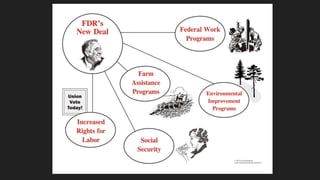
Later, a second New Deal was to evolve; it included union protection programs, the Social
Security Act, and programs to aid tenant farmers and migrant workers. Many of the New
Deal acts or agencies came to be known by their acronyms. For example, the Works
Progress Administration was known as the WPA, while the Civilian Conservation Corps was
known as the CCC. Many people remarked that the New Deal programs reminded them of
alphabet soup.
By 1939, the New Deal had run its course. In the short term, New Deal programs helped
improve the lives of people suffering from the events of the depression. In the long run,
New Deal programs set a precedent for the federal government to play a key role in the
economic and social affairs of the nation.
It had four major goals and achievements:
•Economic Recovery: The New Deal stabilized the
banks and cleaned up the financial mess left over
from the Stock Market crash of 1929. It stabilized
prices for industry and agriculture, and it aided
bankrupt state and local governments.
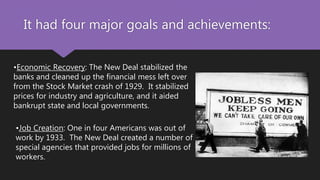
•Job Creation: One in four Americans was out of
work by 1933. The New Deal created a number of
special agencies that provided jobs for millions of
workers.
It had four major goals and achievements:
•Investment in Public Works: The New Deal built
hundreds of thousands of highways, bridges,
hospitals, schools, theaters, libraries, city halls,
homes, post offices, airports, and parks across
America—most of which are still in use today.
•Civic Uplift: The New Deal touched every state, city
and town, improving the lives of ordinary people and
reshaping the public sphere.
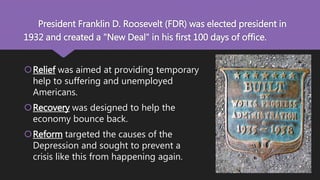
President Franklin D. Roosevelt (FDR) was elected president in
1932 and created a "New Deal" in his first 100 days of office.
Relief was aimed at providing temporary
help to suffering and unemployed
Americans.
Recovery was designed to help the
economy bounce back.
Reform targeted the causes of the
Depression and sought to prevent a
crisis like this from happening again.

New deal slideshare

  • 1.
    The New Deal ReliefRecovery Reform
  • 2.
    What was theNew Deal? The New Deal was the set of federal programs launched by President Franklin D. Roosevelt after taking office in 1933, in response to the calamity of the Great Depression.
  • 3.
    The New DealRoosevelt had promised the American people began to take shape immediately after his inauguration in March 1933. Based on the assumption that the power of the federal government was needed to get the country out of the depression, the first days of Roosevelt's administration saw the passage of banking reform laws, emergency relief programs, work relief programs, and agricultural programs. Later, a second New Deal was to evolve; it included union protection programs, the Social Security Act, and programs to aid tenant farmers and migrant workers. Many of the New Deal acts or agencies came to be known by their acronyms. For example, the Works Progress Administration was known as the WPA, while the Civilian Conservation Corps was known as the CCC. Many people remarked that the New Deal programs reminded them of alphabet soup. By 1939, the New Deal had run its course. In the short term, New Deal programs helped improve the lives of people suffering from the events of the depression. In the long run, New Deal programs set a precedent for the federal government to play a key role in the economic and social affairs of the nation.
  • 4.
    It had fourmajor goals and achievements: •Economic Recovery: The New Deal stabilized the banks and cleaned up the financial mess left over from the Stock Market crash of 1929. It stabilized prices for industry and agriculture, and it aided bankrupt state and local governments. •Job Creation: One in four Americans was out of work by 1933. The New Deal created a number of special agencies that provided jobs for millions of workers.
  • 5.
    It had fourmajor goals and achievements: •Investment in Public Works: The New Deal built hundreds of thousands of highways, bridges, hospitals, schools, theaters, libraries, city halls, homes, post offices, airports, and parks across America—most of which are still in use today. •Civic Uplift: The New Deal touched every state, city and town, improving the lives of ordinary people and reshaping the public sphere.
  • 7.
    President Franklin D.Roosevelt (FDR) was elected president in 1932 and created a "New Deal" in his first 100 days of office. Relief was aimed at providing temporary help to suffering and unemployed Americans. Recovery was designed to help the economy bounce back. Reform targeted the causes of the Depression and sought to prevent a crisis like this from happening again.