Red Summer (1919)
MAST HS
US HIS – Period 4
Ms. Richardson
Great Migration
The movement of 6 million African
American out of the rural South to
the urban Northeast, Midwest and
West from 1910-1970.
• 1916 – 1919  500,000 A.A moved
from the South to North.
Great Migration
PUSH
• Poor economic
conditions in the
South
• Sharecropping
replaced slavery
• Jim Crow Laws
PULL
• Educational
opportunities
• Work (WWI)
• Enlistment in army
(segregated)
• Better wages & living
condition
Reception In North
• Came into conflict with other “inner city”
ethnic minorities
• White flight
• Permanently changed the ethnic makeup
of many Northern Cities
• When European immigration was curtailed
at the end of World War I, the African-
American population in many
predominately white cities drastically
increased.
• While first settling in the southern part of
the city, African Americans eventually
moved into Irish neighborhoods.
• Competed for housing & employment in
Chicago.
“The Red Summer of 1919 broke in
fury. The colored people throughout
the country were disheartened and
dismayed. The great majority had
trustingly felt that, because they had
cheerfully done their bit in the war,
conditions for them would be better.
The reverse seemed to be true.” –
James Weldon Williams
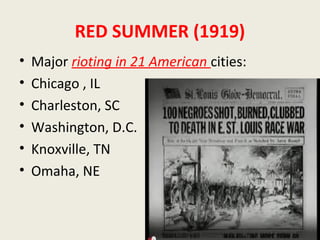
RED SUMMER (1919)
• Major rioting in 21 American cities:
• Chicago , IL
• Charleston, SC
• Washington, D.C.
• Knoxville, TN
• Omaha, NE
Causes
• The Great Migration
• Whites & blacks were competing for jobs
and housing.
• Ku Klux Klan & nationalism
• World War I
Document A: Textbook
In the summer of 1919, over 20 race riots broke out across
the nation. The worst violence occurred in Chicago. On a
hot July day, African Americans went to a whites-only
beach. Both sides began throwing stones at each other.
Whites also threw stones at an African American teenager
swimming near the beach to prevent him from coming
ashore, and he drowned. A full-scale riot then erupted in
the city. Angry African Americans attacked white
neighborhoods while whites attacked African American
neighborhoods. The riots lasted for several days. In the
end, 38 people died—15 white and 23 black—and over 500
were injured.
Source: The American Vision, 2006, p. 393.
Document B (Modified)
Since 1915 the colored population of Chicago has more than
doubled, increasing in four years from a little over 50,000 to what is now
estimated to be between 125,000 and 150,000. Most blacks lived in the
area called the “Black Belt.” Already overcrowded, this so-called “Black
Belt” could not possibly hold the doubled colored population. One cannot
put ten gallons of water in a five-gallon pail.
Whites who are afraid that blacks will move out of the “Black Belt” and
into “white” neighborhoods have formed the “Property Owners'
Association” to keep blacks out of white neighborhoods. They discuss ways
to keep Negroes in “their part of town.”
In a number of cases during the period from January 1918 to August
1919, there were bombings of colored homes and houses occupied by
Negroes outside of the “Black Belt.” During this period no less than twenty
bombings took place, yet only two persons have been arrested and neither
of the two has been convicted.
Source: The document above was published in an African-American newspaper in
1919. Its author was a leader of the NAACP, an organization devoted to protecting
African American rights.

Red Summer 1919

  • 1.
    Red Summer (1919) MASTHS US HIS – Period 4 Ms. Richardson
  • 3.
    Great Migration The movementof 6 million African American out of the rural South to the urban Northeast, Midwest and West from 1910-1970. • 1916 – 1919  500,000 A.A moved from the South to North.
  • 4.
    Great Migration PUSH • Pooreconomic conditions in the South • Sharecropping replaced slavery • Jim Crow Laws PULL • Educational opportunities • Work (WWI) • Enlistment in army (segregated) • Better wages & living condition
  • 5.
    Reception In North •Came into conflict with other “inner city” ethnic minorities • White flight • Permanently changed the ethnic makeup of many Northern Cities
  • 6.
    • When Europeanimmigration was curtailed at the end of World War I, the African- American population in many predominately white cities drastically increased. • While first settling in the southern part of the city, African Americans eventually moved into Irish neighborhoods. • Competed for housing & employment in Chicago.
  • 7.
    “The Red Summerof 1919 broke in fury. The colored people throughout the country were disheartened and dismayed. The great majority had trustingly felt that, because they had cheerfully done their bit in the war, conditions for them would be better. The reverse seemed to be true.” – James Weldon Williams
  • 8.
    RED SUMMER (1919) •Major rioting in 21 American cities: • Chicago , IL • Charleston, SC • Washington, D.C. • Knoxville, TN • Omaha, NE
  • 9.
    Causes • The GreatMigration • Whites & blacks were competing for jobs and housing. • Ku Klux Klan & nationalism • World War I
  • 10.
    Document A: Textbook Inthe summer of 1919, over 20 race riots broke out across the nation. The worst violence occurred in Chicago. On a hot July day, African Americans went to a whites-only beach. Both sides began throwing stones at each other. Whites also threw stones at an African American teenager swimming near the beach to prevent him from coming ashore, and he drowned. A full-scale riot then erupted in the city. Angry African Americans attacked white neighborhoods while whites attacked African American neighborhoods. The riots lasted for several days. In the end, 38 people died—15 white and 23 black—and over 500 were injured. Source: The American Vision, 2006, p. 393.
  • 11.
    Document B (Modified) Since1915 the colored population of Chicago has more than doubled, increasing in four years from a little over 50,000 to what is now estimated to be between 125,000 and 150,000. Most blacks lived in the area called the “Black Belt.” Already overcrowded, this so-called “Black Belt” could not possibly hold the doubled colored population. One cannot put ten gallons of water in a five-gallon pail. Whites who are afraid that blacks will move out of the “Black Belt” and into “white” neighborhoods have formed the “Property Owners' Association” to keep blacks out of white neighborhoods. They discuss ways to keep Negroes in “their part of town.” In a number of cases during the period from January 1918 to August 1919, there were bombings of colored homes and houses occupied by Negroes outside of the “Black Belt.” During this period no less than twenty bombings took place, yet only two persons have been arrested and neither of the two has been convicted. Source: The document above was published in an African-American newspaper in 1919. Its author was a leader of the NAACP, an organization devoted to protecting African American rights.